Wednesday, January 25, 2006

IT JUST KEEPS ON KILLING


The use of depleted uranium by the US military (and others) is one of those evils that just get lost in the myriad of other "evils" reported upon everyday. The problem is this one doesn't just go away. Depleted uranium has a half life of 4.5 billion years, and the presence of depleted uranium ceramic aerosols can pose a long term threat to human health and the environment.

The following article comes from The Centre for Research on Globalisation (CRG)

========================================================================

Nothing depleted about 'depleted uranium'
by Abel Bult-Ito


Iraqi and visiting doctors, and a number of news reports, have reported that birth defects and cancers in Iraqi children have increased five- to 10-fold since the 1991 Gulf War and continue to increase sharply, to over 30-fold in some areas in southern Iraq. Currently, more than 50 percent of Iraqi cancer patients are children under the age of 5, up from 13 percent. Children are especially vulnerable because they tend to play in areas that are heavily polluted by depleted uranium.

The Pentagon has been using radiooactive weapons for at least a decade and a half with full complicity of at least three White House administrations and Republican and Democratic congressional legislators. Conservatively, at least 300 tons and 1,700 tons of depleted uranium were used in the Gulf War and the current Iraq War, resectively. This is about 70 grams of depleted uranium per Iraqi citizen, and if inhaled or ingested, it is enough to kill them all.

Is this not radioactive genocide, especially when our troops used and continue to use most of the depleted uranium munitions in densely populated areas such as Baghdad and Fallujah? Depleted uranium has a half-life of billions of years. Consequently, Iraq will be a wasteland forever and essentially uninhabitable for anyone.

After the 1991 Gulf War, about 1 in 4, or 150,000, U.S. veterans came down with what is referred to as "Gulf War Syndrome." Most of the ailments characteristic of Gulf War Syndrome are consistent with radiation or heavy-metal poisoning. Veterans' children are now also born with higher proportions of birth defects and other genetic disorders, according to sporadic accuonts. The Pentagon continues to deny the harmful effects of depleted uranium or its role in Gulf War Syndrome.

As described by a report of the World Health Organization Depleted Uranium Mission to Kosovo, uranium can be found in rocks and soil and contributes to natural background levels of radioactivity. Depleted uranium is a waste product of uranium enrichment for nuclear reactors and is about 60 percent as radioactive as naturally occurring uranium. Depleted uranium is considered weakly radioactive.

Nevertheless, depleted uranium is considered nuclear waste and has to be disposed of accordingly, which is expensive and a potential environmental hazard. The nuclear industry must be very pleased the U.S. military has found a way to get this stuff off their hands cheaply.

Depleted uranium is really a misnomer, because the potentially harmful effects are by no means depleted. Research reports have found that when depleted uranium is ingested or inhaled, it can cause cancers and birth defects. It has considerable heavy-metal toxicity.

As stated in the WHO report, because of its high density, depleted uranium is used in armor-piercing ammunition and as reinforcement against conventional weapons. Upon impact, the depleted uranium fragments burn at intense heat, and 10 to 35 percent of it becomes aerosolized. This aerosolized uranium "dust" is the most harmful component because it can easily be ingested or inhaled.

Wind and people walking through it also easily disperse the depleted uranium dust. This dust is a predominant byproduct of military use of depleted uranium, in contrast to, for example, exposures in uranium mines or nuclear reactors.

Our troops in Iraq will be severely affected by this radioactive war, not only because a lot more depleted uranium has been used and continues to be used, but also because they have been there a lot longer than during the Gulf War. Hundreds of thousands of our troops will come down with Gulf War Syndrome as a result of depleted uranium poisoning, and thousands will die from it. Thousands of their children will be born with genetic diseases, cancers and birth defects.

The continued use of depleted uranium harms our own troops and innocent civilians exposed to our war machine, is un-American, and a crime against humanity. We need a worldwide ban on depleted uranium use.

You have probably noticed Fairbanks Daily News-Miner staff writer's reports as an "embedded journalist" with the 172nd Stryker Brigade Combat Team in Mosul, Iraq. Her "feel-good" stories do not tell you the reality of what is happening in Iraq. Will she report on depleted uranium poisoning as a result of heavy U.S. bombing of Mosul?

Sadly, she and those of the 172nd Stryker Brigade Combat Team, if they survive the war, will have a high chance of coming down with Gulf War Syndrome. How much support do you think they will then get from our government or their employers?

Abel Bult-Ito is an associate professor of biology at the University of Alaska Fairbanks and is a member of the Fairbanks Coalition for Peace and Justice.

Tuesday, January 24, 2006

CUBANS PROTEST US PROVOCATIONS


A massive march past the US Interest Section in Havana took place today. The protest called by Cuban President Fidel Castro was meant to highlight opposition to various acts of "provocation" by the US aimed at Cuba. The following is from a speech by Fidel broadcast on television throughout the island earlier this week and is reproduced in English by the Cuban News Agency (AIN).
-------------------------------------------------------------------------------

President Fidel Castro’s closing remarks, during his special television appearance on January 22, 2006, on the maneuvers surrounding the case of the notorious terrorist Luis Posada Carriles and in response to new acts of provocation and misdeeds by the US government and the US Interests Section in Havana.

The government of the United States is deliberately pursuing the following objectives:

First, the release of terrorist Luis Posada Carriles, who was trained by US authorities —Bush Sr. included— and used to perpetrate monstrous crimes against the Cuban people. Recruited in 1961, this repulsive character was trained to carry out special operations during the Bay of Pigs invasion. He and Orlando Bosch, officially pardoned by Bush Sr., subsequently received rigorous training to execute despicable acts of terrorism against Cuba. Likewise, he was given instruction to take part in Operation Condor, an international terrorist organization responsible for odious crimes against Latin American personalities. He is the mind behind the midair bombing of a Cubana de Aviación airliner, which claimed the lives of 73 people, off the coasts of Barbados, on October 6, 1976. Taken out of a Venezuelan prison by the CIA on August 18, 1985, he immediately became involved in the dirty war against Nicaragua, supplying weapons to the ‘contras’ in El Salvador and shipping drugs to the United States. For over four decades, Luis Posada Carriles maintained close ties with US intelligence agencies, received financing from various administrations and was used by the Cuban American National Foundation in attempts to assassinate the Cuban head of state. Efforts by the current US President, and a pardon signed by Panamanian President Mireya Moscoso, finally secured his release from prison on August 26, 2004. Then, taken to a Central American country under protection from the US government, he was authorized to secretly enter the United States. Between March 18 and 20, 2005, he entered the country on the Santrina, a yacht captained by the notorious terrorist Santiago Álvarez, a man who, strangely enough, is also being held for weapons trafficking and gross violations of US national security laws. These are irrefutable facts.

Second, the current US administration has utterly failed in its efforts to isolate and stifle Cuba economically. But it does not accept this failure, and grows ever more desperate.

Third, the government of the United States has done everything in its power to please the Cuban American terrorist mafia, which resorted to fraud, in Florida, to put President George W. Bush in office.

Fourth, President Bush and his administration have committed themselves to implementing a macabre transition plan in Cuba, an act of flagrant interference in the internal affairs of our country, which would return it to a state of backwardness.

Fifth, the government of the United States has implemented every imaginable measure to deprive Cuba of completely legitimate sources of income. It has made it more difficult for people to send remittances to Cuba and even, callously, forbidden, or made it next to impossible, for Cuban-born US residents to visit their relatives on the island.

Sixth, under pressure from the Cuban-American mob, and as one their next step, the government of the United States is intent on openly violating the US – Cuba Migratory Accords.

Seventh: The government of the United States is looking for any pretext to prevent, at all costs, the sale of agricultural products to Cuba, which has been growing, while our country has paid every cent on time during five years, something it did not expect from a blockaded nation facing constant aggression.

Eighth, the government of the United States, unhappy about President Carter’s decision of May 30, 1977, is intent on breaking the minimal diplomatic links which exist between Cuba and the United States today. The gross acts of provocation of the US Interests Section in Havana do not and could not have a different objective.

The Bush administration is well aware that no government on earth can tolerate such an affront to its dignity and sovereignty. As the government of Cuba hasn’t the slightest doubt about the aim behind these new actions, it shall take whatever measures are necessary to respond to these provocations. On the other hand, Cuba has been and continues to be strongly committed to wholly fulfilling our obligations towards US agricultural producers and suppliers --who have seriously and effectively fulfilled their share of the agreements--, while the U.S. doesn’t impede us from doing so. However, we shall take appropriate measures to avoid whatever repercussion this treacherous action by the current US government could have for Cuba, so that, an abrupt interruption of food supplies coming from the United States would not bear heavily on our people.

Cuba’s attitude, and its response to the empire’s provocations, will be entirely peaceful, but we shall strike back with all the strength of our moral fortitude and we shall persist in our determination to fight to the death, against whatever act of belligerence of the restless and brutal empire that threatens us. Let no one for a minute forget the oath of Maceo, our Bronze Titan, when he said that whosoever attempts to take possession of Cuba shall conquer but the blood-soaked ground beneath his feet, if he does not first perish in battle.

Within a day and a half, in the morning of January 24 when the status of the vicious terrorist will be reviewed, the people of Havana will show their discipline, unity and revolutionary spirit marching on the US Interests Section of Bush’s fraudulent and bastard government, a government which has been imposed upon the people of the United States and which constitutes today’s greatest threat to world peace.

World public opinion will once again witness an irrefutable testimony of what Cuba is and where it stands.


Homeland or death!


We shall overcome!

BURN IN HELL OR WHERE HAVE ALL THE FLOWERS GONE


Climate Change Will Kill Billions This Century, Scientist Says
Source: Bloomberg


Climate change will kill billions of people this century as the Earth warms, passing into a ``fever'' phase from which it may take 100,000 years to recover, James Lovelock, the scientist who propounded the ``Gaia'' theory, said.

Temperatures in temperate regions such as Europe and the U.S., will soar by 8 degrees Celsius (14 degrees Fahrenheit) this century, and those in the tropics will rise by 5 degrees as a result of man-made emissions, Lovelock wrote in today's Independent newspaper.

``We have given Gaia a fever and soon her condition will worsen to a state like a coma,'' Lovelock wrote. ``She has been there before and recovered, but it took more than 100,000 years. We are responsible and will suffer the consequences.''

Lovelock's Gaia theory, advanced in the 1970s, sees the Earth behaving like a self-sustaining organism, with a control system that keeps the environment fit for life. By trying to take over regulation of the planet's climate, humans have condemned themselves to ``the worst kind of slavery,'' and will soon find it impossible to keep the Earth fit for life, Lovelock said.

``Much of the tropical land mass will become scrub and desert, and will no longer serve for regulation; this adds to the 40 percent of the Earth's surface we have depleted to feed ourselves,'' he said. ``Before this century is over billions of us will die and the few breeding pairs of people that survive will be in the Arctic where the climate remains tolerable.''

Not all scientists and politicians support the theory that the planet's climate patterns are changing as a result of human activity. The administration of U.S. President George W. Bush has said there's no proof that global warming is causing a change in the weather. (Ed: and, by golly, George ought to know because he does clear brush after all...)

Lovelock said that with the U.S. and emerging economies such as China and India unlikely to cut back emissions of so-called greenhouse gases that trap the sun's heat, ``the worst will happen and survivors will have to adapt to a hell of a climate.''
-------------------------------------------------------

Hey, but we've got more important things to worry about. Right?

Monday, January 23, 2006

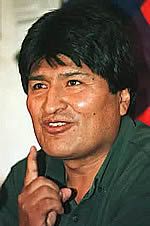
EVO MANIA


From Democracy Center - Blog From Bolivia
Jim Shultz - Sunday, January 22, 2006

I am sitting in an Internet cafe just beside Plaza San Francisco – in a capital city gripped by ¨Evo Mania¨. Evo being Evo Morales, who two hours ago was sworn in as Bolivia´s president.

It is ironic. Back in the days of ¨Oh my God, the sky will fall if Evo becomes president,¨ the fearful proclaimed that Bolivia would become isolated, a nation shunned. Tell that to a city so full of heads of state and luminaries that people like the literary giant Eduardo Galleano and former Mexico prsidential candidate Cuauhtémoc Cárdenas get barely noticed. I met a reporter for breakfast at the Raddison this morning and the staff proudly reported five heads of state in residence. More than 400 foreign media are here. Hotel rooms are virtually impossible to find. If Bolivia´s GNP were measured just by these two days it might compete with China, for all the economic activity generated by the inauguration.

Yesterday Morales passed through another inauguration, standing atop the 1000 year old ruins at Tiahuanaco. In a ceremony that hasn’t taken place since the consquest half a millenia ago, Bolivia´s first indiginous president was granted powers by the indian communities of the altiplano. Indiginous leaders from throughout the Americas and elsewhere were on hand to participate – from Guatemala to the USA. An indiginous leader from the US handed Morales an eagle feather, noting that the eagle would fly with the condor.

Reporters, many sunburned from yesterday´s harsh altiplano sun in Tiahuanaco, asked me all the usual questions. Won´t MAS screw up at governing? What government have they ever run?

(A parade of rainbow-colored, checkered wipala flags – symbol of the indiginous communities – has just gone bounding by on the street outside, to the tune of flutes.)

The U.S. government has planted some of these questions I learn, at a private off-the record chat the ambassador held at his house the other night with visiting US journalists.

In a congress chamber filled to the brim with the heads of Argentina, Chile, Peru, Brazil, Venezuela, Slovenia, and many other nations, Morales broke the media-generated suspense over what he would wear to such a formal occasion by showing up in a black tunic ringed with indiginous weaving. I had thought about sending Morales a George Bush 2000 inaugural tie that a Republican acquaintance of mine gave me a couple of years back (inexplicably thinking that I might actually use it) but I decided to keep it, knowing that it has come in handy as an emergency halloween costume.

I watched Morales take his oath on TV, in a take-away pizza place a half mile from the Congress. Behind me sat two women, weeping tears and saying over and over ¨que impresionante!¨ As he put on the green, red, and yellow sash of his country, Morales broke down in tears of his own. A split screen image, showing both Morales and the crowd gathered outside here in the plaza, revealed that he was not the only Bolivian marking with tears the moment of history all were living.

Morales began by asking the dignataries, the Congress, and the nation to mark a moment of silence for the martyrs—from Inca kings who died at the hands of the Spanish to Che Guevarra and the humble who have lost their lives in five years of social struggle here.

¨Five hundred years of indiginous resistance have not been in vain,¨ he said. He then luanched into a presidential address – on everything from the US war on drugs to corruption in the building of highways – that was so long that at one point he stopped to ask a Senator in the chamber to wake up from his nap (I am betting it was Omar Fernandez from Cochabamba, who ALWAYS falls asleep when we are in meetings together). The channel I was watching featured CNN-style captions summararizing key points and it was, well, just so Bolivian, when the caption changed to, ¨Morales tells Senator to wake up.¨ The whole ceremony had the air of a young democracy and inexperienced president trying to awkardly find their footing.

Even Morales, at one point acknowledged that his speech was lasting a very long time. ¨Brothers and sisters, I apologize for going on so long. Maybe I caught something from Castro or Chavez (the chamber breaks into laughter and the camera turns to Chavez who appeared to be rustled from a little nap of his own). I just want to express myself about the reality of Bolivia.¨

On my way to the rally here that awaits Morales´ arrival, the streets were nearly deserted . The one person who seemed oblivious to the whole thing was an older indian woman sitting in a narrow alley way, footsteps from princes and presidents, asking for small change.

The question that remains is, once the hoopla is over and the dignitaries are gone, will it make any difference in her life? To be sure, that is what Morales is promising and I believe that he and MAS are sincere in that. But governing and delivering the goods will be a good deal harder than they think.

But for today, La Paz and Bolivia is a spectacle of optimism and history being made. Back to the flutes and the wipalas!

Roma, Jews Fight Whitewashing


From Jewish Telegraph Agency
By Dinah Spritzer


PRAGUE, Jan. 19 (JTA) — As Holocaust Memorial Day approaches next week, it is not only Jews who must confront those who wish to deny the horrors of the Holocaust.
It was “just a labor camp” and “we didn’t do it” are two of the mantras voiced at former Holocaust victims by the fringe nationalist party in the Czech Republic known for its xenophobic platform.

They are talking about Lety, the World War II Nazi concentration camp run exclusively by Czech guards where 300 Roma, mostly children, perished. Today, Roma, also called gypsies, are the main target of nationalist extremists and skinheads in the Czech Republic.

The Nationalists, a very small party with no parliamentary seats, outraged many in the country when it announced at the end of December that it would unveil a memorial at Lety that would say the camp was run by Germans and that those who died there did so of natural causes.

After politicians and Roma groups protested, the Nationalists changed their strategy, and now plan to unveil a giant stone inscribed with “To the victims” on Jan. 21.

The move hasn’t gone over well with any public figure.

Lety’s mayor said he would like to have the stone removed but is not sure that he has the legal authority to do so.

Tomas Kraus, chairman of the Federation of Jewish Communities in the Czech Republic, said he and the Czech Council of Nazi Victims condemn the Nationalist memorial, which he said was clearly meant to provoke the Roma and gain attention for the party.

“What the Nationalist Party does, and what others like them continue to do — just look at the Iranian president — is play with words. This concerns Jews very much,” he said.

Trying to diminish the Holocaust by calling a concentration camp a labor camp is the first step toward Holocaust denial, he added.

Katerina Jacques of the government’s Human Rights Office agreed.

“It must be analyzed whether” the National Party, in its original monument proposal “committed the crime of supporting and promoting fascism,” Jacques said.

The myth that Lety was a German-run labor camp, created by the Communist authorities to instill patriotism and anti-German sentiment, has long been discredited, as was the illusion that Terezin, or Theresienstadt in German, was a camp used primarily to persecute Communists, not Jews, another idea propagated by the totalitarian regime.

The parallel is not lost on Jake Roth, a leader of the Prague Jewish community.

“People who go around putting forth denial, lies that Roma were not persecuted or were persecuted for their own faults, these are the same arguments that get used against Jews,” he said.

“Any denial or false statements about our past have always led to evil things that hit the entire society.

The Porrajmos, literally “the Devouring,” is the term that the Roma use to describe the Nazi regime’s attempt to wipe their people off the face of the earth.

Between 200,000 to 600,000 Roma were murdered during World War II — only 5 percent of the Czech-born population of some 8,000 survived. Nearly all who lived through internment in the Czech-run labor camps in Hodonin and Lety — the site of a pig farm since the 1970s — later perished in the “Gypsy family camp” at Auschwitz-Birkenau.

Last year the European Parliament chastised the Czech government for not removing the pig farm, as Roma activists and their allies have been requesting for the last decade. The government had previously said such a move would be too expensive but earlier this week the Prime Minister Jiri Paroubek announced that the Finance Ministry had allocated funds to purchase the farm so that a memorial could finally be constructed.

Even former President Vaclav Havel, usually quiet on political affairs since his departure from office in 2003, entered the Lety debate Tuesday, blaming current President Vaclav Klaus’ reaction to the European Parliament criticism for the Nationalist Party’s recent activities.

“Vaclav Klaus has opened the door to the current events around Lety as he said that it was not a concentration camp in the proper sense of the word,” Havel told the Czech News Agency on Tuesday.

In May, reacting to E.U. pressure, Klaus remarked about Lety, “It was originally a labor camp for those who refused to work. Not only for Romanies. It is really not a concentration camp in the sense as we all subconsciously understand this word and imagine Auschwitz, Buchenwald and others.”

Vladimir Spidla, former Czech prime minister and the current E.U.’s commissioner for social affairs, disagrees: “The Romany Holocaust existed, a Romany camp in Auschwitz existed, as well as the concentration camp in Lety. There are things that mustn’t be forgotten.”

A LESS ORIGINAL OREAD DAILY


I no longer have time to write much of my own stuff. So from now on unless otherwise indicated articles appearing here will be reprints. The source will, of course, as always be noted.

At least, this will be true until further notice.

Friday, January 13, 2006

MEDECINS SANS FRONTIERES: TOP TEN UNDER-REPORTED HUMANITARIAN STORIES OF 2005


Well, friends it is one of those Fridays where all you get is a reprint(s) from other sources.

From: MEDECINS SANS FRONTIERES


Congolese ravaged by war and disease

The extreme deprivation and violence endured by millions of Congolese goes virtually unnoticed to the rest of the world.

Since mid-November, renewed fighting between the Congolese Army (FARDC) and the Mai-Mai rebels has caused the displacement of tens of thousands of people throughout Katanga province, in southeast Democratic Republic of Congo (DRC). In one instance in early December, armed men attacked a camp for displaced people in Katanga, forcing some 3,000 people to once again flee for their lives.

This spate of violence is just the most recent endured by people in the DRC.

More than a decade of war and devastation has collapsed an already weak public health system and caused widespread misery for people throughout the country. During the past year, the northeastern regions of Ituri, North Kivu, and South Kivu were again the epicenter of violence, with multiple factions fighting for the control of the area's resources, preying on civilians, and committing appalling sexual violence against women.

Between January and May, MSF assisted many of the 80,000 civilians who had fled their homes in Ituri because of fear and insecurity. Emergency relief programs in the DRC represent MSF's largest mobilization of aid in the world today, and recent MSF surveys found staggeringly high child mortality rates in several regions - more than six times the emergency threshold in the violence-plagued town of Lubutu and more than five times in the relatively stable town of Inongo.

The surveys also revealed that few people have access to health facilities let alone treatment, even in areas not ravaged by violence, in part because they cannot afford the fees, leading to an even greater human toll taken by easily treated diseases like malaria and cholera. While the war officially ended in 2003, peacekeeping and political efforts have not translated into better living conditions for most Congolese and the situation remains dire in many parts of the country.

--------------------------------------------------------------------------------

Staggering needs, insecurity, and dismal response for Chechens living in fear

Caught in a stranglehold between Russian Federation forces and Chechen armed groups, traumatized civilians continue to bear the brunt of this conflict of attrition and find they have nowhere to go to be safe.

Driven back to Chechnya out of tented camps in Ingushetia, thousands of reluctant civilians returned to their devastated homes only to find what they had fled: fear, violence, and an ever-growing feeling of isolation. Officials claim that the situation in Chechnya has "normalized", but so-called sweep operations to round up suspected rebels, landmine accidents, disappearances and violence perpetrated by local militias are all too common.

With a limited international aid presence because of the insecurity, MSF has found ways to support health structures, surgical programs, and start assistance projects in several regions of Chechnya with Chechen staff. At the MSF-supported Hospital Number Nine in Grozny, the largest trauma center in Chechnya, staff treated hundreds of patients for violent trauma last year, including many gunshot and land-mine victims.

Many Chechens who have returned live precariously as internally displaced because their homes were destroyed or their towns are still insecure. The living conditions for the tens of thousands of Chechens remaining in Ingushetia vary from difficult to unbearable, with many inhabiting overcrowded, dank, dilapidated buildings that enable diseases like tuberculosis (TB) and pneumonia to flourish.

"Recently, it is the absolute sense of despair and hopelessness which is proving hardest to treat," said an MSF nurse in Ingushetia - herself displaced from Chechnya. While insecurity persists in the entire region, there is an extremely limited international aid response and the Chechen conflict has all but disappeared from the international political agenda.

--------------------------------------------------------------------------------

Haiti's capital wracked by waves of violence

Many people in Haiti's capital, Port-au-Prince, are trapped by the widespread violence that has hit the city in waves since President Jean-Bertrand Aristide was pressured into exile in February 2004.

People have been shot and killed, deliberately and unintentionally, by all of the armed factions fighting in the seaside slums, or "quartiers populaires," and the violence - both politically motivated and criminal - is spreading throughout the city.

MSF treated more than 2,250 people for violence-related injuries in 2005 at a trauma center set up in the capital, including nearly 1,500 gunshot victims. Half of those treated are women, children or the elderly, underscoring the toll the violence has taken on civilians. Appalled by the deteriorating security situation, in July MSF called on all armed groups to respect the safety of civilians and to allow the wounded to access emergency medical care. The following day, however, the trauma center received 27 gunshot victims - three-quarters of them women and children - who were wounded during a day-long military operation launched by the UN Stabilization Mission in Haiti (MINUSTAH) in Cité Soleil, the most violent part of the capital.

In August, MSF reopened Choscal Hospital and the Chapi Health Center in the heart of Cité Soleil, where 250,000 people live in abject poverty and were effectively excluded from any health care. In just three months, MSF performed nearly 12,000 medical consultations and treated more than 800 patients needing emergency care.

"Civilians in many parts of Port-au-Prince are struggling just to survive," said Ali Besnaci, head of mission for MSF in Haiti. "Everyday, people throughout the city tell us that they have never experienced such levels of violence before."

--------------------------------------------------------------------------------

No R&D for HIV/AIDS tools adapted to impoverished settings

The overall picture is well-known. More than 40 million people worldwide have HIV/AIDS, and every day, 8,000 people die of AIDS-related illnesses - 1,400 of them children.

While the HIV/AIDS pandemic receives regular media coverage, almost no attention is paid to the near-total lack of research and development (R&D) into new tools specifically adapted for patients most affected by the AIDS crisis: those living in poverty in the developing world.

Diagnosing HIV infection in infants, for example, currently requires extremely resource-intensive technology, so few HIV-positive infants can initiate life-prolonging treatment and half die before their second birthday. Even if children are diagnosed in time, there are no pediatric versions of easy-to-take antiretroviral (ARV) combinations like those that exist for adults.

Slowing the pandemic's toll will also require substantial investment into diagnostic tests that identify tuberculosis (TB) infection - the leading cause of death among people living with HIV/AIDS. The current sputum-based test is more than 100 years old and fails to detect TB in HIV-AIDS co-infected patients.

Tools are also needed to help clinicians recognize when current ARV treatments are failing so patients can be switched to more effective drug regimens, and there's a dire need for patient-friendly combinations of second-line drugs so patients are not faced with an increased pill burden when changing treatment regimens.

Without such R&D into new HIV/AIDS diagnostics and medicines adapted to the realities of people in impoverished areas the HIV/AIDS catastrophe could, astonishingly, become even more devastating.

--------------------------------------------------------------------------------

Clashes in northeastern India take a heavy toll on civilians

Civilians in India's northeastern Assam and Manipur states continue to be affected by recurring outbreaks of political violence along religious and ethnic lines, as well as by long-lasting conflicts between the Indian government and militant groups.

More than 90 people were massacred in Assam's Karbi Anglong district during the latest outburst of violence and retaliatory killings in October 2005. The clashes - all too common in India's northeast - drove an estimated 40,000 people from their homes in Karbi Anglong and nearby North Cachar district to seek safety in nearby hills. Over the last five years, more than 150,000 people have fled their homes in the region because of such violence.

Without food, shelter, and other resources, the displaced often have no choice but to gather in overcrowded camps set up by the state government, where the general lack of provisions has led to outbreaks of measles, diarrhea and other illnesses. Authorities have kept thousands of people in deplorable conditions in such camps for more than eight years.

In Goiramari, the displaced became so desperate that they threatened to hunger strike. Government neglect, terror from armed groups, and grinding poverty have also wrecked the region's existing health care system. Malaria has inflicted a terrible burden and few people have access to effective treatment, and MSF expects to treat as many as 50,000 people in Assam for malaria alone in 2006.

The dire state of health care is also reflected in the mounting toll taken by HIV/AIDS and the growing number of people living with tuberculosis (TB) in Manipur. Despite the existence of treatment for both diseases, the vast majority of civilians caught up in the conflict zone cannot get the medical care they need.

--------------------------------------------------------------------------------

War is officially over, but urgent needs go unmet in southern Sudan

When the government of Sudan and the southern Sudan People's Liberation Army (SPLA) signed a peace agreement in January 2005, Africa's longest-running civil war officially came to an end. But hope - as well as media attention - was short-lived.

One year later, those most affected by the twenty-year conflict have yet to witness any real improvement in their abysmal living conditions. Recurrent medical emergencies, sporadic fighting (most alarmingly in Upper Nile and Western Equatoria), and a potential massive return of people to areas with little or no access to care means that many people will depend on humanitarian aid for some time to come.

The near-total lack of infrastructure means that even basic health care is beyond the reach of most, leading to a heavy burden from vaccine-preventable diseases like measles and treatable endemic diseases like malaria and tuberculosis (TB). Many patients walk for days to Akuem, Bahr-El-Ghazal in order to reach MSF's hospital - one of the only functioning hospitals in the entire province. MSF also provides treatment for kala azar in Upper Nile and for sleeping sickness in Western Equatoria.

And with six million people largely relying on food assistance, it takes little for families to fall into an acute nutritional crisis.

In 2005, failed rains combined with the return of tens of thousands of displaced people and refugees from neighboring countries, aggravated the region's chronic food insecurity.

Throughout the year, MSF treated thousands of children for severe malnutrition in Upper Nile, Jonglei, and Bahr el Ghazal, while little has been prepared for the hundreds of thousands of people expected to return to southern Sudan this year. This may only worsen the dire situation faced by people in a region where resources are stretched thin and the infrastructure lays in ruins.

--------------------------------------------------------------------------------

Somalis endure continuing conflict and deprivation

Since 1991, Somalia has been a state without a functioning central government. Fourteen years of conflict has precipitated the collapse of public health structures and a total absence of health care services.

In most parts of the country, clinics and hospitals have been looted or seriously damaged by armed groups, while the UN estimates that there are only four doctors and 28 nurses or midwives for every 100,000 people. Sometimes, people travel 500 miles just to reach one of the few existing health centers. The result of this situation has been catastrophic, with malnutrition, extreme poverty, and drought just some of the many scourges faced by Somalis.

Last year's lack of rain - one of the worst droughts to hit the country in twelve years - may expose nearly two million people in the south to acute food shortages in the next six months.

Few aid agencies, though, choose to work in Somalia because violence is so widespread and the country's clan structure so complex, yet with no state medical services, there is a desperate need for assistance. MSF has been working in the country since 1986, and provides emergency assistance in the worst-affected areas in south and central Somalia.

In addition to primary health-care services, MSF teams perform surgery, treat tuberculosis (TB) and kala azar, and provide pediatric care and therapeutic feeding for severely malnourished children. But the assistance falls far short of what is needed, and thousands of Somalis continue to die in the shadows of this forgotten disaster.

--------------------------------------------------------------------------------

Colombians trapped by violence and fear

The situation for Colombians affected by the country's 40-year-old civil conflict did not improve in 2005. For decades, government military forces, paramilitary groups, and armed guerrillas have fought against the backdrop of the narcotics trade and conflict over natural resources, terrorizing and targeting civilians in both rural and urban areas.

Violence continues to be the leading cause of death in the country and more than three million people have fled from their homes. Colombia now has the third highest number of internally displaced persons (IDPs) in the world, behind Sudan and the Democratic Republic of Congo, with many seeking safety and anonymity among the masses in shantytowns outside major cities where poverty, disease, and violence are rampant.

Up to 62,000 people were displaced in the first part of 2005 alone - a 10 percent increase from the previous year. More recently, MSF teams in Cordoba and Norte de Santander brought emergency assistance to people affected by attacks and subsequent displacements.

Armed groups involved on all sides exploit the displacement of civilians as a war strategy, while continuing violence against civilians throughout the country, including executions and kidnappings, causes multiple displacements and debilitating psychological anxiety. And even though the displaced are eligible for medical and social benefits from the Colombian government, fear and lack of information cause many to remain unregistered, thus without access to assistance.

In an effort to alleviate some of the suffering, MSF provides essential medical services in Caqueta, Chocó, Cordoba, Sucre, Bolivar, Nariño, Norte de Santander, Tolima, Cundinamarca, and Bogotá, and runs mobile clinics to reach people in more remote parts of the country.

--------------------------------------------------------------------------------

Insecurity worsens already desperate situation in northern Uganda

For nearly 20 years, people in northern Uganda have suffered from brutal conflict, including attacks by the Lord's Resistance Army (LRA) and forced displacements by the government.

Today, more than 1.6 million people - nearly 80 percent of the population in the north - have been uprooted to camps that offer false security and hardly any assistance. While the death toll from direct violence continues to climb, many people die needlessly from preventable diseases like malaria, respiratory infections and diarrhea.

Most of the displaced people in camps in towns like Gulu, Lira, Pader, Kitgum, Apac, and Katakwi are barely managing to survive in deplorable conditions, with chronic food and water shortages exacting a heavy price. As families struggle to survive the stress of war and displacement, poverty and high prevalence of diseases like HIV/AIDS also threaten to tear apart the entire social fabric.

Violent ambushes on civilians and humanitarian aid workers in Kitgum and Pader districts in late 2005 only deepened peoples' fears and worsened the desperate situation faced by hundreds of thousands. The killings led MSF in November to call on all parties to the conflict to respect the safety of civilians and their freedom of movement as well as the independence and safety of humanitarian aid workers.

MSF medical teams throughout the north continued to provide emergency relief, but warned that if the insecurity persisted, assistance to displaced people - woefully inadequate for years - could be reduced even further.

--------------------------------------------------------------------------------

Crisis deepening in Ivory Coast


The war that started in the Ivory Coast in 2002 has resulted in thousands of civilian deaths and forced hundreds of thousands of desperate residents to flee their homes.

It has destroyed the livelihoods of many farmers, severely damaged the country's health-care system, and left many of the most vulnerable Ivorians without primary health care or sufficient food. Violence again broke out in November 2004 and February 2005, causing even more casualties and displacement.

Civilians also face the constant threat of violence along the UN and French patrolled 1,200-mile line that divides the country's north and south. The recent formation of a transitional government offers some hope, but no immediate relief for the tens of thousands of people affected by treatable diseases like malaria and measles.

There is no viable health system in much of the country. MSF operates medical programs on both sides of the frontline - often times as the only provider of free basic primary and secondary health care. At hospitals in Bouaké, Man, and Danané, and health centers and mobile clinics in Bangolo, Kouibly, Guiglo, and Bin Houin, MSF provides essential medical care including pediatric consultations, emergency medicine, obstetric and gynecological care as well as surgery.

Mobile clinics in the west bring care to those living in more isolated areas. Malaria is a huge threat throughout the country, and MSF treated more than 70,000 cases in 2005. Family separations and the influx of soldiers have left many women and young girls vulnerable to sexual violence, prostitution, unwanted pregnancy, and sexually transmitted infections (STIs).

MSF teams in western Ivory Coast have encountered high rates of STIs - just one of the many health problems Ivorians face - and started treatment of HIV/AIDS and TB alongside national authorities.

Thursday, January 12, 2006

ZANY CHRISTIANS OUT FORD MOTOR COMPANY OR HOW LESBIANS IN LAND ROVERS THREATEN THE FAMILY OR SOMETHING


Where do they find these people?

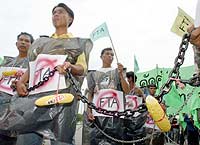
The American Family Association (AFA), along with 41 other organizations is all hot and bothered by the fact that the Ford Motor Company puts ads in gay publications.

They threaten a Christian boycott of Ford.

"We strongly suggest that Ford remove itself from involvement in the cultural war and apply its resources to building the best product possible," AFA chairman Donald E. Wildmon said in the letter sent Tuesday.

"We cannot, and will not, sit by as Ford supports an agenda aimed at the destruction of the family."

Not only that, but it seems Ford has donated hundreds of thousands of dollars to homosexual groups, sponsors gay pride parades and holds mandatory diversity training for managers. Like the other Detroit automakers, Ford also recognizes same-sex partnerships in employee benefits packages.

Ye Gads! Who knew that Ford was pushing that famous and often elusive “Homosexual Agenda” and was intent on destroying your family?

Others who signed the AFA letter include James Dobson, founder and chairman of Focus On the Family, American Values President Gary Bauer and D. James Kennedy, president of Coral Ridge Ministries, Dr. Richard Land, President The Ethics and Religious Liberty Commission, The Southern Baptist Convention, Paul Weyrich, National Chairman, Coalitions for America, Beverly LaHaye, Founder and Chairman, Concerned Women for America, Dr. Leo Godzich, Chairman, National Association of Marriage Enhancement (sounds like a pro-Viagra group), Carol L. Wagstaff, M.A., Executive Director, Living Stones Ministries (AKA “Living Stoned Ministries”)

The letter reads, "Ford’s support for these groups pushing homosexual marriage can only hurt dealers across the country. Why would Ford put the interests of seven homosexual groups ahead of the interests of all their dealers? Simply because Ford considers seven homosexual leaders more important than thousands of their dealers(you know those guys on the corner slipping Ford executives those little packets).”

The 3-million-member AFA charged that Ford reneged on promises the organization said the Dearborn automaker made to the group in November. The AFA said Ford agreed to stop sponsoring homosexual groups that promote same-sex marriages and running ads in gay publications and other media outlets in the United States, except for a small number by its Volvo brand.

Volvo? How come Volvo can push the "homosexual agenda" and no one else can anyway?

In June, the Tupelo, Miss.-based AFA delayed a boycott after collecting pledges from 110,000 people not to buy Ford vehicles. On Dec. 5, the AFA called off the planned boycott after Ford said its Jaguar and Land Rover brands would pull ads from magazines catering to gays and lesbians.

Run for your lives. Lesbians in Land Rovers!!!

And strange as it may seem, I actually know a lesbian who drives a Jaguar...but that's another story.

Ford has said it met with the AFA, but that its move to pull Jaguar and Land Rover ads was a business decision that was unrelated to the planned boycott and not part of a deal with the AFA.

Anywho, after several gay-rights activists complained about the company's apparent promise to remove ads from gay publications, Ford said on Dec. 14 it would run corporate-wide ads featuring all of its brands in gay publications. At the time, Ford also said its financial troubles could cause some cuts in its sponsorship of gay and lesbian groups and events.

"As far as we're concerned, when Ford made its statement to us last month, the matter was finished and we went on with our lives," said Jeffrey Montgomery, executive director of the Detroit-based Triangle Foundation. "The AFA can't seem to do the same."

Justin Nelson, co-founder and president of the National Gay and Lesbian Chamber of Commerce, called the letter "beyond ridiculous."

"I sit here in amazement that these people do not understand that unlike them, bigotry and hatred is not a mantra a major corporation wants to promote," he told the PlanetOut Network. "It's economics 101: Companies target and market to diverse segments in which they do business in an effort to increase market share and make a positive impact on the bottom line. If a company was to employ the AFA strategy it would not only be morally bankrupt, but would be in chapter 11 as a business enterprise."

We thank Justin for his succinct teaching on the nature of capitalism.

It’s the MONEY stupid! Sources: Detroit Free Press, Planet Out, 365 Gay, Agape Press (Ugh), AFA (double ughs)

STOP THE KILLING IN UGANDA


UN High Commissioner for Human Rights Louise Arbour says the situation in war-ravaged northern Uganda is "extremely grave" with atrocities and abuses committed by both the notorious rebel Lord's Resistance Army (LRA) and the Ugandan military.

"People are deprived of social, material and human rights needs," she told reporters during a visit to Uganda, adding that abuses of civilians by the LRA were of "great magnitude" but compounded by violations by the Ugandan People's Defense Forces (UPDF), which Arbour said amounted to a "breach of trust."

"Even though these violations may be of a smaller magnitude, violations by the UPDF contain an element of breach of trust where the person that is supposed to defend you instead offends you," she said.

Tens of thousands of people have been killed, thousands brutally attacked and some 1.6 million people, about 80 percent of the population, have been driven from their homes in fear of the LRA, which is known for its brutal treatment of civilians.

Many of the displaced live in squalid camps, prone to disease, harassment and abuse from their would-be protectors.

"There is violation of human dignity in the camps," Arbour said. "People complained about lack of access, violations of their rights, denials of health and economic rights."

"The most severe violation is the total incapacitation of the people to participate in decisions concerning their future," she added. "They express their needs in the very short term and the deprivation of hope is very serious."

The Christian LRA has become well-known for its brutal attacks on villages in which it kills, maims and abducts people, mainly children, to work as rebel fighters or sex slaves.

Last year the International Criminal Court indicted five of the group's leaders, including its elusive supremo, Joseph Kony, on war crimes charges.

None of the five have been arrested.

In a report released yesterday by the Belgium based International Crisis Group (ICG), Sudanese military officers have been accused of continuing to aid the LRA despite the international arrest warrants.

"There are credible reports that elements of Sudanese military intelligence still aid them [the LRA]," said the International Crisis Group (ICG) in the report.

"[LRA leader Joseph] Kony's location roughly 100 km north of Juba [in southern Sudan] indicates he is still being given sanctuary by elements in the government," it said on Wednesday.

The ICG said, however, that while the Sudanese government had admitted using Kony as a destabilization strategy against a rebellion in the south in the past, any support currently being given to the LRA did not reflect official policy.

Sudan had in the past named Uganda as a supporter of the southern Sudan People's Liberation Army (SPLM/A). Following the signing of a peace agreement to end a 21-year war between the SPLM/A and the Khartoum-based government in January 2005, relations between Uganda and Sudan thawed.

"Spoilers within the ruling National Congress Party and military, who continue to exert full control over the security structures of the new government, are hostile towards the Comprehensive Peace Agreement, and the LRA remains a tempting tool with which to help scuttle the agreement," the ICG noted.

The report, "A Strategy for Ending Northern Uganda's Crisis", said as one of the world's worst and most neglected wars enters its 20th year, the conflict which has shattered northern Uganda shows "no end in sight."

"Without a comprehensive government-donor strategy, the northern Uganda problem will never be definitively solved," Suliman Baldo, ICG Africa program director said.

The report outlined a far-reaching plan to execute the International Criminal Court (ICC) arrest warrants and bring the twenty-year-long conflict to a close.

"The U.S., UK, Norway and the Netherlands (the informal " Quartet" of concerned countries in Kampala), along with other ICC supporters and the UN must all work with the Ugandan and neighboring governments to fashion a comprehensive approach that integrates both military and non-military elements," it said.

"In isolation, military, diplomatic, political, and judicial strategies have no realistic prospect of success", said ICG senior adviser John Prendergast.

The IGC called on governments committed both to ending the war and achieving accountability in Uganda to devise and apply a comprehensive strategy that complements and reinforces the ICC indictments and the peacemaking efforts of Bigombe.

In order to end the 20-year old insurgency, the IGC recommended that both Uganda and neighboring states should be pressed to cooperate to fight LRA incursions; getting the Ugandan military to focus on protecting civilians; and supporting former Ugandan minister Betty Bigombe ' s moves to renew dialogue with the LRA including incentives for its non-indicted leaders.

"The UN Security Council should recognize the LRA poses a threat to international peace and security, endorse this plan, and appoint a UN envoy," said ICG.

The LRA has waged a bloody war in northern Uganda since 1988, taking over from a previous insurgency against President Yoweri Museveni's government. Sources:AFP, IRIN, New Vision (Uganda), ReliefWeb

Wednesday, January 11, 2006

STATEMENT OF DR. H. NESE OZGEN ON THE POLICE RAID AT THE AEGEAN UNIVERSITY CAMPUS IN IZMIR TURKEY


Dr. H. Neşe Özgen, a professor at Aegean University’s Sociology Department who was attacked by the Police last December 27th, gave a statement on the events that took place that day.

“On December 27th, around 300 police, who we think belong to the `Swift Force` units, accompanied by two panzer tanks, entered the Aegean University campus from 11:30 AM to 2:00PM. They were screaming, “Allah, Allah” and they attacked the students inside the buildings with batons, pepper sprayed them and dragged female students on the floor.”

“They pushed the teaching staff around, broke the windows of the buildings, fired pepper gas and chased the students with their panzer tanks inside the campus. They swore and threatened the faculty and when the Dean of Faculty of Literature asked them, ‘I am the Dean here, why are you in this faculty?’ they replied, ‘We don’t care who you are... f***ing man won’t allow us in to get those who hurl rocks at our friends.. Let’s go in!’ “

“8 years ago, Serkan Eroğlu, a student of Faculty of Communications, was found dead in the bathroom of the same faculty. First his death was reported as a suicide. But later it was revealed that he had chloroform in his blood, and it became certain that he was either killed then hung or was killed by hanging. But his murderer was never caught. Every year, the students of Faculty of Communications and Literature commemorate a day for him. But the police never entered the campus before to prevent this memorial day. On December 27th, they raided the school with a huge force, and attacked the students. The police told the press that they were called in by the school authorities.”

“The tanks entered the campus from the exit gate as if there was an emergency and started ordering the faculty staff, “back up, back up your car you son of a bitch!” They were also yelling and swearing at the faculty members who were trying to protect the students and got stuck in the middle.”

Our Medical Center refused to treat and give medical attention to the students who were injured, thus, violated their oaths. The school security, instead of telling the police that their presence in the campus was illegal, joined forces with the cops and shoved the students as well. The students the police tried to arrest or beat mercilessly are the students who peacefully sit under the trees and eat their lunches every day….”

“We are calling on the public to be sensitive to the events that are taking place…”

Prof. Dr. H. Neşe Özgen,
Aegean University
Sociology Department

Note: Serkan Eroğlu was taken into custody on November 27, 1997, by civil
police officers and taken to the anti-terrorism branch, where he was
threatened and beaten.

It is also known that Serkan had earlier submitted a petition to the
Izmir Attorney General, in which he stated that should anything happen
to him, those "responsible" would be the security forces. Three weeks
after this incident, he was found dead. Source Sendika.org, Misc. Activist

MOSCOW SYNAGOGUE SCENE OF BLOODY ATTACK


Following the latest racist or anti-Semitic attack in Russia, Moscow police have arrested Alexander Kopstev, a 20-year-old skinhead, who stabbed at least eight people before evening prayers at a Moscow synagogue Wednesday evening.

Amongst those injured was Rabbi Avraham Berkowitz, a son-in-law of the synagogue's rabbi who along with his son disarmed the terrorists and tied him up until police came.

Eyewitnesses said the attacker yelled, "Heil Hitler" and “I come to kill you,” as he attacked the men, who were eating in the kitchen prior to evening prayers. The man, wearing a leather jacket, continued to attack people in offices on the second floor before being stopped.

The floor of the synagogue was covered with blood stains.

The incident took place when the Bolshaya Bronnaya Synagogue in downtown Moscow was full of worshippers.

One man was in critical condition and at least four others are in serious condition, medical officials said Wednesday night. Among those wounded were Russians, several Israelis, an American and a resident of Tajikistan. The Rabbi was one of those rushed to the hospital and was undergoing surgery, Borukh Gorin, a spokesman for the Federation of Russia's Jewish Communities, said.

Gorin condemned the attacker as a Nazi. "It [Nazism] should be eradicated," Gorin said. He also said the Federation would boost security measures in synagogues across Russia.

The Russian Orthodox Church also condemned the attack. "The law enforcement agencies, the authorities and the public at large should make every effort to prevent such attacks," a spokesman for the Moscow Patriarchy said.

A police source told Interfax, "Twenty-year-old Muscovite Alexander Koptsev has never been a member of any extremist organizations. He has no previous criminal record, either.”

Meanwhile, the Israeli embassy said it had approached Russia's Foreign Ministry in the wake of the attack, demanding to ensure security for the local Jewish community. "Events in Moscow have aroused grave concerns. Our embassy has approached the Russian Foreign Ministry, demanding to ensure the Jewish community's security and prevent anti-Semitic acts," embassy press secretary Mikhail Brodsky said.

The synagogue is one of the oldest in Moscow and serves as the base of the Agudas Chasidei Chabad in Russia, a Lubavitch organization.

Just yesterday, hundreds of foreign students gathered before the Smolny Gates in St. Petersburg to protest yet another gruesome stabbing death of a student from Cameroon that local authorities are attributing to skinheads. The demonstrators handed an open letter to city authorities demanding they put an end to the spate of deadly attacks against foreign students that cities like St. Petersburg, Voronezh, and Moscow have witnessed in the recent year.

The group "African Unity," representing students from countries all over Asia and Africa, were joined somewhat surprisingly by activists of the Kremlin-spawned Nashi youth movement. They carried banners reading "Stop Racism" and some students covered themselves with white sheets. The city's education chief, Alexander Viktorov, came out to meet the demonstrators and was handed a letter. "The geography of losses of the past two years is vast: Cameroon, Tunisia, Morocco, Congo, Mali, Guinea, Burkina Faso, China, Vietnam, Azerbaijan, Russia. When will this countdown end? We call on law enforcement agencies to rid St. Petersburg of this evil," the letter said. Sources: Interfax, MosNews, RIA Novosti, Jewish Telegraph Agency , Arutz Sheva, Moscow News

DON'T DRINK THE WATER


Public Employees for Environmental Responsibility (PEER) is calling for the removal of the Inspector General for the Florida Department of Environmental Protection (FDEP), Pinky Hall. PEER says Hall has ignored a steady stream of whistleblower reports about political interference in pollution enforcement. PEER further says that Hall has “…issued exonerating reports that conflict with the sworn testimony…”

“Pinky Hall makes Inspector Clouseau look like a rock star,” stated Florida PEER Director Jerry Phillips, a former Florida DEP enforcement attorney. “The lack of effective oversight by the Office of Inspector General means that outrageous travesties of justice continue without consequence. There will be no positive change unless and until she is removed from her position as Inspector General.”

According to PEER, in the just past few months, for example, Hall’s office has dismissed employee reports, backed by sworn testimony, that –

• Politically-connected corporations are given 24 to 48 hours of advance notice of pollution inspections. One advance notice order followed a major fish kill by the company;

• A major pollution investigation was shelved after a request from the office of Governor Jeb Bush. In another case, a $250,000 fine was reduced to community service; and

• In a series of cases, DEP investigators were told to overlook finding cattle carcasses buried in protected wetlands, slurries of toxic waste running into St. Joe’s Bay and oil spills from sunken tug boats owned by a state contractor.

The focus of much of this activity has been the Northwest region of the state, including the Florida Panhandle, containing some of the least developed portions. Consequently, the damage from illegal development is often more serious than in Florida’s over-developed southern peninsula.

“The Northwest is the final frontier for Florida developers and, with DEP and its Inspector General under orders to stay quiet, the Panhandle has become the Wild, Wild West for pollution violations,” Phillips added. “Going through the Inspector General’s files one can’t help but notice unmistakable patterns, such as findings that do not match the evidence, a complete lack of investigative notes, failure to put top managers under oath and a failure to follow-up on additional allegations that come out of the testimony.”

As if to add insult to injury, in November, 2005, Pinky Hall could not determine who placed a printout of political donations in the file of a candidate selected to fill a key enforcement slot and closed that investigation without even contacting the state agency which produced the printout. That case also involved the role of campaign contributions in deflecting pollution enforcement in the Panhandle.

The problems exemplified by Pinky are pervasive.

Late in 2005, the Florida Department of Law Enforcement (FDLE) Office of Executive Investigations wrote off, without a criminal investigation, allegations by federal criminal investigators and state employees that Mary Jean Yon, the Director of Waste Management, aided and abetted companies involved in trafficking of toxic and hazardous waste.

Yon is the Florida's top regulatory officer presiding over hazardous and solid waste and was formerly the Director of the Northwest Florida District of the Department of Environmental Regulation.

The FDLE Office of Executive Investigations, an arm of the Governor's office, received a criminal complaint on March 2, 2005. A day later, on March 3, the FDLE office dismissed allegations made by Special Agent Paul Bouffard of the United States Environmental Protection Agency, Criminal Investigation Division, Tampa, Florida.

The complaint, described as highly criminal in nature by FDLE Special Agent Terry Rhodes of the Clearwater field office, was then forwarded for administrative review to, you guessed it, Pinky Hall.

The criminal complaint, including allegations made by the supervisor of Panama City field office, Henry Hernandez, was immediately dropped without investigation.

An administrative and management review excluding the criminal activities was instead ordered by Hall.

The Office of Inspector General instead conducted an investigation of management activities, narrowing down and questioning employees about their management styles and petty differences. The results of that investigation were issued October 13, 2005.

In the report about its own activities and those about Mrs. Yon, the DEP found all allegations were unfounded.

Missing from the report are the serious criminal allegations that Yon aided and abetted Aztec Environmental and Big Wheel Recycling in disposing toxic and hazardous waste, resulting in groundwater contamination and possible poisoning of drinking water supplies in the Florida Panhandle.

Meanwhile, scientific specialists who have worked for the state, monitoring water quality and other pesticide-related issues, say they sometimes were overruled by their superiors when they tried to ban pesticides they considered dangerous.

"We were hired to protect the health and welfare of the people of Florida," says Alex Simons, a former environmental specialist for the Florida Department of Agriculture and Consumer Services. "But the monitoring of pesticide use in Florida has become make-believe. It is Disney-esque."

Some of the specialists told the Palm Beach Post the influence of large agrochemical companies and unhealthy relationships between the firms and top state officials are the problem.

"There was a little group of people who basically worked for DuPont and the other chemical companies," said Tom Greenhalgh, a former water contamination investigator for the Florida Department of Environmental Protection, referring to agriculture department supervisors who reversed recommendations made by specialists.

Simons agreed. "The problem is the whole matter became politicized," he said. "They were in close contact with these companies, and things were being decided over our heads."

The four former specialists interviewed by the Post no longer do pesticide and ground-water work for the state and stopped doing so between 1997 and 2002. But they believe the same problems exist today because many of the top state agriculture officials, whom the specialists accuse of hiding pesticide-related dangers from the public, are still shaping state pesticide policy.

Those officials include: Marion Fuller Aller, head of food safety; Steven Rutz, chief of agricultural and environmental services; Dale Dubberly, who heads the state's main pesticide monitoring office, the Bureau of Compliance Monitoring; and Richard Budell, assistant director of the Office of Agricultural Water Policy. Although contaced by the Post, none would comment.

Theodore C. McDowell, who has advanced degrees in plant pathology and horticulture, quit the agriculture department in 1996 after 10 years, only to transfer to the Florida Department of Environmental Protection (FDEP), where he encountered similar problems until he retired in 2000. "They wouldn't listen to you."

Mark A. "Tony" Murray, 46, who earned undergraduate degrees in both biology and chemistry, also was an environmental specialist for FDEP.

"The people I was working for were always looking over their shoulders, afraid that if they didn't make the right registration decision they would lose their jobs," Murray said. "I was doing scientific work, but they were taking that work and making political decisions." Murray left the department recently, after 15 years of service. Sources: Palm Beach Post, PEER, Coalition for Free Thought in Media

Tuesday, January 10, 2006

KILLING WOMEN IS MURDER


Pakistan’s Daily Times reports Nazir Ahmed appears calm and unrepentant as he recounts how he slit the throats of his three young daughters and their 25-year old stepsister to salvage his family’s “honor” - a crime that shocked Pakistan. The 40-year old laborer, speaking to The Associated Press in police detention as he was being shifted to jail, confessed to just one regret - that he didn’t murder the stepsister’s alleged lover too.

Male relatives murder hundreds of girls and women each year in the country, rights groups said on today.

The Human Rights Commission of Pakistan said that more than half of such cases do not make it to court. Most are settled with cash settlements paid by relatives to the victims’ families, although under a law passed last year, the minimum penalty is 10 years, the maximum death by hanging.

Ahmed’s wife Rehmat Bibi witnessed his killing spree as she cradled their three month-old baby son on a Friday night in December at their home in the cotton-growing village of Gago Mandi in Punjab. It is the latest of more than 260 such honor killings documented by the rights commission, mostly from media reports, during the first 11 months of 2005.

Bibi recounted that she was woken by a shriek as Ahmed put his hand to the mouth of his stepdaughter Muqadas and struck her in the throat with a machete. Bibi looked helplessly from the corner of the room as he then killed the three girls - Bano, eight Sumaira, seven, and Humaira, four, pausing between the slayings to brandish the bloodstained knife at his wife, warning her not to intervene or raise alarm. “I was shivering with fear. I did not know how to save my daughters,” Bibi, sobbing, told AP by phone from the village. “I begged my husband to spare my daughters but he said, ‘If you make a noise, I will kill you.”’ “The whole night the bodies of my daughters lay in front of me. I did not have the sense to know what has happened.”

The next morning, Ahmed was arrested. Speaking exclusively to AP in the back of police pickup truck, as he was shifted to a prison in Multan, Ahmed showed no contrition. Appearing disheveled but composed; he said he killed Muqadas because she had committed adultery, and his daughters because he didn’t want them to do the same when they grew up. He said he bought a butcher’s knife and a machete after midday prayers on Friday and hid them in the house where he carried out the killings.

“I thought the younger girls would do what their eldest sister had done, so they should be eliminated,” he said, his hands cuffed, his face unshaven. “We are poor people and we have nothing else to protect but our honor.” Despite Ahmed’s contention that Muqadas had committed adultery, the rights commission reported that according to local people, Muqadas had fled her husband because he had abused her and forced her to work in a brick-making factory. Muqadas was Bibi’s daughter by her first marriage to Ahmed’s brother, who died 14 years ago. Ahmed married his brother’s widow.

“Women are treated as property and those committing crimes against them do not get punished,” said the rights commission’s director, Kamla Hyat. “The steps taken by our government have made no real difference.” Activists accuse President Pervez Musharraf, a self-styled moderate Muslim, of reluctance to reform outdated Islamized laws that make it difficult to secure convictions in rape, acid attacks and other cases of violence against women. They say police are often reluctant to prosecute, regarding such crimes as family disputes.

Statistics on honor killings are confused and imprecise, but figures from the rights commission’s web site and its officials show a marked reduction in cases this year: 267 in the first 11 months of 2005, compared with 579 during all of 2004. The Ministry of Women’s Development said it had no reliable figures. Ijaz Elahi, the ministry’s joint secretary, said the violence was decreasing and that increasing numbers of victims were reporting incidents to police or the media. Laws, including one passed last year to beef up penalties for honor killings, had been toughened, she said.

Police in Multan said they would complete their investigation into Ahmed’s case in the next two weeks and that he faces the death sentence if he is convicted for the killings and terrorizing his neighborhood. Ahmed, who did not resist arrest, was unrepentant. “I told the police that I am a honorable father and I slaughtered my dishonored daughter and the three other girls,” he said. “I wish that I get a chance to eliminate the boy she ran away with and set his home on fire.”

Women’s groups around the world, Muslim and non-Muslim alike have railed for years against honor killings. They wonder where the men are.

Abed Anabtawi, spokesman for the Higher Arab Monitoring Committee in Palestine, insists men have not abandoned the arena. He says, in 1997, for example, the committee issued a denunciation of family honor killings, and it plans to discuss the issue again soon, at the request of the women's organizations. Such killings were also discussed a few weeks ago at a conference about violence in Arab society, he noted.

"These murders are misnamed," he declared. "This is not where real honor lies, either for the family or for the Arab public as a whole."

Women's organizations also accuse the police and prosecution of not doing enough to fight the phenomenon: Often, only the murderers are charged, but not other family members who abetted the killing. And women who complain to the police about threats are still usually sent back to their families - even though some complainants were ultimately murdered.

Shahed Amanullah, editor-in-chief of alt.Muslim, writes, “Violence against women is by no means limited to the Muslim world, but as Muslims we are called upon to be better. All the Islamic condemnations of violence against women mean nothing if they lay in dusty, unopened books and are not used against the tribal, patriarchal madness that has continued to infect the Muslim world from the beginning. And even then, condemnations are not enough. The men who commit these crimes and who are escaping with slaps on the wrist must be brought to justice.”

She writes further on, “We have a long way to go to rid ourselves of this plague. Legal systems in the Muslim world, which often mete out light sentences for "honor" killings, need to be strengthened to provide appropriate punishments. Participants in these crimes should not be allowed to hide behind qisas, which allows the relatives of a woman (who often are sympathetic to the murderer) to forgive him or offer blood money to avoid punishment. And Muslim states should offer proper protection to women who are escaping domestic violence or threat of death. And most importantly, we must not allow these people to hide behind Islamic justifications for "honor" killing. Even if "honor" killers don't fear God, we must at least make them fear us.”

Following the murder in Pakistan the Muslim Women’s League and the Muslim Public Affairs Council issued the following statement:

“The Muslim Women's League and the Muslim Public Affairs Council strongly condemn any and all honor killings as a complete violation of the teachings of Islam. On December 23rd, Nazir Ahmed murdered his 25 year old stepdaughter and three daughters (all under the age of 9) in a village in Pakistan. This case is an aberration, reflecting the actions of a deranged, mentally unstable individual.

“Religious illiteracy is a pervasive problem in the Muslim world that allows for such crimes to be erroneously justified by Islam. The Muslim Women's League and MPAC call upon the religious leaders of Pakistan, and other Muslim countries, to begin a campaign of religious education of their people, emphasizing the principles of equality, justice and accountability as expressed in the Qur'an.

"A woman's moral conduct is not 'owned' by anyone else but herself. Her honor belongs to her, and not to her family," argues Dr. Maher Hathout in his new book "In Pursuit of Justice: The Jurisprudence of Human Rights in Islam". "It is for God to judge her, and to determine the punishment for any moral indiscretions on her part, not for her family of the society to do so."

“The general devaluation of female children, along with the culturally acceptable notion that women bear the burden of honor for their entire family, creates an environment where such a heinous act could occur. According to Islamic law, or Shari'a, children are not considered accountable for their deeds in a legal or moral sense until after they complete puberty. All children, both male and female, are guaranteed basic rights in Islam including the right of safety and security.

“Furthermore, individual members of society are not allowed to take the law into their own hands and render punishment, regardless of whether a crime has been committed or not. Therefore, the murder of these young girls in Pakistan can be viewed only as a horrible homicide for which their father should be punished under the full extent of the law.

The Muslim Women’s League suggests for a more detailed discussion of the issue of honor killings within Islamic law go to http://www.mwlusa.org/publications/positionpapers/hk.html

The Muslim Women's League is a non-profit Muslim American organization working to implement the values of Islam and thereby reclaim the status of women as free, equal and vital contributors to society. Sources: Muslim Women’s League, Alt. Muslim, Daily Times (Pakistan), Pakistan Tribune, Ha’aretz (Israel), Feminist Majority Foundation

From the Leonard Peltier Defense Committee


WHAT ARE YOU DOING ON FEB 6, 2006?

We, the LPDC team, the Leonard Peltier Legal team and KOLA/IPF would like to know what are YOU doing on Febuary 6, 2006?

February 6th, marks the 30th anniversary of Leonard’s illegal extradition to the United States from Canada. Supporters all around the world are getting together in honor of our warrior-Leonard.

Will you be meeting with friends to view “Incident of Oglala?”
Attend a candlelight vigil?
Get together with friends to write letters to our Politicians?
Coordinate a benefit event?
Call your favorite radio station and request a special song dedicated to our Warrior?
Place an order with our Café Press online store
@http://www.cafepress.com/leonardpeltier
Proudly wear your Leonard Peltier T-shirt and hand out information brochures? (available via our website)
Sign the online petition to George Bush?
@http://users.skynet.be/kola//ppet.htm (online cards to George W. Bush also available)

Be AN Army OF ONE, and plan an event for Leonard! Get others to join you and lets us know what you’ll be doing for Leonard on Feb 6, 2006?

Call the LPDC @ 915-533-6655
Email us at:info@leonardpeltier.org and share with us your plans and ideas!

Join Us! We would love to hear from you ! LET US put your name on the Map!
Please continue to check our website : www.leonardpeltier.org/ WE WILL BE POSTING A MAP with all the activities that supporters are doing on FEB 6, 2005.

LOOKING FORWARD TO HEARING FROM YOU!
Leonard Peltier Defense Committee

AN EXPRESS TRAIN HEADING TOWARDS A DISASTER"


The Bangkok Post reports that that the Thai-US free trade area (FTA) talks were forced to halt for a while today after about 500 protesters managed to get past 2000 police and enter the hotel compound where the talks were being held.

Outside nearly 10,000 others rallied in the streets for a second day.

The 500 protesters, most of them from HIV/Aids groups, vowed to make their way to the meeting rooms to prevent negotiations on drug patenting and other intellectual property rights issues.

Small clashes with police were reported from around the site.

One group of protesters opposing the Thai-U.S. FTA pact and gathering at Chiang Mai's Sheraton Hotel, the venue for the talks, swam across the Mae Ping River, trying to approach the back of the hotel located alongside the riverbank. They were blocked by police units about two meters away from the hotel compound. Sporadic clashes lasted for several minutes but caused no injuries and the police were successful in keeping control of the situation.

Another group of some 300 protesters prostrated themselves on the street on the way to the meeting venue, praying for sacred spirits to protect the country from the FTA.

“It is crucial for us to stop the negotiations, because our lives are at stake,” Nopparat Sa-ngiemjitr, from an HIV/Aids group in Chacheongsao province told Nation. “We are fighting against drug patenting with our lives. I know I might get arrested or injured in clashes with police, but we are all willing to face that, because we have more to lose if the talks succeed.”

An observer said that if the protesters managed to stop the FTA negotiations in Chiang Mai, it would be only the second time since the WTO ministerial meeting in Seattle was scuttled in 1999 that a free-trade negotiation had been disrupted.

Thai chief negotiator Nitya Pibulsonggram said he was ready to listen to their concerns and suggested the protesters list them in writing.

The protesters, however, were not satisfied and insisted the FTA negotiations be scrapped.

''Thank you very much Mr Nitya for coming to meet us. But what you said to us means that you have never listened to our concerns. We have used all channels to express our voice. But unfortunately you have not heard us,'' said Nimit Tienudom, director of Aids Access Foundation.

In Loei, where he was attending a cabinet meeting, Prime Minister Thaksin Shinawatra told the Thai delegates in the FTA negotiations to put national interests first and listen to protesters' suggestions.

''If a deal puts the country at a disadvantage, we'll not sign it. And we'll listen to the complaints of the protest groups,'' said Thaksin.

Many say that the FTA will certainly be “disadvantageous.”

''Thailand stands to lose much if the FTA with the U.S. is signed,'' Saree Ongsamwong, general secretary of the Foundation for Consumers (FOC), a non-governmental organization (NGO), said in an interview. ''It will increase poverty among the small farmers in the provinces.''

Thai farmers took a beating following similar bilateral trade deals that the government of Prime Minister Thaksin Shinawatra signed with China, Australia and New Zealand.

Cheaper imports of garlic and onions from China have put 40 percent of Thai farmers out of business, Witoon Lianchumroon, coordinator of FTA Watch, told reporters on Thursday. ''About 50,000 farming households have been affected.''

Likewise, an estimated 100,000 Thai farmers who raised cattle for meat have been unable to compete against cheaper imports from New Zealand that followed the Thai-New Zealand FTA agreement.

Witoon estimates that nearly 6.5 million farmers will be affected if Bangkok signs a similar trade deal with Washington, resulting in U.S. agriculture products flooding the local markets.

Proposed changes would not only mean a possible loss in income for Thais farmers but also possible loss of lives among Thais living with HIV/AIDS who depend on cheap, locally-produced generic anti-AIDS drugs.

''The government's policy to provide cheap drugs for people with AIDS will be threatened with this FTA,'' says Kamol Uppakaew, chairman of the Thai Network of People Living with HIV/AIDS. ''Those who need the new line of drugs will not be able to get it because the price will be too high, 20,000 baht (500 dollars) per month.''

Currently, the Thai government's universal health care program supplies generic anti-AIDS drugs to nearly 100,000 people who need medication. In all, there are some 670,000 people with HIV in this country, where over 300,000 people have died from AIDS-related causes since the pandemic was first detected in the 1980s.

According to the activists, the planned FTA with the U.S. would make it difficult for the state-run pharmaceutical agency to produce the new line of anti-AIDS drugs because of the position Washington is taking over intellectual property rights.

The U.S. wants to enforce a 25-year period to protect patents for drugs as against the 20-year patent protection that is the case under the existing global free trade rules.

Street protests are the only avenue open for opponents of the FTA, since the Thai government has shrouded its policies in secrecy, says FOC’s Saree, whose group belongs to a nationwide coalition of anti-FTA NGOs, called FTW Watch. ''There has been no public debate and the government has refused to listen to our concerns.''

''This agreement is like putting people on an express train heading towards a disaster,'' adds Witoon. Sources: Spero News, Xinhua, Nation (Thailand), Bangkok Post

Monday, January 09, 2006

LANCE HILL REPORTS FROM NEW ORLEANS


Footprint or Bootprint?
Thoughts on the Political Uses of Population Estimates in New Orleans


Lance Hill
January 6, 2005

How many people live in New Orleans today? Some government leaders and media organizations are using demographers’ estimates that 100,000-150,000 people have returned to the city. While these surprisingly high numbers can encourage optimism and recovery, we also must acknowledge that population estimates are laden with political meaning. Estimates of repopulation trends can and are being used validate and legitimize recovery policies for housing, education, and the local economy.

In the coming years, these polices will disproportionately affect New Orleans flood-ravaged black neighborhoods which were hardest hit by the hurricanes. The small group of policy planners who are currently debating and finalizing the city’s future blueprint are doing so in the absence of nearly 80% of New Orleans previous black inhabitants. Working outside the democratic process, these planners need public legitimacy. High population estimates and rosy repopulation trends create the impression that a sufficient number of residents have returned to justify making long-term decisions today. Many planners are advocating plans to reduce the city’s population, using the expression “a smaller footprint.” The hard reality is that this means some black neighborhoods will not be allowed to rebuild. For advocates of the reduced population, it has become crucial that black New Orleanians don’t view the “footprint” as a “bootprint.”

Most demographers agree that there are no reliable methods for determining how many people have returned to housing units made uninhabitable by wind or floodwaters. We should be mindful that all the total population estimates contain some potentially misleading data. All current population estimates include the 56,782 residents of the Algiers community, which sits on the west bank of the Mississippi river and which experienced little or no flooding. Algiers was also exempted from some of the martial law and mandatory evacuation orders and was re-opened to evacuees months before other sections of the city. Virtually all of the homes were immediately habitable once utilities were restored.

Demographers also include in their totals the 40,000 people who lived in the un-flooded sections of the Uptown corridor where, as in Algiers, most homes were left habitable. That 100,000 people have returned to their homes tells us little about repopulation trends or progress in the flooded areas where 120,000 housing units were made unlivable, and which was home to most of the city’s black and poor population. All that current population estimates tell us is that, for the most part, the people who have returned are the ones who never had to leave in the first place. Including these 100,000 residents into figures used to gauge the effectiveness of the recovery process is of little value for evaluating recovery policies and cannot serve as a useful predictor of future repopulation trends.

Where, then, can we find reliable population estimates? First, it is unlikely that businesses, utility companies, and government officials and agencies who want to promote the impression of growth will provide population estimates that reveal real racial and economic disparities or a general lack of progress. But if we want to create an effective and equitable recovery, we need to know the bad news as well as the good news.

In the final analysis, the most reliable method for measuring recovery effectiveness and equity requires multiple data sources, including survey research, analysis of consumer trends, and usage of educational and social services.

Public education usage is a revealing case in point. There is no question that students are returning to schools. But consider that virtually all of the predominantly white private schools in New Orleans will reopen in January to predicted enrollments of 75% or higher. Contrast those numbers to the harsh reality that, if we exclude the public school students who returned to Algiers and Uptown, only about 7% of the 65,000 students who attended New Orleans pubic schools are returning to enroll in January. That the Orleans Parish School Board plans to terminate all but 61 of the 7,000 former school employees speaks volumes about who will find it convenient and hospitable to return in the near future.

It would be shortsighted to assume that the working and unemployed poor will not return to New Orleans, even if there is no affordable housing. New Orleans is one of the few major cities in the United States that does not have a public vagrancy law (it was overturned by federal courts several years ago). Homeless people have the right to sleep in public spaces and parks. In December of 2006, FEMA rent supports will end across the nation and tens of thousands of homeless New Orleanians will likely attempt return to their hometown where their only family support networks exist. Without adequate planning, New Orleans could become home to thousands of homeless living in sprawling tent cities in the parks and massive squatters communities in abandoned housing.

If we are to build a better city, we need to have an accurate idea of not only who has come home, but also who has not and why.

Lance Hill, Ph.D.
Executive Director
Southern Institute for Education and Research
Tulane University

AIN'T OVER 'TILL ITS OVER


New Orleans area law enforcement and emergency service volunteers also are reporting medical problems and attempting to alert the Louisiana Department of Health and Hospitals to recognize the health hazard being dubbed the Katrina Rash or New Orleans Crud.

The Daily Leader reports toxic water resulting from Katrina is taking a toll on the health of area first-responders who answered medical and law enforcement calls for assistance after back-to-back hurricanes earlier this year that may have changed Louisiana’s Crescent City and other Gulf Coast parishes forever.

Louisiana State Trooper David Bryant responded three times to the help call and also is receiving medical assistance after contracting a recurring 102-degree fever following his third trip. Doctors have been unable to determine whether his illness, which resembles pneumonia or bronchitis, is fungal or bacterial.

“It definitely came from New Orleans,” the trooper said. “My chest started hurting in October and lasted for more than a month. I returned to Ruston, but went back to New Orleans for a week over Halloween. When I came home the third time is when I had the high fever.”

“David (Bryant) is home now, but he’s going to a specialist in New Orleans after the first of the year,” fiancé Carol Dreyfus said. “They really don’t know what he has — they just call it the New Orleans Crud. But he’s lost 32 pounds and looks horrible.”

Bryant blames part of his woes on lack of preparedness by state police headquarters.

“They dumped us off in New Orleans without the right equipment and they didn’t give us shots or respirators,” first responder David Bryant said. “The whole thing in New Orleans was really unorganized — horribly, horribly, horribly unorganized by both the governor and state police headquarters.”

Bryant has been in and out of hospitals suffering with chest pains, abdominal problems, extreme weakness and fatigue.

“I’m tired of my chest hurting,” the eight-year veteran trooper said. “I’m tired of the cramps.”

Lincoln Parish Deputy Tommy Doss, another early responder, had a different experience — a rash developed on his forearm shortly after returning from his stint in New Orleans. Topical skin treatment helped his forearm for a few days, but then the rash emerged on his legs. During treatment, it also returned to his arm.

“Now I’ve got the rash on both legs and my arm,” Doss said. “I don’t know for sure that I caught it in New Orleans, or what it is, but a lot of people are coming down with weird rashes.”

The American Society of Health-System Pharmacists (ASHP) reports several residents in other states who traveled to New Orleans in the wake of Katrina have come down with skin infections and rashes.

Amy M. Hollar, a pharmacy practice resident at Mission Hospitals in Asheville, N.C., calls the condition the Katrina Rash. The ASHP field hospital treated several local (New Orleans) residents and relief workers for various skin infections and rashes. Several patients were diagnosed with methicillin-resistant Staphylococcus aureus (MRSA).

Robert Leeds, a critical care pharmacist at Durham (N.C.) Regional Hospital, part of the Duke University Health System, said another skin infection is being identified as being caused by the marine bacterium Vibrio fischeri.

A third skin infection is suspected by epidemiologists at the field hospital to be a contact dermatitis, Hollar said.

Heather Tornabene is a licensed practical nurse and a first-responder EMT. She volunteered to go to New Orleans twice and says MRSA is very dangerous.

“MRSA is antibiotic resistant,” Tornabene said. “Most antibiotics won’t touch it, so it is extremely hard to treat.”

And according to Medscape hurricane Katrina evacuees are not listed as a risk group for MRSA.

And other health concerns are also appearing.

Unsafe levels of lead have been found in soil and sediments left behind in New Orleans following Hurricane Katrina and could pose a heightened health threat to returning residents, particularly children, according to a new study published in the American Chemical Society's journal Environmental Science & Technology. In some soil samples collected from the area, lead levels were as much as two-thirds higher than what the U.S. Environmental Protection Agency considers safe, according to researchers at Texas Tech University.

The same scientists also found concentrations of aldrin (an insecticide), arsenic, and seven semivolatile organic compounds that exceeded EPA Region VI safe levels and are on EPA's list of known or suspected human carcinogens. In all, the researchers analyzed the sediment and soil samples for 26 metals and more than 90 semi-volatile compounds.

In addition to sediment and soil samples, the researchers also tested water and animal tissues following the flood. Other contaminants found among samples include high levels of iron, several banned pesticides and pathogenic bacteria, but the researchers say that concentrations of most of these contaminants were unlikely to pose an immediate human health threat. The peer-reviewed study, which represents one of the most detailed environmental sampling efforts to date following the flooding caused by Katrina, will appear in the Jan. 15 issue of ES&T.

"The purpose of this study is to gather more extensive samples and establish baseline data upon which to evaluate the long-term environmental impact of the storm," says Presley. "It may take years before we really know the full extent of the human health risks and wildlife impact from the Katrina contaminants, but this is an important step."

The researcher cautions that this study alone won't answer the much debated question of whether it is safe to return to the area. Nonetheless, says Presley, people should be made aware of the contaminants that are present and take appropriate cleanup measures to minimize the potential health risks. Sources: Science Daily, Medscape, Daily Leader (Ruston, Louisiana)