Thursday, December 12, 2013

"AMBROSIO FOUGHT HARD...NOW WE'VE LOST HIM"

ALWAYS AT THE FOREFRONT OF THE STRUGGLE


Last week a great man died.

Guarani Indian leader Ambrosio Vilhalva was murdered as he approached his community, known as Guyra Roká, near the town of Caarapao, in Mato Grosso do Sul state, Brazil.

Vilhalva travelled extensively internationally to speak out about his tribe's plight, and push the Brazilian government live up to its legal obligations and protecting Guarani land.   The Guyra Roká community was evicted from its land by ranchers many decades ago, forcing the people to live in conditions of poverty on the side of a motorway while their land was predominantly turned into sugar plantations. In 2007, the Guyra Roká community began to occupy a part of the land which was taken from them and now live on a small portion of this territory.

In 2010, Vilhalva said, "  The sugar cane plantations are finishing off the Indians. Our lands are getting smaller and smaller. The plantations are killing the Indians."

Survival International  reported that Vilhalva had been receiving death threats, a situation all too common for Guaraní indigenous leaders.  It also wrote:


Ambrósio Vilhalva was a spokesman for his people and a leader in his community’s struggle to reclaim their ancestral land. In the words of another Guaraní spokesman, 


Ambrósio Vilhalva was also an actor. In 2008 he took part in the Italian-Brazilian film Birdwatchers, at the same time a love story and an attempt to describe the plight of the Guaraní-Kaiowá people and their forest homeland. Produced with significant participation from the Guaraní themselves, and with several Guaraní actors in leading roles, the film drew a very diverse range of reactions, from thoughtful praise to angry criticism. This controversy, however, could be counted as a victory for the film, since one of its goals was precisely to call attention to the situation of the Guaraní.


A Guarani spokesman told media: "Ambrósio fought hard against the sugar cane. He was one of our main leaders, always at the forefront of our struggle, so he was being threatened. He was an extremely important figure in the Guarani land campaign, and now, we've lost him".

Vilhalva’s ceaseless campaigning against sugar cane planting made an impact when a joint campaign between the Guyra Roká community and Survival International forced Raízen, a venture between fuel companies Shell and Cosan to use sugar cane for biofuel production, to stop using produce from the Guarani’s ancestral land.


A few days after his death, a protest in Brazil's capital served as a reminder of the deprivations and danger that face many Indigenous Brazilians.  Indian Country Today reported:


...an estimated 1,700 representatives of dozens of tribes marched on Brazil’s Presidential Palace and the Ministry of Justice to protest a proposed judicial decree that would change the rules for creating indigenous territories in a way that protesters said would make it nearly impossible for Indians to gain title to ancestral lands. It was the latest of various indigenous protests this year to bring attention to moves by branches of the Brazilian government that threatened Native land rights, and the increase in violence against their leaders.

 During the  march a confrontation broke about between some protesters and the Palácio do Panalto security force, which used pepper spray to disperse the group. "Some participants were hospitalized," an indigenous leader, Marcos Xukuru, told the Brazilian news agency Adital. The marchers then moved on to the Justice Ministry and requested an interview with the minister; they were told he was out of the office. 

The following is from Survival International.


Ambrósio Vilhalva, 1960-2013 – an obituary

Ambrósio Vilhalva, 1960-2013
© Fiona Watson/Survival
One of Brazil’s most prominent indigenous leaders, Ambrósio Vilhalva, has been stabbed to death near his community in southern Brazil. He was 53.
Although details of the murder are confused and there are conflicting accounts, many believe his murder was at the behest of the landowners who have taken over his people’s territory.
With his large, powerful frame, Ambrósio’s physical presence made an instant impact. He was genial and outgoing, and well known for his philosophizing. He liked nothing better than to expound his views on the universe whilst drinking tereré (the ubiquitous tea of southern Brazil) from a cow-horn gourd. His easy-going manner masked a strong will and a deep determination to fight for what he believed in – land, above all, and justice for his people.
Ambrósio’s life typified that of so many Guarani. His community, Guyra Roka or ‘Place of the Bird’, was expelled from their tekoha (ancestral land) in the 1940s and 50s by ranchers and farmers, and dumped in a tiny reserve already overcrowded with hundreds of other Guarani refugees. Violence, suicide and malnutrition were soon rife.
This pattern has been repeated across southern Brazil, where the Guarani, numbering some 50,000, have been powerless witnesses to the theft of 99% of their once-verdant territory. With no land to cultivate and no means of sustaining themselves, the Guarani now have one of the highest suicide rates in the world.
Like many, Ambrósio and his community dreamed of returning to their tekoha. In 2000, led by Ambrósio and his father Papito (the rezador or religious leader) the community moved out of the reserve to camp on a roadside near their land, now cleared, fenced off and filled with endless fields of sugar cane. Life here was grim too – their rickety tarpaulin shelters were permanently enveloped in clouds of dust from the trucks thundering past day and night. Children were malnourished, and adults were forced to seek work on the ranches occupying their land.
Tired of waiting for the government to take action, Ambrósio and Papito led three attempts to reoccupy their land, finally succeeding in 2004. Avoiding the ranchers’ pistoleiros, the community settled on a tiny piece of land where they planted crops amidst the sugar cane. Largely thanks to Ambrósio’s tireless and passionate advocacy, the Minster of Justice finally recognized Guyra Roka as Guarani land in 2009. But it was a victory in name only – the landowners vowed not to move, and occupy the area to this day. The largest and most powerful is Zé Teixeira, a state congressman.
Ambrósio was catapulted into international stardom in 2008 when he played the lead role in Birdwatchers, an award-winning feature film that highlighted the bitter conflict between the ranchers and the Guarani. With his love of language and powerful, brooding presence, Ambrósio was a natural. The film’s director later said he tore up the script and let the Guarani speak their parts as they saw fit.
He attended the launch of the film at the Venice Film festival in 2008, along with other Guarani actors. Here he spoke of the Guarani’s long struggle for land rights and equality in one of Brazil’s richest and most violent states, and said, ‘This is a great film, as people can observe who the Indians really are and see their problems.’
Prophetically, he told a Survival campaigner who accompanied him that, ‘I am marked. When I return to my land they will come for me.’
In a grim turn of the dice, fiction has become reality. Ambrósio’s character in the film is brutally murdered as he leads his people back on to their land at the dead of night to avoid the ranchers’ gunmen.
Whilst he wore his fifteen minutes of fame lightly and toured the sights of Venice with his tereré gourd always to hand, it was not easy to return to the grinding poverty, the constant death threats from the patrolling gunmen, and the total abandonment by the Brazilian state.
Ambrósio is the latest in a long line of Guarani leaders systematically targeted for their activism. Ever since the reoccupation he had received death threats, and the intimidating presence of pistoleiros patrolling around the community meant that he rarely ventured out. Medical staff from the government health agency who were supposed to make regular visits stopped coming, and abandoned the community to their fate. All this undoubtedly took a toll on his health and his family.
When taking his leave Ambrósio would say Ñe’e porã, tape puku, tape porã – ‘Nice talk, a long path, a beautiful path.’
Ambrósio leaves his wife Maria, his father Papito and several children and grandchildren.

Wednesday, December 11, 2013

BRITISH OCCUPIED IRELAND: FREE STEPHEN MURNEY NOW


The case against Irish activist Stephen Murney is unraveling but Murney remains in prison.  

Most of you probably never heard of Stephen Murney.

Murney is a 29 year old who lives in the city of Newry, which is locagted just inside the borders of British occupied Ireland.  He was going about his business preparing to celebrate his birthday when a unit of heavily armed British police charged into his home and arrested him.  They took him to a high security interrogation center and charged him with a number of rediculous charges related to, what else, terrorism.

Stephen is a member of the socialist republiclan political party Eirigi.  He had been in the heart of a struggle against an ongoing campaign of harassment by the PSNI against Republicans in the Newry area.  Stephen has frequently documented, photographed and recorded incidents of harsh PSNI (Police Service of Northern Ireland) stop and searches of people, house raids and other rough treatment in the Newry area. Stephen regularly highlighted these issues in local newspapers and on the internet..  He, himself, has been the subject of nearly daily harrasement, threats and assaults.

As reported by Censor Offender:


In late November 2012, Stephen Murney wrote a letter to a local newspaper expressing his strong condemnation of several early morning raids by the PSNI on homes in the Derrybeg Estate, Newry. He stated that these incursions were causing deep distress to the targeted families and maintained the raids were excessive, unnecessary and avoidable.

On November 28th, some 24 hours after Stephen’s letter was published, in scenes similar to those he had described and criticised, police smashed in his front door and stormed into his home in a dawn raid. Police officers searched his house, seized a computer, political literature and a flute band uniform and arrested Stephen.

The PSNI then three days later charged Stephen Murney with three ‘offenses’. The first charge is, collecting information which maybe of use to terrorists. The second charge is, distributing information which maybe of use to terrorists. The third charge is, possessing items which could be used for terrorist purposes.

The first charge concerns Stephen openly taking photographs of people, including PSNI officers at a protest rally in Newry in June 2012. The PSNI didn’t question, or arrest Stephen, or confiscate or examine his camera/phone or ask for certain images to be deleted at that time. The police did ask him to stop taking photographs and he promptly agreed and did so. The second charge relates to Stephen later posting the same photographs on Facebook, as well as having other political images on this computer. The third charge is in regards to the items of clothing (flute band uniform), two airguns and political literature seized from his home.

At a hearing on December 21, Stephen’s lawyer said the photographs had been openly taken, that Stephen had stopped when instructed and that the posting of some photographs was also for a perfectly legitimate purpose. Some of these photos were taken by Stephen at political protests, commemorations and other events. But most of the photos were downloaded from the internet, many were old, dating back to the Civil Rights Movement in north of Ireland in the late 1960s. The lawyer added that the items that could allegedly be used for ‘terrorist’ purposes consisted of flute band uniforms, possessing two ball-bearing airguns (belonging to his son and are legal and widely available throughout Ireland), legal political leaflets and images freely available to the public on the internet. Many supportive references from community organisations in Newry in support of Stephen Murney were also presented to the court.


On that charge of having articles likely to be of use to terrorists, we find Stephen was in possession of two BB guns (ball-bearing airguns), berets, trousers and jumpers which were all part of the uniform of a drum and flute band that Stephen was previously a member of.

As the Green Left reported Pat McNamee, a member of the Northern Ireland Assembly and a friend of Murney stated at a recent protest:


“Stephen Murney is charged with having a band uniform that he wore whilst a member of a local republican flute band. In ‘newspeak’, that is having a paramilitary uniform and being equipped for terrorism.”

“Stephen Murney is charged with having photographs of protests he had taken part in, which inevitably included images of members of the PSNI, who were also present at these demonstrations. In ‘newspeak’, that is having information useful to terrorists.

“Stephen Murney is charged with having his son’s toy guns in his home. In ‘newspeak’, that is having an imitation firearm.

“In 'real speak', however, Murney has been held in jail for more than six months solely because he is an effective republican and community activist.”


Since his arrest several Irish republican and other groups have campaigned for his freedom, including Eirigi, Republican Network for Unity, Irish Republican Socialist Party, Republican Sinn Fein, 32 County Sovereignty Movement, as well as local Councillors and other individuals.


Again, from Green Left:


Murney is in jail, not because he has done or planned to do anything unlawful, but due to his political views and role as an active, outspoken and effective Republican and community activist.

In a normal, civil society, there would have to be substantial evidence against Murney to warrant the serious charges he now faces. But Ireland's north is not a normal, ordinary place. So, rather than these charges being recognised as ridiculous, in the six Irish counties still claimed by Britain, they are depicted by the PSNI as a very grave matter. If Murney is convicted, he faces a lengthy prison sentence.

The British authorities have used a policy of selective internment against Murney in an bid to silence him and other opposition. A political activist is now in effect interned without trial on the basis of the most ridiculous “evidence”.

Murney is innocent and his jailing utterly unjust. The flimsy charges against him should be dropped and Murney should be immediately and unconditionally released.

Murney said: “Internment was wrong and unjust in previous years and it remains as equally wrong and unjust today. I would encourage all those that disagree with its continued use to organise and publicly oppose internment in its current form.”  


It is centuries overdue...the British must get the hell out of every bit of Ireland.

Stephen Murney must be set free.

The following is from The Irish Revolution.


Stephen Murney case: dismissal of some charges demonstrates paucity of prosecution case


Stephen MurneyIn a dramatic follow-up to the ‘no bill’ application made by Stephen Murney’s legal team on Tuesday 26th November, the judge hearing the case summoned the defence and prosecution teams to a brief sitting yesterday evening (Friday 29th November).
Although he had previously stated that judgment was being reserved until December 10th, the judge announced that he was dismissing those charges relating to “items for use in terrorism”. These charges related to old band uniforms of Stephen’s and to toy guns belonging to his son – facts that had been consistently presented by the defence ever since Stephen was first charged exactly one year ago.
The charges featured heavily in every court hearing during the past twelve months as PSNI witnesses and the prosecution, constantly and without fail, portrayed these “terror” charges and the items they related to as some sort of evidence to show Stephen’s involvement in a “terrorist conspiracy”.
Far from accepting that the items were, in fact, band uniforms and toys, the prosecution continuously referred to “paramilitary uniforms” and “Uzi machine guns” that could be used in “paramilitary shows of strength”.
Tuesday’s lengthy legal submissions to the court by the defence – along with the ability to demonstrate the true nature of the items which included photographs of Stephen wearing the uniform in a band and evidence relating to the toy guns – clearly demonstrated the spuriousnature of the charges against Stephen.
While these charges are now dismissed, Stephen still remains in custody and will face trial in January in relation to “collecting and possessing items that may be of use to terrorists”.
Those charges relate directly to photographs of PSNI harassment of citizens, raids and houses searches. The photographs had been taken quite openly by Stephen to document and record human rights abuses and infringements of civil liberties by the PSNI in his role as publicity officer for éirígí in the Newry area.
Speaking last night after the dismissal of the charges, éirígí’s Breandán Mac Cionnaith said, “It has taken a full year for Stephen’s case to reach this pre-trial stage. With this dismissal of some charges, it is clear that the entire PSNI/prosecution case is entirely without any foundation whatsoever.
“From the outset, we have said that these charges were nothing more than a spurious means to remove a committed and dedicated party activist from his family and his community. In short, Stephen’s imprisonment has been tantamount to ‘internment by remand’.
“Tomorrow, we will be protesting in Newry to highlight Stephen’s ongoing and unjust detention in Maghaberry where he has now been held for one full year.
“His continued imprisonment makes a complete nonsense of the propaganda spewed out by constitutional nationalist politicians who say that this Six County state has been reformed; that the PSNI is completely different to the RUC, and that political policing is a thing of the past.
“Those politicians know the truth but they also know by publicly acknowledging that truth, they admit to their own failure.”
This article is taken from the éirígí site.


Tuesday, December 10, 2013

THE CHOICE IS NOT ANIMAL LIBERATION OR HUMAN LIBERATION


Oftentimes those in the Animal Liberation movement are berated for "caring more about animals then humans (as if humans are not animals)."  Usually, Animal Liberationists just move on and don't even bother to respond.  Well, maybe it is time someone did...and, guess what, someone did.

For me, carrying about non human animals is a good thing in its own right.  It would be a good thing even if it was of zero benefit to the human species.  Non human animals are alive, they are sentient, conscious, and thinking.  They care, they love, they have emotions, they hurt, and they surely feel pain.  Science has confirmed all of this.  Step into a slaughter house and you will also know that animals know what is coming and they feel fear.

Now, I realize nature, being nature, there are times when animals kill other animals, often for food, or for protection...humans included.  If I or someone I loved were starving to death, I won't claim that I might not have to kill a rabbit for food.  I wouldn't, me being me, feel great about it, but I'd do it.  It happens.  It is part of nature.

However, many of us humans have the choice not to do so.  We most definitely have the choice not to torture other living things for fun and profit.  

Personally, I can't figure out how any feeling human can look at how we treat animals in those giant production facilities and factory farms, how we pack them together, stuff them with crap, make them live in hell, and not recoil.  I can't figure that out, but that is me, I suppose.

I can't understand how people torture, maim, and murder beautiful greyhounds like my best friend Hawk, but they do.

I  don't want to hear from those who can't understand that caring about animals, does not mean you don't care about people.  That is nonsense.  For me, the two go together.  Most of my political work, mine personally, is about people, I suppose, but it is also about the rest of our environment and all the animals living in it.  We are, after all, in some sense all in this together.

I have drifted astray.  I didn't mean to get up on some high horse here.  I am far from perfect.  I am a vegetarian for example, but I am not a vegan.  What can I say?

It is also true if it came down to choosing between saving a crow (and I love crows) and saving a human, I'd save the human almost every time.  There are, of course, humans whom I would opt to not choose in favor of a crow.  I bet the crow feels the same way...in reverse.

The reality is we almost never have to make such choices in the real world.

The reality is animal liberation does benefit humans and human liberation.

The following is from Animal Liberation Front.com

HOW ANIMAL LIBERATION WILL BENEFIT HUMAN RIGHTS

Compiled from various sources

The moral foundation of the animal liberation movement is the belief that all beings should be granted rights based on their sentience, which includes their ability to have hopes, preferences, and the capacity to be moved by love. The granting of basic rights to animals (the freedom to live a natural life; free from human exploitation, unnecessary pain and suffering, and premature death) separates them from “property”, which is essential because a number of human beings treat their property like a baby treats a diaper.

The animal liberation movement’s focus on sentience stems from the understanding that there is continuity between the human and animal condition. Human sentience has ethical significance. Humans are not granted rights because they can Cha Cha, but because they can suffer. Pain and suffering are regrettable states to endure regardless of physical form, including shape, color, ethnicity, species, or even someone who lost their job at the waffle house due to their appearance.


Giving moral consideration to non-human animals has been advocated by scholars from Buddha to Pythagoras to Leonardo da Vinci to Abraham Lincoln to Albert Einstein. Einstein, whose Theory of Relativity laid the foundation for our understanding of physical reality, called human bigotry according to species an “optical illusion of consciousness.” He stated that the human task is “to free ourselves from this prison by widening our circle of compassion to embrace all living creatures.”

Animal liberation is the culmination of a vast historical learning process whereby human beings gradually realize that arguments justifying hierarchy, inequality, and discrimination of any kind are arbitrary, baseless, and fallacious. Rev. Dr. Martin Luther King, Jr. said that the arc of history is long, but that it bends toward justice and compassion (King’s wife and son, Coretta and Dexter Scott King, are vegans).

The Animal Liberation Front grew out of the hunt saboteur movement in England in the 1970s. Today they still stand between hunters and the hunted. The photo below was taken in 2007.


Five ways animal liberation will benefit human rights:

1. Less abuse and less exploitation of vulnerable human beings. The correlation between abusing animals and abusing vulnerable humans (children, spouses, the elderly, and me after two beers) is well documented. Teaching children compassion toward any and all vulnerable beings is vital.

Research provides strong evidence that many violent adults as children harmed animals, and many times they weren’t taught that it was wrong. Anthropologist Margaret Mead said, “One of the most dangerous things that can happen to a child is to kill or torture an animal and get away with it.”

The FBI has detailed common histories of animal cruelty in serial killers and more recently mass murderers, such as school shooters. The most famous case is Jeffrey Dahmer, whose neighbors remember the dog skulls the youth kept on stakes in his backyard.

Law enforcement will never be able to suitably intercede in these crimes until animals have basic rights. Recently in Lima, Ohio a woman left her abusive spouse only to return after receiving a letter threatening that every day that she was gone their dog would painfully lose a body part.

In a 1997 study of battered women’s shelters 85% of women and 63% of children in these shelters reported incidents of abuse toward family pets in their homes.

The correlation between animal rights and human rights has been known for millennia.

Pythagoras, a Greek mathematician in 569 B.C. said, “As long as man continues to be the ruthless destroyer of lower living beings he will never know health or peace. For as long as men massacre animals, they will kill each other.”

Buddha, in 500 B.C. said, “The eating of meat extinguishes the seed of great compassion.”

Leo Tolstoy, Russian author of “War and Peace”: “What I think about vivisection is that if people admit that they have the right to take or endanger the life of living beings for the benefit of many, there will be no limit to their cruelty.”

Rev. Dr. Albert Schweitzer (Nobel Peace Prize 1952) from “The Philosophy of Civilization”:
“Until we extend our circle of compassion to all living things, humanity will not find peace.”

C.S. Lewis, Irish author, novels and essays: “If we cut up beasts simply because they cannot prevent us and because we are backing our own side in the struggle for existence, it is only logical to cut up imbeciles, criminals, enemies, or capitalists for the same reasons.”

Animal rights advocates have long been engaged in human rights reforms. ASPCA co-founder Henry Bergh had a central role in the formation of the Society for the Prevention of Cruelty to Children in 1874. Humanitarian William Wilberforce, who co-founded the Royal Society for the Prevention of Cruelty to Animals, is best remembered for helping to abolish the slave trade throughout the British Empire.

George T. Angell, Founder of Massachusetts SPCA said in a 1884 speech: “I am sometimes asked: ‘Why do you spend so much of your time and money talking about kindness to animals when there is so much cruelty to men?’ I answer: ‘I am working at the roots.’”

2. Less world hunger and starvation. Approximately 854 million people do not have enough to eat. Thirty-three countries are facing food crises, according to the World Bank, and food riots have recently erupted in Egypt, Haiti, Yemen, Malaysia and other poor nations. That is hard for me, in England, to comprehend. The closest I’ve come to a food riot was when someone cut in line at a football stadium nacho concession stand (in my defense I swear that I thought it was the end of the line).

More than 6 million children under five die each year from malnutrition while a third of the world’s grain is fed to farmed animals. This doesn’t have to happen. A plant-based diet feeds more human beings with less money. Admittedly, just not feeding grain to farm animals doesn’t feed the hungry. It will require getting the food to those in need (hint: look for anyone who is licking discarded candy wrappers for nourishment).

Following are some supporting facts excerpted from the Pulitzer Prize nominated book “Diet for a New America” by author John Robbins. Full documentation of every fact is available fromwww.EarthSave.org .
Human beings who could be fed by the grain and soybeans eaten by U.S. livestock: 1,300,000,000
Number of people who will starve to death this year: 60,000,000

Number of people who could be adequately fed by the grain saved if Americans reduced their intake of meat by 10%: 60,000,000

Water needed to produce 1 pound of wheat: 25 gallons. 1 pound of meat: 2,500 gallons

Cost of hamburger meat if water used by meat industry was not subsidized by taxpayers: $35/pound
Current cost for pound of protein from wheat: $1.50. From beefsteak: $15.40

Cost for pound of protein from beef if taxpayers ceased subsidizing meat industry's use of water: $89


3. A healthier population. A plant based diet results in less cancer and heart strokes. (Warning: It also means that you are more likely to reach an age when that sound behind you will be your bottom hitting your heels.). More excerpts from “Diet for a New America”:

Heart attacks

How frequently heart attacks kill in U.S.: Every 45 seconds

Risk of death from heart attack by average American man: 50%. Average vegetarian man: 15%
Amount you reduce the risk of heart attack by reducing your consumption of meat, dairy products, and eggs by half: 45%. Reducing consumption entirely reduces risk 90%.

Cholesterol

Meat, dairy, and egg industries claim there is no reason to be concerned about your blood cholesterol as long as it is: “normal”

Your risk of dying of a disease caused by clogged arteries if your blood cholesterol is “normal”: over 50%. Your risk if you do not consume saturated fat and cholesterol: 5%

Cancer

World populations with high meat intakes but without corresponding high rates of colon cancer: 0
World populations with low meat intakes but without corresponding low rates of colon cancer: 0
Increased risk of breast cancer for women who eat meat daily compared to women who eat meat less than once a week: 4 times higher

Increased risk of fatal prostate cancer for men who consume meats, cheese, eggs, and milk daily compared to men who eat these foods sparingly or not at all: 3.6 times higher

Excess Protein

Diseases linked to excess protein consumption: Osteoporosis and Kidney failure

Number of cases of osteoporosis and kidney failure in the United States: Tens of millions
Bone loss

The average measurable bone loss of female meat-eaters at age 65: 35%. Vegetarians at age 65: 18%

Diseases which are commonly prevented, consistently improved, and sometimes cured by low-fat vegetarian diet include: Strokes, Heart disease, Kidney stones, Cancers (Breast, Prostate, Pancreatic, Cervical, Stomach, Colon, Ovarian, Endometrial), Diabetes, Hypoglycemia, Peptic ulcers, Constipation, Hiatal hernias, Diverticulosis, Gallstones, Hypertension, Salmonellosis, Trichinosis, Osteoporosis, Kidney disease, Hemorrhoids, Obesity, Asthma, Irritable colon syndrome.

Pesticides and male sterility

Chlorinated hydrocarbon pesticide residues in U.S. diet attributable to meats and dairy products: 94%
Relative pesticide contamination in breast milk of meat-eating mothers compared to pesticide contamination in breast milk of vegetarian mothers: 35 times as high

Male college students sterile in 1950: 0.5%. In 1978: 25%

Principle reason for sterility: Chlorinated hydrocarbon pesticides.

The USDA tells us: Our meat is inspected. It doesn’t tell us that less than 1 out of every quarter million slaughtered animals is tested for toxic chemical residues.

Antibiotics

Total antibiotics used in U.S. fed routinely to livestock: 55%

Staphylococci infections resistant to penicillin in 1960: 13%. In 1988: 91%

Reason: Breeding of antibiotic resistant bacteria in livestock due to routine feeding of antibiotics

Effectiveness of all “wonder-drug” antibiotics: Declining rapidly

Reason: feeding of antibiotics resistant bacteria to livestock

Response by entire European Economic Community to routine feeding of antibiotics to livestock: Ban

Response by American meat and pharmaceutical industries to routine feeding of antibiotics to livestock: Full and complete support.

On average vegetarians live six to ten years longer than meat-eaters, who are nine times more likely to be obese than vegans. Studies have shown that vegetarian kids grow taller and have higher IQs than other children, and adults who switch to a plant-based diet can prevent and even reverse many chronic ailments.

Albert Einstein said, “Nothing will benefit human health and increase chances of survival for life on earth as much as the evolution to a vegetarian diet.”


Disclaimer: Skeptics argue that Einstein was overrated.
If he knew so much about gravity, why did his hair stand up like that?

4. Less destruction of the planet. There is compelling evidence that our meat-centered diet and the large-scale animal agriculture that supports it is devastating all the life support systems upon which we depend - the topsoil, the forests, the rivers, the ground water, the air and the oceans. There is reason to be extremely alarmed. Earth is the only planet with chocolate.

John Robbins wrote, “A reduction in beef and other meat consumption is the most potent single act you can take to halt the destruction of our environment and preserve our natural resources. Our choices do matter. What's healthiest for each of us personally is also healthiest for the life support system of our precious, but wounded planet.” Excerpts from “Diet for a New America”:

Rainforest Destruction

A driving force behind the destruction of the tropical rainforests: American meat habit

Current rate of species extinction due to destruction of tropical rainforests: 1,000/year

Amount of trees spared per year by each individual who switches to pure vegetarian diet: 1 acre

Energy, True Cost

Length of time the world’s petroleum reserves would last if all human beings ate meat-centered diets: 13 years. If all human beings ate a vegetarian diet: 260 years.

Pounds of soybeans produced by the amount of energy needed to produce 1 pound of feedlot beef: 40

Raw materials consumed in U.S. for producing meat-centered diet: 33% of total. Vegetarian diet: 2%

Feedlot Sewage

Production of excrement by total U.S. human population: 12,000 pounds/second

Production by U.S. livestock: 250,000 pounds/second. Sewage systems in U.S. feedlots: Nil

Amount of waste produced annually by U.S. livestock which is not recycled: 1 billion tons

Where feedlot waste often ends up: In our water

Factory farms are a major source of water and air pollution for rural communities in their vicinity. These “farms” pack as many animals as possible into each cage, shed and pen. According the Environmental Protection Agency (EPA), manure and wastewater from these facilities pollute the environment with nitrogen, ammonia, hormones and heavy metals among other pollutants. In fact, 35,000 miles of river in 22 states have been contaminated from these operations. People living in the vicinity of factory farms have reported high rates of miscarriage, respiratory problems, nausea and an inability to leave their home or open windows because of the stench.

According to the Environmental Protection Agency, factory farming pollutes U.S. waterways more than all industrial sources combined.

Robert S. Lawrence, Associate Dean at Johns Hopkins School of Public Health said, “As we become increasingly aware of the finite limits to the carrying capacity of the planet, the inefficiency of converting eight or nine kilograms of grain protein into one kilogram of animal protein for human consumption would by itself be sufficient argument against continuation of our present dietary habits. When one adds in the abuse of animals inherent to factory farming methods, the depletion and contamination of aquifers, the intense use of grain crops and grazing areas, and the release of methane and other greenhouse gases into the atmosphere, the case against our meat-eating behavior becomes overwhelming. And that is before we factor in the effects of animal fats - an inescapable component of meat and poultry - on human health.”

So eat as though the planet depended on it, since it just might.

5. Fewer dangerous drugs being tested on humans. Testing drugs on animals is primarily done because it gives corporations legal protection, not because it advances science. (Not to mention the waste of our tax dollars such as those spent on the University of Utah’s government-funded study “Are worms gay?” The conclusion, “We cannot say what this means for human sexual orientation.” After my father read the conclusions a dozen taxpayer-funded animal studies he looked a little like a steer must when it’s just been hit over the head with a sledgehammer at the slaughterhouse.

Herbert Gundersheimer, M.D. said, “Results from animal tests are not transferable between species, and therefore cannot guarantee product safety for humans...In reality these tests do not provide protection for consumers from unsafe products, but rather they are used to protect corporations from legal liability.”

Dr. Vernon Coleman, Fellow of the Royal Society of Medicine, said: “Many vivisectors still claim that what they do helps save human lives. They are lying. The truth is that animal experiments kill people, and animal researchers are responsible for the deaths of thousands of men, women and children every year.”

Dr. Charles Mayo, founder of the Mayo Clinic, said: “I know of no achievement through vivisection, no scientific discovery, that could not have been obtained without such barbarism and cruelty. The whole thing is evil.”

Conclusion

Isaac Bashevis Singer, the Nobel laureate, stated that “As long as human beings go on shedding the blood of animals, there will never be any peace. There is only one little step from killing animals to creating gas chambers a la Hitler and concentration camps a la Stalin... There will be no justice as long as a man will stand with a knife or with a gun and destroy those who are weaker than he is.”

Human rights and animal rights are one struggle. Perhaps that realization prompted the 16th US president, Abraham Lincoln, to say “I am in favor of animal rights as well as human rights. That is the way of a whole human being.”

Monday, December 09, 2013

THE EXCITING TALE OF THE G-MEN AND THE PHILOSOPHERS

SECRET COMMUNIST CELL PLOTTING THE DESTRUCTION OF THE USA

How can you not enjoy an article that dares to ask the question, could Jean-Paul Sarte have been the Second Shooter in Dallas on November 22, 1963?

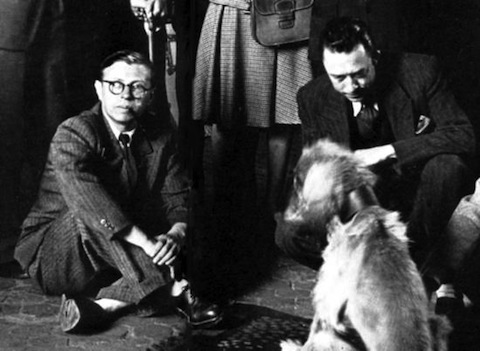
Yes, it is cultural Monday (or is it Philosophical Monday) and I wandered into this delightful storry of J. Edgar Hoover, Jean-Paul Sartre and, who else, but Albert Camus (or is it really Canus).  Of course, anything with J. Edgar in the middle is likely to be both disgusting and crazy, since besides being the epitome of the epithet "PIG", that is what Hoover was.

This, then is a tale, of the neo-existential FBI and the two French philosophers whom J.Edgar sent his agents out to "figure out."

That the FBI had files on Sartre and Camus is, of course, no big shockeroo.  The FBI had files on everybody (long before Mr. Snowden came along with his "big" revelation of big brother).  It is also not unusual that Hoover took a personal interest in these guys.  Mr. Hoover took a personal interest in lots of us..."guys."   In this case, Hoover figured he had to find out if existentialism and absurdism were merely a front for communism.  Then again, in Hoover's paranoid mind, what wasn't a front for communism.  I wonder if he wondered what communism was a front for....

Anyway, what is really interesting is Andy Martin's unique perspective on the whole thing  (If he were alive today, Hoover would also get to the bottom of just who this Andy Martin is and what is he up to).

So curl up in a comfortable chair and enjoy the exciting tale of the G-Men  and the Philosophers.....

The following is from Prospect.


The FBI files on being and nothingness


by  

From 1945 onwards, J Edgar Hoover’s FBI spied on Camus and Sartre. The investigation soon turned into a philosophical inquiry…


I was leafing through some FBI files on French philosophers when a new candidate for occupancy of the populous Grassy Knoll in Dallas leapt out at me. To the massed ranks of the CIA, the Mafia, the KGB, Castro, Hoover, and LBJ, we can now add: Jean-Paul Sartre. FBI and State Department reports of the 1960s had drawn attention to Sartre’s membership of the Fair Play for Cuba Committee, of which Lee Harvey Oswald was also a member. And—prophetically?—Sartre had “dismissed the US as a headless nation.” Naturally I rushed around trying to work out exactly where Sartre might have been on 22nd November 1963. Could he, after all, have been the Second Shooter? Suddenly all the pieces started to fall into place.

But subsequent references in the main Oswald file showed that the FBI, although generally perturbed by the “Leftist tendencies” of Sartre, and his association with Communists, Castro, and Bertrand Russell, were specifically concerned that he was now—in addition to protesting against US involvement in Vietnam—threatening to “take an active part in the French Who Killed Kennedy Committee” (according to an article in the Washington Post of 14th June 1964). The FBI was wedded to the Lone Gunman theory. The emphasis of their interest in Sartre, then, was not on whether he had participated in any conspiracy, but rather that he was a believer in conspiracy theory and “supported the position that Oswald was not the true assassin of President Kennedy.”
The FBI had been keeping an eye on Sartre from as early as 1945. Soon after, they began to investigate his contemporary, Albert Camus. On 7th February, 1946, John Edgar Hoover, director of the FBI, wrote a letter to “Special Agent in Charge” at the New York field office, drawing his attention to one ALBERT CANUS, “reportedly the New York correspondent of Combat [who] has been filing inaccurate reports which are unfavorable to the public interest of this country.” Hoover gave orders “to conduct a preliminary investigation to ascertain his background, activities and affiliations in this country.” One of Hoover’s underlings had the guts to inform the director that “the subject’s true name is ALBERT CAMUS, not ALBERT CANUS” (diplomatically hypothesizing that “Canus” was probably an alias he had cunningly adopted).
The irony that emerges from the FBI files on Camus and Sartre, spanning several decades (and which, still partly redacted, I accessed thanks to the open-sesame of the Freedom of Information Act) is that the G-men, initially so anti-philosophical, find themselves reluctantly philosophizing. They become (in GK Chesterton’s phrase) philosophical policemen.
Hoover needed to know if Existentialism and Absurdism were some kind of front for Communism. To him, everything was potentially a coded re-write of the Communist Manifesto. That was the thing about the Manifesto—it was not manifest: more often it was, as Freud would say, latent. Thus FBI agents were forced to become psychoanalysts and hermeneuts—drawn into what the historian Carlo Ginzburg neatly called the “cynegetic paradigm” (a brotherhood of clue-hunting detectives in which he includes Freud and Sherlock Holmes). Thus we find intelligence agents studying scholarly works and attending lectures.
But the FBI were “philosophical policemen” in a second sense: in tracking Camus and Sartre (surveillance, eavesdropping, wiretapping, theft) they give expression to their own brand of philosophical investigations. In particular, the FBI philosophy files reveal how the agency became so dogmatically anti-conspiratorial.
Sartre had been invited to the US, towards the end of World War Two, as part of a propaganda campaign overseen by the Office of War Information (OWI). In the face of FBI scepticism as to whether the author of Nausea and Being and Nothingness was capable of coming up with decent propaganda on behalf of anyone, Sartre had at least one stout supporter: Archibald Macleish, Under Secretary of State, and assistant director at the OWI. Macleish is now best-known as the author of the classic formulation of the modernist aesthetic: “A poem should not mean/ But be.” He was a poet in Paris in the 1920, and went on to become Librarian of Congress and Professor of Rhetoric at Harvard. But during the war he was a founding figure of the “Research and Analysis Branch” of the Office of Strategic Services—precursor to the CIA, the more international intelligence service (and thus rival to the FBI) that Hoover tried to abort and undermine.
In an interview published in France-Amérique in March 1945, Macleish asked his interviewer “not to forget to inform Sartre, whose talent he loved so much, that he was rejoicing in advance over his visit.” Meanwhile, from the FBI point of view anyone who had been in the Resistance (whether actively—Camus—or more marginally—Sartre) was automatically under suspicion. Especially journalists and philosophers. And even more so when another French writer, based in the US, Geneviève Tabouis, was busily denouncing them as Communists. (Sartre wrote an article denouncing her as a spy for the State Department, something she vigorously denied, even while reporting it back to the State Department.)
Sartre expected to be spied on. But he was never undercover. He valued total transparency. Hence his scorn for the Freudian unconscious and his anticipation and appreciation of the role that visibility plays in celebrity culture. Sartre proved a mystery to the FBI: it was impossible to steal information from him because he was desperate to give it away. Even so, after a quarter century of puzzling over his work, noting his links with Che, Russell, the Black Panthers, and the anti-Vietnam War movement they had to conclude, in their 1970 synopsis of his oeuvre, that, on the one hand, he can be “described as pro-communist” (and “encouraged youth to believe in nothing spiritual”) while at the same time is “also described by some sources as anti-communist.”
Camus, following in Sartre’s footsteps in 1946, was held briefly by immigration owing to Hoover’s stop notice. In contrast to Sartre, Camus proposed an aesthetics of discretion and privacy. Whereas Sartre tended towards a maximization of information, to the point of obscenity, Camus believed that there can be such a thing as too much information.
Camus, like Sartre, had a supporter within the proto-CIA: Justin O’Brien, Professor of French at Columbia, and translator of the journals of André Gide. O’Brien was also chief of the French desk at the Office of Strategic Services during the war, which was tasked with “establishing intelligence networks behind German lines in France.” In the course of the Occupation, he developed a fondness for the work of Eluard, Michaux, Vercors, “the poetic renaissance that marked the occupation,” and Louis Aragon, who was explicitly Communist.
Once the war was over, the two intelligence services, the FBI and the CIA became locked into “a binary praxis of antagonistic reciprocity” (as Sartre would say). In other words, the FBI, specifically Hoover, hated first the OSS and then, after 1947, its avatar, the CIA. But there is more than just a turf war dividing the two agencies. There is a broad philosophical (and, it should be added, aesthetic) divergence.
Hoover’s FBI was deeply suspicious of philosophers, especially foreign ones, virtually philosophobic; but this does not stop the organisation from developing its own brand of philosophical thinking in response to Sartre and Camus—the FBI files on being and nothingness.
The FBI did not read Sartre or Camus in the original French. One of the agents, having stolen some notebooks and diaries (“obtained from the personal effects”) in early 1945, complains that this “material [is] all in French” and translators were drafted in. Then the investigation proper could begin.
The FBI emerge from these files as neo-existentialists in the classic early Sartrian mould. They, like the early Archibald Macleish, take the view that people, not just poetry, “should not mean, but be.” They don’t like meaning—they are on the look-out for it, especially secret coded meanings, but they don’t like it. They certainly subscribe to the “hell is other people” school of thought. And Hoover, in particular, would be greatly relieved if only everyone across the whole of the USA was an angst-ridden, anomic, introverted loner. In short, an Outsider. What they fear and object to is meaning, and finally, the plot—or narrative. They are anti-narrativists.
The FBI echo Sartre’s classic modernist critique of narrative, in his novel Nausea. Hoover’s FBI are quintessential existentialists in refuting teleological narrative—they would rather have contingency and chaos than telos. The FBI found Camus fundamentally their kind of guy: the Camus of the Absurd and the Outsider, according to which the individual will never really make sense of the world, nor hook up, in any kind of long term way, with others.
We are apt to think of the FBI as the great conspiracy theorists. But the reality is quite nuanced: I am tempted to say they are not conspiratorial enough. They resist theory. They don’t really want to believe in plots. Hence their primal attitude, their metaphysics, when it comes to the question, Who Killed Kennedy? Was the assassination of Kennedy a conspiracy? The FBI won’t have it. They were, in their typically neo-existential way, intent on the Oswald lone-wolf story—or non-story. Oswald, in short, is just their kind of guy: a conflicted, anomic, disconnected loner. More Meursault than conspirator.
Narrative, philosophy, and espionage share a common genesis: they arise out a lack of information. Sartre’s expectation of a world of total information would kill them all stone dead. There would be no need of the FBI, novelists, or French philosophers. Existentialism and Absurdism insist on an asymmetry  between being and information. Agent James M. Underhill, who heroically pursued the elusive “Albert Canus,” encapsulated the theory in a resonant phrase:  “The file does not show the final disposition.”
So where was Sartre on 22nd November, 1963? The FBI files have no record of him entering the country in that year. He was probably in Paris, where he was bringing out the second instalment of his autobiography in Les temps modernes. Camus’s alibi is even more secure, since he died in a car-crash in January 1960. But was that a random accident or… a conspiracy?
This essay is based on a lecture given earlier this year at the Maison française, Columbia University, New York, as part of its centenary celebrations