Monday, June 23, 2014

"...SO THAT THE VERMIN WOULD NOT ENTER..."

WHAT SCARES THE RICH IN THEIR DREAMS INTO PRIVATIZING SPACE ITSELF

I really don't have any time today.  I searched for a while for something for Theoretical Monday and along the way ran into this piece about gates, walls, gated communities, race, and class.  I wondered, should I post it.  I read it.  I wondered should I post it.  I thought, I should spend more time thinking about this.  I realized I don't have any more time.  I realized neither do some of the people discussed in the post below from Void Mirror and, what, the American Sociological Association. 

By the way, I picked the title from the midst of a quote below.  Kind of says it all, doesn't it. 


"Gated Communities for Rich and Poor" 

by Zaire Zenit Dinzey-Flores


Sociologist Zaire Zenit Dinzey-Flores discusses how the concentration of class and racial privilege in gated communities takes place alongside the spatial concentration and confinement of the poor. She argues that gates help sort and segregate people, physically and symbolically distinguish communities, and cement inequality.

“You drive to the gate. The community is in the shape of a U. You come in one gate and leave through the other. When you get to the gate, you will have a dial pad. You have to dial my number. Here is the number. Wait for me to answer. I will ask you who you are. You will tell me. Once you talk to me I will push the button to open the gate and let you in. The gate will open. You will be allowed in. You will drive to my house. I will be outside waiting for you.”

Following Ramiro’s careful directions, I entered Extensión Alhambra a subdivision of colorful, concrete, one and two-story single-family homes located in Ponce, Puerto Rico’s second largest city, in the southern part of the island. Extensión Alhambra which looks like a mid-century American suburb, was intended to be an exclusive community for middle- and upper-middle-income families, its name evoking Spain’s famous Moorish castle, the Alhambra. When it was built in the early 1970s, Extensión Alhambra was open to all. But in 1993 residents took advantage of a 1987 law (Ley de Cierre, or “closing law”) that permitted communities to build gates for protection. With that law, many previously open and private middle-class housing subdivisions were gated—part of the vast array of communities worldwide that form neighborhood associations, erecting fences and fortresses, and taking protection into their own hands.

Less than half a mile from Extensión Alhambra is a very different kind of gated community. Here, in a development called Dr. Manuel de la Pila, twenty low-rise multiple-dwelling buildings, totaling 906 units, comprise the largest public housing community in the city of Ponce. Dr. Manuel de la Pila is one of 337 public housing projects built in Puerto Rico as part of the massive post-war U.S. federal public housing push that by the second half of the twentieth century had furnished Puerto Rico with more public housing units than any U.S. city—after New York.

Like Extensión Alhambra, when it was first built Dr. Pila was an open community. But early one November morning in 1994, two years after a private firm had taken over its management, three helicopters carrying national guards and police descended upon the project, officially occupying it. Operation Centurion, popularly known as Mano Dura Contra el Crimen (Strong Arm Against Crime), had dictated that the largest, presumably most dangerous public housing projects should be gated in order to reduce crime. Over the course of four years, nearly a quarter of
Puerto Rico’s 337 public housing developments were “rescued” or “occupied,” leading to arrests of residents, the establishment of police outposts, and the erection of fences to control movement. Dr. Pila became a gated public housing development.

Gates and guards have typically been ways for privileged communities to “defend” themselves, creating secure residential environments. In their quest for security, gates symbolize “withdrawal [from the city]” and they also produce fear, according to
Teresa P. R. Caldeira, professor of city and regional planning at the University of California. Promising to protect residents from crime, as well as from fears of declining property values and loss of prestige and exclusivity, gated communities enable affluent residents to imagine that they can leave the unruly, dangerous spaces of cities behind.
The concentration of class and racial privilege in suburbs, fortressed enclaves, securitized buildings, and private islands takes place alongside the spatial concentration of poverty in ghettos, favelas, and barrios. Residential gates for the rich have also led to the rise of gates for the poor—in favelas in Brazil, South African townships, peripheral urban migrant settlements in China, and even in some public housing developments in the United States. The built environment sorts and segregates people, physically and symbolically distinguishing communities from one another. Whether one is locked inside or kept outside is determined by one’s race, class, and gender. In both kinds of gated communities, controlled access points restrict movement in and out. However, living in gated communities of the rich and poor are vastly different experiences.

The privileged gates of Extensión Alhambra offer a retreat into a secure, idyllic community; newly privatized street and sidewalks are restricted to sanctioned, paying community members, who can decide who is allowed inside. In the impoverished community of Dr. Pila, in contrast, government and private overseers control the movement of residents. So while the gates of Extensión Alhambra permit their affluent residents to exert greater political and social influence over their home turf, in Dr. Pila they have the opposite effect, diminishing residents’ power. In privileged communities, gates lock undesirables out; in poor communities, they lock them in. In both cases, gates are erected to serve the interest of the upper classes, who are primarily white. In other words, gates reproduce inequality, and cement or—to use Michel DeCerteau’s term—“politically freeze” social distinctions of race and class.

In And/Or Out

Ramiro greeted me warmly. To enter the well-appointed homes and interior gardens of Extensión Alhambra, where he lived, I had to find people who would vouch for me and arrange for me to gain entrance. Once inside the gate, I had to justify myself and answer their interrogations about who I knew, what I was doing, and why. I came to understand that the residents of Extensión Alhambra were suspicious or confused about me because of my brown skin, which contrasted with the light-skinned people depicted in the photographs sitting on Ramiro’s living room coffee table. According to the 2000 Census, most residents of these privileged communities racially identified as “Caucásico” (Caucasian) or “Blanco” (white)— “race symbols,” in the words of economist Glen Loury, which are enlisted to help navigate these newly privatized community spaces. Negotiations of membership and belonging occur; outsiders and insiders are sorted and profiled.

The residents of Dr. Pila know that they are the ones affluent Alhambra residents wish to keep out. “The controlled access in Extensión Alhambra allows people from that area to enter,” one woman explained. “They think people from public housing want to go there to rob them. For them, we are society’s scum.” Another Dr. Pila resident agreed: “When they put up that gate in Extensión Alhambra, it was so that the people from public housing would not go there, so that the vermin would not enter.” Residents of both private and public communities told me that a race credential was required for someone to enter community spaces. A resident of a nearby private upper-middle class community that had been unsuccessful in putting up gates said that her whiteness prevented her from entering Dr. Pila: “I would be in a panic,” she said, “because I feel different even physically [as a] a blonde woman!”
Gates separate adjacent neighborhoods, freezing race, class distinctions, and demarcating social distances; they segment identities and mark the “unmarked.” Gates position and remind specific bodies of their rightful place, delineating identities and neighborhood limits, and discouraging movement. They also remind people that public housing is dangerous. Together with media representations of crime, they reinforce the idea that dark young males, in particular, are unemployable, dangerous, and criminal.
Rafa, a dark-skinned, bored young man who lived in Dr. Pila, explained, “You go and ask if they have [any work] and they say they don’t. And then they give the job to the favorites.” Residents of public housing projects often spoke about being turned down for jobs, which they saw as related to their place of residence. Don Ramon, an employer at a job fair organized by the social workers in Dr. Pila, said he was there to offer job opportunities that were typically denied to residents of public housing. Dinora, a resident, described a job interview. When she got there, the supervisor asked her where she was from. “When I told him I was from Dr. Pila,” she said, “his attitude changed to ‘I’ll call you if anything comes up.’ He went from an attitude that the job was for-sure to an attitude, once I said where I lived, of ‘I’ll call you later.’”
The physical and symbolic meaning of the gates were obvious to public housing residents. As one woman told me: “By putting up our gate,” they’re not interested in “protect[ing] our community, or its residents.” What they are doing, she said, is “isolat[ing] public housing from wealthy people. They have no reason to think they’re better than us. We’re all people.” The gates cement physical separation. Public housing residents resent not being able to take their children to trick-or-treat during Halloween in the more privileged areas. Opportunities for engaged contact are practically nonexistent.

Getting Inside The Gates


Getting inside Extensión Alhambra takes careful planning. Ramiro’s screening interrogation gave him decisive control over my entry and presence in the public streets and sidewalks of the community, much like the power he and his neighbors wield to make decisions about who enters their private home spaces. With the Closing Law that allowed private communities to gate themselves in the interest of safety, security technology came to facilitate the control rich people exercise over private spaces. Private guards follow orders through telecoms or telephones; electronically-powered gates allow owners to exert control through remote beepers, security spikes and electric currents, administering entry and exit as they see fit. In private communities, residents and visitors are welcomed into safe havens protected from outside perils. Whether one is welcome depends on who is seeking entry, and who is doing the credentialing. This credentialing is done by residents; in public housing, in contrast, the government makes such decisions, seizing control from residents. The gate in Extensión Alhambra “is private,” a resident of Dr. Pila told me: “here it is controlled.” When a temporary fence was first built, residents of Dr. Pila thought their own gate would function similarly to that of Extensión Alhambra, with residents controlling entry either through remote access or granting approval to the guard. But in time, their ability to control entry diminished. Rather than work in the service of residents, a police sentry with a one-way mirror came to control residents, federally inspired zero-tolerance regulations demanded that residents be screened, and the government appointed social workers to organize community activities. Residents, not visitors, came under scrutiny. As one woman explained: “I have been stopped, and asked what building I am going to, what am I going to do. They see the face of a crook in me.”
To enter the gated caserío (public housing) was, as one resident said, to lose the capacity to “move freely,” and instead to be controlled, isolated, and actively barred from freedom of contact both inside and outside. Just as residents’ movements were restricted, so were mine. Upon entering Dr. Pila, visitors and residents are signaled to stay out or wait by a sign in front of the guardhouse that reads: “Residential zone with controlled access. Any resident or visitor without identification must identify himself at the entry. Visiting cars are subject to search. Housing Administration.” The sign is a reminder that entering public housing makes one suspect.
As they block access to outsiders and turn public spaces—the street, the sidewalks—into private community property, these gates expand the power of privileged insiders over urban space and development. The gates that lock some in and others out hand control over the city to the privileged, giving the poor little recourse, little control, and less and less power.

Cemented Distinctions


Puerto Rico illustrates the ways social inequalities are physically and symbolically articulated in residential urban built environments throughout the world, underscoring differences in power and agency. Throughout the world, security policies have become a popular way to address feelings of insecurity in urban areas. Gates in residential areas and public spaces, security guards, security cameras, and metal detectors sort and divide city residents. In China, for example, new urban migrants are being locked in enclaves in the city’s periphery. There, as in Latin America and the rest of the developing world, as well as in the United States, grave social inequalities are spatialized in residential neighborhoods, new technologies delimit insiders and outsiders, and the rich exert power over the poor.
Community gates signal and reconstitute deep social inequalities, both imagined and real. For the rich, the public is increasingly privatized; for the poor, the private sphere is increasingly subject to public surveillance. For both, social activities are limited to the family unit and to intimate and exclusive spaces. Those who can afford to do so “bowl alone” and live alone. Those of lesser means are subjected to monitoring, control, and surveillance in their places of residence. This bunker mentality diminishes the spontaneity of public life.
Although the gates of Puerto Rico’s public housing are not in operation today, the fences are still there. The police no longer patrol the grounds, and only a boarded-up guardhouse remains. Entry and exit is no longer formally monitored, but the remains of the public gates continue to interfere with everyday routines, segregating and re-inscribing social inequality. Meanwhile, the gates around the private enclaves continue to be fortified by technology. The gates of the poor and the rich face each other, turning residents away from the city and its salutary social promises.

Recommended Resources

Atkinson, Rowland and Sarah Blandy. Gated Communities: International Perspectives (Routledge, 2006). Provides a wide array of gated community case studies.
Blakely, Edward J. and Mary Gayle Snyder. Fortress America: Gated Communities in the United States (Brookings Institution Press, 1999). The first book-length work on gated communities, it provides an account of how gated communities emerged in the United States.
Caldeira, Theresa P. R. City of Walls: Crime, Segregation, and Citizenship in São Paulo (University of California Press, 2000). Examines gated communities and their relationship to crime and class segregation in Brazil.
Costa Vargas, João. “When a Favela Dared to Become a Gated Condominium: The Politics of Race and Urban Space in Rio de Janeiro,” Latin American Perspectives (2006), 33(4): 49–81. One of the few examinations of gates in poor communities, it explores the relationship of gates to urban poverty and race in Brazil.
Low, Setha. Behind the Gates: Life, Security, and the Pursuit of Happiness in Fortress America (Routledge, 2003). Provides a historical background of gated communities and uses ethnography to see how privilege is contained behind gates.
Safa, Helen I. The Urban Poor of Puerto Rico: A Study in Development and Inequality (Rinehart and Winston, 1974). The first and only book-length study examining life in Puerto Rico’s public housing.

>>>
Zaire Zenit Dinzey-Flores is in the sociology and Latino & Hispanic Caribbean studies departments at Rutgers University. She is the author of Locked In, Locked Out: Gated Communities in a Puerto Rican City, from which this article was adapted.  

source: American Sociological Association 

Friday, June 20, 2014

AT THE CORNER WHERE THE BULLET MEETS THE BONE

Milwaukee, Division and Ashland. Six floors below the ground.
The rupture begins here...

It is Prison Friday at Scission and this isn't exactly a prison story, but then again this is exactly a prison story.  It is the story of the bigger prison and the smaller prison.  It is not exactly a story about resistance, but then again this is exactly a story about resistance.  It is a story about resistance that is not on its own going to smash the State and free the multitude, but it is a story about a resistance that helps keep up the spirit, or arm the spirit is perhaps better, so that we and our friends can keep the faith, as it were.  This is a story that could have been on Cultural Monday, but then there is no more Cultural Monday, and today is Friday.  This is a story about America, the one we used to spell with a K or even a KKK, and is also about tomorrow, maybe, and some other America, better yet, some other world.  This is a story of racism and white supremacy, of cops and bullets, of blood and guts, and remembrances past and promises future.  This is just a short little thang from the blog known as Prison Culture where sometimes one can catch a glimpse of the world, of scission, of the place where white supremacy and global capital meet, and where a sharp knife slashes both and where the tear turns to a rupture and the rupture to a revolution.  If you know what I mean.

STANDING ON A SOAPBOX, CALLING OUT THE COPS...


I stood on a soapbox Saturday. I mean a real one.
Me on a soapbox (photo by Sarah Jane Rhee, 6/7/14)
On an overcast afternoon, on a concrete island at the intersection of Ashland, Milwaukee and Division, I joined a couple dozen people (mostly young) who were reading/performing poetry in opposition to state violence.
I was invited to say a few words, so I did. I shared words written by Langston Hughes and AI. I added a few of my own too.
On Friday, Damo was laid to rest. I planned to attend the funeral but in the end I was unable due to a previous commitment. It’s just as well. I hate funerals. I despise them especially when the person being buried is in his early 20s.
So I stood on a real soapbox and in memory of Damo & others who are victims of state violence, I shared two poems. Here are a few lines from one by Langston Hughes:
Three kicks between the legs
That kill the kids
I’d make tomorrow.
I’ll admit to actively suppressing any thoughts of a young man being tased (twice) and hitting his head so hard that he was basically brain dead when he arrived at the hospital. How does this happen? Then I remember the disposability and un-humanness of black and brown people. I know how this happens. I am a witness but I’d rather not be.
Ethan spoke before me. No, that’s not actually true, Ethan bled before me. I watched with others transfixed by his words and his pain. I hoped that it was catharsis towards healing. But I don’t know how young black men can heal in the midst of continuing, continual, unrelenting violence. Is this possible?
The title of the gathering organized by members of the Chicago Revolutionary Poets Brigade was‘No Knock’ An Artistic Speak-Out Against the ‘American Police State.’ The title is inspired by Gil Scott Heron’s poem “No Knock.”
No knocked on my brother Fred Hampton
Bullet holes all over the place
No knocked on my brother Michael Harris
And jammed a shotgun against his skull
It is as it ever was. No knocked on Damo who is now six feet under ground.
Passersby stopped to listen as various people read poems about Guantanamo, police violence, prisons, surveillance, and more. Audre was right: “Poetry is the way we help give name to the nameless so it can be thought.” There is magic in hearing voices speaking out for justice over the din of a bustling city. You had to be there to understand what I mean. Gathering as a collective to recite poetry can’t end state violence but it does keep our spirits up so that we can demand and fight for more justice. It does help to “give name to the nameless so that it can be thought.” And now more than ever we need the words and we need to be able to think through that which cannot be thought. These are revolutionary acts in our time.
Over the next few weeks, I will be working with others to strategize and organize around the epidemic of police violence experienced by our young people of color in Chicago. I don’t know what will come of our discussions but I am sure that nothing will change unless we change it.
I stood on a soapbox Saturday. I mean a real one. I read some poems including “Endangered Species” by AI.
At some point, we will meet
at the tip of the bullet,
the blade, or the whip
as it draws blood,
but only one of us will change,
only one of us will slip
past the captain and crew of this ship
and the other submit to the chains
of a nation
that delivered rhetoric
in exchange for its promises.
I hope that you find your own soap box. I mean a real one and read some poems, calling out the cops…


Thursday, June 19, 2014

CAMEROON: ONE FRONT IN THE STRUGGLE AGAINST GLOBAL CAPITAL'S WAR ON THE EARTH


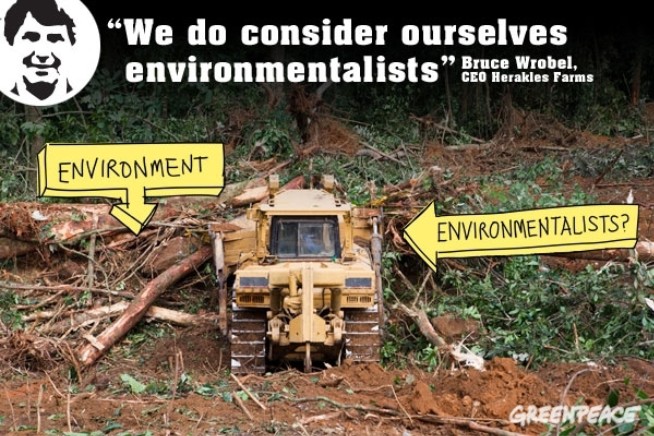
In Cameroon, Herakles Farms, a US company, has been chopping down miles of dense forest. Last February, according to Greenpeace,  Herakles began clear-cutting trees with an illegal permit in hand. The permit also allowed the illicit timber to be sold on international markets. And this is all happening with the complicity of the Cameroonian Ministry of Forests and the full knowledge of the European Union (EU). 

Local activists have succeeded at times in their fight against Herakles.  They have reduced the amount of land Herakles can legally steal.  However, Herakles Farms is still  engaged in the development of a controversial oil palm plantation in the South-West Region of Cameroon that faces strong opposition from affected communities.   The company's so-called sustainable project will destroy the ecosystem of tens of thousands hectares of ancient rainforest and replace it with monoculture oil palm plantations. 


The company isn't stupid.  According to activists they have tried to use rice and fish to bribe and seduce the indigenous people of Mundemba, Toko and Nguti sub-divisions in the Southwest Region of Cameroon in order to grab their ancestral lands for 99 years.  An open letter from one environmental activist, Andrew M. Edimo, Chairperson Natural Resources and Development Committee Oroko Cultural Association,to Bruce Wrobel, CEO, of Herakles Farms states:

Africans do not need handouts.  Handouts have not worked in the past and will not work today. How long will the tens of thousands of people dislocated, dehumanized and enslaved by your so-called sustainable development project live off your 11 tons of rice and 10 tons of fish?  Are they going to be eating the rice and fish for 99 years as they will have no land to farm after you have seized and destroyed their only treasure and hope for a livelihood...


You have forgotten to tell the world that you are the CEO of a venture capital company that invests in places where the overhead expenditures are low and your profit margin is high. A country like Uganda where large quantities of crude oil have been discovered and many companies are rushing in is certainly a profitable destination for you to generate and sell electricity to those who will be investing in crude oil as well as the locals, making millions of dollars annually and paying little or nothing to the indigenous people of the area.


...in the convention your company signed with the Government of the Republic of Cameroon, your company has been given the absolute rights to logging, water and clay and if any mineral is discovered in the concession area, be it oil, gold, diamond, and so on, the government of Cameroon will only be able to explore and exploit it with your approval.  After all, that very government also gave you the right not to allow any indigenous person to trespass in the concession area as well as the right to arrest and persecute trespassers....


...We know you and your company are above all laws in Cameroon, that is  why an  injunction order was issued by  a court in Mundemba  instructing your operations in Ndian division to stop  until an agreement is reached with regards the  future of the livelihood of  the people whose land you want to acquire and you defiled the injunction. Instead you worked through your Cameroonian surrogates to make sure the judge who had passed the judgment was transferred. In America, not even the President can disrespect a court judgment, but in Cameroon an American company disrespects the laws of the land without any consequences...

Reading through the website of Herakles Farms, I discovered that you are telling the world how you are helping to develop the continent of Africa by building hydroelectric power stations in Uganda, bringing internet cables to the continent of Africa, establishing palm plantations in Ghana and grabbing land in Cameroon. I learned, too, that your NGO, All For Africa, has a program, Palm oil Out of Poverty (POP). I think the acronym P.O.P. should stand for Palm oil On to Poverty because razing the forest for your proposed plantation and employing just 7000 – 8000 out of the 58,000 people who depend on that forest for their livelihoods, food, medicine and wood for fuel and building, will lead to increased poverty and early deaths.

As per your own projections, you will be investing about seven hundred million dollars in your Cameroon palm oil project and will make an annual profit of seventy million ...

As such you will pay off the project in 10 years and for 89 years remaining; your children’s generation and the generation after them will make seventy million dollars yearly, while generation after generation of the 58,000 indigenous people whose land you’ve grabbed will continue to live in abject poverty...


You are dealing with a new generation of Africans who always question what they hear or see and have no reason to believe that others know best. We are able to gather and share information on what your company says and does. We are not fooled by gifts of fish and rice. We are fully capable of deciding for ourselves what sort of development we want for our region .....


Greenpeace research has revealed recently that Herakles Farms, using a front company, colluded with Cameroon's Minister of Forests to unlawfully obtain a logging permit allowing it to clear cut 2,500 hectares of forest and export valuable species of timber, while paying 17 times fewer royalties to local communities than average.   "This was a deliberate attempt to hide an illegal decision taken in favor of Herakles Farms" explained Irene Wabiwa, Head of Greenpeace Africa's Forest Campaign.  A Greenpeace press release says, 

It appears the Cameroonian authorities and Herakles Farms are collaborating to make illegal logging happen at the expense of Cameroon's treasury, the Nguti local council and local communities which are supposed to receive a forestry royalty. The illegal granting of Uniprovince's logging permit without an auction will cost the government: Uniprovince will pay 17 times less tax than the average paid by logging companies with similar permits in 2014. Yet, Herakles farms will exploit greater volumes of timber than other companies since it will raze the forest to make way for its palm plantation.

According to Irene Wabiwa, "Contrary to the declarations made by Herakles Farms, the company has no intention to develop Cameroon. In reality, Cameroon is losing enormous revenue because of the illegalities and corruption surrounding the company's activities."

By signing the Voluntary Partnership Agreement (VPA) with the European Union, Cameroon committed to fight illegal logging and illicit commerce of timber. Despite efforts made by the two parties to implement the VPA, the granting of Uniprovince's illegal permit calls into question Cameroon's will to respect the agreement and the credibility of the initiative as a whole.


Activists have faced repressive measures, arrests, and intimidation from the government, from the State, from Global Capital.


International agreements between states and the like are not going to stop global capital from exploiting indigenous people and others or wreaking havoc on the Earth.  NGOS and nation states aren't going to do that either.  There is only one entity on the planet that can in the end defeat global capital, and that is the multitude itself, the working people, the peasants, the indigenous.  The battle in the Cameroon is only one small part of a large war...a war that WE cannot afford to lose.

The following is from Farmlandsgrab.org


Land grabber's paradise: Cameroonian environmentalist faces trial, while charges against his attackers mysteriously "disappear"


GRAIN | Oakland Institute | World Rainforest Movement

Press release
18 June 2014

Arrested, assaulted and then charged with libel: this is just some of what land and environmental activist Nasako Besingi has faced while helping communities from the southwest region of Cameroon stop US company Herakles Farms (HF) from grabbing their lands for the development of a 20,000 hectare palm oil plantation.  

On June 19, 2014, Besingi and four other opponents of the HF project will be in court, accused by the government of “participating in the organisation and holding of an undeclared public meeting”. The five were arrested and charged while distributing t-shirts critical of Herakles Farms in November 2012.

Nasako Besingi was travelling to a village to talk about Herakles' plans when he was ambushed by a group of men. (Screenshot: France24)
Besingi will face separate charges of defamation on June 24, brought against him by the US firm. Herakles Farms alleges that Besingi published "false news via the internet” when he sent out a private email detailing how he was ambushed in August 2012 by four men employed by Herakles as he was travelling on motorbike to a community affected by the company's plantations.

Besingi filed a complaint against his assailants after the incident. But the public prosecutor, who is pursuing the two cases against Besingi, has yet to bring charges against the four men who attacked him. Besingi was recently told by the state council of the legal department, Ndian Division, that the file had "disappeared".

"The Government of Cameroon is sending a message that the lands of its people are up for sale to foreign companies while anyone who resists will be punished," says Ange David Baimey of GRAIN.
Both court cases have been adjourned multiple times, causing enormous stress on Besingi and the other activists and their families, and adding to the cost of legal fees.

"Despite its initial plans of taking over 73,000 ha of the world’s second largest rainforest for its oil palm plantation having been reduced to some 20,000 ha, Herakles faces strong opposition on the ground. Resorting to intimidating local activists through frivolous law suits adds to their long list of wrongdoings such as illegal logging, corruption, and other questionable tactics used by the New York-based firm to make the project look sustainable and beneficial to Cameroon," says Frédéric Mousseau of the Oakland Institute.

"Herakles and the Government of Cameroon are hoping that people will tire of hearing about their intimidation of activists and communities," says Besingi. "International attention on this company and the government's attacks against its people is badly needed. Now."


GRAIN, the Oakland Institute and the World Rainforest Movement call on Herakles and the Cameroonian government to stop all forms of intimidation against critics of the Herakles Farms land deal and drop all charges against Nasako Besingi and his fellow activists. The government and the company should instead bring those who violently attacked Besingi and his fellow activists to court and engage in good faith with local communities seeking to defend their lands.
Both court cases will take place at the Court of First Instance, Mundemba, Ndian Division.

Contacts

Nasako Besingi, Struggle to Economize Future Environment (SEFE)
+23775136000
nasako.bondoko@gmail.com
Frederic Mousseau, Oakland Institute (FR, EN)
+1510 512 5458
fmousseau@oaklandinstitute.org
- See more at: http://farmlandgrab.org/post/view/23627-land-grabber-s-paradise-cameroonian-environmentalist-faces-trial#sthash.HZjn78Me.dpuf

Tuesday, June 17, 2014

ROMA YOUTH LYNCHED IN FRANCE: NOT AN ABERRATION, JUST RACIST POLICY CARRIED TO ITS NATURAL CONCLUSION

WELL, NOT SO MUCH


Some like to pretend that a lynching is an aberration that just happens...the result of some bad people or some bad thinking.  You and I know there is a lot more to it then that.

Take a look at what is described as a "vigilante" attack against a Roma youth left for dead in France last week.  A sixteen year old kid was found unconscious in a supermarket grocery cart last Friday after being beaten by a dozen residents just north of Paris. The youth, named only as Darius, suffered multiple head injuries and has been placed in an artificial coma by doctors.

The attackers claimed he had broken into an apartment.  IOL News reports:


Officials (said) the group had come looking for the youth earlier that day at the abandoned house opposite the housing project, where he was living with his family.
They took him away and locked him a basement where he was accused of breaking into an apartment, and then was beaten, they said.

The Guardian adds,

A police source suggested there were four kidnappers, but a Romanian garage owner opposite the Roma camp said his wife had warned him a group of a dozen hooded youngsters were causing trouble, according to Le Monde. A few hours later, Darius's mother received a call made from her son's mobile telephone allegedly demanding a €15,000 (£12,000) ransom for his safe return....


Out comes the sympathetic French President Francois Hollande who called the attack "an offense against the founding principles of our country."  Of course, Holland failed to mention the outrageous, racist policies his government has directed against the Roma, and the propaganda of fear and hate it has spewed forth.

Prime Minister Manuel Valls, who took a hard line on the Roma in his previous role as interior minister, also condemned the attack.  More to the point, he suggested to vigilantes to let the police deal with the Roma.

Well, the authorities have been dealing with the Roma, thank you...in their own ways.

The Romeurope Association said the youth's lynching last week was "the terrifying consequence of years of ineffective public policy and remarks by politicians, officials and journalists and media outlets that maintain and seek to harness this unhealthy [social] climate."

From the Guardian:


In February the case against a 40-year-old man accused of throwing a mixture of bleach and cleaning fluid at Roma living near the Place de la République in central Paris was dismissed by a judge for lack of evidence.

In May 2013 several Gypsy families were attacked at a campsite in the north of France, and in October 2012 locals drove a group of Roma out of an improvised encampment and burned everything that remained. Local people had warned police they would be taking action against the 35 Roma.

Last year the EU warned France it could face sanctions over the treatment of its Roma community after Valls, who was then interior minister, suggested that most should be deported and France was "not here to welcome these populations".


About 20,000 Roma families were expelled from their makeshift homes in 2013, most of them in the summer, according to Amnesty International. A new round of expulsions is expected to begin shortly, with a major Roma camp in the southern city of Marseille being dismantled on Wednesday, Amnesty said.


During the elections in Paris a member of the French National Front suggested the best way to deal with the country's Roma population was to "concentrate" them in "camps"


SOS Racism said the attack was caused by an alarming change in attitudes towards Roma, which it added was "the clear result of the disgusting tensions into which our citizens have been plunged".


The European Grassroots Antiracist Movement (Egam) president, Benjamin Abtan, said: "There are racist insults and attacks against the Roma that are being used with increasing frequency. We are waiting for a radical change in the way this is being addressed and an extremely clear condemnation of the violence."

Will Freeman, writing at Think Progress points out,


Frequently, nationalist politicians from Europe’s right wing fringe have echoed popular anti-Roma sentiments in order to gain political clout. The arrival of thousands of Roma immigrants from Eastern Europe since 2010 has led some French to stigmatize the Roma as unwanted intruders and blame their make-shift encampments for a recent spike in crime. Politicians play on these fears and amplify xenophobia by vocally contributing to negative stereotypes about the Roma.

Notable among far-right European parties for its fiercely anti-Roma rhetoric is France’s National Front. Led by Marine Le Pen, daughter of controversial French right winger Jean-Marie Le Pen, the National Frontswept France’s elections last month to choose new representatives for the European Parliament, the governing body of the E.U. While formerly marginal right wing parties racked up votes across the continent, the National Front’s success in France was unprecedented allowing the party to come in in first place. The party that once compared Muslim prayer to the Nazi occupation of France is unsurprisingly totally willing to stir up animosity against the Roma whenever they can. In March, a National Front candidate running for mayor in Paris said he would “concentrate” the Roma in “camps,” and described them as “an invasion of lepers.” The Roma suffered losses second only to Jews during the holocaust, with the Nazi genocide claiming as much as 25 percent of their population during the holocaust.

Anti-Roma sentiment isn’t limited to the far-right parties only starting to gain influence: it’s unfortunately widespread throughout French politics. Former conservative president Nicolas Sarkozy gained notoriety among the Roma for forcibly clearing their settlements and deporting thousands. While Hollande promised not to evict any of the Roma without a plan for their relocation on the campaign trail, deportations have actually ramped up since his socialist party took office in 2012, with 20,000 evictions occurring in 2013 alone.

French Interior Minister Manuel Valls has also publicly called for the forced deportation of the majority of Roma people living in France, claiming “there is no other solution.” A memo calling on Paris police to “systematically evict” the city’s Roma population that leaked inApril suggests Valls’ orders are being followed.

Lynchings don't just happen. 


The following is from Amnesty International.


France: Forced evictions add to climate of fear amid alleged hate crimes

The ongoing forced evictions of minority and migrant communities around France are inflammatory and further violate the human rights of the affected communities.


The apparent lynching of a Roma teenager in a Paris suburb that left him in a coma is just one of several recent alleged hate crimes against minorities that demand thorough investigations and not just condemnation by the French authorities, Amnesty International warned.

Instead, the authorities have been focusing their resources on carrying out forced evictions that crack down on Roma and other minority communities, as well as migrants, refugees and asylum-seekers. 

“By failing to bat an eyelid in the face of alleged hate crimes, the French authorities are incubating a climate of fear that will spawn more such vicious attacks. All those responsible must face thorough investigations and prosecutions that take into account any discriminatory motive behind the assaults,” said Jezerca Tigani, Deputy Director for Europe and Central Asia at Amnesty International. 

“In this context, the ongoing forced evictions of minority and migrant communities around France are inflammatory and further violate the human rights of the affected communities. Roma and other minorities have a right to protection from discrimination, not additional targeting by the authorities.”
Vicious attacks on minorities
According to media reports, a 16-year-old Roma boy living in a squatted building in Pierrefitte-sur-Seine (outside Paris) was reportedly kidnapped, severely injured and left in a coma late last week by around a dozen people who suspected him of burglary. Police reportedly found him unconscious and badly beaten in a trolley outside a supermarket on Friday 13 June. 

The previous night, 12 June, a 26-year-old man in the northern port town of Calais allegedly shot two migrants from Sudan and Eritrea. The Sudanese man was hospitalized for his injuries, while the suspect was reportedly arrested on 15 June. 

Amnesty International has not been able to verify whether the victims in these two incidents were targeted mainly or partially because of their minority background. But the organization has researched past violence and threats against minority communities in France and found that while the French Criminal Code treats a discriminatory motive as an “aggravating circumstance” and provides for increased penalties as a response to hate crimes, investigations have lacked specific procedures aimed at tackling discriminatory violence. 

“Under international law, the French authorities have an obligation not only to pursue the suspected perpetrators of an alleged hate crime, but also to ensure that the investigation and prosecution uncover and account for the discriminatory nature of the crime,” said Jezerca Tigani. 
Forced evictions

Besides facing an ongoing threat of discriminatory violence, Roma and migrants continue to be forcibly evicted by French authorities in violation of international and domestic safeguards. 

A 200-strong Roma community in Bobigny, near Paris, and another with 400 people in La Parette, Marseille, are at risk of being evicted in the coming days. Neither community has been thoroughly consulted or offered any alternative housing. 

Migrants, refugees and asylum seekers are also at risk of such forced evictions. On 28 May 2014, French authorities forcibly evicted an estimated 700 migrants and asylum-seekers from makeshift camps in Calais in response to an outbreak of scabies. 

“Whether faced with a public health scare or alleged hate crimes, instead of resolving the issue at hand, the French authorities seem to resort to forced evictions as a backup plan. This is a dangerous and unlawful response that will only exacerbate the underlying problems and make hundreds of people homeless in the process,” said Jezerca Tigani.