Tuesday, April 29, 2014

DONALD STERLING, WHITE SUPREMACY, AND THE FORTY MILLION DOLLAR SLAVE

HMMM....


Hey, don't get me wrong, I was thrilled, ecstatic even when I heard the news that  NBA Commissioner Adam Silver dropped the hammer on the white supremacist known as Donald Sterling.   The owner of the NBA Clippers has been banned for life from associating with the Clippers and the NBA, and fined the maximum of $2.5 million. In addition, commissioner Adam Silver said he has asked the Board of Governors to force a sale of the Clippers.  Silver has only been on the job for a few months.

Good!

Should have been done long ago (and why, in the name of God, was the NAACP actually getting ready to give this guy an award).

You do wonder where everyone has been looking until now.  We're talking about a guy who  has been sued twice for housing discrimination.  Back in 2009 Sterling   agreed to pay a record $2.725 million to settle allegations that he discriminated against African Americans, Hispanics and families with children at scores of apartment buildings he owns in and around Los Angeles.

We should also recall that  according to then-GM Paul Phipps, during an airport meeting with Rollie Massimino—a potential candidate to replace the fired Paul Silas as head coach—Donald Sterling asked the Villanova coach: "I wanna know why you think you can coach these niggers."   Massimino told Phipps he began screaming at Sterling and swore he’d rather die than become coach of the Clippers.

It goes on.  It went on.  ESPN, The Magazine did a little piece on Sterling a while back. Here are a few of the highlights as noted on Deadspin:


"JUST EVICT THE BITCH." It was 2002, and Donald Sterling was talking to Sumner Davenport, one of his four top property supervisors, about a tenant at the Ardmore Apartments. Already the largest landowner in Beverly Hills, Sterling had recently acquired the Ardmore as part of his move to extend his real estate empire eastward toward Koreatown and downtown LA. As he did, Sterling "wanted tenants that fit his image," according to testimony Davenport gave in a discrimination lawsuit brought against Sterling in 2003 by 19 tenants and the nonprofit Housing Rights Center.
...
Cultivating his image, Davenport said, meant no blacks, no Mexican-Americans, no children (whom Sterling called "brats") and no government-housing-subsidy recipients as tenants. So according to the testimony of tenants, Sterling employees made life difficult for residents in some of his new buildings. They refused rent checks, then accused renters of nonpayment. They refused to do repairs for black tenants and harassed them with surprise inspections, threatening residents with eviction for alleged violations of building rules.
...
When Sterling first bought the Ardmore, he remarked on its odor to Davenport. "That's because of all the blacks in this building, they smell, they're not clean," he said, according to Davenport's testimony. "And it's because of all of the Mexicans that just sit around and smoke and drink all day."He added: "So we have to get them out of here." Shortly after, construction work caused a serious leak at the complex. When Davenport surveyed the damage, she found an elderly woman, Kandynce Jones, wading through several inches of water in Apartment 121. Jones was paralyzed on the right side and legally blind. She took medication for high blood pressure and to thin a clot in her leg. Still, she was remarkably cheerful, showing Davenport pictures of her children, even as some of her belongings floated around her.
...
Davenport reported what she saw to Sterling, and according to her testimony, he asked: "Is she one of those black people that stink?" When Davenport told Sterling that Jones wanted to be reimbursed for the water damage and compensated for her ruined property, he replied: "I am not going to do that. Just evict the bitch."
Repairs never came. The shower stopped working, and the toilet wouldn't flush; Jones needed to use a plunger and disposed of waste tissue in bags. Kandynce Jones departed the home she loved but that caused her so much grief when she passed away, on July 21, 2003, at age 67.
He wasn't just horrible with his tenants. He demeaned women, too.
But it's the people who work for Sterling and live in his buildings who say they bear the worst of his unconventional behavior. For years he has run semianonymous ads (crude design jobs he reportedly mocks up himself) seeking "hostesses" for Clippers events and his private parties. In a Times ad last summer, Sterling's company solicited "attractive females" to bring a résumé and photo to his address, where employees reviewed their looks. Some of the women who have gone through this process found it humiliating. "Working for Donald Sterling was the most demoralizing, dehumanizing experience of my life," says a hostess from the 1990s who says she helped set up "cattle calls" to find other women to work the job. "He asked me for seminude photos and made it clear he wanted more. He is smart and clever but manipulative. When I didn't give him what he wanted, he looked at me with distaste. His smile was so empty."
In 1996, a former employee named Christine Jaksy sued Sterling for sexual harassment. The two sides reached a confidential settlement, and Jaksy, now an artist in Chicago, says, "The matter has been resolved." But The Magazine has obtained records of that case, and according to testimony Jaksy gave under oath, Sterling touched her in ways that made her uncomfortable and asked her to visit friends of his for sex. Sterling also repeatedly ordered her to find massage therapists to service him sexually, telling her, "I want someone who will, you know, let me put it in or who [will] suck on it."
...
Sterling's testimony in another case, this one involving former associate Alexandra Castro, underscores his aggressiveness with women. When Castro, whom Sterling met in Las Vegas at Al Davis' birthday party over Fourth of July weekend in 1999, visited his Beverly Hills office, Sterling later stated under oath that she brought a lab report proving she was HIV-negative, freeing him to continue having unprotected sex with his wife. "The woman wanted sex everywhere," Sterling said. "In the alley, in her car, in the elevator, in the upstairs seventh floor, in the bathroom." And he paid her for it. "Everytime she provided sex she got $500," he testified in 2003. "At the end of every week or at the end of two weeks, we would figure [it] out, and I would, perhaps, pay her then."
"When you pay a woman for sex, you are not together with her," he further testified. "You're paying her for a few moments to use her body for sex. Is it clear? Is it clear?"
Sterling isn't a total racist, to be sure. He has a fine appreciation for Asian culture, for one thing.
"He would tell me that I needed to learn the ‘Asian way' from his younger girls because they knew how to please him," Davenport testified in 2004. Davenport also stated: "If I made a mistake, I needed to stand at my desk and bow my head and say, ‘I'm sorry, Mr. Sterling. I'm sorry I disappointed you. I'll try to do better.' "
Sterling's preference for Asians extended to the people he wanted in his buildings. "I like Korean employees and I like Korean tenants," he told Dean Segal, chief engineer at a Sterling property called the Mark Wilshire Tower Apartments, according to testimony Segal gave in the Housing Rights Center case. And Davenport testified that Sterling told her, "I don't have to spend any more money on them, they will take whatever conditions I give them and still pay the rent … so I'm going to keep buying in Koreatown."
But Mexican culture? Certainly not.
Raymond Henson, head of security at the building, who was standing outside the room, heard what happened next. Sterling, according to Henson's 2004 sworn statement, once again expressed his distaste for Mexicans as tenants, saying, "I don't like Mexican men because they smoke, drink and just hang around the house."


Again, why were we still dealing with this guy as late as yesterday?

I'd suggest a glance at the book Forty Million Dollar Slaves by William C. Rhoden.  While the book wasn't as good as I hoped it would be, its author as written on Sports in Black and White effectively:


... continually compares the sports world to the plantation systems of the 19th century, asserting that white owners remain in control of their black “slaves” and derive profit from their labor.

John Garrison Marks adds on the Rice website:


 In the book, Rhoden argues that from the time sports were introduced to plantations in the antebellum South through the present, black athletes have been exploited and denied a place within the power structure of American athletics.  Whenever black athletes are perceived to have gained too much power or to pose a threat to white cultural values, the rules are changed to detriment of blacks.  In essence, the rules of modern athletics are rigged against black athletes to ensure that they are barred from positions of power.

Although basketball and the NBA are steeped in black culture, and while 80% of  NBA players are African-American, the league is no different in some ways than any other professional sports league.


As Jerod Mustaf writes at Sportsblog.com,


 While the NBA is the most diverse professional sports league in the world, the culture of NBA ownership is relatively intact. The fact remains that in 68 years, there is still only one majority-minority owner in the NBA and he(MJ) was only able to purchase from another minority during a 'fire sale'. The question for the owners who have been largely silent on the Sterling matter, is whether they are also part of the culture often mentioned on the Sterling recordings, and is this the investigation that Adam Silver was referring that he would (did?) initiate.  

Josh Levin at Slate makes a direct connection to Sterling and writes:

Elgin Baylor, the Clippers’ longtime general manager, laid out Sterling’s plantation mindset in a 2009 employment discrimination lawsuit. Baylor, an African-American,accused Sterling of saying he “wanted the Clippers team to be composed of ‘poor black boys from the South’ and a white head coach.” (In the years hence, Sterling did bring in Doc Rivers to coach the team, so I guess that’s some kind of progress.) Baylor also alleged that Sterling told Clippers draft pick Danny Manning, in the presence of David Stern, that he was “offering a lot of money for a poor black kid.” 


Rhoden, by the way, does not exempt the vast majority of players, African American sports figures, from criticism.  Where have they been he asks?  How have they become so divorced from their own communities?  Rhoden answers the question in an interesting manner:


"Though integration was a major pivot in the history of the black athlete, it was not for the positive reasons we so often hear about. Integration fixed in place myriad problems: a destructive power dynamic between black talent and white ownership; a chronic psychological burden for black athletes, who had to constantly prove their worth; disconnection of the athlete from his or her community; and the emergence of the apolitical black athlete, who had to be careful what he or she said or stood for, so as not to offend white paymasters. At the same time it destroyed an autonomous zone of black industry, practically eliminating every black person involved in sports -- coaches, owners, trainers, accountants, lawyers, secretaries and so on -- except the precious on-field talent."
I will conclude this with a bit from the site US Slave (citing Sports Illustrated as a source):

Rhoden concludes his mostly bleak but profoundly educational survey with a manifesto. "Winning means ownership: owning teams, owning networks, owning the means of communication, and owning our collective image," he writes. He also proposes the creation of "an association of black professional athletes [that] would galvanize the power of a rich past and a prosperous present and figure out a plan for the future." It remains to be seen how many $40 million slaves will so rise, even in semi-revolt.

The following is from Racism Review.


Donald Sterling is “a Racist”: Feel Better Now?


On April 25th, 2014, TMZ released an audio recording of Donald Sterling, owner of the Los Angeles Clippers chiding his girlfriend for posting photos of herself with Magic Johnson on “The Instagram.” Pleading with her that she can spend her whole life with black people as long as it’s in private and she doesn’t bring them to his game, his tirade sounds like something from another, earlier, less enlightened period of U.S. history. The Internet lit up with calls for Sterling’s head: Clippers players should go on strike and we should boycott the NBA. Prominent musicians and artists spoke out against him and the Los Angeles branch of the NAACP pulled the Lifetime Achievement Award he was slated to receive. Even President Obama, who has been conspicuously silent on issues of race commented on the issue.
Almost all of the commentary has treated Donald Sterling as an anomaly, as an aberration—a throwback to Jim Crow racism. Even President Obama, who, in his response said, “The United States continues to wrestle with the legacy of race and slavery and segregation, that’s still there, the vestiges of discrimination,” falls into this trap. Assuming that Sterling’s comments represent the normally silent and marginal remains of a bygone era that will “percolate up every so often,” is either a misunderstanding of contemporary race relations, or a disingenuous attempt to mischaracterize them.
In reality, we live in a society that is fundamentally structured by race and characterized by persistent racial inequality. Many social scientists have argued that contemporary racism is more subtle, institutionally embedded, and behind the scenes, than the in-your-face, “Negroes need not apply”, racism of the Jim Crow era. Therefore, when “old-fashioned” racism rears its ugly head, scholars and pundits alike seem shocked, or at least disgusted. Incidents like the release of Sterling’s openly racially hostile comments to his girlfriend, Paula Deen’s admission that she uses the n-word and the discrimination suit against her, and the racist comments of Nevada rancher Clive Bundy who suggests African Americans were better off a slaves than they are today, all become the stuff of headlines, media and scholars alike rush to comment and denounce the remaining racist expressions of a bygone era.
We would like to first of all suggest that attitudes like Sterling’s are not rare. Rather, they offered a glimpse into a backstage that many whites witness but rarely speak of. This is the backstage where white daughters are forbidden to date black boys, black jokes are still funny, and private dinner table conversations include the casual use of racial epithets. Secondly and perhaps more importantly, the media spectacle around incidents like this create a racist boogey man that average white people can point the finger at, a tactic that serves to tacitly define “racism,” provides white people with a deviant racist other from which they can disassociate, and simultaneously obscures the multiple ways in which whites participate in color-blind and institutionalized racism.
The self-righteous indignation that the media has shown and that is filling up many Facebook and Twitter feeds in the last couple days about Donald Sterling says, “look, he’s the real racist.” Sterling offers well-meaning liberal white people an opportunity to feel good about themselves for actively denouncing the racist, and gives them an example of “real racism” that they can point to and distance themselves from. As a result, the Sterling incident diverts the attention away from the more pernicious aspects of structural racism; the racism that is embedded in the institutions we all interact in, and shapes the life chances and lived daily lives of people of color.
So while Donald Sterling will face the consequences of his speech, as we all must, we cannot let this occasion pass without pointing out that, for one, he is not a lone aberration. He does not represent a “vestige” or a left over “legacy” of slavery and segregation. On the contrary, Donald Sterling is much more representative than we might like to think. But more than this, Donald Sterling does not let the rest of us off the hook. Racism is not simply a set of attitudes to which one can subscribe or not. Rather, racism works in and through all social institutions. So while we point the finger at Sterling, let us also bring the same critical interrogation to all of the social, political, and economic forces that perpetuate racial inequality. Let this also be an opportunity to take responsibility for the less obvious ways that even well-meaning white people engage in colorblind racism and benefit from the status quo subjugation of people of color through inaction.

Monday, April 28, 2014

THE SALEM WITCH HUNT AND THE BIZARRO WORLD PRESENTED BY WGN TV


Today, we make a quick return to Cultural Mondays.  Recently, I watched the first episode of WGN's Salem.  I had sort of hoped (why, I know not) that maybe the show would be done with some degree of historical accuracy, maybe even present some sort of political perspective to the Salem witch hunts.  Needless to say it did neither.

WGN apparently is living in the late 1600s.  I guess they represent the moderates who while they find Cotton Mather and his Puritan buddies a bit much, are not to enamored with those monstrous witches either.  

In the real world, the one we live in (or our ancestors lived in), there were real women and a few men who were tortured and executed during the witch hunts in Salem.  However, none of them were working with the devil, none of them had some sort of super powers that they used to control people (something which WGN apparently doesn't know).  In fact,  Satanism is not part of the Wiccan religion.  There is no such being in the Wiccan religion; only in the Christian traditions.  Don't tell WGN.  And don't tell them their show is also racist.

As Zack Handlen writes at TV Club:


Salem uses real life to prop up its shallow theatrics, and the result is too distractingly tacky to be enjoyed as pure foolishness. The premise isn’t simply that witches are real—it’s that these witches are, in fact, controlling Salem just as their accusers believed them to be, and their aims are far from noble. The closest the first episode gets to moral ambiguity is the implication that nearly everyone, from the supposedly pure to the thoroughly corrupted, is up to something less than wholesome. This doesn’t excuse the fact that the show’s seemingly sole minority character is introduced performing the sexiest backwoods abortion in the history of television, or a dozen other sins besides.

The real witch hunts were actually not about any of that supernatural stuff anyway.  They were about controlling women, about land grabs and enclosures, about the birth of capital. 

But on WGN its about the witch Mary and her plot to orchestrate the Salem witch trials to her own advantage and to use them to essentially destroy the community so the witches can take over.  Who can blame the Puritans for being upset.

Did I mention that the obvious hero is  a guy named John?  A white male savior of sorts.  A man who went off to defend "his country" against the Indians (and the French), who was captured, has some good things to say about Indians, some bad things to say about Puritans, is mad that "his" woman didn't wait for him, but still loves her (I think), and who even thinks nature isn't so bad.  Kind of a liberal, I would say.

Meanwhile, back to the real world again.  Silvia Federici author of the great book "Caliban and the Witch - Women, the Body and Primitive Accumulation,"  makes the point that the witch hunts of the 16th and 17th century were instrumental to establishing a new capitalist order through 'the development of a 'new sexual division of labour subjugating women's labour and women's reproductive function to the reproduction of the workforce.'  The Church, the State, the early capitalist's were the enforcers. She says the witch hunts were not some oddity of history, but were central to the formation of capitalism.  To get there, the power of women had to be broken.  The witch became the, 


...embodiment of a world of female subjects that capitalism had to destroy: the heretic, the healer, the disobedient wife, the woman who dared to live alone, the obeha woman who poisoned the master's food and inspired the slaves to revolt.

 In her account she highlights:
...the development of a 'new sexual division of labour subjugating women's labour and women's reproductive function to the reproduction of the workforce,' [...] 'the construction of a new patriarchal order based upon the exclusion of women from waged work and their subordination to men' [...] and 'the transformation of the female body into a machine for the production of new workers.

Federici doesn't once mention toads coming out of the mouths captive old husbands  as WGN shows us.

The witch hunts were no joke.  In a review of Federici's book, Alex Knight writes and I will quote here at length:


During the 15th – 17th centuries the fear of witches was ever-present in Europe and Colonial America, so much so that if a woman was accused of witchcraft she could face the cruellest of torture until confession was given, or even be executed based on suspicion alone. There was often no evidence whatsoever. The author recounts, “for more than two centuries, in several European countries, hundreds of thousands of women were tried, tortured, burned alive or hanged, accused of having sold body and soul to the devil and, by magical means, murdered scores of children, sucked their blood, made potions with their flesh, caused the death of their neighbors, destroyed cattle and crops, raised storms, and performed many other abominations” .

In other words, just about anything bad that might or might not have happened was blamed on witches during that time. So where did this tidal wave of hysteria come from that took the lives so many poor women, most of whom had almost certainly never flown on broomsticks or stirred eye-of-newt into large black cauldrons?

Caliban underscores that the persecution of witches was not just some error of ignorant peasants, but in fact the deliberate policy of Church and State, the very ruling class of society.

...The Witch Hunt initiated a period where women were forced to become what she calls “servants of the male work force” (115) – excluded from receiving a wage, they were confined to the unpaid labor of raising children, caring for the elderly and sick, nurturing their husbands or partners, and maintaining the home. In Federici’s words, this was the “housewifization of women,” the reduction to a second-class status where women became totally dependent on the income of men."

The author goes on to show how female sexuality, which was seen as a source of women’s potential power over men, became an object of suspicion and came under sharp attack by the authorities. This assault manifested in new laws that took away women’s control over the reproductive process, such as the banning of birth control measures, the replacement of midwives with male doctors, and the outlawing of abortion and infanticide.4 Federici calls it an attempt to turn the female body into “a machine for the reproduction of labor,” such that women’s only purpose in life was supposedly to produce children.
... For Silvia Federici, it’s no accident that “the witch-hunt occurred simultaneously with the colonization and extermination of the populations of the New World, the English enclosures, [or] the beginning of the slave trade” (164). She instructs that all of these seemingly unrelated tragedies were initiated by the same European ruling elite at the very moment that capitalism was in formation, the late 15th through 17th centuries. Contrary to “laissez-faire” orthodoxy which holds that capitalism functions best without state intervention, Federici posits that it was precisely the state violence of these campaigns that laid the foundation for capitalist economics.But we also learn that this was just one component of a broader move by Church and State to ban all forms of sexuality that were considered “non-productive.” 

...For elite European nobles and clergy, the Witch Hunt succeeded in stifling a working class revolution that had increasingly threatened their rule. Even more, Silvia Federici puts forward that the Witch Hunt facilitated the rise of a new, capitalist social paradigm – based on large-scale economic production for profit and the displacement of peasants from their lands into the burgeoning urban workforce. In time, this capitalist system would dominate all of Europe and be dispersed through conquistadors’ “guns, germs and steel” to every corner of the globe, destroying countless ancient civilizations and cultures in the process.6 Federici’s analysis is that, “Capitalism was the counter-revolution that destroyed the possibilities that had emerged from the anti-feudal struggle – possibilities which, if realized, might have spared us the immense destruction of lives and the environment that has marked the advance of capitalist relations worldwide”.


And now back to the world of WGN where there is a character (so far the lone African American) most who watch the show Salem will not realize was an actual historical figure.  That is Tituba.  Tituba was likely a West Indian slave who herself was accused of witchcraft at Salem, arrested in 1692. African American feminist historians depict Tituba as black. With Tituba married to a man named John Indian, at the time the trans-Altantic slave trade was transporting Africans throughout and among the Caribbean islands, also known as the West Indies, Tituba's racial identity, they say, is only obscured to those who erase the history of slavery.  Others say she was  a member of the Arawak Indian tribe from present-day Guyana or Venezuela, where she was stolen into slavery and eventually bought by Samuel Parris, a merchant in Barbados (also a Harvard man, I must say), before he moved to Boston in 1680.   

Tituba, black (which is what I and WGN think she was), Indian, both, whatever, was subjected to the same gender restrictions placed on Puritan women...and upon blacks.  And Puritan men had only two views of women: the good wife and the bad witch.  And we know what they thought of blacks...and Indians.

Henry Louis Gates, Jr. writes at The Root:


In any case, the winter of 1691-92 is when Tituba—the Tituba of Salem—first appeared in the historical record. By then she was likely in her late 20s or early 30s. The reason for her appearance: accusations of witchcraft. Parris’ 9-year-old daughter, Elizabeth, and 11-year-old niece, Abigail Williams, were suffering repeated episodes of falling down, shaking and babbling. Speculation, even by their doctor, swirled around a supernatural source, perhaps even a curse.

Tituba is forced to confessed with the use of enhanced interrogation techniques available at the time that she was a witch.   Tituba was known throughout Salem to tell tales from her African folklore tradition that both frightened and fascinated children and adults alike, stories later seen as evidence of her personal witchcraft.  She was not merely forced to confess.  Her jailers wanted more and eventually  she named other witches, Good and Osborne, as her accomplices. Confession is what the judges were looking for, and Tituba's "evidence" of a conspiracy of witches in Salem Village stimulated the court and the ministers a license to hunt and kill witches with a religious fervor and zeal.

Though Tituba was not executed for her participation as a witch, she was forced to languish in jail for thirteen months after Parris refused to pay her imprisonment costs. She was finally freed from jail when an unknown person redeemed her jail fees and took her from the Village. Nothing is known about her life beyond Salem Village.

On WGN, at least in the first episode which I have seen, Tituba's slavery is never mentioned.  In fact, virtually nothing about her is mentioned.  She is just presented as a rather seductive looking, black woman, who with the help of Satin forcefully  aborts her mistress' fetus (against her will), sacrifices it, and then proceeds to lead her to the dark side.  

Speaking of that "abortion," the anti-abortion folks should perhaps make it into one of their videos to show outside clinics.  Katie Yoder writing at NewsBusters describes the scene in the show this way,


Mary Sibley ...Confronted with an out-of-wedlock pregnancy by her beau John Alden (Shane West) who left her for war, Mary relies on her mysterious confidante, Tituba, for help. Tituba and Mary decide on abortion in return for power from the devil. 


But as they head into the dark forest to commit the deed, Mary hesitates, “I've changed my mind. I want to go back.” Tituba warns, “There is no place for that child in Salem,” and questions what the town’s leader might “do to you when he finds out you're pregnant with John's baby?” She continues, “Do not fear the woods. The woods are gonna take care of that little soul. And you.” 


Against Mary’s repetitive pleas, Tituba threatens more harshly, “You want to live? Lie still.” and pushes, “You don't have a choice, Mary.” 


When Mary cries at the sight of her flat stomach after the ritual filled with a dark demons, flesh-eating beetles and black ooze crawling up her spread legs, Tituba consoles, “All the world shall be yours in return.” 

Unfortunately, Salem will have a following.  I watched it and I assure it will have a following.  People will view it for entertainment, but they will absorb a message and the message is not a good one. 

If you ask me, its as if WGN decided to do a story on the Holocaust in which they failed to mention the reasons for the rise of nazism, failed to mention anti-Semitism, did present the Nazis as not such good folks who went overboard, but added that the world of the Jews really was the one presented in the Protocols of the Learned Elders of Zion and in Mein Kampf. .


All that said, here is a review (which I think is far too kind and far too hopeful and fails to understand what is going on here) written by Heather Greene and which I found at The Wild Hunt: A Modern-Pagan Perspective.


Review: WGN America’s Salem

On Sunday WGN America debuted its first originally-scripted TV series: Salem. Crafted in the horror genre, the show follows in the footsteps of the popular American Horror Story: Coven.  WGN uses the tag line: “The Witch Hunt Has Begun – In Salem, witches are real, but they are not what they seem.”
On opening night Variety reported that the show earned “1.5 million viewers” which is “seven times the network’s season-to-date average in the 10 p.m. timeslot.” WGN is capitalizing on the recent popularity of witches in order to launch its new original production offerings. In July the network will premiere its second series, Manhattan, and then in 2015, Ten Commandments.
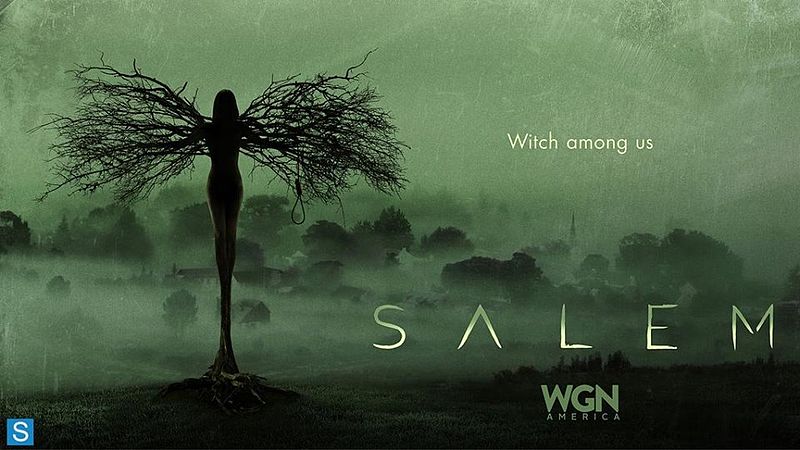
WGN America's Salem Promotional Poster
WGN America’s Salem Promotional Poster
WGN’s Salem is the latest in a very long-line of television and film productions using the city as its setting. Hollywood began its love-affair with the trials in 1909 with the release of Edison’s In the Days of Witchcraft. Perhaps the most famous rendering of the Salem story is Arthur Miller’s play “The Crucible” which transforms the city’s history into an allegory for McCarthy-era politics. Kate Fox, executive director of Destination Salem said, “The Salem Witch Trials are a rich and compelling subject for novelists and screenwriters…”
In this latest adaption, the witches are rendered as actual creatures. WGN’s Salem presents a historically-derived Puritan world complete with “witch” panics alongside the genuine existence of Satanic-based witchcraft. In doing so, it attempts to offer a far more complex ethical structure than past Salem or witch stories.
When production was initially announced, a group of Salem citizens and business owners discussed the potential for damage caused by yet another Hollywood show conflating history and horror. Should they protest? Elizabeth Peterson, director of Salem’s Witch House, said:
The Witch House is the only historic site left that was an absolute witness to the conversations and phenomena [of that time].  It is our responsibility to dignify and intellectualize that history. 
After multiple conversations, the group opted for a different approach. Fox said, “I will welcome the opportunity [the show] will afford to talk about the destination Salem with viewers who may find a new interest in our town.”
Salem Witch House [Photo Credit: Scott Lanes]
After seeing the show Peterson said, “I’m not worried that [Salem] could be mistaken as historical because it is so fantastical.” She points out that show contains many inaccuracies but it’s presented in such a way that there is no danger in mistaking it for fact. In other words, WGN’s Salem is not even pretending to be real. It is pure horror entertainment.
Due to the continued fascination with the trials, Salem and New England in general have ascended historicity to become a modality within American popular myth. Salem as a backdrop is strongly rooted within Hollywood’s own narrative symbolism. Even Samantha makes a trip to Salem for a Witches Convention in 1970. If you make a witch movie or show, it should be set in a small town in New England.
Just as it capitalizes on historical lore, WGN’s Salem also makes use of the archetypal Hollywood Satanic witch. Narratively speaking these witches are villagers who have sold their souls to the Devil for personal gain. They perform magic with oils, frogs, lizards, hogs, blood and fire. They hold sabbats in the dark woods wearing beastly masks. They have familiars and understand the nuances in “life, love, war and death.”
Visually speaking the witches are monstrous, zombie-like creatures that only appear in quick cuts or extreme close-up. Such shots are often flanked by tilted visions, screams and flashes of light. These are all very typical elements of the modern horror montage. To counter that extreme, these same witches appear as their respectable former selves during the day and are shot in a non-dynamic simple composition.
At first it might seem WGN’s Salem is yet another horror show fostering the negative representations of witches. It is after all presenting a typical Satanic witch story. However it does do something a bit different. It offers an atypical dynamic morality that embraces the complexity of contemporary social issues. This complexity is best demonstrated though three characters: John Alden, Cotton Mather and Mary Sibley.
John Alden is defined as the imperfect but good secular American. He fights for “his country,” befriends Native Americans and stands against the Puritan moral panic. At one point he tells Mather, “She needs a doctor not your prayers.” John is the open-minded, modern cowboy who believes in love and even Paganism. When Anne Hale explains that Mather calls drawing “idolatry” or nature worship, Alden responds, “There are worse things to worship.”
Cotton Mather is the polar opposite. He represents the religious zealot who publicly defines life through absolutes found in the testimony of his books. Giles Corey describes Mather as the “most dangerous type of fool…The kind that thinks he knows everything.” Mather is further demonized through his apparent hypocrisy. While inspecting the wounds on an hysterical young girl, Mather pushes her dress up to her thighs. At that point, the camera rhythmically cuts between his face, her face and his hands on her thighs. Then the show abruptly cuts to a salacious scene of Mather in a brothel. The viewer is left wondering if Mather abused the girl.
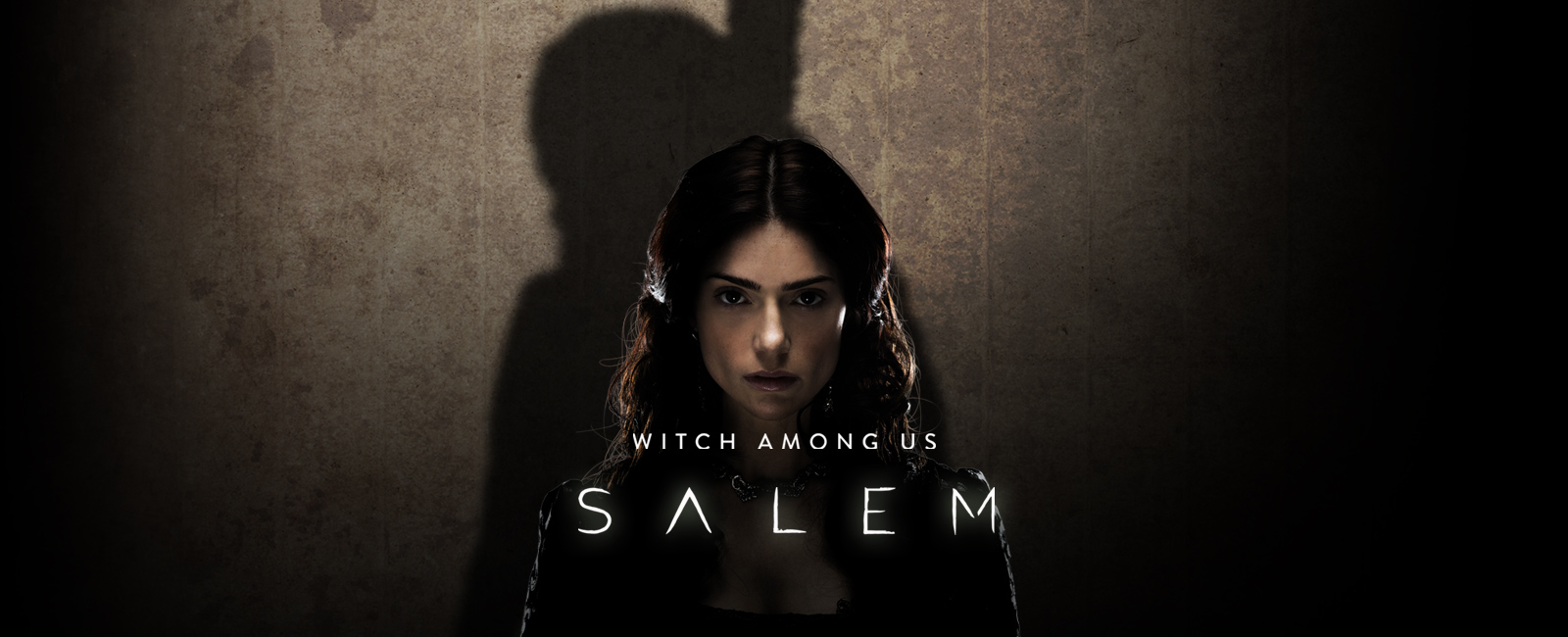
WGN America's Salem Poster
WGN America’s Salem
To complete the triad, there is Mary Sibley, the witch.  As a young unwed pregnant girl, Mary is led to witchcraft by Tituba in order to escape public shame and punishment. The show posits that Mary and ostensibly the others turn to the Devil in order to escape the horrors of Puritanism. However at the same time, Mary is also depicted as cruelly toying with John Alden, driving a young girl mad and killing Giles Corey. Her vengeance knows no boundaries.
These witches are morally complex representing a type of social defiance that is very contemporary. The show appears to oppose the tyrannical religious teachings of its conservative Christian environment.  At one point Giles Corey says, “Puritans know their sun is setting. Nothing like a new enemy … to get people behind ya.” This statement recalls recent discourse surrounding the religious climate in the Unites States.
Similarly Puritan leader George Sibley yells out, “We cannot expect God to be on our side if we tolerate abominations or those that commit them.”  While he is referring to “fornication,” his line resembles language used to counter the Marriage Equality movement.
WGN’s Salem explores the progressive ethics that are now appearing within contemporary American discourse. It is mediating the mythological Salem story through very current cultural politics. The witches themselves are the tipping point that places the viewer into the uncomfortable position of liking the goal but disliking the means. Through them we can ask, “success at what the cost?”
Are these witches representative of real Witches, Wiccans or Pagans?  No they aren’t.  As with the use of Salem, the witches are merely typical Hollywood archetypes representing social defiance. In fact the narrative makes a direct distinction between a “nature worshipper” and the Witch.
How the show proceeds over its run will be interesting. How will it negotiate the issues presented? How will it handle race and explain the origins of the young, beautiful Tituba as instigator of Salem’s witchcraft?  What is Nathan and Anne Hale’s story?
With all that said, was it a good entertainment? It was average, sensationalistic and at times campy. It falls into the category of recent shows pushing the limits of television horror by exploring the limits of our humanity. If the show continues on its current course, it may hold a season worth of interest beyond that, who knows.
- See more at: http://wildhunt.org/2014/04/review-wgn-americas-salem.html#sthash.trIC61fi.dpuf


Friday, April 25, 2014

THE TRIAL OF ONE WOMAN FOR BEING GRABBED BY THE BREAST AND BEATEN BY A COP - SAY WHAT?

APPARENTLY WHAT WE ARE VIEWING HERE IS
CECILY MCMILLAN ASSAULTING A POLICE OFFICER

BULLETIN:  

Cecily McMillan Found Guilty – Write to Her!

Cecily McMillanOn Monday, May 5th, Cecily McMillan was found guilty of assaulting a cop. That McMillan was merely reacting to an actual assault by the cop seemed irrelevant to the judge. She was immediately remanded and will be jailed until her sentencing date on May 19th.
Being unexpectedly jailed is terrifying and the first few days are understandably the most difficult. Help make this time more bearable by writing to Cecily to let her know folks on the outside have her back.

Her current address is:
Cecily McMillan
Book & Case Number 3101400431
Rose M. Singer Center
19-19 Hazen Street
East Elmhurst, New York 11370
For up to date information and other ways to help, make sure to visit justiceforcecily.com

Cecily McMillan is on trail essentially for being assaulted by a cop.  That isn't the charge, but that is the reality.  

On March 17, 2012 McMillan was at Zucocotti Park on the six month anniversary of Occupy Wall Street. Although Cecily had participated in OWS, she wasn't even there to protest that day.  She was just meeting some friends on the way to a St. Pats day celebration.  Young people, what are ya gonna do?

Anyway, as they are always wont to do, the cops swept in.  She was grabbed on her breast from behind.  She instinctively responded.  Apparently her elbow made contact with a cop's head.  Uh oh, can't have that! She was charged for assault for that reaction and faces up to seven years in jail.  

Of course, the real assault by the police didn't end with one grope, one violent grope which left major bruising, no that wasn't the end.  After being taken into custody she was beaten so severely that she went into a seizure and was denied medical treatment.  There were lots of witnesses who pleaded with the cops for help.  They didn't.  As Kathryn Funkhouser writes on the Toast:


Protestors stand behind a barricade, near a city bus where the police are taking the people they have arrested. McMillan is being escorted there in handcuffs when she collapses to the pavement and begins to seize uncontrollably. The police officers stand over her in a tight circle wordlessly watching as she, in her bright green shirt, lies on the ground, unable to breathe as her body jerks violently. The visual is chilling. Do they think she’s faking? The protestors curse and shout for the officers to help her, protect her head, give her space, but none of them acknowledge the cries. Several officers finally pick her up, take her out of the street, and put her down on the sidewalk, removing the handcuffs. It’s more difficult to see her, but she seems to be going in and out of consciousness and she’s clearly in distress. The protestors begin to roar for a medic. The officers respond by fanning out along the barricades, looking around warily at the protestors, their faces unreadable. McMillan tries to sit up, can’t seem to breathe, then collapses, again and again.  All of the officers seem to be moving maddeningly slowly, milling around with hands on hips. It takes a very, very long time for the ambulance to come.

When she wakes up in the hospital, she’s covered in bruises and doesn’t know where she is. She thinks her rib is broken, it hurts so much. In the next forty-odd hours, she is shuttled between the hospital and jail, and although she asks over and over, she is not allowed a phone call to a lawyer, friends, or family.

This is not about McMillan’s elbow. This is about changing the conversation.


Need I bother to say that the cop, Grantley Bovel has been charged in other incidents of excessive force and illegal behavior.  I need bother because the judge isn't allowing that into evidence.  Michelle Goldberg writes at the Nation:


... Bovel has twice been investigated by Internal Affairs, including for one incident in which he and his partner were alleged to have run down a 17-year-old on a dirt bike. He received a “command discipline” for failing to radio that they were in pursuit. In another case, he was filmed kicking a suspect on the floor of a Bronx bodega.

Oh yeah, Bovel is also currently being sued by a protester arrested the same day for bashing his head into seats of a police bus.  The Guardian further reports on this little fact that the jury won't get to hear:


The protester (suing Bovel), Austin Guest, alleges that Bovell dragged him down the aisle of a bus while “intentionally banging his head on each seat”. His attorneys said in an updated complaint filed to federal court in Manhattan last week that as a result he “suffered physical, psychological and emotional injuries, mental anguish, suffering, humiliation, embarrassment, and other damages”.

They allege that after being put face-down on the ground and tightly handcuffed, Guest, a 33-year-old graduate of Harvard University, was “dragged up the stairs and thrown head-first into the bus”, which was to take him and other protesters to a courthouse for processing.

“He was carried like a battering ram so that his head struck each seat as they took him to the back of the bus,” said Rebecca Heinegg, an attorney for Guest. “They were clearly aware that this was happening.”

I don't really need to go on with this, do I?  You, and me, and the people down the street all know what happened, all know what is happening here.  We have all seen it before.  Goes on every day.  Doesn't usually happen to middle class white woman (although it can, especially in the middle of some protest).  Usually it happens to some unknown black person, in the night, where no one can see.

This time though the victim was white.  This time  we could see.  There are plenty of videos floating around where we can still see.  This time there are lots of supporters, lots of press, lots of attention.  Hell, here I am.

As the post below says:

Of course, it is important to cover Cecily McMillan's case, and to speak up for the rights of people everywhere to peaceably assemble in protest. It is equally important not to forget that there are people all over New York whose trials are not getting this kind of attention, or who do not go to trial at all because they have no help, no support, no one to stand by them while they refuse a plea bargain in an attempt to keep felony charges off their records. 

I agree.  I totally agree. 

So here we are on Prison Friday and you can read the rest from In These Times Below. 


Post-Occupy, #myNYPD Makes New York’s Blood Boil

As Occupier Cecily McMillan stands trial, the city’s 99% rediscovers its anger toward the NYPD.
BY SARAH JAFFE

 On Tuesday, April 22, the New York City Police Department had a very bad idea. Someone at the NYPD decided that the department could be doing better with its social media engagement and asked people to tweet photos of themselves with NYPD officers using the 
hashtag #myNYPD.

Perhaps predictably, the photos were not what they wanted. Activists quickly flooded the hashtag with photos of violent arrests, many of them from the days of Occupy Wall Street. The result was that the hashtag trended, with activists around the world joining in, prompting spinoff hashtags and even garnering the notice of the tabloids and the New York Times.
It seems the NYPD doesn't quite understand the depth of the city’s anger toward the department, even with a new (well, new-old) commissioner under a new mayor who ran a campaign against stop-and-frisk.  Mayor Bill de Blasio even went so far as to declare: “Now that we've moved away from that broken policy, and we've settled the lawsuits, and we are changing the dynamics on the ground between police and community, I think the average officer's having a much better experience.”
The average officer may be faring better, but a whole lot of New Yorkers out there still aren't.
On April 23, the day after #myNYPD hit Twitter, I spent the afternoon in a criminal courtroom in Lower Manhattan listening to some reasons why New Yorkers don't feel safer with police around. Cecily McMillan, a graduate student and Occupy Wall Street organizer, sat in the defendant's chair, scribbling notes to her attorneys on hot pink note-paper. McMillan was arrested on March 17, 2012—the six-month anniversary of Occupy—when Zuccotti Park was cleared of protesters who had briefly taken back the park late in the night. She is accused of having elbowed NYPD Officer Grantley Bovell in the face during the course of her arrest. McMillan faces felony charges of assault on an officer; if convicted, she could serve seven years. The trial began April 11, and is expected to last about three weeks.
McMillan contends that Officer Bovell grabbed her breast from behind and she reacted instinctively, elbowing backwards in reaction to what she considered an assault. 
I never met Cecily McMillan at Occupy Wall Street and I didn't meet her on Wednesday. I was unable to speak with McMillan’s lawyers, who are under a gag order from the judge and prohibited from talking to reporters. Instead, I simply sat in the audience, one of many there to observe.
And I didn’t see McMillan's arrest. But like many people who'd been around Occupy Wall Street, I stopped by the park that night after drinks with friends in the area. The park was ringed with police, but for the time I was there, the atmosphere was celebratory if tense. Old friends chatted; bagpipers were playing. At one point a small handful of police officers charged into the park and pulled down a tarp draped between two trees, but there were no arrests, and after a while, I went home. Looking back at my Alternet report on the event, I note I told friends: “I just want to get out … before they stomp on someone again.” The park was evicted of Occupiers while I was somewhere underground on a 2 train.
What happened after I left was captured on cell phone video and livestreams. A video of McMillan apparently having a seizure after her struggle with the officer was disallowed from the courtroom the morning of April 23, according to Wall Street Journal reporter Nick Pinto, who's been covering the trial daily. But as the New York Times described the scene back in March 2012: 
At one point, a woman who appeared to be suffering from seizures flopped on the ground in handcuffs as bystanders shouted for the police to remove the cuffs and provide medical attention. For several minutes the woman lay on the ground as onlookers made increasingly agonized demands until an ambulance arrived and the woman was placed inside. 
Also disallowed from the trial was Officer Bovell's record; he has faced prior allegations of brutality, and is currently being suedby another Occupier, Austin Guest, who says Bovell dragged him down the aisle of a bus while “intentionally banging his head on each seat.” The NYPD has paid out thousands to settle claims by Occupiers. That includes a $55,000 settlement announced Thursday, April 24 [video at the link] to be paid to Josh Boss, who was livestreaming an Occupy march when he was thrown to the ground and kneed by Chief Thomas Purtell, who was at the time the commanding officer of the Manhattan South Patrol Division. Also among the final tally is $82,500 to Shawn Schrader, who goes by Shawn Carrie, over three separate violent arrests. A joint report from NYU’s Global Justice Clinic and Fordham’s Walter Leitner International Human Rights Clinic [PDF] found that the police's treatment of Occupy included “frequent alleged incidents of unnecessary and excessive police use of force against protesters, bystanders, journalists, and legal observers; constant obstructions of media freedoms, including arrests of journalists; unjustified and sometimes violent closure of public space, dispersal of peaceful assemblies, and corralling and trapping protesters en masse.”
Yet Cecily McMillan, not Officer Bovell, is on trial, and the judge ruled that the officer's record is irrelevant.
When testimony began at the trial that afternoon, Officer Linda Waring was on the stand. Waring took custody of McMillan after she was sent to the hospital, to jail and eventually to Central Booking. McMillan's lawyer, Martin Stolar, asked Waring repeatedly whether she saw injuries to McMillan, what her complaints were at the hospital, how she reacted to the news that she was being charged with assaulting an officer. Waring responded that McMillan seemed surprised, that she didn't know why she'd be charged with such a thing. When Stolar asked her opinion of the Occupy protests, the judge disallowed every question except: “Were the protesters smelly?” and “Was it personal for you?””— to which Waring replied, “No, it's business.”
What they don't tell you about court, what the courtroom dramas don't show, is how deadly boring it is. At one point during the testimony of the District Attorney's Office forensic video expert, explaining a video that allegedly depicts McMillan's altercation with Officer Bovell, at least one juror appeared to actually fall asleep. And yet as you sit there, watching, listening to the same question being asked over and over, you remember that someone's life is on the line, that the third repetition of a blurry YouTube video from the night of March 17 could make the difference between conviction and acquittal. The video expert—in his three-piece suit and his smiles at the jury box, pointing at a green blur on a screen— becomes less boring when you remember that. You begin to sift through the hundreds of answers, looking for something that seems relevant. The fact that struck me was that the video was, according to the expert's testimony, downloaded from YouTube on the morning of March 18, 2012, just hours after McMillan's arrest. How quickly did the prosecution begin preparing its case? But those individual bits of information don't add up to anything on their own. You have to go every day for them to make a story, and even then you have to decide which bits fit into the story you believe is true. 
Cecily McMillan's story fits into a bigger story about the NYPD and the city that I've been following for a while. Like many white women in New York, my first experience getting pushed around by the NYPD was at Occupy Wall Street. As a reporter, I would attempt to ask questions of officers and be rebuffed, sometimes physically; in a crowd, I looked like other protester and was shoved around accordingly. I witnessed plenty of violent arrests, including those of friends and fellow reporters. I tweeted a few photos of those incidents on the #myNYPD hashtag.
These days, protest arrests are scarce and attention has faded from the NYPD's repressive tactics; some seem to consider the matter of police abuses closed with the reforms passed by City Council and imposed by a court of law. Yet protest arrests have largely faded because Occupy no longer holds parks and takes streets—and out in residential neighborhoods, there are no livestreamers and few reporters.  I rarely go a week without seeing police detaining someone, usually a young man of color.
Of course, it is important to cover Cecily McMillan's case, and to speak up for the rights of people everywhere to peaceably assemble in protest. It is equally important not to forget that there are people all over New York whose trials are not getting this kind of attention, or who do not go to trial at all because they have no help, no support, no one to stand by them while they refuse a plea bargain in an attempt to keep felony charges off their records. There were only two reporters who seemed to have stuck around for all of McMillan’s multi-week trial. How many reporters cover the courthouses for everyday arrests?
Cecily McMillan's case can't just be about her, whether she's a nice girl or a pacifist or not. It has to be—as the #myNYPD hashtag reminded us with its seemingly endless stream of violent photographs— about a police force that has gotten away with too much for too long and has not changed nearly enough. 


Sarah Jaffe is a staff writer at In These Times and the co-host of Dissent magazine's Belabored podcast. Her writings on labor, social movements, gender, media, and student debt have been published in The Atlantic, The Nation, The American Prospect, AlterNet, and many other publications, and she is a regular commentator for radio and television. You can follow her on Twitter @sarahljaffe.