Friday, June 14, 2013

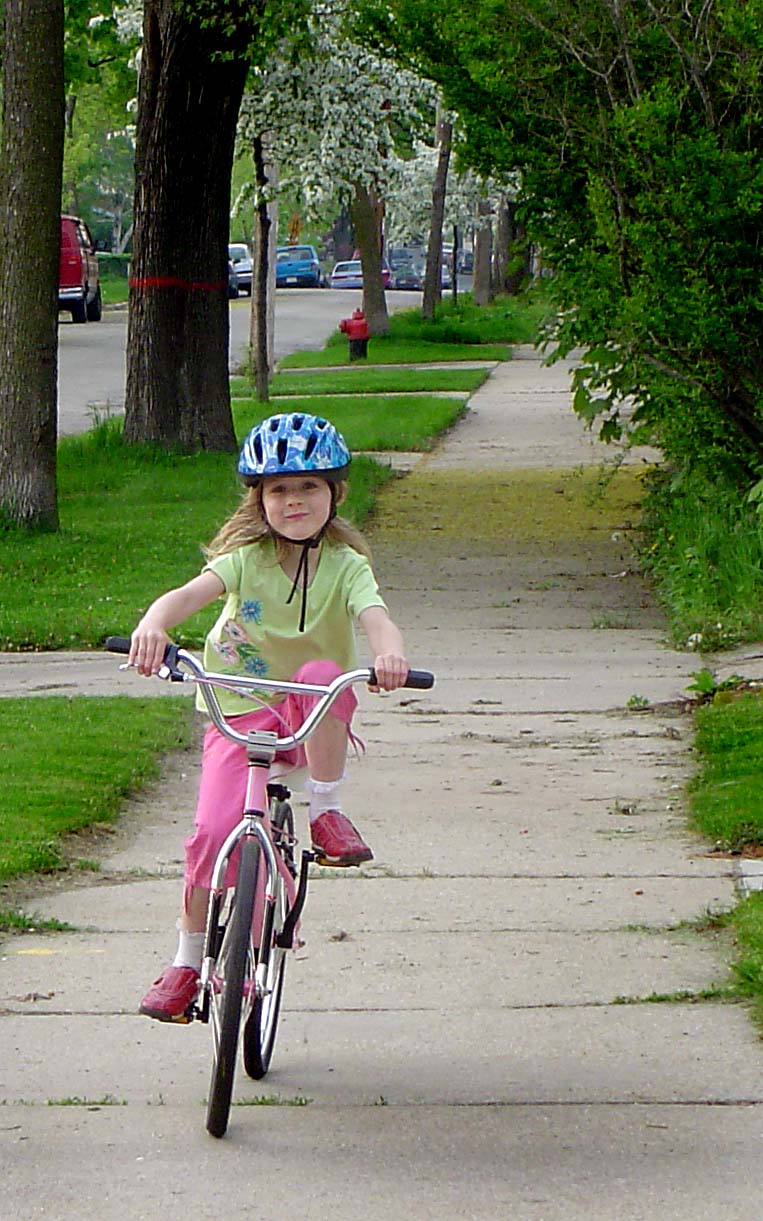
JERRY ROAD HIS BIKE ON A SIDEWALK AND WENT TO JAIL

NOT BLACK
NOT ARRESTED
NOT JAILED
HMMM.....


The post below is both fortunately about something that happened that usually doesn't.  It is also about what usually does and the good that did happen should have never had to happen...and even the fact that the outcome was better than usual doesn't excuse what one young man had to go through.

Are you confused?

This is the story of Jerry who made the mistake of riding his bike on the sidewalk and ended up in jail.  The good news is Jerry had a community that rallied around him, raised his bond money, and got him out to fight the bogus charges.  The bad news is 1) Jerry got arrested, 2) Jerry had to sit in jail, 3) Jerry has to go to court, 4) people had to pay to give him his freedom back.

There is more bad news, of course.

Most Jerrys out there don't have this sort of immediate support, don't get out of jail, and plead guilty because they have no choice.

Those Jerrys, of course, are black kids and young black men.

The place this time is Chicago.

The place is everywhere, USA.

That this stuff goes on is bullshit.  It is a blatant example of the white supremacist society that so many call America.  

There is no reason to think this crap will ever stop until WE stop it...

The following post for Prison Friday is from Prison Culture and is merely a day in the life of millions African Americans living in the USA.


The Abduction of Young Black Men in Chicago…


Jerry rode his bike on a sidewalk. He was arrested. At the police station, an officer said that Jerry kicked him in the shin. He was sent to jail. At Jerry’s hearing, the judge ordered a $20,000 bond. He has no money and could not post $2,000 bail.

So the community rallied in record time to raise the funds to bail him out of jail. Since the funds were not immediately available, Ethan, co-founder and facilitator of Circles and Ciphers, offered to use his personal credit card to post the bond.


At 10 am this morning, Ethan arrived at Cook County Jail and paid $2,000 to free Jerry. He stood in line with dozens of other people waiting for the release of their friends and loved ones. Minutes turned into hours. People who were waiting began to talk about being disrespected and feeling dispirited. There was radio silence; no information about when anyone would be released. The system dehumanizes.

Seven hours later Jerry walked out of jail and Ethan was there to meet him. He waited those long hours for Jerry’s release. Standing with the others who were anxiously and apprehensively waiting the (perhaps temporary) return of their missing…

I’ve been really sick for days and decided to leave my house because I was going stir-crazy. I returned to hear Jerry’s voice on my answering machine and for the first time in days, I felt the knot in my stomach begin to loosen just a little.

Jerry’s next court date is June 24th. He is like countless young men in Chicago ensnared in the web of a corrupt criminal legal system intent on devouring him. The system is voracious and insatiable.

Jerry is unlike countless young black men in Chicago because he had a community who could and did rally to his support. A community that refused to allow the system to feed on his body until he was fully consumed.

As Jerry sat in jail for days, he contemplated his “choices” — plead guilty to a crime that he didn’t commit or sit in jail until his next court date nearly three weeks away. Jerry would have pleaded guilty had he not been informed yesterday that funds had been raised to post bond. He said that he didn’t think that he would have lasted much longer in jail.

So for now, the system has not succeeded in abducting another young black man. Jerry will survive to fight another day against the bogus charges he faces. And I can only say thank you to each person who made this outcome possible. As I sit here tonight to write these words, I am also shedding a few tears for the thousands of Jerrys sitting in Cook County Jail facing a similar ‘choice.’ They’ve been accused and are waiting for their cases to be heard. They are behind bars in a jail that is a living hell. They are mostly black and brown bodies who don’t have a community and who must face the beast alone.

I breathe deeply and recommit to resisting the injustice of this criminal legal system. I vow to continue to fight for all of the Jerrys and the Jennys in this city and I hope that you will too. Thank you and peace to you all.

Thursday, June 13, 2013

THE RESIDENTS OF THESE CHINESE DEVELOPMENTS ARE BEING POISONED


It's late and I don't have much time, but I am nothing if I am not compulsive so I am getting you a Scission whether you want one or not.

This story comes from China, but it could have come from the USA, or for that matter any industrialized or industrializing country in the world.  I don't know of any such States currently in existence that give much thought to the environment, not really, or the the humans who are part of that environment (well, at least those that aren't part of the ruling class itself).  Ecocide and pollution, environmental racism and environmental classism, these are all hallmarks of capitalism from its beginning and must be until its end.  Even a country like China which is not exactly your normal capitalist state, but which cannot escape global capital, even such a country that has awakened to the fact that it can't keep polluting the air and the water and the land hasn't really found a way or found the guts to stop doing just that.  It plans, it makes some improvements, but as the post below shows, it sure as hell ain't there yet and as long as it grasps any part of Capital it simply cannot get there.  On top of this, China is industrializing late and fast and is sort of back where the other industrial powers were back in the early days, if you know what I mean.  Maybe, China will come around, but it will take some big changes, changes driven by the Chinese multitudes themselves that can make those changes.

No state has shown the way yet.  The Chinese have a chance, but I ain't holding my breath (although holding our breath may at some point be the only way to stay alive).

Meanwhile the following is from China Dialogue.


The houses built on China’s 'poisoned' land


Gao Shengke
Wang Kai


Gao Shengke and Wang Kai have won the prize for Best Investigation atchinadialogue’s and The Guardian’s China Environmental Press Awards - 2013 for their investigation into contaminated earth in Chinese cities. Here is the first of their three-part series of reports.


The excavators are rumbling and dust swirls all about at the second phase of the Kangquan New City construction project in Guanzhuang village, Chaoyang District, outside Beijing’s east fifth ring road.


A 20-metre deep pit has been dug on the site. A foul stench rises from the pile of earth that has been removed. Until now, few people knew about the secret that was buried here.  


This plot of land was previously the site of a factory owned by the Ministry of Railways that made anti-corrosive railway sleepers. The plant was in operation for more than 30 years; many kinds of organic pollutants continuously seeped into the topsoil, deeper soil layers, and into the groundwater. Some seven or eight years ago, the factory was relocated and this plot of ground was left unused. In January 2011, the city administration decided to convert the land into a development for affordable housing and it was taken over by the Residential Construction Service Centre for Civil Servants to build low-cost housing for civil servants from all ministries.


After the Civil Servants Residential Centre took over the plot, a number of specialists carried out an initial land survey. In May 2011, the Chinese Research Academy of Environmental Sciences released a public environmental impact assessment report which made no mention of any soil pollution problem. There was also no mention of the historical use of the site or the original environment.


However, Caijing magazine got hold of another similar survey report by the Chinese Research Academy of Environmental Sciences, which showed that pollutants in the soil seriously exceeded approved levels, especially semi-volatile organic pollutants such as polyaromatic hydrocarbons. There were many kinds of hydrocarbons, most of them relatively strong carcinogens and mutagens.


Furthermore, the groundwater pollution was also relatively serious. The report said the most serious pollution occurred at a depth of between 0 and 7 metres, though at 12 metres pollutants still exceeded limits.


Heavy metals, electronic waste, petrochemical organic pollutants and persistent organic pollutants are the four main types of pollutants in contaminated land. One specialist said that there are countless plots of land larger than Kangquan New City that are even harder to remediate. “Last century, from the 1950s to the 1980s, Beijing’s south third ring road was a chemical factory zone, with a concentration of pesticide plants. How many times has this plot of land been surveyed? How many times has the soil been remediated? This area was converted into a residential and commercial district long ago.”


The problem of polluted land extends far beyond Beijing. After 2001, a large number of polluting enterprises were moved out of the Yangtze River Delta, the Pearl River Delta, and the old industrial bases of China’s northeast. In 2008, the central office of the State Administration of Work Safety insisted that highly-polluting chemical enterprises should be phased out.


Research undertaken by Luo Yongming, a senior soil expert at the Chinese Academy of Sciences, showed that from 2008 countless polluting companies relocated from Jiangsu, Liaoning, Guangzhou, Chongqing, and other areas, displacing over 20,000 hectares of contaminated land.


From 2004 to 2012, Chongqing relocated 137 polluting factories. Furthermore, these factory sites are mostly now prime real estate locations. For three consecutive years, Jiangsu relocated more than 4,000 heavily polluting chemical enterprises, leaving behind a large area of land with unknown levels of pollution.


Exactly how widespread the problem is in China is unclear, but a senior industry specialist pointed out that there must be tens of thousands of plots of polluted land nationwide; of these pesticide plants occupy quite a high proportion but only a miniscule number of these have been treated or are undergoing treatment.


In Beijing, for example, between 2001 and 2005, 142 factories were relocated, displacing 8.78 million square metres of reusable land. According to Li Jingdong, section head of the polluted land management department under the Beijing Bureau of Environmental Protection, from 2004 until now, only a few dozen contaminated sites have been identified, out of which only eight have been remediated.


Because of a lack of both facilities and awareness at old state-owned factories, pollutants were handled in a fairly basic fashion. In those days, pesticide factories usually just buried pesticide residues and harmful chemical residues onsite, just five or six metres below ground.  A lot of land that was treated this way still has high concentrations of pollutants, sometimes hundreds or thousands of times above set limits. 


These days “the number of plots of land that have been identified as polluted still hasn’t reached 100,” says Jiang Lin, associate director of the Beijing Municipal Research Institute of Environmental Protection. There are about 400,000 to 500,000 polluted sites in the US. Europe also has several tens of thousands of sites.


Cheng Mengfang, a researcher with the Institute of Soil Science at the Chinese Academy of Sciences, pointed out that in China a lot of contaminated ground has not been treated or remediated, it’s just directly exploited for development.


The danger to public health


Polluted soil endangers the human body both directly and indirectly. The indirect channels are through groundwater, surface water and the atmosphere. The direct channel is through dust in the air or when children play and without paying attention absorb some of the contaminated soil.


Since the mid-1990s, polluted sites in China have led to an excessive amount of acute poisoning incidents. As the rate of land development has accelerated, these kinds of accidents are becoming more frequent.


On April 28, 2004, at the construction site for the Songjiazhuang subway station at the south third ring road in Beijing, three workers were poisoned while  underground. They were sent to hospital, while the worker with the most serious condition had to be given hyperbaric oxygen therapy. A pesticide factory previously occupied the site.


In July 2006, at the site where a chemical factory was moved from Guoxiang, near the south ring road in Suzhou, Jiangsu, leaving behind 20mu of contaminated land, six construction workers fell into a coma after diggging up a pile of contaminated earth.


During Spring Festival in 2007, at the Heshan construction site in Wuhan, a pungent stench grew stronger after a deep layer of soil was excavated. One after the other, the workers began to feel dizzy and have difficulties breathing. Because they didn’t know what the problem was, they carried on working. Finally, several of the poisoned workers were sent to hospital for emergency treatment. This was the former site of a pesticide plant.


A professional in pollution remediation who took part in the sampling of the site of Beijing Chemical Factory number 2 described how toxic gas was continuously emitted from a pipe. The gas could be ignited with a lighter, which showed that the concentration of the pollutant was high enough to cause fatal poisoning.


Chen Tongbin, the director of the Environmental Bioremediation Centre at the Chinese Academy of Sciences, said that there could be relatively long incubation periods depending on the kind and concentration of pollutants. “When poisoning becomes acute, it shows that the pollution at the site has reached a grave level. Those people who are long-term residents of this plot of polluted ground may then become chronically contaminated.  Symptoms may not appear for five years, 10 years, even dozens of years later.” 


A lack of transparency


Even though some plots of contaminated land have come to light, news about them is strictly blocked. It is only for internal discussion by specialists and closed-door decision-making by the government. A specialist who has taken part in many soil remediation projects gave the example of a commercial building site in Guangzhou that was formerly the site of a key fertiliser factory, and where heavy metals and petrochemical pollutants both exceeded safety levels. This site was chosen for Guangzhou’s Asian Games Village. The pollution problem was only discovered after an investigation and so finally the Asian Games Village was moved to Panyu District. However, the residents of the construction site were never told the truth.


A senior industry insider disclosed to Caijing that a particular industrial plot in Shenzhen was the original location of a large number of electronics companies. After these companies were relocated, they left behind a serious amount of solid waste pollution. All the offices on this plot of land currently have no idea. Even the local government doesn’t have a clear idea of the extent of the problem.


Caijing 
also found out that the polluted ground in the second phase of the Beijing Kangquan New City construction project has already been treated. Someone who identified themselves as the person in charge of onsite earthwork construction with the Beijing Zhonghou Construction Machinery Company said that the contaminated soil was moved to Beijing’s eastern suburbs. It was handled by “digging down several dozen metres, and then covering with good soil. This was done according to requirements and with the Ministry of Environmental Protection making several inspections.”


After bringing the polluted soil to the landfill, anti-seepage work must be carried out on the landfill to prevent polluting the groundwater. Someone with inside knowledge of the second phase of the Kangquan New City construction project claimed that the “contaminated soil that was dug up, after it was moved away was sorted into several different categories according to how it would treated such as pyrolyzed, incinerated, or composted, but during the treatment process there could be some non-standard procedures.”


But the Civil Servants Residential Centre has positively confirmed neither of these claims. Another person familiar with the matter said that at the meeting to evaluate bids for the second construction phase of Kangquan New City, a specialist in the evaluation group claimed bidders were judged solely on the company’s qualifications and estimate; it took no account of any initial plan for remediation. “At the meeting someone even joked, after the project is completed, we can ask the Ministry for Environmental Protection, the Ministry of Land and Resources, and the Ministry of Housing and Urban-Rural Development to move in.  If there’s no problem then other ministries can move in too. After all, these ministries have a better level of knowledge than the others.”

Originally published by Caijing magazine


Wednesday, June 12, 2013

MORE THAN FIVE HUNDRED YEARS OF INDIGENOUS REVOLUTION


Five hundred and twenty-one years ago Christopher Columbus showed up in the Americas and it has been a war and a revolution ever since.  The war is by patriarchal capitalism against the indigenous people and against the land and water and all of nature as well.  The revolution has been fought constantly by the indigenous Americans on behalf of themselves and the Earth has gone on ever since.

It all continues today.

The following post is all about that and I have borrowed it from Indianz.com.

A revolution began when Columbus set sail
The following opinion by Andrea Landry appears in the latest issue of the Native Sun News. All content © Native Sun News.


The revolution began when Columbus set sail
By Andrea Landry


We stand in solidarity with our land, our waters, and our traditional knowledge. We stand together to give voice to those who have passed on before us. We stand to acknowledge the work that we must complete in order for our future generations to survive culturally, linguistically, and most importantly sovereignly, as Indigenous peoples on Turtle Island.


Indigenous women are gaining momentum in the Indigenization of colonial realms, deconstructing the Doctrine of Discovery, a piece of international law passed through in 1823, which stated that lands are in the hands of the government who have explored and colonized a territory.


This doctrine has led to the raping of mother-earth and the invalidation of Indigenous sovereign rights over traditional territories and livelihoods. Yet, we now see a resurgence; the battling the Doctrine of Discovery with words as weapons and truth as shields.


Indigenous women and younger generations are reiterating the importance of the protection of our traditional territories, livelihoods, and linguistic sovereignty. With this, they are challenging Doctrines and Declarations that have impeded on our rights for generations.


This abuse of the land goes hand in hand with violence against Indigenous women. By saying that it is okay to rape and pillage our traditional territories for all she is worth, we are saying it is okay to do the same within our communities.


These processes neglect our seven grandfather teachings of wisdom, respect, love, humility, truth, bravery and honesty. The teachings we are to bring to life with our relationships to one another, to our land, and to the animals are being neglected by the force of mining companies, oil pipe-lines, and the desecration of our lands.


This is where the change comes. Informing and educating others on the importance of implementing our sovereign rights, by practicing our freedom of speech, and by Indigenizing and decolonizing the systems that have been forced upon our minds, bodies, and spirits since the process of colonialism became normalized on the lands of Turtle Island. The change of viewing violence against our traditional land bases as economic development and full of opportunity into a view of this deconstruction developing notions of violence against Indigenous women as okay. The more we lose pieces of our mother earth, the more we lose our livelihoods, our languages, and our territories.


Idle No More, the Indigenous rights movement has carried on the voices of revolutionary change-makers since colonization has begun its process on Turtle Island. The voices of leaders such as Haudenosaunee Chief Deskaheh, Tecumseh, Ellen Gabriel, Elijah Harper, and many others have, and are, continuously passing on balancing between traditional knowledge and ensuring our future generations have a brighter future.
Women are explaining how it all relates to the epidemics in our communities. Men are taking a stand on ending violence against women. Young people are speaking about how they need clean drinking water rather than a mine for dollars within their communities. And the ancestors are honoured that the teachings are alive and well.


The reality is, Idle No More can be viewed as a shift, an awakening. But this awakening has been happening since Columbus set sail and landed on Turtle Island. The battle for our sovereign rights, for the free, prior, and informed consent over the body of Mother Earth, and for the voices of all generations to be heard in order for a future of our lands, our peoples, and our livelihood.


Idle No More may have shifted the energy to allow communities to come together, for voices to overcome governmental constraints, and for media to view the story in the same way it always views Indigenous revolutions, but the reality is – Indigenous Peoples have been battling for sovereignty since the Doctrine of Discovery slathered its consumerism and capitalism over traditional territories for land enslavement.


Idle No More reopened the battle that occurs in the League of Nations (now known as the United Nations,) that occurs on traditional territories across Turtle Island. This revolution is not new; it is recharged energy that carries the spirits of our ancestors and the voices of our future.


So here we stand, in solidarity to ensure that this battle ends - that our mother earth is no longer beaten, neglected, raped, and left for dead; that our young women will not be left voiceless as they go missing in the cities; that our young men no longer consume lies and poison, and that our ancestors will stand behind us and say “miigwech for carrying our message on.”


Andrea Landry is an Anishinaabe woman from Pays Plat First Nation in Ontario, Canada. She is currently completing her Masters of Communications and Social Justice at the University of Windsor and is highly involved in the realm of activism for Indigenous rights on an International Scale.


Editor’s note: This is part 3 of our Native Women Columnist series.
Copyright permission by Native Sun News

Tuesday, June 11, 2013

TURKEY: "THE SELF ORGANIZATION OF LIFE"


I've been out of the country for a while, but I am back and so is Scission.

Turkey was on my mind when I left and Turkey remains on my mind now that I am back.  

Turkey is an interesting case.  A strange sort of Islamic run government that tries to pretend at times that it isn't.  A history of secularism of which it has always been quite proud.  Various internal struggles and on going urban and rural guerilla fights and a long standing Kurdish uprising (which by the way, I believe, goes unmentioned in the article I am posting).  Democracy and repression and on again off again "friendship" with Israel as well as a peculiar relationship with the Arab world.  Throw in a longstanding "alliance" with the USA and a geography that ensures it is middle eastern, Asian and European.  Combine all that with a long, tumultuous, and fascinating history, not to mention the genocide of the Armenians (which it still denies ever happened).  Finally, it has a "people" who have never feared expressing themselves in any way necessary.

And let's be honest, most of us really don't know all that much about Turkey's internal politics despite the fact that we should.

Now we have an uprising that began over a park and well, hopefully we can all learn something from the post below from Roarmag.org.

By the way if you are wondering who the hell Roar is, well,  according to itself:


ROAR Magazine is an online journal of the radical imagination that seeks to amplify the voice of our generation amid the clamorous cacophony of a rapidly changing world.

ROAR aims to bring you some of the world’s most inspiring news, stories, analysis, ideas, actions, books, poems, tunes, photos, videos and doodles from the front-lines of the Real Democracy Movement.

ROAR was founded in Oakland, CA., in 2010 as an alternative media collective that seeks to contribute to the ongoing wave of global uprisings by freely sharing information and breathing inspiration into the Creative Commons.

ROAR is edited by Jérôme Roos, a writer, activist and filmmaker from Amsterdam and a PhD Researcher at the European University Institute in Florence. Our contributions come from volunteers around the world.


LATE BREAKING NEWS...TURKISH POLICE MOVE IN...FROM THE GUARDIAN:


8:48pm BST

Governor: Taksim operations to continue day and night

Istanbul's Governor has just announced that police will continue operations in Taksim Square "day and night" until it is cleared, according to a snap on Reuters.
Seems like it's going to be a long night there.
"We will continue our measures in an unremitting manner, whether day or night, until marginal elements are cleared and the square is open to the people," Governor Huseyin Avni Mutlu said in a brief television announcement.
( Note: This entry originally, and wrongly, referred to Mutlu as Istanbul's mayor. )
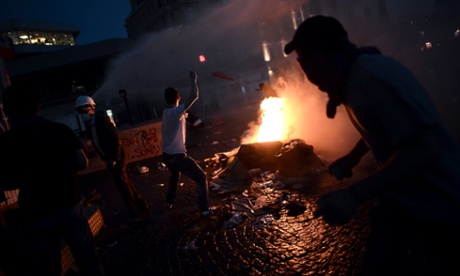
Protesters clash with riot police at Taksim square as darkness falls.
Protesters clash with riot police at Taksim square as darkness falls. Photograph: ARIS MESSINIS/AFP/Getty Images
Updated 
Turkish media is reporting that dozens of lawyers who were arrested earlier today have now been released.
Meanwhile Turkey's Medical Association has said that, as of late Monday, 4,947 people had sought treatment in hospitals and voluntary infirmaries for injuries, ranging from cuts and burns to breathing difficulties from tear gas inhalation, since the unrest began more than ten days ago.

Audio update

The major Turkish major news channels have been providing rolling live coverage of events in Taksim Square today for the first time, according to the Guardian's Constanze Letsch.
"It's not the same media blackout as before," she told me when we spoke a short time ago (listen below)
As for the possibility of protesters meeting Erdogan tomorrow, she too has doubts: "I don't know who woudl accept to meet him now under these circumstances."
"Promising talks and then doing this now is not very believable for many people".
Updated 
Is Turkey's Prime Minister Recep Tayyip Erdogan really going to go through with a meeting tomorrow with representatives of the protestors?
A spokesman for Erdogan's AKP Party said earlier today that the prime minister would only meet with those involved in "legal protest".
"It's very chaotic now and difficult to establish what is happening," Ziya Meral, a Turkey analyst based at the University of Cambridge, has told BBC News.
Meral adds that a number of those who were reportedly in line to meet Erdogan have now made it clear this evening that they will not bee meeting him tomorrow in the light of what has been happening today.
Some extraordinary aerial scenes of Taksim Square at the moment, Here's a pic tweeted by journalist Tim Pool:
Many fires are lit. People are chanting and cheering.pic.twitter.com/sU3aTUpVua
— Tim Pool (@Timcast) June 11, 2013
A statement expressing concern about today’s arrests of a further 45 lawyers at Caglayan Court in Istanbul has been issued by the international human rights arm of the Bar of England and Wales.
It said in a statement that it:
deplores the arbitrary arrest and detention of human rights defenders which is currently taking place in the context of the violent repression of peaceful anti-government protests across Turkey.
Clashes are still on going tonight in the Taksim Square area, where protesters have been setting off fire works and lighting bonfires.
It's been a long day of clashes. The Guardian's Constanze Letsch has filed a report on how events unfolded from early in the morning. You can read it here.
According to the Turkish Medical Association, almost 5,000 people have been wounded since demonstrations broke out more than ten days ago, and three people have been killed.
On Tuesday, several hundred people reportedly needed treatment in volunteer field infirmaries and hospitals, and at least one protester was said to be in critical condition.
Some wondered if the Gezi Park movement was in need of leadership to organise continued resistance. "This is a movement of civil society's dissent, and there are many groups with many demands and political views here," said Hamit Menemencioğlu, 21, manning a stand distributing food and water.
"Things might be easier if we had a leader, but many people here do not want that."
Dozens of police have been again been sweeping across Taksim Square this evening, backed by water cannon.
Reuters reports that riot police fired volleys of teargas canisters, driving thousands into narrow side streets.
Moments before their advance, police were confronted by protesters jeering and calling for them to leave the square.
Simon Johns, who works for Istanbul's Acik Radio, sent this tweet in the last fifteen minutes:
Barrage of gas being fired. About one canister every three seconds at the moment.
— Simon Johns (@simonwjohns) June 11, 2013
Scott Peterson of the Christian Science Monitor has also been tracking events this evening:
Taksim Square cleared in two minutes by wave of tear gas, again. Dusk falls on an urban battlefield...
— Scott Peterson (@peterson__scott) June 11, 2013
Police firing continuous volleys of tear gas to keep protestors back from Taksim Square, sometimes into Gezi Park. Big anger...
— Scott Peterson (@peterson__scott) June 11, 2013
Updated 
The air in Taksim is reportedly thickening once again with tear gas as police move against new supporters of the OccupyGezi movement who are arriving at the square after work.
Here's one image as tweeted by Zeynep Ozar:
taksim is under attack, again! @bbcnews @cnn @reuters@hrw #occupygezi pic.twitter.com/QJ1gWaejcW
— zeynep ozar (@zeynepozar) June 11, 2013
The owner of one of Turkey's largest publishing houses, Can Publishing,has written a piece for the Guardian in which he expresses the fear that the events of today and recent weeks may lead to civil war.
Can Oz also refers what he experienced in Taksim Square today, a few hours after police cleared the area:
The purpose of my visit to Taksim Square was to listen to the press conference the Taksim Solidarity movement had prepared; and I was confident that I could trust the chief of police and Istanbul mayor's assurance that the park would not be attacked.
Then, right before the press conference was about to start, gas rained down over our heads once again. It was a moment of crushing disappointment.
Coughing, wiping tears out of my eyes, practically blind, I realised that our government would never understand the meaning of the passive resistance that Martin Luther King Jr and Mahatma Gandhi were famous for. That's when I ran out of the park.
Meanwhile, Emre Peker of the Wall Street Journal and Dow Jones has some more on the detention of lawyers earlier:
#Turkey releases 49 lawyers detained earlier at a courthouse not for from Taksim Sq for staging protest to support #occupygezi@cnnturkcom
— Emre Peker (@wsjemre) June 11, 2013
Updated 
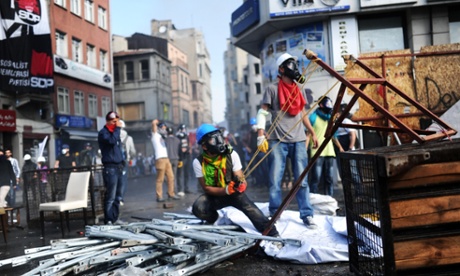
On a day of startling images, you can view a selection here, including this one (below) showing protestors pulling back the cord on a home-made slingshot in Taksim Square.
This is Ben Quinn taking over the liveblog now.
A protester pulls back the cord on a slingshot in Taksim square in Istanbul.
A protester pulls back the cord on a slingshot in Taksim square in Istanbul. Photograph: BULENT KILIC/AFP/Getty Images
Updated 

Summary

Here's a summary of the main events so far today:
• Turkish riot police broke up a protest by lawyers at Istanbul's main court as they gathered to make a statement about police brutality. More than 50 lawyers were detained. Video footage showed that many of them were beaten.
• At least 15 people were treated in hospital, including one man with a brain injury, after police used teargas and water cannon to regain control of Taksim Square from anti-government protesters.Police briefly entered Gezi Park but were resisted by protesters. Earlier the governor of Istanbul had pledged that police would not enter Gezi Park.
• Protesters accused the security services of trying to provoke violence by using provocateurs to throw petrol bombs at police vehicles. Observers noted that the protest movement opposes violence and that those throwing the petrol bombs resembled policemen.
• Prime minister Recep Tayyip Erdogan praised the police operation and urged the protesters to leave the streets. He said: "I request all activists to see the big picture, understand the plot, and withdraw from the streets."
Updated 

Audio summary from Constanze Letsch

Turkish police have regained control of Taksim Square but were rebuffed by protesters when they tried to enter Gezi Park, Constanze Letsch reports from Istanbul.
"A lot people I spoke to were angry at what they saw as deception from the government, and the governor who had promised not to intervene in the park," she said.
There is much uncertainty and speculation about who was responsible for throwing petrol bombs at the police, she added.
Asked what could happen next she said:
The Turkish Communist party and several other parties and factions have called for a big meeting at 7pm Istanbul. I'm sure a lot of people will show up. Every evening was more crowded than the previous one. I'm not sure how the police are going to respond. We will have to see tonight.

What future for the Turkish uprising?

By Mehmet Döşemeci On June 10, 2013
Post image for What future for the Turkish uprising?
Provided the uprising is not crushed or hijacked — and does not fizzle out — it has the potential to create long-lasting changes in Turkish democracy.

The actions taken by a coalition of activists against the destruction of a public park in central Istanbul have spread to more than 60 cities and provinces, bringing several million people onto the streets in widespread protest against the ruling AKP government. The government has periodically jammed communications, shut off surveillance cameras, and used its influence over the national media to suppress knowledge of both the scale of the uprising and the brutality of the police response.

As of June 8, 2013, the police have withdrawn from Taksim Square, leaving it at least temporarily in the hands of protesters. The protesters have erected networks of makeshift barricades at 50 meter intervals along all major routes leading to the square. Major clashes have occurred in other areas around Istanbul and in many cities across Turkey. There have been three confirmed deaths, thousands injured, mass arrests, and unconfirmed reports of widespread police torture.

This article does not aim to give a structural account of the causes of the uprising, an undertaking that, like an obituary for a celebrity, could be scripted before an uprising even begins. Such accounts do more to explain away the events taking place within Turkey rather than engaging seriously with them. They speak more to the Turkey of yesterday than the Turkey of tomorrow. Instead, this article attempts to outline the possible paths the uprising may take.


State Violence and Capital

Beginning with the pre-dawn raid of Gezi Park on May 30, the state response made aggressive use of riot police, assaulting crowds with copious amount of gas, water, and rubber bullets. Although blanketing many urban areas of Turkey in a near continuous cloud of gas, choking bystanders and protesters alike, the state apparatus has — for the moment at least — avoided the excesses of the Arab Spring.

Although there have been a number of confirmed instances where AKP thugs backed by police have attacked peaceful protesters, Erdoğan has yet to make good on his repeated threats to bring out his army of supporters. On June 4, the Istanbul Police issued an order to refrain from the use of gas save for instances of self-defence, though unprovoked police aggression continues throughout Turkey. The protesters, for their part, have shown remarkable restraint.

How long this situation will last is an open question. As the uprising has spread, it is beginning to have a perceptible impact on the functioning of Turkish capitalism itself. Major commerce centers throughout Turkey have turned into quasi-warzones, the stock market dropped over 10 percent on its first day of trading following the start of the uprising, and the protests are starting to affect Turkey’s lucrative gas deals with its neighbors. On Tuesday, Deputy Prime Minster Bülent Arınç warned that the protest had already cost the economy 70 million Turkish lira (28 million Euros).

If these disturbances continue, or are intensified by large-scale strikes, the situation may change dramatically. While the government seems to have pulled back somewhat from its initial onslaught, perhaps hoping to ride out the storm, capitalism is much less patient and has many more friends. If Turkish and international capital feel that the uprising poses a threat to their interests, Erdoğan will face increasing pressure to resolve the crisis. Such a scenario would have two solutions: increased support for Erdoğan and a consequent escalation of state violence, or international pressure for Erdoğan to diffuse the situation (through concessions or resignation) and a consequent de-escalation of state violence. At the moment the latter is looking more likely.


The Hijacking of the Uprising by Opposition Parties

The Greek and Spanish revolts that erupted in the summer of 2011 were marked by a total renunciation of the existing political order. The protests were aimed not only at the ruling government but against the political system in its totality. All of the existing political parties, in fact the entire system of representative parliamentary democracy, came under indictment. Revolting against the “democratic” society that denied their existence, the Greek and Spanish occupations created, through their vast networks of general assemblies, structures of a direct democracy they believed should take its place.

The current situation in Turkey is different. The AKP has been in sole possession of government power since 2003. As a result, the various opposition parties, led by the Republican People’s Party (RPP) and the National Action Party (NAP), have not been implicated in the current crisis. The uprising has singled out the AKP and only the AKP as the root of its problems. Much like the Muslim Brotherhood in Egypt, the opposition parties have been caught totally off guard by the scale of the uprising and have scrambled to interject themselves into the situation. For their part, the protesters have shown a remarkable eagerness to move beyond the old political, ethnic, and religious allegiances. However, despite the present non-partisan tenor of the uprising, it would be unwise to discount the possible future impact of the opposition parties.


"We Never Have Been, Never Will Be, Anyone's Soldiers"

As the days have passed, Turkish flags and nationalist chants of “we are the soldiers of Atatürk” have made their mark in the streets. Perhaps more worrisome have been the belated but effective attempts of opposition leaders and MPs to capitalize on the events, throwing their weight behind the uprising in speeches praising the courage of Turkey’s youth. If this trend accelerates there is the possibility that the uprising could devolve into a forced referendum (successful or not) on the AKP government, leaving the underlying political system unchanged. Such an outcome could presumably have waited for the next election cycle and avoided the gas clouds, mass arrests, and bloodshed.

The Self-Exhaustion of the Uprising

A persistent concern of many involved in the uprising has been the possibility of its self-exhaustion. These fears have so far remained unjustified. The first week of the protests have been marked by both an increase in absolute numbers of protesters and a widening of the social and political backgrounds of those involved. As the weekend battles gave way to the working week, the central squares of Turkey have become permanently occupied by different sections of society depending on the time of day. More radical activist groups maintain a night watch over the squares and are joined by striking unions and students during the work day.

The largest crowds occur during the evening hours as middle and lower class workers bring their families to picnic, protest, and share the news of the day. There is a perceptible though by no means certain shift of the uprising from the initial violent clashes to a more festival-like atmosphere. What this heralds for the future is an open question. Though a minority, there are groups — especially on the more radical left — who are itching to take a more violent path and see in these developments an enervation of the struggle.

How long the government will allow barricades and the unpoliced occupation of central squares is also not clear. On Friday, the Istanbul Police issued a statement that they would refrain from further police action until Monday, leaving the city in the hands of the protesters throughout the weekend at least. Continued stalemate could in turn lead to a dissipation of the uprisings energy, something the AKP government may be banking on. Though, if the size of the protests of this weekend are a guide, this strategy does not seem to be working.


The Space and Time for Revolutionary Creation

Provided the uprising is not quashed by murderous repression, hijacked by a nationalist discourse that serves only to empower the opposition, and does not fizzle out through exhaustion, it has the potential to create long-lasting changes in the practice of citizenship and representation in Turkish democracy. This path involves the wholesale or partial reconfiguration of political participation in Turkey. It involves the creation of new democratic forms and practices and stands (in the absence of massive worker rebellion) as the most revolutionary outcome of the uprising. It is also, without question, the most precarious and fragile of its possible solutions and one open to immediate undoing.

The most profound yet overlooked aspect of the uprisings that shook the Mediterranean world in 2011 was the countless practices and institutions that spontaneously emerged within its central squares. In Cairo, as the state apparatus withdrew (though not before committing 800+ murders), upwards of a million people, left to their own devices, had to figure out how they would live together in a square in order to sustain a revolt aimed outside of it. Within this space, the Egyptian people organized and orchestrated their own security, dealt with human and regular waste, and created services for the elderly and the poor.

The Egyptian revolutionaries established supply networks for food and information, set up a kindergarten, handled hired agitators, and protected each other’s religious practices. The same spontaneous creation of new institutions and practices was even more evident in Greece and Spain, where nightly assembly meetings empowered and funded subcommittees dealing with food, protection, medicine, outreach, horticulture, information, tattoos, and the media, managing all aspects of social and political organization within the squares themselves. Life in these squares stood as a powerful testament to what ordinary people can build in the absence of state power.

Similar practices and forms are developing in the Turkish uprising. The networks of medical and legal support, the supply lines servicing protesters with free food, supplies, internet access, and safehouses, even the collective building of barricades and the organization of night-watches to protect liberated zones from police assault, are proof of this spirit. Perhaps more important is how these acts of solidarity have gone viral within Turkish social media networks, shared as joint reminders of the latent generosity of the Anatolian people.


It is still early going, but the spatial conditions for more permanent structures and initiatives have begun to materialize. For the past few days Taksim Square has become a ‘liberated zone’, a fragile oasis surrounded by massive and ever growing barricades. As of June 5, a people’s library, dozens of free food, blanket, and medical supply stations, LBGT and gender awareness tents, and areas for musical performances and political speech have been set up in the square. For the religious holiday of Kandil, protesters have set up alternate spaces for prayer and dance and invited all those in the square to find a stranger with differing political beliefs to sit and chat with.

These spontaneous structures and initiatives mushrooming amidst the now ubiquitous graffiti and political banners offer a stark contrast to the scripted choreography and corporate sponsorship of festivals previously organized by the municipal-capitalist alliance. More than an assertion of the right to the city, the self-organization of life in the square attests to the power of ordinary people to actively structure the social space itself.

Such police-free zones are also taking root elsewhere in Turkey. Barricaded against police harassment, freed from the constant threat of dispersal, these encampments are creating new practices, allegiances, and institutional forms organically within the uprising. Only time will tell if these spaces can be sustained and what the Turkish people will make of them. One thing, however, is clear: the reconfiguration of the Turkish political field, if it is to happen, will happen here.

Another factor that has ironically pushed the uprising down this path has been the relative impotence of established experts and commentators. Here the total media blackout during the initial days of the uprising by domestic outlets has actually been a blessing in disguise. That documentaries on Antarctic penguins aired while violent clashes were being waged in every major city in Turkey drew people away from their televisions and into the streets. It has also forced people to discuss and debate among themselves the meaning and direction of the uprising rather than defer opinion to the tried and tired talking heads of the Turkish media. As the mainstream television channels slowly begin to report on the ongoing events, this is something to keep in mind.

The Turkish president Abdullah Gül recently remarked that “democracy does not mean elections alone.” A statement of the obvious and the only one from the AKP leadership to acknowledge the truth of situation. To this statement we would add one thing. For the moment, the uprising has located this democracy in the collective participation and poetry of the Turkish people. It has so far refused to entrust the uprising to any sort of leadership — whether old, new, or military. Keeping the uprising this way will be no easy task in a country which has grown accustomed to strong leaders since its inception.

Perhaps now will be the moment when Turkey finally embraces the profound meaning of the slogan, uttered countless times throughout its history, that “there can no longer be a revolution for the people in spite of them.”

Mehmet Döşemeci is an assistant professor of History at Bucknell University working on the entangled histories of Modern Europe and the Turkish Republic. His book,Debating Turkish Modernity: Civilization, Nationalism, and the EEC, will be published in Fall 2013 through Cambridge University Press. He is just beginning a new research project exploring the histories of radical publics within Europe and the Middle-East, providing historical context for the popular uprisings that have mushroomed across the Mediterranean basin since 2011. Yetkin Nural assisted in the research of this article.