Friday, November 09, 2012

"THIS IS THE LAST FUNDAMENTAL GROUP THAT'S STILL EXCLUDED FROM DEMOCRATIC PARTICIPATION"


For Prisons Friday let's review a little about some people like me who can't vote in the USA.

Did you know that a majority of Americans favor voting rights for felons.  This as nearly six  million Americans with felony convictions were disinfranchised this year. A Harris Interactive Omnibus Telephone Poll of July 18-22, 2002 (I know ten years ago), found:


A clear majority (60%) favors restoring voting rights to people who have exited prison and are now on parole in the community.


Fully two-thirds (68%) endorse voting rights for people under supervised probation in the community.


But support for voting rights disappears at the penitentiary gate; only 31% of Americans endorse allowing people currently in prison to vote.


Support for restoring the right to vote to former felons who have completed their entire sentence (both prison and probation) varies depending on the specific kind of offense. With no reference to the nature of the crime, four-fifths of Americans favor restoring voting rights to former felons who have served their entire sentences. But support drops to 66% for people convicted of a violent crime, to 63% for a white-collar conviction, and to a bare majority of 52% when highly stigmatized sex offenders are at issue.


The key finding is that a majority of Americans favors restoring voting rights to former felons who have completed their sentences – even when told that convicts had served time for highly stigmatizing offenses such as sex crimes. Majorities in favor of voting rights for ex-felons are much stronger for less stigmatizing crimes. And high proportions of Americans favor voting rights for probationers who are currently serving their sentences in their communities, as well as for former prisoners serving time on parole.

In many states felons can vote once they are out of prison and off probation or parole.  Still,   more than 4 million Americans who cannot cast a ballot because they're on probation or parole, or live in a state that withholds the right to vote from all ex-felons.

 Four states permanently disenfranchise ex-felons. In Florida, Iowa, Kentucky and Virginia, it takes a decree by the governor or a clemency board to restore a person's voting rights, and only after a predetermined waiting period and all fines and fees are paid can an individual submit an application.

 Sentencing Project's executive director Marc Mauer says: 


 These policies go back to the founding of this country. [The U.S.] was founded as a great experiment in democracy, but was very limited. Wealthy, white male landowners granted themselves the right to vote, but women, poor people, African Americans and people with felony convictions could not vote.

"This is the last fundamental group that's still excluded from democratic participation.

The Huffington Post reports a majority of felons and ex-cons blocked from voting reside in a core of six Southern states -- Alabama, Florida, Kentucky, Mississippi, Tennessee and Virginia -- where more than 3 million people are banned from the rolls.


As a result, in Virginia, 20 percent of blacks can't vote. In Florida, that number is 23 percent. In Kentucky one if five blacks can't vote.  The Sentencing Project, a Washington, D.C.-based group that advocates for prison and sentencing reform, estimates that 200,000 felons in Arizona, half of whom aren't in prison, aren't eligible to vote.


"There's no question this has a basis in race discrimination," ACLU Voting Rights Program director Laughlin McDonald told The Huffington Post. "It's part of the history of the racial minorities in the South. The Southern states adopted a whole variety of measures to take away the right to vote after Reconstruction."

The Tucson Sentinel reports:


Josh Vander Kamp, a father of two who leads an average life, working, paying taxes and running a household with his wife, Katie, in Apache Junction. Vander Kamp has two felony convictions from 2004 and 2005 related to drug paraphernalia and possession of a burglary tool.


In 2011, years after serving his prison sentence and paying all his fines, he said he tried to get his right to vote restored but was denied without any indication as to the reason or what he needs to do to get it back.

Vander Kamp said he's moved well beyond his past and deserves to have his rights back but is frustrated by the process.

"It's a matter of me sending in a piece of paper and praying to God," he said.

Meanwhile, as the election nears and debates with friends and family on Facebook heats up, he wants to participate but never feels quite right.

"I pay taxes, I work, I definitely have opinions as far as politics go, but I feel kind of stupid," Vander Kamp said. "I talk politics with people, but then I can't vote. So why am I even talking?"


 Me, I'm lucky.  I have a forty year old felony conviction relating to my, shall we say, radical political activities and beliefs, but I actually can now vote, having been released from the supervision of whoever it was decades back.
A whole lot of people cannot.

Whether or not you think voting is very useful, this just is not right.


The following is from Criminal Law Brief Blog.


Felony Disenfranchisement


Election Day! It’s the day when citizens who want to be engaged in the political process, get the opportunity to have their say.  Unfortunately, for the nearly six million individuals who are disenfranchised due to felony disenfranchisement laws, Election Day is just a reminder of this basic civil right they are denied.[1]  Felony disenfranchisement occurs when an individual’s right to vote is taken away (either temporarily or permanently) because they have been convicted of a felony.  Forty-eight states and the District of Columbia currently have felony disenfranchisement laws in effect.  Only Maine and Vermont do not.   


The practice of restricting a convicted felon’s right to vote dates back to ancient Greece and Rome.  Certain criminals were denied the right to vote and the right to perform other civic duties.[2]  Its practice in the U.S. began during the colonization.  Voting rights were taken away from convicts who had committed crimes that brought their morality into question, such as fornication.  Later in the history of the U.S., the practice became popular again in the 1800’s in the South when white citizens where attempting to suppress the votes of African Americans.  After the passage of the Fifteenth Amendment, racists could not deny Blacks the right to vote without violating the law.  However, felony disenfranchisement provided a loophole.  Since Blacks were disproportionately convicted of crimes, disenfranchising criminals had the effect of restricting the right to vote of Blacks more than any other group. Although it is difficult to prove racist motivation in enacting felony disenfranchisement laws, it has been shown that the more minorities in a state’s prison system, the more likely a state is to enact felony disenfranchisement.[3]

The Supreme Court upheld felony disenfranchisement in the 1974 case, Richardson v. Ramirez.[4]  The Court ruled that disenfranchising convicted felons did not violate the Equal Protection Clause of the Fourteenth Amendment.  The plaintiffs in this case were three ex-felons in California who had served their sentences and paroles.  However, because of a provision in the California Constitution disenfranchising convicted felons, they were not allowed to vote.  They sued the Registrar of Voters in each of their counties, demanding that they be allowed to register to vote.  The Supreme Court ruled that section two of the Fourteenth Amendment differentiates felony disenfranchisement from other voting restrictions, so it is does not need to be “narrowly tailored to serve compelling state interests.”  

In his dissent, Justice Marshall highlighted four important issues with felon disenfranchisement.  First, states cannot provide any compelling or even a rational interest in disenfranchising felons.  Second, felons who have served their time have paid the debt they owe to society, so why continue to punish them?  Third, felons are affected by government action just as much as any other citizens and therefore should be able to participate in the process.  And fourth, disenfranchisement is a hindrance to rehabilitating felons and helping them to become productive law-abiding citizens. 

Among those who are opposed to felony disenfranchisement, there is debate amount the best way to challenge it.[5]  Some advocate for the Supreme Court to address the issue again, while others believe that this is an issue best reserved for state legislatures.  If the Supreme Court were to rule on the issue, it would become law for all states.  However, this would require the Court to overrule itself, which it does not often do.  If the issue is left to the states, as it is now, that will result in different rules all across the country with no uniform practice.  


 Felony Disenfranchisement Laws Nationwide [6]
There are five different types of disenfranchisement laws that exist today: permanent disenfranchisement for all felons, permanent disenfranchisement for some felony convictions, temporary disenfranchisement for the duration of incarceration, voting rights returned after completion of prison sentence and parole, and voting rights returned after completion of sentence, parole, and probation.  The right to vote is such an important facet of American society.  It’s too important to have the lack of uniformity we see in our current system.  Some might say that there are plenty of issues that are left up to states to make their own policy decisions regarding.  But, I would argue that because this felony disenfranchisement has the potential to deny a basic civil right from such a large portion of society, it should be held to a higher standard.  Marriage is a civil right that states were once allowed to deny to people. Each state was able to determine who could get married in that state. However, after it became evident that some states were discriminating against Blacks, the Supreme Court acted and established national law on the issue.[7]  Because Blacks and Hispanics are convicted at higher rates than their white counterparts, denial of voting rights because one is a felony has a heavier burden on them.  They are the groups that will be denied their rights.  Because of the potential for this to become a legalized discrimination on the basis of race, the policy should be outlawed.

International Disenfranchisement Laws
A look at other nation’s laws on felony disenfranchisement shows that the U.S. is not in sync with much of the international community.  The U.S. is a party to the International Convention on the Elimination of All Forms of Racial Discrimination (ICERD), treaty.  In 2001, the committee that monitors the implementation of the treaty, the Committee on the Elimination of Racial Discrimination, issued a report expressing concerns with the U.S.’s felony disenfranchisement laws.  In reaffirming the importance of the right to vote, the Committee found that the U.S. was violating UN principles of equity and fairness because such a large percentage of minorities are disenfranchised by the laws.  

In many other nations, Canada and South Africa for example, even inmates are are allowed to vote.  Other nations have prohibitions against felons voting, but the crimes for which this is allowed are well defined and narrow.  This is a huge contrast to the overly broad American practice, which prohibits nearly everyone with a felony conviction. 

Arguments against Felony Disenfranchisement
Felony disenfranchisement is unconstitutional and the practice should be outlawed. Although felony disenfranchisement laws appear to be race neutral, they have a discriminatory impact.  Not only is this evident to U.S. citizens, but as shown above, the international community notices as well.  Felony disenfranchisement affects the Black community more than any other in the country.  While around 2% of the entire voting-age population is disenfranchised, the number is nearly 7.5% for the Black voting-age population.  Thirty-six percent of the total disenfranchised population is Black, and 13% of all Black men cannot vote due to disenfranchisement.

Furthermore, disenfranchising felons serves no legitimate interest and it protects no ones rights.  It is an outdated practice that needs to be discontinued.  Citizens are not safer by denying the voting rights of felons.  Like Justice Marshall highlighted in Richardson, disenfranchisement also hinders the ability of felons to become engaged in society in a productive way.  If the Court will not overrule the practice, then it is up to state legislatures to pass legislation allowing felons to vote.


Bethany J. Peak
Blogger, Criminal Law Brief
*I would like to thank my classmate, Justin Clayton, for sharing with me some of his prior research on international felony disenfranchisement laws.


Thursday, November 08, 2012

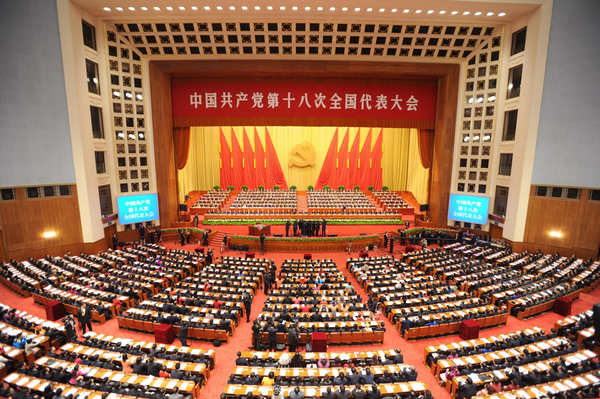
AS THE 18TH NATIONAL PARTY CONGRESS OPENS, WHO ARE THE CHINESE COMMUNIST PARTY?


The electoral process is underway right now in CHINA.  Like in the USA there is one party with different wings.  Unlike in the USA, they admit that up front.

The 18th National Congress of the Communist Party of China (CPC) is underway now in Beijing. The congress is expected to make strategic arrangements for the overall advancement of China’s reform and opening up, the country’s socialist modernization drive and the overall advancement of the new grand project of the Party building.

The Central Leadership of the Chinese Communist Party (CPC) actually seems somewhat aware of the problems they and China both face.  They know that income disparity, the environment, transparancy, social unrest, unemployment,  effective urbanisation and corruption are real issues they need to deal with.  The question is will they, and if they do, how will they.


During his opening address to the Congress, outgoing President Hu Jintao cited the widening divide among the rich and the poor, the imbalances among the burgeoning cities and the struggling countryside. Hu also stressed the need to curb personal greed and called for better discipline.
"Nobody is above the law...," Hu said, and added, "If we fail to handle this issue well, it could prove fatal to the party, and even cause the collapse of the party and the fall of the state."


A survey of Chinese citizens conducted by  Tony Saich of  Harvard University came up with some intersting results.  Those surveyed express high levels of satisfaction with the central government, but satisfaction declines with each lower level of government. While in 2009, 95.9 per cent were either relatively or extremely satisfied with the central government, this dropped to 61.5 per cent at the local level (still pretty high by US standards).  As the site, In Praise of China, points out this is something that the CPC needs to take note of because, 

In China, local governments provide almost all public services and the fact that satisfaction levels decline as one gets closer to the people is a worrying sign.


While the consequences of these findings may raise concerns about the quality of local governance, it is not necessarily bad news for the central government. In 2009, 30 per cent of respondents thought that their officials were incompetent, and 40 per cent that they just looked after their own interests. Corruption is always ranked as the biggest problem. The low levels of satisfaction might be an indicator of possible social instability, but the survey suggests that citizens do not see the problem as lying with the central government but rather with poor implementation at the local level or the incompetence or venality of local officials.


The CPC has opened up the internet to citizens wanting to make proposals and comments to the Congress. and already more than 4.5 million have done so.  The China Daily reports:


 The three web portals namely sina.com, news.cn and cctv.com have been officially entrusted by the CPC Central Committee to solicit public opinions for the 18th CPC National Congress scheduled to open on Thursday, Cai Mingzhao, spokesman for the congress, said at a press conference.

Most of the re-tweets on these web sites pin hopes on the congress, to be attended by more than 2,000 delegates representing the Party's 82 million members, to tackle corruption, wealth gap, price hikes, income distribution, and the improvement of people's livelihood.


Meanwhile, the CPC itself now includes almost 83 million members. The number is more than the population of England or France, and almost the population of Germany.  According to the China Daily:


 Statistics show there are 20.62 million CPC members under the age of 35, making up 25 percent of the total. 31.91 million CPC members with college degree or above, making up 38.6 percent of the total.


Some 200,000 college graduates serving as grassroots village officials will have four delegates for the first time. More people representing the 240 million migrant workers in China have also been given a voice.
 

 Migrant worker Cheng Junrong from Jiangsu province was elected a delegate of 18th CPC National Congress in August 2012. He and 25 other migrant worker delegates will step into the Great Hall of the People on Nov 8, when the 18th CPC National Congress begins. It is considered a symbol that migrant workers are becoming part of the political scene.


 The number of CPC members working for private enterprises is also increasing. In 2002, seven private enterprise owners were elected as delegates of 16th CPC National Congress, 17 delegates in 17th CPC National Congress in 2007, and 27 in 18th CPC National Congress this year. According to statistics, at the end of 2011, some 983,000 private enterprises, 26,500 social organizations and 27,400 private non-enterprise organizations have Party organizations, welcoming talented people joining the CPC at any time.

Several CPC members working for new economic organizations and social organizations have also been voted delegates.


Somehow, if you have to have a Party which is supposed to be all about the working class, it would be nice if you could have more than a handful of workers themselves at your Party Congress.   You ought to be able to find some way to, at least,  represent the Party members at the Party Congress.  In fact, you ought to be able to find a way to allow for the Party membership to have a real say in the direction of the Party and the country.   As the post below will show, if you spend a minute thinking about it, this isn't being done either.

Rather, as we have seen in every vanguard party around the world, the number of actual workers represented at the Party Congress although increasing in the CPC is very low.   Of the 2,270 delegates to the 18th CPC National Congress, the percentage of workers  has increased all the way  to 7.4 percent. Their number grows from 51 five years ago to 169, including 26 farmer-turned workers.  The number of leading officials at different levels accounts for 69.5 percent of the total delegates to the 18th Party congress, 2.1 percentage points lower than that at the previous congress. Like in every vanguard party the working class is supposed to depend on others outside their class to represent their interests.   Good luck with that.


The following is from Offbeat China.


Who are the Chinese Communist Party?


What comes to mind when you hear the word “the Chinese Communist Party (CCP)”? The Party that produces nothing but corrupt officials? The Party that rules the world’s biggest authoritarian country? The Party that lifts million of people out of poverty? Or the Party that leads China on route to become a world power? That answer can be difficult. But a simpler answer is that the Chinese Communist Party is one that is comprised of thousands of Chinese people, most of which look no different than an ordinary Chinese people anyone can run into on the streets of Bejing, Shanghai, Xi’am, Chongqing or any other city in China. “Who are they?” is sometimes a more important question to ask than “what is the CCP?”

According to China’s Organization Department, China has a total of 82.602 million party members as of the end of 2011, a number that is nearly as big as the population of the UK and France combined. In China, approximately one out of fifteen is a party member. A party member is much more likely to be a Han male aged 35+ who doesn’t have a college degree and works as a farmer. Not exactly an image that many people have in mind when criticizing the corrupted CCP, isn’t it?


The skewness towards certain demographics aside, the sheer number of CCP members in China makes one wonder whether the discussions of China and its problems should pick up a different rhetoric. CCP, as a faceless united whole, is an easy target. But at the end of the day, it’s those party members that can make a difference to the Party and to China. The third-person effect may be an appropriate analogy here. More often than not, especially on the Chinese Internet, people blame “the Party” for problems in China. When doing so, no one exactly has their party-member family members or friends in mind. But what these over 82 million party-member “family and friends” look like, if put together, is what the CCP will look like and what China will look like.

Hanhan, China’s most popular blogger, once commented in a post titled “On democracy” at the beginning of the year [Translated by ESWN]:

“Today, the Chinese Communist Party has 80 million members. 300 million persons live in families which have members with party membership. The Party is no longer just a political party or a class. Therefore, many of the flaws of the Communist Party are also the flaws of the people. I believe that a very strong one-party-system is the same as a no-party system. When the party organization reaches a certain size, it becomes the people itself. So the issue is not to deal with the Communist Party this way or that. The Communist Party is just a name. The system is just a name. If you change the people, everything changes. Therefore, it is more important to seek improvement. Rule of law, education, culture … there are the basics.”

Wednesday, November 07, 2012

GLENN BECK SAYS GOD SUCKS


Glenn Beck has figured it out.  

Old Glenn who had been predicting a Romney victory for months has had to face up to the fact that it just didn't go the way he figured.

What could have happened.

Well, at one point last night Beck put it like this,  "the body of America is even sicker than I thought it was."  He declared that he no longer can say that he knows who Americans are."  Glen just can't figure out where all the white people went.  

Glen thinks it time for real Americans to start buying up farmland, pull their kids out of the public schools, and loading up on guns.

But the best was yet to come (see below).

Meanwhile, I can't leave without turning to the words of an aging, ever more crazy dumb ass whose guitar has more brains than he, Ted Nugent.  Ted Nugent (who many believe is married to Donald Trump) called voters who re-elected Obama “soulless fools” who voted for “economic and spiritual suicide.” In a series of tweets, he also blamed “pimps whores welfare brats” and “subhuman varmints” for re-electing a President who will “destroy America” and force others to “pay for their obesity booze cellphones birthcontrol abortions lives.”  

And Donald of the hair called for revolution.

One of the few kicks I get out of electoral politics is waiting to see how all the right wing nut jobs react when things go awry.

Now, back to Glenn and his religious epiphany. 

The following is from the Raw Story.


Beck on Romney’s loss: ‘Man, sometimes God really sucks’


By David Edwards
GBTV's Glenn Beck
Conservative radio host Glenn Beck on Wednesday declared that Mitt Romney’s loss to President Barack Obama proved that “sometimes God really sucks.”
As it was becoming apparently that the president was going to be re-elected on Tuesday, Beck had told a panel on his Blaze TV network that “the body of America is even sicker than I thought it was.”
“Twelve years ago, I could say with real assurance that I knew who Americans were,” he explained. “And I can’t say that any more.”
During his radio show the next morning, Beck told listeners that he had realized Romney was going to lose while praying before the polls opened on Tuesday.
“Man, sometimes God really sucks,” the radio host lamented. “I got up yesterday at 3:00 in the morning and I knew. And I couldn’t sleep and I started to say my prayers and I got up and kneeled down by the edge of my bed and I knew that — or I suspected that my mind’s not God’s mind, and the peace and the comfort that he had given me and so many of my friends was not about an election.”
He added: “Just like those Christians that rolled up the Dead Sea Scrolls and put them in pots. I don’t know what happened to those Christians but they hid them. They hid them and they preserved them because it was important. The Bible was never wiped out, but the people who originally wrote the Bible were scattered.”
But in the weeks leading up to Tuesday’s election, Beck had repeatedly said that God was orchestrating Republican nominee’s path to the presidency.
Speaking to his radio listeners in September, he insisted that Romney’s poll numbers had fallen as a part of a plan from God to make it obvious to the American people that divine intervention was responsible when Republicans took the White House in November.
The conservative radio host later speculated that Romney had lost the final debate because he was “being guided” by God to be “less contentious” and agree with President Barack Obama.

Raw Story (http://s.tt/1stZO)

Tuesday, November 06, 2012

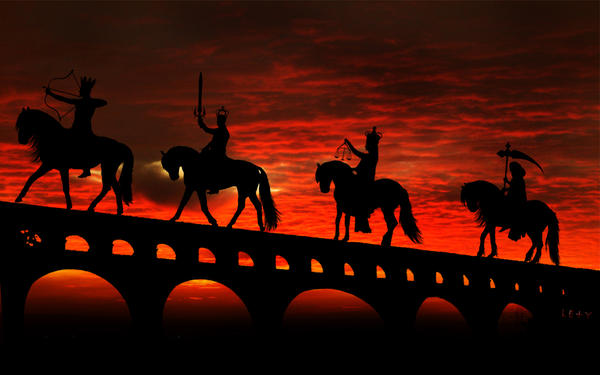
THE FOURTH HORSEMAN OF THE APOCALYPSE WAS NAMED SANDY


Okay, I admit, yet once again, I am going to hold my breath and vote today...vote for the less obnoxious of the two candidates put forward by the Capitalist Party.  If for no other reason, that I just can't imagine spending four years looking at and listening to Mitt Romney.  I also live in a state where one candidate for the Senate believes that there is a form of rape that is legitimate, who believes that a women's body "shuts down" after a rape and she can't get pregnant, and who believes that no matter what no women should have the choice of what to do with her body, should be able to choose abortion, even if she is raped.  I mean, you kind of feel like you just have to vote against that.  Still, I know all this voting stuff is certainly no answer to anything, but for whatever reason, I'll go stand in line and vote, if they let me.  However, if you aren't voting because it is all a charade, I certainly understand.

Anyway, I am going to post something, kind of in line with this mood, that is far too moderate for me, but I think makes some good points and in an interesting manner concerning global climate change.  

One other reason I chose this to post today is because I anticipate standing, and standing, and standing in line at the Church to vote, I figure I need to get out there in mid afternoon when most people can't be there...so I need to be fast here...so here goes...

Forgive me for not making revolution today.

The following is from Tom's Dispatch.


THE FOURTH HORSEMAN OF THE APOCALYPSE
HURRICANE SANDY RIDES IN


By Rebecca Solnit
The first horseman was named al-Qaeda in Manhattan, and it came as a message on September 11, 2001: that our meddling in the Middle East had sown rage and funded madness. We had meddled because of imperial ambition and because of oil, the black gold that fueled most of our machines and our largest corporations and too many of our politicians. The second horseman came not quite four years later. It was named Katrina, and this one too delivered a warning.
Katrina’s message was that we needed to face the dangers we had turned our back on when the country became obsessed with terrorism: failing infrastructure, institutional rot, racial divides, and poverty. And larger than any of these was the climate -- the heating oceans breeding stronger storms, melting the ice and raising the sea level, breaking the patterns of the weather we had always had into sharp shards: burning and dying forests, floods, droughts, heat waves in January, freak blizzards, sudden oscillations, acidifying oceans.
The third horseman came in October of 2008: it was named Wall Street, and when that horseman stumbled and collapsed, we were reminded that it had always been a predator, and all that had changed was the scale -- of deregulation, of greed, of recklessness, of amorality about homes and lives being casually trashed to profit the already wealthy. And the fourth horseman has arrived on schedule.
We called it Sandy, and it came to tell us we should have listened harder when the first, second, and third disasters showed up. This storm’s name shouldn’t be Sandy -- though that means we’ve run through the alphabet all the way up to S this hurricane season, way past brutal Isaac in August -- it should be Climate Change.  If each catastrophe came with a message, then this one’s was that global warming’s here, that the old rules don’t apply, and that not doing anything about it for the past 30 years is going to prove far, far more expensive than doing something would have been.
That is, expensive for us, for human beings, for life on Earth, if not for the carbon profiteers, the ones who are, in a way, tied to all four of these apocalyptic visitors. A reasonable estimate I heard of the cost of this disaster was $30 billion, just a tiny bit more than Chevron’s profits last year (though it might go as high as $50 billion). Except that it’s coming out of the empty wallets of single mothers in Hoboken, New Jersey, and the pensions of the elderly, and the taxes of the rest of us. Disasters cost most of us terribly, in our hearts, in our hopes for the future, and in our ability to lead a decent life. They cost some corporations as well, while leading to ever-greater profits for others.
Disasters Are Born Political
It was in no small part for the benefit of the weapons-makers and oil producers that we propped up dictators and built military bases and earned the resentment of the Muslim world. It was for the benefit of oil and other carbon producers that we did nothing about climate change, and they actively toiled to prevent any such action.
If you wanted, you could even add a fifth horseman, a fifth disaster to our list, the blowout of the BP well in the Gulf of Mexico in the spring of 2010; cost-cutting on equipment ended 11 lives and contaminated a region dense with wildlife and fishing families and hundreds of thousands of others. It was as horrendous as the other four, but it took fewer lives directly and it should have but didn't produce political change.
Each of the other catastrophes has redirected American politics and policy in profound ways. 9/11 brought us close to dictatorship, until Katrina corrected course by discrediting the Bush administration and putting poverty and racism, if not climate change, back on the agenda. Wall Street's implosion was the 2008 October Surprise that made Americans leave Republican presidential candidate John McCain's no-change campaign in the dust -- and that, three years later, prompted the birth of Occupy Wall Street.
The Wall Street collapse did a lot for Barack Obama, too, and just in time another October surprise has made Romney look venalclueless, and irrelevant. Disaster has been good to Obama -- Katrina’s reminder about race may have laid the groundwork for his presidential bid, and the financial implosion in the middle of the presidential campaign, as well as John McCain’s disastrous response to it, may have won him the last election.
The storm that broke the media narrative of an ascending Romney gave Obama the nonpartisan moment of solidarity he always longed for -- including the loving arms of New Jersey Governor Chris Christie. But it’s not about the president; it’s about the other seven billion of us and the rest of the Earth’s creatures, from plankton to pikas.
Hope in the Storm
Sandy did what no activist could have done adequately: put climate change back on the agenda, made the argument for reasonably large government, and reminded us of the colossal failures of the Bush administration seven years ago. (Michael “heckuva job” Brown, FEMA's astonishingly incompetent director under George W. Bush, even popped up to underscore just how far we've come.) 
Maybe Sandy will also remind us that terrorism was among the least common, if most dramatic, of the dangers we faced then and face now. Though rollercoasters in the surf and cities under water have their own drama -- and so does seawater rushing into the pit at Ground Zero.
Clearly, the game has changed. New York City’s billionaire mayor, when not endorsing police brutality against Wall Street’s Occupiers, has been a huge supporter of work on climate change.  He gave the Sierra Club $50 million to fight coal last year and late last week in Sandy’s wake came out with a tepid endorsement of Obama as the candidate who might do something on the climate. Last week as well, his magazine, Bloomberg Businessweek, ran a cover that could’ve run anytime in the past few decades (but didn’t) with the headline: “It’s global warming, stupid.”  
There are two things you can hope for after Sandy. The first is that every person stranded without power, running water, open grocery stores, access to transportation, an intact home, and maybe income (if work isn’t reachable or a job has been suspended) is able to return to normal as soon as possible. Or more than that in some cases, because the storm has also brought to light how many people were barely getting by before.  (After all, we also use the word “underwater” for people drowning in debt and houses worth less than what’s owed on their mortgages.) The second is that the fires and the water and the wind this time put climate change where it belongs, in the center of our most pressing issues.
 We Have Power! How Disasters Unfold
A stranger sent me a widely circulated photograph of a front gate in Hoboken with a power strip and extension cord and a little note that reads, “We have power! Please feel free to charge your phone.” We have power, and volunteers are putting it to work in ways that count. In many disasters, government and big bureaucratic relief organizations take time to get it together or they allocate aid in less than ideal ways. The most crucial early work is often done by those on the ground, by the neighbors, by civil society -- and word, as last week ended, was that the government wasn’t always doing it adequately. 
Hurricane Sandy seems to be typical in this regard. Occupy Wall Street and 350.org got together to create Occupy Sandy and are already doing splendid relief work, including for those in the flooded housing projects in Red Hook, Brooklyn. My friend Marina Sitrin, a scholar and Occupy organizer, wrote late last week:
“Amazing and inspiring work by community and Occupy folks! Hot nutritious meals for many hundreds. Supplies that people need, like diapers, baby wipes, flashlights etc., all organized. Also saw the first (meaning first set up in NYC -- only tonight) scary FEMA site a few blocks away. Militarized and policed entrance, to an area fenced in with 15-foot fences, where one gets a sort of military/astronaut ration with explanations of how to use in English that I did not understand. Plus Skittles?”
Occupy, declared dead by the mainstream media six weeks ago, is shining in this mess. Kindness, solidarity, mutual aid of this kind can ameliorate a catastrophe, but it can’t prevent one, and this isn’t the kind of power it takes to pump out drowned subway stations or rebuild railroad lines or get the lights back on. There is a role for government in disaster, and for mobilizing all available forces in forestalling our march toward a planet that could look like the New Jersey shore all the time.
When Occupy first began, all those tents, medical clinics, and community kitchens in the encampments reminded me of the aftermath of an earthquake.  The occupiers looked like disaster survivors -- and in a sense they were, though the disaster they had survived was called the economy and its impacts are usually remarkably invisible. Sandy is also an economic disaster: unlimited release of carbon into the atmosphere is very expensive and will get more so.
The increasingly turbulent, disaster-prone planet we’re on is our beautiful old Earth with the temperature raised almost one degree celsius. It’s going to get hotter than that, though we can still make a difference in how hot it gets. Right now, locally, in the soaked places, we need people to aid the stranded, the homeless, and the hungry. Globally we need to uncouple government from the Big Energy corporationsand ensure that most of the carbon energy left on the planet stays where it belongs: underground.
After the Status Quo
Disasters often unfold a little like revolutions. They create a tremendous rupture with the past. Today has nothing much in common with yesterday -- in how the system works or doesn’t, in what people have in common, in how they see their priorities and possibilities. The people in power are often most interested in returning to yesterday, because the status quo was working for them -- though Mayor Bloomberg is to be commended for taking the storm as a wake-up call to do more about climate change. For the rest of us, after such a disaster, sometimes the status quo doesn’t look so good.
Disasters often produce real political change, not always for the better (and not always for the worse). I called four of the last five big calamities in this country the four horsemen of the apocalypse because directly or otherwise they caused so much suffering, because they brought us closer to the brink, and because they changed our national direction. Disaster has now become our national policy: we invite it in and it directs us, for better and worse.
As the horsemen trample over all the things we love most, it becomes impossible to distinguish natural disaster from man-made calamity: maybe the point is that there is no difference anymore. But there’s another point: that we can prevent the worst of the impact in all sorts of ways, from evacuation plans to carbon emissions reductions to economic justice, and that it’s all tied up together.
I wish Sandy hadn’t happened. But it did, and there have been and will be more disasters like this. I hope that radical change arises from it. The climate has already changed. May we change to meet the challenges.
Rebecca Solnit wrote about disasters and civil society in A Paradise Built in Hell: The Extraordinary Communities That Arise in Disaster and in many reports for TomDispatch and other websites.