Tuesday, July 13, 2010

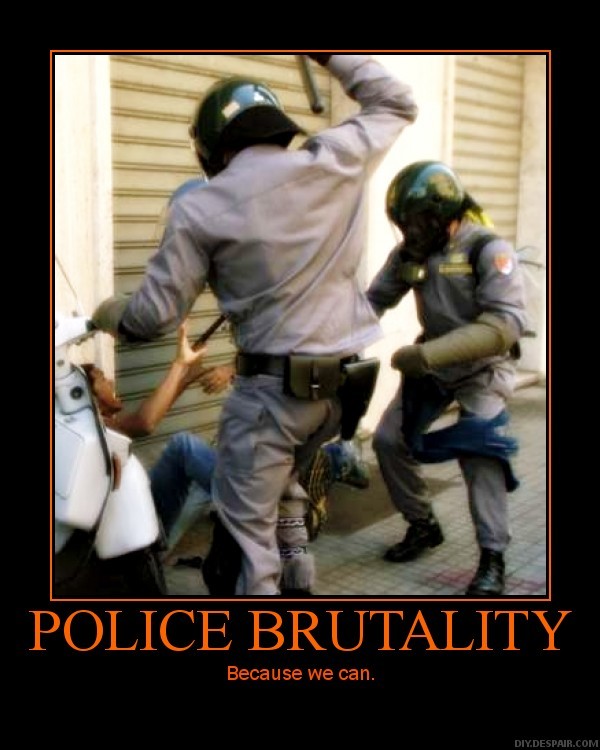
THE LYNCHING CONTINUE: POLICE BRUTALITY IN AMERICA

I'm still on hiatus, but I had to post this from the STEVELENDMANBLOG.


THE LYNCHINGS CONTINUE:

Police Brutality in America

by Stephen Lendman
Tuesday, 13 July 2010
Despite Congress passing the 1994 Violent Crime Control and Law Enforcement Act, Congress has consistently failed to fund it. Further, the legislation doesn't require local police agencies to keep records, nor does it criminalize police violence and excessive force as human rights violations.
Across America, daily incidents occur, one of many the cold-blooded January 1, 2009 murder of Oscar Grant - unarmed, offering no resistance, thrust face-down on the ground, shot in the back, and killed, videotaped on at least four cameras for irrefutable proof. USA Today said five bystanders taped it.
His killer: Oakland, CA transit officer, Johannes Mehserle, tried for the killing, the jury told to consider four possible verdicts - innocent, second-degree murder, voluntary manslaughter, or involuntary manslaughter, jurors deciding the latter.


The Legal Dictionary defines it as "The act of unlawfully killing another human being unintentionally," the absence of intent distinguishing it from voluntary manslaughter. Many states don't define it or do it vaguely. Wallin & Klarich Violent Crime Attorneys say in California it carries a two - four year sentence. However, since a gun was used, Judge Robert Perry can add three to 10 additional years.
Because minority victims seldom get justice, especially against police, Mehserle may serve minimal time, then be paroled quietly when the current furor subsides.


After the verdict, it erupted on Oakland streets, hundreds turning out to protest, Bay Area indymedia.org saying:
"The actions of the Police in Oakland tonight (including dozens of arrests) show their disrespect for justice in General. Their heavy handed violence towards protestors just reinforces their total disconnect with the people of Oakland." It's as true everywhere across America, police acting like Gestapo, usually unaccountably.
Grant's family will appeal the verdict and is suing the Bay Area Rapid Transit (BART) for $25 million, his mother Wanda Johnson saying "My son was murdered (and) the law has not held the officer accountable." It rarely does for Black, Latino, or other minorities, no matter the injustice, civil rights lawyer John Burris, representing Grant's family in the civil suit, saying:
"The system is rarely fair when a police officer shoots an African-American male." Police brutality against them and other minorites is systemic, including beatings, torture, and cold-blooded murder, usually with impunity, justice nearly always denied.
While far from certain, the Obama administration may charge Mehserle with civil rights or hate crime violations, DOJ spokesman Alejandro Miyar saying:
"The Justice Department has been closely monitoring the state's investigation and prosecution. The Civil Rights Division, the US Attorney's Office, and the FBI have an open investigation into the fatal shooting and, at the conclusion of the state prosecution, will conduct an independent review of the facts and circumstances to determine whether the evidence warrants federal prosecution."
Systemic Police Brutality
An earlier Jones Report.com text and video account headlined, "Epidemic of Police Brutality Sweeps America," showing footage of police repeatedly tasering a student with 50,000 volts of electricity for questioning the 2004 election results at a campus meeting.
Other videotaped incidents showed:
  • a man victimized by police violence;
  • a former sheriff's deputy acquitted of voluntary manslaughter for shooting an unarmed man;
  • police repeatedly beating an old man on the head, "for the crime of intoxication;"
  • officers violently using assault rifles, tear gas, dogs, and at least one helicopter in an alleged narcotics sweep;
  • a woman tasered to death by police; and
  • a man in shock, bleeding and burned over much of his body, ordered to lie on the pavement, then tasered and shot to death while he sat dazed, the Report highlighting systemic police violence "repeated almost every day in (America), the police (getting) away with murder," beatings, and other lawless acts - poor Blacks, Latinos, and Muslims for their faith and ethnicity their usual victims.
Amnesty International (AI) on American Police Brutality
On its web site, AI says "Police brutality and use of excessive force has been one of the central themes of (AI's) campaign on human rights violations in the USA," launched in October 1998. In its "United States of America: Rights for All Index," it documented systematic patterns of abuse across America, including "police beatings, unjustified shootings and the use of dangerous restraint techniques to subdue suspects."
Yet little is done to monitor or constrain it, evidence showing that "racial and ethnic minorities were disproportionately" harmed by harassment, verbal and physical abuse, false arrests, and in the case of West African immigrant, Amadou Diallo, shot at 41 times by four New York policemen, struck 19 times and killed while he stood in the vestibule of his apartment building, unarmed and nonviolent, victimized by police brutality.
Nationwide, driving while black has been criminalized, racial profiling used for traffic stops and searches for suspected drugs or other reasons, the practice especially common in California, Colorado, Florida, Illinois, Indiana, Maryland, Massachusetts, Pennsylvania, Oklahoma, Rhode Island, and Texas.
AI cited numerous incidents, including beatings and "questionable" shootings, usually found to be unjustified, yet cops most often absolved. Although most US police departments stipulate that officers should only use deadly force when their lives, or others, are endangered, dozens of cases show they do it indiscriminately, at most being "mildly disciplined" even if guilty of serious misconduct.
"Police shooting(s) resulting in death or injury are routinely reviewed (internally or) by local prosecutors....to see whether criminal laws (were) violated. However, few officers are criminally charged and little public information is given out if a case does not go to trial." As a result, systemic abuse stays hidden, police brutality allowed to persist with impunity.
Despite Congress passing the 1994 Police Accountability Act, incorporated into the 1994 Violent Crime Control and Law Enforcement Act to require the Attorney General to compile national data on excessive police force, Congress has consistently failed to fund it. Further, the legislation doesn't require local police agencies to keep records or submit data to the Justice Department. Nor does it criminalize police violence and excessive force as human rights violations.
ACLU Report on Racial and Ethnic Profiling
In August 2009, the report titled, "The Persistence of Racial Profiling in the United States" [PDF graphicDownload full report] quoted Rep. John Conyers (D. MI) saying "Since (9/11), our nation has engaged in a policy of institutionalized racial and ethnic profiling," although, as an African-American, he knows the problem goes back generations, most recently in the "war on terrorism" against Blacks, Latinos, and Muslims for their faith, ethnicity, activism, prominence, and at times charity, a topic this writer addresses often - arrests, some violently, bogus charges, prosecutions, and imprisonments often compounding the injustice.
Post-9/11 under Bush and Obama, federal, state and local law enforcement agencies have engaged in virulent racial/ethnic profiling, what the ACLU calls "a widespread and pervasive problem throughout the United States, impacting the lives of millions of people in African American, Asian, Latino, South Asian, and Arab communities."
Evidence shows that racial minorities are systematically victimized, without cause, in public, when driving, at work, at home, in places of worship, and traveling, often violently.
A "major impediment to (prohibiting it) remains the continued unwillingness or inability of the US government to pass federal legislation (banning the practice) with binding effect on federal, state or local law enforcement."
Nor do authorities comply with the provisions of the 1994 Convention on the Elimination of All Forms of Racial Discrimination (ICERD) that obligates all levels of government.
In addition, the Justice Department's 2003 Guidance Regarding the Use of Race by Federal Law Enforcement Agencies designed to ban federal officers from engaging in racial profiling is, in fact, flawed and does little to end it, because it doesn't cover "profiling based on religion, religious appearance, or national origin."
Nor does it apply to state and local law enforcement where police brutality is systemic. In addition, it specifies no enforcement mechanisms or punishments for violators, and contains a "blanket exception for national security and border integrity cases," besides being advisory and not legally binding.
As a result, it actually promotes profiling and abuse, including false arrests, beatings and killings. It's not surprising how minorities have been systematically mistreated by federal, state and local authorities, or that congressional legislation introduced to stop it never passed.
On December 13, 2007, the House and Senate introduced their versions of the End Racial Profiling Act (HR 4611 and S. 2481). Both bills were referred to committee and never enacted - making it extremely hard to nearly impossible for victims to successfully challenge abuses against them.
As a candidate, Obama promised a "Blueprint for Change" to ban racial profiling and related mistreatment, criminalizing them, but so far, no measures have been introduced or passed, showing another promise made, another broken, a systematic pattern under his leadership, across the board against the constituencies that elected him. Hopefully they'll remember next election and choose another way, a third way, both parties equally corrupted in deference to big money and systemic police brutality that serves it.
National Police Misconduct Statistics
The Injustice Everywhere.com (IE) web site compiles them, publishing them in regular reports, some for individual cities, including daily accounts. One on July 10 covers King County, WA deputy Paul Schene, captured on videotape assaulting a 15-year old girl in jail. He was tried twice, hung juries resulting each time.
On July 9, the County Prosecutor's Office dropped the charges, and won't pursue a third trial. As a result, the sheriff's department may rehire Schene, though he still faces possible disciplinary action. It's currently in arbitration, IE saying decisions nearly always favor officers, in which case he'll likely be reinstated to abuse other detainees, off camera to avoid being charged.
In early 2010, IE published an April - mid-December 2009 (8.5 months) Police Misconduct Report, from figures compiled in its National Police Misconduct Statistics Reporting Project (NPMSRP), begun earlier in March 2009, analyzing data:
"by utilizing news media reports of police misconduct to generate statistical information (to) approximate how prevalent (it) may be in the United States."
Police departments don't usually provide them, nor do courts, except for successful prosecutions, omitting confidential settlements and cases resulting in disciplinary action only, not trials. Media reports, though imperfect, are more complete because laws limit or filter information released. As a result, IE's data "should be considered as a low-end estimate of the current rate of police misconduct," as well as in individual cities covered.
Statistics compiled follow the same DOJ/FBI Uniform Crime Reporting (UCR) methodology, recording only the most serious allegation (not conviction) when multiple ones are associated with a particular incident. The findings were as follows:
  • 3,445 police misconduct reports;
  • 4,012 officers charged;
  • 261 law enforcement officials (police chiefs or sheriffs) cited;
  • 4,778 alleged victims;
  • 258 fatalities reported;
  • an average of 15.05 daily incidents or one every 96 minutes;
  • nearly $200 million in related civil litigation expense, excluding legal fees and court costs;
  • 980.64 per 100,000 officers charged;
  • one of every 266 officers accused of a violent crime;
  • one of every 1,875 charged with homocide;
  • one of every 947 accused of sexual assault;
  • 33% of police officers charged were convicted, not necessarily justly for the offense committed;
  • 64% of officers convicted were imprisoned, not necessarily as long as justified;
  • those sentenced served an average 14 months, far less than citizens for the same crime;
  • misconduct by category included 18.1% for non-firearm related excessive force; 11.9% for sexual misconduct; and 8.9% for fraud or theft;
  • analyzing reports by last reported status showed 45.9% affected officers adversely, including 14% internally disciplined and 31.9% criminally charged; of the latter, 32.5% were convicted "for a 10.4% total criminal conviction rate for alleged misconduct incidents; and
  • 27% resulted in civil lawsuits, 34.3% favoring victims.
In addition, data were compiled for states, cities and counties, excluding unavailable federal statistics as well as local omissions, especially in some states. Various offenses included:
  • accountability: evidence of coverups, lax discipline, and other failures to adhere to official policies or processes;
  • animal cruelty, harming them by unnecessary shooting, inappropriate KP unit training, or other mistreatment;
  • assault: "unwarranted violence" off-duty, excluding murder;
  • auto incidents involving recklessness, negligence, and other violations of official policies;
  • brutality, involving excessive physical force on-duty, excluding firearms or tasers;
  • civil rights, including unconstitutional civil liberties violations such as lawless peaceful protest disruptions;
  • sexual misconduct, including rape, sexual assault, sexual battery, wrongfully eliciting sex, harassment, coercion, prostitution, sex on duty, incest, and molestation;
  • theft or fraud, including robbery, shoplifting, extortion or bribery;
  • shooting: gun-related incidents both on and off-duty, including self-harm;
  • taser: excessive force, including usage not according to guidelines, resulting in excessive injury or death; also, improper taser use may be recorded as "brutality;"
  • color of law, including incidents involving misuse of authority such as bribery, soliciting favors, extortion by threat of arrest, or using badges to avoid arrest;
  • perjury, including false testimony, dishonesty during investigations, and falsifying charging papers or warrants; and
  • raids, including misconduct during warranted or warrantless operations or searches, wrong address raids, mistaken ones, use of no-knock ones when warrants require notification, or mistreatment during executions.
Misconduct status stages go from allegations to investigations, lawsuits, charges, trials, judgments, disciplinary measures, terminations, convictions, and sentences.
IE compiles data regularly, prepares daily and quarterly reports, and henceforth an annual one each January the following year. It explains that its statistics:
"should only be used (as) a very basic and general view of the extent of police misconduct. It is by no means an accurate gauge that truly represents the exact extent (of its extensiveness) since it relies on the information voluntarily gathered and/or released to the media, not (first-hand) by independent monitors who investigate complaints.....because no such agency exists for any law enforcement agency...."
Detailed quarterly and annual reports are produced, not monthly ones considered a less accurate "depiction of the overall extent of police misconduct...." Daily reports cover a sampling of individual incidents. Overall, IE provides a valuable reading of systemic police misconduct, though capturing only a snapshot of the full problem - widespread, abusive, violent, often with impunity, and when officers are held accountable, imposed discipline is usually mild, prison sentences rare and short-term, victims cheated by a criminally unjust system, favoring power over people, no matter the offense.
Final Comments
In December 2007, the UN Committee on the Elimination of Racial Discrimination published a report titled, "PDF graphic In the Shadows of the War on Terror: Persistent Police Brutality and Abuse of People of Color in the United States," saying:
"Since this Committee's 2001 review of the US, during which it expressed concern regarding incidents of police brutality and deaths in custody at the hands of US law enforcement officers, there have been dramatic increases in law enforcement powers in the name of waging the "war on terror (resulting in) the use of excessive force against people of color....(It's not only continued post-9/11), but has worsened in both practice and severity" - a NAACP representative saying it's "the worst I've seen in 50 years."
On April 4, 2007, Ryan Gallagher, writing for Medill Reports, produced by Northwestern University's Medill School of Journalism, headlined, "Study: Police abuse goes unpunished," saying:
From 2002 - 2004, over "10,000 complaints of police abuse were filed with Chicago police....but only 19 resulted in meaningful disciplinary action, a new study asserts." According to Gerald Frazier, president of Citizens Alert, it reflects "not only the appearance of influence and cover-up," but clear evidence that city residents are being abused, not protected, despite the department's official motto being "We Serve and Protect."
Most disturbing is that the Chicago pattern reflects what's happening across America, people of color like Oscar Grant systematically abused, in his case murdered in cold blood, what no criminal or civil actions can undo.


Stephen Lendman

    Stephen Lendman

    About Me

    I was born in 1934 in Boston, MA, raised in a modest middle income family, attended public schools, received a Harvard BA in 1956 and a Wharton MBA in 1960. After six years as a marketing research analyst, became part of a new small family business in 1967, remaining there until retiring in 1999. Have since devoted my time to progressive causes, extensive reading, and since summer 2005 writing on vital world and national topics, including war and peace, American imperialism, corporate dominance, political persecutions, and a range of other social, economic and political issues. In early 2007, began regular radio hosting, now The Progressive Radio News Hour on The Progressive Radio Network. Full information above.

    Wednesday, July 07, 2010

    TIME FOR A BREAK

    I have some reading to catch up with, so I'm taking the rest of the month off...

    EARTH FIRST! TAKES ON WIND POWER IN MAINE

    Four Earth First! protesters were arrested yesterday after they temporarily stopped a semi-truck carrying a 140-foot wind turbine blade to the Kibby Wind Power Project. One of those arrested ran under the truck and locked herself to the trailer’s steel supports. A group of about 50 people who had been attending the national Earth First! summer meeting at a camp in Coplin Plantation, began assembling at 5 a.m. at the entrance to the Gold Brook.

    The meeting itslef was branded by many as a terrorist gathering. Harriet Powers, who attended the meeting, told the Sun Journal she blames police and the Federal Bureau of Investigation for riling people up about Earth First!.


    “It looks to me like the sheriffs and the cops want to start something, and I guess that the FBI is the one that we found out started everything in town, telling everybody they were terrorists and everything,” she said.


    The following is from the Irregular.

    EARTH FIRST! PROTESTS KIBBY WIND POWER.

    David Hart
    Willow Amanda Cordez-Eklund of Minnesota sits beneath a turbine blade transport vehicle around 1 p.m. with her neck locked to the trailer's steel frame. The protest action stopped traffic for nearly 45 minutes. (David Hart photo)Willow Amanda Cordez-Eklund of Minnesota sits beneath a turbine blade transport vehicle around 1 p.m. with her neck locked to the trailer's steel frame. The protest action stopped traffic for nearly 45 minutes. (David Hart photo)COBURN GORE -- Nearly 60 Earth First! environmental activists came out early Tuesday morning and arranged themselves along the Gold Brook Road off Route 27 near the Canadian border to protest the Kibby Wind Power development. Four of the activists were arrested and sent to the Franklin County Detention Center.
    Wind developer TransCanada has begun its second phase of approved development, the delivery and installation of the second 22 turbines in its 44-turbine, 132-megawatt project begun last year.
    The action was staged during the delivery of turbine parts and just before the Land Use Regulation Commission’s meeting today, July 7 when it will consider TransCanada's proposal to install 15 more turbines on neighboring Sisk Mountain.
    The planned protest came on the heels of the national Earth First Round River Rendezvous, hosted this year by Maine Earth First. The weeklong campout was held along the South Branch of the Dead River on land owned by Basil and Harriett Powers.
    Maine State Police, Franklin County Sheriff’s Department and the U.S. Border Patrol were present before the 5 a.m. gathering and called the protest for the most part, peaceful.A stand-off between police and Earth First protesters along Route 27 at the Gold Brook entrance to the Kibby Wind Power project. (David Hart photo)A stand-off between police and Earth First protesters along Route 27 at the Gold Brook entrance to the Kibby Wind Power project. (David Hart photo)
    Several activists were escorted off land owned by Plumb Creek and issued warnings for trespassing in the early morning hours. Others were moved off the access road to the shoulder along Route 27 after a lockdown or blockade was broken up.
    After 11 a.m. police warned the protesters that they needed to stand on one side of the road and gave them a specific time frame in which to relocate.
    Earth First activist Courtney-Ann Boucher, 25, of Pine River, Minn., was the only member who did not obey and was the first activist to be placed in handcuffs that day.
    The event wound down at the wind project access road, but not before a similar rally took place a couple of miles south at the Sarampus Falls rest area.
    A truck carrying a 150-foot, five-ton turbine blade was temporarily stopped. Two activists jumped on the truck telling the driver to remain stopped and turn off his engine.
    The pair, Ana Isabel Rodriguez, 29, of Lake Worth, Fla. and Erik Gillard of Keene, N.H., were taken into custody.
    While the truck was stopped, Willow Amanda Cordez-Eklund, 26, of Minneapolis put a U-shaped bicycle lock around her neck and locked it to the underside frame of the transport vehicle in an effort to keep the wind power equipment from being delivered to the nearby Kibby project. This action convinced the trucker to turn off his engine.
    Cordez-Eklund remained beneath the truck for nearly a half hour while police scrambled to find bolt cutters. Traffic was stopped along Route 27 as this took place. Cordez-Eklund was asked to leave the scene voluntarily, but refused and was arrested once she was cut free from the steel frame.
    Courtney-Ann Boucher, 25, of Pine River, Minn., is arrested for refusing to listen to police officers who asked Earth First! protesters to disperse to the other side of the road for safety reasons. Earth First! activists staged a protest of the Kibby Wind Power project Tuesday; four members were arrested. (David Hart photo)Courtney-Ann Boucher, 25, of Pine River, Minn., is arrested for refusing to listen to police officers who asked Earth First! protesters to disperse to the other side of the road for safety reasons. Earth First! activists staged a protest of the Kibby Wind Power project Tuesday; four members were arrested. (David Hart photo)Protesters then moved to the detention center in Farmington to rally for their fellow members being held in custody. The four were arrested on charges of “failure to disperse” and held on $500 bail.
    “In the face of the Gulf oil disaster, and massively destructive coal mining, we recognize the value of developing alternative energy systems,” said Meg Gilmartin of Maine Earth First, in a prepared statement. “But these projects are a perfect example of how corporations and investors are taking advantage of the climate and energy crises to make profits while avoiding accountability. We don’t view projects on this industrial scale as being the solution to our problems.”
    “If we really want to look at how the north woods can mitigate climate change, we should restore our forest and protect sensitive ecosystems, like those on Sisk and Kibby mountains,” said Ryan Clark of Maine Earth First. “These unique high altitude areas are breeding grounds for the endangered Bicknell Thrush, nesting sites for the federally protected Golden Eagle and critical habitat for endangered Canadian Lynx.”
    The project is also being protested for moving forward without public hearings, the group explained.A truck containing wind turbine parts rolls into the Kibby Wind Power project location as the Earth First! protest begins to disperse Tuesday, July 6. The police formed a shoulder-to-shoulder blockade to keep activists from stopping this truck. (David Hart photo)A truck containing wind turbine parts rolls into the Kibby Wind Power project location as the Earth First! protest begins to disperse Tuesday, July 6. The police formed a shoulder-to-shoulder blockade to keep activists from stopping this truck. (David Hart photo)
    According to a press release, Maine Earth First is the local component of the national environmental group Earth First, a network of activists that focuses on grassroots organizing and direct actions in defense of the earth’s natural systems, and maintains a no-compromise stance.

    ATLANTA IS STILL IN GEORGIA WHICH IS UNFORTUNATE IF YOU HAPPEN TO BE GAY

    A gay couple were attacked an d robbed in a city park July 2 in Atlanta. There are three interesting parts of this story (an attack on a gay couple, unfortunately is not all that uncommon). First, the couple fought back and until the three attackers were reinforced by eight to ten others had the upper hand. Second, the police responded quickly and arrested six people. Third, the Atlanta police have classified the attack as a bias crime although the great state of Georgia does not have a hate crime statute. In fact, Georgia doesn't view lesbians, gays, transgender, bisexual and queer people as deserving of full rights, but rather as still second-class citizens who are not legally allowed to get married but can be fired for being gay.

    Meanwhile, Atlanta Police Department Officer Patricia Powell, the recently appointed LGBT liaison, said she is considering offering a safety course to gay Midtown residents following the incident.


    THE FOLLOWING IS FROM THE GEORGIA VOICE.

    Atlanta Police classify attack of gay couple in Piedmont Park as 'bias crime' 


    gay couple beaten and robbed in Piedmont Park by a group of male youths has been classified as a "bias crime" by Atlanta Police officials.
    Rev. Josh Noblitt (pictured here) of Saint Mark United Methodist Church and his partner were picnicking in the park on the evening of July 2 when they were approached by several young black males and beaten and then robbed at gunpoint.
    The first three young men who approached Noblitt and his partner asked, "Are y’all gay? Two men laying on a blanket. We ought to beat y’all for that,’” Noblitt told the Georgia Voice.
    Carlos Campos, spokesperson for the APD, said today they have classified the crime as a "bias crime."
    Campos said the APD is acknowledging it also did not follow protocol by informing Officer Patricia Powell, the LGBT liaison, about the incident until several days after it occurred.
    Campos said in a statement:
    "The Atlanta Police Department is treating Friday’s armed robbery of two gay men in Piedmont Park as a 'bias crime.' This is how the department classifies crimes in which bias based on color, nationality, sexual orientation or other factors played a role in the attack.
    "Georgia, however, does not have a hate crimes statute, so there is not a separate charge attached to the incident.
    "Department policy requires that the GLBT liaison be contacted in the event of a bias crime against anyone in the gay community. That did not happen in this incident. Department commanders will reiterate this policy to ensure compliance in the future.
    "Senior Patrol Officer Patricia Powell, who recently was named a GLBT liaison, will also be visiting personally with officers in the field to emphasize the importance of this procedure. It should also be noted that Officer Powell reached out to the victims of the Piedmont Park assault upon learning of the incident, and is re-doubling her efforts to communicate with the gay community, including the forming of a new GLBT advisory board for the APD."
    Six suspects were arrested in the crime, ranging in ages from 13 through 19.
    Watch www.thegavoice.com for further information as it is made available.

    Tuesday, July 06, 2010

    AND NOW BACK TO THE STRUGGLE NO ONE SEEMS TO TALK ABOUT


    The ongoing struggle of the Sahrawi people for an independent homeland continues and continues.  


    Few are those who take note.


    Last week, however, the European Social Forum (ESF), held in Istanbul, Turkey, actually went to the trouble to issue a statement of solidarity."We participants in the 2010 European Social Forum held in Istanbul coming from all parts of Europe wish to express our solidarity with the People of Western Sahara in its quest for self-determination ", the participant said in this appeal. 

    As reported by the Sahara Press Service, "They called on the United Nations to implement without delay the resolutions regarding the organizing of a referendum so the Saharawi people can freely determine their destiny."

    They also called on the Kingdom of Morocco to free all the Saharawi political prisoners."

    Finally, they called on the European Union and all its members to stop the plundering of the Saharawi natural resources and especially to annul the illegal fishery agreement with Morocco that includes the Saharawi waters which is a violation of international law."

    And then, as if by magic, the Nigeria Labor Congress via the Chair of its Women Commitssion, Ladi Illiya, declared at the weekend in Abuja while receiving the President of the Saharawi Women Union, Fatima Mehdi, that "Just like what we witnessed in the struggle for South Africa independence, the Nigeria Labour Congress (NLC) mobilised resources to fund activities aimed at getting the independence of South Africa and we are prepared to do the same again to force Morocco to set machinery in motion for the independence of Western Sahara."

    The following is from Sahara Press Service.


    Launch of week of brotherhood and solidarity with Saharawi people
    Algiers, July 5, 2010 (SPS) - The start of the Algerian-Sahrawi week of brotherhood and solidarity was given Sunday in the presence of several Algerian, Saharawi and international delegations.

    This event which will run until July 11, constitutes according to organizers an opportunity to publicize the struggle of the Sahrawi people against the Moroccan occupation and its commitment to its right to self-determination, through various cultural, artistic, political and sports events.

    Besides Sahrawi delegations from the liberated and occupied territories, delegation of the Latin American Association of Solidarity with the Saharawi people and Youth of Mali have come to renew their unwavering support to the struggle of the Saharawi people.

    On the agenda of this demonstration, exhibitions of Sahrawi crafts and photos about the repression undergone by the Sahrawis in the occupied territories as well as Sahrawi poetic and musical evenings.

    The kickoff of the event was marked by a march from Ouagnouni stadium (center of Algiers) to the Big Post Office with the participation of several groups representing different national folks of the wilayas to express their solidarity with the Saharawi people.

    The President of the Algerian National Committee of Solidarity with the Saharawi people (CNASPS), Mr. Mahrez Lamari, said in a statement that the Week of Solidarity "is an opportunity to raise awareness of the need to consolidate solidarity and cooperation among peoples of Africa and Latin America and renew the appeal to the United Nations to accelerate the implementation of Security Council resolutions in favor of the Saharawi people and their right to self-determination ".

    He also stressed the "popular dimension" of this event which asserts the "unconditional" solidarity of the Algerian people with the right of the Saharawi people to self-determination and its commitment to international legality. 

    From his part, Rabah Balahouane, responsible of the center of Algiers municipality indicated that the event which is a part of the twinning between the center of Algiers municipalities and El Aaiun will be "an opportunity to launch a strong message to address the United Nations and the international community on behalf of Africa for the completion of the decolonization process in the continent. 

    The Governor of the Wilaya of El Aaiun (Saharawi refugee camps), Mohamed Lamine Dadi underlined from his part that these events allow the Saharawi people to publicize its cause at the regional and global levels. They reiterate, he said, solidarity with the Saharawi people and support its legitimate struggle for freedom and independence.

    He added that the meeting reflects the common will of the Algerian-Sahrawi to strengthen relations rooted since decades and enable the Algerian civil society to express its solidarity with the Saharawi counterpart to follow the example of the support of the Algerian leadership with the Saharawi people, suffering under the Moroccan repression and which needs support and assistance of all peace-loving countries. (SPS)

    WE MUST NOT LET THEM STONE HER!


    Can you believe it is 2010 and we are talking about the scheduled stoning death of a woman.  Unbelievable!  

    Iranian Sakineh Mohammadi Ashtiani is sentenced to death because she allegedly had sex outside of marriage.  She is the victim of a theocratic regime that executes women who stray from the scriptural, patriarchal dogma they are otherwise compelled to observe.

    It's disgusting and don't tell me I should mind my own business and stay out of other people's cultures or relgions, because that isn't going to happen.

    But I digress. Under the Islamic Penal Code of Iran states that the stones used should “not be large enough to kill the person by one or two strikes” – clearly aiming to inflict a slow and painful death.  Wouldn't want a "gentle" stoning, for god's sake...literally for god's sake, I guess.

    Enough!

    I know that the actions suggested below pale before what really needs to be done, but what can I say.  I can say support the progressive and left forces who have struggled for years to topple the reactionaries from power in Iran.  Support a real People's Revolution and a real Revolutionary Iran - an Iran that will both oppose imperialism and stand for the human rights of it's people.  You know, like a socialist Iran or something...


    The following is from Maryam Namazie.


    We must not let them stone her!


    The Islamic regime of Iran will decide on Sakine Mohamadi Ashtiani’s stoning case on Saturday 10 July. Even though the sentence was final and her stoning imminent, they will be meeting to discuss it given the public outrage and condemnation.

    You can help by keeping the pressure on. Here are a few things you can do:

    Sign the petition.

    Send messages of protest to the Islamic regime of Iran: 


    Ayatollah Sadegh Larijani
    Head of the Judiciary of the Islamic Republic of Iran
    Howzeh Riyasat-e Qoveh Qazaiyeh (Office of the Head of the Judiciary)
    Pasteur St., Vali Asr Ave., south of Serah-e Jomhouri, Tehran 1316814737, Islamic Republic of Iran
    Email
    (Put given name in first starred box, family name in second starred box, and email address in third. Paste appeal in large box)

    Put pressure on other governments to condemn the stoning and urge Sakine’s release.

    Take stones to public places and leave them there with messages of solidarity for Sakine and against stoning.

    Here is some background information on her case:
    Guardian article, which quotes Mina Ahadi of the International Committee against Stoning.

    Letter from Sakine’s two children calling for public support.

    We must not - will not - let them stone her.

    ANOTHER INDIAN DEAD IN POLICE CUSTODY IN CANADA

    This story sounds all too familiar to me. Brandon Travis Daniels, 19, was arrested Friday just after 6:30 p.m., when police responded to a complaint "regarding possible drunkenness," a police spokeswoman said Sunday. Twelve hours later, still in police custody, the indigenous man was dead.

    To begin with it is unlikely 
    Brandon was drunk. The Mistawasis First Nation man, was visiting cousins and shopping for an uncle's wedding when he went missing Friday afternoon, said his mother Sherry Bird. While his cousin was applying for a job, Brandon waited outside. When his cousin returned, he was gone.

    Police had been called by someone who saw Daniels sitting on a bench and vomiting around 6:30 p.m. Friday. Thus, the cops figured - drunk Indian. I mean, why else would a person vomit?

    I've seen this story too often for my liking.


    THE FOLLOWING IS FROM THE NATIONAL POST.

    Teen visiting Saskatoon found dead in police cell

    Kathryn Blaze Carlson, National Post · Tuesday, Jul. 6, 2010
    Brandon Travis Daniels’ weekend visit to Saskatoon descended into tragedy after he was found dead in a police detention cell on Saturday morning, and now his family wants to know why the “quiet, shy” 19-year-old did not make it through the night alive.
    Mr. Daniels, who was a sibling to eight brothers and sisters and who lived with his mother on Mistawasis First Nation reserve, was reportedly picked up alone near a movie theatre for public drunkenness on Friday night. Twelve hours later, the shaggy-haired teen was pronounced dead.
    “It’s sort of unbelievable,” his mother, Sherry Bird, said from her home 120 kilometres north of Saskatoon. “To hear that he was picked up by police in the first place is surprising, but to hear that he died in a cell, of all places, is unbelievable.”
    Ms. Bird said her son’s death is made ever more surreal by the fact that she has yet to see her son, as his remains are still in Saskatoon awaiting an autopsy sometime on Tuesday.
    Mr. Daniels’ Facebook page is rife with references to playing video games, and lists his interests as graffiti, nature, reading the Twilight series, listening to Michael Jackson and surfing. By Saturday night, his sister’s Facebook profile was filled with condolences and personal reflections about her loss.
    “I sooo wished i wouldve woke up this mornin and you would come walkin through those doors,” his sister, Krista, wrote on Sunday afternoon. “Brother come home.”
    Bev Wise, Mr. Daniels’ aunt and a former councillor on the reserve, said the tight-knit family is “lost” and desperate to know how Mr. Daniels’ weekend visit to see his older cousin could have turned fatal.
    “Why didn’t they take him for medical attention?” said Ms. Wise, adding that the family was told Mr. Daniels — who was unemployed at the time — was found vomiting on a bench near a Galaxy Cinema. “We’re lost; we really don’t know how this could have happened.”
    The Saskatoon Police Service has launched an investigation and will rely on interviews with officers, witnesses and video footage of Mr. Daniels’ cell, said Const. TishaRae Stonehouse. The province’s Ministry of Justice appointed the RCMP to oversee the probe.
    “We’ll do all we can to discover why it took place,” Const. Stonehouse said, adding that video-monitoring of cells was part of a recent revamp of the detention centre. “If anything is determined that we could do better, then that is something that would be looked at in the context of an inquiry.”
    Const. Stonehouse said detention cells are checked every 10 minutes by commissionaires and every hour by the sergeant or special constable on duty. She said it is “up to officer discretion to determine whether an individual is in medical distress,” and said the officers who made initial contact with Mr. Daniels “determined that police cells were the appropriate place for this male.” The issue of death in police custody made headlines in Saskatoon four years ago when a 38-year-old man died from a mix of drugs and alcohol after lying on the concrete floor of a police cell for eight hours.
    Judy Othner, a spokeswoman for the Ministry of Corrections, said the province “takes these situations very seriously,” and said deaths in cells is a public safety priority.
    “Custodial supervision turns over much of an individual’s rights to a police service, and we count on a police service to ensure that the person in custody is receiving appropriate supervision,” she said.
    Ms. Othner said Mr. Daniels’ passing marks the province’s fourth death in a police cell since February 2004.
    His death also marks the second fatal tragedy to rock the Daniels family: In 2006, Mr. Daniels’ 22-year-old cousin was killed in a double-homicide on the reserve. Earlier this year, the accused was found not guilty.
    “First the justice system failed us, and now the police,” said Patricia Daniels, Mr. Daniels’ aunt. “Yet another young boy is lost from our family.”
    National Post
    kcarlson@nationalpost.com


    http://www.nationalpost.com/news/canada/toronto/Teen+visiting+Saskatoon+found+dead+police+cell/3239181/story.html#ixzz0sw902JM9