Saturday, October 15, 2005

NAZIS DON'T MARCH


THE FOLLOWING IS TAKEN FROM ONE PEOPLES PROJECT

You know things are interesting when they are being covered on the news live! Here's the deal: all HELL broke loose in Toledo! We will have more on this shortly, but the one thing we can confirm is that there was no march. The National Socialist Movement (NSM) actually fled the scene as things got raucous. Now normally when that happens, that means the police end up getting into a huge battle with the assembled counter demonstrators. Why should today be any different? We are getting word of a number of cars being vandalized and at least six arrests. The police brass is saying they are expecting about 40 arrests before all is done. The mayor imposed a 8 PM curfew for today because everything is going insane! Bill White is pissed, by the way. He is on Hal Turner's radio show to discuss what happened - and he is saying the cops, pretty much double-crossed the NSM! Whatever. Note that this is all just coming to us now. We will have more as we get it. We have some people on the ground that are giving us the story as it develops, and the police should have a press conference soon. In the meantime, to all of those who are dealing with the situation out in the Buckeye State, keep your head up. Unless you are a Nazi. In that case, keep your head down. You shamed yourselves today!


By One People’s Project


TOLEDO, OH—According to reports, the march planned through North Toledo by the National Socialist Movement was cancelled after over 200 antifa came out to oppose them in a situation that exploded into a full-blown riot. At the time of this writing, one arrest was reported in the midst of a confrontation between police and those who came out to oppose the NSM.

Reportedly, there was not one moment of peace. The Associated Press reported that two dozen Nazis came out for the NSM march against gang violence, while antifa only counted twelve. Whatever the real count was, it was dwarfed by the large numbers that came out against them. Four to five chapters of Anti Racist Action (ARA) were represented, as was the International Socialist Organization (ISO), but the largest group were community members themselves. Larges still were the number of police officers that were deployed for the march. At a certain point about one-quarter of a mile away along the planned route on Mulberry near Central, the cops reportedly charged the antifa. When this happened, the assembled Nazis, fearing they were now vulnerable ran off, and authorities announced via loudspeaker that the march was cancelled. By this point, however, things were so out of control that rocks were being thrown and tear gas was deployed. Media and police vehicles were damaged as well. One police car reportedly ran into a parked ambulance after a rock went through the vehicle’s window.

Although one arrest was reported, it is likely that there were others. Police were supposed to report on the day’s events early Saturday afternoon. The NSM meanwhile have not been heard from since they fled the scene. Overthrow.com, a website maintained by NSM Spokesman Bill White, has not been updated since Friday afternoon.

THE OREAD DAILY CALLS IT HOME


(CLICK ON THE PICTURE TO GET A MORE DETAILED/LARGER LOOK)

In honor of its birthplace in Lawrence, Kansas...

Friday, October 14, 2005

CHINESE POLICE ATTACK WORKERS AHEAD OF CONFERENCE


Numerous sources have reported that scores of Chinese workers were injured, with more than 20 taken to hospitals, after police broke up a 10,000-strong protest over lay-offs from a state-owned steel factory in the northwestern city of Chongqing several days ago.

Details of the incident are just now becoming more widely available.

On October 7, over 1,000 police officers seized Chongqing’s Shuangbei Garden, where several thousand sacked workers of the state-owned Chongqing Special Steel Co. Ltd. had been peacefully protesting, demanding unpaid wages, severance payments, and investigation into the company’s corruption. Eye witnesses say the police savagely beat the protesters, and many were seriously injured. They say that at least two women and a child of 7 or 8 years old died afterward.

The Australian reports that a 40-year-old protester with a bleeding and disfigured chin, who gave his name only as Cao, said another worker had his spine broken.

Cao said the medical records of those taken to hospital were confiscated so "if we come back to complain about what happened, there is no record".

Many of the protesters' families had worked for the 70-year-old factory for three generations. In July it was announced that the factory would be made bankrupt with debts of Y4.6billion ($758 million).

But the workers say it is a "fake bankruptcy". They say the profitable operations are being split off into a new company for the benefit of factory leaders. The new operation will employ only 1000 people, compared with the 18,000 employed by the Tegang plant at its peak.

The Epoch Times says that before it went bankrupt in July, the Chongqing Special Steel Co. Ltd. was a 70 years old huge state-owned enterprise. At its prime, the company had as many as 18,000 employees and was called “the mother of all industries in southwest China.” The company’s financial crisis was first exposed in early 1997 when it failed to pay its workers for five consecutive months. Until that time, the workers were told that the company was making profits.

In the following years, workers were laid off without compensation; those who stayed were often paid late or not given reimbursement for their medical bills.

The workers believe that the Chongqing Special Steel’s bankruptcy was mainly caused by corruption and corruption-related mismanagement. In 1990, the company spent over 200 million yuan (about US$25 million) purchasing a second-hand machine, which was broken and useless three years later. Another expensive machine was brought from Germany around the same time and was never put in service.

Many of the company’s transactions are questionable, say the workers. The company frequently purchased materials at prices higher than the market rate or sold its products at surprisingly low prices.

AsiaNews quotes a 41-year-old woman who said corrupt senior managers were to blame for the factory's failure. "These cadres spent 50 per cent of the company's revenue on their salaries and welfare," she said. “My family has worked for the factory for more than 50 years. We all joined the company when we were kids but now we've got nothing at the end."

The protests have been on going since August.

On 12 August, more than 2,000 laid-off workers barricaded one of the main city streets, bringing traffic to a standstill, to demand severance wages. The company managers said “they did not want to negotiate anything” with the workers who had lost their jobs and who were asking for 2,000 yuan (around 1,000 euros) per head.

The steel workers' main demand was an extremely modest one: that the factory should pay them 2,000 Yuan each in severance payment for their loss of employment.

The workers had originally planned to continue their protest on 10 October outside the venue of the Asia-Pacific Mayors' Summit, held in Chongqing on 11-14 October, but the police crackdown prevented this protest action from going ahead.

It seems that it is no coincidence that the police assault happened just one day before the fifth plenary session of the 16th Central Committee of the Chinese Communist Party (CCP) was to meet in Beijing, and four days before the fifth Asia Pacific Cities Summit was to be held in Chongqing.

Years of preparation went into the summit which is the largest international event ever hosted by the municipality. The Chongqing summit played host to 932 guests from 124 cities in 41 countries or regions, as well as 255 corporate representatives. It seems apparent that Chinese officials didn’t want a bunch of angry workers messing things up. Sources: AsiaNews.it, Epoch Times, The Australian, China Daily, China Labor Bulletin

URGENT PROTEST TODAY NEW YORK


The ProLibertad Freedom Campaign is calling on the Puerto Rican movement,
our friends and allies, to come out to an emergency protest at the Federal
Building, 26 Federal Plaza, City Hall, this Friday, October 14, 2005, at
5:00 p.m. Take the 4,5,6 to Brooklyn Bridge/City Hall!!

Former Puerto Rican Political Prisoner Antonio Camacho Negron, arrested for
being a part of the MACHETEROS in the late 1980s, communicated this evening
that an arrest warrant has been issued for him and that the FBI is searching
for him.

Antonio is asking that an urgent protest be organized demanding that his
life and physical integrity be respected.

He is also asking that the Venezuelan Consulate be contacted and asked to
request of the U.S. Government that his life and physical integrity be
respected.

WE NEED PEOPLE TO COME OUT AND SUPPORT ANTONIO CAMACHO NEGRON!! NO MORE
PUERTO RICAN POLITICAL PRISONERS!!

Todo Boricua Machetero!!
Hands Off Antonio Camacho Negron!!
Stop Repression Against the Puerto Rican Independence Movement!!
Stop The FBI Assassinations in Puerto Rico!!
Free All Political Prisoners!!
Free Puerto Rico!!

ONE PEOPLE'S PROJECT


The following is a note from One People's Project about an upcoming national television broadcast on which the organization appears. As described at its group site, "The One People's Project is about one thing: disseminating information. We are a collection of people across the country and in Canada the UK that are active in gathering that information about any and all persons involved in racist/right-wing activity. We may participate in the organization of an action from time to time, but our primary mission is to be an online resource for those fighting fascism." I consider the One People's Project's web sites to be one of the best and more signficant out there.


One People’s Project will be featured on the newsmagazine show "A Current Affair" on Oct. 24, 25. I taped my interview for these segments in mid September, and according to the producer the programs are going to be about the collapse of modern neo-nazi movements. In addition to myself, the segments will also feature Shaun Walker of the National Alliance, Bill White, and Erica Hardwick, who as many people might know used to run in those circles but is now working with us.

We should note that "A Current Affair" is Fox, but there were other factors other than our concern about the political questions surrounding that network that weighed in our decision. We thought that this was an important thing to do for several reasons, the absolute biggest being the fact that Bill White, who is getting a lot of play these days as spokesperson for the NSM, is a trust fund baby who has been purchasing homes in black neighborhoods and kicking tenants out for bogus reasons, in a effort to create a whites-only living space. A number of tenants have suffered because of this, yet even though the FBI and HUD are investigating him, the public has paid (no) attention to this, save for the local NAACP. That needs to change, and we need to get more people involved so we can shut this idiot down. He has recently been slapped with a $800K lawsuit from one of those tenants, so that's a positive step in that direction.

Frankly, I am glad we did this considering how a WNWO-24, a Toledo, OH television station attempted to slam us regarding Saturday’s march in that town. They didn’t particularly like our tagline, but screw it. Yes, WNWO, hate DOES have its consequences! It doesn't mean what we are going to be some reckless morons fighting neo-Nazis and the like, but it is not going to go unopposed or any further if we have anything to say about it. Imagine how pissed they would have been if they saw our old one about how we are an organization for folks who didn’t play nice, but I digress. Anyone that has had any issues about who we are and what we are about has never had any problems contacting me to ask about them - including the WNWO reporter, who when he called me yesterday afternoon seemed like he was going in a negative direction to begin with. The Toledo Blade reporter however was willing to listen, and I hope her story is a lot more informative than her television counterpart.

The fact remains that it is important that we define ourselves and not allow anyone else to do so. People have questions about what is going on, and what we can do about it. We should be able to provide answers.

Anyway, I just wanted to let heads know about the show. I will be putting an announcement on the site on Monday. "A Current Affair" is cancelled, and this will be one of the last shows to air. Incidentally, this will be the first time we have been profiled on national television. Hopefully they got my good side.

Sincerely,

Daryle Lamont Jenkins
One People’s Project

Wednesday, October 12, 2005

ANYTHING BUT POPULAR


Tens of thousands are in the streets of the main cities of Colombia today protesting a proposed free trade pact with the United States and accusing President Alvaro Uribe of selling out the country.

Thousands of state judicial, transport and education employees walked off the job, forcing the closure of public schools and notary offices in Bogota.

"Four more years of Uribe and we'll be in a coffin," chanted the demonstrators, who urged Colombia's highest court to strike down a measure that would allow Uribe to seek a second consecutive term in office during next year's presidential elections.

Hundreds of riot police erected road blocks across the capital to keep the protesters, some of whom wore Uncle Sam outfits, from straying off the planned march route.

The demonstrators are mainly trade union workers, students, and Indians.

Trade union leaders charge a free trade deal with the United States - expected to be signed within months - will make it impossible for Andean growers of sugar cane, rice, corn, potatoes and cotton to compete with heavily subsidized U.S. agricultural products. Further, they say the pharmaceutical patent protection clauses sought by Washington, that would make local production of generic medication illegal, will lead to a surge in the cost of medicine i the country.

"We are against the pact because we don't think that selling the country to the gringos is the best thing," said Oscar Mora, a teacher marching through Bogota.

Before the protests began Unitary Workers´ Central (CUT) President Carlos Rodriguez told Prensa Latina that more than a half million people would be at protests throughout the country to demonstrate against the negative effects resulting from the FTA´s implementation.

The CUT, along with other labor unions, students and social organizations plus the Colombian Federation of Teachers, called for a strike today to show the government people’s rejection of the commercial treaty with Washington.

“With this strike and rally we want to reject immediate presidential reelection of president Uribe as it is neither logical nor ethical that the Republic’s president be simultaneously a presidential candidate and head of state and use the nation’s budget for his campaign,” emphasized the CUT president.

The community protest coincides with an indigenous protest that started Sunday and was suppressed Monday by members of antiriot squadron, where one person was killed and more than 40 injured, among them seven minors.

Some 8,000 Indians embarked Monday on what was to be a weeklong march in western Colombia to protest the trade deal that they say would only worsen Colombia's unemployment woes.

Alberto Wazorna, a protest leader, said violence erupted after police provoked the marchers when they reached a major highway near Viterbo, 130 miles west of Bogota. "It was not necessary for the police to confront us, we were walking peacefully," he said.

The pact has been the target of other demonstrations in other countries in the past as well. In fact, popular protest broke out in most of the nations involved, led by farmers and labor organizations.

For example, on July 14 of this year some 500,000 people—construction workers, teachers, students and many others—marched in seven of Peru’s regions to protest the Andean free trade pact. The protests were organized by the General Confederation of Peruvian Workers (CGTP). A day earlier, July 13, some 4,000 people marched in Lima in another protest against the Andean trade pact, this time organized by the Association of Pharmaceutical Industries of National Origin and Capital (ADIFAN) and the National Convention of Peruvian Agriculture (CONVEAGRO).

“The Peruvian negotiators seem to be gringos, since until now they have achieved nothing for the country. On the contrary, they have given up 50 percent of the national market to the U.S.,” said CONVEAGRO president Luis Zúñiga at the time.

In September Peruvians took to the streets again.

A year ago, in Guayaquil, Ecuador’s main commercial city, negotiators from Ecuador, Colombia, Peru and the U.S. (as well as Bolivia, which has only observer status) held the fifth round of talks over a free trade agreement (TLC). At the same time, members of indigenous, campesino and grassroots organizations from Ecuador and other participating countries gathered in Guayaquil to protest the negotiations and strategize against the pact.

On October 25, the first day of the talks, five women activists from the group Ecological Action (Acción Ecológica) managed to sneak past heavy security into the reception area of the Hilton and pull out anti-TLC protest signs which they had hidden under their clothes. They shouted slogans (including “We don’t want to be a U.S. colony”) as guards grabbed them and threw them out.

On October 27, some 5,000 people protested the TLC by marching from the State University of Guayaquil coliseum to the Colón Hilton hotel, where the talks were taking place. The “March for Sovereignty and Life” was organized by the Confederation of Indigenous Nationalities of Ecuador (CONAIE), the National Campaign Against the TLC-ALCA and other groups. The same day, October 27, the groups participating in the “social round” issued the “Andean Declaration of Guayaquil,” reiterating their rejection of the TLC negotiations and announcing their intention to deepen and expand their struggle against the trade pact.

In Bolivia, too, indigenous farmers have protested and blocked roads. Today, with the volatile situation in that country, the government there would just as soon not even talk about such a deal with the US.

Back in Peru, Miguel Palacin, a leader of Peru’s Agricultural and Communities Front, which groups together more than a dozen associations of small-scale farmers warns, "The free trade agreement is going to destroy traditional agriculture in Peru. Millions of farming families are going to be pushed deeper into poverty by tariff-free imports."

The front, as well as Peru’s largest umbrella union, the General Confederation of Peruvian Workers, wants an eventual free trade agreement to be put to a referendum, in which voters and not Congress will decide if the trade pact should be ratified.

Peruvian economist Humberto Ortiz, who coordinates the Humanization of the Global Economy project for the Latin American bishops' council, known by its Spanish acronym CELAM says, "For nearly 20 years, our countries in Latin America and the Caribbean have been implementing a so-called development model that has led not to development, but to greater inequality and the loss of opportunities for the majority of people. What we need is a more humane model."

Riordan Roett, director of Latin American studies at Johns Hopkins University speaking of the popular opposition to the Andean trade pact, told the New York Times there was more than just a backlash against market reforms and the perceived trade agenda of the United States. "It's almost a wholesale rejection of what people believe they were fed by the folks in Washington," he said. Sources: Global Exchange, Fundacion Solon, Prensa Latina Seattle, Post Intelligencer, New York Times, bilaterals.org, Resource Center of the Americas

TOMMIE SMITH AND JOHN CARLOS TO BE HONORED


On October 17th (Monday) 1968 Olympic gold and bronze medal winners and San Jose State University (SJSU) student activists Tommie Smith and John Carlos will be honored with the unveiling of a 20-foot sculpture, located in the Sculpture Garden.

Designed by artist, Rigo 23, the sculpture depicts the pivotal moment in history when Smith and Carlos took a stand for human rights on the victory podium at the Olympics, a silent protest that was seen around the world.

Australian Peter Norman, the silver medalist who was with Smith and Carlos on the victory podium and supported their stand, will be at SJSU for the day-long celebration.

Smith and Carlos became one of the symbols of the civil rights movement of the 1960s when, after winning the gold and bronze medals for the 200-meter race in the 1968 Olympic Games in Mexico City, they put their fists in the air as a gesture of protest against the racist treatment of African Americans in the United States. For doing this, they were stripped of their medals.

SJSU President Don Kassing noted recently, "(Smith and Carlos) put everything at risk. Their medals were taken away from them. They were pushed out of the Olympic Village. They came back to San Jose and were treated terribly."

An entire day of activities is planned to honor these men and to commemorate student activism. Beginning at 10:30 a.m. to noon, in the Student Union, Smith, Carlos, Norman and gold medalist Lee Evans will join a panel discussion to talk about their roles in the historic 1968 Olympics. From 1 to 2:30 p.m. at the same location, a second panel discussion on Student Activism in the 60s will feature the above athletes and special guests. At 5 p.m., the special ceremony to unveil the sculpture will begin in the Sculpture Garden.

In addition to the above activities, the documentary, "Fists of Freedom," that portrays this courageous moment in civil rights history will be shown in the Mosaic Cross Cultural Center in the Student Union throughout the morning at 9 a.m., 10 a.m., 11 a.m., and noon.

The sculpture is the result of nearly three years of work by Associated Students to design and raise funds for the Tommie Smith/John Carlos Project. "The Tommie Smith – John Carlos Project teaches students that they can become active today and should not wait until they reach a certain age to address the issues that are important to them. The Project is more than the erection of a monument; it is the recognition of the sacrifices made by many students during the torrid civil rights era."

The initial fund raising effort supported the design and construction of the sculpture. The remaining funds will support the ongoing Project initiatives that include developing and delivering social awareness education for students; supporting student activists’ initiatives; and supporting those students who choose to get involved in the issues they believe in.

Earlier this year, the California State University and San Jose State University presented honorary doctorates to Smith and Carlos at the university's 148th commencement ceremony. At that event Smith said, "A lot of people have died for the freedom I was able to express in the 1960s." Sources: Associated Students San Jose State University, Spartan Daily (San Jose State University), Ascribe, San Jose State University

Tuesday, October 11, 2005

THEY'RE JUST OLD


During the course of the last week I'd been watching reports from Canada on the growing number of deaths at a Toronto nursing home. For days, the cause was said to be unknown, but the situation was described as "under control." But the deaths mounted. Then the government said not to worry the whole thing was probably caused by Legionnaires'disease. Anyway, health authorities said, the dead were old. "Some people are fragile enough that they may still succumb to this," David McKeown of Toronto's healt department said at a briefing that included Toronto Mayor David Miller and Dr. Donald Low, medical director of Ontario's Public Health Laboratories. "There is not and never was a threat to the general public," Toronto Mayor David Miller, said. He didn't add but we know he was telling everyone, "just a few old folks in a nursing home." Governmental officials seemed more concerned with tourism then the death of the residents of the nursing home. Toronto Coun. George Mammoliti said he feared the coverage could "scare the living daylights out of people" and cause long-lasting damage to the city's tourism industry. "SARS killed us economically," said Mammoliti. "We really don't need this." One newspaper brought the "thank God they're just old" together with bring on the tourists line as it without shame reported, "Earlier this week, local government officials and business owners took a collective sigh of relief when it was revealed that the mysterious deaths of 17 elderly people in Toronto, Canada was actually due to Legionnaires' disease, a non-contagious form of pneumonia that typically only affects the elderly or immunocompromised."

The following is taken from the Ocotber 8th Toronto Star...

Nothing normal about 17 dead in a week
Politicians focused on Toronto's image


by
THOMAS WALKOM

Now that the "mystery virus" that killed 17 residents of a Scarborough nursing home has been tentatively identified, everything in Toronto is business as usual.

The tourists can keep coming; the hotels can continue to boom. The city's media, which for reasons best known to themselves chose to downplay this rather astonishing public health story, can deliver a smug "I told you so" to the doomsayers.

Did foreigners refer to Toronto as "ground zero" of a mystery disease? Fie upon them. As it turned out, the pathogen that health officials originally called a mystery virus is neither a virus nor a mystery. It's a well-known pneumonia-causing bacterium that goes by the name of legionnaires' disease.

Or, to be more accurate, it is "likely" legionnaires' disease, according to Toronto's chief medical health officer David McKeown

As such, it's both treatable and non-contagious. So relax. Don't sweat it. There's no problem.

Except for the fact that 17 people died in one week.

Now, let us assume, for the sake of argument, that a disease has just killed 17 infants at the Hospital for Sick Children and caused 38 more people, including nursing staff and adult visitors, to be hospitalized.

Assume further that for a week or more public health authorities have no idea what this disease is or how to fight it.

In fact, they initially misidentify it as a virus.

How would you expect the public and government to react?

I would expect outrage. I would expect parents to demand that something be done to prevent similar outbreaks at other hospitals, child-care centres or schools.

I would expect political leaders to be on the hot seat.

I would expect Torontonians to be more concerned by the outbreak's immediate human cost than its effect on the city's tourist trade.

And I would expect this story to dominate the front pages of the newspapers.

But replace 17 infants with 17 nursing home residents and, for some inexplicable reason, everything changes.

The provincial government response, for instance, has been to say that old people die.

Such things, Health Minister George Smitherman said on Wednesday, are "regrettably not a new story."

In fact, Smitherman is wrong.

It is true that old people, like infants, are susceptible to disease. It is true that people get sick. But in the Toronto of recent memory, it is unprecedented for so many to die in such a short period of time from the same disease.

In the winter of 1997-98, a particularly virulent strain of influenza ravaged one Scarborough nursing home.

But the 16 deaths then occurred over a month, not a week. And not all deaths were attributable to the same cause.

Even during the Toronto SARS outbreak of 2003 — one that ultimately claimed the lives of 44 — there were never 17 deaths recorded in one week.

And while it is true that 12 of those who died this week were more than 80, one was in his mid-50s.

So, why exactly was Toronto so cavalier about this remarkable event?

At first, I assumed it was because most people simply don't value the old, that once a person is consigned to a nursing home, he or she is assumed to be of no value and less interest.

This was certainly the subtext of statements from officials and politicians who, in effect, said the 17 were doomed to die anyway.

(We are all doomed to die anyway — but this is a larger story.)

But then the Lake George tragedy occurred, the one in which 21 elderly Americans aboard a New York cruise boat drowned.

That garnered great attention here. It made the front pages of all the Toronto dailies and dominated the television newscasts.

Yet, of the four major city papers, only the Star and Sun bothered to give front-page coverage to early reports of a mystery illness that was killing Canadian old people.

And after that, even as deaths mounted, governments focused not on the outbreak itself but on making sure that news of the mysterious illness didn't hurt the Toronto tourist trade.

The message from authority, dutifully reported, was that everyone was doing a great job and everything was under control.

In spite of the inconvenient deaths, Smitherman told reporters, it was "business as normal" in Toronto.

But is it really that normal when 17 people in a provincially licensed institution die during a one-week period?

Are we really supposed to just shrug it off and order another latte?

FOREIGN STUDENTS VICTIMS OF HATE CRIMES IN RUSSIA


Foreign students in the central Russian city of Voronezh rallied twice Tuesday in protest of an incident where a Peruvian student was murdered in a racist attack earlier this week. Two other students were beaten in the same assault.

According to the Moscow News around noon on Tuesday, some 300 students set out from the Voronezh State (University) to the main square in the town where they encircled a monument to Vladimir Lenin for the rally.

The rally and another held the same day was organized by the group “Nashi (Ours).”

“We want to draw attention of the general public to the problems of racial and national discrimination,” the organization’s press centre told Itar-Tass.

Prosecutors in Voronezh, a city of 1 million located 580 kilometers south of Moscow, called the Sunday evening attack an act of hooliganism, and the region's governor concurred that it could not be considered a hate crime because a Russian student was also injured. The Russian student suffered minor injuries but was not hospitalized.

The foreign students were walking with a Russian student near the Olimpik Sports Complex on the outskirts of Voronezh at around 6 p.m. Sunday when they were attacked by 15 to 20 young men carrying knives and "blunt metal and wooden objects," Galina Gorshkova, a spokeswoman for the Voronezh regional prosecutor's office, said Monday.

Killed was Peruvian national Enrique Arturo Angeles Hurtado, a first-year student at the Voronezh State Architecture and Civil Engineering University.

Peruvian national, Alexander Manuel Navarro Ayala, 18, was hospitalized with a concussion and was in stable condition Monday, said Egorov Ramirez Hinojosa, consul-general at the Peruvian Embassy in Moscow. He said Ayala had arrived in Voronezh about a week ago.

Ilyas Altavil, who lived in the same dormitory as Hurtado, said on NTV television that the slain student had been considering leaving because of fears for his safety. "He asked me: 'Is it too scary to live here? Should I go back and live with my friends?'" Altavil said.

Sunday's attack was the latest in a series of apparently racially motivated attacks in Voronezh. Over the past five years, 13 foreign students have died in racially motivated slayings, said Gabriel Kotchofa, president of the Foreign Students Association in Russia.

Human rights activists say the practice of classifying such crimes as hooliganism rather than racially motivated has only encouraged an increase in similar attacks. "These crimes are not punished seriously, meaning the perpetrators face no consequences," Alexander Brod, head of the Moscow Bureau for Human Rights told the Moscow Times.

Brod said Voronezh was one of the top five cities in Russia in terms of skinhead and extremist activity, along with Moscow, St. Petersburg, Volgograd and Rostov-on-Don. "The difference is that in cities like St. Petersburg, local authorities are trying to take active measures to combat xenophobia," Brod said. "In Voronezh, regional authorities are doing almost nothing."

Foreign students in Voronezh mounted a wave of protests last year after the stabbing death of Amaro Antonio Limo, a 24-year-old medical student from Guinea-Bissau. Limo was stabbed a few hundred meters from his dormitory in central Voronezh on Feb. 21, 2004. Police detained three suspects the next month, and they were convicted in September 2004 and sentenced to prison terms ranging from nine to 17 years.

According to a report from the Moscow Bureau for Human Rights, “The level of xenophobia remained constantly high in the first half of 2005. According to different sociological surveys the percentage of supporters of xenophobic viewpoints fluctuated between 50 and 60 percents. Among the nations - top targets of population's dislike and hostility are, first of all, Chechens (14.8%), Azeri (5.1%), Armenians (4.1%) and migrants from the Caucasus in general (6.0%). Gypsies are also on the list (5.1%). Jews are mentioned less often (2.5%).” There was no information in the report concerning foreign students.

There are about 100,000 foreign nationals studying in Russia’s colleges and universities. Students from the CIS countries — the former Soviet republics — account for approximately one-third of them.

With attacks on foreign nationals on the rise across the country many of them are considering leaving Russian out of fear for their personal safety.

A 40-year-old Chinese national — a student at the St. Petersburg Rimsky-Korsakov conservatoire — was severely beaten by unidentified attackers recently. He was hospitalized with a head injury and brain concussion.

In a separate incident, an Angolan national — a former student of the Agricultural University — was attacked and wounded in the Northern capital.

Last March students at Kuban State University in Krasnodar staged a picked at the university urging authorities to protect them from skinhead attacks. That protest was held in the wake of a March 26 attack on two foreign students of the Kuban University and Medical Academy — nationals of Syria and Lebanon. Both suffered numerous injuries.

Arab students have also been attacked in St. Petersburg. Gannam Mohamad, representative of the Union of Arab Students told the Moscow Times earlier this year, “We no longer have any trust in the law enforcement agencies, while protest rallies are, apparently, useless.” Sources: RIA-Novosti, Itar-Tass, Moscow Times, Xinhua, Moscow News

Monday, October 10, 2005

COOPERATION AND SOLIDARITY


A Venezuelan delegation is carrying out a working visit in the Saharawi Republic (Western Sahara), in the context of bi-lateral agreements signed in October 2004. The delegation led by the general director of the administrative management of the Ministry for Health, Dr Alberto Randon, will evaluate needs in the areas of health and training. "I come bearing a message of support and solidarity from the President Hugo Chavez and all the people in the Bolivarian Republic of Venezuela to the Saharawi people and their heroic struggle for self-determination and independence", Randon declared during a reception.

It was a year ago that Venezuela announced its plans to cooperate with Cuba to provide humanitarian aid for the people of the Western Sahara. "Venezuela and Cuba will join forces to give humanitarian aid to the Saharan Republic ... Spain, too," Venezuelan Foreign Minister Jesus Perez said in October 2004.

At that time Venezuelan President Hugo Chavez said, "We strongly support Saharawi people's struggle for their self-determination and dignity." Chavez made the statement during a meeting on his plane with a delegation of Saharawi ministers of state. Chavez reaffirmed the commitment of his Government to back Saharawi people's struggle against the foreign occupation and for a full exercise of their legitimate rights to self-determination and independence, before declaring the signing of accords of cooperation between the two Governments, Saharawi and Venezuelan.

In a speech last week at the United Nations Cuban alternate permanent representative to the UN, Ileana Nuñez expressed concern for the paralysis of the process for the Western Sahara region, and said that Cuba supports creation of a referendum to find an honorable solution to the Saharan situation, including the right of the Saharan people’s self-determination in the solution of their case. Sources: All Africa, SPS, Western Sahara Referendum Support Association, Prensa Latina, Alert Net

NOT GOING BACK TO EARLIER TIMES


Navajo Nation officials claim El Paso Natural Gas Co. (EPNG) is manipulating the facts and attempting to bypass the tribe's sovereignty by going directly to the Interior Department in an attempt to get a better right-of-way deal for its pipeline across tribal land.

The Arizona Republic reports EPNG wants the U.S. Department of the Interior's approval of a pipeline right-of-way easement that would allow the Houston-based company to continue shipping natural gas throughout the Southwest. The move is unusual because EPNG has yet to strike a financial deal with the tribe, typically a required step before the feds consider such an application.

EPNG officials told the Arizona Republic that the tribe's demands have been unreasonable and could result in higher bills for customers such as Southwest Gas, which supplies natural gas to a half-million Arizona homes.

Navajo Nation Attorney General Louis Denetsosie says EPNG is trying to scare consumers into thinking the Navajo Nation is profiteering from scarce energy supplies in its bid to renegotiate a better rights-of-way deal for itself.

“If anyone is profiteering at the expense of customers, it is El Paso,” Denetsosie said

El Paso has employed a variety of avenues to obtain rights to Navajo Nation land for inadequate consideration, Denetsosie said. For instance, in the recent federal energy legislation, it sought unsuccessfully to get Congress to violate solemn promises of the United States in its treaties with the Navajo Nation.

“It is now apparently seeking to obtain a 20-year renewal of its rights-of-way without Navajo Nation consent using the Navajo Nation’s federal trustee, the Secretary of the Interior,” the attorney general said. “Its most recent gambit is a public relations strategy to scare consumers and regulators alike.”

Denetsosie said consumers have no reason to be concerned. He said the Navajo Nation has offered reasonable terms for a 20-year renewal of EPNG’s rights-of-way. If accepted by the company, the effect would be “utterly insignificant from the consumers’ perspective,” he said. “EPNG’s competitors have accepted comparable terms,” Mr. Denetsosie added. “El Paso simply wants to return the Navajo Nation to the earlier times when rights-of-way over Native American lands were granted by the United States for nominal consideration, thus gaining a competitive advantage over other gas pipeline companies.”

Denetsosie emphasized that the Navajo Nation is willing to agree on reasonable terms with EPNG. “But we will not willingly submit to the type of predatory behavior that El Paso has visited on other groups in recent years, most notably California and Arizona consumers,” he said.

Keith Harper, attorney for the Native American Rights Fund, said the tribe has a right to negotiate its own terms and doubts the federal government would become involved in the negotiations. ''I think if the Interior gets involved in undermining the decision-making right of a sovereign nation, they are treading on very shaky ground,'' Harper said, according to The Associated Press.

Furthermore, Harper said studies have shown that Native Americans historically have been short-changed in right-of-way negotiations with utilities and oil companies.

A 2003 study of such transactions showed individual Native American property owners were reimbursed an average of $25 for every 3 yards of pipeline, compared with the non-Native rate of $135 and up for a similar-sized stretch of pipeline.

Denetsosie points out that under a Federal Energy Regulatory Commission (FERC) settlement in March 2003, El Paso agreed to pay more than $1.7 billion to California customers to settle lawsuits claiming El Paso manipulated the natural gas markets.

Denetsosie says, "El Paso is currently seeking higher tariffs from FERC over its western pipeline system and, in lieu of settlement payments, is offering favorable rates to California customers, placing the burden of the higher rate adjustment on east-of-California customers." Sources: Arizona Republic, Arizona Central, Navajo Nation, Indian Country Today

HIGH SCHOOL STUDENTS TAKE ON ANTI-ABORTION NUTCAKES


Disgusted by the anti-abortion antics of Wichita's Spirit One Christian Center, students from Wichita’s West High School showed up at the Center in protest. In particular, the students were ticked off about that anti-abortion protest the church supported earlier this week at the high school.

The West High students were joined by students from North, Northeast and Southeast high schools and Wichita State. There also were supporters from the Peace and Social Justice Center and others.

It started as a peaceful protest, but the two sides got pretty heated throughout the morning.

Louis Goseland, a senior at West told the Wichita Eagle the anti-abortion group, at the school demonstrations, had lashed out against Muslims and homosexuals in addition to abortion. "We will not tolerate their intolerance," Goseland said.

“Basically, we're wanting to respond to them, and let them know their hate speech wasn't appreciated at West," said Goseland.

On October 3 through 8, Spirit One embarked on a campaign called 'Operation Save America. OSA is an out-growth of the well-known Operation Rescue only OSA chose to specifically targets high-school and college students for protests and demonstrations.

George Harper, a student at West said the OSA anti-abortion people who showed up at his school, “…were harassing students and not allowing them to leave until they took a paper.” Harper also said that the protesters disrupted classes, "They were there for about an hour after school started. They had their speakers aimed at the school."

One brochure passed out at West read, "The bible and the 10 commandments have been outlawed, illegal, made contraband, in your public school. Your Christian rights are being denied you."

Another brochure had to do with Mark Tiller, a local doctor who specializes in abortions. This one stated, "Following the shedding of their innocent blood, he then places the children he has slaughtered on his altar to burn them as an offering to his god. This makes him a priest of Satan." Below this message is a picture of a lady handing a baby to a priest. In the background is a cackling horned demon, his hands dripping with blood. Sources: Blogcritics.org, KBSD (Dodge City), Wichita Eagle, KAKE (Wichita)

THE PHONY CAMPAIGN OF "LOVE ULSTER"


The following is just in to me from sources in Northern Ireland...

'Love Ulster' welcoming of loyalist paramilitaries must be condemned by DUP if they are serious about tackling North Antrim sectarianism

For Immediate Release:10/10/2005

Ballymena Sinn Féin Councillor Monica Digney has said that she is appalled at remarks from ‘Love Ulster’ spokesperson Willie Frazer about welcoming loyalist paramilitaries to the ‘Love Ulster’ campaign. Cllr Digney’s comments come after Mr Frazer addressed Ballymena Borough Council at the invitation of Unionist Councillors.

Cllr Digney said:

“Willie Frazer has said that loyalist paramilitaries are welcome in his campaign as individuals - in other words those involved in the pipe-bombing of Catholics in Ahoghill and the attacks on Catholic businesses throughout the Ballymena area are welcome to attend any future rallies and meetings of this group. Mr Frazer, in no shape or form, asks these people to stop their anti-Catholic attacks before they will be accepted into this campaign. They are quite clearly acceptable to the ‘Love Ulster’ campaign in their present form.

“These comments have again shown the ‘Love Ulster’ campaign up as having strong links with the UDA, UVF and other loyalist paramilitaries. From Day 1 we saw UDA men unloading the campaign’s newspaper at its Larne launch, which was also fronted, by local DUP man Willie Wilkinson.

“This campaign is more about sectarian hatred than ‘Love’ and I would hope that no Unionist party endorses the campaign in the wake of Mr Frazer’s words of welcome for UDA and UVF members. If the DUP is serious about opposing those who are attacking Catholic homes and property in this borough then they should not be standing shoulder to shoulder with loyalist paramilitaries at this group’s march in Belfast at the end of the month. This will be a litmus test of their commitment to tackle the loyalist paramilitaries within their community.”

++++++++++++++++++++++++++++++++++++++
The following are the stated goals of "Love Ulster" as noted on their web site:

LoveUlster is a campaign for Unionist unity.

LoveUlster calls for the democratic rights of the Unionist community to be recognised and respected by government.

LoveUlster calls for an end to government concessions to Irish nationalism/republicanism

LoveUlster gives people a voice and encourages them to have their say.

LoveUlster is a peaceful and democratic initiative by a range of organisations across the Province, including the Shankill Mirror, victims support groups and the Orange Institution.
+++++++++++++++++++++++++++++++++++++++++++++++++++++

The following is taken from the International Relations and Security Network which is run by the Center for Security Studies based in Zurich:

'Love Ulster’ campaign sparks criticism

ISN SECURITY WATCH (30/08/05) - A new grassroots campaign dubbed “Love Ulster”, on Monday began disseminating newsletters across Northern Ireland aimed at denouncing nationalist dominance over the political process.

The Love Ulster campaign will disseminate 200,000 free newsletters across Northern Ireland, highlighting unionist concerns at political concessions granted to Sinn Féin and the Irish Republican Army (IRA) since the latter’s statement that it was ending its nearly four-decade campaign of violence against British rule.

In the days after the statement, the British government announced radical plans for demilitarization in Northern Ireland - a move unionists view as premature at best and a betrayal at worst. They see the disbandment of the British army’s Royal Irish Regiment as a move that will harm unionist culture.

William Wilkinson, a spokesman for the Love Ulster campaign, told ISN Security Watch that unionists were “shocked at the speed of the [British] concessions [after the IRA statement]”.

Wilkinson, who works for a support group for victims of IRA violence, said he believed there was a reason for unionists to distrust the British government, which he accused of “negotiating aspects of the current process behind our backs and over our heads”.

The head of the exclusively Protestant Orange Order has backed the campaign, which says Northern Ireland is at a crisis point, with a clear need for a movement to oppose the creation of a unified all-Ireland state.

Wilkinson feels that the Irish government is being given an increasing role in Northern Ireland, and notes that the British government, as far back as 1991, had said it had no “strategic or economic interest” in remaining in Ireland.

Now unionist activists are taking matters into their own hands, without confronting or criticizing mainstream unionist politicians. “We are not pointing the finger at our politicians, but seek to complement them,” Wilkinson said, adding that “both parties [the Democratic Unionist Party and the Ulster Unionist Party] have voiced their opposition to the current process of appeasement”.

The Love Ulster pamphlets were landed at the port town of Larne in a symbolic re-enactment of the 1914 landing of guns at the port, intended for use by the old Ulster Volunteer Force to resist pre-World War I plans for devolved government or “Home Rule” for Ireland.

Wilkinson insists the re-enactment is merely symbolic. However, the reported participation of loyalist paramilitaries in distributing the pamphlets may cause nationalists to see differently.

Social Democratic and Labour Party (SDLP) vice-president Alasdair McDonnell said the involvement of loyalist paramilitaries in a “phony campaign against a united Ireland” was “utterly disgraceful”.

The SDLP said the campaign was a disgraceful attempt to spread fear and a sense of crisis.

Saturday, October 08, 2005

THE QUAKE: FROM ALJAZEERA, PERSONAL BLOGS AND MEDECINS SANS FRONTIERES


Quake kills hundreds in India, Pakistan
from Aljazeera
Saturday 08 October 2005 9:49 AM GMT


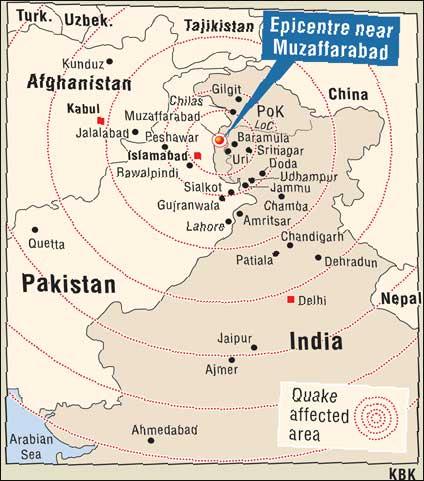
A powerful 7.6-magnitude earthquake near the Pakistan-India border reduced villages to rubble, triggered landslides and flattened an apartment building, killing more than 1000 people in both nations.
Pakistan's army called Saturday's devastation "a national tragedy".

In the capitals of Pakistan, India and Afghanistan, buildings shook and walls swayed for about a minute, and panicked people ran from their homes and offices.

Tremors continued for hours afterward. Communications throughout the region were cut.

About 1000 people died in Pakistani Kashmir, said Sardar Mohammed Anwar, the top government official in the area.

"This is my conservative guess, and the death toll could be much higher," Anwar told Pakistan's Aaj television station. He said most homes in Muzaffarabad, the area's capital, were damaged, and schools and hospitals collapsed.

At least 550 people died in Pakistan's North West Frontier Province, the local police chief said.

"The death toll is between 550 and 600 in North West Frontier Province and it is likely to rise," Riffat Pasha, the provincial head of police told AFP.

Another police official said more than 500 people had died in the province's remote districts of Mansehra and Malakand.

"We still do not have any full death count but the reports sent by different police stations say between 500 to 600 people have died," Mansehra police official Mohammad Asghar told AFP.


The quake, which occurred directly on the dividing line between the Indian and Pakistani controlled zones of Kashmir, triggered landslides and sent terrified residents fleeing into the streets.

Senior Pakistani officials described scenes of "massive devastation".

Thirty-five people were feared killed when a courtroom and two schools collapsed in northern Pakistan during the huge quake, police and officials said.


The Pakistani military said that at least one village in Kashmir had been destroyed and that troops and helicopters had been scrambled to reach the stricken areas.

"There are reports of buildings collapsing in several cities in central Pakistan. We have no exact estimates, but the casualties could be very high," said one Pakistani official, asking to remain anonymous.

The Indian army said at least 31 people - 16 civilians and 15 soldiers - had been killed in the Indian-controlled zone of Kashmir and about 300 taken to hospital.

Indian army spokesman P Sehgal said many soldiers had died when their positions caved in along the line of control, the heavily-militarised de facto border which divides Kashmir into Indian- and Pakistani-administered zones.

Sehgal said others were hit by falling trees and landslides.

The US Geological Survey and the Pakistan Meteorological Department said the quake measured 7.6 on the Richter scale, while the Japanese Meteorological Agency put the temblor higher at 7.8.

The epicentre was around 100km northeast of Islamabad, according to most agencies, although the Earth Sciences Observatory in the French city of Strasbourg said the epicentre was just inside Indian Kashmir.

The divided territory of Kashmir is claimed in full by India and Pakistan. Thousands of troops face off on each side of the line of control and the two countries have fought two wars over the territory.

The quake shook the desert town of Quetta, 700km southwest of Islamabad as well as the northern Afghan city of Kunduz, 500km north of the Pakistani capital.

In Islamabad, part of an 11-storey apartment block collapsed leaving dozens of people trapped and neighbours clawing at the rubble in an attempt to free them.

Bloodstained people could be seen trapped beneath huge stone slabs at the scene while desperate cries for help could be heard.

A school in the nearby city of Rawalpindi also came down, killing one child and injuring six others, while Afghan officials said at least two children had been killed near the town of Jalalabad.

Witnesses in Islamabad said the ground shook for more than 30 seconds, rocking buildings and causing widespread panic. A second, less severe jolt lasted about five seconds.

Many mosques in Islamabad started reciting special prayers straight afterwards.


The quake was felt strongly in Indian Kashmir, causing panic and bringing people pouring out onto the streets of the summer capital, Srinagar.

"This is the strongest earthquake I have ever witnessed in my life"

"This is the strongest earthquake I have ever witnessed in my life," said Aisha Begum, 84.

Screams were heard from across Srinagar as people fled homes, shops and offices fearing they would be buried under rubble.

Doctors at Srinagar's main hospital said more than 200 people were admitted with injuries and shock, while more than 100 people were being treated at an army hospital in the northern town of Uri alone.

The tremor also brought down part of the state-owned television's main transmitter tower on a hill overlooking Srinagar.

The disputed Kashmir region is an area of high seismic activity that lies in the collision zone of the Eurasian and Indian tectonic plates.


FROM PERSONAL BLOGS

Sat Oct 8 13:17:15 2005
Name: VINEET SANTOSHI
Email: vineet_santoshi@rediffmail.com
Quake Experience: I was driving my bike to office on red signle my bike is moving like a boat i was supriesed every body was looking each other this nature
City: New Delhi

Sat Oct 8 13:17:46 2005
Name: NEERAJ
Email: neeraj.bhatia@rediffmail.com
Quake Experience: Everything was quiet.Suddenly things started shaking.. we could see shaking window blinds and everbody was havin an indifferent and experience
City: New Delhi

Sat Oct 8 13:18:04 2005
Name: Sunil Macwan
Email: rushi_intl2003@rediffmail.com
Quake Experience: Never to say....This was a great exp. of my life....like a high BP of a man, the heart beat increased.. the same way i wast felt the earth beats...
City: Anand

Sat Oct 8 13:18:19 2005
Name: archana
Email: archanamishra@yahoo.co.in
Quake Experience: i was waiting for my friend outside her hostel suddenly i found that someone is pushing me after some time i realize that it was earthquake
City: chandigarh

Sat Oct 8 13:18:32 2005
Name: A.Murali Reddy.
Email: muralireddya@yahoo.com
Quake Experience: I am In Kabul it is around 8-30 am just I am reading my mails on laptop suddenly on my table laptop shaking little bit immediately run away from office, but still I have fear may be earth quake come again. A. Murali Reddy.
City: Kabul

Sat Oct 8 13:18:47 2005
Name: Abhijit Das
Email: abhijitdas86@rediffmail.com
Quake Experience: Our aquarium in our house in New Delhi crashed onto the ground and the sofa moved from one end to the other.
City: New Delhi

Sat Oct 8 13:19:09 2005
Name: karthik
Email: karthikv22@rediffmail.com
Quake Experience: I wremember the time as i was jus lookin at my watch.we were waiting for our college bus.me and my friends were sitting on a platform. I felt a sudden movement I initially felt that it was my head that was spinning. , so when everyone felt the same way we then thought it was the platform. When we reached college, we got to know that it was a quake.
City: Dehradun

Sat Oct 8 13:19:24 2005
Name: debashis
Email: debashis_mazumdar@rediffmail.com
Quake Experience: i was talking to my colleague, when we felt a sudden tremor and saw the computers shaking and the fan swinging, all the people in the office started vacating luckily nobody got injured, and there was no damage to building, but pretty horrifying experience.
City: New Delhi

Sat Oct 8 13:19:52 2005
Name: PANKAJ
Email: PANKAJ_JAIN1985@REDIFFMAIL.COM
Quake Experience: I WAS NOT ABLE EVEN TO FEEL IT
City: DELHI

Sat Oct 8 13:20:05 2005
Name: Sanjeev
Email: sanzy_28@rediffmail.com
Quake Experience: I was in office..... and it was like somebody is pushing my chair then after few minutes i came to know that its earthquake... but its tooooooooooooo scary... Thanks to God Almighty that we are safe
City: Vaishali (Ghaziabad)

Sat Oct 8 13:20:19 2005
Name: sanjay
Email: vo12da@yahoo.com
Quake Experience: Arround 9:25 am my computer started shaking, I thought its elelc. prob.Next my chair started shaking.I thought my friend is doing something.but he was bussy with pfone.Then i saw almira it was also swaying.Then i saw the one cable which was shaking.At that moment i relised tha it is an earthquake.Me & my friend rushed to open space.
City: baddi,distt:solan,Himachal

Sat Oct 8 13:20:56 2005
Name: juned umer
Email: umer_80@rediffmail.com
Quake Experience: Today morning at 9.25 am I am sitting down infront my computer in the office. suddenly something is hanging in our top. I so anxes. In running out the office. We are so nerves & after 10 minutes we are relaxing. J&K is very upset God bless him.
City: Chandigarh

Sat Oct 8 13:20:57 2005
Name: G. Agrawal
Email: grics@sify.com
Quake Experience: Well it was around 9.00 I was standing in my factory which has a small water pool. Suddenly the water starts shaking and the 1/3 water just overlowed. Then I hear the clattering of the factory windows. By the time we evacuated the building it was all over. We could see the entire shed shaking. Luckily there was no damage caused.
City: Kathua

Sat Oct 8 13:21:00 2005
Name: T R Balakrishnan
Email: trbala2005@rediff.com
Quake Experience: Not felt in New Mumbai
City: New Mumbai,Maharashtra

Sat Oct 8 13:21:17 2005
Name: Shahzad
Email: bunny2000@rediffmail.com
Quake Experience: As you know it is the holy month of our ramzan going on, we slept so late after taking sehri(pre dawn meal)but we had to wake up early yo attend office.I was reciting Quran in loud voice and my mother was also in other room. We live at the fourth floor of our building. Suddenly i felt some viberations. I adjusted my chair as it is of some shaking nature and started again on Quran but again i felt even the table over which i was doing the same. I looked back my sister was on her bed in other room complaining that some thing has moved inside her bed and viberating it my mother also felt the same. in no time we took a final nod that this is an earthquake. we started jumping stair by stair but instantly i thought ofmy third floor family whose husband goes office early in the morning she must be left with her two wards she would be feeling helpless. I knocked out her door and lifted her one of the child and asked to run as she by the time now has also felt the tremor. Thus, we all just came out of the building and escaped the high shocking tremors to fall on us.
City: New Delhi
6 for 6 minutes...
It was extremely terrifying. Was sleeping at around 8:45 when suddenly heard a strange sound, 'gaunj' which woke me up for a while but just as I was about to close my eyes for sleep something shook my bed totally. It was the quake. In sleep I failed to recognise it first and tried sleeping again but the second shock was the worst. the whole structure seemed to move for a while. I ran outside trying to go in the street when our maid shouted me to stay where i am and sit down immediately. I din't know what was going on I tried to run again but was again asked to sit down where i stood. I sat on a nearby bench while she recited Kalima in a hoarse voice. The whole house seemed to be moving, shaking badly. Thankfully it stopped soon but it was horrible. I gathered my senses and went to sleep again..

The sound of Geo's broadcaster woke me up from sleep as I heard him talking about the earthquake. I never realised it was that bad till i got to see the television. Margalla Bulding was left to dust, several casualities were reported. They fear that the death toll may rise beyond 1000!. Tauheed Khalla called from Islamabad and told that a crack appeared on one of their walls. The news agency's are only talking about Islamabad and nothern areas not even mentioning Lahore which shows how viscious the quake was over there.

May Allah help us recover from this terrible incident and Save us in future!
Aamin!

Massive tremors rock north India
Massive tremors rocked North India at 9.25 AM on Saturday morning. Tremors measuring 6.8 on the richter scale were felt in Delhi, Srinagar, Amritsar, Patiala, Jaipur, Chandigarh and Dehradun. The quake had its epicentre in Pakistan.

Immediate reports from Jammu & Kashmir say that normal life has been disrupted. Communication lines have been disconnected. People have left their houses and taken refuge under the open sky.

The tremors went on for about thirty seconds and are reported to have also been felt in neighbouring Pakistan and Afghanistan.
...
[+] Expand this post
Bala at 12:04:00 AM | 0 comments | Post a Comment | Want to help? | Need help? |

SATURDAY, OCTOBER 08, 2005
Pakistani college closed - Update from Ayub Medical College, Abbottabad
Abbottabad and areas around faced a heavy eartquake (7.6) at 8:42 AM today the 8th September 2005 which resulted in damage to many buildings and have claimed many lives in Abbottabad, Mansehra, Balakot, Garhi Habibullah, Muzafarabad and areas north to this region.

All hospitals in the region are on Red Alert receiving victums of the quake. More than 200 patients have been treated in Ayub Teaching Hospital till now (3:30 PM)

The Surgery Paper B of Final Year MBBS has been posponed while the rest of the examination will be on schedule. The College will remain closed till further order. The hostels have been evacuated as a precaution. For more information please email, call +92-(992)-381907 or send a fax to +92-(992)-382321


Source: Ayub Medical College
Angelo Embuldeniya (Strav) at 11:38:00 PM | 0 comments | Post a Comment | Want to help? | Need help? |
Fearing aftershocks, Pakistan hospital treats wounded outdoors
Lying on makeshift beds on a hospital lawn in this northwestern Pakistani hill town, some screaming in pain, hundreds of men, women and children wait for help. But they have to stay there for now, because doctors say the monster earthquake that rumbled through the region early Saturday could have made the building dangerous.

"We feel it is unsafe to keep patients inside," Amir Shah, a senior doctor at the Ayub hospital in Abbotabad, told AFP.

Already at breaking point because of the flood of victims and a shortage of supplies, vilent aftershocks added to the worry.


From MEDECINS SANS FRONTIERES

TEAM AT ASIAN EARTHQUAKE ZONE
MSF has a staff of three who recently arrived in the Pakistani area to start a project on safe motherhood. The focus now is to mobiize more staff and supplies to the region.
An earthquake measuring 7.6 on the Richter Scale struck in the north of Pakistan this morning, just 80 kms north of the Pakistan capital, Islamabad. The affected area runs from the north of Afghanistan and Pakistan to the Indian Kashmir.
The damage throughout the affected region is considerable and the number of victims is expected to be high. Immediate media estimates anticipate over 1,000 feared dead.
MSF was already present in the area with three expats in the village of Lamnian in Pakistani Kashmir, some 15 kilometers from the line of control with Indian Kashmir and close to the epicentre of the earthquake. The three are a project coordinator, logistician and nurse and were about to start a project there and were hiring national staff.
The village has been completely destroyed, including the clinic where we are about to start working and the MSF house. The project would focus on safe motherhood. All team members are fine.
The Pakistani army is responding with big logistical/medical capacity
MSF is now focusing to getting reponse capacity to the region. Stocks from Quetta, Dubai and Mumbai will be moved up to the north and MSF is looking into how to get additional resources in the country; cargo as well as people (blankets; jerrycans; sleeping mats and tents) ...

Friday, October 07, 2005

COMING UP: SCORCHING DESERTS OF NEW ENGLAND


It so happens that on some Friday’s I just reprint an article of interest or importance from another source en lieu of the Oread Daily. Today, my friends, is such a day.

The following is taken from MotherJones.com

The Other Hurricane
Has the Age of Chaos begun?


Mike Davis
October 07 , 2005

The genesis of two category-five hurricanes (Katrina and Rita) in a row over the Gulf of Mexico is an unprecedented and troubling occurrence. But for most tropical meteorologists the truly astonishing "storm of the decade" took place in March 2004. Hurricane Catarina -- so named because it made landfall in the southern Brazilian state of Santa Catarina -- was the first recorded south Atlantic hurricane in history.

Textbook orthodoxy had long excluded the possibility of such an event; sea temperatures, experts claimed, were too low and wind shear too powerful to allow tropical depressions to evolve into cyclones south of the Atlantic Equator. Indeed, forecasters rubbed their eyes in disbelief as weather satellites down-linked the first images of a classical whirling disc with a well-formed eye in these forbidden latitudes.

In a series of recent meetings and publications, researchers have debated the origin and significance of Catarina. A crucial question is this: Was Catarina simply a rare event at the outlying edge of the normal bell curve of South Atlantic weather -- just as, for example, Joe DiMaggio's incredible 56-game hitting streak in 1941 represented an extreme probability in baseball (an analogy made famous by Stephen Jay Gould) -- or was Catarina a "threshold" event, signaling some fundamental and abrupt change of state in the planet's climate system?

Scientific discussions of environmental change and global warming have long been haunted by the specter of nonlinearity. Climate models, like econometric models, are easiest to build and understand when they are simple linear extrapolations of well-quantified past behavior; when causes maintain a consistent proportionality to their effects.

But all the major components of global climate -- air, water, ice, and vegetation -- are actually nonlinear: At certain thresholds they can switch from one state of organization to another, with catastrophic consequences for species too finely-tuned to the old norms. Until the early 1990s, however, it was generally believed that these major climate transitions took centuries, if not millennia, to accomplish. Now, thanks to the decoding of subtle signatures in ice cores and sea-bottom sediments, we know that global temperatures and ocean circulation can, under the right circumstances, change abruptly -- in a decade or even less.

The paradigmatic example is the so-called "Younger Dryas" event, 12,800 years ago, when an ice dam collapsed, releasing an immense volume of meltwater from the shrinking Laurentian ice-sheet into the Atlantic Ocean via the instantly-created St. Lawrence River. This "freshening" of the North Atlantic suppressed the northward conveyance of warm water by the Gulf Current and plunged Europe back into a thousand-year ice age.

Abrupt switching mechanisms in the climate system ? such as relatively small changes in ocean salinity -- are augmented by causal loops that act as amplifiers. Perhaps the most famous example is sea-ice albedo: The vast expanses of white, frozen Arctic Ocean ice reflect heat back into space, thus providing positive feedback for cooling trends; alternatively, shrinking sea-ice increases heat absorption, accelerating both its own further melting and planetary warming.

Thresholds, switches, amplifiers, chaos -- contemporary geophysics assumes that earth history is inherently revolutionary. This is why many prominent researchers -- especially those who study topics like ice-sheet stability and North Atlantic circulation -- have always had qualms about the consensus projections of the Intergovernmental Panel on Climate Change (IPCC), the world authority on global warming.

In contrast to Bushite flat-Earthers and shills for the oil industry, their skepticism has been founded on fears that the IPCC models fail to adequately allow for catastrophic nonlinearities like the Younger Dryas. Where other researchers model the late 21st-century climate that our children will live with upon the precedents of the Altithermal (the hottest phase of the current Holocene period, 8000 years ago) or the Eemian (the previous, even warmer interglacial episode, 120,000 years ago), growing numbers of geophysicists toy with the possibilities of runaway warming returning the earth to the torrid chaos of the Paleocene-Eocene Thermal Maximum (PETM: 55 million years ago) when the extreme and rapid heating of the oceans led to massive extinctions.

Dramatic new evidence has emerged recently that we may be headed, if not back to the dread, almost inconceivable PETM, then to a much harder landing than envisioned by the IPCC.

As I flew toward Louisiana and the carnage of Katrina three weeks ago, I found myself reading the August 23rd issue of EOS, the newsletter of the American Geophysical Union. I was pole-axed by an article entitled "Arctic System on Trajectory to New, Seasonally Ice-Free State," co-authored by 21 scientists from almost as many universities and research institutes. Even two days later, walking among the ruins of the Lower Ninth Ward, I found myself worrying more about the EOS article than the disaster surrounding me.

The article begins with a recounting of trends familiar to any reader of the Tuesday science section of the New York Times: For almost 30 years, Arctic sea ice has been thinning and shrinking so dramatically that "a summer ice-free Arctic Ocean within a century is a real possibility." The scientists, however, add a new observation -- that this process is probably irreversible. "Surprisingly, it is difficult to identify a single feedback mechanism within the Arctic that has the potency or speed to alter the system's present course."

An ice-free Arctic Ocean has not existed for at least one million years and the authors warn that the Earth is inexorably headed toward a "super-interglacial" state "outside the envelope of glacial-interglacial fluctuations that prevailed during recent Earth history." They emphasize that within a century global warming will probably exceed the Eemian temperature maximum and thus obviate all the models that have made this their essential scenario. They also suggest that the total or partial collapse of the Greenland Ice Sheet is a real possibility -- an event that would definitely throw a Younger Dryas wrench into the Gulf Current.

If they are right, then we are living on the climate equivalent of a runaway train that is picking up speed as it passes the stations marked "Altithermal" and "Eemian." "Outside the envelope," moreover, means that we are not only leaving behind the serendipitous climatic parameters of the Holocene -- the last 10,000 years of mild, warm weather that have favored the explosive growth of agriculture and urban civilization -- but also those of the late Pleistocene that fostered the evolution of Homo sapiens in eastern Africa.

Other researchers undoubtedly will contest the extraordinary conclusions of the EOS article and -- we must hope -- suggest the existence of countervailing forces to this scenario of an Arctic albedo catastrophe. But for the time being, at least, research on global change is pointing toward worst-case scenarios.

All of this, of course, is a perverse tribute to industrial capitalism and extractive imperialism as geological forces so formidable that they have succeeded in scarcely more than two centuries -- indeed, mainly in the last fifty years -- in knocking the earth off its climatic pedestal and propelling it toward the nonlinear unknown.

The demon in me wants to say: Party and make merry. No need now to worry about Kyoto, recycling your aluminum cans, or using too much toilet paper, when, soon enough, we'll be debating how many hunter-gathers can survive in the scorching deserts of New England or the tropical forests of the Yukon.

The good parent in me, however, screams: How is it possible that we can now contemplate with scientific seriousness whether our children's children will themselves have children? Let Exxon answer that in one of their sanctimonious ads.


Mike Davis is the author of many books including City of Quartz, Dead Cities and Other Tales, and the just published Monster at Our Door, The Global Threat of Avian Flu (The New Press) as well as the forthcoming Planet of Slums (Verso).

Copyright 2005 Mike Davis

This piece first appeared, with an introduction by Tom Engelhardt, at Tomdispatch.com.

. . . . . . . . . . . . . . . . . . . . . . . . . . . . . . . . . . . . . . . . .

This article has been made possible by the Foundation for National Progress, the Investigative Fund of Mother Jones, and gifts from generous readers like you.

© 2005 The Foundation for National Progress

BRIEF FROM NORTHERN IRELAND


For Immediate Release:7/10/2005

North Antrim Sinn Féin MLA, Philip McGuigan, has said that he found it quite sad that the SDLP excluded members of his party from attending a ‘North-South Makes Sense’ conference in Derry. All parties that have representatives in the Dáil were invited to attend the conference except for Sinn Féin members.

Mr McGuigan said:

“The decision by the SDLP to exclude members of Sinn Féin from a conference on promoting North-South co-operation, a premise that we totally adhere to, is in my opinion both childish and hypocritical.

“The politics of exclusion is something that is more commonly found in the DUP and it saddens me that the SDLP feel it is necessary to go down this road. Sinn Féin is a big supporter of further North-South co-operation, indeed we are the only party that operates across the entire island, and it seems absolutely ludicrous that the SDLP is penalising us because of this.

“The fact that parties such as the Conservative Progressive Democrats will be attending this conference – a party which is quite happy for partition to remain in place – whilst Sinn Féin is discriminated against is something that speaks for itself. It makes sense for the SDLP and Sinn Féin to be working together to promote North-South co-operation and indeed a united Ireland. Exclusion and alienation doesn’t make any sense at all.”

Thursday, October 06, 2005

RELIGIOUS WORKERS OF THE WORLD UNITE


The Korea Times is reporting on the unionization of lay Buddhists working at the Samkwang Temple in the southern port city of Pusan.

Around 30 ``Bodhisattvas’’ who work as security guards, parking agents and cooks at the Temple have been at odds with temple management for a while now and have recently joined the Pusan branch of the Korean Confederation of Trade Unions (KCTU). Bodhisattva, in this case, refers to a lay Buddhist who vows to live by compassion and seek enlightenment while serving priests and working for the temple administration.

Last Saturday the workers gathered in front of the temple gates with other labor activists carrying sings and banners with such messages as ``Stop Unfair Labor’’ and ``Be Sincere in Negotiations.’’

``Even though most of us have been working hard here for more than a decade, the temple doesn’t treat us as workers but as volunteers. They see no need to compensate us for our labor,’’ a Bodhisattva claimed. ``The temple should be quick in coming to the negotiation table and listening to complaints about its unappreciation for our sacrifices,’’ he said.

The temple says the workers are just volunteers. ``They don’t have legal status as employees. And the temple is not in the position to improve their working conditions,’’ a temple official said.

In July, lay Buddhist workers at the Central Directorate of Religious Affairs of the Jogye Order of Korean Buddhism filed an application with the order’s regional office to create their own union. A decision has not yet been made. If the union is permitted, it will be the first union of Buddhists in Korea.

``The union will help Buddhist management be responsible to its laypeople,’’ said a member of the would-be first Buddhist union. ``There are corruption scandals popping out from the Buddhist community. And we think the Buddhist union will also be helpful in preventing them,’’ he said.

But it isn’t just Buddhists.

Lee Kil-won, pastor of Kyonggin Church in Inchon, created the first Christian labor union in Korea in May 2004. The union caused concern in the Christian community, as critics said struggle and conflict accompanied with union activities oppose the Christian principle of love. However, the union is getting positive reactions so far, mainly for its activities to help church workers who were unfairly dismissed to be reinstated.

``Unionization doesn’t infringe on religious principles. Rather, it helps workers facing unfair working conditions at churches gain their rights as workers,’’ Lee told the Korea Times. ``Every religious organization should take responsibility for its hired workers. As we have set a precedent, it will not be as difficult for them (Buddhists) to have one,’’ he said.

And it isn’t just Korea.

Religious workers in the United Kingdom have been organizing for almost five years. In 2000 nearly 2,000 letters were sent by Reverend Paul Flowers to Methodist ministers and deacons across Great Britain urging them to join a trade union – the Transport and General Workers' Union. Rev. Flowers told the Telegraph and Argus at the time the move was not an expression of dissatisfaction with the church's hierarchy. It was merely to provide his colleagues with a professional body to represent them and create a forum where issues could be raised with the church. The additional benefit clearly of being in a trade union is that it is independent of the church structures. We hope that it could be seen as a useful forum to talk through issues."

Last year after Rev. Flowers was nominated to sit on a government working group set up to examine employment rights in religious organizations. At that time he said, “The absence of any clear guidance for the employment of the clergy means officials often lack the full protection of the law. The T&G has been involved in a number of cases where officials are concerned by unfair dismissal and discrimination.” Many religious officials are considered self-employed which has given rise to problems of employment protection.

And now members of what is believed to be the first workers' union in a Roman Catholic Church say church leaders are trying to break the labor contract and undermine the union. The charges involve lay workers at churches in the Diocese of Brownsville who signed up with the United Farm Workers in 2003.

"During the two years since Aug. 18, 2003, the agreement signed before Judge Ramirez has been broken, and the employees in the diocese and at Holy Spirit have suffered terribly," Rebecca Flores, a spokeswoman for the workers, wrote in a news release.

The union has drawn praise from liberal Catholic Church groups like Call to Action, which said the church should be applying its own teachings about workers' rights in its own backyard. “The Catholic Church has always been at the forefront of supporting workers, yet I don't know of any group of employees that is treated more unfairly than the employees of the Catholic Church," Call to Action spokeswoman Linda Pieczynski said.

Meanwhile, volumes of anecdotal experience suggest, as two Vanderbilt University sociologists concluded in an AFL-CIO-commissioned study, anti-union campaigns at Catholic hospitals are indistinguishable from anti-union campaigns in the corporate world. It's no mystery as to why.

To respond to union organizing drives, they hire the same consulting firms, companies that specialize in "union avoidance."

Yet, most national church bodies are unequivocal on the right of workers to form unions, and issue statements periodically reaffirming the principle.

"The Church fully supports the right of workers to form unions," declared the National Conference of Catholic Bishops in one of several such statements. "No one may deny the right to organize without attacking human dignity first; therefore we firmly oppose organized efforts to “prevent workers from organizing." Sources: Northwest Labor Press, Star Telegram (Texas), T and G News, Telegraph & Argus (UK), Korean International Labor Federation, Korea Times

A SIMPLE CASE OF ENIVIRONMENTAL RACISM


A group of protesters organized by the Long Island Progressive Coalition (LPC) demonstrated at the site of a proposed power plant in Yaphank, New York on Tuesday. The group accused the Long Island Power Authority (LIPA) of racism and of dumping on their neighborhoods.

The protesters said the proposal by the Manhattan-based Caithness Energy to build a 326-megawatt plant near the low-income, black neighborhood of North Bellport would unfairly burden a community already living in the shadow of the Brookhaven Town landfill. They asked LIPA to instead look at repowering existing plants and alternative energy.

"When people think of North Bellport, they think of a poor community, a minority community," Maurice Mitchell, project coordinator of the Long Island Progressive Coalition told Newsday. "We think LIPA is siting their plant here because they think the people won't fight back."

Organizers were curious as to why several environmental groups declined invitations to join the protest. "We just don't understand, because we believed that all environmental groups oppose power plants," said coalition director Lisa Tyson. "Just because this is a poor community, doesn't mean we don't put resources into it."

Richard Amper, executive director of the Pine Barrens Society, an environmental group situated on Long Island said his group is not opposing the plant because Caithness agreed to build outside the Pine Barrens. "Would we love it if we could supply all of Long Island's energy needs with wind turbines and solar cells? Yes!" Amper said. "Is that realistic? No." According to Newsday Amper accused the LPC of “playing the race card.”

Adrienne Esposito, executive director of the Citizens Campaign for the Environment, agreed. "This type of egregious accusations don't change the scientific fact that this plant is a cleaner, safer technology," she said. Esposito recently was quoted as saying, "I know no one likes a power plant in their neighborhood, but we have to have power, and it's going to come from somewhere."

Both of these environmental groups seem unable to understand the question of environmental racism being raised by the LPC, a community-based organization dedicated to promoting sustainable development, revitalizing local communities, enhancing human dignity, creating effective democracy, and achieving economic, social, and racial justice.

And then there is Caithness Energy which doesn’t even seem to accept the fact that the affected communities exist.

Ross Ain, senior vice president Caithness Energy told the Long Island Press recently that the new plant will be a bonus for Long Island. "This plant will be the most efficient plant on Long Island from an energy standpoint," says Ain. "We save on water, we save on fuel, we save dramatically on air emissions. And we're not in anybody's backyard."

Well, at least, not in the backyard of wealthy Long Islanders anyway.

The plant would be in the neighborhood, if not the backyard, of Miles Malone, who has lived on Bellport Avenue, less than two miles from the proposed site, all his life. Other neighborhoods surrounding the plant include Gordon Heights, Medford, Bellport, North Bellport, Patchogue and Shirley.

"I'm completely outraged," says Malone, the 39-year-old entrepreneur who is vice chairman of the Central Bellport Civic Association. "If it's so benign and so clean, why don't they put it in the Pine Barrens where really no one lives?"

During a question and answer period with Caithness Energy Senior Vice President Ain earlier this year, Don Seubert, an executive board member of the Medford Taxpayers and Civic Association, expressed concerns that Medford “is in an area that is already impacted with a metal recycling plant, concrete company, auto wreckers, the old Holtsville landfill, the town landfill, sand and gravel facilities, and a 250,000-square-foot warehouse on Sills Road.” Seubert is also concerned about the close proximity of some of Patchogue-Medford’s schools to the site of the proposed power plant. “Our schools are much closer than some of South Country’s schools,” Seubert said. “I also think that we’re going down the same fossil fuel trail with another gas and oil-fired plant that I’m not so sure will displace older plants we already have.”

The LPC and Malone believe that increased supply, via underground cables or upgrades to existing plants, can eliminate the need for additional plants. The Cross Sound Cable to Connecticut has been supplying LI with power since last summer, and the Neptune cable from New Jersey is expected to be connected by 2007 and boost capacity by more than 600 megawatts.

LPC Director Lisa Tyson believes the lack of public outcry may have more to do with the socioeconomics of the proposed location.

"I just find it amazing that when a power plant is proposed on [Spagnoli Road], the community got up in arms, organizations focused on it and they stopped it from happening," she says. She's referring to the opposition that KeySpan Energy faced when planning to put up a plant in tony Melville.

Bellport/North Bellport is not “tony.” It is an economically depressed area, with a Main Street of "junkyards, usurious delis and vacant lots," according to Malone.

"In this community, where there's poverty and they're unable to have that kind of activity on such an issue, where is everyone? Where are those other organizations? Where are the people who oppose power plants?" she continues. "Just because it's in a poor black community should not be a reason why people don't fight it. This is environmental racism at its best—or its worst." Tyson is willing to admit the new plant will be, “… cleaner than traditional power plants, which we are of course happy with. However, she points out, “At the same time, it will still give thousands and thousands of tons of pollution to the Bellport community every year—tons."

The Long Island Press reports the plant which is projected to come on line in May 2008 if a projected timeline is met would be sited in an Empire Zone, a state-designated area that provides incentives for businesses to stimulate depressed local economies. Caithness will save millions of dollars in taxes by locating there, which the company says will be passed onto LIPA.

But even Ain admits that the plant will create few if any new permanent jobs for area residents. The entire facility will employ only about 25 workers, he says, and most of those are specialists who may have to be recruited from elsewhere.

"When you have an Economic Development [Zone], you're trying to lift a particular area out of poverty," says Connie Kepert, a local civic leader who is running for Town Council of the District. "That [plant] doesn't help do that." Sources: Newsday, Long Island Press, Suffolk Life Newspapers, LPC

Wednesday, October 05, 2005

ALLEGATIONS OF RACISM AND BEATINGS IN BRITISH JAILS NOT BEING TAKEN SERIOUSLY


A British judge investigating the killing of teenage prisoner Zahid Mubarek has charged that allegations of racist abuse made by black and Asian inmates are not being properly investigated.

Mubarek, 19, of Walthamstow, east London, was beaten to death by his white cellmate Robert Stewart, a known racist psychopath, at Feltham young offenders' institution in west London.

The judge says that the overwhelming majority of prisoners with mental disorders were not segregated in Britain's jails.

The judge also said that he was told by jailers that allegations of racism involving just the word of an inmate against a prison officer were most often rejected out of hand.

The Scotsman reported the judge added that in cases where an allegation of racism centered on an incontrovertible fact - such as a non-white prisoner being kept on the lowest level of privileges - it appeared to him that investigators looked for ways not to find against the accused officer. He said: "At the end of the day I was not convinced that complaints were being investigated, albeit by officers of goodwill who thought that they were doing a good job. I just got the impression that there were many cases that were passing them by."

Inmates who have been interviewed or taken part in focus groups during the investigation report that allegations of racism are not taken seriously and take months even to be acknowledged. One inmate complained he had been racially abused by a prison officer in September and received a letter the following March, which was dated October, asking him if he still wanted to pursue the complaint.

Inmates reported that Muslims were often picked on for abuse. One said that a Muslim who was kneeling to pray was kicked in the backside by a warder.

Inmates from all races had little confidence that prison officers had enough racial or religious awareness to be able to "effectively offset" potential risks.

The judge conducting the investigation had previously stated, "The position of Muslims in prison is now high on the agenda - not simply because Zahid Mubarek was a Muslim, but also because of the significant increase in Muslim prisoners in recent years, and the possibility of reprisals against them by other prisoners in the wake of recent terrorist outrages."

It has also emerged that an Asian inmate was badly beaten in a racist attack weeks before Zahid Mubarek's murder at the same young offenders' institution. The teenager was left without help for 24 hours and, when he did receive treatment, needed 19 days in hospital with a broken jaw and other injuries. Sources: Huddensfield Daily Examiner (UK), Guardian, Scotsman, Hindustan Times, Islamic Forum Europe