Tuesday, May 22, 2012

TEXAS: TEACHING HISTORY ITS OWN WAY


Again, for reasons almost beyond my control, I simply have no time for a commentary.  I will say, is anyone surprised by the article below from alternet.


Is Texas Waging War on History?

Christian-nationalist zealots are rewriting US history, airbrushing slavery and enshrining creationism in Texas schools.
 
Photo Credit: bioraven | Shutterstock.com
 
 
LIKE THIS ARTICLE ?
Join our mailing list:

Sign up to stay up to date on the latest headlines via email.


Don McLeroy, chairman of the Texas State Board of Educationfrom 2007 to 2009, is a “young earth” creationist. He believes the earth is 6,000 years old, that human beings walked with dinosaurs, and that Noah’s Ark had a unique, multi-level construction that allowed it to house every species of animal, including the dinosaurs.
He has a right to his beliefs, but it’s his views on history that are problematic. McLeroy is part of a large and powerful movement determined to impose a thoroughly distorted, ultra-partisan, Christian nationalist version of US history on America’s public school students. And he has scored stunning successes.
If you want to see a scary movie about this movement, consider taking in Scott Thurman’s finely-crafted documentary Revisionaries, currently making the festival circuit, which records the antics of McLeroy and a hard right majority on the Texas State Board of Education (SBOE) as they revise the textbook standards that will be used in Texas (and many other states).
The first part of this documentary deals with the familiar “science wars”, in which one side seeks to educate children in the sciences, and the other side proposes to “teach the controversy” in order to undermine those aspects of science that conflict with its religious convictions. But it’s the second part of the movie where the horror really kicks in. As I explain in more detail in The Good News Club: The Christian Right’s Stealth Assault on America’s Children, the history debate makes the science debate look genteel. While the handful of moderates on the SBOE squeals in opposition, the conservative majority lands blow after blow, passing resolutions imposing its mythological history on the nation’s textbooks.
Cynthia Dunbar, a board member who has described public education as a “subtly deceptive tool of perversion,” and who homeschooled her own children, emerges as a relentless ideologue. During the hearings, she yanks Thomas Jefferson from a standard according to which students are expected to “explain the impact of Enlightenment ideas … on political revolutions from 1750 to the present,” and replaces him with the 13th-century theologian St Thomas Aquinas. Moderate Republican board member Bob Craig points out that the curriculum writers clearly intended for the students to study Enlightenment ideas and Jefferson in this part of the standard, not a mix of Protestant and Catholic theologians, but the resolution passes anyway.
Dunbar isn’t very subtle about her agenda. In one scene, the filmmakers track her to a prayer rally in Washington, DC, where she implores Jesus to “invade” public schools.
The board goes on to remove the word “slavery” from the standards, replacing it with the more benign-seeming “Atlantic triangular trade.” They insist on calling the United States a “constitutional republic” rather than a “democracy” – largely because they want students to think of their country as Republican, not Democratic. So convinced are they of the timeless superiority of American/Republican values that one of them introduces a standard asking students to “explain three pro-free-market factors contributing to European technological progress during the rise and decline of the medieval system.”
Historical figures of suspect religious views (like Jefferson, Thomas Paine, Benjamin Franklin) or political tendency (like union organizer Dolores Huerta) are ruthlessly demoted or purged altogether from the study program. Meanwhile, the board majority makes room for an eclectic array of ancillary figures from the revolutionary period, such as Charles Carroll and Jonathan Trumbull. What these marginal figures have in common, other than being dusted off from high shelves and promoted by the board, is the fact that they were loud defenders of orthodox Christianity.
Even by their own admission, the board members were hopelessly unqualified to make judgments about the history. So they appointed a committee of academic “experts” to vet the standards. The committee was a model of “bipartisanship” in the modern era. For their part, the moderates on the board appointed credible historians, professors at Texas universities; one was defended by a moderate Republican board member as “a good Republican … not some kind of crazy liberal.”
The conservatives, on the other hand, appointed Peter Marshall of Peter Marshall Ministries, a group that seeks to “reclaim America for Christ” and is “dedicated to helping to restore America to its Bible-based foundations through preaching, teaching, and writing on America’s Christian heritage and on Christian discipleship and revival.” They also appointed pseudo-historian David Barton, the former vice-chairman of the Texas GOP and founder of the Black Robe Regiment. The latter, sinister-sounding organisation is an association of “concerned patriots” whose goal is to “restore the American Church in her capacity as the Body of Christ, ambassador for Christ, moral teacher of America and the world, and overseer of all principalities and governing officials, as was rightfully established long ago.”
Barton is known for fabricating quotes from America’s founders, or taking them out of context to build his case that America was established as a so-called “Christian nation.” And here’s the gruesome kicker: the Texas board actually ignored advice from its own, balanced committee whenever it contradicted the agenda of the far-right majority.
Sometimes, the most important characters in a story are the ones who don’t show up. In the Texas battle over history, the heroes who went missing were the kind of people and organizations that might have defended the teaching of history in the way that the scientists mobilized to defend the teaching of biology. The scientists are reasonably well-organized. When creationism rears its paleolithic head in state legislatures or on school boards, it faces the opposition of organizations such as the National Association of Biology Teachers, the American Association for the Advancement of Science, the National Center for Science Education, the American Institute for Biological Sciences, the National Association of Geoscience Teachers, the National Earth Science Teachers Association, and others.
Defenders of biological sciences can also fall back on court rulings such asKitzmiller v Dover Area School District and Edwards v Aguillard, which prohibit teaching of creationism. They also have a wealth of popular treatments of scientific issues to draw upon, such as explanations of evolutionary theory by Richard Dawkins and other scientists.
History, however, is often left to fend for itself.
To be fair, in the Texas proceedings, some historians and activists made valiant attempts to contain the damage. Kathy Miller, spokesperson for the Texas Freedom Network, an Austin-based research and advocacy group, was allocated several minutes for her impassioned defense of religious and political neutrality in public education. Professor Steven K Green, director of Willamette’s Center for Religion, Law, and Democracy, used his five minutes in front of the board to remind them that “the supreme court has forbidden public schools from ‘seeking to impress upon students the importance of particular religious values through curriculum.’” The board majority smiled and looked away.
So, where are history’s defenders?
Part of the problem here has to do with a common fallacy about history. We think of history as a “soft” subject. We know that it always involves some degree of interpretation, that the “narratives” are always “contested”, and that the answers are never so obviously right or wrong as they are in science. We also know that there have been leftwing versions of the history that are just as distorting as the rightwing propaganda served up by McLeroy and friends. But it’s plain wrong to think that we can only throw our hands in the air and conclude that history is whatever anyone chooses to say it is.
Some academics have gotten too used to speaking only with one another. Many could do a more forceful job of seeking to protect the public from disinformation. When I was researching my book, I came across plenty of academic historians who were dismissive about David Barton in private; but few were willing to go public, or to invest the effort in refuting him in detail.
Barton recently came out with another piece of propaganda, The Jefferson Lies: Exposing the Myths You’ve Always Believed About Thomas Jefferson. To their credit, a pair of professors who identify themselves as conservative Christians, Warren Throckmorton and Michael Coulter, have stepped forward to debunk Barton’s latest exercise in their book, Getting Jefferson Right: Fact Checking Claims About Our Third President. But that hasn’t stopped Barton’s book from becoming a bestseller.
Maybe, we find it easy to underestimate the harm that bad history can do. McLeroy and his cohorts desperately want students to be taught that America is beyond criticism. It’s greatness, they believe, stems from the values, principles, and methods of America’s conservatives, and the only safe path to the future is to suppress or eliminate whatever does not conform to their image of a purified America. These “revisionaries” are far from the vision of the US bequeathed by the same founders whom the far right claims to revere.
The “glory of the people of America” as James Madison actually said, is that they broke free from the “blind veneration” of the ways of the past and learned how to draw on the “lessons of their own experience” in order to build the world anew.

Katherine Stewart is the author of "The Good News Club: The Christian Right’s Stealth Assault on America’s Children" (PublicAffairs). Visit her Web site or follow her on Twitter @kathsstewart.

Monday, May 21, 2012

WHITECLAY NEBRASKA: A TOWN THAT SPECIALIZES IN POISONING INDIAN PEOPLE

THIS IS WHAT THE WHITE PEOPLE OF WHITE LAKES, NEBRASKA THINK AND THIS IS WHY IT IS PAST TIME TO SEND THOSE WHITE BASTARDS PACKING


Whiteclay is an unincorporated village of 14 people in northwest Nebraska bordering the Pine Ridge Indian Reservation, home to the Oglala Lakota (also known as the Oglala Sioux Tribe). The Pine Ridge lies almost entirely in South Dakota.  Whiteclay lies on disputed land, merely 200 feet from the official reservation border, and less than 2 miles from the center of Pine Ridge, South Dakota, the largest town on the reservation.


The white people there have decided a good way to make some cash is to poison the nearby Indians with alcohol.


Am I being harsh?  I don't think so.


Sale and possession of alcohol is prohibited on the reservation under tribal laws.  This has been the case with one short exception since the reservation has existed.


Whiteclay has four off-sale beer stores licensed by the State of Nebraska which sell the equivalent of 4.5 million 12-ounce cans of beer annually (12,500 cans per day), mostly to the Oglalas living on the Pine Ridge.


Frank LaMere,  an activist and a member of the Winnebago Tribe of Nebraska wrote last week in the NY times,
Any action short of shutting down Whiteclay and crippling the enterprise that peddles alcohol among the Lakota people is unacceptable. The death toll exacted on the Lakota people by Anheuser-Busch and its partners continues to rise, and the sooner the Sheridan County hell-hole can be leveled the better off Nebraska will be.

 County, state and liquor industry officials have long known of the lawlessness and illegal activities that go on there, but they have been allowed to run from their responsibilities as public trustees by reducing the sad reality to a discussion about personal responsibility and market demand.

Lakota children are orphaned and struggle through life with the effects of fetal alcohol syndrome. Their fathers, their mothers and their nation slowly bleed to death while officials wring their hands, proclaim that there are no easy answers, and mutter something about legal businesses and capitalism.

This free enterprise mumbo jumbo spewed by public officials serves no purpose other than to reassure good ol’ boys and the liquor industry that all is O.K. as long as the victims of murder, rape and exploitation at Whiteclay are not white.

Nebraska has blood on its hands. The offended will want to debate that claim. They would rather assert their morality than address the fact that, under their watch, people are freezing to death in the streets, violence against women is epidemic, sexual abuse continues, and murders go unsolved. Nebraskans used to have nerve. It has now been purchased by Anheuser-Busch, which further asks: What price their souls?


To change things at Pine Ridge, have Anheuser-Busch allocate to the Lakota what it allocates to its Clydesdales! The local economy would be built in a year. The company could treat people at least as well as it treats its horses. 

Nicholas Kristof, writes in the same paper,

The human toll is evident here in Whiteclay: men and women staggering on the street, or passed out, whispers of girls traded for alcohol. The town has a population of about 10 people, but it sells more than four million cans of beer and malt liquor annually — because it is the main channel through which alcohol illegally enters the Pine Ridge Indian Reservation a few steps away.

So Anheuser-Busch and other brewers pour hundreds of thousands of gallons of alcohol into the liquor stores of Whiteclay, knowing that it ends up consumed illicitly by Pine Ridge residents and fuels alcoholism, crime and misery there. In short, a giant corporation’s business model here is based on violating tribal rules and destroying the Indians’ way of living.


The tribe says that more than 90 percent of arrests by the tribal police are alcohol-related, along with 90 percent of arrests of juveniles. Children often begin drinking in their early teens.

Alcohol also fuels stunning rates of domestic violence, suicide and crime on the reservation. I spoke to one family that first lost a father to cirrhosis, then a son, killed in a knife fight with his own cousin over a bottle of beer. A few weeks later, the dead man’s younger sister killed herself at age 16.

Since March, I have repeatedly tried to get a comment from Anheuser-Busch or, more recently, its lawyers. The company has had nothing to say, not a peep in its defense.

For now, Pine Ridge’s alcohol problem is matched only by Anheuser-Busch’s greed problem. Brewers market beers with bucolic country scenes, but the image I now associate with Budweiser is of a child with fetal alcohol syndrome.

That’s why I’ll pass on a Bud, and I hope you’ll join me.


The following is from from Deep Green Resistance.

In Solidarity with Pine Ridge – DGR Great Plains Announces Action at White Clay, NE

The film Battle for White Clay, a documentary about the ongoing genocide in White Clay, Nebraska
March for Justice 2012: Always in Memory of Wally Black Elk and Ron Hard Heart
Date: June 9th, 2012 at 12 pm
Location: Billy Mills Hall, Pine Ridge, SD
A Day of Action against White Clay, NE


Help make this action a success! Donate to the White Clay Action Fundraiser


White Clay, Nebraska is an unincorporated village with a population of 14 people in northwest Nebraska. The town sits on the border of the Pine Ridge Indian Reservation, home to the Oglala Lakota (also known as the Oglala Sioux Tribe), only 200 feet from the official reservation border and less than 3 miles from the center of Pine Ridge, South Dakota, the largest town on the reservation. On June 9th, the fight against White Clay continues.


Sale and possession of alcoholic beverages on the Pine Ridge is prohibited under tribal law. Except for a brief experiment with on-reservation liquor sales in the early 1970s, this prohibition has been in effect since the reservation lands were created. White Clay has four off-sale beer stores licensed by the State of Nebraska which sell the equivalent of 4.5 million 12-ounce cans of beer annually (12,500 cans per day), mostly to the Oglalas living on Pine Ridge. These retailers routinely violate Nebraska liquor law by selling beer to minors and intoxicated persons, knowingly selling to bootleggers who resell the beer on the reservation, permitting on-premise consumption of beer in violation of restrictions placed on off-sale-only licenses, and exchanging beer for sexual favors.


Many people have died in the streets due to exposure, as the state of Nebraska fails to address the breaches of state law and countless deaths as a result of dealers in White Clay. As long as the liquor stores in White Clay remain in business, the genocide of the Oglala Lakota people will continue.


Deep Green Resistance Great Plains and other Deep Green Resistances organizers across the country are coordinating support for the Oglala Lakota activists organizing the action against the liquor peddlers in White Clay. We stand with the people of Pine Ridge and the organizers of this action against the continuation of genocide. Stand with us as we send the message: “No more liquor in White Clay!”


On June 9th 1999 two Lakota men, Wally Black Elk and Ron Hard Heart, were brutally murdered in White Clay. It is in their memory that we will march for justice. We are seeking material support, in the form of food and donations for caravans and for the action itself. Additionally, we will be collecting donated fans and air conditioners to bring to elders on Pine Ridge.


If you’re interested in attending this day of action, please contact TR Mckenzie, coordinator of DGR Great Plains at trmckenzie[at]riseup[dot]net or one of the regional organizers:


Eastern Iowa – Nate Adeyemi:
adeyemi_dgr_gp[at]riseup[dot]net
(815) 632-7243
Wisconsin – Ben Cutbank:
contact[at]deepgreenresistancewisconsin[dot]org
(262) 208-5347
Omaha/Lincoln, NE – Christie Schoening:
tuffenoughtorock[at]gmail[dot]com
Colorado – Alex Budd:
alexbudd[at]riseup[dot]net
(720) 425-4955
Western IA/Eastern SD – T.R. McKenzie:
trmckenzie[at]riseup[dot]net
(605) 868-8111
West Coast – Xander Knox:
xander_dgr[at]riseup[dot]net
(253) 906-4740

Sunday, May 20, 2012

THE WORLD VIEW OF C.L.R. JAMES


From theoretical weekends at Scission to you from Bring the Ruckus.


The World View of C.L.R. James


by Noel Ignatiev
The World View of C.L.R. James
by Noel Ignatiev
Cyril Lionel Robert James was born in Trinidad in 1901 to a middle-class black family. He grew up playing cricket (which he credited with bringing him into contact with the common folk of the island). He also reported on cricket, and wrote a novel, several short stories, and a biography of Captain Cipriani, a Trinidadian labor leader and advocate of self-government. In 1932, James moved to England, where he covered cricket for the Manchester Guardian and became heavily involved in Marxist politics.
He wrote a history of the San Domingo revolution and a play based on that history, in which he and Paul Robeson appeared on the London stage. He wrote a history of the Communist International, The History of Negro Revolt, and translated into English Boris Souvarine’s biography of Stalin. Together with his childhood friend, George Padmore, James founded the International African Service Bureau, which became a center for the struggle for the independence of Africa, helping to develop Jomo Kenyatta, Kwame Nkrumah, and others. He also spent time with coal miners in Wales (among whom he reported he felt no consciousness of race).
In 1938, James came to the United States on a speaking tour, ending up staying for fifteen years. He had discussions with Trotsky in Mexico and took part in the Trotskyist movement in the U.S. While in the U.S., James wrote a study of Hegel and the application of the dialectic in the modern world, a study of Herman Melville, a three-hundred-page outline for a study of American life (later published as American Civilization), and a number of shorter works (including the first of the two in this volume). During World War II he lived among and organized sharecroppers in southeastern Missouri. In 1952 James was arrested and interned on Ellis Island; the following year he was deported from the U.S. (His deportation was perhaps one of the greatest triumphs of McCarthyism: how might history have been different had he been in the country during Malcolm X’s rise?)
For most of the next few years, CLR James lived in the United Kingdom, returning to Trinidad briefly to edit The Nation (the paper of the People’s National Movement) and serve as secretary of the Federal West Indian Labour Party (which advocated a West Indian federation). He left in 1961 after a falling out with Eric Williams, Prime Minister of Trinidad and a former student of James’s, over Williams’s turn toward supporting U.S. imperialism. Before leaving, he delivered a series of lectures aimed at providing the citizens of the new nation with a perspective on Western history and culture; these lectures, which for years were kept locked in a warehouse in Trinidad, have been published under the title, Modern Politics.
In 1968, taking advantage of the rising mood of revolution on the campuses, a group of black American students at Northwestern University brought James to the U.S. There he held university teaching posts and lectured widely until 1980. For the last years of his life, he lived in south London and lectured on politics, Shakespeare, and other topics. He died there in 1989.
In the West Indies, James is honored as one of the fathers of independence, and in Britain as a historic pioneer of the black movement; he is regarded generally as one of the major figures in Pan-Africanism. And he led in developing a current within Marxism that was democratic, revolutionary, and internationalist.
Obviously, this is a great variety of activities for a single individual to undertake. If the word “genius” has any meaning, then it must be applied to C.L.R. James. Most important, however, is not his individual qualities, but the worldview that enabled him to bring light to so many different spheres of activity. James says in Notes on Organization that when you develop a new notion, it is as if you have lifted yourself to a plateau from which you can look at familiar things from a new angle.
What was James’s notion, and how did it enable him to make unique contributions in so many areas?
For James, the starting point was that the working class is revolutionary. He did not mean that it is potentially revolutionary, or that it is revolutionary when imbued with correct ideas, or when led by the proper vanguard party. He said the working class is revolutionary and that its daily activities constitute the revolutionary process in modern society.
This was not a new idea. Karl Marx had said, first, that capitalism revolutionizes the forces of production and, second, that foremost among the forces of production is the working class. James, in rediscovering the idea and scraping off the rust that had accumulated over nearly a century, brought it into a modern context and developed it. James’s project was to discover, document, and elaborate the aspects of working-class activity that constitute the revolution in today’s world. This project enabled James and his co-thinkers to look in a new way at the struggles of labor, black people, women, youth, and the colonial peoples, and to produce a body of literature far ahead of its time, works that still constitute indispensable guides for those fighting for a new world.
James and his co-thinkers focused their attention on the point of production, the scene of the most intense conflicts between capital and the working class. In two trailblazing works, “An American Worker” (1947) and “Punching Out” (1952), members of the Johnson-Forest Tendency led by James documented the emergence on the shop floor of social relations counter to those imposed by management and the union, relations that prefigured the new society.
Not every example James cited was from production. In “Negroes and American Democracy” (1956) he wrote, “the defense of their full citizenship rights by Negroes is creating a new concept of citizenship and community. When, for months, 50,000 Negroes in Montgomery, Alabama do not ride buses and overnight organize their own system of transportation, welfare, and political discussion and decision, that is the end of representative democracy. The community as the center of full and free association and as the bulwark of the people against the bureaucratic state, the right of women to choose their associates as freely as men, the ability of any man to do any job if given the opportunity, freedom of movement and of association as the expansion rather than the limitation of human personality, the American as a citizen not just of one country but of the world – all this is the New World into which the Negro struggle is giving everybody a glimpse…”
That is the new society and there is no other: ordinary people, organized around work and activities related to it, taking steps in opposition to capital to expand their freedom and their capacities as fully developed individuals. It is a leap of imagination, but it is the key to his method. Of course the new society does not triumph without an uprising; but it exists. It may be stifled temporarily; capital, after all, can shut down the plant, or even a whole industry, and can starve out an entire community. But the new society springs up elsewhere. If you want to know what the new society looks like, said James, study the daily activities of the working class.
James insisted that the struggles of the working class are the chief motor in transforming society. Even before it overthrows capital, the working class compels it to new stages in its development. Looking back at U.S. history, the resistance of the craftsmen compelled capital to develop methods of mass production; the workers responded to mass production by organizing the CIO, an attempt to impose their control on the rhythms of production; capital retaliated by incorporating the union into its administrative apparatus; the workers answered with the wildcat strike and a whole set of shop-fl oor relations outside of the union; capital responded to this autonomous activity by moving the industries out of the country in search of a more pliant working class and introducing computerized production to eliminate workers altogether. The working class has responded to the threat of permanent separation from the means of obtaining life with squatting, rebellion and food riots; this is a continuous process, and it moves the society forward – ending, as Marx said, in the revolutionary reconstitution of society at large, or in the common ruin of the contending classes.
James observed the triumph of the counter-revolution in Russia, the crushing of the workers’ movement in Europe by fascism, and the role of the Communist Parties, and he concluded that these developments indicated that capitalism had reached a new stage. This new stage, like every development of capitalist society, was a product of workers’ activity. The labor bureaucracy, that alien force ruling over the working class, grows out of the accomplishments of the workers’ movement. In a modern society like the U.S., the working class struggles not against past defeats but against past victories – against the institutions that the workers themselves have created and which have become forms of domination over them. The social role of the labor bureaucracy is to absorb, and if necessary repress, the autonomous movement of the working class, and it scarcely matters whether it is Communist in France, Labour in Britain, or the AFL-CIO in this country.
“The Stalinist bureaucracy is the American bureaucracy carried to its ultimate and logical conclusion; both of them products of capitalist production in the epoch of state-capitalism,” wrote James in State Capitalism and World Revolution (1950). In that work he called the new stage state capitalism, a system in which the state assumes the functions of capital and the workers remain exploited proletarians. He said that Russia was this type of society. Others before him had come to similar conclusions. James’s theory was distinctive: it was a theory not of Russia but of the world. It applied to Germany, England, and the U.S. as much as to Russia. He wrote, “What the American workers are revolting against since 1936 and holding at bay, this, and nothing else but this, has overwhelmed the Russian proletariat. The rulers of Russia perform the same functions as are performed by Ford, General Motors, the coal operators and their huge bureaucratic staff s.” This understanding of the “organic similarity of the American labour bureaucracy and the Stalinists” prepared James and his colleagues to see the Hungarian Revolution of 1956, the French General Strike of 1968, and the emergence of the U.S. wildcat strikes of the 1950s and the League of Revolutionary Black Workers in Detroit in 1967 as expressions of a global revolt against the domination of capital.
In an industrial country, it is not the guns and tanks of the government that hold the workers down. When the working class moves, the state is powerless against it. This was true in Hungary in 1956, it was true in France in 1968, and it was true in Poland in 1980. It is not guns and tanks but the relations of capital within the working class, the deals that different sectors of it make with capital, that hold the workers back. According to James, the working class develops through the overcoming of internal antagonisms, not external foes. He saw a civil war within the ranks of the working class and within the mind of each individual worker: two ways of looking at the world, not necessarily fully articulated, manifest in different sorts of behavior.
Consistent with this notion, he saw the autonomous activities of groups within the working class as a crucial part of its self-development. As a Marxist, James believed that the working class, “united, disciplined, and organized by the very mechanism of capitalist production,” had a special role to play in carrying the revolution through to the end.
But he also believed that the struggles of other groups had their own validity, and that they represented challenges to the working people as a whole to build a society free of the domination of one class over another. In “The Revolutionary Answer to the Negro Problem in the U.S.A.” (1948), he opposed “any attempt to subordinate or push to the rear the social and political significance of the independent Negro struggle for democratic rights.” In that same work, written long before the Black Power movement, James spoke of the need for a mass movement responsible only to the black people, outside of the control of any of the Left parties.
He and his colleagues adopted a similar attitude toward the struggles of women and youth. “A Woman’s Place” (1950), produced by members of the tendency led by James, examined the daily life of working-class woman, in the home, the neighborhood, and the factory, and took an unequivocal stand on the side of women’s autonomy. They brought the same insights to the struggle of youth.
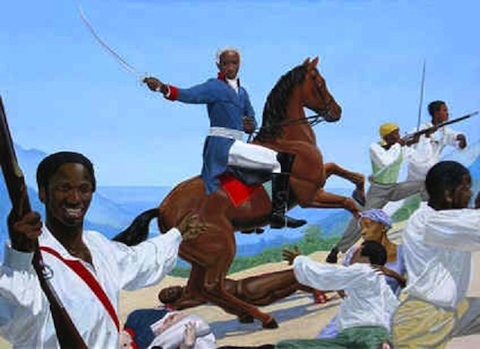
James also paid close attention to the struggle against colonialism. In 1938, he wrote The Black Jacobins: Toussaint L’Ouverture and the San Domingo Revolution. In that work he spoke of the tremendous creative force of the colonized peoples of Africa and the West Indies, and established the link between the masses of San Domingo and the masses of Paris.
His appreciation of the struggles of black people, of women, of youth, of the colonial peoples expressed his dialectical thinking. Here you have this revolutionary working class, said James, and at the same time you have the domination of capital, which also expresses itself within the working class. One of the places this conflict appeared was in culture.
The dominant tradition among Marxists held that popular culture is just brainwashing, a distraction from the class struggle. To James and his co-thinkers, the point was, how do the outlines of the new world manifest themselves in culture? In Mariners, Renegades and Castaways: The Story of Herman Melville and the World We Live In (1953), James demonstrated that the struggle for the new society was a struggle between different philosophies as they are lived. (It is my personal favorite among his works; among other virtues, it offers the most exciting explanation I have ever read of the process of literary creation.) His autobiographical book on cricket, Beyond a Boundary (1962), was not merely a sports book. It was about the people he knew intimately in the West Indies, and how their actions on the playing field showed the kind of people they were. There is a need for a similar study of basketball and the Afro-American people. Anybody can write about how black athletes are exploited by the colleges and later on by professional basketball and the TV and the shoe manufacturers – and all that is true. But for James the question was, How have the black people placed their stamp on the game and used it to express their vision of a new world?
Consider the figure of Michael Jordan in this light. Here is a person who has achieved self-powered flight. Every time he goes up with the ball, he is saying in your face to the society of exploitation and repression. His achievements are not his alone, but the product of an entire community with a history of struggle and resistance. The contrast between the general position of the Afro-American people, pinned to the ground, and the flight they have achieved on the basketball court is an example of the new society within the shell of the old. (I wrote this paragraph in 1992; since then, a book has appeared that does for basketball what James did for cricket: Hoop Roots by John Edgar Wideman. Wideman has said he wrote it with a copy of Beyond a Boundary on his desk.)
The task of freeing that new society from what inhibits it led James to a certain concept of organization. It has been asserted that James opposed organization – more particularly, that he opposed any form of organization that assigned distinctive tasks to those who sought to dedicate their lives to making revolution. The general charge is easily refuted: James spent his whole life building organizations of one kind or another, from the International African Service Bureau in Britain to a sharecroppers’ union in Missouri to the Workers and Farmers Party in Trinidad. The function of these organizations was not to “lead the working class” but to accomplish this or that specific task. The more particular charge requires closer examination.
James argued that, in industrial societies, in which the very mechanism of capitalist production unites, disciplines, and organizes the working class, in which people take for granted modern communications and mass movements, the idea that any self-perpetuating group of people can set itself up to lead the working class is reactionary and bankrupt. In other words, he was a determined opponent of the vanguard party idea. But he did more than curse the Stalinists (and Trotskyites, whom he called “the comedians of the vanguard party”): in Notes on Dialectics: Hegel, Marx, Lenin (1948), he analyzed the organizational history of the workers’ movement, and showed that the vanguard party reflected a certain stage of its development. In that same work, James anticipated the new mass movements (France, Poland) that would erase the distinction between party and class. (He did not oppose the vanguard party for peasant countries, where he thought something like it might be necessary to mobilize and direct the mass movement – but even there he searched for ways to expand the area of autonomous activity. Nkrumah and the Ghana Revolution, a collection of articles and letters he wrote between 1958 and 1970, shows James grappling with the problem of leadership in a country where the forces of production are undeveloped. It is the least satisfying of his works.)
In modern society, whoever leads the working class keeps it subordinated to capital. A revolutionary crisis is defined precisely by the breakdown of the traditional institutions and leadership of the working class. James argued that it was among the sectors of society least touched by official institutions that relations characteristic of the new society would first appear. It is not the job of the conscious revolutionaries to “organize” the mass movements; that is the job of union functionaries and other bureaucrats.
James’s rejection of the vanguard party, however, did not lead him to reject Marxist organization. For proof, one need only recall the great attention and energy he dedicated to building Facing Reality, an avowedly Marxist organization headquartered in Detroit with branches around the U.S. (These efforts are recounted and documented in Marxism for Our Times: C.L.R. James on Revolutionary Organization, edited by Martin Glaberman.) But what would the Marxist organization do? This is where it gets difficult. I once asked him that question and got from him the reply, “Its job is not to lead the workers.” Very well, I said, but what was it to do? For an answer, I got the same: It was not to act like a vanguard party. It was obvious that James was not going to elaborate with me, a person who might for all he knew carry with him the vanguardist prejudices of the “left” he had been fighting for decades. I would have to extrapolate the answer from his works. To these, then, I turned.
In Facing Reality, coauthored by James, Grace Boggs and Carlos Castoriadis, in the section “What To Do and How to Do It,” it says, “Its task is to recognize and record.” That is a start. Over the next few pages, Facing Reality lays out a plan for a popular paper that will document the new society as it emerges within the shell of the old. As should surprise no one, it is most concrete when discussing what was then called “The Negro Question in the United States”:
For the purpose of illustrating the lines along which the paper of
the Marxist organization has to face its tasks (that is all we can do),
we select two important issues, confined to relations among white
and Negro workers, the largest sections of the population affected.
1) Many white workers who collaborate in the most democratic
fashion in the plants continue to show strong prejudice against
association with Negroes outside the plant.
2) Many Negroes make race relations a test of all other
relations…
What, then, is the paper of the Marxist organization to do?…
Inside such a paper Negro aggressiveness takes its proper
place as one of the forces helping to create the new society. If
a white worker… finds that articles or letters expressing Negro
aggressiveness on racial questions makes the whole paper offensive
to him, that means it is he who is putting his prejudices on the race
question before the interests of the class as a whole. He must be
reasoned with, argued with, and if necessary fought to a finish.
How is he to be reasoned with, argued with, and if necessary
fought to a finish? First by making it clear that his ideas, his
reasons, his fears, his prejudices also have every right in the paper….
The paper should actively campaign for Negroes in the South
to struggle for their right to vote and actually to vote…. If Negroes
outside of the South vote, now for the Democratic Party and now
for the Republican, they have excellent reasons for doing so, and
their general activity shows that large numbers of them see voting
and the struggle for Supreme Court decisions merely as one aspect
of a totality. They have no illusions. The Marxist organization
retains and expresses its own view. But it understands that it is far
more important, within the context of its own political principles,
of which the paper is an expression, within the context of its
own publications, meetings, and other activities in its own name,
within the context of its translations and publications of the great
revolutionary classics and other literature, that the Negroes make
public their own attitudes and reasons for their vote. [Published
1958; given the massive disenfranchisement of black people in 2000,
2004 and 2008, which no major or minor candidate has chosen
to make an issue, it might not be a bad thing if revolutionaries,
without abandoning their view of the electoral system, were to join
in a campaign on behalf of prisoners’ right to vote – NI.]
Such in general is the function of the paper of a Marxist
organization in the United States on the Negro question. It will
educate, and it will educate above all white workers in their
understanding of the Negro question and into a realization of
their own responsibility in ridding American society of the cancer
of racial discrimination and racial consciousness. The Marxist
organization will have to fight for its own position, but its position
will not be the wearisome repetition of “Black and White, Unite and
Fight.” It will be a resolute determination to bring all aspects of the
question into the open, within the context of the recognition that
the new society exists and that it carries within itself much of the
sores and diseases of the old.
While the above passage focuses on the role of a paper, it provides a guide for other aspects of work. James’s approach was in the best tradition of Lenin (whom James much admired). Lenin, it must be remembered, did not invent the soviets (councils). What he did, that no one else at the time was able to do, not even the workers who invented them, was to recognize in the soviets the political form of the new society. The slogan he propagated, “All Power to the Soviets,” represented the intervention of the Marxist intellectual in the revolutionary process. In basing his policy on the soviets, those “spontaneous” creations of the Russian workers, he was far removed from what has come to be understood as vanguardism.
I recall once in the factory, a group of workers walking out in response to a plant temperature of one-hundred degrees-plus with no fans. Our little group, schooled in the teachings of James and Lenin, understanding that the walkout represented a way of dealing with grievances outside of the whole management-union contract system, agitated for a meeting to discuss how to make that walkout the starting point of a new shop-floor organization based on direct action. That was not vanguardism but critical intervention.
Another example from personal experience: I once worked a midnight shift in a metalworking plant. There were two other workers in the department on that shift, Jimmy and Maurice. Maurice had been having money troubles, which caused him to drink more than he should, which led to missed days and more trouble on the job, which led to troubles at home, etc. I came to work one night after missing the previous night, and Jimmy told me that Maurice had brought a pistol to the plant the night before, planning to shoot the general foreman if he reprimanded him in the morning about his attendance. “Did you try to stop him?” I asked. “No, what for?” queried Jimmy. “What happened?” I responded. “When the foreman came in,” explained Jimmy, “instead of stopping to hassle Maurice, he just said hello and kept going to his office. He doesn’t know how close he came to dying.”
I, of course, did not want Maurice to shoot the general foreman because I did not want him to spend the rest of his life in prison for blowing away an individual who was no worse than the generality of his type. Jimmy looked at matters differently: for him, Maurice’s life was already a prison that could be salvaged by one dramatic NO, regardless of the consequences. Who was right? Well, I had read all the books and knew that ninety-nine times out of a hundred nothing would come of Maurice’s action: the plant guards or the cops would take him away or kill him on the spot. But on the hundredth time, something different might happen: the workers would block the plant guards, fight the cops, and the next thing you knew you had the mutiny on the Potemkin. The new society is the product of those two kinds of knowledge, Jimmy’s and mine, and neither could substitute for the other. As a person who had decided to devote his life to revolution, my job was to Recognize and Record the new society as it made its appearance.
In 1969, a black worker at a Los Angeles aircraft plant, Isaac (“Ike”) Jernigan, who had been harassed by management and the union and then fired for organizing black workers, brought a gun to work and killed a foremen; then he went to the union hall and killed two union officials. Our Chicago group published a flyer calling for workers to rally to his defense. Not much came of it until… the League of Revolutionary Black Workers in Detroit reprinted our flyer in their paper. A Chrysler worker, James Johnson, responding to a history of unfair treatment including a suspension for refusing speedup, killed two foremen and a job setter, and was escorted from the plant saying “Long Live Ike Jernigan.”
The League waged a mass campaign on Johnson’s behalf, including rallies on the courthouse steps, while carrying out a legal defense based on a plea of temporary insanity. The high point of the trial came when the jury was led on a tour through Chrysler; it found for the defense, concluding that working at Chrysler was indeed enough to drive a person insane. (This was Detroit, and many people already knew that to be true.) Johnson was acquitted and sent to a mental hospital instead of to prison; as an added insult, Chrysler was ordered to pay him workmen’s compensation. Such was the political power contained in the simple words, Recognize and Record.
The task of revolutionaries is not to organize the workers but to organize themselves – to discover those patterns of activity and forms of organization that have sprung up out of the struggle and that embody the new society, and to help them grow stronger, more confident, and more conscious of their direction. It is an essential contribution to the society of disciplined spontaneity, which for James was the definition of the new world.


Thursday, May 17, 2012

REPRESSION AND RESISTANCE IN CHIAPAS


It isn't easy being a Zapatista, and it isn't safe being a supporter of the Zapatista either.  Many around the world have long forgotten about Chiapas, its fight lost somewhere in the midst of all the drug killings and wars between cartels and military. 


Well, folks the incredible story of Chiapas continues and support remains very much in need.  


As the post below indicates paramilitaries and death squads operate throughout the region.  People die in their beds and disappear in the night.  Others who struggle for a free space are just officially locked away in the State's prison.


The Empire understands the nature of the threat the Zapatista represent.  That threat goes far beyond guns and bullets.


What to do with a rebellion that is simply not trying to seize state power, but is actually building a new society in the midst of the old.


The Empire resorts to all the old methods.


We must look to the new.


The following is from The Flower of the World Will Not Die.


Paramilitaries threaten Cintalapa Women


** They say that they will go today to carry them away to kill them today if they have not abandoned the community


San Cristóbal de Las Casas, Chiapas, May 15, 2012


“On May 16, the paramilitaries threatened to come to kill the compañeras that continue in la comunidad,” denounced Armando Méndez Núñez, native of Cintalapa community, Ocosingo municipality, representative of a group of families displaced from the village since March 2007. The threats were made last Mat 10 by Herlindo López Pérez and Domingo Gutiérrez Hernández, PRI leaders and members of the Organization for the Defense of Indigenous and Campesino Rights (Organización para la Defensa de los Derechos Indígenas y Campesinos, Opddic, for its initials in Spanish).


“They told the compañeras that if they don’t leave their homes, they are going to enter on Wednesday to take them to the mountain to kill them,” adds the Tzeltal campesino, belonging to a group of 13 families displaced by the Opddic from the neighboring Cintalapa and Busiljá ejidos, who are part of the Other Campaign.


In Busiljá, the little girl Gabriela Sánchez Morales was kidnapped in July 2011 and continues to be disappeared. The last time that anything was known of her she was found in conditions of slavery in the home of another Opddic member, an organization pointed to as paramilitary in many communities in the state’s Northern Zone and the northern part of the Lacandón Jungle.


Armando Méndez Núñez, the former “political prisoner, also demanded freedom for Amílcar Méndez Núñez, of Cintalapa, a prisoner since December 2008, and Elías Sánchez Gómez, of Busiljá, detained in December 2011. Both are imprisoned in the State Center for Social Reinsertion of the Sentenced (CERSS) Number 17 in Playas de Catazajá “unjustly,” the denouncer maintains.


Weeks ago, on March 24, Busiljá residents denounced that the para-militaries “passed into each one of our houses, came to the natural spring, after they attacked us by throwing stones on top of our houses and they intimidated us because they were strongly armed and uniformed with bullet-proof vests.”


Afterwards, they went down to the highway “with the intention of murdering a transport driver so that our compañero Elías Sánchez Gómez (padre) would be blamed, but at that moment they encountered a private truck in which soldiers were traveling.” The paramilitaries “began to shoot, to which the soldiers responded, leaving a paramilitary Enoc Gómez Gutiérrez, injured.” After the incident, the soldiers found two long arms and a red motorcycle owned by the paramilitaries from the Busiljá ejido.


The displaced families warn about the danger that their compañeros run that remain in their homes, ask for the detention of those who have been their aggressors, plunderers and expellers without punishment for five years, as well as guarantees to be able to leave exile and return to their communities.


“We demand punishment for the paramilitaries from these ejidos, who are the ones responsible for the kidnapping and for all the crimes that they are denouncing to the public ministers of Palenque, Ocosingo and San Cristóbal de las Casas.”

Wednesday, May 16, 2012

BLOCUPY EUROPE BEGINS HERE


Better late then never.  


However, I will make this short and sweet.  


In Europe, they are taking a step beyond sitting in a park, building tents, or marching around in circles.  They are planning blockades fin one of the centers global capital to show the widespread disgust with austerity capitalism and the Empire.  It ain't a revolution, to be sure, but if you get enough folks involved, blockades can be bothersome to the powers that be.  It will be interesting to see how it goes, and then move on to the rest of Europe.  I will follow the post below from Precarious Workers Brigade with the call to action from May Action Against TheTroika.


Solidarity with Blockupy Frankfurt


“In the periphery of the EU we are experiencing the extreme effects of politics pushed for by the governments of Germany and France and enacted by institutions representative of global capitalism: the ECB, IMF, EU, and their imposed technocratic governments. Millions of us have been impoverished and driven to misery by austerity and structural adjustment programs, the denial of labor rights and the slashing and privatization of public services, such as education, healthcare and welfare. We are experiencing the looting of human and natural resources by supposedly democratic institutions! (…)

A broad coalition of organizations, initiatives and networks are mobilizing to diverse days of action in Frankfurt from May 16th to 18th . The central element of the protest choreography is mass blockades on May 18, taking place after the take the squares action on May 17 and before the mass demonstration on May 19. The goal of our action on this day is to effectively disrupt the normal business activities of European Central Bank and other central actors in the financial center in Frankfurt. The parties responsible for the global politics of crisis and impoverishment are to be confronted directly in front of the doors of their decision-making headquarters with imaginative blockades and creative forms of civil disobedience.”


#BLOCKUPY FOR GLOBAL CHANGE!
* Transnational call to action in Frankfurt, May 16-19 * International solidarity in our common struggle *
We are calling for massive protests in Frankfurt this May against the crisis regime of the European Union. We are activists representing a multitude of movements and struggles from different European countries and elsewhere, who have risen up in the past months and years to protest the assaults on our freedoms, jobs and livelihoods that have become fiercely intensified in the global crisis. We have joined together and shared our struggles and experiences, and we have realized that in a multitude of local forms, we are fighting the same fight. Like never before, our movements are starting to strengthen each other: a truly transnational opposition is beginning to emerge.
Directly following the global action days on 12M and 15M, where we will protest in our own cities and regions, our transnational struggles will join together in Frankfurt, the European hub of global capitalism and the place of origin of the distress and misery that dictatorship of the markets has caused for millions of people.
We are protesting the widespread impoverishment and denial of democratic rights occurring in the Eurozone as part of a global systemic crisis.
In the periphery of the EU we are experiencing the extreme effects of politics pushed for by the governments of Germany and France and enacted by institutions representative of global capitalism: the ECB, IMF, EU, and their imposed technocratic governments. Millions of us have been impoverished and driven to misery by austerity and structural adjustment programs, the denial of labor rights and the slashing and privatization of public services, such as education, healthcare and welfare. We are experiencing the looting of human and natural resources by supposedly democratic institutions!
These processes are only the most evident sign of the precarization of working and living conditions experienced in all of Europe and beyond. Our social uprisings, traversing the internal borders of the EU, are the expression of indignation acting outside every form of political representation. As representative democracy fails, we leave it behind, creating our own democratic practices in everyday struggles against exploitation.
We are experiencing global migration as another clear sign of the refusal of this transnational system of exploitation, its border regimes and violent wars. It is devastating our earth and basic livelihood. The situation is urgent: we are facing a human-made climate disaster!
Yet in Europe and beyond, we are also experiencing the emergence of political movements that are challenging the everyday exploitation of people and the earth, the social fragmentation, precarization and racism that pretend to divide and then weaken us. By creating connections among these movements and making ourselves visible and powerful, we are attempting to practice a real democracy right now.
In Frankfurt, we have the opportunity to make these connections real, and to empower local struggles on a transnational level. We will blockade a crucial center of global capitalism, learning from what we watched in Oakland and the Occupy movement in the United States, who in turn learned from the revolutions across North Africa, the Middle East and the Indignados of Southern Europe. Let us bring our movements together in solidarity to continue the fight! Let us not miss this opportunity to set the agenda to reinvent our common future!
On May 17 we will occupy parks and main squares in the city center with our tents to create spaces for discussion and exchange. On May 18 we will advance from different points toward the financial district: our vision is a full blockade of the ECB and all the other important financial institutions in Frankfurt to stop their running business. On May 19 we will show our magnitude in a mass demonstration and make it known that we will not allow our societies to be destroyed by financial institutions.
FOR A TRANSNATIONAL MOVEMENT TO END PRECARITY AND IMPOVERISHMENT!
FOR INTERNATIONAL SOLIDARITY, FREEDOM and REAL DEMOCRACY NOW!
#BLOCKUPY FRANKFURT!
May 16 – arrival and actions at the ECB board meeting
May 17 – OCCUPY the financial district, asambleas, cultural program
May 18 – BLOCKADE the ECB and major banks
May 19 – MASS international demonstration
http://blockupy-frankfurt.org / http://17to19m.blogsport.eu
+ create local and regional planning groups + spread infos and stay tuned + come in masses