Last week, we once again saw that it is apparently okay in white supremacist America to gun down a young, black male if you are white. Apparently playing your music too loud is reason enough to get you killed...if you are African American. A jury couldn't seem to find it in its heart to convict the killer of murder. Some of the jurors wanted to, but some didn't. They did convict him of attempted murder and he should spend a long time in prison (but then who knows). How you shoot and kill someone and get convicted of ATTEMPTED murder baffles me.
Today is the second in a series of articles this week dealing with White Supremacy and white skin privilege. This one is written by Tim Wise. Wise is described at his blog site:
Wise began his career as a Youth Coordinator and Associate Director of the Louisiana Coalition Against Racism and Nazism: the largest of the many groups organized in the early ‘90s to defeat the political candidacies of white supremacist, David Duke. From there, he became a community organizer in New Orleans’ public housing, and a policy analyst for a children’s advocacy group focused on combatting poverty and economic inequity. He has served as an adjunct professor at the Smith College School of Social Work, in Northampton, MA., and from 1999-2003 was an advisor to the Fisk University Race Relations Institute in Nashville, TN. Wise is the author of six books.
Wise's perspective on white skin privilege differs somewhat from that of Noel Ignatiev or Ted Allen (or me). If you are interested in learning more about his perspective, go here.
On November 23, 2012, Michael Dunn pulled into a gas station in Jacksonville Florida. He parked next to a red Dodge Durango with four black teens inside playing loud rap music. One of them was Jordan Davis. Dunn, a white man, didn't think much of the choice of music, so he fired ten bullets into the vehicle. There were no guns in the vehicle. There was only a basketball, basketball shoes, clothing a camera tripod and cups. No guns were found in the Durango or in that general area! The only one who had a gun was Dunn.
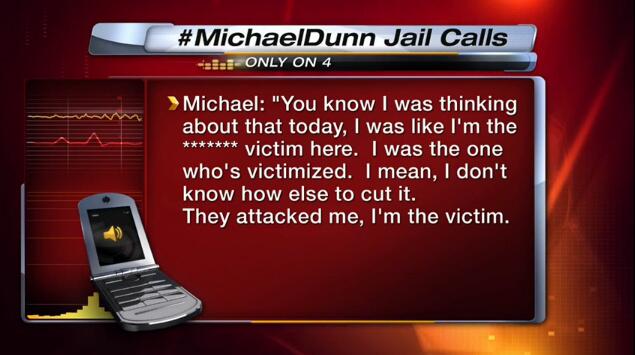
Dunn who says he has no racial prejudice wrote his grandmother from jail,
The jail is full of blacks and they all act like thugs. This may sound a bit radical but if more people would arm themselves and kill these (expletive) idiots, when they’re threatening you, eventually they may take the hint and change their behavior.
I’m really not prejudiced against race, but I have no use for certain cultures. This gangster-rap, ghetto talking thug ‘culture’ that certain segments of society flock to is intolerable. They espouse violence and disrespect towards women. The black community here in Jacksonville is in an uproar against me — the three other thugs that were in the car are telling stories to cover up their true “colors.”
There was indeed one thug involved in this shooting and that thug's name is Michael Dunn.
The following is from Tim Wise.org
Choosing Whiteness or Humanity: Jordan Davis and the
Minimizing of Black Pain
And so a despairing ritual has once again played out, and once again in a Florida courtroom, where apparently some number of jurors find it difficult to accept that a young black male might not be to blame for his own murder; that his killing might actually have been completely and entirely unjustified. Then again, perhaps it’s premature to say it this way. Until the jury or some member of it speaks, we won’t know for sure why they were unable to agree as to the murder charge against Michael Dunn.
Yes, it could be that some among them believed the utterly preposterous self-defense claim put forth by Dunn and his attorney.
This, despite the fact that the gun Dunn claimed to see pointed at him did not exist.
This, despite the fact that he claimed to hear Jordan Davis threaten his life, even over music that was so loud, Dunn said he couldn’t hear himself think (and even though Dunn had by then rolled his window up, suffers from partial hearing loss, and had consumed, by his own admission 3-4 rum and Cokes that night).
This, despite the fact that he then fled the scene and didn’t call police to tell them what had happened.
This, despite the fact that he didn’t mention Davis having a gun to his fiancee, who was with him at the time, until several weeks later.
This, despite the fact that he kept shooting at the SUV which held Davis and his friends, even as that SUV tried to get away from the gunfire.
Sure, despite all of this, some jurors might have believed that Dunn acted out of a genuine concern that his life was in danger. Some people, after all, cling stubbornly to their belief in unicorns, and the idea that the Earth is only 6000 years old, and that God fabricated and then planted all those fossils (which are, shall we say, quite a bit older than that), solely as a way to test our faith. And a full 1 in 4 believe that the sun revolves around the Earth. Some people, in short, are so painfully imbecilic as to suggest that they should never be allowed anywhere near a jury room, whether in Florida or anywhere else.
But then again, it is also possible that the jury hung because although all agreed the shooting was unjustified, some refused to accept that Dunn’s act constituted first-degree murder, while others refused to go along with the notion that it was anything less. Given the defense’s painting of Dunn’s character as generally placid and kind — and given the state’s refusal to impeach this image, by introducing the overtly hateful and racist letters written by Dunn while awaiting trial, or testimony from a neighbor who said Dunn was racist, violent, and had actually approached him to solicit help with killing someone — one can imagine some being unable to see the man in the Mister Rogers’ sweaters (and for that matter, with Mr. Rogers’ voice) premeditating Davis’s death. This, despite the fact that premeditation under Florida law can be formed in an instant, so that it matters not whether Dunn had attended his son’s wedding that night, all the while secretly plotting to kill a black teen at a gas station. That notion of premeditation is a decidedly Hollywood version. It has nothing to do with the law. But perhaps some jurors couldn’t see that. So be it, and the state will get another chance to make that case. Hopefully they will make it better, and this time fully eviscerate the desiccated character of this rancid little man, so that the people of Florida will know: you cannot kill black people simply because you don’t like their music and because they back-sass you when you ask them to turn it down. But if you do, you will be found solely and entirely to blame, and punished accordingly.
Beyond the Xs and Os, however, and beyond the question of what should be done with “Stand Your Ground” laws — which were implicated in this case because of the way Dunn’s attorneys made their self-defense argument and because of the jury instructions — there is another matter, at once more abstract and yet far more important. It is the question of what it might ultimately take for black life to be realized as fully human by some (indeed many) white people? And what it might take for black pain to actually matter? To be seen as worthy of concern, and more than concern, worthy of being seen asequal to white pain, without reservation or hesitation?
I ask this not because whites did in this case what most did in the case of Trayvon Martin and George Zimmerman — namely, line up behind the killer of the black child and presume that the latter had it coming — for it appears that the racial fault lines were not so neat and tidy this time. Most whites, or so it appears from what is most assuredly an unscientific observation of social and other media, view the killing of Jordan Davis as far less justifiable than the killing of Martin. So there’s that, one supposes; a small peg of progress upon which to hang one’s hopeful hat, for what it’s worth.
But it probably isn’t worth much. After all, even if most white folks actually agree this time with black people, and are appropriately horrified by murder (a type of progress about which one can hardly become too animated, since condemning murder hardly requires much moral fortitude), there are still plenty of us who are not. Too many of us — millions upon millions no doubt — still find it possible to give equal consideration to a white man’s paranoiac and racist hallucinations as to a black man’s life; to believe that the former is just as worthy of our indulgence as the latter, maybe more so.
Or even if we are horrified by Dunn, we cannot allow ourselves to dwell for long in that place, and so we change the subject, and with a rapidity unrivaled in the history of rhetoric. Yes, it is terrible, we say, about that Jordan Davis fellow. But, but, but…what about all those black people killed by other black people?
@mychalsmith have u mentioned any of the 400-500 killed in chicago the past 4-5 yrs ?#dunntrial . you tired of chicago as well ?
— lonnie (@Wake_up_service) February 16, 2014
#DunnTrial now the trial is over we can go back to ignoring the real threat to black teens…other blacks. #chicago
— dominos guy (@jagdan2) February 16, 2014
#DunnTrial who mourns for the dozens of Black kids murdered by gangs in Chicago? Crump? Don Lemon ?
— Wilhelm II (@knightofgood) February 16, 2014
Ah yes, what about Chicago? Chicago having become the new Detroit or DC or Compton or wherever: the geographic fulcrum of white anxiety, even as — it should be pointed out — homicide rates in that city, and specifically among black folks, are actually down considerably from previous years, and now stand at their lowest point since 1965, much as crime rates are down in virtually all major cities, and more broadly, throughout the United States.
Some not-small portion of whites, it seems, will almost inevitably change the subject to that which is more comforting to us, and which requires of us no moral or historical reckoning, no grappling with the underbelly of our national existence, no uneasy wrestling with our patriotism. And so we’ll quickly bring up “black-on-black” crime, or the rate of out of wedlock births in the black community, or something, anything, about the evils of rap music.
But let us be clear: rap music did not kill Jordan Davis. A white man, who had been led to believe (and no doubt by other white people) that rap music was an audible confirmation of thuggishness in its black listeners, did.
Jordan Davis was killed by a white man, who had learned well the lessons of his country, handed down by other white men going on 400 years now. The fact that some black men have also internalized those lessons — that black life is not worth much and as such can be disposed of with nary a second thought — does not change the identity of the teacher.
Indeed, the fact that more black males are killed by other black males than by white men like Michael Dunn does not change anything. Nor is it even remotely worth noting at moments such as this. In fact, to so readily leap to that deflection suggests a level of callousness beyond even that which one might have suspected was possible. After all, even during the height of American segregation and enslavement, more blacks were killed by other blacks than by whites, if simply because most violent crime has always been intra-racial (because in a racially-divided society, we tend to live around others of our same race). But what are we to make of that fact? There were also more blacks killed by King Leopold in the Congo than by whites in the United States, but that would hardly have rendered the architects of American apartheid less worthy of condemnation or overthrow. The white man who would have referenced the Belgian empire and its crimes each and every time the NAACP raised its voice to protest yet another American lynching in those years, would rightfully have been seen as a pitiable propagandist, a grotesque and puerile apologist for the inhumanity of his own people. So too should we see Bill O’Reilly and Ted Nugent in this way, whenever they meet evidence of white animus against blacks with yet another chorus of “they do it to themselves.”
The reality of blacks killing blacks in 1916 (and please make a note of it, Sean Hannity) wasn’t the problem for Jesse Washington, in Waco, Texas. The problem was a white mob, convinced that he had raped and killed a white woman. The mob, of course, felt no need to wait for a trial to determine the truth of that charge, preferring instead to mutilate Washington’s body and pose for pictures beside his charred corpse, which pictures would later become souvenirs much coveted by locals, who despite their moral and behavioral depravity no doubt managed to still see themselves as members of some superior race.
The reality of blacks killing blacks in 1920 wasn’t the problem for Elias Clayton, Elmer Jackson and Isaac McGhie in Duluth, Minnesota ; it was Irene Tusken and James Sullivan — a white couple — who claimed to have been assaulted, and Tusken raped, by the three black men, who were part of a traveling circus. Without evidence or an actual trial the three were lynched. That somewhere that same day in America there may well have been a few black folks killed by other blacks, could not, cannot and does not diminish by one iota the stain on Duluth from that crime, or the one upon the white people who stood by and let it happen, or even gleefully participated.
That somewhere in America a few blacks were likely felled by other blacks on August 28, 1955 is of no importance whatsoever when it comes to how we understand the death of Emmett Till that day at the hands of deranged white men in Money, Mississippi. It does not make their crime less important, and it sure as hell does not suggest that those who used his murder as a rallying cry for the civil rights struggle, including his mother, were somehow “ignoring the real problem” of black violence, or missing some bigger picture.
To be sure, Ida B. Wells-Barnett was not, for all those years, “missing the point.” She understood it all too well. That neither Rush Limbaugh nor likely more than a handful of his rabid listeners have evenheard of her is all one needs to know, and it should disqualify them, morally, from so much as even opening their fetid mouths to speak on issues of race, ever again.
And to so rapidly pivot to “black-on-black” crime when confronted by yet another example of the white-on-black variety is especially precious coming from those who trumpet every case of black-on-white violence as indicative of some widespread social phenomenon, while conveniently ignoring that whites are roughly 4 to 5 times more likely to be assaulted by another white person than by a black person. In other words, doctor, heal thyself. And watch out for your white neighbor. It is he, whether a fan of Meek Mill or George Strait, who poses the greatest danger to you. Yet this specter of white-on-white crime never haunts you, indeed fails to register even sufficiently to allow you to utter that phrase, which does not, so far as I can tell, even exist in your vocabulary.
Worse still, the artless dodge about black-on-black violence is tantamount to telling your mother that although, yes, you did break a window playing baseball outside, it was Billy who insisted on playing so close to the building, and so the blame must really be shared. Surely I am not alone in having had a mother who, in such a moment, would have quickly launched into some parable about a bridge, and whether I would follow Billy were young Master William to decide to hurl himself from it in the manner of a damned fool. Or in modern terms (and in words that my mother would have likely been thinking if yet too genteel to verbalize), Fuck Billy. Own your shit.
Those who engage this time-tested duck-and-cover are properly understood as amoral monsters, too besotted with smug and solipsistic contempt for the intelligence of black people (and even some whites) to be viewed as remotely worthy of serious engagement. They cannot be reasoned with. They must be destroyed, and by that I mean politically, not physically, for by their hatreds and disingenuousness they shall surely consume themselves. They will need no help from us in that regard. But in the political sense, oh yes; they must be utterly trounced at every turn and pushed to the shadows of our political and cultural discourses, rendered as marginal as the old Know-Nothing party, or the German-American Bund. For they are no better, no more moral, no more capable of human empathy than these. They deserve no pity, no serious contemplation for their cruel and ignominious buck-passing. They deserve political and social death, finally and completely.
Ultimately, it is their allegiance to the ideological strictures of whiteness that makes their demise necessary; and it is indeed whiteness that calls forth their inability to fully feel the pain of so-called non-white peoples, and causes them to shift the discussion and the burdens of proof to black and brown folks, whenever harm comes their way. It is whiteness — a paradigm of thought that relies upon the presumption of cultural superiority for those of us called white in this society, and which presumes that we better understand the problems faced by peoples of color than they do, which must be demolished.
In short, for America to live, whiteness must die. Not white people but whiteness. You may not know the difference, but if not, that is your problem, not mine.
Do not misread me here. This is not, dear Nazis who so readily regale me with hate mail, a call for “white genocide.” I do not assume, as do you, that whiteness is an inherent essence of people of European descent. I contend it is a sickness foisted upon us by men who sought to maintain their power and control, and needed some among the Euro-peasantry to help them do it; and so they resolved to make us part of their racial team, even as they had maintained us in poverty for generations in England and Ireland and Italy and France and everywhere else from which our people come.
And so they told us to fear them, and to hate them, and to place our boots upon their necks so that they, the elite, could go about the business of accumulating great wealth at the expense not only ofthose people over there, but us too. If they could keep us fighting perhaps we wouldn’t notice as they plundered our labor, encircled the common land and made it their own, sent our people to war to fight and die for their gold. And accumulate they have, with great aplomb, and with our pathetic acquiescence. And they laugh at average, workaday white people with no less disgust than that which they hurl at blacks; and they begrudge them a living wage too, and affordable health care, and affordable college education for their children, and they prattle on about how only those who make enough money to owe income taxes should be allowed to vote and how the more you make the more votes you should have. And how, if you aren’t in the 1 percent it’s because you don’t work hard enough. Got that white people? Do we hear them now? No, of course not. Because we’re too busy fearing and hating black people and rap music and immigrants from the global south. Suckers.
Whiteness is a lie, a ghost, a legend, a will-o-the-wisp, but one that we have believed for so long that it seems real to us, and allows us now to blame black people for the death of Jordan Davis and Trayvon Martin, and Renisha McBride, and Amadou Diallo, and Oscar Grant, and of our country, which stopped belonging to us the minute we cut that side deal with the landowners in the colonies, and agreed to wage war on the indigenous, and go along with the enslavement of Africans — the minute we decided to become white.
Many years ago, during a family reunion, a great-aunt asked me – she knowing what I’m about and what I do for a living – whether or not I thought there was ever going to be a race war. She asked it much as you might expect an older white person to, with a gravity and fear in her voice betraying real terror. Still living in the same house in which she had resided for decades, and having seen the neighborhood around her become increasingly black, she felt certain that it was only a matter of time before something horrible would befall her. I told her then, and I will say it again now — only with more certitude and evidence with which to make the case — that no, there is not going to be a race war. Rather, we are in one now, and have been since that first boat landed at Jamestown, piloted by Christopher Newport: a renowned pirate who regularly raided ships for the English elite, and who I should note with no pride, but rather quite a bit of disgust, was my 13th great-grandfather.
Ever since that day we have been engaged in a race war. While white people might not have realized it, this was only because for so long, those we sought to cow and control were disallowed by and large from fighting back. Or rather they did, but news of those rebellions, of those acts of resistance, were studiously kept from our ears, as we were instead regaled by Uncle Remus tales and assurances that the targets of our iniquities were quite content with their lot.
But for several generations now, during which time it has become impossible to cover up the truth — that they were not happy but quite a bit something else — white folks, by and large, have been in the midst of an existential crisis. We have been so reliant on the fraud called America, and have for so long basked in the supposed glories of our truly odious history, that we find it almost impossible to understand why the rabble protest and revolt and refuse to roll over. Why one such as Jordan Davis might tell Michael Dunn to “fuck off” when asked to turn his music down, rather than simply reply, “Yessa Boss, right away Boss, sorry to bother you.” But black people do not have to be polite anymore, however much politeness itself might be a virtue. They do not have to cower, or prostrate themselves before the presumed authority of sad and febrile pus-balls of hatred like Michael Dunn. Deal with it.
And as for the race war, let there be no mistake. It is on, and has been since long before you or I came in. The only question now, white folks, is this: Which side are we on? The side of whiteness — a lie that has left us with nothing but the vanity of skin, which vanity I should note will neither pay our rents, nor our hospital bills — or the side of humanity, which, should we choose it, might yet provide a small sliver of hope that all is not yet lost?