Thursday, January 23, 2014

WHAT THE HELL IS GOING ON IN THE UKRAINE


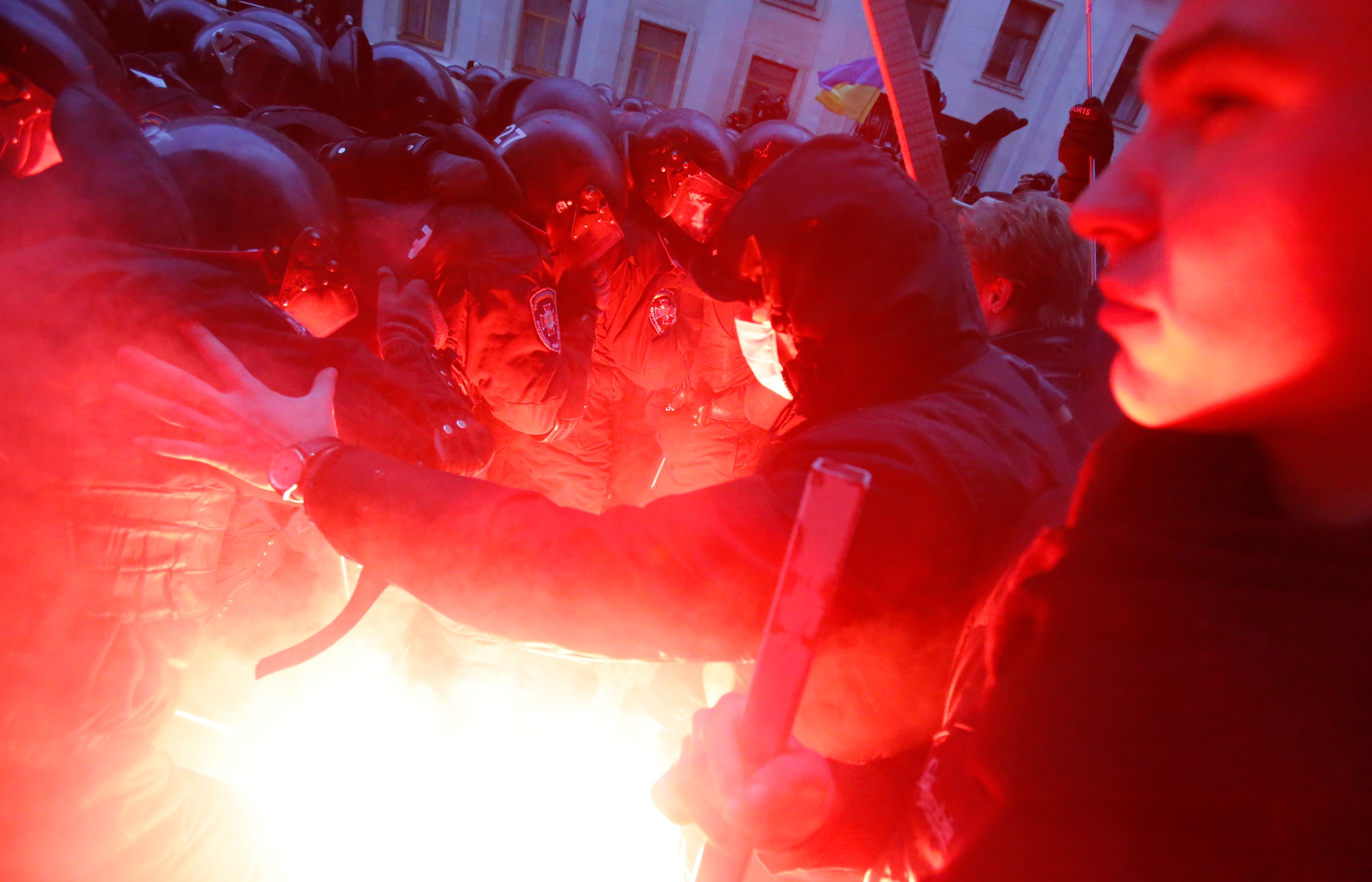
The Ukraine is now and has long been, in my book, a big mess and a breeding ground for nazi like fascism.  The "protests" we see on TV are not all protests of liberation, as I am sure you know.  A few days ago the media showed us images of cops battling with protesters trying to take over the parliament building in Kyiv.  What they mostly neglected to mention was that the cops (who are no friends of working people), in this instance, were fighting with neo-nazis and other reactionaries.  What are the reactionaries and nazis upset about?  According to one writer at Revolution News:


The “Right Sector”... is guided in these events by the sincere feeling of insult. Yanukovych “stole their culture” and started implementing the fascist program without their participation. If they came to power, they would pass the same bills as those passed by the Party of Regions and the “Communist” Party, only with a racist agenda.

However, it isn't as simple as I or some others make it out to be.

The Autonomous Workers Union of Kyiv make clear to me and others in a letter addressed to European leftists:


We, the members of leftist, trade union and human rights organizations in Ukraine, as well as individual activists, would like to draw your attention to the recent events in our country.

On Thursday, 16th of January 2014 without the discussion and contrary to its own regulations and to the Constitution of Ukraine, the Ukrainian parliament, passed a series of laws directed at limiting freedom of speech and citizens’ right to peaceful protest. One of the approved items is the infamous amendment to the Criminal Code which bans so-called “extremism”. In this amendment “inciting social discord” is defined as “extremism”. It is clear that any kind of drawing attention to social problems, to the blatant inequality that exists in Ukrainian society, can be qualified as “inciting social discord”, therefore the activities of left, trade union and social activists in Ukraine can be criminalized to a large extent.

The Communist Party of Ukraine (CPU) plays a particularly shameful part in these events. Not only did the Communist Party’s faction unanimously voted for the repressive bills, but the CPU official website also features materials that condemn the recent protests as being inspired by foreign actors with the aim of destabilizing Ukraine. Spreading such opinion, the CPU in fact fulfills the task of the whitewashing of Yanukovych’s regime.

It is true that open anti-communists do play a significant role on Maidan, but this anti-communism is caused mostly by the arrogant position of the Communist Party itself. It is not the first time the CPU has tried to de-legitimize civil protests and adopted a conservative position. In addition to this, in the country that suffered the catastrophic losses caused by hunger and repressions during the Stalinist regime, the CPU refuses to condemn the actions of the USSR’s leaders or at least apologize for them, which makes socialist ideas less popular in Ukrainian society.

Yanukovych’s regime has demonstrated its readiness for repressions. It is evident today that the CPU will use its international connections in order to justify this regime’s actions. That is why we believe that the left all around the world and especially in the European Union must terminate any relations with the Communist Party of Ukraine and condemn its actions.

We believe that the party that treats popular uprisings with open hatred, the party that speaks out against “inciting social discord”, is not fit to be called communist or leftist and is “communist” in  name only.

We ask you to bring this letter to the attention of the leadership of the parties which are members of your Union.


Confused, me, too.  I just have not paid the required attention to all this that I should.

Consequently, rather than drone on about something I myself need more education about, I will leave you with two different articles.

The first is from Revolution News.  The second from the Nation. 


Russian & Ukrainian Antifa Rallies Held, Nazis Riot in Kyiv


1425623_804577886225449_526572716_nNeo-nazis attacked about 30 antifascists in Kharkov, Ukraine who were commemorating the lives of comrades assassinated in Moscow 5 years ago. Those remembered were Anastasia Baburova – an anarchist and journalist, who was a member of the Autonomous Action, and relentlessly investigated the Neo-nazis – and Stanislav Markelov, a human rights lawyer. Nazis retreated behind police lines for protection, after being beaten back by the antifascist group. Shortly after, police forced two antifascists to write accounts of them beating back the fascists, clearly in favor of the nazis who attacked.
Kharkov: a nazi runs to his police allies for protection from anarchists
Kharkov: a nazi runs to his police allies for protection from antifascists
1555518_674904332531513_1742979823_n
Kyiv: Neo nazis clash with Berkut police forces at parliament
Meanwhile, in Kyiv, cops clashed with Neo-nazis as they tried to take over the Parliament during a protest against recent legislation. Mainstream media widely reported these clashes, victimizing the Neo-nazis who were holding crusader shields bearing the white pride cross and “Heil Hitler” nazi symbols, as well as the symbol for white supremacist David Lane’s 14 words (“We must secure the existence of our people and a future for White children.”) Writers for Nihilist.li have referred to these riots as an “involuntary ejaculation of fire,” explaining that ”This is the natural act of desperate people who are sick of all politicians and who are not ready to accept the state of emergency. This is not a revolutionary act of the people, this is not parliamentary masturbation – simply an involuntary ejaculation due to long lasting abstinence from sensible and purposeful actions.” Images emerged of nazis beating cops, as can be seen in this video.
DSC_1253
Anastasia and Stanislav were investigating the crimes committed by Yuri Budanov, a Russian officer convicted of war crimes in Chechnya. Two members of a neo-Nazi group, who confessed to their murders, were convicted later, though the entire circumstances of the double assasination remain murky. ”Stanislav Markelov was shot dead after attending a press conference at which he had discussed plans to appeal against the early release of a Russian former colonel who was imprisoned for the murder of a Chechen girl. Anastasia Baburova, a journalist from the newspaper Novaya Gazeta who was accompanying Stanislav Markelov, was seriously injured when she tried to stop the killer. She died later that day in hospital, without regaining consciousness.“ 
baburova_markelov
The International Federation of Journalists documented that over the past 20 years, 300 journalists were killed or have disappeared in Russia.
“To remember means to fight. If you remember, you know what to do” – this was written on a bannerwhich was hanged by activists in Moscow, near Putin’s Krelmlin. Earlier, hundreds of antifascists marched through the streets of Moscow, guarded by riot cops, in remembrance of Anastasia Baburova and Stanislav Markelov.
tumblr_inline_mznz5xsFIE1ruq6cstumblr_inline_mznz6hYp791ruq6cs1530377_669717899717857_1553044551_n


On Sunday in Kyiv, 200 anarchists and antifascists remembered the double assassination, holding portraits of their fallen comrades, candles, and banners reading: “No political terror,” “We are all antifascists,” “Remembering means fighting.” These messages have a tragic echo in Ukraine these days, as the current ruling power of Ukraine, against the country’s Constitution, passed laws banning “extremism,” which is defined against its own meaning, as “inciting social discord.” This means that any dissent has became a crime. As the Autonomous Workers Union in Kyiv points out, “It is clear that any kind of drawing attention to social problems, to the blatant inequality that exists in Ukrainian society, can be qualified as “inciting social discord,” therefore the activities of left, trade union and social activists in Ukraine can be criminalized to a large extent.”
-
They also spoke out against the strengthening of the police state, which western media is ironically referring to as a “dictatorship” and as “totalitarian.” While this is true, it is also true of western countries who have enforced similar measures criminalizing protests. The difference is that when protests are criminalized in the West, mainstream media don’t call that tyranny, but “democracy.”
Later in the evening supporters of the opposition coalition of Merkel-created UADR, nationalist Fatherland, and neo-nazi Svoboda clashed with the riot police, who responded with tear gas and water cannons.
The UADR leader called for early elections in a desperate attempt to fully exploit the fact that the West has made them credible, and directly helped them make use of the protests as a powerful electoral tool.
Fatherland leader Yulia Tymoshenko called for a new constitution, and Svoboda leader Oleh Tyahnybok claimed that they are forced to give protesters a leader, since the crowds demand it. In other words – the opposition claim they are being invited to take power by the crowds they manipulate. While the opposition figures have taken the stage of their manufactured Euromaidan protests, they have done an awful job maintaining support and trust between each others respective parties.
Vitali Klitschko sprayed with a fire extinguisher by nazi protestors while trying to stop clashes with police
Tyahnybok also made some awkward claims – he said the government would rob a gun shop and take guns on the streets so they can blame them of being armed. There is no proof to sustain this and it did not happen, but the fact that he mentioned guns should perhaps be kept in mind. Some 100 people were injured during the street clashes, a fifth of them cops.
+++++++++++++++++++++++++++++++++++++++++++++++++++++

The Ukrainian Nationalism at the Heart of ‘Euromaidan’


Kiev protest
Members of the nationalist Ukrainian Insurgent Army rallied in Kiev in December 2013. (Reuters/Gleb Garanich)
Kiev’s two-month-long “Euromaidan” protest turned violent on Sunday as people in masks, outraged over restrictive protest laws hurriedly passed last week, marched on parliament and ran into police cordons that they pelted with stones and Molotov cocktails. Police hurled gas canisters, stun grenades, and a water cannon and rubber bullets at them, setting off a wave of clashes previously unknown at the largely peaceful protest.
Spearheading the clashes with police was Right Sector, a group with ties to far-right parties including the Patriots of Ukraine and Trident, which BBC Ukraine reported is largely comprised of nationalist football fans. In a statement the next day, the group claimed credit for Sunday’s unrest and promised to continue fighting until President Viktor Yanukovich stepped down.
“Two months of unsuccessful tiptoeing about under the leadership of the opposition parties showed many demonstrators they need to follow not those who speak sweetly from the stage, but rather those who offer a real scenario for revolutionary changes in the country. For this reason, the protest masses followed the nationalists,” the statement read.
The surge in violence sparked by Right Sector has revealed how uncritical and undiscerning most of the media has been of the far-right parties and movements that have played a leading role in the “Euromaidan,” the huge protests for closer ties to Europe that flared up in November and have taken over Kiev’s Independence Square (“Maidan Nezalezhnosti”). Protest coverage focused on the call for European integration and the struggle against the Yanukovich regime has largely glossed over the rise in nationalist rhetoric, often chauvinist, that has led to violence not just against police, but also against left-wing activists.
According to Maksim Butkevich of the coordinator of the No Borders Project of the Center for Social Action NGO, which works against discrimination and xenophobia, far-right groups have grown in popularity over the course of Euromaidan.
“I wouldn’t say it’s big, that huge numbers of activists will join far-right groups after this, but they became more acceptable and in a way more mainstream than before for many active citizens,” Butkevich said.
Although the outcome of the protests is still up in the air, if they lead to snap elections, nationalists could win greater political power, Butkevich said, especially Svoboda, the far-right parliamentary party in the coalition of three opposition parties leading the protest. (Right Sector criticizes all three for “pacifism,” including Svoboda.)
It was Svoboda that was responsible for the most iconic image to come out of Euromaidan: On December 8, masked protestors waving blue Svoboda flags and yelling “Hang the Commie!” toppled a 67-year-old statue of Vladimir Lenin in the city center. Svoboda leader Ihor Miroshnychenko, who has faced charges for pulling down a Lenin statue in another city, told journalists his party was responsible.
Svoboda is the most visible party on the square, it has essentially taken over Kiev City Hall as its base of operations, and it has a large influence in the protestors’ security forces.
It also has revived three slogans originating in the Ukrainian nationalist movement of the 1930s that have become the most popular chants at Euromaidan. Almost all speakers on Independence Square—even boxer-turned-opposition-leader Vitaly Klitschko, who has lived mostly in Germany and has a US residence permit—start and end with the slogan, “Glory to Ukraine!,” to which the crowd responds “To heroes glory!” Two other nationalist call-and-response slogans often heard on the square are “Glory to the nation! Death to enemies!” and “Ukraine above all!”
Progressive activists have “to fight on two fronts, against a regime that supports harmful police violence … and also against extreme nationalism, which is recognized and legitimate on Maidan,” Nikita Kadan, an artist and activist in Kiev, said via Skype during a discussion of nationalism at a Moscow bookstore in December.
The Euromaidan protests began on November 21 after the government halted the process of signing an Association Agreement and a Deep and Comprehensive Free Trade Agreement with the European Union. The EU offered Ukraine what many have framed as a “civilizational choice” between East and West, which have recently been at odds over a traditionalist social agenda—including a controversial law against gay propaganda—implemented under President Vladimir Putin in Russia.
The association agreement would have reduced tariffs but would not have led automatically to visa-free travel or the ability for Ukrainians to work in Europe. (EU politicians and even Senator John McCain have come to Kiev to stump for European integration, and McCain had dinner with Svoboda’s head and the two other leaders of the opposition coalition.) Instead, President Yanukovich, who is from the generally Russian-speaking eastern half of the country, later signed an agreement with Putin that will see Russia buy $15 billion in Ukrainian government bonds and discount the gas it delivers to Ukraine by a third.
The protests come amid a resurgence of nationalist sentiment in Ukraine that can be compared to a Europe-wide rise of nationalist parties. Svoboda, which was originally known by the Nazi-esque moniker “Social-National Party of Ukraine” and whose leader Oleh Tyahnybok is infamous for a 2004 speech in which he argued that a “Moscow-Jewish mafia” was ruling Ukraine, entered parliament for the first time in 2012 by winning 10.44 percent of the popular vote. Before this, the party had come to dominate regional parliaments in three provinces in the largely Ukrainian-speaking west of the country. In last year’s elections, Svoboda notably finished second in cosmopolitan, Russian-speaking Kiev.
“In the 2010 and 2012 elections, it became visible that a big part of the youth are moving toward nationalism,” said Georgy Kasyanov, a researcher at the Institute for the Development of Education. He noted that one factor is youth unemployment, which is rising in Ukraine as in the rest of Europe.
Despite its leading role at Euromaidan, Svoboda’s political program is at complete odds with the “European values” for which the protestors at Euromaidan are ostensibly agitating. (Admittedly, some of the party’s populist economic program is in fact relatively progressive.) During its time in parliament, the party was best known for introducing a bill to ban abortions, but in its program, it also promises to abolish gun control, “ban the communist ideology,” criminalize “Ukrainophobia,” ban the adoption of Ukrainian children by foreigners and reinstate a “nationality” graph on passports and birth certificates.
On New Year’s Day, Svoboda led about 15,000 people in a torchlight march in honor of Stepan Bandera, the controversial leader of the wartime Ukrainian Insurgent Army, which fought the Soviets for an independent Ukrainian state but also ethnically cleansed tens of thousands of Polish civilians. (Right Sector also announced its own march that day in honor of Bandera.) Some historians have accused the Ukrainian Insurgent Army of cooperating in the massacres of thousands of Ukrainian Jews during the Nazi occupation, and Tyahnybok even commended the rebels in 2004 for fighting “Russians, Germans, Jewry and other crap.” The Simon Wiesenthal Center put Svoboda at number five on its 2012 list of top anti-semitic slurs, citing Tyahnybok’s “Moscow-Jewish mafia” comment and Miroshnychenko calling Ukrainian-born actress Mila Kunis a “dirty Jewess.”
How can the slogan “Ukraine above all!” sound on Independence Square alongside the slogan “Ukraine in the EU!”, Ukrainian progressive activist Olga Papash asked in a recent piece on the politics and culture website Korydor. Any ideology has a certain point that integrates dissimilar ideas into a single system, Papash argued.
“I think the attachment point, that shared place of rightist ideology in Ukraine today, that ‘ideal’ that removes the contradiction between different calls to action and messages, is the fear of (dislike of, reluctance toward) entering into any sort of ‘civilized’ relationship with Russia,” Papash wrote.
Even Yury Noyevy, a member of Svoboda’s political council, admitted that the party is only pro-EU because it is anti-Russia.
“The participation of Ukrainian nationalism and Svoboda in the process of EU integration is a means to break our ties with Russia,” Noyevy said.
For now, Svoboda and other far-right movements like Right Sector are focusing on the protest-wide demands for civic freedoms government accountability rather than overtly nationalist agendas. Svoboda enjoys a reputation as a party of action, responsive to citizens’ problems. Noyevy cut an interview with The Nation short to help local residents who came with a complaint that a developer was tearing down a fence without permission.
“There are people who don’t support Svoboda because of some of their slogans, but they know it’s the most active political party and go to them for help,” said Svoboda volunteer Kateryna Kruk. “Only Svoboda is helping against land seizures in Kiev.”
Kruk freely admitted she doesn’t support Svoboda’s nationalist platform and “would be very concerned” if the party won a majority in parliament. Nonetheless, she volunteers for Svoboda because she likes “the idea of a party that is Ukrainian-focused” and thinks it is the most active of the opposition parties.
This kind of reserved support of Svoboda as the party most likely to enact change despite its intolerant rhetoric was echoed by several protestors on Independence Square. Katerina, a doctor who also declined to give her last name for fear of repercussions at work, said although she disagrees with Svoboda’s nationalist program, she supports them “for now” for their strong anti-oligarch stance.
“They’re not afraid to make demands,” she said.
Alexander, who came to Independence Square from a village outside Kiev, said that the nationalists have been essential to the growth of Euromaidan.
“Without nationalists, there wouldn’t be any protest,” Alexander said, declining to provide his last name.
Ivan Kozar, a Cossack from Khmelnitsky who came with his brethren to provide security on Independence Square, said Svoboda “is the one political party that has a well-formed concept.”
“Sure there are those who say, ‘Beat Moskali!’” he said, referencing the derogatory term for Muscovites sometimes heard on the square, “but they are few in number.”
Nonetheless, some left-wing parties, including the Marxist party Borotba, don’t support the protests because they worry about the growing power the demonstrations have given to Svoboda. Their concern alludes to a darker side to patriotic hymns and sayings.
The fact that nationalist slogans “became mainstream of course points to the danger of providing greater legitimacy to groups promoting positions that yesterday were really marginal, and this danger is still in place,” Butkevich of No Borders said.
But rhetoric can quickly escalate into action, and already protestors with apparent nationalist sentiments have taken part in a spate of attacks on left-wing activists on Independence Square. On November 27, activists with signs reading “Freedom, Equality, Sisterhood,” “Europe is sex education,” “Europe is equality” and “Organize trade union instead of praying for Europe” said they were assaulted by “far-right thugs” calling themselves “organizers of the protest,” who tore the banners. On November 28, several men with covered faces pepper-sprayed a group of feminists and tore a banner reading “Europe means paternity leaves.”
On December 4, labor organizer Denis Levin and his two brothers were beaten by a small crowd shouting “Glory to Ukraine” and “Death to Enemies” after a nationalist writer on the stage pointed them out as “provocateurs” with red flags, Levin told The Nation. Shortly before and after the attack, Miroshnychenko, a member of Svoboda’s political council, came by the tent where the brothers were agitating for the Confederation of Free Labor Unions, Levin added. The nose of one brother was broken, and Denis suffered from the irritative gas used against the trio.
Men wearing armbands with the wolfsangel nationalist symbol also started the violent clashes on nearby Bankova Street on December 1 that led to riot police counter-attacking and beating journalists, photos from the incident show, although it’s not clear in whose interests they were acting.
“People are not thinking about how an association with the EU will actually affect us, they’re still finding simple answers for complicated questions. They are blaming the Moskali for everything,” Levin said.
“The main mistake of Maidan is that the parties came, and social questions were replaced by nationalist ones,” he added. “Maidan didn’t grow into Occupy [Wall Street], it became reactive.”
However, Noyevy denied Svoboda activists had beaten the Levin brothers.
“I know this situation, unfortunately Svoboda wasn’t involved in this action,” he said. “Thank god everything turned out okay. Those provocateurs are mainly extremists, they have an extremist liberal ideology and are using the funding of western organizations.”
“Anyone who says he’s a communist is a provocateur,” he added. “We will be against any left-wing party.”
Former Svoboda member Ivan Ponomarenko, an architect from Kiev, said the party is ineffective politically and will not be able to enact its measures, as its leadership is only “pretending” to be extreme nationalists for their own political and economic gain.
“They are playing at Klu Klux Klan,” Ponomarenko said.
But political analyst Kost Bondarenko, commenting on Svoboda’s recent torch-lit march in Radio Free Europe/Radio Svoboda’s Russian service, said that as the dominant far-right political party, Svoboda could benefit politically from any continuation of radical actions at Euromaidan.
“Any radicalization on the right, and Maidan is right-wing in its essence and ideology, will lead to a growth in the ratings … of this political force,” Bondarenko said. “On the other hand, such a turn of events is desirable to the authorities, I think, since Viktor Yanukovich understands that he will win if Oleh Tyahnybok makes it to a second round” in the presidential election in 2015.
For his part, a bright-eyed Noyevy promised to implement a radical nationalist platform.
“Svoboda is going to be the biggest winner among the opposition parties in increasing its level of support after Euromaidan,” he added. “Right now the majority of people on Maidan demand more radical actions, and I don’t see how other parties will enact these wishes.”

Wednesday, January 22, 2014

WONDER AND AWE AND SIMPLE JOY


Sometimes even this old dude sees something that leaves him in awe.  The video here, which you may have already seen, is one of those times.  I happened upon it this morning as if by chance, perhaps.  It is this sort of phenomenon caught here on a video that makes me happy to have been so lucky as to actually exist at all (by the way the odds of any one of us existing is, well, far beyond imaginable itself).  

Scientists make be figuring out some of how this works - what they call "murmuration".  Maybe one day, they will figure out all of how it works. The bigger question though is WHY.  They may tell us they move as an intelligent cloud as a means of safety.  But still, really...quite a spectacular safety mechanism the universe has given to these birds...far better, far more astounding than some story about parting the Red Sea or some tale about never ending loaves of bread.

Scientists studying this say,


Measuring how a change in direction by one bird affects those around it, the team discovered that one bird's movement only affects its seven closest neighbors. So one bird affects its seven closest neighbors, and each of those neighbors' movements affect their closest seven neighbors and on through the flock.

So, okay.  Why seven???  All they say is that it is one of those numbers that just works.

Uh, huh, just works 

And, yeah, how come it is virtually instantaneous?

I spend too many hours, I sometimes think, chronicling so many awful things on this blog.  The truth is I do get sick of it from time to time.

The other me, the one you don't know, loves WONDER...loves to be filled with a sense of AWE.   It is why I am so drawn to the incredible (and for me joyous) science of  quantum physics and things like String Theory.  If I have a spiritual side, this is where it is found.  The science of quantum particles and fluctuations, multiverses, multiple dimensions... or the actions of a bunch of starlings...WONDER AND AWE...

Everything came from nothing, a weirdness all its own, but sometimes what is here is enough to make it all worthwhile.

PS: the bird show is amazing, but the expression on the young women's face at the end of the video, well, you tell me.

I've never done anything remotely like this on my blog before, but what the hell...have a wonderful day...


The following is from Wired.  If for some reason you can't actually see it on the blog, then just go to here.


The Startling Science of a Starling Murmuration

Video of a massive starling flock turning and twisting over a river in Ireland has gone viral, and with good reason. Flocking starlings are one of nature’s most extraordinary sights: Just a few hundred birds moving as one is enough to convey a sense of suspended reality, and the flock filmed above the River Shannon contained thousands.
What makes possible the uncanny coordination of these murmurations, as starling flocks are so beautifully known? Until recently, it was hard to say. Scientists had to wait for the tools of high-powered video analysis and computational modeling. And when these were finally applied to starlings, they revealed patterns known less from biology than cutting-edge physics.
Starling flocks, it turns out, are best described with equations of “critical transitions” — systems that are poised to tip, to be almost instantly and completely transformed, like metals becoming magnetized or liquid turning to gas. Each starling in a flock is connected to every other. When a flock turns in unison, it’s a phase transition.
At the individual level, the rules guiding this are relatively simple. When a neighbor moves, so do you. Depending on the flock’s size and speed and its members’ flight physiologies, the large-scale pattern changes. What’s complicated, or at least unknown, is how criticality is created and maintained.
It’s easy for a starling to turn when its neighbor turns — but what physiological mechanisms allow it to happen almost simultaneously in two birds separated by hundreds of feet and hundreds of other birds? That remains to be discovered, and the implications extend beyond birds. Starlings may simply be the most visible and beautiful example of a biological criticality that also seems to operate in proteins and neurons, hinting at universal principles yet to be understood.

Tuesday, January 21, 2014

THE STRUGGLE FOR WOMEN'S LIBERATION, REPRODUCTIVE AND ABORTION RIGHTS IS NOT FOR THE TIMID


Reproductive freedom and abortion rights were NOT won in the courts, they were won in the streets.  They weren't won by using nice sounding moderate language, they were won by shouting the truth, clearly, plainly, in a way that could not be misunderstood.  I know this.  I was around.  I supported and was taught more  than a few lessons by the women's liberation movement of the 60s and 70s.  It was a time of radicalism and revolution and the movement for women's liberation was a true part of all that.  The courts showed up because they had no choice but to do so.  Women weren't on the defense, they were the offense.  Somewhere along the line too many grew too content, too many forgot or never knew a time before 1971, too many take too much for granted.  I am not lecturing women.  I am lecturing all of us.  Let the moderate women's rights proponents go about their business in the legislatures, in congress, and in the courts.  Fine, no problem.  However, we must get back to where WE came from.  The battle for reproductive rights, for the true liberation of women will be won or lost in the streets...not in a courtroom, not on Facebook, not with a bunch of tweets.  It is time, as Stop Patriarchy writes, "... to wage fierce cultural and political resistance to wake others up, and to celebrate, fight for, and win the full equality and liberation of women."

The current right wing, reactionary onslaught on women in general and abortion and reproductive rights in particular must be met, turned back, and crushed.  Again from Stop Patriarchy:


Fetuses are not babies. Women are not incubators. Abortion is not murder. 

Women are not objects. Women are not things to be used for the sexual pleasure of men NOR are they breeders of children. WOMEN ARE HUMAN BEINGS CAPABLE OF FULL EQUALITY IN EVERY REALM!

Socialist World Net. reminded us ten years ago (and I will quote at some length),


Women made the right to abortion a central demand of their movement because they understood that women could never be equal with men without control over their reproductive lives.


... Nothing inspired the birth of the women’s movement more than the anti-Vietnam War movement and especially the civil rights movement. African Americans’ determination to achieve equality through actions such as the famous sit-in at a Woolworth’s segregated lunch counter had a contagious effect. Women became radicalized as they participated in mass protests...


Young radical women formed women’s liberation groups in 1967, which spread to over 40 cities by 1969, organizing one of the most liberating activities of the new movement, consciousness-raising. The terms “liberation” and “consciousness-raising” were inspired by the black and colonial liberation movements as well as socialist ideas.

Consciousness-raising groups came together to question unequal gender roles and to talk frankly about sexual issues which had long been hidden causes for shame and embarrassment, turning depression into anger and building self-confidence and strength together. They also debated issues and strategies to focus their movement around and how to eradicate sexism and overthrow capitalism.

These younger radicals considered NOW’s emphasis on courtroom tactics too stodgy and conservative. Instead, they organized large demonstrations in the streets and took direct action to confront instances of sexism, making far-reaching demands for changing society with the intention of raising other women’s consciousness, confidence, and expectations. Anything that degraded women became a target for protest.

The victories of the women’s movement, such as Roe v. Wade, were not handed down by enlightened judges or politicians from either party, but were won in spite of them. Women had to fight hard for these gains by building their own independent mass movement and large-scale protests.

Women also multiplied the power of their movement by linking their struggles together with other social movements. The women’s movement would never have won the right to abortion if it had not been for the millions of others who protested against racism, the Vietnam War, and low wages and benefits...

The victories of the women’s movement prove that radical social change is completely possible. In spite of the politicians, courts, corporations, media, educational system, and FBI all being stacked against the women’s movement, a small minority of determined women were able to build a mass movement that won to their side the majority of ordinary Americans – the same working-class people who are so often dismissed as hopelessly conservative and consumeristic.

The explosive growth of the women’s liberation movement disproves the idea put forward by many liberals – then and now – that change only happens gradually, step-by-step...


 The liberal strategy of lobbying politicians for only gradual changes and the partial reform of abortion laws dominated the early years of the women’s movement. But as the movement grew and learned through experience, the radical and socialist wings of the movement rapidly gained support. The “realistic, practical” liberal strategy was quickly discarded as it became apparent that it was anything but practical, and the “extreme” socialist strategy of mass struggle and demanding the full legalization of abortion was adopted. 

We can learn from the younger, militant women’s insistence on calling for radical changes, such as free abortion on demand, free childcare and equal pay for equal work, as opposed to the pragmatic outlook of today’s women’s leaders who continually preach “moderation” and “realism.” The radicals’ bold, unapologetic case for abortion rights raised the confidence of millions of women and changed the terms of public debate. This stands in stark contract to the increasingly apologetic, timid defense of abortion by today’s leaders of NOW and NARAL Pro-Choice America.


Although the movement did not succeed in achieving free abortion on demand, subsequent events have confirmed how correct the socialist feminists were to argue for it. The experience of the past 30 years since Roe has demonstrated beyond a doubt that the legal right to an abortion is not enough if abortion services are not also accessible and affordable.

The religious right has seized on this by focusing its strategy on rolling back access to abortion services in order to make them more and more difficult to obtain. The lesson is clear – as we re-build the women’s movement, we need to defend the right to an abortion but also explain that real choice means free and accessible abortion.

The experience of the past 30 years shows that reforms won under capitalism will always be temporary and partial. The ruling class can be forced to make certain concessions (such as legalizing abortion) under the pressure of mass movements, but as soon as these movements subside, the capitalists will move to claw back the reforms.

We must fight for every reform possible, but clearly reforms are not enough. To secure real reproductive freedom and put an end to sexism, we must overthrow the capitalist system itself.

But there is more to it than even this. As is too often the case, the above analysis and history pretty much leaves out the role of women of color.  We can't do that.

 Michelle Moravec writes in a review that  in her book "Women of Color and the Reproductive Rights Movement,


(Jennifer) Nelson sets out to place women of color in the center of the movement to secure reproductive rights for women in the 1970s, 1980s and 1990s. Nelson's thesis is that women of color were responsible for moving a discourse centered on access to legal abortion to one that more broadly defined reproductive rights to include an end to forced sterilization and the right for all women to bear as many children as they chose. She does a fine job of illustrating how Puerto Rican and African-American women advocating for reproductive rights addressed the controversial issues of population control and racial genocide within their own communities.

Nelson contends, I believe correctly,  the reproductive rights movement was made more inclusive through the efforts of women of color to push white feminists further in their analysis.  Moravec adds:


Nelson begins her study with an overview of The Redstockings, a New-York based radical feminist group formed in 1969, which she uses to represent "white" feminism. Because the Redstockings's analysis of patriarchy led them to conclude that the root of women's oppression lay in lack of control of their bodies, much of their early agenda focused on legalizing abortion. Freedom from unwanted pregnancies, the Redstockings reasoned, would free women from sexist roles and allow women to participate more fully in the sexual revolution. This exclusive focus on abortion would have profound implications for both the emerging reproductive rights movement and the increasingly popular women's liberation movement, as Nelson makes clear in subsequent chapters.


 Nelson's second and third chapters explore the controversial charge that birth control and abortion were tools of genocide against the black community. She argues that these debates must be understood within the larger discussion that occurred about the black family in the 1960s and 1970s. Nelson shows how African-American women attempted, with varying degrees of success, to push nationalist groups, such as the Black Panthers and the Nation of Islam, towards a more feminist reproductive rights agenda. She details their critique of a black masculinity dependent on controlling women's fertility and limiting women's economic and political role. This analysis draws on both organized black feminists--the Black Women's Group of Mount Vernon, the Black Women's Liberation Committee of SNCC which became the more inclusive Third World Women's Alliance, the National Black Feminist Organization, and the Combahee River Collective--and prominent black feminist theorists such as Cellestine Ware and Toni Cade Bambara, and women within black nationalist groups, including Angela Davis.

In 1970, the Third World Women's Alliance wrote:

It is women who must decide whether they wish to have children or not. Women must have the right to control their own bodies. And this means that we must also speak out against forced sterilization and against compelling welfare mothers to accept contraceptive methods against their will. There is now a women's liberation movement growing in the United States. By and large, Black women have not played a prominent role in this movement. This is due to the fact that many Black women have not yet developed a feminist consciousness. Black women see their problem mainly as one of national oppression. The middle class mentality of some white women's liberation seem to be irrelevant to Black women's needs. For instance, at the November 1969 Congress to Unite Women in New York, some of the participants did not want to take a stand against the school tracking system fearing that "good" students thrown in with "bad" ones would cause the "brilliant" students to leave school, thus lowering the standards. One white woman had the gall to mention to me that she felt women living in Scarsdale were more oppressed then Third World women trapped in the ghetto! There was also little attempt to deal with the problems of poor women, for example the fact that women in Scarsdale exploit Black women as domestics.


The movement must take a clearer stand against the horrendous conditions in which poor women are forced to work. Some women in the movement are in favor of eliminating the state protective laws for women. However, poor women who are forced to work in sweatshops, factories and laundries need those laws on the books. Not only must the State protective laws for women remain on the books, but we must see that they are enforced and made even stronger.


Women in the women's liberation movement assert that they are tired of being slaves to their husbands. confined to the household performing menial tasks. While the Black woman can sympathize with this view, she does not feel that breaking her ass every day from nine to five is any form of liberation. She has always had to work. Before the Emancipation Proclamation she worked in the fields of the plantation, as Malcolm X would say, "from can't see in the morning until can't see at night."


And what is liberation under this system? Never owning what you produce, you are forced to become a mere commodity on the labor market. Workers are never secure, and their length of employment is subject to the ups and downs in the economy. Women's liberation must relate to these problems. What is hampering it now is not the fact that it is still composed of mainly white middle class women, Rather it is the failure to engage in enough of the type of actions that would draw in and link up with the masses of women not yet in the movement., including working and Third World women. Issues such as daycare, support for the striking telephone workers, support for the laws which improve working conditions for women, and the campaign to free Joan Bird are a step in the right direction. I don't feel, however, that white women sitting around a room, browbeating one another for their "racism," saying, "I'm a racist, I'm a racist," as some women have done, is doing a damn thing for the Black woman. What is needed is action.


Women's Liberation must not isolate itself from the masses of women or the Third World community. At the same time, white women cannot speak for Black women. Black women must speak for themselves. The Black Women's Alliance has been formed in New York to begin to do this. We felt there was a need for a revolutionary Black women's movement that spoke to the oppression of Black women as Blacks, as workers, as women. We are involved in reading, discussion, consciousness raising and taking action. We feel that Black women will have a difficult time relating to the more bitter anti male sentiment in the women's liberation movement, fearing that it will be a device to keep Black men and women fighting among themselves and diverting their energies from the real enemy.


Many Black women realize it will take both men and women to wage an effective struggle. However, this does not negate the necessity of women building our own movement because we must build our struggle now and continue it after the revolution if we are to achieve real emancipation.

When the Third World woman begins to recognize the depth of her oppression, she will move to form alliances with all revolutionary forces available and settle for nothing less than complete destruction of this racist, capitalist, male-dominated system.

 As Redstockings, the  radical feminist group mentioned above, said in its 1969 Manifesto, “Men have controlled all political, economic and cultural institutions. They have used their power to keep women in an inferior position. All men receive economic, sexual, and psychological benefits from male supremacy. All men have oppressed women."

Well, many battles have been fought.  Many battles have been won.  However, all of the above are still true and that means many more battles must be waged.  Moreover, more than the above is true. It is not just patriarchy that needs to be abolished.  It is global capital as well.  What we are really fighting is a form of global patriarchal capitalism and white supremacy.

It isn't 1970 anymore.  What was was, what will be is up to us.  

Okay, when I started this rant, I intended it to be an introduction to something about the anniversary of Roe V. Wade.  That isn't going to happen it seems.  The hodge podge I have thrown together will have to suffice.  I have no article that really fits with it.

All I really wanted to say to begin with  I said in the first paragraph, long ago, and I will repeat here so it isn't totally lost:

"The battle for reproductive rights, for the true liberation of women will be won or lost in the streets...not in a courtroom, not on Facebook, not with a bunch of tweets."


Monday, January 20, 2014

DR. MARTIN LUTHER KING: ONE OF THE MOST DANGEROUS MEN IN AMERICA...ABSOLUTELY


Today is set aside to honor the memory and the work of Martin Luther King, Jr.  All across America celebrations will be held.  The problem is that very few of those will  "celebrate" the real Martin Luther King, Jr.  There will be singing and dancing and politicians and religious figures galore.  Everyone loves Martin Luther King, Jr. TODAY.  

They didn't all love him when he was alive.  J. Edgar Hoover thought he was the most dangerous man in America.  He didn't mean that as a compliment.  He wasn't alone in that thought.  I remember the racial slurs directed his way at my high school by the majority of kids there.  I won't repeat them here.

Confession of my own.  I thought of myself back then as a Malcolm X guy.  I loved the Panthers.  Rap Brown and Stokely Carmichael were heroes to me.  All of that is still true.  What isn't true today is the simple fact that I didn't understand Dr. King.  The more militant I grew then, the more I though of him as a man preaching a sermon of non violence at a time when turning the other cheek had to end.  I dismissed, in my young mind, Dr. King as just way too moderate and as a man whose days had passed him by.  Fortunately, I did have enough sense to realize that it wasn't up to a white guy like me to really even make such decisions privately, let alone publicly.  I pretty much kept my big mouth shut.  

I didn't get it.  It took a while for me to get it.  I did eventually have the brains and experience to realize there was so much more to Dr. King then I realized.  I was blinded by what I thought was my own revolutionary zeal.

I am a person who dismisses the "great person" theory of history, but really, can you imagine what might have been if both Martin Luther King and Malcolm X had lived?  Can you imagine those two, whose directions were moving toward each other, alive would have meant?  I know they were just two human beings, but I honestly believe the world could have been much different...not just because of  these two human beings, but of what they meant to so many.

But that just could not be.

Those were the two most dangerous men in America and America knew it.

And the rest is history.

So today while so many are talking about a Martin Luther King who everyone always loved, I will share a kept of articles about the Martin Luther King, Jr. who so many feared.

And I apologize for the misguided opinion I held as a youth.

The first article below comes from the San Francisco Bay View.   The second is from the American Prospect.  Neither is particularly current, but both tell us about a Martin Luther King, Jr.  the powers that be wanted to erase back then and still want to erase today.


Beyond the dream: Martin Luther King Jr. and Africa

August 27, 2013
by Harold Green
“In this period when the American Negro is giving moral leadership and inspiration to his own nation, he must find the resources to aid his suffering brothers in his ancestral homeland.” – Martin Luther King Jr., Hunter College, New York City, Human Rights Day, Dec. 10, 1965

When discussing the legacy of Martin Luther King Jr., especially his “I Have a Dream Speech,” what is often missed is his concern for global justice, particularly in Africa. While Dr. King’s outspokenness about the Vietnam War toward the end of his life has been well documented and discussed, his views about the need to support anti-colonialism and anti-Apartheid in Africa is less so.
Martin Luther King, Coretta in Ghana 0357
Dr. King and Coretta King attend the independence celebration in Ghana in March 1957. Six years later, speaking at Western Michigan University on Dec. 18, 1963, he said: “I can remember when Mrs. King and I first journeyed to Africa to attend the independence celebration of the new nation of Ghana. We were very happy about the fact there were now eight independent countries in Africa. But since that night in March 1957, some 27 new independent nations have come into being in Africa. This reveals to us that the old order of colonialism is passing away, and the new order of freedom and human dignity is coming into being.”
Dr. King was very much aware of our connection to Africa and clearly understood the parallels between our struggle for freedom here and the struggle for freedom on “the continent.” Having attended the inauguration of Kwame Nkrumah as prime minister of newly independent Ghana – King was in Ghana from March 4-27, 1957 – Dr. King was quick to recognize this connection.
Dr. King spoke of being overcome with emotion during the independence ceremony, as he understood the historical significance of the moment on the one hand and the source of inspiration Ghana’s independence meant for the fight for freedom of Black people in America on the other.

Dr. King was very much aware of our connection to Africa and clearly understood the parallels between our struggle for freedom here and the struggle for freedom on “the continent.”

Upon his return to America, Dr. King would talk about his impressions of his trip to Ghana in a sermon entitled, “The Birth of a New Nation.” Within that sermon, Dr. King talked about continuing to fight not just against segregation but also against colonialism, imperialism and exploitation in Africa. We forgive Dr. King who did not have the benefit of African centered scholarship at the time for his historically inaccurate references to Egypt in this sermon. Dr. King would eventually speak out against Apartheid in South Africa and as early as 1964 was calling on “Western” powers to impose economic sanctions on the racist regime.
I have to admit that as a young student activist, I never embraced Dr. King’s philosophy of passive resistance; nonetheless, time has allowed me to take full measure of the man and recognize that this monumentally heroic figure, was far more complex and engaged in the world – especially the African world – than his iconic “I Have a Dream Speech” reveals.
King was in the audience in Ghana and heard Kwame Nkrumah say, “Our independence is meaningless unless it is linked up with the total liberation of Africa,” during Nkrumah’s Independence Day speech. It has even been suggested that the phrase “free at last” was influenced by similar words Nkrumah spoke in that speech.
Dr. King was also extended and accepted an invitation from Nnamdi Azikiwe to attend Azikiwe’s appointment as governor general of Nigeria on Nov. 16, 1960. Nigeria had declared its independence from Britain on Oct. 1, 1960.
Dr. King was no doubt an internationalist when it came to the issue of human rights. His views and concerns were not confined to the geographical boundaries of the United States. Dr. King would visit the United Nations, where he met with many leaders of the world, but specifically those African leaders of newly independent countries and those whose independence had not yet been achieved.
Thus, what should not be overlooked is the view that Dr. King shared with Malcolm X, that the plight of the Black man in America was one of a violation of his “human rights” and not just civil rights and that America should be brought before the United Nations, where the plight of African Americans could be raised. Part of this strategy involved the solicitation of those newly independent African countries, which could offer resolutions condemning “Apartheid in America” and embarrass America before the international community.

Dr. King was no doubt an internationalist when it came to the issue of human rights.

What should also not be overlooked is the inspiration the civil rights and Black power movements in America provided to the various independence movements in Africa. Dr. King, like Malcolm X, sought to grow this connection as the above quote clearly indicates and understood the system of “white supremacy” was global and needed to be defeated globally.
Additionally, Dr. King realized the importance to Blacks in America, having been snatched from Africa and having lost our culture and identity, of reclaiming that culture. It is through this process of reclaiming African culture, Dr. King would go on to say, that we will regain our humanity. Dr. King’s growing international views would not be welcome by the system of “global white supremacy,” of course, and even some of his close Black associates would eventually become detractors.
When J. Edgar Hoover described Dr. King as “the most dangerous man in America,” those were foreboding words. But with Dr. King’s growing outspokenness on international matters, J. Edgar Hoover’s view was no doubt shared by forces involved in exploiting Black people and other people of color in other parts of the world.
As we commemorate the 50th anniversary of Dr. King’s “I Have a Dream Speech,” let us not forget it was a speech inspired by his desire to see all people in the world free from injustice, but especially those of African descent – at home and abroad – something not lost on many Africans on the continent today.
 ================================================================================


Dr. King, Forgotten Radical


Long before Dr. Martin Luther King Jr.'s death, America began to forget his true legacyAmerica began perverting Dr. Martin Luther King Jr.'s message in the spring of 1963. Truthfully, you could put the date just about anywhere along the earlier timeline of his brief public life, too. But I mark it at the Birmingham movement's climax, right about when Northern whites needed a more distant, less personally threatening change-maker to juxtapose with the black rabble rousers clambering into their own backyards. That's when Time politely dubbed him the "Negroes' inspirational leader," as Gene Roberts and Hank Klibanoff point out in their excellent book Race Beat.
Up until then, King had been eyed as a hasty radical out to push Southern communities past their breaking point -- which was a far more accurate understanding of the man's mission. His "Letter from a Birmingham Jail" is in fact a blunt rejection of letting the establishment set the terms of social change. "The purpose of our direct-action program is to create a situation so crisis-packed that it will inevitably open the door to negotiation," he wrote, later adding, "We know through painful experience that freedom is never voluntarily given by the oppressor; it must be demanded by the oppressed."
Shame that quotation rarely makes it into the sort of King remembrances that will mark today's 40th anniversary of his assassination. Generations after the man's murder, our efforts to look back on his life too often say more about our own racial fantasies and avoidances than they do about his much-discussed dream. And they obscure a deeply radical worldview that remains urgently important to Americans' lives. Today, I don't mourn King's death so much as I do his abandoned ideas.
We've all got reason to avoid the uncomfortable truths King shoved in the nation's face. It's a lot easier for African Americans to pine for his leadership than it is to accept our own responsibility for creating the radicalized community he urged upon us. And it's more comfortable for white America to reduce King's goals to an idyllic meeting of little black boys and little white girls than it is to consider his analysis of how white supremacy keeps that from becoming reality.
Take, for instance, his point that segregation's purpose wasn't just to keep blacks out in the streets but to keep poor whites from taking to them and demanding economic justice. There's a concept that's not likely to come up in, say, the speech John McCain was rumored to be planning for today. "The Southern aristocracy took the world and gave the poor white man Jim Crow," King lectured from the Alabama Capitol steps, following the 1965 march on Selma. "And when his wrinkled stomach cried out for the food that his empty pockets could not provide, he ate Jim Crow, a psychological bird that told him that no matter how bad off he was, at least he was a white man, better than a black man."
It's thoughts like those that made him decidedly less popular at the time of his death than today. The bloom started to wear off King's media rose when he turned his attention to Northern racism. The central defense Southern segregationists offered when thrust on the national stage was that their Jim Crow was no more of a brute than the North's. King agreed, and in announcing his organization's move into Chicago, he called the North's urban ghettos "a system of internal colonialism not unlike the exploitation of the Congo by Belgium." And he named names, pointing to racist unions as one of a dozen institutions conspiring to strip-mine black communities. So much for "inspirational." But then, like now, nobody wanted to hear such talk -- only the black press paid any attention.

Later, when a white mob hurled bricks and cherry bombs at marchers in Chicago, King told reporters that the scene outdid anything below the Mason-Dixon Line. "I have never in my life seen such hate," biographer Taylor Branch quotes him as saying. "Not in Mississippi or Alabama." Today, we hear little about the ideas that experience provoked for King: His deathbed blueprint for changing America's caste systems included a three-pronged attack on racism, poverty, and war.
It's that last charge, to fight war-making, that got him in the most trouble during his time and that gets most readily ignored today. Despite grenades of criticism from his fellow civil-rights leaders, his erstwhile ally in the president, and the press, King declared he had no choice but to stand up against the Vietnam War. But what's striking is the still red-hot relevance of his reasoning, a perspective also likely to be left out of the dreamy platitudes delivered on days like today.
King called the armed forces a "cruel manipulation of the poor" and likened war funding to "some demonic destructive suction tube," siphoning off resources needed to deal with pressing domestic issues. And he warned that our zeal for the fight reflected "a far deeper malady in the American spirit," one which drives us to consider the protection of our "overseas investments" to be a greater imperative than the preservation of life. The 1967 speech bears quoting at length:
I am convinced that if we are to get on the right side of the world revolution, we as a nation must undergo a radical revolution of values. We must rapidly begin the shift from a thing-oriented society to a person-oriented society. When machines and computers, profit motives and property rights are considered more important than people, the giant triplets of racism, materialism, and militarism are incapable of being conquered.
It's to our detriment that we whitewash all of these valuable ideas from our national memory of King. But the greatest tragedy may be that African Americans have morphed his belief in the power of community into a follow-the-leader obsession. Each King holiday and memorial spawns another round of "Where's Waldo?" pondering over who our new leader is, or should be, or if one exists at all.
I suspect King's answer would be who cares? Indeed, while the rest of the civil-rights establishment cringed when black college students launched their own, amorphous movement of sit-ins, King applauded it. He called the student movement "a revolt against Negroes in the middle class who have indulged themselves in big cars and ranch-style homes rather than joining a movement for freedom," according to Branch. Today's preoccupation with naming King's successors seems similarly trivial.
Black America first anointed King its savior after he stormed onto the national scene in Montgomery, holding together the prolonged 1954 bus boycott with nightly speeches in which he exhorted everyone to stay the course. Jet magazine called him "Alabama's Modern Moses." We've been waiting for another prophet since he was gunned down on April 4, 1968. I just wish our last one would come back and remind us that our power lies not in leadership but in a collective refusal to be oppressed.