Tuesday, March 05, 2013

THE EMPIRE, IN THE FORM OF MAD MAX, ROLLS OVER NAMIBIA

COMING TO A PRISTINE DESERT NEAR YOU


I am as surprised as you are to find myself writing about the film Mad Max Fury Road.

The Mad Max films, which feature an apocolyptic world, have to find an apoloclypic looking place to film, you know.  This time they chose Namibia.  You see the film was to be shot in Australia, but the weather intervened when as the Namibian reports:

...unseasonal heavy rain rid the Australian desert landscape of its post-apocalyptic features and turned it into a bed of wild flowers.

But that's another story....


At first, everyone figured that was bad news for Australia (economy wise, I suppose) and good news for Namibia (economy wise, I suppose again).  The film costs one hundred million dollars or so to make, so I guess people figured some of that would get spread around.

Well, seems that is not all that got spread around, but more of that later.

Extras always get a little cash and they often come from amongst the "locals."  The film shooting in Namibia was no exception.  They needed about fifty children between the ages of 16 and 18, for example,  and sent out a recruiting scout to track down some kids who, as again reported in the Namibian, were, "tall and skinny and had a certain look in their face".  They found these tall skinny kids with that look at three Namibian high schools.  The produces checked things out with principals and parents and requested the kids sign an employment contract.  From there it gets a little dicey.


A parent said they were promised that most of the work would be done during the May school holidays. This arrangement changed, according to the parent. The second term exams were approaching and work on the film was increasing, putting pressure on the children. Call-outs were random, with no real schedule.

The extras said on a few occasions they were called at 06h00 in the morning to meet at the production headquarters in town (the old Swakopmund municipal building) and be shuttled to a set.

"There would be no breakfast. We were just hustled into a changing room and jumped into action. We would have to stand bare-chested on moving cars. It would be freezing," one said. On one occasion they were out for two days near Henties Bay for about seven hours a day.

For this the "extras (and that is what they were, you know)" received a very little cash money.

Oh well.

However, a larger controversy has developed since then.  It seems that the film of the apocalypse decided to do its little part to bring on the apocalypse, well, sort of, not quite, but wouldn't have cared obviously.  Seems many believe, quite correctly, that the film crew, probably a bunch of those Hollywood liberals, messed up a very pristine and ancient environment.


Guess what roaring around in road vehicles and and bringing in all kinds of cool looking end of the world machinery does in such a place.

Oh, but surely the crew would fix things up.

The desert where the film was prodiuced is so sensitive and so dry that 120 year old oxwagen tracks are still visible in the sands, or they were anyway. the Dorob national park, where the filming took place, is in the Namib desert, along southern Africa's Atlantic coast. Scientists estimate the area to be between 50m and 80m years old.

In a place where there is less then 20mm of rain per year, almost nothing, the very slow growing plant life that does survive, does so barely, and when messed with takes a whale of a long time to recover, if it ever does.


Travel Time wrote last August, "Man made rehabilitation is pretty much impossible and what remains is loss of habitat and visual scaring."

In fact, he Guardian reports;

A leaked environmental report claims film crew damaged sensitive areas meant to be protected, endangering reptiles and rare cacti.

The independent researcher appointed to write the report, the ecological scientist Joh Henschel, says public consultation prior to filming was insufficient.

"It all happened without an environmental impact assessment," he said, "so it's difficult to assess the extent of the impact without a baseline."

Henschel said the decision to grant permission to film was made before the country's newest enviromental legislation was promulgated. This, he says, which would have prohibited it.


Still the film crew said they put things back to order and the Namibia Film Commission (NFC) has absolved the production team of the film 'Mad Max: Fury Road' of any environmental wrongdoing and attacked the report as incomplete.

But, then, as the Guardian writes, that same government that glossed over the complaints of environmental havoc welcomed the whole mess with open arms and dollar signs in their eyes.  The Namibian government,

...was delighted when the director George Miller chose to shoot his post-apocalyptic sequel, Mad Max: Fury Road, starring Charlize Theron, in its country, bringing in 370m Namibian dollars (£27m) to the economy, employing about 900 local staff, and paying 150m Namibian dollar in taxes.


It's called cover your ass and pocket your cash. 

A failing and flailing Empire has a million ways to mess with you, with your well being, with your planet, and they do it with no shame.  They don't care.  They don't even always get it.  They just roll along.  Global capital is global capital whether it is heavy industry, the computer game, communications, services, agriculture, or FILM.  

Global capital is on a mission of seek and destroy..


The following is from the Pacific Standard by way of Slate.


How the New Mad Max Movie Messed With Namibia

The cautionary tale of resource scarcity actually caused harm during filming.

Dorob National Park.
Photo by Ebe 1003

This article first appeared on the website of Pacific Standard magazine.


Here’s a drinking game: Sit down with some friends and talk about modern life and fossil fuels—supply, demand, embargoes, carbon, cars, batteries, whatever—and see how long it takes for someone to mention Mad Max. Ever since 1979, when an Australian ER doctor named George Miller and his friend James McCausland released a bootstrapped film about a bunch of gnarly drifters driving around looking for gasoline after the apocalypse, Mad Max has become thecultural reference point for fossil fuel depletion and the dystopia that ensues when “people don’t believe in heroes anymore.” Indeed, the film's rather didactic modern fable has been highlighted in all sorts of serious discussions about resource depletion, oil dependency, chaos, and environmental collapse.

Mad Max makes a compelling moral fable for first-world viewers about fossil fuel dependence leading to environmental collapse and moral decadence. But it makes for a flimsy system of analysis in the real world. That problem is illustrated perfectly by the many troubles that transpired when Mad Max: Fury Road, the fourth installment of the franchise, was filmed in Namibia in July-November 2012. The issues ranged from the comical (the caterer reportedly disappeared without paying the Hollywood stars’ hefty imported almond milk bill) to the sobering (damaging the local ecosystem and playing to stereotypes of Africa). Altogether, the story reveals just how deeply we misunderstand energy scarcity and environmental destruction, especially in the underdeveloped world.

Of course the production of Mad Max: Fury Road wasn’t adequately green—that’s entirely predictable, given the 800-person crew and fleet of freakish vehicles. What’s more interesting is that environmental degradation—of the type that makes us stop believing in heroes—doesn’t necessarily look bad or ugly. In fact, the movie was filmed in Namibia in the first place because of changing climate. For a decade or so, Miller planned to shoot the film in Australia, in the New South Wales desert town of Broken Hill. But freak rains have turned the formerly dry-as-an-apocalypse area into a field of bobbing wildflowers. Really. And fields of wildflowers, while they may be real signs of ecological calamity, do not read as such on the screen. So the film had to up and move to Namibia, which boasts a desert landscape—with a healthy but nearly invisible lichen crust—that appears properly damaged to Western eyes. Whew!


Namibia may have nearly looked the part, but creating a fable about the effects of environmental destruction predictably still required quite a bit of mutilation—in a fragile place whose yearly rainfall is measured in wisps of fog, where tiny crusts of lichen take decades to develop. On a message board devoted to the film, a tourist wrote that he or she heard from a guide that the crew “brought in sand to simulate a more desert like enviroment (sic).” A “lonely tree” apparently looked a little too lonely—“new branches had to be glued” onto it. Of course this is hearsay, but it shows how cinematic environmental ruin is at odds with the real.

More seriously, a resident of the major regional town of Swakopmund complained that the crew was “systematically” destroying sensitive dune ecosystems and rare animal habitats in the Dorob National Park. “The Mad Max people go where they want, when they want,” Kit Collard wrote in aletter to government ministers that got a lot of press in Namibia. Apparently this complaint was echoed by the more influential coastal conservation commission.


Environmental impact aside, the shear surrealism of Mad Max: Fury Road’s experience in Namibia reveals the limits of the fable. Mad Max’s implicit warning about the perils of gasoline dependence makes intuitive sense to Americans and Australians—sitting in traffic jams, we feel we've become morally soft. In Australia, there are 551 cars per thousand people—cars are part of the culture and soul of the country. But in Namibia cars are a rarity. For every thousand Namibians, there are 52 cars. So this “Road War” is being shot in a country with very few roads, and only 14 percent of them are paved.

It’s a little perverse to use Namibia to teach the developed world this lesson. For Namibia and other under-developed countries, burning more fossil fuels offers one path to social cohesion and environmental preservation—the very opposite of collapse. The average Namibian creates just 1.4 metric tons of carbon a year, while the average Australian creates 16.7. In 2010, only 34 percent of Namibians had access to electricity, which means they cut wood or other biomass to cook dinner. Increasing electrification in Africa preserves remaining forests, cuts the time people spend scavenging wood, improves health, and, because of electric lights, creates more opportunities for education. (Of course, Nambians don't have to use fossil fuels to make electricity; they could use solar or nuclear.) Per capita, Americans use nine times as many kilowatt hours as Namibians do. All of that energy gives Americans a certain degree of control over our destinies—we can work in IT rather than tilling the land; we can avoid asthma attacks by cooking over an electric stove rather than a wood fire. We are engaged in a Rube Goldberg-esque machine that turns energy into economic value, and it has meant that we keep our antibiotics in the fridge and leave the trees standing when we cook dinner. We in the first world obviously need to make our own factory way less carbon intensive. But there's nothing inherently evil about creating progress itself.

Namibia also provides a slightly bizarre counter-argument to the fears of resource scarcity that run through Western culture from Malthus to Mad Max. With a stable government, a smallish population of 2 million, and 10 percent of the world’s uranium, Namibia is not on the verge of running out of anything except water and arable land. The country literally has a beach covered in diamonds; as with all diamond producers, its main challenge is to extract diamonds from the seabed slowly enough to maintain high prices. The perception of scarcity is an important commodity itself in hypercapitalist societies—it's what keeps stock prices high, makes lines form outside the Apple Store, and gets people asking $10,000 for a ticket to the Hurricane Sandy benefit concert. Fear of scarcity is as vital to our culture as consumption—which is part of what gives the Mad Max fable its power.

Namibia also offers a hopeful lesson in environmental stewardship. After a century of German colonial occupation, South African apartheid, and war, Namibia’s lion population was down to a few dozen by the 1980s. Now, thanks to a community stewardship program that cut poaching, the country has 120 lions, and the elephant and rhino populations are also flourishing. During a trip in 2012, I sat in the safety of a rental car and watched five lions roughhousing under a tree.


Finally, there was something a bit sour about the way the film production hired local boys to portray the downfall of civilization. The boys, who were recruited from three local high schools, said they sometimes started work at 6 a.m., when the desert can be cold. They earned between $12 and $59 per day for riding around in the backs of trucks without shirts on, embodying the myth of the African with nothing left to lose. According to the local paper, the boys were chosen because they were "tall and skinny and had a certain look in their face." What was that certain look? Maybe they were worried about missing their exams. Namibian media reported that parents and high school principals were angry that the boys were missing too much school. The boys themselves reportedly said that being extras was "fun, but not worth it," suggesting that they had a very good sense of what they had to lose. Anyway, the meaning of “skinny” is entirely different in Namibia—which currently has high HIV rates—than it is in Hollywood.

I'm not dissing Fury Road. I'll definitely go see it. What I will stop doing is using Mad Max as shorthand for a fossil-fuels-and-the-fall-of-paradise parable that simply isn't true. Paradise is falling all the time—but in unexpected ways. It could be that perpetuating the Mad Max vision of disaster could even blind us to realities—like when environmental apocalypse is a field of flowers in the wrong place. The truth is that we, not high-school boys from Namibia, are those people “who will do anything” for fuel, even pay for gasoline on credit cards with 28 percent interest. My advice for the next Mad Max: Avoid national parks, and find something more actually downfallen, like abandoned shopping malls.

Monday, March 04, 2013

ISRAELI BUSES, JIM CROW, AND THE CALL TO "DO SOMETHING"

A mother and child on a segregated bus in Alabama in 1955.
Photo by Alexander M. Rivera Jr., courtesy of N.C. Central University.


If Israel wanted to prove it was running an apartheid Jim Crow operation what better could they do to symbolize this then SEGREGATE the bus lines.  Not only is this racist, wrong, immoral, and all that, it is just plain STUPID.  But when it comes to policy decisions made by the State of Israel, stupid is normal.

When the Israeli Transportation ministry announced that it would begin operating "designated" lines for Palestinians in the West Bank, somewhere in their graves a horde of dead Southern Governors put a grin on their bony skulls.

The Ministry, of course, tried to put a friendly face on this.


 "The new lines are not separate lines for Palestinians but rather two designated lines meant to improve the services offered to Palestinian workers who enter Israel through Eyal Crossing."

Thank God, and whew for the Ministry of Transportation which is always looking out for the Palestinian People.

However, the truth is that complaints from Israeli settlers about having to share buses with Palestinians led to the decision, not some kind hearted attempt to make life easier for those same Palestinians.  

And while the Transportation Ministry says the plans do not amount to segregation and that Palestinians can ride any bus they want, YNet News reports several bus drivers told them that Palestinians who choose to travel on the so-called "mixed" lines, will be asked to leave them.

There are other reasons why the State wants to stick Palestinians on their "own" busses.  According to AntiWar.com:


Bus drivers assigned to the new routes have reportedly expressed concern about driving “Palestinian only” buses, saying that they fear the new routes could create a new series of problems, potentially being targeted by settlers and security forces as a convenient place to find a lot of Palestinians clustered together outside of their villages.

Meanwhile, the Palestinian General Federation of Trade, Workers and Labour Unions has already announced that it will lodge a complaint with the International Labour Organization (ILO).  Shaher Sa’ad, the President of the Palestinian General Federation of Trade, Workers and Labour Unions told Gulf News:


 “Separate bus lines for Jews and the Arabs is a discriminatory crime which violates all labour standards and movement freedom.” 

 Sa’ad said that the federation will get in immediate contact with labour syndicates in Israel to condemn the Israeli procedure and force a reversal of the decision.  That should be interesting.

One thing to keep in mind here is that while we are all in an uproar over this disgusting decision, we should keep in mind as +972 writes:


...it shouldn’t overshadow the fact that, if we consider Israel/Palestine as one continuous territory under a system that privileges Jewish Israelis, there is already de facto bus segregation on the ground in occupied East Jerusalem and the West Bank.


Mya Guarnieri, who is not a Palestinian writes from experience of the segregation that has long existed, 


...  I experience this segregation every day because I work at a Palestinian university in Area B. Every morning, I make the trip to East Jerusalem, where I head towards the “Palestinian buses.” Sure, there are Israeli buses that head into the West Bank, too. But they only serve the settlements. They do not serve all of the people who are under Israeli control...


 It starts with the station itself. While the Arabic and Hebrew signs say that it’s the “Central Bus Station,” East Jerusalem’s tachana merkazit bears little resemblance to the one Israeli settlers use to go to the West Bank. That Central Bus Station, which is located in the city center, is indoors. It is air-conditioned in the summer and heated in the winter. It’s clean...


In East Jerusalem, a lone street sweeper does his best to keep the Central Bus Station clean. There is an overhang to protect passengers from the rain as they wait for the bus. But the station is open otherwise—hot in the summer, cold in the winter...

While Israeli buses destined for the West Bank leave on schedule regardless of whether or not they’re full—because they’re heavily subsidized—the Palestinian buses have to wait until there are enough passengers on board that it’s worth it. This can make punctuality difficult. It also adds extra time onto the trip. As the bus to school leaves when it’s full, I get there early so I don’t miss it. A handful of students and I usually end up sitting half an hour...

And the two separate and unequal lines enter the West Bank, passing settlements, and then they split as the Palestinian bus heads towards Area B. There’s the illusion of autonomy, save for the occasional Hebrew road sign. But it doesn’t last for long—while Area B is under Palestinian administration, it is also Israeli security control and Israeli soldiers and military jeeps are a common sight here. The army can “serve” the area. But the bus lines can’t.


Meanwhile, let's get back to the uncanny and disturbing parallels with the history of the American South.  This little anecdote, I found on Mondoweiss, tells about the experience of one man and how his personal experience of Jim Crow changed his life.


In June 1961, the Freedom Rides were heating up, and the late William M. Kunstler was traveling cross-country when the legal director of the American Civil Liberties Union asked him to stop in Mississippi "and tell the black lawyer that's handling cases that the ACLU stands behind him."

Kunstler told the story of his visit to Sarah Kunstler and Aimee Pohl-Deming. It was published by Michael Steven Smith in his book Lawyers We Love (Smyrna Press, 1999).


I landed in Jackson, Mississippi, on June 15, 1961, and the next day I went to the office of Jack Young. I said, "I'm here to offer you the regards of the ACLU."

He replied, "I don't want regards, I need lawyers. I'm going crazy. If you want to see something that will make you want to do this, go down to the Greyhound bus terminal. There's going to be an arrest."

More than a hundred Freedom Riders had been arrested in Mississippi and Jack Young was the only lawyer working for them.

He sent me down to the Greyhound bus terminal and the place was filled with cops. CORE [the Congress of Racial Equality] had this action called Operation Mixer and Captain William Ray from the Jackson Police Department had the whole place ringed with police officers. I went to have something to eat at the lunch counter and wait, and then the police ordered everyone, including me, to clear the waiting room. All of a sudden, the back door opened and in came five young people, three white young women, a white man, and a young black man, all scared to death. They went and sat down at the lunch counter I had just left, and then they were swooped up and arrested because they had ridden on an interstate bus together. The mayor had ordered the police to arrest the bus riders.

Once I saw that, I went back to Young's office and I said, "I'm yours. I'm going to be a lawyer, not just bring you regards from the ACLU." That was the start of it. I never forgot that day, my brother's birthday, June 16, 1961. I didn't realize it then, but there was going to be a change in my whole life.

I knew I had to get those five young people out of jail....

When I arrived in Jackson, 111 riders had been arrested, and before I left in late August, over 400 had been arrested. It was impossible to get a fair trial for the hundreds of arrested riders given the hostile climate of the South at that time.


He knew had to do something as any simply decent human being  would have known as well...Let's hope that there are a whole lot of decent Israeli citizens who recognize that they, too, are called upon to "DO SOMETHING."


The following is from Desertpeace (and YNET News).


SEGREGATED BUS LINES A GREATER PRIORITY THAN FORMING A NEW GOVERNMENT

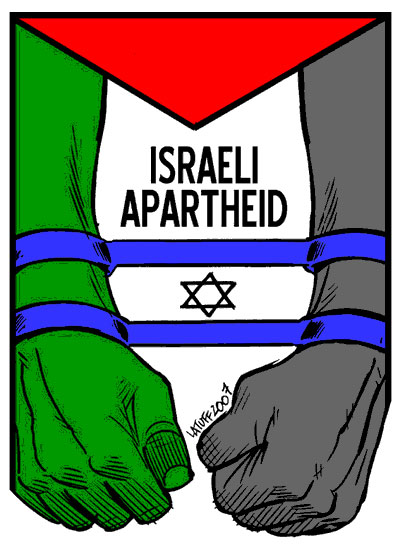
Israeli elections were held almost two months ago. To date, a new government has not been formed. The Israeli Ministry of Transport announced on Saturday that there would be segregated bus lines for Jews and Arabs in the Occupied West Bank. These lines of apartheid started to operate today. We can see from this what the priorities are …

*
Peace Now activists also protested the operation of these lines and said, “the decision to (operate) separate bus lines in the territories is shocking and turns racism into the norm. A Palestinian Rosa Parks is needed to insist upon sitting on Jewish bus lines, (someone) who won’t surrender to discrimination.”

*
Image ‘Copyleft’ by Carlos Latuff

israeli-apartheid-2
*

Separate but equal bus lines?

Palestinian workers travelling between West Bank, Israel to use separate public transportation after settlers complain of potential security risks. Leftists call these ‘apartheid lines’, Transportation Minister Katz says ‘Palestinians entering Israel will be able to ride on all public transportation lines’
Reuters, Itamar Fleishman*

Tension, delays and chaos ensue on the first day segregated, Palestinian-Israeli bus lines are operated in the West Bank.

On Monday morning, a riot broke out at the exit point of the Eyal crossing, adjacent to Qalqilya after numerous Palestinian laborers could not get to work within the Green Line. They protested the fact that as of now, they must arrive at the crossing from far-off places in the West Bank since the new bus lines are their only means of entering central Israel.

In response, Transportation Minister Yisrael Katz said that “Palestinians entering Israel will be able to ride on all public transportation lines, including all those already existing in the West Bank.”

In addition, according to a Transport Ministry announcement, Katz instructed that all new Afikim bus company lines will be reinforced immediately according to demand. “In light of the great overflow on the few lines operated this morning, the ministry will asses the possibility that lines will leave from additional West Bank points, making it easier for the travelers.”

נאבקים על מקום באוטובוס. הבוקר במעבר אייל (צילום: EPA)
Monday morning at the Eyal crossing (Photo: EPA)

Israel launched two Palestinians-only bus lines in the West Bank on Monday, a step an Israeli rights group described as racist and which the Transport Ministry called an improvement in service.

The ministry opened the lines, to be used by Palestinian laborers travelling between the West Bank and Israel, after settlers complained that Palestinians on mixed buses were a security risk.

The separate Palestinian bus line initiative aroused a wave of reactions from both sides of the Israeli political spectrum. Leftists called upon the Transport Ministry to cancel what they call “Apartheid lines.”

Meretz Chairwoman Zahava Gal-On turned to Katz and demanded that he “immediately cancel the segregated lines in the West Bank. Separate bus lines for Palestinians prove that occupation and democracy cannot coexist,” she said.

According to Gal On, the decision to separate between Jews and Arabs stems from settler pressure and not from the desire to improve upon services for the Palestinians. “Separation on buses based on ethnicity was customary in the past in racist regimes around the world and is unacceptable in a democratic country.”

Peace Now activists also protested the operation of these lines and said, “the decision to (operate) separate bus lines in the territories is shocking and turns racism into the norm. A Palestinian Rosa Parks is needed to insist upon sitting on Jewish bus lines, (someone) who won’t surrender to discrimination.”

Conversely, Karnei Shomron Regional Council Chairman Herzl Ben-Ari, one of the leading pressure-putters on the Transport Ministry for finding a solution to the overload and the tension on the regular West Bank bus lines commented as well.

Ben-Ari said that “the situation in the past few months in which Israeli citizens have been compelled to ride on bullet-proof buses under IDF instruction and find buses full of people from the Arab population, is absurd, not to mention the security risk involved. On the other hand, the Arab population is compelled to pay a fortune for unlicensed drivers to pick them up straight from the crossing. The current solution is good for all. It allows Arabs to ride cheaper and regulated buses.”

“Creating separate bus lines for Israeli Jews and Palestinians is a revolting plan,” Jessica Montell, director of the B’Tselem rights group, said on Army Radio. “This is simply racism. Such a plan cannot be justified with claims of security needs or overcrowding.”

עומס בעלייה לאוטובוס. הבוקר במעבר אייל (צילום: גור דותן)
Overload on Palestinians-only buses (Photo: Gur Dotan)

Ibrahim, from the West Bank village of Bidya said, “it is impossible for to make it all the way here. I need to leave an hour and a half earlier because I live far from the Eyal crossing, and if I miss the bus – my whole workday is gone.”

Fauzi, who lives in the village of Zaita, adjacent to the West Bank city of Ariel, requested to arrive to work in Israel and was also delayed at the Eyal crossing. He expressed his frustration regarding the situation and said “this chaos is unclear to me. I need to drive an hour and a half just to get to the bus, and now it is not clear if there are even enough buses.”

"לא ברור אם בדרך חזרה נספיק להגיע לאוטובוס" (צילום: גור דותן)
No room on buses (Photo: Gur Dotan)

Additional laborers who arrived at the crossing, verbally confronted Transport Ministry and Afikim bus company representatives, who were guarded by police officers who arrived at the scene to maintain order.

“The Ministry of Transport has not issued any instruction or prohibition that prevents Palestinian workers from travelling on public transport in Israel nor in Judea and Samaria,” it said, referring to the West Bank.

“Furthermore, the Ministry of Transport is not authorized to prevent any passenger from using public transport services.”

Rights groups, however, voiced concern that Israeli police at checkpoints in the West Bank would remove Palestinian passengers from regular bus lines and order them to use the new ones.

Police spokesman Micky Rosenfeld said all Palestinians returning to the West Bank would be searched for stolen property, describing this as a routine Israeli precaution.
He said he did not know whether and how this might affect Palestinian travel on regular buses.