Tuesday, July 01, 2008

ALL HELL BREAKS LOOSE IN MONGOLIA FOLLOWING ELECTION


The president of Mongolia has issued a decree introducing a four-day state of emergency in the capital, Ulan Bator, because of rioting (first picture above) after Sunday's parliamentary elections. Public gatherings are banned and any such meetings will be broken up, according to the TV announcement, which also includes a ban on media except for Mongolian national TV and state media organisations.

The action was taken in response to the protests involving thousands of people in Mongolia's capital voicing outrage over what they claimed were rigged elections.

In the elections the Mongolian People's Revolutionary Party won 41 of the 76 seats in parliament. The Mongolian Democratic Party has 25 seats and independent candidates have just one seat. Final election results are expected today.

Mongolia Web has reported:


"Protesters have set fire to the Mongolian People's Revolutionary Party (MPRP) building (second picture above) in Mongolia's capital Ulaanbaatar. Fire trucks are trying to get near the site. Military and police are joining forces to control the crowd. Eagle TV shows images of smoke coming from the MPRP building and protesters trying to enter. Around 19.30 fire was coming from the windows at the ground floor, but the fire brigade seems to have controlled. "

In the meantime protesters look for the confrontation. Police men are shooting at the crowd with what seem to be rubber bullets."

Protesters have taken possession of bottles of a duty free shop and are throwing the bottles at the building while setting fire to the carton boxes."


Journalist Irja Halasz told Al Jazeera that the rioters had prevented firefighters from reaching the burning MPRP building.

"The police have withdrawn their lines back because of the rioters throwing a lot of stones, and at this point it looks like no one is in control," she reported from the building next to the headquarters.

"It looks like the rioters here have not heard the [president's] speech, they are going on and it looks like there is no end to it."

In addition part of the Cultural Palace, which contains an art gallery, a museum and a theatre, was on fire early Wednesday as violence continued.

The technically neutral President Enkhbayar -- previously with the MPRP -- earlier called an emergency security meeting that involved Prime Minister Sanjagiin Bayar and all opposition party leaders.

At the meeting, broadcast live on the privately run Eagle television, the MPRP-affiliated Bayar renewed his calls for restraint while blaming the Democrats for inciting the rioters after losing the elections.

International observers say that overall the election was free and fair, but new election rules that changed the first-past-the-post system to one of multi-member constituencies have led to procedural problems and confusion.

With an economy based on nomadic herding, Mongolia was heavily reliant on support from Moscow, but when this was withdrawn its financial systems quickly collapsed. The political system which was modeled after that of the old Soviet Union also went by the wayside.

During the difficult intervening period, the former Communists, the MPRP, and the emergent Democratic Party have competed for power.

Four years ago, they were pretty much forced to form a coalition, but in 2006 they broke apart again acrimoniously. Since then the MPRP has hung on to power through alliances with splinter parties.

Despite years of political unease, politics in Mongolia was relatively calm as long as the country was poor.

But that has changed, as the previously untapped and considerable mineral wealth of the vast Mongolian plateau starts to be exploited.

With a "victory" in the latest elections, the MPRP was expected to open the way for long-awaited agreement on how to handle billions of dollars of foreign investment in the country's mining sector.

According to the East Asia oriented web site Secure my Country, the previous broadly split parliament had failed to agree revisions to the mining law seen as essential to promoting foreign investment or to approve the long-stalled multi-billion dollar Oyu Tolgoi copper project backed by Ivanhoe Mines of Canada and Rio Tinto.

Mongolia's large estimated reserves of resources such as copper, gold, coal and uranium have drawn increasing international interest amid rising commodity prices and the rapid economic growth of China, the grassland nation's southern neighbour.

However, international mining executives have expressed deep frustration at slow progress in setting the terms of foreign involvement in projects such as Oyu Tolgoi and the Tavan Tolgoi coalfield.

Sumati, head of the Sant Maral independent political polling group, said before the rioting began the election result was likely to lead to early approval of the mining law and Oyu Tolgoi project.

The following is taken from Montsame Agency (Mongolia).

PRESIDENT DECLARES STATE OF EMERGENCY

Ulaanbaatar, /MONTSAME/. In connection with an emergency situation occured in Ulaanbaatar, President of Mongolia N.Enkhbayar issued June 2 at 00.00 a.m. a decree in frames of his competence.

Under his decree, a state of emergency is declared in the capital for four days.

The decree says, due to actions with use of violation of a group of people on the territory of Sukhbaatar district of Ulaanbaatar, mass disturbances are occurred. Forces of the law enforcement organs were attacked, material values were destroyed, and fires were set up in several objects. In order to eliminate consequences of the emergency situations and ensure the security of the population, the President of Mongolia declares a state of emergency from 00.00 a.m. on the territory of the city for four-day term.

The President orders to take the following measures:
1. To strengthen the security of objects of state significance.
2. Using forces permitted by the law, to break up any kinds of demonstrations and mass activities arranged with infringing the law.
3. To restrict the traffic movement in the central part of the capital and to check motor vehicles.
4. Using forces, to disperse and arrest persons and groups of people who break the public order and arrange actions with use of forces and to examine whether they have arms and technical devices.
5. To impose a curfew from 22.00 p.m. to 08.00 a.m. in the central part of the capital, to check persons breaking it, to arrest individuals having no ID cards with forces of the police or military patrol in the period until the expiring the quarantine or for 72 hours no long until the person will identified.
6. To ban the use of devices intensifying sounds, in case of necessity to seize them and to stop activities of all televisions and radios except the national public television and radio until the expiration of the state of emergency term.
7. To prohibit the sale and distribution of alcoholic beverages.
8. To put control over individuals having firearms and cold steel, over entities and plants using explosives, virulent chemicals, and radioactive substances, and over military arms and techniques used in training.
9. To charge Minister of Justice and Internal Affairs Ts.Monkh-Orgil to organize actions for implementing the decree.

Tuesday, June 17, 2008

NAP TIME


THE OREAD DAILY WILL BE SHUTTING DOWN FOR A COUPLE OF WEEKS OR SO. STAY SAFE OUT THERE...AND GET SOME REST.

(pictured here is my friend and Oread Daily co-publisher Whitney the greyhound catching some badly needed zzzzzzzsssss)

Monday, June 16, 2008

THE RIGHT TO FOOD IS AN INALIENABLE HUMAN RIGHT


Finance ministers from the G8 countries met on 13 and 14 June in Hokkaido, Japan to discuss the current state of the global economy. The group expressed "strong concerns" about soaring crude oil and agricultural commodity prices, issues that are also high on the EU's current political agenda.

They "focused" also on the global food crisis.

Don't hold your breath waiting for a great plan from the developed world. That's what some protesters from around the world said last Friday at a protest in Brussels.

The fact of the matter is that it is the policies of the powerful that are causing the crisis in the first place.

Take Haiti for example.

Haiti used to produce most of the rice that its population ate. Then, in 1995, the World Bank and IMF made it open its markets to cheap imports and the country was flooded with cheap rice from the US. Now it import 80% of its rice. When prices rocket, as they're doing now, and poor people spend 50-80% of their income on food, it doesn't take a genius to work out what will happen.

Haiti has seen some of the worst food riots in recent months. More than half the population is malnourished while an estimated 830,000 jobs have been lost in recent years, primarily in agriculture.

Another example of the irony of it all comes from another a different food crisis conference earlier this month in Rome (these conferences are becoming all the rage). At the Rome conference the head of the World Bank, Robert Zoellick, spoke about the importance of helping small farmers in developing countries (forgetting to mention that his organisation has helped to put a lot of them out of business over the last 20 years).

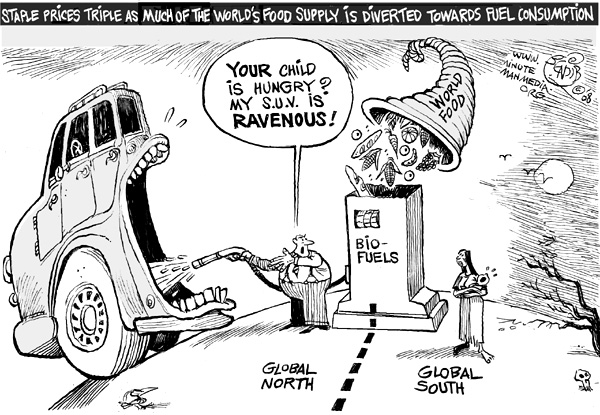
Let's not forget a large percentage grain production now goes into making biofuels. Subsidies worth $11-12 billion for biofuels were used to divert 100 million tons of cereals from human consumption in 2006. Why? Because it would help "fight climate change." However, the carbon footprint of the developed world shows no sign of decline as a result. There is in fact little evidence that biofuel production does anything to help out in the fight against global warming. Actually, quite the contrary.

An editorial in the Appeal-Democrat (California) states:


"To continue these subsidies in the wake of the current food crisis is indefensible on economic and humanitarian grounds. Eliminating them for a few years at least would be the single most constructive thing developed countries could do to alleviate food shortages. Yet the U.S. and Europe — joined by Brazil, which has a huge domestic industry in ethanol from sugar cane — stubbornly refused to reconsider their policies."

In other words, a large part of the mess that agriculture is today is the result of the developed world's policy, the policy that puts profit above everything else.

Venezuela's ambassador to the Food and Agriculture Organization of the United Nations, Gladys Urbaneja Duran, told delegates at the Rome conference that the current food crisis is "the biggest demonstration of the historical failure of the capitalist model".

"The main reason for the rise in food prices isn't growing demand from the Indian and Chinese markets, or the rise in petroleum prices," she said. "The main reason is that food has been turned into yet another object of market speculation."

José Ramón Machado Ventura, vice president of Cuba’s Councils of State and Ministers, summed it up this way in Rome:


"The world food crisis is not a circumstantial phenomenon. Its recent appearance in such serious form, in a world that produces enough food for all its inhabitants, clearly reveals that the crisis is systemic and structural."

...the countries of the North bear responsibility for the hunger and malnourishment of 854 million people. They imposed trade liberalization and financial rules that demanded structural adjustment on a world composed of clearly unequal actors. They brought ruin to many small producers in the South and turned self-sufficient and even exporting nations into net importers of food products."

The governments of developed countries refuse to eliminate their outrageous agricultural subsidies while imposing their rules of international trade on the rest of the world. Their voracious transnational corporations set prices, monopolize technologies, impose unfair certification processes on trade, and manipulate distribution channels, sources of financing, trade and supplies for the production of food worldwide. They also control transportation, scientific research, gene banks and the production of fertilizers and pesticides."

He also cited this truism, "The right to food is an inalienable human right."

The following is from La Via Campesina.

EU in bed with hunger profiteers : Dying for money

The farmers organisations and social movements CPE, COAG and Seattle to Brussels Network staged a symbolic action in Brussels on Fiday the 13th of June, 2008, to denounce the EU involvement in the corporate profit over the food crisis.

Last week in Food and Agriculture Organization (FAO) conference on food security, the EU promoted more free-trade by concluding the Doha Round, fuelling cars instead of feeding people and more pesticides and fertilizers.

Over the last years, these so-called « solutions » have lead to more profits for the big agribusiness corporations and more poverty and hunger for the people.

These figures are for just three months at the beginning of 2008.

Number of hungry people:

+ 100 million people, reaching one billion hungry people in the world (1/6 of the world total population)

Grain Trading:

Archer Daniels Midland (ADM): Gross profit: $1.15 billion, up 55% from last year

Cargill: Net earnings: $1.03 billion, up 86%

Bunge: Consolidated gross profit: $867 million, up 189%.

Seeds & herbicides:

Monsanto: Gross profit: $2.23 billion, up 54%.

Dupont Agriculture and Nutrition: Pre-tax operating income: $786 million, up 21%

Fertilizer

Potash Corporation: Net income: $66 million, up 185.9%

Mosaic: Net earnings: $520.8 million, up more than 1,200%

Meanwhile, local markets are being destroyed and land, water and seeds are being privatized, preventing peasants and small-scale farmers to supply their communities with appropriate food.

Small-scale food producers are able to produce healthy food for everybody. They supply local markets all over the world, while cooling down the earth and protecting biodiversity. For them to continue to do so and prevent further food crisis, we need market regulation and agrarian reform, we need food sovereignty.

STOP FREE-TRADE AGREEMENTS !

IMPLEMENT FOOD SOVEREIGNTY !

Contacts:

Seattle to Brussels Network: Tom Kurschaz +34 619949053

CPE: Morgan Ody +32 486888845

CANADIAN ENVIRONMENTALIST AND FIRST NATIONS ASK THE OIL AND GAS BOSSES TO DRINK THE WATER


The Canadian Association of Petroleum Producers is holding an Oil and Gas Investment Symposium in Calgary from June 16-18. The event brings together over 85 companies and 375 investors from Canada, the USA, and around the world - many of these folks are big funders in the Alberta Tar Sands, with others looking to expand into that market.

Today, on the first day of their meeting, they had some unwelcome guests.

Activists from the Alberta Environmental Network (AEN) showed up to tell the big shots they are not thrilled with what development of the oilsands is having on the water they drink.

They offered to share their water with those at the meeting. Their were no takers.

Members of the Athabasca Chipewyan First Nation and the Mikisew Cree First Nation joined AEN at the demonstration..

Community members of the Athabasca Chipewyan First Nation, located downstream from Alberta's tar sands, continue to experience high rates of rare cancers and auto-immune diseases they believe are linked to the development of the tar sands.

"Investors need to know that our land, our lakes and our people are being poisoned by tar sands development so they can decide, with full disclosure, if they still want to put their money in a human rights and environmental nightmare," said Lionel Lepine, a member of the Athabasca Chipewyan First Nation.

"The tar sands have become Canada's ever expanding black hole and by the end of this conference we're hoping investors see that the same hole will sink their money," said Leah Henderson of ForestEthics.

AEN says at their website:

"While people living in communities downstream from tar sands developments continue to experience devastatingly high rates of rare cancers, while Alberta's lands and waters are contaminated with cancer-causing toxins and are transformed from pristine Boreal forest into what former Alberta Premier Lougheed refers to as a "moonscape," investors in the industry and corporations continue to make record profits. Just weeks after 500 ducks died landing on a toxic tailings pond in Alberta's tar sands region, and Alberta Premier Ed Stelmach announced his government's intention to launch a $25 million advertising campaign to depict Alberta as an "Environmentally-friendly" province to the rest of the world, investors in the most destructive project on Earth are gathering to promote their interests and ensure the tar sands continue to expand, at the expense of the environment and the health of downstream communities!"

Oilsands are deposits of bitumen, a molasses-like viscous oil that will not flow unless heated or diluted with lighter hydrocarbons. They are contained in three major areas beneath 140,200* square kilometres of north-eastern Alberta - an area larger than the state of Florida.

Tar sands oil is sent to the U.S. Midwest and Rockies for upgrading and refining. U.S. refineries are proposing major expansions to handle promises of larger supplies. Last summer the BP refinery on the shores of Lake Michigan created a public uproar when its plan for tar sands expansion included dumping more pollutants into the Lake.

In addition to the problems of torn up forests and toxic lagoons, the process for making the synthetic crude produces three times the greenhouse gases per barrel as conventional oil production.

The respected Pembina Institute in a report released today says Alberta should not approve more oilsands refineries near Edmonton until the province has a solid plan to limit the fresh water they will use and to better manage the pollution they will produce.

The Institute says nine upgraders are expected to begin operating northeast of the capital between 2015 and 2020.

The Oilsands Fever report says together they will consume 10 times as much water as the City of Edmonton each year and spew 45 megatons of greenhouses gases - the same amount that 10-million vehicles produce.

The following is from 660 News.

Demonstrators protest environmental impact of oil sands

Protesters converged on a downtown hotel Monday, trying to bring attention to the effects of the oilsands on their drinking water.

About 40 members of the Alberta Environmental Network staged the demonstration near the investor's symposium hosted by the Canadian Association of Petroleum Producers.

The Network is made up of members of the Sierra Club, Greenpeace and other environmental groups. Representatives are arguing that development of the oilsands should stop because it is affecting the quality of water, air and land in their area, and that in turn is impacting the health of the residents.

Protesters were inviting investors to take a drink of water from their local river; however, by the end of the demonstration, not one person had taken them up on the offer.

Thursday, June 12, 2008

FACTORY WORKERS FIGHT ON IN IRAN


Around 5,000 workers at Haft–Tapeh sugar cane Company in the Khuzestan province of Iran have been on strike since 5 May 2008. The strike action has brought the whole company to a standstill. Haft-Tapeh workers have continued their strike action since then, despite brutal attacks by the security and Special Forces of Iran's Islamist regime.

The blog HOPI Ireland Discussion reported thousands of Haft Tapeh sugar cane workers marched through Shush on May 17. The 3,000 marchers, were joined along the way by local people, swelling their ranks to 5,000. After first gathering outside the Governor’s Office at 8.00 a.m., they then marched with their families and supporters, towards the city centre. The slogans included: “Livelihood and dignity is our certain right,” “Legal cases must be closed,” “Head of security must be fired,” and “Haft-Tapeh workers are hungry.”

Around 11.30 a.m. the security forces attacked the marchers with tear gas.

Three days later, 6000 took to the streets. At one point the workers blocked the main highway in the area.

On May 26th a large number of workers went to the Governor General's office in Shush and began demonstrating. Their numbers swelled by the minute.


Then the security forces and the special guard attacked the protesting workers in front of the Governor General's office. They arrested twelve workers and took them to an undisclosed location.

Last week workers gathered in the industrial complex on their 28th day of strike. They shouted, "Workers will die but will not give to humiliation," "Our monthly salary is our inalienable right" and "Job and life are our inalienable rights." Several thousand protesting workers marched toward the building of the factory's management.

Afraid of agents of the clerical regime getting their names,the workers refused a request by the management to send their representatives for negotiations. They said that they would only accept the management's offer if all workers could attend.

The demand of Haft-Tapeh sugar cane workers are as follows:


- Release of arrested workers and the dropping of all charges against theme and other labour activists;

- The setting up of an independent syndicate (trade union);

- Payment of three months unpaid wages;

- The sacking of the general manger of the company, a mullah called Yaghoob Shafiee, and the whole management committee;

- The sacking company's security chief, Zibdari;

- An end to legal proceedings against the workers.


A statement of solidarity by workers of Ahvaz Pipe Manufacturing Company in Iran reads:

In the name of God, the great nation of Iran and workers

Fourteen days have passed since the strike of the Haft Tapeh Sugar Cane Plantation and Industrial Company workers began. Yet again the military and security forces have, unfortunately, instead of confronting the economically corrupt elements and the sugar mafia, attacked our dear countrymen with truncheons and tear gas in Shush city. They even showed no mercy towards their wives and children. And at a time when the officials of the Islamic Republic are always criticising the Israeli government for various reasons, especially for its attacks on children and women, and by always showing scenes [of these attacks] try to defend the people of Palestine and Lebanon.

But during the past few days when, together with their wives and children, the workers of the Haft Tapeh Sugar Cane Plantation Company came on to streets of Shush to get justice and their rights and were [chanting] the slogan "We are hungry"; the security forces responded to the demand of "Military brother, support us, support us" by firing tear gas [canisters]. Shame on you who attack women and children, who had no demand other than to get their legal rights, in this way.

The worker who had never said that he wanted to overthrow the system; the worker who never thought of causing a disturbance; the worker who does not shirk from any effort to keep the wheels of the Iranian economy turning; the worker who gives his all in the unbearable heat of Khuzestan; the worker who is from the family of [an Iran-Iraq war] martyr; the worker whose family goes through the night hungry; the worker who is a war veteran with chemical [weapon] injuries; but for getting his rights is attacked with a truncheon and sent to hospital.

We, the workers of Ahvaz Pipe Manufacturing Company, who have not been paid for several months and are in a similar situation to the workers of Haft Tapeh, declare our support for the legal protests of the Haft Tapeh workers, condemn the repressive action and demand an end to the gathering of legal dossiers against Haft Tapeh workers.

The following is from Iran Labor Rights.

Security forces brutally confronted protesting workers of Haft Tapeh

Hundreds of Haft Tapeh Sugar Factory workers who took their protests to the streets of Shoush in Khouzistan province on June 10, 2008 were brutally confronted by law enforcement and security forces.

They were beaten and arrested, however the number of arrestees is not clear.

Haft Tapeh workers have limited their protests by gathering in front of the management offices of the company, following another brutal confrontation by security forces three weeks ago, when the workers along with their families staged a widespread rally in the city of Shoush.

The new wave of Haft Tapeh protests started on May 5, 2008 with no results so far.
Thousands of workers in Haft Tapeh have not received their wages for the past three months. They also want to establish an independent workers union, they call for the resignation of the director and security director of the company and an end to the prosecution of Haft Tapeh labour activists.

THE LAWSON FILE: PIPELINE OPPONENTS FACE OFF WITH BIG COMPANY - GOOD LUCK WITH THAT


How many pipelines running through your neighborhood would you consider enough. How about 23?

Yikes!

What if they wanted to run a couple more by your place.

Get out.

Ruby Pipeline, a natural gas pipeline that’s proposed to run from Wyoming to Oregon, with its route crossing through the southern portion of Cache Valley is one of two proposed new pipelines. The proposed route for the pipeline has drawn vehement opposition from property owners and Cache County leaders.

Concerns have ranged from environmental to property rights to property values.

Some say it is just another "not in my backyard," but it seems to me they already got plenty of crap in their backyards as it is.

Houston-based El Paso Corporation and partners want to build the Ruby Pipeline from Opal in southwest Wyoming to Malin, Oregon, near California’s northern border. It’s designed to move 1.2 billion cubic feet of gas a day with the capability of expanding to 2 billion cubic feet.

Cache County commissioners are opposing a leg of a 680-mile pipeline that would deliver the natural gas from Wyoming to Oregon.

After crossing the Cache National Forest, ranchers say the pipeline would damage and devalue their land and they won't get enough compensation for it.

The company could really care less what the ranchers think.

The company "basically said, 'We're not gonna honor ag protection areas; we're not gonna honor state law; we'll just use federal law, and if we have to condemn, we'll condemn,"' Cache County Executive Lynn Lemon told the Deseret News. "It appears to us that Ruby doesn't really care about the private individual landowners," Lemon said.

``Based upon the information currently available to us, the route as currently proposed can be expected to have a substantial negative impact on private property rights and important agricultural and environmental assets,'' Lemon wrote in a recent letter to the Federal Energy Regulatory Commission (FERC).

The Feds will probably care about as much as the company.

But the fight continues.

Stop the Ruby Pipeline is a coalition of ranchers, farmers, landowners, conservation groups, and private citizens from Northern Utah who are committed to stopping El Paso Corp from constructing a new utility corridor through Rich County, Cache County, and Box Elder County, Utah.

The group says El Paso's proposed 42" natural gas Ruby Pipeline unfairly burden's the private citizens of Northern Utah with the costs and risks of a high pressure natural gas pipeline. The Ruby Pipeline will establish a new utility corridor that devalues the land, endangers people and the environment and will attract more unwanted utility construction in the future.

The Stop the Ruby Pipeline group outlines a number of specific reasons for their opposition:
a. No Significant Utah Benefit
i. Citizens subsidize long term gain of gas company

b. Private Property Impact
i. Primarily cuts through private property in Utah
ii. Cuts through scenic “Greenfield” instead of existing utility corridors
iii. Large scenic ranches/valuable real estate impacted
iv. Situated near existing towns instead of open public ground
v. Ruby saves money in shorter route - Utah subsidizes savings

c. Construction Impact/Aesthetic Impact
i. Pipeline construction easement 200'/ permanent easement 50'
ii. Permanent cleared scar
iii. No buildings or trees over 50' corridor
iv. Erosion problems in many steep areas
v. Compressor stations loud and unsightly in otherwise peaceful areas

d. Earthquake Danger
i. Runs over 10-15 earthquake fault lines, some of which are active
ii. Runs through USGS location labeled “hot zone”
iii. Placed next to earthen dam which is also on fault line
iv. Runs through flood plain if dam breaks

e. Safety Risk
i. Since late 1980's:
(1) 2,200 pipeline accidents,
(2) 225 deaths
(3) 700 million in damage
ii. Ruby parent El Paso was steward of Carslbad NM Pipeline that exploded
killing 12 - negligent inspection/failed pipeline

f. Emergency Resources
i. Would drain vital local resources in event of emergency to remote
locations
ii. Emergency sites may be inaccessible

g. Environmental Hazards
i. Moose, Elk and Deer winter and summer range
ii. Raptor nesting areas
iii. Endangered/sensitive species impacted
(1) Bonneville and cutthroat trout
(2) Sharp tailed sage grouse
iv. Noxious weed spread
(1) Cheatgrass and medusa head rye
(2) Creates fire “corridor”

h. Agricultural Impact
i. Ruby spokesman says federal law will preempt state Agricultural
Protection Area Laws
(1) Proposed route crosses existing APA areas
ii. Impacts conservation-minded generation ranchers and farmers
iii. Acres of disturbed grazing land difficult to reestablish
iv. Crosses existing conservation easements held by State of Utah
v. Disturbs many buried clay drainage lines in Box Elder County
(1) Extremely difficult to correctly reestablish once disturbed
vi. Permanent easement and new roads encourage unauthorized trespass
i. Watershed Damage
i. South Canyon is an important watershed
(1) Relatively undisturbed ecosystem
(2) Little Bear River
(3) Porcupine Dam/Hyrum dam

But money talks and the money will flow through that pipeline to the El Paso Holding Co.

And I won't even get into the issue of the other pipeline today.

The following is from the Salt Lake City Tribune.

Idaho gas line plan rankles Utah pipeline foes

LOGAN - Foes of the proposed Ruby natural-gas pipeline across three northern Utah counties may have another rival for their attention: a second interstate line, comparable in size and capacity, but routed just north of the Idaho state line.

Cache County Council members are concerned that two pipeline projects are proposed in Cache Valley because the valley's north end extends into Idaho. They invited Kent Connelly, chairman of the Lincoln County (Wyo.) Commission to tell them about the projects' impacts.

Connelly's own neighborhood hosts 23 natural gas pipelines. He said Cache Valley residents can expect more pipeline proposals, as well as requests from power-transmission operators to develop new corridors.

Planned jointly by natural-gas companies Williams and TransCanada, the latest proposal, to be known as Sunstone Pipeline, would be a 585-mile, 42-inch-diameter system that can carry up to 1.2 billion cubic feet per day. Completion is scheduled for 2011.

Sunstone would primarily run through Idaho's Franklin County, south of the route of the Williams' Northwest Pipeline System between Wyoming's Opal hub and Stanfield, Ore. There, it would connect with TransCanada's Gas Transmission Northwest pipeline system, terminating at Malin, Ore.

Similarly, El Paso Holding Co. proposes to complete the Ruby Pipeline across northern Utah in 2011 with a 680-mile, 42-inch pipe from Opal to Malin. It would have an initial daily capacity of 1.2 billion cubic feet of natural gas with the option to increase that capacity to 2 billion cubic feet per day.

The Ruby line would run through Utah's Rich, Cache and Box Elder counties just south of the Utah-Idaho line.

Members of a grass-roots group - Stop the Ruby Pipeline - have argued that Ruby would breach private-property rights and environmental stewardship across northern Utah.

But Stop the Ruby Pipeline spokesman Bruce Leishman said his apprehension isn't limited to Ruby, although the Sunstone proposal is more viable because it's near an existing corridor.

"It's a general concern for all [pipelines]," said Leishman, a Logan real-estate agent. "It would diminish the value of property anywhere because it limits what you can do with it, and it limits the pristine nature of what we have out here."

Sunstone spokeswoman Michele Swaner said earlier this week that the Sunstone project is in preliminary stages. The proposed route will cross BLM territory and only a minimal amount of private land in southern Idaho's Franklin County.

"We sent Sunstone Pipeline project packages to 11 landowners in Franklin County, which accounted for 28 parcels of land," Swaner said. "We have been [operating] in the Pacific Northwest and Idaho for 50 years, and we know the communities we serve."

SUIT TARGETS TEXAS YOUTH FACILITY


The Texas Youth Commission runs what is essentially a state prison system for juveniles. When a court finds that a juvenile has engaged in delinquent conduct, the court--depending on the juvenile’s history and the details of the delinquent conduct--may have the authority to place the juvenile in Texas Youth Commission (TYC) custody.

One of those places where kids are kept is the Brownwood State School which is actually nothing more than a high security prison.

TYC inmates have filed hundreds of sexual abuse complaints against corrections officers within the last few years. Generally nothing much happens with those compliments.

More than a year ago reports surfaced of abuse at the Brownwood "school."

One particularly noxious story told of sexual abuse which took place in a supply closet of a dorm over many months at Brownwood according to documents obtained by the San Antonio Express-News and the Houston Chronicle.

The purported predator was a correctional officer and his victims were wayward teens.

Superiors were alerted to the alleged problem but the staff member who reported her suspicions said she was subject to retaliation, the documents say.

The Brownwood case involved a male correctional officer and four female victims, including a 16-year-old San Antonio girl, according to the documents.

Then, in April of this year, two former correctional officers at the Brownwood state school were indicted on allegations of sexual harassment of students. Such an indictment is rare. (Keep reading and you'll find out why).

Unfortunately it seems these cases are just the tip of the iceberg of problems at Brownwood. Today the ACLU announced a suit whhich charges girls at the school have been subject "...to unwarranted solitary confinement, routine strip searches and brutal physical force." Hopefully the suit will get further than most criminal complaints of abuse in the sytem have.

In May, Houston Chronicle, columnist Lisa Falkenberg discussed one reason why such abuse generally goes unpunished. She suggested there is an obvious problem with placing Texas Youth Commission (TYC) facilities in rural areas which on top of everything else allow for insular "friendly" small-town grand juries and prosecutors to be the chief investigative tool in abuse cases. These grand juries generally are unwilling to charge TYC employees with abuse.

TYC Inspector General Bruce Toney told Falkenberg, "Maybe it's the small town or county attitude of, 'Hey, that's my neighbor, I grew up with him, I grew up with her, I'm not going to see them go to jail over a juvenile that's done nothing but cause trouble all his life.'"

Just as troubling (and another factor in the failure of abuse cases within the sytem to go anywhere) is the fact that Randall W. “Randy” Reynolds, a West Texas district attorney accused of ignoring a graphic and detailed report alleging rampant sexual abuse at a state juvenile jail, won the March Democratic primary with 68% of the vote essentially guaranteeing his re-election as there is no Republican challenger.

According to a Texas Ranger report, the allegations of sexual abuse were laid out and handed over to Reynolds more than two years before the claims of abuse were made public.

And the public apparently didn't care all that much.

The following is a press release from the ACLU.

ACLU Challenges Solitary Confinement And Unwarranted Strip Searches Of Girls Held In Texas Youth Prison

FOR IMMEDIATE RELEASE
CONTACT: (212) 519-7808 or 549-2666; media@aclu.org

AUSTIN, TX – The American Civil Liberties Union and the ACLU of Texas filed a class action lawsuit today on behalf of five girls – all of whom have histories of sexual, physical, or emotional abuse – held in the Brownwood State School. Brownwood is a "high security" youth prison located in central Texas and operated by the Texas Youth Commission (TYC), the state's juvenile corrections agency. The ACLU charges that TYC subjects the girls to unwarranted solitary confinement, routine strip searches and brutal physical force.

"Throwing children into cold, bare solitary confinement cells is profoundly damaging, especially to children who previously have been abused," said Mie Lewis, staff attorney with the ACLU Women's Rights Project. "The ACLU has closely monitored developments in the Texas Youth Commission over the last year, and although we see some improvements, TYC's reliance on solitary confinement has to stop."

The ACLU charges that the treatment the girls have suffered violates their constitutional rights under the Fourth, Fifth, Eighth, and Fourteenth Amendments as well as international standards protecting children from abuse and prohibiting torture and other forms of cruel, inhuman or degrading treatment or punishment. The lawsuit was filed in U.S. District Court for the Western District of Texas.

"We are optimistic that we can meet with the defendants soon and come to an amicable solution," said Lenora Lapidus, Director of the ACLU Women's Rights Project. "It's in the interests of both the children and TYC to stop these practices."

Brownwood State School serves as the reception site for all girls committed to TYC custody and nearly all girls in custody in Texas are held there. Brownwood holds approximately 150 girls who have been sent there for offenses ranging from school-related disciplinary infractions to minor property offenses and more serious offenses.

Girls at Brownwood are regularly placed in punitive solitary confinement in oppressively cold, concrete cells, empty except for a metal slab intended to be used as a bed. Solitary confinement is imposed for minor misbehavior, for self-harm or for expressing a desire to commit self-harm. Terms of solitary confinement can be brief or can last for days, weeks and even months.

Upon entering or exiting solitary confinement and on other occasions when they have not left the facility - for example, when they finish a work assignment within the prison - girls are subject to invasive strip searches. When girls resist, guards regularly use physical force, pepper spray, handcuffs and leather straps to force them to comply. These tactics are also used on girls already in solitary confinement in response to self-harm, shouting, and banging on the wall. Girls subjected to this treatment report suffering flashbacks to childhood rapes and feeling degraded, humiliated and afraid.

"The link between psychological trauma and delinquent behavior is well established," said Lisa Graybill, Legal Director of the ACLU of Texas. "Instead of helping girls learn to cope with their experiences, TYC is re-traumatizing them through the use of solitary confinement and strip searches. TYC must do better, for the sake of our clients and all children in the state's custody."

Attorneys on the lawsuit, K.C. et. al v. Nedelkoff et. al, include Lewis and Lapidus from the ACLU Women's Rights Project, Graybill from the ACLU of Texas, Steven M. Watt from the ACLU Human Rights Program and Elizabeth Alexander from the ACLU National Prison Project.

The complaint is available online at:
www.aclu.org/womensrights/crimjustice/35632lgl20080612.html

The motion for class certification and memorandum in support of motion for class certification are available online at:
www.aclu.org/womensrights/crimjustice/35631lgl20080612.html

More information on the ACLU's work on girls in youth prisons including excerpts of interviews with the girls held in the Brownwood facility is available at:
www.aclu.org/womensrights/crimjustice/girlsinprison.html

Wednesday, June 11, 2008

ALBERT WOODFOX, OF THE ANGOLA THREE, TO GET NEW TRIAL?


WBRZ News in New Orleans is reporting thirty-five years after Angola prison inmate Albert Woodfox (see drawing here) was convicted in the murder of a prison guard, a federal jurist has recommended he receive a third trial. Woodfox has maintained that he did not participate in Miller’s murder and that he was targeted for prosecution in the case because he had helped establish a prison chapter of the Black Panther Party.

Woodfox, 61, one of the prisoners known as the "Angola Three," spent most of the past three decades in solitary confinement after he was convicted in the stabbing death of guard Brent Miller during a prison riot.

U.S. Magistrate Judge Christine Noland concluded Tuesday that Woodfox did not receive effective legal counsel during a 1998 re-trial that again resulted in his conviction.

She recommended that U.S. District Judge James Brady return the case to state district court for a third trial.

Herman Wallace along with Woodfox for more than 30 years remained in extended isolation at Louisiana State Penitentiary in Angola. They have been confined alone to small cells for 23 hours a day with only three hours of outdoor exercise a week. Both men were reportedly suffering from serious health problems as a result of their conditions.

As the blog Why Am I Not Surprised has commented back in the early 70s both men (along with Robert King who was freed in 2001, after a successful appeal to the federal court system on another unrelated charge) were committed to address the system of sexual slavery that lay at the base of abuse and rage so intense among the population that there was on average a murder a week inside the walls.

They organized a chapter of the Black Panther Party within the notorious prison to try to alleviate the hell the place had long before become. The organizing capability of the Black Panther Party inside prison, however, was even more threatening to the Powers-That-Be than similar activities in the street at that time. The prison administration couldn't tolerate prisoners taking control of their own lives. It did all it could to put a stop to any such thing in their prison.

But the spirit of men like Woodfox would not be crushed.

"I had to fight corruption and the things being tolerated by the prison administration to control the population," Woodfox, 61, said in an interview. "When you saw the look on these kids' faces -- to see the spirit of another human being broken -- it affected the way you looked at life."

The Times-Picayune in an article this spring wrote:

"In 1972, Angola was a horror-show of corruption and abuse that inspired state legislators and a newly-elected governor to call for an investigation into what was taking place behind the front gates, where at the time none of the guards employed were black."

"It was also completely segregated," said Nick Trenticosta, a New Orleans attorney who continues to fight for the freedom of Woodfox and Wallace, as King was released in 2001. "There were lots and lots of weapons, at least a murder a week - inmates being murdered. It was against that backdrop that Albert and Herman formed a Black Panther Party chapter. They were trying to stop the sexual slavery and rampant rage occurring there everyday."'

Left to fend for themselves at the plantation-turned Angola state prison, inmates in 1973 were subject to being "sold" to each other to be used as "sex slaves" or prostituted out to other inmates in exchange for prison-brands of currency, such as cigarettes."

The warden at the time, C. Murray Henderson, later confirmed this system of sexual slavery in his own book. Henderson was later sentenced to 50 years in prison for the 1997 attempted murder of his wife, writer Anne Butler, on her front porch in St. Francisville."

Back in 72 Leontine Verrett was the fiance of the murdered guard Brent Miller. She long believed the three men charged in the crime were guilty. That began to change a couple of years ago. It was then that Billie Mizell, a legal investigator and fledgling author, showed up at Verrett's home near the banks of the Bayou Teche. She said she wanted to talk about Miller's murder.

The LA Times reported last month what Mizell told Verrett stunned her. A bloody fingerprint found at the scene did not match Woodfox or Wallace. There was never any physical evidence linking them to the crime.

Mizell said the star witness against Woodfox and Wallace, a repeat sex offender serving a life sentence, was promised freedom for his testimony -- a deal that the prosecution never disclosed to the defense. He was later transferred to another building where guards plied him with cigarettes, a prized jailhouse currency.

The Times wrote Verrett was still skeptical. But she and Dean, who had also worked as an Angola guard, corroborated everything Mizell said by digging up court files and talking to friends and former co-workers.

After years of struggling with questions about the cold way prison authorities treated her when she sought compensation for her husband's death, issues she ignored as a teenager but that gnawed at her as an adult, she came to a troubling realization.

Maybe the men charged with the murder were not guilty at all.

"If I were on that jury," Verrett now says, "I don't think I would have convicted them."

The following is from the New Oreleans Times-Picayune


'Angola 3' member to get 3rd trial in prison guard's death

A federal magistrate recommends a third trial for a former Black Panther who spent 36 years in solitary confinement after being convicted of killing a prison guard.

Magistrate Judge Christine Noland says Albert Woodfox's attorney should have objected to testimony presented in his 1998 retrial, but failed to do so.

That included statements by an inmate who was promised help getting an early release in exchange for testimony, and expert testimony about blood spatters on clothing that state officials said had been lost.

Both witnesses had died since Woodfox's first trial in 1972. Their trial testimony was read to jurors.

Woodfox was among three inmates held in solitary for decades. They say the reason is that they had been Black Panther activists.

One of the "Angola Three" is now free after his 1973 conviction for murdering a fellow inmate was overturned and he pleaded guilty to conspiracy to commit murder. The other two were convicted of killing a guard during a 1972 riot. They were moved to a maximum security dormitory in March.

RAYTHEON PROTESTERS ACQUITTED IN NORTHERN IRELAND


UTV reports six Derry (Northern Ireland) anti-war protesters (pictured here) have been unanimously acquitted of destroying property belonging to multinational arms company Raytheon.

They were each found not guilty of causing criminal damage to the building and offices and an employee`s car in Derry in August 2006.

But, Eamonn McCann, a founder of the 1960s civil rights movement in Northern Ireland, a veteran socialist and trade unionist, and one of Ireland's most widely read journalists, was convicted of stealing two computer disks belonging to the company.

However, he walked free after Judge Tom Burgess imposed a 12 month conditional discharge.

McCann's co-accused were James Anthon Kelly, (47) of Rathkeele Way, Eamon O'Donnell, 53, of Campion Court, Colm Donal Sarto Bryce, 42, of Westland Avenue, Sean Heaton, 35, of Circular Road and 42-year-old Kieran Vincent Gallagher of Craft Village.

Speaking outside the court, McCann said the men welcomed the jury's decision and said it had "completely vindicated" their actions.

The men took part in a protest at Raytheon's offices in August 2006.

The company is the maker of "Bunker Buster" bombs, Tomahawk and Patriot missiles, and manufactured the missile that killed 62 civilians in a Baghdad market in 2003.

Raytheon set up their office in Derry in 1999. Their arrival was announced by John Hume and David Trimble, shortly after collecting their Nobel Peace Prizes. For years Raytheon’s presence in Derry has been opposed, with regular vigils, public meetings and debates, marches and appeals to local politicians.

There was outrage in Derry when, in 2006, one of Raytheon's guidance systems for missiles developed in Derry and which was being used by Israel smashed into a block of flats in Qana, Lebanon killing 28 people, mostly children.

A few days later, the local anti-war group decided to occupy the Raytheon building as a protest.

In an interview with Britain's Socialist Worker in late May McCann said:

"There's a straight line from 40 years ago to what is happening today. In 1968, we were outraged by the U.S. war in Vietnam and inspired by the Black struggle for civil rights. We were moved by this. In Ireland, we were fighting against local injustices, but we viewed ourselves and our struggles as part of an international struggle."

Today, we continue to fight against local injustices in Ireland, but we also see it as connected to a global struggle. There's never been a contradiction between fighting local injustices and fighting injustice in the world."

The U.S. is attempting to violently dominate the Middle East and control the oil there. Iraq and Lebanon, as well as Palestine, are at the frontline of this struggle. The location of struggle may have changed, but the struggle for liberation and justice continues."

Oh, and by the way, Raytheon is reportedly ready to go with something new. Yes, it is the Silent Guardian, ADS, or the Pain Ray. Actually, some report versions of the weapon are already up for sale. Counterpunch describes the weapon thusly:
"Transmitted at the speed of light over a 700 yard distance, the Pain Ray is a millimeter-wave beam that penetrates 1/64th of an inch beneath the skin, causing the water molecules there to bubble, producing an intense burning sensation, said to feel like being burnt by molten lava or a hot iron. Its delivery system attached to a Humvee and aimed right, the Pain Ray makes people run away -- fast."

The weapon has been described as "Holy Grail of crowd control."

Colonel Kirk Hymes, who is in charge of testing at Moody Air Force Base in Georgia, demonstrated the weapon recently by staging a mock protest rally. A handful of military volunteers, dressed as civilian protesters, carried signs saying "Peace Not War" and threw objects at a group of soldiers. A series of raygun blasts from half a mile away disrupted their chants and forced them to disburse.

Raytheon is currently selling a more limited-range civilian version of the system, under the name “Silent Guardian,” which it promotes as being suitable for “law enforcement, checkpoint security, facility protection, force protection and peacekeeping missions.”

Ostensibly developed as a "non-lethal" tool for crowd control, researchers at the Loma Linda University medical center claim that cataracts and cancer are among the possible long-term negative health effects.

The following is from the Derry Journal (N. Ireland).

Raytheon 6 cleared

There were jubilant scenes in a Belfast court today as six Derry anti-war protesters were unanimously acquitted of destroying property belonging to multinational arms company Raytheon.
As the Crown Court jury of four men and seven women were led from Court 14 at the Laganside complex, the six men and their supporters who had packed the public gallery clapped and cheered in appreciation of the not guilty verdicts.

The six, 65-year-old author and journalist Eamonn McCann, from Westland Avenue, and his co-accused James Anthony Kelly (47), of Rathkeele Way, Eamon O'Donnell (53), of Campion Court, Colm Donal Sarto Bryce (42), of Westland Avenue, Sean Heaton (35), of Circular Road, and 42-year-old Kieran Vincent Gallagher, of the Craft Village, all Derry, were each acquitted of causing criminal damage to the building and offices of Raytheon and an employee's car on August 9, 2006.

However, McCann was convicted by a majority of ten to one of stealing two computer disks belonging to the company but he walked free after Judge Tom Burgess imposed a 12 month conditional discharge.

Speaking outside the court, Colm Bryce declared that their actions had been "completely vindicated" and that the verdicts were "very welcome to ourselves and our families". He said he wanted to dedicate the not guilty verdicts to the bereaved families in Qana in the Lebanon who had been bombed by Israeli Forces using missiles made by Raytheon.

"We feel vindicated in taking the action that we did," declared the anti-war activist.

Mr McCann read from a prepared statement in which he echoed the sentiments that the six "have been vindicated".

"The jury have accepted that we were reasonable in our belief that the Israeli Defence Forces were guilty of war crimes in Lebanon in the summer of 2006. The action we took was intended to have, and did have, the effect of hampering or delaying the commission of war crimes."

He also called on politicians and the citizens of Derry "to say in unequivocal terms that Raytheon is not welcome in our city".

"We have not denied or apologised for what we did," he added. "Personally speaking, and I believe I speak for all of us, it was the best thing I have ever done in my life," declared Mr McCann.

Over the course of the last four weeks, the jury had heard that, following repeated bombing of Lebanese property in which numerous civilians died, the group of anti-war protestors forced their way into the Raytheon plant in Derry and caused significant damage to its server and computers.

The six all claimed their reason for doing so was to protect the lives and property of people in the Lebanon from being attacked by Israeli Forces who bought their weapons, weaponry systems and missiles from Raytheon.

Tuesday, June 10, 2008

HOMELESS FIGHT SWEEPS IN SEATTLE


More than a dozen homeless people and friends were arrested yesterday in Seattle after camping overnight outside Seattle's City Hall. They were protesting new rules authorized by Seattle Mayor Greg Nickels. The rules come on the heels of the removal of at least six homeless camps across the city this year.

"It's like, if the police came into your apartment and went through your apartment and decided what to keep and what to throw away, its like the same thing," said Bill Shephard, homeless advocate.

The demonstration was organized by the group
Real Change.

One of those arrested, Mike Smith, contrasted the cordiality of the police action against the protesters to the sweeps of homeless encampments which he likened to a death sentence.

A downward economic spiral will keep "people dropping to the bottom," Smith told the Seattle Post-Intelligncer, who has cerebral palsy and lives in low-income housing near Pike Place Market.

"They're lucky to have a tent and a place to put it to survive. When you take away their means to survive, you're going to kill a percentage of them -- guaranteed. So as far as I'm concerned, the sweeps policy is about killing people."

During the protest Women in Black read the names of 283 homeless people who have died outside since 2000.

One man, John who has lived on Seattle's streets for six months told radio station KIRO that many of his friends have lost work tools, clothes, pots, pans, tents warm weather gear. "Throwing it away when it's brand-new stuff half the time," he says. "It's about common decency."

He says the current city policy requires police and parks' workers to throw-out everything, which he says doesn't make sense, "They were constantly losing stuff and constantly re-buying it, and then they'd lose it again a few days later," John says. "You can only knock somebody down so many times before they decide they're just not going to get back up."

Chris Kissel at the blog "SLOG News and Art" told about some people she met at the protest:

"Finally, I met Veronyka Tristan and Neres Johnson, a homeless couple standing outside the gathering. Tristan, who said she had recently become pregnant, told me that she and Johnson have been homeless for months. “You try to sleep at a park and the police wake you up; you try to sleep under a bridge, and people throw water on your stuff,” she said. Tonight, the couple would be camping out. After that, they said they’d be sleeping “wherever the Lord lets us sleep.”'

Tristan and Johnson, like nearly everyone I talked to yesterday, had a few choice words for city politicians. “If the mayor were here, I’d tell him to grow some balls,” said Tristan. “I’d kick his ass,” Johnson added."

Tim Harris, Executive Director of Real Change said, "I think in an ideal world no one should have to sleep in a park, but I think some people have to sleep outdoors because there isn't anywhere else for them to be. To bar from the usage of public land is criminal and inhumane."

The Real Change Homeless Empowerment Project has many faces, a newspaper, an advocacy group, a Homeless Speakers Bureau, and literary workshops.

The following is from the Seattle Times.

15 seized in homeless protest

Fifteen people protesting the sweeps of homeless encampments in Seattle parks were arrested Monday morning after they blocked Cherry Street on the north side of City Hall in Seattle by pitching a tent in the street and standing in the road.

The protesters, who included homeless people and their supporters, including at least two clergymen, were arrested before 9:35 a.m. The 15 were interviewed and released, according to police spokesman Sean Whitcomb. He said it will be up to the City Attorney's office whether to file charges of pedestrian interference.

The last to be arrested was Dana Sutliffe, with the Real Change Organizing Project. She yelled, "Stop the sweeps!" as she was led away. Sutliffe said she is from Norway, and "to see people on the street here is just an atrocity for me."

John Moorehead, a homeless man who works construction jobs, said he participated in the blockade because "my camps have been raided three or four times when I'm trying to get ahead. How can you get ahead when they're taking your stuff?"

The Rev. Rich Lang, pastor of Trinity Methodist Church in Ballard, was wearing his clerical vestments when he was arrested in the rain. He said Mayor Greg Nickels "has chosen the side of the developers and people with financial interests. That's not bad, but he's forgotten the people on the lower rung."

"It's my understanding everybody was cooperative. It went fairly smoothly. This was a planned event," said Seattle police spokesman Mark Jamieson.

After the last person was arrested, officers took down the tent that was blocking traffic.

Protesters chanted, "Sweep Nickels, not the homeless," referring to a homeless sweeps policy initiated by the mayor. Sunday night, the homeless, their supporters and activists had pitched tents in front of City Hall in protest.

It was the third annual overnight protest camp-out, and organizer Timothy Harris said advocates are frustrated, calling the policy unfair and inadequate.

Alex Fryer, a spokesman for Nickels, said the sweeps policy tries to balance the needs of the homeless with protecting city parks.

THE LAWSON FILE: FREEDOM OF EXPRESSION NOT ALLOWED


So there are these students in Redding, California and as their high school years were coming to a conclusion they made a decision that shocked and horrified school administrators. They ran an editorial in their school newspaper defending any American's right to burn the flag and they ran a photo of a student doing just that right on the front page (see picture).

It was too much for the grown ups to handle.

Sure, the adults said, we understand there is such a thing as freedom of speech, but who are these kids to actually practice it (and wait until you read the bizarre excuses the principal came up with for his actions against the kids and the newspaper in the article below).

Quite a lesson learned for these kids, I'd say.

Unfortunately, of course, such censorship of high school newspapers is hardly uncommon despite our supposed freedom of speech...and it isn't only the kids who pay the price.

Linda Kane's "reassignment" at Naperville Central High School as advisor to the school paper followed the school's student newspaper publishing articles on drug use among students.

The newspaper published three pieces about marijuana, one of which was an anonymous column that used profanity. Principal Jim Caudill called for changing the newspaper's policy on using profanity.

Kane and her student editors refused, noting they had based the policy on guidelines from the Student Press Law Center. A week later, Kane said in a Daily Herald article that Caudill and other administrators "don't know squat" about 1st Amendment law in newspapers. She also said Caudill "is all about PR and doesn't want any bumps in the road."

You can guess how that went over with the tin horn dictator who ran the school.

Caudill asked her to resign as adviser and journalism teacher. She refused and was fired from those positions despite protests from students and parents. Six weeks later, the schools newspaper, the Central Times, finished third in the Illinois High School Association's journalism competition, in a field of 66 schools.

And then there is Eureka (California) High School Principal Robert Steffen who pulled 400 copies of the Redwood Bark student newspaper after the paper's April issue hit the stands. Steffen pulled the newspaper because of a nude drawing by student Natalie Gonzalez in the paper's art section.

Principal Steffen has since "apologized." Still Steffen said in his "apology" he didn't see his action as censorship, and instead called it “restricted circulation.” Redwood Bark staff and some experts in student journalism law thought otherwise.

I could go on and on with examples, but what's the point? None of this can come as a surprise to anyone who ever went to high school. High school is so far from a place for free expression of any kind as to be down right scary. Imagine a country run like your old high school. I'd kind of hoped things had changed over the decades since I was in school, but apparently that isn't the case. It appears that high school administrators remain as afraid of their students "thoughts" today as they did yesterday.

Mark Goodman, holder of the Knight Chair in Scholastic Journalism at Kent State University, says, "I think anybody who's been involved in this issue for any length of time can tell you that there are more censorship conflicts today than at any other time."

No one is keeping score, but Goodman and other 1st Amendment advocates say anecdotal evidence, court rulings and surveys of high school students clearly show a constricting of the students' free speech.

An editorial written by Charles Haynes, senior scholar at the First Amendment Center in Washington, and printed in the Fond du Lac Reporter made a great point:


"Students have become canaries in the free-speech coal mine: We can predict the future health of freedom of speech in America by looking at how public schools live up to — or fail to live up to — the First Amendment."

Right now, there are a lot of sick canaries out there. It's no mystery why so many young people tune out public-policy debates, stay home from the polls and become cynical about their government."

OR maybe they'll learn what I did and fight back against all forms of authoritarianism from those with too much power.

The following rather amazing article is from the Chicago Sun Times.

Flag-burning editorial helps kill school paper in Redding, Calif.

The adviser calls it sabotage, the principal finds it embarrassing and the superintendent is offended.

The students see it all as a matter of freedom of speech.

Shasta High School, in Redding, Calif., published its last issue of the Volcano, the student newspaper, before the end of classes last week with an image on the front page of a student burning the American flag and an editorial inside defending the practice.

"The paper's done," said Milan Woollard, Shasta High principal. "There is not going to be a school newspaper next year."

Shasta had been looking at cutting the paper already -- funds are tight as the school anticipates receiving fewer state dollars from Sacramento this fall, Woollard said.

"This cements that decision," he said.

Judy Champagne, the Volcano's faculty adviser, is upset that some of the students decided to use the newspaper as a platform to engender controversy during the last week of school. Planned for the paper was coverage of Shasta's prom, announcements of scholarship recipients and other news.

Those items made the paper, she said. The editorial and image of flag burning were added at the last minute.

"I think that the students were sabotaging what should have been a positive last issue," she said. "I think it's very sad that we're not going to have a paper."

Upsetting to Champagne, who's been the newspaper's adviser for years, is what she called a lack of news judgment from some of the students on staff. While flag burning may be a salient national issue, she said, nothing has happened recently in northern California to make it a current, local issue.

Until now.

"I thought it was bad journalism," she said.

The editorial, written by Connor Kennedy, who graduated Friday, explained that a person has the right to burn the flag, that it's protected speech under the first amendment. Kennedy did not return a phone call made to his home Monday.

Administrators at the school and district level said students have a right to run the photo and print the editorial under the first amendment, but all of them called it poor judgment.

"I think that they misused (their freedom of speech)," Champagne said. "I think this was a game for them."

Mike Stuart, Shasta Union High School superintendent -- a U.S. Army veteran and paratrooper -- said just because the students have a right to defend and run the image doesn't mean the administration has to approve of it.

"Personally, I find it offensive," he said. "Especially the last newspaper of the year. It's like a parting shot."

Stuart said it showed the students' immaturity.

"I think it was especially self-indulgent," he said. "I don't like it at all."

Kennedy, who won an award from the local chapter of the Daughters of the American Revolution earlier this year for an essay he wrote, was president of Shasta's student union and helped organize a demonstration on campus last fall to protest the high school's decision to combine its junior and senior prom and the vote that led to the decision.

Woollard said he believes Kennedy and other students placed the photo and editorial in the paper simply to get a reaction. And it's what they've got, he said.

"I'm just embarrassed that the thing was ever done," he said.

RACISM ALIVE AND WELL


This is not a new story, but it is one I just became aware of...and it is what it is...a story of racism plain and simple.

Black News Your Views reports in Metairie Louisiana it took less than one week for a black family moving into a predominantly white neighborhood to be greeted by racism. Someone burned the letters KKK into their front yard four weeks ago (see picture).

The letters were carefully shaped into the ground and easy to read, sending this African American couple in a predominately white neighborhood a clear message.

“I feel like I've been disrespected. Not just me, but my family. I feel like I'm being threatened, and those markings in our history, it's known for a marking of territory, to let you all know don't come back here,” the husband told WWLTV. “You're not welcome.”

The couple asked that their identity be withheld not for their safety, but to protect their children.

FYI: The Louisiana Interchurch Conference (LIC) is coordinating an interfaith response to this situation. If you live in Metairie and would like to participate in interfaith planning and response, please email the LIC representative, Rev. John Deschner, Associate Pastor at Munholland United Methodist Church, in Metairie at LICMETLA@AOL.COM.

The following is from the New Orleans Times-Picayune (and thanks to Lance Hill for the heads up).

Authorities investigating burning of racist symbols in yard of African-American family in Metairie
by Michelle Hunter, The Times-Picayune

More than four weeks after someone burned the letters KKK and the shapes of three crosses in the front yard of an African-American family's Metairie home, the grass still refuses to grow. And the family has not rushed to remove the symbols.

"We left it out there because we want people in the neighborhood to know that there are people in their own backyards that believe in this garbage," said the family's patriarch, who asked not to be named when a reporter stopped by Monday. He said he doesn't want any publicity for himself, just public awareness that "racism is still alive and it is well."

The Jefferson Parish Sheriff's Office and the FBI are investigating the damage as a possible hate crime. The symbols appear to have been made by a chemical, not by fire. They were reported May 7. No suspects have been arrested.

The property, in a predominantly white section of northeast Metairie, is home to a 35-year-old chef and a 34-year-old cosmetologist and their three children. They had lived in the house only five days when the symbols were discovered.

"I just didn't know what to think," the man said, holding his 19-month-old son in one arm and his 5-month-old daughter in the other. "I didn't know what to say. I was just in awe."

The father said he was afraid at first, then outraged. Now he's confused and frustrated.

"I want to ask, 'Why?' We haven't been in the neighborhood long enough to cause a ruckus. We didn't do anything. It's 2008 and you still can't get past the racial issue?"

Perhaps the hardest part for the couple was explaining to their 9-year-old son why there were so many police cars in the yard last month, the meaning of burned crosses and the Ku Klux Klan, and why someone might not like the boy because of his skin color. It was a painful conversation the father said he never imagined having to have in this day and age.

But the family is determined to stay put, said the father, recalling that they have moved three times since Hurricane Katrina. "After my wife made me pack up all that stuff and move, I'm not going anywhere," he said with a laugh.

He called the vandalism a cowardly act born of ignorance, and a similar reaction on his part would amount to stooping to the culprit's level. As a father, he said, he must be a better model for his son.

"I still have to be a responsible adult in this house," he said. "We're trying to teach them that they should not live in fear, to speak when spoken to, keep your hands to yourself and respect others."

The family has been helped by neighbors who, one by one, came to their door and offered support as word of the incident spread. One of those neighbors was Dave Tibbetts, 52.

"It's just unbelievable that this would happen," Tibbetts said.

The family is confident that the guilty party will be caught. The father said he's not looking for a stiff jail sentence or fines, but for the perpetrator to be sentenced to community service in an African-American neighborhood.

"I want him . . . to come out of his comfort zone," the father said, "to see that black people are not animals. They are everyday people."

Anyone with information about the incident can call the FBI at (504) 816-3000 or the Sheriff's Office investigations bureau at (504) 364-5300.

Monday, June 09, 2008

TAKE BACK THE ECONOMY STUPID


The New York Daily News reports a protest of a John McCain's $28,500-a-head event at the 21 Club in the city is being organized by the SEIU with an assist from the labor-backed Working Families Party. The improv group "Billionaires for Bush" will also be on hand.

This is part of an ongoing effort by the SEIU to highlight the fund-raising done for McCain by Henry Kravis, of the private equity firm Kohlberg Kravis Roberts (KKR), which the union argues has gamed the tax code to make big money during the buyout boom.

Kravis is being joined as an organizer of McCain's 21 Club fund-raiser by his fellow investment fund big Ted Forstmann, hedge-fund head Paul Singer (a former Rudy Giuliani supporter), Merrill Lynch CEO John Thain and JP Morgan executive James Lee.

Speaking about the current recession Kravis told the Wall Street Journal, "Economic environments like these provide opportunities. We at KKR have made some of our best investments in periods like these".

On July 17th, the SEIU will be holding a global action day against private equity firms such as the Amsterdam-listed KKR. There will be demonstrations in 100 cities and 25 nations. The rallying cry will be: Take back the economy from buyout firms that have exploited tax loopholes to amass great wealth at others’ expense.

“We think the buyout industry and the way it operates are systematic of what’s wrong in this economy,” said Stephen Lerner, director of the union’s private equity project. “We want to make them responsible corporate citizens.”

The union also argues that the attention on private equity firms has been justified by the huge role they now play in the economy. Companies owned at least in part by Kohlberg Kravis employ more than 816,000 people, according to the firm’s Web site — more than the population of San Francisco.

According to the SEIU, KKR founder Henry Kravis made about $51,000 per hour in 2006, yet he would pay a lower tax rate on his profits than nurses and teachers on their incomes of $50,000 per year.

The following is a press release from the Service Employees International Union.

Workers, 'Billionaires for Bush' to Gather Outside McCain's Big Money Private Equity Fundraiser in Manhattan

Controversial buyout baron Henry Kravis to host event

Advocates for a fairer, better economy, workers, and political improv troupe "Billionaires forBush" will gather in front of the posh 21 Club in Manhattan on Tuesday to protest John McCain's support for tax loopholes for some of the wealthiest buyout executives in the country. The $28,500 a ticket luncheon is being
organized by some of the most controversial names in business, including
buyout baron Henry Kravis.

John McCain has said he does not support closing tax loopholes for
hedge fund managers and buyout industry executives such as Kravis, who have
pocketed billions of dollars by paying a lesser percentage of their income
to taxes than many regular working Americans. Besides helping to organize
Tuesday's event, Kravis has been a major fund-raiser for John McCain
throughout his campaign for president.

McCain's tax plan also includes two huge tax cut giveaways for American
corporations--lowering rates from 35% to 25% and adding other new
deductions. KKR companies stand to make millions of dollars off the new
cuts. According to the Center for American Progress, "The centerpiece of
Sen. John McCain's (R-AZ) tax plan is two huge tax cuts for American
corporations, including utility and energy companies." A CAP analysis finds
that McCain's tax policy--which lowers corporate tax rates from 35 to 25 %
and makes equipment and technology investments immediately
deductible--would give a single KKR portfolio company, Energy Future
Holdings (formerly TXU), a $49 million tax cut.

The country's fastest-growing union - the Service Employees
International Union - recently launched a multi-tier global campaign
directed at world leaders and legislators, pressing for fairer taxation of
the multi-trillion-dollar private equity industry, with an eye toward
shaping the debate during the U.S. presidential race.

WHAT:

Dozens of protesters fighting for a fair economy; performances by the
"Billionaires for Bush."

WHEN/WHERE:

June 10 - 6:30 PM

The 21 Club -- 21 West 52nd St.

New York City, NY

BOLIVIANS PROTEST US GRANTING OF ASYLUM TO TWO ACCUSED OF CRIMES AGAINST HUMANITY


More than 7000 Bolivian workers, farmers and others demanded justice in front of the US Embassy in La Paz today. They are outraged over the US granting political asylum last week to former Defense Minister Carlos Sánchez Berzaín who has been accused of crimes against humanity relating to a massacre in October 2003. Berzain fled the country during the wave of government directed violence against protesters.

The protest at the embassy also demanded punishment for former Bolivian President Sánchez de Lozada for his involvement in the action.

Luis Ramos, an official of the Federation of Neighboring Boards, told Prensa Latina that protesters were upset with the decision of Washington to shelter criminals that supported the police massacre five years ago where 68 people died and more than 400 were injured.

Below is a partial list of those killed on the orders of Berzaín and the former Bolivian Presdient.

NAME AND AGE PLACE OF DEATH CAUSE OF DEATH
Constancio Quispe M. (43) Puente Rio Seco bullet impact (abdomen)
Felix Javier Quispe (23) Rio Seco bullet impact(abdomen)
Teodocia Morales M. (38) Rio Seco (ex – tranca) bullet impact(abdomen)
Carmelo Mamani P. (47) Senkata bullet impact(back)
Nicolas Morales C. (24) Av. Bolivia bullet impact(chest)
Luis F. Quelca (16) Av. Julian Apaza bullet impact(chest)
Juan Cosme A. (44) Warisata bullet impact (chest)
Marlene Nancy Rojas Ramos (7) Warisata bullet impact (chest)
Sergio Vargas C. (19) Warisata bullet impact (chest)
Efrain Mita Q. (22) Extranca Senkata bullet impact(face)
Narciso Colque M. (26) Rosaspampa bullet impact(face)
German Carvajal V. (36) bullet impact (head)
Marcelo H. Cusi V. (21) Apaña bullet impact (head)
Ramiro Vargas A. (22) Av. 6 de Marzo (El Alto) bullet impact (head)
Luis R. Cusi. Q. (22) Av. Julian Apaza bullet impact(head)
Victor Arcani Ticona (36) Ballivian (El Alto) bullet impact (head)
Roxana Apaza Cutipa (19) Final Los Andes bullet impact(head)
Alex Llusco M (5) Rosas Pampa bullet impact (head)
Juan C. Barrientos (32) San Julian (Santa Cruz) bullet impact (head)
Marcelo Chambi M. (NS) Rio Seco bullet impact(hip)
Arturo Mamani V. (48) Apaña bullet impact (leg)
Maximo Vallejos M. (21) Puente Rio Seco bullet impact(leg)
Damian Luna P. (30) Villa Ingenio bullet impact( neck )
Roberto Huanca P. (34) Villa Ingenio bullet impact(neck)
Filomena Leon M. (36) Patacamaya bullet impact (spinal column)
Jaime V. Quispe Z. (30) Chasquipampa bullet impact(stomach)
Wilson H. Chuquimia D. (32) Puente Elizardo Perez bullet impact(stomach)
Lucio S. Gandarillas A. (33) Senkata bullet impact(stomach)
David Salinas M. (29) Senkata (El Alto) bullet impact(stomach)
Marcelino Cuti M. (NS) Ventilla bullet impact(stomach)
Diego Mamani M. (32) Apaña bullet impact(thorax)
Francisco Ajllahuanca (43) Av. Julian Apaza bullet impact(thorax)
Manuel Yanarico J. (35) Ballivian bullet impact(thorax)
Marcelino Carvajal L. (59) Final Los Andes bullet impact(thorax)
Jose Miguel Perez C. (40) Plaza Ballivian bullet impact(thorax)
Feliz Bautista Paco (26) Puente Elizardo Perez bullet impact(thorax)
Jose Macias Quispe (30) Puente Elizardo Perez bullet impact (thorax)
Richard Charca C. (23) Puente Elizardo Perez bullet impact(thorax)
Damian Larico M. (22) Puente Rio Seco bullet impact(thorax)
Juan Ticona M. (68) Puente Rio Seco bullet impact(thorax)
Enrique H. Marin L. (40) Rio Seco bullet impact(thorax)
Jhonny Suñavi Q. (28) Rio Seco (ex – tranca) bullet impact(thorax)
Demetro Coraca C. (62) Sorata- Ilabaya bullet impact(thorax)
Simael Marcos Quispe (22) Warisata bullet impact (thorax)
Vidal Pinto Blanco (21) Zona Panoramica bullet impact(thorax)
Rosendo Riolobos A. (43) San Francisco (La Paz) bullet impact (heart)
Eduardo Hino P. (35) Senkata bullet impacts (heart)
Augusto Hilari P. (50) Puente Rio Seco bullet impact(body)
Jacinto bernabe R. (61) Apaña bullet impacts (legs)
Benita Ticona (38) gas station Rio Seco burned in gas station explosion
Braulio Callisaya D. (38) gas station Rio Seco burned in gas station explosion
Florentino Poma M. (34) gas station Rio Seco burned in gas station explosion
Jose L. Atahuichi (41) Ventilla grenade explosion
Walter Huanca C. (25) Ballivian (El Alto) impact by tear gas
Serapio Arnada C (40) Ceja (El Alto) impact by tear gas
Edmundo Charcas C. (41) Final Los Andes suffocation by tear gas
Wiler Ortiz Cordova (35) Munaypata bonebreak by militar car
Edgar Lecoña A. (20) Apaña

In the US, the International Human Rights Clinic at Harvard Law School, along with other human rights lawyers, has filed two lawsuits charging former Bolivian President Gonzalo Daniel Sánchez de Lozada Sánchez Bustamante and former Bolivian Minister of Defense Jose Carlos Sánchez Berzaín for their roles in the killing of civilians during popular protests against the Bolivian government in September and October 2003. The case will be heard in Miami.

The suits, which seek compensatory and punitive damages under the Alien Tort Statute (ATS) and the Torture Victim Protection Act (TVPA) charge Sánchez de Lozada and Sánchez Berzaín with extrajudicial killings and crimes against humanity for their roles in the massacre of unarmed civilians, including children. In particular it charges the two with ordering Bolivian security forces to use deadly force, including the use of high-powered rifles and machine guns, to suppress popular civilian protests against government policies.

Legal experts say the case, filed by a group of 10 victims' family members, marks the most notable civil suit against a foreign former head of state residing in the United States since legal action was brought against former Philippines president Ferdinand Marcos in the 1980s

Each of the ten plaintiffs, who are Aymara natives of Bolivia, are survivors of individuals who were killed by forces under Sánchez de Lozada’s and Sánchez Berzaín’s command. The ten plaintiffs include among them: Eloy Rojas Mamani and Etelvina Ramos Mamani, whose 8-year-old daughter was killed in her mother’s bedroom when a single shot was fired through the window; Teofilo Baltazar Cerro, whose pregnant wife was killed after a bullet was fired through the wall of a house, killing her and her unborn child; Felicidad Rosa Huanca Quispe, whose 69-year-old father was shot and killed along a roadside; and Gonzalo Mamani Aguilar, whose father was shot and killed.

“We would prefer to see Sánchez de Lozada and Sánchez Berzaín sent back to Bolivia to stand trial, but if that does not happen, the U.S. courts are the best alternative. We hope that the judiciary in the United States will give a fair trial for the victims and defendants. We are asking for justice,” said Plaintiff Juan Patricio Quispe Mamani.

"Violators of human rights no longer have any refuge. They will be judged and held accountable. This is the case for Sánchez de Lozada and Sánchez Berzaín, who will answer to a court of law, either in the United States or Bolivia," said Harvard Law School Clinical Professor and Executive Director of the Human Rights Program James Cavallaro

The Bolivian Supreme Court has approved a formal extradition request for Sanchez de Lozada and two of his ministers to face trial in their home country on similar charges.

One of Sanchéz Berzain's US lawyers is Gregory B. Craig. Craig is a senior foreign policy advisor to presumptive Democratic nominee Sen. Barack Obama

The following article is from Reuters News Service.

Thousands of Bolivians protest at U.S. embassy

LA PAZ (Reuters) - Thousands of supporters of leftist president Evo Morales protested outside the U.S. Embassy in La Paz on Monday, demanding the United States send home for trial two right-wing Bolivian politicians.

The protest followed comments by former Defense Minister Carlos Sanchez Berzain, who told a local radio station last week that a U.S. court had granted him political asylum.

The protesters blame Sanchez Berzain and former President Gonzalo Sanchez de Lozada, who also lives in the United States, for the deaths of 60 people and wounding of hundreds more in an army clampdown on anti-government protests in 2003.

"We want Bolivia to be free, not a Yankee colony," shouted the irate protesters, most of whom were Bolivian Indians.

Hundreds of policemen in riot gear struggled to keep rock-throwing demonstrators away from the fortress-like embassy building and ended up firing tear gas to disperse them.

Morales, a leftist, often criticizes Sanchez de Lozada for his pro-business policies when in office and for being too close to the U.S. government.

Sanchez de Lozada stepped down as president during the political upheaval of 2003 and fled to the United States 13 months into his second term as president of the poor South American country.

"The government of George Bush has decided to give refuge to the butcher Sanchez Berzain, and also I suspect to the genocidal Gonzalo Sanchez de Lozada ... we cannot tolerate (that)," protest leader Roberto de la Cruz told a local radio station.

The U.S. Embassy in La Paz has neither confirmed nor denied if Sanchez Berzain has been granted political asylum, saying that his immigration status is his private matter.

In September Bolivia's top court asked the government to start extradition proceedings against Sanchez de Lozada. But U.S. Ambassador Philip Goldberg was quoted as saying by Bolivian daily La Razon on Monday that Bolivia has not made a formal extradition request.

Like his ally Venezuelan President Hugo Chavez, Morales is a fierce critic of U.S. foreign policy, which he often describes as "imperialistic."

(Writing by Eduardo Garcia; Editing by Fiona Ortiz and Eric Walsh)

Sunday, June 08, 2008

SPECIAL REQUEST: VOTE HAMISH NOW


June 20 is "National Take Your Dog to Work Day", and Hamish asked me to pass along this request for your support in the TYDTW photo contest (and Florida votes will be counted in full) with a "five paw" vote!! To vote for Hamish, click on the link below and then click on the paws...

See
http://www.takeyourdog.com/Gallery/index.php?dog_breed=Golden%20Retriever

I have personally met Hamish and will testify he deserves your full support. Further, even though he is not a greyhound, my friend Whitney (who is) has announced she will cast a vote for him.

The Oread Daily has now officially endorsed HAMISH.