Thursday, April 25, 2013

CAPITAL'S WAR ON GREYHOUNDS: IS IT THE CAUSE OF ALL THE OSTEOSARCOMAS? OF COURSE IT IS!

I AM NOT A COMMODITY


Do you realize that upwards of 25% of all racing greyhounds die of osteosarcoma (bone cancer).  I have had three greyhounds.  My first two died of that dreaded disease.  The third is two years old now and I am just hoping he has is graced with a long healthy life.

Do you realize that almost no AKC greyhounds die of osteosarcoma.  Almost none versus 25%?  These are basically the same dog with one big difference...the racetrack.  The race-death-profit making complex.

There are a number of theories but no proven reasons for this obvious disparity.  The two most likely suppositions are:


1. Racing greyhounds get osteosarcoma because of the injuries they regularly received when they are being run at such high levels of competition.

2. Breeding practices have ensured that the genes that predispose greyhounds to osteosarcoma are deeply ingrained in the racing greyhound gene pool.

I would guess both play a part.  I would also throw in all the other stress placed on these dogs, all the chemicals pumped into them and put on them, all the substandard food, all the time they spend locked up in small crates...and on and on.  Yes, I would guess it all plays a part.

But let's look at one obvious fact.  Greyhound training and racing leads to bone density changes and numerous micro fractures (not to mention the more serious fractures and injuries).  

DUH, could there be a connection to the osteosarcomas later in life?

Greyhounds are wondrous dogs who have done nothing to deserve the lousy fate they face in an industry, that like all other industries under capitalism are concerned with only one thing - profit.  Like workers in general, these dogs are viewed as just another commodity.  The difference is workers, being humans, can fight back.  Greyhounds cannot self organize, they can't form unions, they can't sabotage the track, they can't do any of this.  They are more like slaves, I suppose, then workers in that regards.

It's got to stop. 

The following is from Stop Greyhound Racing and it from 2012.


Study: Greyhound Training Causes Bone Density Changes and Microfractures


Researchers at Massey University in New Zealand just completed a five-year studyof issues related to the greyhound racing industry. Not surprisingly, their conclusions provide even more evidence that dog racing is cruel and inhumane.

According to an abstract for the study, which was conducted between 2007 and 2011:

“We identified that hock injuries were the single most important cause of catastrophic failure and dog loss. The combination of training practices, questionable feeding practices, and the suspicion of stress-induced fractures was also a significant cause of dog loss.”
In particular, the study found that training and racing on an oval track actuallychanges a greyhound’s bone density, and results in microfractures:


“An initial subjective assessment has revealed asymmetry between the bone density of the left/right central tarsal bones, as the result of track running, and increases in bone volume and density following training. Also, microfractures appear to result during training.”

Finally, and perhaps most notably, the study found that the bone density changes that take place during training may cause greyhounds to be predisposed to a later catastrophic injury:


“We are uncovering the early changes in bone that occur after the onset of training, and which may predispose it to catastrophic fracture later.”

Greyhound breeders often claim that catastrophic injuries are mere accidents they are not responsible for. In their own words, a broken leg is “no big deal.” This new study provides even more evidence that this is simply not the case. Catastrophic greyhound injuries are an entirely predictable result of this cruel industry. As long as dog racing continues, thousands of greyhounds will suffer broken legs and die on the track.

Wednesday, April 24, 2013

RESPONSE BY HEALTHCARE WORKERS TO BOSTON BOMBING REVEALS "PEOPLE HAVE THE POWER"


If the civility, courage, focus and determination could occur every day what a utopia we would live in.....
                                                  -----Someone

What would it take to make things work, to fix the problems, to save the earth, to save each other, to make it right.  Really, what would it look like?  How would we do it?  What is communism anyway.  I don't mean the theory, I mean the reality.  

We, every now and again, catch a glimpse of a world we just don't live in...yet.  It is hopefully one we will live in one day, probably, almost certainly not me, maybe you, but for sure some future generation (well, presuming the world survives long enough).

The post below from the New Yorker  on the amazing response by healthcare workers in Boston to last week's bombing will strike some as an odd answer, an odd prescription, just odd for Scission in general.  What I am asking you to do though is to think about how these human beings who lead a regular life on regular days did something extraordinary on an extraordinary day.

I hope this doesn't come across as some sappy CNN or NBC let's look at today's heroes segment, because that isn't what this is about.  I don't count these people as heroes.  They didn't throw themselves on the grenade to save their platoon or jump in front of a bus to save a child.  What they did do, however, goes, in some ways beyond heroism, because they did it as a collective.  These aren't individual stories.  This is the story of a collective which not only acted as such, but worked to be able to act as such only in case they ever had to act as such.

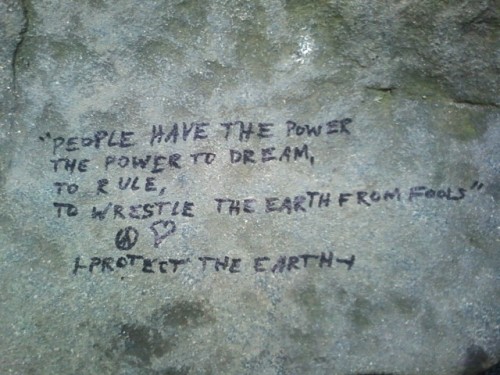
We could all, everyone of us, do this, if only we cared enough (or maybe if only we believed we could).  Maybe that is it, we have to realize the power we all have when we work with each other, organized and in cooperation,  and not in competition or against each other.  The power we as people have...realized people, as Patti Smith sang, do indeed have the power...to "TURN THE EARTH'S REVOLUTION," and make one while we are at it. 

Just try and imagine, if you will, the multitude waking up one morning and saying you know we have to get ourselves together and figure out how when the time comes we could actually DO IT...and imagine, if you will, the time coming, and it actually BEING DONE.

Then again maybe you will just see this as the story of some healthcare folks who practiced some drills and then happened to be able to do what they needed to do.  That in itself is interesting.

I hope you see it as more though...


Why Boston’s Hospitals Were Ready


boston-hospital-580.jpg

The bombs at the Boston Marathon were designed to maim and kill, and they did. Three people died within the first moments of the blast. More than a hundred and seventy people were injured. They had their limbs blown off, vital arteries severed, bones fractured, flesh torn open by shrapnel or scorched by the blasts’ heat. Yet it now appears that every one of the wounded alive when rescuers reached them will survive.


Medically speaking, this is no small accomplishment. We’ve seen bombs like this in the battlefields of the Middle East, but rarely in cities like Boston. In the past century of wartime conflict, explosive devices have escalated to become the predominant cause of military casualties. Among American personnel wounded in our wars in Iraq and Afghanistan, they have accounted for three-quarters of injuries; gunshot wounds for just twenty per cent. It has been an historic accomplishment for military medical units to bring case-fatality rates from such injuries down from twenty-five per cent in previous conflicts to ten per cent today. And according to data from the Israeli National Trauma Registry, explosives used in terror attacks have tended to be three times deadlier than those used in war—because civilians don’t have armor, because victims span a wider range of age and health, and because preparedness tends to be less systematic. Nonetheless, in Boston, they survived.


How did this happen? Something more significant occurred than professionals merely adhering to smart policies and procedures. What we saw unfold was the cultural legacy of the September 11th attacks and all that has followed in the decade-plus since. We are not innocents anymore.


The explosions took place at 2:50 P.M., twelve seconds apart. Medical personnel manning the runners’ first-aid tent swiftly converted it into a mass-casualty triage unit. Emergency medical teams mobilized en masse from around the city, resuscitated the injured, and somehow dispersed them to eight different hospitals in minutes, despite chaos and snarled traffic.


My hospital, the Brigham and Women’s Hospital, received thirty-one victims, twenty-eight of them with significant injuries. Seven arrived nearly at once, starting at 3:08 P.M. All required emergency surgery. The first to go to surgery—a patient in shock, hemorrhaging profusely, with inadequate breathing and a near-completely severed leg—was resuscitated and on an operating table by 3:25 P.M., just thirty-five minutes after the blast. The rest followed, one after the other, spaced by just minutes. Twelve patients in all would undergo surgery—mostly vascular and orthopedic procedures—before the evening was done.


This kind of orchestration happened all across the city. Massachusetts General Hospital also received thirty-one victims—at least four of whom required amputations. Boston Medical Center received twenty-three victims. Beth Israel Deaconess Medical Center handled twenty-one. Boston Children’s Hospital took in ten children, ages two to twelve. Tufts Medical Center and St. Elizabeth’s Medical Center each treated eighteen victims. One emergency physician told me he’d never heard so many ambulance sirens before in his life.


There’s a way such events are supposed to work. Each hospital has an incident commander who coördinates the clearing of emergency bays and hospital beds to open capacity, the mobilization of clinical staff and medical equipment for treatment, and communication with the city’s emergency command center. At my hospital, Stanley Ashley, a general surgeon and our chief medical officer, was that person. I talked to him after the event—I had been out of the city at the time of the explosions—and he told me that no sooner had he set up his command post and begun making phone calls then the first wave of victims arrived. Everything happened too fast for any ritualized plan to accommodate.


So what did you do, I asked him.


“I mostly let people do their jobs,” he said. He never needed to call anyone. Around a hundred nurses, doctors, X-ray staff, transport staff, you name it showed up as soon as they heard the news. They wanted to help, and they knew how. As one colleague put it, they did on a large scale what they knew how to do on a small scale. They broke up into teams of six or so people, one trauma team for each patient. A senior nurse and physician stood at the door to the ambulance bay triaging the patients going to the teams. The operating-room director handled triage to, and communication with, the operating rooms. Another staff member saw the need for a traffic cop and began shooing extra clinicians into the waiting room, where they could stand by to be called upon.


Richard Wolfe, the chief of the emergency department at Beth Israel Deaconess Medical Center, told me he had much the same experience there. Of twenty-one casualties, seventeen were serious and seven required emergency surgery. One patient came in with both legs almost completely amputated already. Another’s leg was too mangled to save. Numerous victims had open, bleeding wounds, with shrapnel and shards of fractured bone. One had a lung injury from the blast. Another was burned on over thirty per cent of the body. One had to have an eye removed. Wolfe arrived in the emergency department expecting to take charge of assigning everyone responsibilities.


“But everybody spontaneously knew the dance moves,” he said. He didn’t have to tell people much of what to do at all.


I spoke to Deb Mulloy, the nurse in charge of our operating rooms that afternoon, and a few of the other nursing leaders to find out how they knew the dance moves. Mulloy began mobilizing as soon as she saw the news flash onto a television screen. Others learned through Twitter, text messages, smartphone news apps. They all began to act before the alarm had been sounded.


“We just knew this was real,” Mulloy said, “and a lot of people could be hurt.”


Change of nursing shift is at three o’clock. So she immediately notified the day shift to stay on. No one wanted to leave, anyway. This doubled the available staff.


The nurses put all scheduled surgery on hold and began readying eight rooms. They ordered equipment trays for vascular and orthopedic procedures to be brought up from stock supply. They called an orthopedics-manufacturer representative for extra hardware to be mobilized. They got in touch with the blood bank, which was already securing blood from other states. They communicated with other operating rooms around the city to make sure they had enough supplies of equipment, too.


How did they know to get eight rooms ready, I asked. And how did they know to get them ready for vascular and orthopedic procedures? “Did someone tell you?”


“No,” said Brenda McKonly, one of the senior nurse leaders. She just saw the descriptions of the explosion like everyone else, made a surmise about the injuries, and recognized that they needed to get as many rooms ready as they could. To be on the safe side, the staff also got equipment for one room to be ready for a neurosurgical injury and another for a thoracic injury. But as word filtered down from the emergency department, it became clear that their original surmise was correct. All eight rooms would be required, and nearly all the cases involved vascular and orthopedic injuries.


Talking to people about that day, I was struck by how ready and almost rehearsed they were for this event. A decade earlier, nothing approaching their level of collaboration and efficiency would have occurred. We have, as one colleague put it to me, replaced our pre-9/11 naïveté with post-9/11 sobriety. Where before we’d have been struck dumb with shock about such events, now we are almost calculating about them. When ball bearings and nails were found in the wounds of the victims, everyone understood the bombs had been packed with them as projectiles. At every hospital, clinicians considered the possibility of chemical or radiation contamination, a second wave of attacks, or a direct attack on a hospital. Even nonmedical friends e-mailed and texted me to warn people about secondary and tertiary explosive devices aimed at responders. Everyone’s imaginations have come to encompass these once unimaginable events.


Hence the grim efficiency with which the city responded. Organizers halted the race. Runners who’d trained for weeks for the event turned away from the finish line in bewildered but stoic acceptance. The press, for the most part, rightly hesitated to amplify unsubstantiated claims about the identity of the perpetrators.


Risks of further attack required assessment. Panic had to be averted. Criminal evidence had to be secured. And above all, victims needed to be saved.


What prepared us? Ten years of war have brought details of attacks like these to our towns through news, images, and the soldiers who saw and encountered them. Almost every hospital has a surgeon or nurse or medic with battlefield experience, sometimes several. Many also had trauma personnel who deployed to Haiti after the earthquake, Banda Aceh after the tsunami, and elsewhere. Disaster response has become an area of wide interest and study. Cities and towns have conducted disaster drills, including one in Boston I was involved in that played out the scenario of a dirty-bomb explosion at Logan Airport on an airliner from France. The Massachusetts General Hospital brought in Israeli physicians to help revamp their disaster-response planning. Richard Wolfe at the Beth Israel Deaconess recalled an emergency physician’s presentation of the medical response required after the Aurora, Colorado, movie-theatre shooting of seventy people last summer. From 9/11 to Newtown, we’ve all watched with not only horror but also grave attention the myriad ways in which the sociopathy of killers has combined with the technology of inflicting mass casualty.


We’ve learned, and we’ve absorbed. This is not cause for either celebration or satisfaction. That we have come to this state of existence is a great sadness. But it is our great fortune.


Last year, after the Aurora shooting, Ron Walls, the chief of emergency medicine at my hospital, gave a lecture titled “Are We Ready?”


In Boston, it turns out we all were.


Photograph, of a patient being transported to an ambulance at Copley Square, by John Blanding/The Boston Globe/Getty.

Tuesday, April 23, 2013

A BELATED "GET LOST" TO THATCHER THE SCAB FROM SCISSION


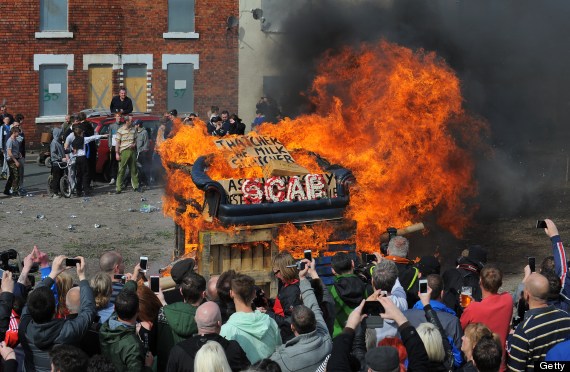
Goldthorpe Former Miners Burn Effigy Of 'Thatcher The Scab


“Seen the site for Maggie’s grave? It’s OK, but I reckon the dance floor is a bit small.”

“Maggie’s funeral is the first time the 21 gun salute is fired into the grave.”

“Breaking news—the devil has been made redundant”.


I haven't said anything about the dead Margaret Thatcher simply because I hate to even utter her name.  Ron Reagan's BFF was a piece of horse dung and hopefully she is burning in a fiery hell.  Margaret Thatcher was an enemy of working people, the Irish, progressives, ordinary British folk, the enemy of human kind in general...and our cheerful commander in chief took her dancing.  

And the British ruling class turned her funeral into an expensive and outlandish piece of state finery.  Well, why not she was their lady, they owed her one.  


At the time of her funeral, CounterFire wrote:


The British ruling class is burying one of its own. Existing in a cocoon of privilege, insulated from the grim mood of alienation that pervades the lower depths of British society, the political establishment has decided to turn Thatcher’s funeral into a state pageant. The profiteers and the millionaires wish to pay homage to the class warrior who smashed the unions, destroyed manufacturing industry, privatised our public services, and screwed the poor.

At a celebration of her death in the community of Goldthorpe, Heather Hopwood, 51, the landlady of the local pub and the daughter of a mine  said, Thatcher destroyed our community. No jobs - people have no jobs. Goldthorpe used to be a thriving community."  Said Robbie Conroy, 66, a miner for more than 30 years who wore a hat with "rust in hell" written on it at the party,  "She was willing to let children starve,"

At another gathering in east Durham David Hopper, of the Durham Miners’ Association (DMA) made his feelings clear in comments to the Northern Echo:


“I am vindictive. I’d have shot her,” he added, speaking in front of the club’s plastic smoking shelter at about lunchtime – after just one pint.

“I am bitter. I wish she’d died 50 years ago – or never been born.
There were many, many such gatherings and many many such stories across Britain when the "Iron Lady" died. 
Working people know their enemies and they knew Thatcher well.
“I’m having a drink to it (her death) right now,” David Hopper, regional secretary of the National Union of Mineworkers (NUM) in north-east England, told AFP.

“It’s a marvellous day. I’m absolutely delighted. It’s my 70th birthday today and it’s one of the best I’ve had in my life.”
In London's Trafalgar Square chants of "Maggie, Maggie, Maggie, dead, dead, dead" filled the air as revelers popped bottles of champagne and danced under intermittent rain showers. 

A tongue in cheek comment at Pride's Purge brought a smile (and a tear) to this old commies face:
   

In a touching tribute to Margaret Thatcher, groups of former miners have decided to honour her memory by agreeing to be beaten up and falsely arrested by police in a demonstration against her legacy taking place in Trafalgar Square today.


As a mark of respect, senior police officers have jointly agreed with miners leaders to recreate the infamous 1984 Battle of Orgreave in which miners were beaten up and falsely accused of rioting and unlawful assembly in celebration of the former prime minister.

The former miners will be joining socialists, travellers, students and other anti-capitalist protesters who were regularly beaten up by the police during Lady Thatcher’s tenure as prime minister to celebrate her legacy of being baton charged and hit on the head with truncheons until they bleed.

A delegation of ex-miners from Durham are also hoping to be assaulted, unlawfully arrested and maliciously prosecuted by police in a memorable re-enaction of the infamous trial in 1987 in which police had to pay out £425,000 to them after admitting they had been stitched up.

Senior police officers have also confirmed they have agreed to honour the former prime minister by not disciplining any officers for misconduct whatever they might get up to during the demonstration.

I'm not done.  I've held this hatred inside for a long, long time.  I remember Margaret Thatcher.  I saw what she did when she did it. 

At a soccer match in Liverpool following her death fans held up a sign which read, "You didn't care when you lied, we don't care that you died."

The People's World reported:

Thatcher sent 5,000 police in to attack the 10,000 striking miners with scores of injuries resulting. "She used miners as a political springboard. She knew what she was doing and it was a horrible way to do it," Daren Vaines, a former miner, told the BBC. In coal country Thatcher is remembered as the person who took nationalized publicly controlled industries and sold them off to private bidders, tossing workers out onto the scrap heap. She branded the striking miners "the enemy within."

No wonder the bar parties last night in Yorkshire, North Derbyshire, Durham, Northumberland, Scotland, south Wales, Kent, Lancashire and Nottinghamshire!

The ex-miners in Yorkshire began celebrations early.

One of them said: "We meet in the club every Monday afternoon. We'd been putting a bit of money by for when she popped her clogs.

"One of the lads waked in, told us she was dead and tipped the money out onto the table."

Among the Yorkshire celebrants last night was Mick Appleyard, a former miner and union official. "She killed my village," he said. "Sharlston [in West Yorkshire] is now a low-wage, menial wage economy, for those who are lucky enough to find jobs. Our young people are on the streets. There's nothing for them. They turn to drugs and drink because there is nothing else."


So yeah, they, we hate that woman, always have and always will. 


David James, whose fathers worked in the mines of Wales wrote in a sadly poetic commentary at TruthDig:

There wasn’t a “state” funeral for my dad or for any other of the hundreds of thousands of courageous colliers of South Wales, and the rest of Britain, who risked everything, every single working day of their lives, in the most appalling working conditions and danger, for the sake of their families and the country, and by whose hard labor and raw courage—courage enough to face plunging down hundreds and hundreds of feet into the blackness of those subterranean hellholes every day in a “cage”—cut the very wealth, by their own hands, that funded the entire might and prosperity of industrial Britain, and won all the wealth that today funds the Tories’ own selfish inheritable privilege and advantage, as well as that of their erstwhile “British Empire,” over more than two centuries. 

 There were no TV crews from around the world in attendance, or pomp and ceremony, or glinting be-sworded regimental cavalrymen, or sickeningly fawning politicians, or kings, queens and heads of state at a Westminster Abbey for my dad’s funeral. Just a simple service and a pint or two, shared amongst loving old friends and family in a spare Welsh chapel and pub. But that man and his collier brothers were worth a thousand more than all the rich Tory bastards on earth put together.


No, there was no such memorial extravagance for either my dad, or all those countless and now historically “anonymous” and “insignificant” workers; the enemies within, who really did deserve such immoderate commemoration, as whole generations of now increasingly forgotten British coal miners and steelworkers surely did. The whole bloody lot of them.


The strength and bravery of those perfectly ordinary men and women of the British working class, summoned up day after relentless day for their whole lives, was brutally and savagely betrayed by that greedy, evil and wholly misbegotten Thatcher.

Have I said enough.  I could go on and talk about her comments that Nelson Mandella should rot in jail, her efforts with Reagan to try and kick off a nuclear war, her attacks on pensioners, the sick, the elderly, the weak and the impovrished.  Some guy named Harry Paterson adds:


The Poll Tax, riots, poverty, record unemployment, the most draconian and repressive employment legislation anywhere in the developed world, more small businesses going to the wall than at any period prior to her rule, her defence of and friendship with Chilean mass-murdering dictator General Pinochet and the ruination of the NHS to name but a few of her achievements.


And so finally, I return to Mr. James who said he just could not face the State Funeral,


No, my wife and I just couldn’t face it. We couldn’t possibly endure the nauseating injustice, perversity and crude horror of it all. We couldn’t possibly be present for such a disgustingly ugly and grotesque spectacle. So we got a plane out of there. We left the Tory-governed, Daily Mail reading, fascist outhouse that is present-day Britain for the duration. Thanks to the generosity of my good Aussie cousin and his lovely wife from Melbourne, since Monday we’ve been in a little townhouse they rented for a couple of weeks in Ronda, Spain.

That’s Ernest Hemingway’s Ronda, the beautiful little pueblo blanco in the southern mountains of Andalucia, where that great American writer, the genuine hero and true hombre valiente, once lived and loved and went to his beloved bullfights, and celebrated his last, best birthday. It’s the town where he wrote of profound human decency and courage in the face of the European-wide onslaught of mindlessly cruel Thatcher-style fascism and anti-art in the 1930s.

Ronda in Andalucia. Where during the Spanish Civil War its noble citizens threw over 400 stinking fascist pigs to a gory death, chucking them alive off the cliff into the deep and plunging ravine that bisects that little mountain town; a town that boasted a number of Welsh coal miners then in Spain to fight fascism for the Republic. I do so hope they had a big hand in the chucking off ceremony.

An excessively merciful end for this kind of subhuman filth? Perhaps. But the good people of Andalucia have always been renowned for their generosity and humanity.

No. On Wednesday, as they deliver the rank and stenching corpse of Thatcher into the moldering earth, my wife and I, and cousin and his bride, shall be in Ronda, raising a glass in celebration of the death of that monstrous woman, as shall millions of righteous people everywhere, and in celebration of the life of my dad, and of the courageous lives of coal miners everywhere, and of the life and works of Ernest Miller Hemingway too.

The following last bit of news come from some copper, no less, who saw the Queen of Evil up close and is from the establishment Daily Mirror.   His analysis is lacking, he is a cop after all,  but his comments are telling all the same.


Margaret Thatcher dead: Authoritarian ruler took us to the brink of becoming a police state

Former Deputy Chief Constable of Greater Manchester says she turned the police into a paramilitary force and put us on to a war footing


PA


Britain has never been closer to becoming a police state than when Margaret Thatcher was in charge.

As Deputy Chief Constable of Greater Manchester I saw at first hand how her authoritarian policies could have permanently shattered the bond of trust between the police and the people.

She turned the police into a paramilitary force and put us on to a war footing.

I met her several times during my time as a senior police officer.

She took an uncommon interest in law and order, and always acted as if she was the Home Secretary as well as the PM.

That was never more clear than during the miner’s strike in 1984 when I believe Margaret Thatcher took Britain to the brink of becoming a police state.

She decided that “her” police force was going to keep the miners and pickets under control. It was all about showing who was boss.

In 1974 changes in policing had seen the formation of huge new forces, such as Greater Manchester, West Midlands and Strathclyde.

A decade later, the Thatcher government decided to bring them together in a “mutual aid system” to deal with the miners – a nationally mobilised police force working under a central command at Scotland Yard.

And it had one of the biggest impacts on the independence of policing because it put chief constables secondary to government wishes.

We got streams of instructions from the Home Office on how the strike should be handled, cleverly covered with legal fig leaves saying things such as, “of course the Chief Constable has complete control over operational matters, but this is our advice”.

They left me staggered.


A picket inspecting a line of police officers outside the Orgreave coking plant near Rotherham. June 1984
Defiant: Striking miner walking past massed ranks of police at Orgreave in 1984


One official guideline said it was “perfectly in order” for miners in Kent to be prevented from travelling to Yorkshire if they were likely to cause disorder – a 300-mile exclusion zone.

It was a form of house arrest and it happened in many places with pickets turned back at county borders.

No chief constable would have taken such measures on his own. The courts would rightly have called it nonsense.

This was a militaristic operation wrapped up in jargon to make it look like policing.

It was even based on national emergency legislation designed for wartime situations.

But to Margaret Thatcher the miners’ strike was a war.

Some chief constables began to see themselves as generals and military strategists.

I’d even heard rumours that soldiers were being dressed up in police uniforms to boost numbers.

An assistant chief constable travelled with Manchester officers wherever they were deployed, so I took him aside and asked: “Are there fifth columnists in there?”

He had no knowledge of it happening and I had to believe him.

But I don’t know for sure that it wasn’t happening in other places – that it isn’t just a myth.

I don’t want to give the impression that the police became a repressive, aggressive force intent on crushing the pickets.

There were excesses on both sides.


Leslie Bolton from 'Women Against Pit Closures' defends herself as Police mounted on horseback attack, Sheffield
Leslie Bolton from 'Women Against Pit Closures' defends herself as Police mounted on horseback 
attack, Sheffield

John Harris


There was some vicious behaviour by police officers – many of whom were responding to violent attacks on them.

I know many officers who never worked again because of the injuries they received.

Our relationship with the public had been set back a long way – and in some parts of the country, such as South Yorkshire, it still hasn’t recovered.

As police we lost a great deal. We became people to be feared, not respected.

There were stories of officers boasting about their overtime money, and sticking notes on pickets’ buses saying: “Thanks, you’ve paid for my two weeks in Majorca.”

The miners’ strike took us beyond what a police force should be.

If it had continued much longer we would have been permanently landed with a nationally-controlled police force.

We could have found ourselves living in a police state. 

I could have quit the job I loved because I knew this wasn’t the right way of doing things.

But after the strike I wanted to help build back trust in the police so that young officers didn’t think this was how it should be.