Tuesday, December 29, 2009

Health Care Reform: Not If You Are Black or Hispanic


Think the health care so-called reform bill is a vast improvement? Chances are your white.

The following is from New American Media.

Blacks and Hispanics Still the Biggest Losers in Health Care Reform Bill Gut

New America Media, Commentary, Earl Ofari Hutchinson, Posted: Dec 28, 2009

President Obama, every Democratic and Republican senator and House member, the private insurers, major pharmaceuticals, liberals, progressives and many conservatives are virtually unanimous in claiming that the big reason for waging the health care reform war is to insure all, most, or many of the estimated 50 to 60 million uninsured Americans. Blacks and Hispanics have the most to gain from real reform. They make up more than half of America’s uninsured. Private insurers, pharmaceuticals and major medical practitioners fought a seven-decade battle against national health care regulation in large part out of horror at having to treat millions of uninsured, unprofitable, largely unhealthy blacks and Hispanics.

The overwhelming majority of black and Hispanic uninsured are far more likely than the one in four whites, who are uninsured, to experience problems getting treatment at a hospital or clinic. A study by the Joint Center for Political and Economic Studies found that they are far more likely than whites to suffer higher rates of catastrophic illness and disease, and are much less likely to obtain basic drugs, tests, preventive screenings and surgeries. They are more likely to recover slowly from illness, and they die much younger. The cost of treatment and care for the millions who suffer chronic and major diseases—cancer, diabetes, asthma and heart disease--is exorbitant. Blacks and Hispanics have far greater incidences of these ailments than whites. According to a Kaiser Foundation study, a family of four without insurance currently would spend an estimated 15 percent of its total income on health insurance, if it had the money.

A fully functioning and funded public option might have covered a moderate number of those totally shut out of access to affordable, quality medical coverage. Obama and top Senate Democrats snatched it off the table in backdoor talks at the White House with private insurers and the pharmaceutical industry in the first months of his administration. The House version of the public option is cautious, moderate and would not fully kick in for a decade. Even then it would cover only a small number of the uninsured.

The House public option almost certainly will be the first casualty in the second round of warfare when House-Senate conference negotiators try to reconcile their two wildly-at-odds health care reform bills. The plan to extend Medicare coverage to millions more would have made a small dent in the number of uninsured and it was lightly floated and then just as quickly tossed. But the Medicare extension had even less chance of getting Senate traction than the public option.

The still undetermined number of uninsured will have to buy health insurance at a still undetermined cost from private insurers, and they’ll have to rely on the major pharmaceuticals for their prescription drugs. The government promises to provide subsidies to those too poor to pay (which will almost certainly be virtually all of the uninsured), enforce a mandate for private insurers to provide coverage to any and all, and to keep the cost of their coverage and drugs down.

That’s the promise. How much the government can and will pay is vague and tenuous. And with public jitters rising over the trillions of government spending and dueling projections on the end cost of health reform creating even more jitters, any dollar figure put forth on the amount of government subsidies for the poor is just guess work. But even if the government has the billions promised to underwrite insurance for those too poor to buy it, even under the most generous provisions of the subsidy plan, according to a Congressional Budget Office Report more than 40 percent would still not get a nickel of help. Yet they’d still have to pay the estimated hikes in premium coverage that they’d be forced at penalty to buy.

The ban on denial of coverage due to preexisting conditions won’t go into effect until 2014. The unanswered question when it finally does take effect is just how tough the government will be in policing the private insurers to make sure they don’t wiggle out of their agreement not to deny anyone coverage on medical grounds, or to arbitrarily raise the cost of coverage. The House and Senate bills are filled with talk of commissions, panels, task forces, integrity councils, and a big role for the departments of Health and Human Services and Justice to prevent fraud and abuse. There’s absolutely no mention of enforcement procedures, or what fines and penalties will be imposed for skirting the ban.

The House bill partly addresses some of the massive problems the uninsured face in getting coverage. The Senate bill addresses almost none of them. As it now stands, health reform is still not the cure for the chronic absence of health care that ails the millions of black and Hispanic uninsured.

Earl Ofari Hutchinson is an author and political analyst. His forthcoming book, How Obama Governed: The Year of Crisis and Challenge (Middle Passage Press) will be released in January 2010.

Monday, December 28, 2009

Six Counties Remain Occupied in the North of Ireland

It ain't over until it's over...and it ain't over yet. For example, in Northern Ireland Britain maintains a garrison of at least 5,000 troops.

The following is from Eirigi.

Welcome to Occupied Ireland
December 22

The tens of thousands of shoppers from the Twenty-Six Counties who have been crossing Britain’s border in search of a bargain have been greeted by adverts of a distinctly different nature than normal in recent days.

The ‘adverts’, unveiled by éirígí in Newry and other border areas of the Six Counties, inform shoppers that “You Are In Occupied Ireland – Garrison to 14,000 British troops and paramilitary police”.

The first banner to go up was placed by Newry-based éirígí activists on the bridge of the Belfast-Dublin railway line to be seen by thousands of passing motorists.

Newry banner

éirígí general secretary Breandán Mac Cionnaith said the initiative was aimed at highlighting the ongoing occupation of the Six Counties.

“People in the Twenty-Six Counties have been bombarded with propaganda in recent years proclaiming that the national question has been conclusively dealt with and all grievances in the North have been resolved.

“Nothing could be further from the truth. Britain maintains a garrison of at least 5,000 troops in the Six Counties, at least one of its regiments – the Special Reconnaissance Regiment – is back on a war footing on Irish soil, the PSNI is harassing nationalists, firing plastic bullets and raiding homes on a daily basis and MI5 is running hundreds of agents from its massive base in north Down.

Newry banner

“This is the reality of Britain’s involvement in modern-day Ireland – it is that of a military and political occupation.”

Mac Cionnaith continued: “In the absence of any meaningful coverage of this occupation from the so-called national broadcaster and the corporate media, éirígí will be increasingly highlighting the ongoing repression in the North among the population of the Twenty-Six Counties and encouraging people to do something about it.

“We will not allow Britain’s occupation of Irish territory to go unchallenged.”

Black Bloc Asks "What's Up With That"

Copenhagen Black Bloc asks, "So just how do you want to proceed?"

The following is from Guerrilla News.

GreenPeace/GreenPolice: Communique of Copenhagen Black Bloc

This communique was given out by a portion of the Black Bloc during the march to the Bella Centre on Saturday at the protests against the U.N. COP-15. Shortly after releasing this communique, windows of the Danish stock exchange and Foreign Ministry were broken. When the police attempted arrests, the Black Bloc was physically prevented by some members of Climate Justice Action from joining the “System Change Not Climate Change” bloc. While the COP15 is over, the debate over the role of internal policing and the “non-violence” code of Climate Justice Action has just begun in the European autonomous movements.

Amongst thousands of people who want to save the world, we are getting together to march to the Bella Centre, but something feels wrong. The slogans just seem too familiar. “Traditional wisdom and new technology must go hand in hand.” Haven’t we been reading them on the ads all over town?

Everyone is playing their role in the summit, just like in a movie. And there are even different versions of the same stage, distinguished mostly by their budgets. The building of the Klimaforum resembles a space station mixed together with a contemporary art museum. Amongst the graffiti, drugs and reggae music in Christiania, the dream is cheaper but more entertaining. Inside the perfectly sterile and opulent Bella Centre, the NGOs are working hard with the delegates on a treaty to rescue us all. Outside, the same faces tell us on loudspeakers to apply “political pressure” to influence the negotiations.

There seems to be a common logic between the government delegates, the NGOs who control the march, and even the radical ecological activists: we are all saving humanity together. Who would not want to fight for this? And even if you did not, do you even have a choice? No one seems to have the time to take a pause and think about what we are supposed to save, what humanity means. What does it imply to have faith in the existence of a single political unit that binds us all together? In the united and pacified world imagined in Copenhagen, politics become obsolete. What if the mobilization of the entire city and even the protests were nothing but an immense peacekeeping operation?

In times of war, there is a call for submission behind every call for unity. Everyone agrees that capitalism is in crisis, that the previous forms of management will not suffice. This summit may be the most obvious sign yet of the shape of the management to come, where everyone’s contribution is obligatory. This step could be described as social engineering. An utopian attempt to produce an entirely controlled life, a totally calculable existence by making us forget that some struggles cannot be reduced to power games, that sometimes friendships are more than just economics. This living excess cannot be described but can only be experienced. What can be described though is how this operation functions: our living is first fragmented into several quantifiable bits and pieces and then resold to us as the real thing. “Hope in a bottle”.

The enthusiasm with which all political stripes have been converted to ecology teaches us about the true nature of this new green universal religion. From the heart of the Bella Centre to the most passionate of activists, beyond all differences in tone, one can hear the single and only call to submit yourself. To sacrifice everything that makes life worth living in the name of life itself. To adjourn the present to save the future. To control our desires, and most of all, to not disturb the delicate equilibrium. Ecology presupposes the same conception of existence that characterizes the police: danger is everywhere, and first of all, in ourselves.

When the success of this summit depends on the participation of the population in every city centre,

WHERE DO YOU THINK WE SHOULD GO?

And if police, in all its forms, is the new essence of global politics,

WHAT DO YOU THINK WE SHOULD DO?

Iran: They Say They Want a Revolution

You Say You Want A Revolution...or...Revolution Number 9?

The following is from In Defence of Marxism

Iran: Power slipping to streets

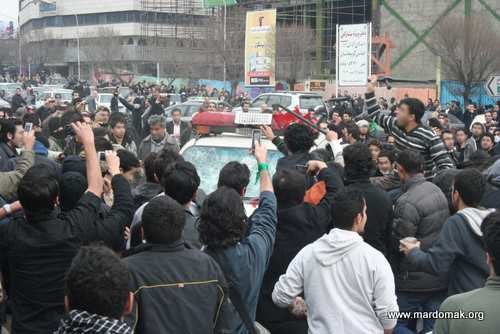
Over the last few days, mass demonstrations have erupted again in Iran. Millions are on the streets and there are reports of the people taking control of the streets, burning down police stations and even of police refusing to fire on demonstrators. These could be the last days of the hated IRI regime. If a revolutionary leadership were present, the hours of the Islamic Republic would be counted. We publish this article with lots of eyewitness reports from the ground.

Iran: Power slipping to streetsA year ago it would have been impossible to believe or even think about it, but as this article goes to print, the power of Islamic Regime is being eroded in Iran and the power is slipping to streets under the massive pressure of people. The equation is simple: millions of people are on streets and there is just not enough police and military forces to contain them.

December 26 and 27 this year was concurrent with the traditional Shiite days of mourning, Tasoa and Ashoora. Shiite Muslims traditionally mourn on these days to commemorate Imam Hossein, a grandson of Prophet Mohammad, who was killed on “Ashoora”. However, like any other religious tradition it has been generally treated like a street carnival by masses. This year, in the midst of a revolutionary movement that started six months ago and has shook Iranian society to its foundations, people had decided to use it as a day of protests. It was therefore for some time generally acknowledged that December 26 and 27 will be days of massive protest.

However, one could say what happened was more massive than most expectations.

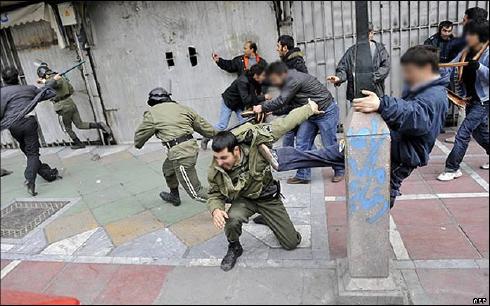
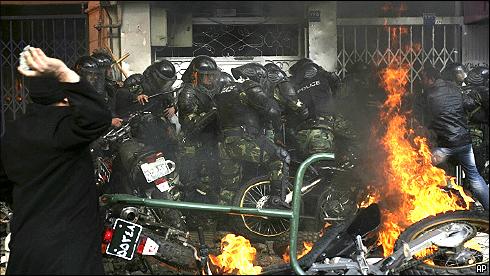
While hundreds of thousands demonstrated in cities all over Iran on December 26, the real showdown came on Sunday, December 27. On this day, and as we are writing this article, millions of people filled streets in cities all over Iran and came into an open fight with forces of the regime. Not only that. Many streets, especially in central areas of Tehran, were actually occupied by people and are currently under their control. People have started taking over police and Basij stations, in different cities of Iran, setting fire to some and attempting to acquire guns from others.

Demonstrators attacking BasijDemonstrators attacking BasijAnother very important development is some reports that show a number of forces have refused to shoot people, dismissing orders from their commanders. A report from Jaras (Green Way Movement network), one of the most credible news sources, said:

“Jaras correspondent reports that clashes all over Tehran are intensifying and police has lost control of many neighborhoods. Military commanders have asked their forces in central Tehran to use direct shooting to disperse demonstrators. But forces are refusing the command, causing disputes between forces and commanders.”

A Jaras correspondent present around Enqelab Square clashes says: “After this dispute, one of the guards said: ‘I will never kill the people of my own country’, he was then slapped by his commander who threatened him with martial court.” (Special Guard Forces Refuse to Shoot People).

Protests were by no means limited to Tehran and included hundreds of thousands coming out in Kermanshah, Shiraz, Isfahan, Qom, Mashhad, Arak, Lahijan, Najaf Abad, Salmas, Naqade, Robat Karim and etc.

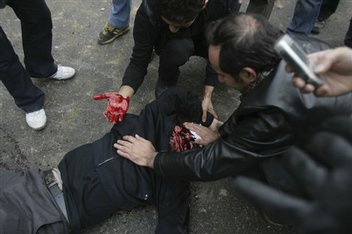
A demonstrator who was shot during anti-government protests in Tehran on Sunday, Dec. 27, 2009.A demonstrator who was shot during anti-government protests in Tehran on Sunday, Dec. 27, 2009.But like any revolution, most eyes were on Tehran, the capital. It witnessed the fiercest battles between people and forces. At least 8 people have been killed there (including Seyed Ali Mousavi, a young nephew of Mirhossein Mousavi, Islamic Reformist presidential candidate, whose death will have political consequences). The regime was so terrified that “certain police and Basij stations [in Tehran] were evacuated to prevent guns from getting to people.” (Basij and Police Stations Evacuate to Prevent Guns Reaching People & Reports from Isfahan).

Let’s have a quick look at the facts: people are not only fighting back against regime forces but conquering police stations and putting streets under their own control; refusal of some forces to shoot at people; slogans like “This is the month of Blood, Khamenei will be overthrown” and “Khamenei should know, he will be overthrown soon”. It is evident that power is slipping onto the streets!

What does this remind you of?

A revolution, of course.

And this is exactly the mood amongst most youth and people in Iran. A lot of political personalities, almost everybody who has access to mass communication, did their best in the last few months to make revolution a “dirty” world, saying people should not go toward another “failed revolution”. But now the word is used more than ever. Iranians from all walks of life, even those who were defending a reformist position a few days ago, are saying: “A revolution is coming”.

This proves correct our perspectives which said from the very beginning that this is the beginning of a revolution.

What lies ahead?

As this article is being written, the night festival of Shaame Ghariban (on Ashoora’s evening) is starting and protests are going on everywhere. De facto martial law is in place in a few cities. Some central areas of Tehran are in effective control of people. There have been attempts by people to take over the National TV & Radio building. It is unclear what could send people home.

If there was any sort of leadership for the movement, the regime could fall in a matter of days. Lack of such leadership might delay the regime’s collapse but will not stop it altogether. The regime days are numbered… literally.

The most important absent element is the direct role being played by the working class. Workers coming on the scene, with their very own general strike, putting a pause to society would be truly the final death sentence for the Islamic regime. However, the lack of a revolutionary leadership and poor organization of workers is the cause of this not happening yet.

Events of December 27 proved once more and more decisively than ever, the regime’s power is being eroded and it will come down, this or that day, with this or that method.

The fall of the regime, however, will be only an introduction to a period of acute class struggle in Iran. The duty of Iranian Marxists remains forming a revolutionary independent party of the working class that could lead the workers to victory in this period. Important battles lie ahead!

Note: most of the factual information in this text comes from Persian2English Blog, a website run by a few activists from Toronto who are also getting help from people in Europe and other regions. These activists, the present author among them, have been keeping awake for the last 2 days, receiving news and translating it to English it as it happens so as to break the wall of regime’s censorship.

ANOTHER ANTI-MINING ACTIVIST MURDERED IN EL SALVADOR

The second anti-mining activist killed this week in the small community of Nueva Trinidad is 32 year old Dora "Alicia" Recinos Sorto. The young woman is a board member of the Environmental Committee of Cabañas, an organization that formed to educate the community about health and environmental risks of cyanide contamination from gold extraction.

The following is from CISPES.


FOR IMMEDIATE RELEASE - December 28, 2009

Contact: Alexis Stoumbelis, CISPES – (978) 394-0425

Another Protester of Pacific Rim Mining Corporation’s El Dorado Site Assassinated in El Salvador

Second community activist killed in less than a week


dora.jpgOn December 26, Dora “Alicia” Recinos Sorto, age 32, was assassinated, the second anti-mining activist killed this week in the small community of Nueva Trinidad in the department of Cabañas. Recinos Sorto was eight months pregnant and carrying her two-year old child when she was shot on her way back from doing laundry at a nearby river. She and her husband, José Santos Rodriguez, were outspoken opponents of the non-operational El Dorado mine which Pacific Rim, a Vancouver-based mining company is desperate to reopen despite widespread community opposition.


Rodriguez is a board member of the Environmental Committee of Cabañas, an organization that formed to educate the community about health and environmental risks of cyanide contamination from gold extraction. The Committee’s vice-president, Ramiro Rivera, was gunned down on December 20 despite having been under 24-hour police protection since being shot eight times in August. Salvadoran President Mauricio Funes vowed to investigate the murder, stating, “I hope this case will not remain in impunity the way that so many others do.” These attacks follow the late June kidnapping, torture and assassination of Marcelo Rivera (no relation), in the nearby municipality of San Isidro.


Earlier this year, Recinos Sorto reported that her husband was receiving death threats and that unidentified men had come looking for him at their home. Oscar Menjívar, the man accused of shooting Rivera in August, had previously attacked Rodriguez with a small machete. Menjívar’s neighbors report that he was one of Pacific Rim Mining’s paid “promoters”. According to Rodriguez, “It is Pacific Rim who is responsible for this, because Oscar and I were great friends before they arrived. They are the source of all of this.”


The ongoing violence in Cabañas, including assaults, attempted kidnappings and death threats, seems to be centered around the controversial presence of Pacific Rim Mining in the region, with prominent anti-mining leaders coming under attack. Pacific Rim ceased operations at El Dorado after local protests forced the company out and the Salvadoran government subsequently denied extraction permits. President Funes also stated his opposition to the project during his presidential campaign earlier this year and University of Central America polls show that over 62% of the population opposes gold mining.


In response, Pacific Rim opened an investor-state arbitration case against the Salvadoran government in April under the U.S.-Central America Free Trade Agreement, or CAFTA (Pacific Rim filed the suit through a recently acquired subsidiary, Pac Rim Cayman, based in Reno, Nevada.) According to Pacific Rim CEO Thomas Shrake, the company is seeking “hundreds of millions” of dollars in the arbitration, which is scheduled to begin in early 2010. In November, Pacific Rim received notice from the New York Stock Exchange that it is in danger of being delisted after posting net losses for five straight years; the company then announced that it will seek to generate CDN $2.36 million by selling shares of stock to finance its legal case against the Salvadoran government. The company does not have any other mining projects in operation.


Sunday, December 27, 2009

Castro Has Something To Get Off His Chest About Copenhagen

Fidel discusses the failures of the climate summit where, "...the blind selfishness of a privileged wealthy minority tries to bring the burden of the necessary sacrifices to weigh heavily on the overwhelming majority of the inhabitants of the planet." Castro called the brutal attacks on protesters a reminiscent of the Nazi occupation of Denmark.

The following is from Earth Times.

Fidel Castro unveils the causes of Copenhagen summit failure

On 26 December 2009 European Council on International Relations published two letters by Fidel Castro analyzing the results of Copenhagen Climate Summit. The letters entitled The Moment of Truth and the second one The Truth About Copenhagen : The truth of what happened at the summit are a cold, full of valuable inside information and précised description of the causes the led to the failures of the Summit Climate. We present small selections from these important documents describing the atmosphere and the tension of the Copenhagen summit. In a press conference that presented to the public this letters Professor Anton Caragea, president of European Council on International Relations described the two letters as documents on the way that leaders of the world failed to agree on important issues regarding conservation of life on the planet, two letters of extensive information, powerful analytic skills and decisive stands wrote by a world renowned intellectual and political figure: Fidel Castro.

In this letters Fidel Castro writes: „ As it is widely known, the UN Agreement on Climate Change was signed in Kyoto in 1997. This instrument bound 38 industrial nations to cut down their greenhouse effect gas emissions to a certain percentage in comparison with those of 1990. The European Union countries committed to an 8% as of 2005, the year when most of the signatories had already ratified it. George W. Bush, then President of the United States, –the largest greenhouse effect gas producer country which is responsible for one-fourth of such emissions—had rejected the agreement since the midst of 2001. The other UN members continued their efforts. The research centers proceeded with their work. It is evident by now that a major catastrophe is threatening our species. Perhaps the worst could be that the blind selfishness of a privileged wealthy minority tries to bring the burden of the necessary sacrifices to weigh heavily on the overwhelming majority of the inhabitants of the planet. That contradiction can be perceived in Copenhagen where thousands of people are standing firm by their views.( …) The social movements will not be allowed to attend. After that show, the "Summit" will resume its works in the plenary hall until its inglorious closing. Since television has carried the images, the world has seen the fascist methods used against the people in Copenhagen. The protesters, most of them young people, have won the solidarity of the peoples. Despite the maneuvers and deception of the leaders of the empire, their moment of truth is drawing closer. Their own allies are losing confidence in them. In Mexico, the same as in Copenhagen or elsewhere in the world, they will be met by the growing resistance of the peoples that have not renounced the hope to survive. (Fidel Castro –The Moment of Truth).

In the second letter Fidel Castro is even more clear in pointing the finger to the responsible of the Copenhagen failure : " If anything significant was achieved in the Danish capital, it was that the media coverage allowed the world public to watch the political chaos created there and the humiliating treatment accorded to Heads of States or Governments, ministers and thousands of representatives of social movements and institutions that in hope and expectation traveled to the Summit's venue in Copenhagen. The brutal repression of peaceful protesters by the police was a reminder of the behavior of the Nazi assault troops that occupied neighboring Denmark on April 1940. But no one could have thought that on December 18, 2009, the last day of the Summit, this would be suspended by the Danish government –a NATO ally associated with the carnage in Afghanistan– to offer the conference's plenary hall to President Obama for a meeting where only he and a selected group of guests, 16 in all, would have the exclusive right to speak. Obama's deceitful, demagogic and ambiguous remarks failed to involve a binding commitment and ignored the Kyoto Framework Convention (….) A small number of countries firmly insisted on the grave omissions and ambiguities of the document promoted by the United States, particularly the absence of a commitment by the developed countries on the reduction of carbon emissions and on the financing that would allow the South countries to adopt alleviating and adjustment measures (…) After a long and extremely tense discussion, the position of the ALBA countries and Sudan, as President of the G-77, prevailed that the document was unacceptable to the conference thus it could not be adopted. In view of the absence of consensus, the Conference could only "take note" of the existence of that document representing the position of a group of about 25 countries".( Fidel Castro-The Truth about what happened at the Summit )

Season's Greetings from Leonard Peltier


Leonard Peltier sends seasons greetings as the government's crime against him continues unabated.

The following is from Radio Havana Cuba.

Season's Greetings from Leonard Peltier: U.S. Political Prisoner

Lewisburg, December 25 (RHC)-- American Indian Movement leader Leonard Peltier, one of the longest-held political prisoners in the United States, has sent a holiday message to his supporters around the world. Leonard Peltier is a member of the American Indian Movement (AIM) who was unjustly convicted and sentenced in 1977 to two consecutive terms of life imprisonment for the murder of two FBI agents. The agents died during a gun battle on the Pine Ridge Indian Reservation in 1975, but Leonard Peltier didn’t kill them.

Having been locked up for more than 33 years, Leonard is one of the longest held political prisoners in the U.S. and is currently incarcerated at the United States Penitentiary in Lewisburg, Pennsylvania.

The special holiday message from Leonard Peltier reads:

Greetings and Happy Holidays. I hope this letter finds you all enjoying the spirit of the season with family and friends.

My August parole denial was appealed in short order. We are expecting a response to that appeal sometime very soon. It has occurred to me that the viciousness of this system knows no bounds, and so I believe strongly in the coming days we will hear of another loss, another denial. This one will be timed and intended specifically as a twisted Christmas present for me, such is the nature of those in charge. With no sense of balance, fairness, or decency, I await my own personal stocking stuffer.

We all know the so-called justice system of this country is more about revenge and retribution than finding true and just resolution. It doesn’t take into account the plight of the wrongfully convicted, nor does it allow flexibility as human endeavors always require. This system has always been about making money at the top, furthering careers in the middle, and forgetting those at the bottom.

Their reason for denying my parole is that I refuse to admit guilt and show remorse for the deaths of two FBI agents. I know the righteousness of my situation. I know what I did and didn’t do. I will never yield.

I also know what this country did and continues to do to me and many others. While they demand I make a false confession for the sake of my freedom, they show no remorse for the loss of much of my life, or the lives of Joe Stuntz and countless others they have murdered over the generations simply for being who they were. Those lives are meaningless when compared to their precious FBI, I guess. And now, some of the very ones responsible for the deaths and suffering of so many of my people, are peddling books and claiming to be a friend of the Indian. We’ve seen this before, and I’ll speak more about this soon.

I remain proud of what I have stood for and mindful of what real justice is. In this season of love and forgiveness, please say a prayer for all of those who never knew justice and others who have such difficulty in finding it still today.

My love and my prayers go out to all of you.

Happy Holidays.

In the Spirit of Crazy Horse, Leonard Peltier


Saturday, December 26, 2009

Jeff Fuers Interview

First interview with eco warrior Jeff Fuers since his release after over nine years in prison.

The following is from Democracy Now.

EXCLUSIVE: Environmental Activist Jeff “Free” Luers Speaks Out in First Interview After 9.5 Years Behind Bars

Jeff-luers-democracynow

In June 2001, Jeff “Free” Luers was sentenced to twenty-three years and eight months in prison. His crime? Setting fire to three vehicles in a car dealership to protest global warming. No one was hurt in the fire. In 2007, the Oregon Court of Appeals overturned Jeff’s sentence and reduced it to ten years. Last week, on December 16th, Jeff Luers walked out of prison a free man. In a Democracy Now! global broadcast exclusive, Jeff Luers speaks out in his first interview since his release. We also speak with his attorney, Lauren Regan, executive director of the Civil Liberties Defense Center. [includes rush transcript]

AMY GOODMAN: After serving nine-and-a-half years in prison, environmental activist Jeffrey Luers is finally free. In June of 2001, Jeff Luers, then a twenty-one-year-old environmental activist, was sentenced to twenty-two years and eight months in prison. His crime? Setting fire to three light trucks at a Chevrolet dealership in Eugene, Oregon.

He said he committed the act to raise awareness about global warming. The fire was put out with a regular fire extinguisher. No one was hurt. The damage to the cars totaled something like $30,000, $40,000. The cars were repaired and eventually sold.

Jeff and his co-defendant, Craig “Critter” Marshall, were arrested minutes after the fire was reported. By the time of Jeff’s trial a year later, he was facing thirteen charges and a hundred years in prison. In 2001, former Lane County Circuit Judge Lyle Velure sentenced Jeff to twenty-two years and eight months in prison with no possibility of parole. Craig Marshall took a plea deal and served four-and-a-half years behind bars.

Jeff Luer’s case became known around the country and around the world. Amnesty International and the Eugene Human Rights Commission questioned whether his sentence was politically motivated.

In 2007, the Oregon Court of Appeals overturned Jeff’s sentence and reduced it to ten years. Last week, on December 16th, Jeff Luers walked out of prison a free man.

Just before today’s broadcast, we spoke with Jeff Luers in a Democracy Now! global broadcast exclusive. I spoke to him in Eugene, Oregon.

    AMY GOODMAN: Jeff, welcome to Democracy Now! I wanted to start by asking you how it feels to be free.

    JEFF LUERS: It’s a bit of an adjustment, going from being stuck in a small cage to having run of the entire world at the moment. It’s nice.

    AMY GOODMAN: Your reflections right now? I mean, how long have you been out at this point?

    JEFF LUERS: A week.

    AMY GOODMAN: And what have you been able to do in this week?

    JEFF LUERS: I’ve been able to spend a lot of time with my family, friends that I haven’t seen in a really long time. I’ve been fortunate enough to be able to get out into the forest and start hiking again and just reconnecting with all the experiences that I haven’t had for nine-and-a-half years.

    AMY GOODMAN: Let’s go back in time for people who aren’t familiar with your case. Talk about what landed you in jail, your original sentence being more than twenty-two years.

    JEFF LUERS: Well, in June 2000, I and my co-defendant Craig Marshall set fire to three trucks at Romania Chevrolet. That resulted in my incarceration and conviction for arson, resulting in twenty-two years and eight months in prison.

    AMY GOODMAN: He plea-bargained and served something like four-and-a-half years?

    JEFF LUERS: Yeah, he was offered a non-cooperation deal to take five years, and he was released after four and a half.

    AMY GOODMAN: Why didn’t you do the same? Why didn’t you plea-bargain? You weren’t contesting what happened at the—that you had set fire to these three—would you call them SUVs?

    JEFF LUERS: They were actually light trucks. But the difference is, is Craig’s offer was for conspiracy. They wanted me to plead guilty to intending to cause physical harm to another person. And for years, the FBI had been trying to show that environmental activists were terrorists, and I didn’t want to give them a victory by pleading to intent to harm someone. I chose to fight that all the way.

    AMY GOODMAN: And you went before a non—you chose a non-jury trial?

    JEFF LUERS: Yes. There was an arson at the same dealership days before my trial was set to begin, and on the advice of my attorney, we decided that that would bias a jury of my peers against me too much to take the chance.

    AMY GOODMAN: On reflection, do you think you should have plea-bargained?

    JEFF LUERS: No, I honestly would have ended up serving the same amount of time. My final plea bargain was for ten years. And I feel that taking it to trial and serving the time that I did has been more beneficial to my struggle and my personal life.

    AMY GOODMAN: What is that struggle, Jeff?

    JEFF LUERS: Well, it’s slightly changed over the years, as the politics and recognition of climate change and global warming have changed. But I was heavily active in forest defense in the late ’90s and in 2000, and that carried over into wanting to protect the larger environment and bring attention to global warming and climate change at a time when there wasn’t much news about it, and it wasn’t really in the public spectrum.

    AMY GOODMAN: When you talk about forest defense, explain what you did in the late ‘90s and in 2000. Explain, for example, tree sitting.

    JEFF LUERS: Yeah, I and a small group of friends helped establish the Fall Creek tree sit just outside of Eugene, Oregon in 1998, and it grew into one of the longest tree sitting campaigns that the United States has seen, ultimately resulted in saving ninety-six acres of old-growth forest. That campaign was really instrumental in building an environmental movement here in the Northwest.

    AMY GOODMAN: You actually sit in the trees? Explain what a tree sit is, for people outside the Northwest.

    JEFF LUERS: Basically, it’s a small piece of plywood suspended through ropes at the top of a tree. They tend to be several hundred feet high, connected by ropes to other tree sits, so that you never have to touch the ground in order to get around or defend the forest. And you live there twenty-four/seven. Sometimes some campaigns will have a single sitter that will stay throughout, such as someone like Julia Butterfly. Other campaigns will cycle their sitters so there’s constantly someone fresh, able to move around and defend the forest.

    AMY GOODMAN: So how did you go from tree sitting to setting fire to these light trucks at the car dealership?

    JEFF LUERS: I was active in civil disobedience and direct action for many years and didn’t see it being as fruitful as I felt that it should be. Through my encounters with law enforcement, I saw that there was a lot of deceit and deception in the manner in which they dealt with protesters and sweeping aside any type of redress—excuse me, redress of grievance. And ultimately, I decided that it was better to make a media spectacle to get my message across and draw attention to issues that I felt were incredibly important and affect every human being on this planet.

    AMY GOODMAN: And so, why did you target this car dealership? What exactly did it mean to you?

    JEFF LUERS: It was two-fold. Partially, I was attempting to bring attention to—


AMY GOODMAN: We’re talking to Jeffrey Luers, having a little problem with the sound there. We’re going to come back to this interview in a minute. Again, Jeffrey Luers was released on December 16th after almost ten years in prison. His crime? Setting fire to three light trucks at a car dealership in Eugene, Oregon.

This is Democracy Now!, democracynow.org, The War and Peace Report. We’ll be back in a minute.

[break]

AMY GOODMAN: David Rovics singing “23 Years”—this is Democracy Now!, democracynow.org, The War and Peace Report—a song about Jeffrey Luers, our guest today in this global exclusive. Jeffrey Luers just returned—just was released from prison on December 16th after serving nine-and-a-half years there. We interviewed him just before this broadcast. Let’s return to the interview.

    JEFF LUERS: …building an environmental movement here in the Northwest.

    AMY GOODMAN: You actually sit in the trees? Explain what a tree sit is, for people outside the Northwest.

    JEFF LUERS: Basically, it’s a small piece of plywood suspended through ropes at the top of a tree. They tend to be several hundred feet high, connected by ropes to other tree sits, so that you never have to touch the ground in order to get around or defend the forest. And you live there twenty-four/seven. Sometimes some campaigns will have a single sitter that will stay throughout, such as someone like Julia Butterfly. Other campaigns will cycle their sitters so there’s constantly someone fresh, able to move around and defend the forest.

    AMY GOODMAN: So how did you go from tree sitting to setting fire to these light trucks at the car dealership?

    JEFF LUERS: I was active in civil disobedience and direct action for many years and didn’t see it being as fruitful as I felt that it should be. Through my encounters with law enforcement, I saw that there was a lot of deceit and deception in the manner in which they dealt with protesters and sweeping aside any type of redress—excuse me, redress of grievance. And ultimately, I decided that it was better to make a media spectacle to get my message across and draw attention to issues that I felt were incredibly important and affect every human being on this planet.

    AMY GOODMAN: And so, why did you target this car dealership? What exactly did it mean to you?

    JEFF LUERS: It was two-fold. Partially, I was attempting to bring attention to the US’s foreign policy in dealing with dictatorships and tyrannical governments like Saudi Arabia, but also the fact that the US—or the US car fleet is responsible for the second highest amount of greenhouse gas emissions.

    AMY GOODMAN: And so, talk about that process, though, of recognizing that and then deciding to engage in property destruction and how you actually carried it out, how you were caught. And then I’d like to ask about your reflections on it now.

    JEFF LUERS: We chose the car dealership partially due to location. It was the first action that I had done of that scale. And quite honestly, it was an easy place to target. It also was catering to commercial fleets rather than to the regular population. So we chose it for those reasons.

    AMY GOODMAN: And how did you set them afire?

    JEFF LUERS: I’m not going to talk about that.

    AMY GOODMAN: But you have accepted that, or you’ve admitted that, yes, you did. And the damage was—

    JEFF LUERS: Yes.

    AMY GOODMAN: How much damage was done to these three cars, the trucks?

    JEFF LUERS: The damage, I believe, came to a grand total of about $28,000.

    AMY GOODMAN: And they were actually able to resell the trucks after?

    JEFF LUERS: They resold—repaired and resold two of them, and one was destroyed.

    AMY GOODMAN: How did you get caught?

    JEFF LUERS: We were under surveillance by a counterterrorist unit that was working, I believe, with the Joint Terrorist Task Force in Eugene.

    AMY GOODMAN: Did you have any idea at the time that you were being followed? And where had they followed you from?

    JEFF LUERS: According to testimony by the detectives involved, they picked me up at a warehouse in which I was renting and followed us using three different vehicles and a roving tail all the way to the Romania dealership.

    AMY GOODMAN: Did they know you were going to be doing this, or were they just following you?

    JEFF LUERS: According to them, they were following me, looking to see if I would lead them to a anarchist party that was happening that night.

    AMY GOODMAN: And what did they charge you with? What were you ultimately convicted of?

    JEFF LUERS: Ultimately, I was convicted of Arson I, attempted Arson I, and possession and manufacture of a destructive device.

    AMY GOODMAN: So, Arson I, you got twenty-two-and-a-half years, you were originally sentenced. That was overturned a few years ago.

    JEFF LUERS: Yes.

    AMY GOODMAN: But how does that compare to murder, to rape, to causing people physical harm?

    JEFF LUERS: Murder in the state of Oregon is punishable by twenty-five years to life. Most rape sentences are less than ninety months. The disproportionate sentence that I received was far out of line with what is standardly given to people convicted of arson.

    AMY GOODMAN: How did you feel when the judge issued the sentence?

    JEFF LUERS: Not really very surprised. I believed that he was going to come down on me as hard as he could, and he did. The DA at the time wanted blood. She wanted to make an example, that you cannot be a radical environmental activist in this country and not suffer severe consequences.

    AMY GOODMAN: What are your thoughts today on what you did? Would you do it again?

    JEFF LUERS: Given all that I know, I would do it again. I think that the things that I’ve experienced and the ability for me to continue my activism from prison and reach out to different media organizations and continue the debate on climate change has added to the fact that we’re now recognizing the danger that climate change and global warming pose.

    AMY GOODMAN: I mean, there’s an irony here, Jeff Luers, in you being released right in the midst of the largest global warming summit the world has ever seen in Copenhagen, not that the powers that be came out with a binding agreement, but that that has been the focus of the last two weeks now of the world community. Your thoughts on that?

    JEFF LUERS: Well, it was kind of summed up when I was resentenced. The first time that I was sentenced, the judge pretty much called me an evil, despicable man. And the second time that I was sentenced, the judge called me a veteran of an ugly campaign and elder statesman of my cause. The public’s view on global warming has changed so much that people who strive to create action on it are no longer fanatics.

    AMY GOODMAN: Jeff, how did prison change you? What was it like in prison? You were in a maximum-security prison for how long?

    JEFF LUERS: I was in a maximum security for six years.

    AMY GOODMAN: Which prison?

    JEFF LUERS: Oregon State Penitentiary.

    AMY GOODMAN: What was that experience like?

    JEFF LUERS: Difficult. You see that violence becomes a way of life. I’ve seen people murdered, and that’s something that I’m going to carry with me for the rest of my life.

    AMY GOODMAN: What do you mean you’ve seen people murdered?

    JEFF LUERS: I mean I’ve seen people murdered in prison. I’ve seen people stabbed. I’ve seen them beaten with locks and strangled to death. I had a man die six feet in front of me.

    AMY GOODMAN: And who were they being killed by? Was it guards? Was it other prisoners?

    JEFF LUERS: No, it was other prisoners. Sometimes it was gang-related. Sometimes it was just personal vendettas.

    AMY GOODMAN: How did you protect yourself?

    JEFF LUERS: I just stayed who I am. I never denied any of my beliefs, and I stood for the same things that I stood for in prison. And unfortunately, when necessary, I fought for those things.

    AMY GOODMAN: What do you mean you fought for those things?

    JEFF LUERS: Physical violence. I defended myself.

    AMY GOODMAN: Do you have thoughts about the prison system today, having lived through it, having survived it, on how the present system works in this country?

    JEFF LUERS: I think it’s a broken system. We take our troubled people, and we throw them away with no solution, and we do not offer them a way to improve their livelihood. In the ten years that I was in prison, there was no rehabilitation offered. There’s no skill sets that they offer to teach you. The closest that comes is they offer some people a GED. But if you don’t meet certain requirements, then you’re restricted from even that. When I first went to prison, I attempted to take college correspondence courses, and I was told, quite simply, that I had too much time, and so, therefore, I wouldn’t be allowed to do anything.

    AMY GOODMAN: So, were you ever able to?

    JEFF LUERS: In my last year, I was able to take college classes, finally.

    AMY GOODMAN: Jeff Luers, explain what happened when the court overturned your sentence. Explain the rationale and what they said.

    JEFF LUERS: My original conviction and sentence gave me three sentences for the same fire. The court of appeals decided that there was only one fire, there could only be one punishment, and that all of those charges had to merge into one conviction and one sentence.

    AMY GOODMAN: Were you surprised that the system worked in your favor that time?

    JEFF LUERS: I wasn’t surprised that the court of appeals agreed with me. The legal error was quite grievous. What I was surprised about is how greatly my sentence was reduced.

    AMY GOODMAN: And how did that shift your—the way you thought, your captivity, knowing you were going from twenty-two to less than ten years?

    JEFF LUERS: It’s a huge culture shock. I imagine it’s probably hard for people at home to imagine, but I lived in a maximum-security prison in a tiny cell, and basically overnight, I went from having experienced nothing but that for six years to living in a dorm with eighty people. And it was hard. It was a difficult adjustment going from a mentality of constantly watching your back and being ready to fight at every second to being around so many people and trying not to be freaked out by that.

    AMY GOODMAN: There has been a very active support group for you over the years that you’ve been in prison. What did that mean to you inside, Jeff Luers?

    JEFF LUERS: It meant everything. I think that people cannot at all underestimate how important letters and emotional support are. The campaign for my release, without a doubt, helped me get out of prison, but it’s the letters that helped me get through prison.

    AMY GOODMAN: And what was it like, as you describe being free for this last week and going into nature, that you had been trying to defend before you went to prison for years? What was that feeling to go from behind bars to the wild?

    JEFF LUERS: It’s really surreal. It took several days for me to, like, accept that it was finally over, that I could wake up in the morning and go outside and be free. The first hike that I went on, everything just seemed like stuck in time, until at a certain point it just hit me I was back where I belonged.

    AMY GOODMAN: What are the conditions of your release now?

    JEFF LUERS: They’re the pretty standard parole package. I cannot commit crime or possess any drugs. I have to stay away from my co-defendant. And I’m, ironically enough, not allowed to possess a bomb.

    AMY GOODMAN: What do you say “ironically enough”?

    JEFF LUERS: Well, it’s against the law to possess a bomb, to begin with, but they specified that in my parole conditions.

    AMY GOODMAN: And do you plan to continue to be an outspoken environmentalist? And what form will that take now?

    JEFF LUERS: I’m definitely going to continue with my environmental and social justice activism. It’s a little too early for me to be deciding what form that’s going to come in at this point. Personally, right now I’m looking forward to going back to school and just re-experiencing life again before I decide to get heavily involved in activism.

    AMY GOODMAN: I wanted to bring in your attorney, Lauren Regan. You’re the executive director of the Civil Liberties Defense Center. You have represented Jeff for a long time. Can you talk about his case in a larger context of how the authorities have dealt with, well, cases like Jeff’s, his first—this enormous sentence of twenty-two-and-a-half years, it being overturned, and how it all fits together?

    LAUREN REGAN: Well, at the time that Jeff was first sentenced, the twenty-two years and eight months that he received from the judge was the longest sentence of any environmental or animal rights activist in the United States. And as Jeff mentioned, it was clearly imposed to send a message.

    He and his co-defendant were the first people to be actually apprehended while committing an arson. There had been a few other arsons starting back in 1997 that are now referred to as part of the “Green Scare.” But those crimes had been unsolved, and law enforcement had no leads at all. When they apprehended Jeff and Craig, they thought that they had apprehended suspects in all of those other unsolved crimes. And it turned out that that was not the case at all. But they were very, very interested in information that they believed that the two had. Part of, I think, the reason that there were no plea deals for Jeff was because they really were putting the screws to him in order to cooperate and name other people. As it turns out, even in the government’s own discovery, they knowledge that Jeff probably had no information about any of those other arsons. But at the time, that was definitely part of their focus.

    And as Jeff mentioned, even in the federal system, the crime of arson normally carries about a two-year prison sentence. So the fact that this particular act of economic sabotage created very little monetary damage, but yet he, you know, got over ten times what someone who would have committed an arson for a greed purpose would have received, definitely drew the attention of the global community. Amnesty International and a number of other human rights groups, including a human rights organization in Eugene, all decried his sentence when it happened. And, of course, you know, the lawyers that surrounded him knew right away that this judge had attempted to mathematically create the longest sentence possible and attempted to impose it on him. We were just really gratified that the court of appeals took the politics out of that case and looked at the law and corrected a really grievous mistake.

    AMY GOODMAN: Let’s talk about politics, the issue of a person who is convicted, who is voicing political motives, versus someone who’s involved with a common crime. How is that dealt with, Lauren Regan?

    LAUREN REGAN: Well, under our Constitution, we have this Equal Protection Clause, which is supposed to say that like crimes are treated in a like manner. And so, whether or not you burn a house down for insurance fraud or whether you burn a building down to destroy a horse slaughterhouse facility, the law is supposed to look at those things in an equal manner and not create disparity between those two crimes.

    But particularly during the Bush administration and with the prosecution of the Green Scare cases, whether it is because the government is pandering to corporate dominance or whether or not the government really does feel that radical activism is this huge threat to them, there have been a number of cases where activists have received extremely long sentences.

    The case of Eric McDavid, a young man who was basically entrapped by an eighteen-year-old woman who was paid by the FBI to infiltrate him and his friends—they were prosecuted for thought crimes. There were no accusations that they burned anything down or caused any damage to anything. But as a result of a conspiracy conviction, a judge imposed twenty-two years on that young man. His case is currently on appeal. And unfortunately, in recent years, we’ve seen several similar cases, where the courts have imposed two decades or more on radical environmental activists as a result of engaging in economic sabotage.

    And the courts have been using new tools that were created via the PATRIOT Act. They’ve also started using old laws in very different ways, things such as terrorist enhancements, which allow for excessive punishment, very harsh incarceration once the people are in prison. And as with the case of Daniel McGowan, we have now seen radical activists sent to literally terrorist facilities, where their conditions are basically entirely in segregation. They have very little—even the normal rights that prisoners have are stripped away from people who are sent to these terrorist facilities.

    AMY GOODMAN: This idea of green being the new red, do you subscribe to this, Lauren Regan?

    LAUREN REGAN: Definitely. I think that the Green Scare and the prosecutions that we’ve seen are our generation’s equivalent of the Red Scare. We’re seeing government rampages, using grand juries in abusive ways.

    If the Bush administration did one thing correctly, it was to manipulate mainstream media and really use words in order to brand and malign people in ways that we hadn’t seen in a long time, probably since the ’50s. And, you know, it really is sort of a war of ideology in a lot of ways. If the government wants to brand you as a terrorist based on your beliefs or based on your ethical principles, there’s really no way for you to defend yourself of that. And it definitely—you know, from the beginning of the Green Scare, the government has really taken this campaign to the media.

    On the first day that people were arrested almost four years ago, the then-Attorney General Alberto Gonzales conducted a national press conference, where he called these defendants, who were innocent until proven guilty, but he labeled them as eco-terrorists on national media, day one. And from that time, it’s been really a challenge for us.

    I think most mainstream humans see a difference between flying an plane into a building or burning down a horse barn to stop wild mustang slaughter. But the government, I think in defense of the corporations that pay them lots of money and have lots of lobbyists, definitely see that as a significant threat to their profit-making abilities.

    AMY GOODMAN: The setting of the fire of the light trucks in Eugene, Jeff, that happened right before September 11th. How did you feel being called a terrorist for what you had done, a domestic terrorist?

    JEFF LUERS: It happened about a year before September 11th. And it was new. It was going from being an activist or a tree hugger and a variety of other names that I’ve been called and are laughable to suddenly being public enemy number one. And it’s really interesting to see that you can have a crime that, if anyone else would do it, is just that, it’s a crime, but if you have some type of political thought behind it or some type of activist motivation, suddenly it’s no longer a crime, it’s an act of terrorism.

    AMY GOODMAN: Why did you decide to do this interview, Jeff?

    JEFF LUERS: Well, that’s a good question. I think that there’s people out there that want to hear my story. And for years, the only interviews that I’ve done were more about defending my belief system and pointing out the scientific facts of climate change. And this is the first interview that I’ve actually given that’s personal and about my experiences.

    And I think it’s important for people to understand that there’s several people incarcerated in the United States right now that are environmental activists that are being treated like terrorists. They’re our own people engaged in acts of illegal civil disobedience, much like the Boston Tea Party. And historically, it’s people like these that bring about positive social change. And we’re throwing them away in prison for decades.

    AMY GOODMAN: What advice would you have now, given the climate today and the level of environmental activism there is, for young environmentalists?

    JEFF LUERS: I think they need to choose their battles and struggles very carefully and look at what has happened to me and other individuals when they make decisions about things that they want to be involved in. And I think it’s really important that we learn lessons from our past and learn ways in which we can be successful without putting ourself at severe risk.

    AMY GOODMAN: The Animal Liberation Front, Environmental Liberation Front [sic] are considered the number one terrorist—domestic terrorist groups in this country. Do you consider yourself a part of the ELF, Jeff?

    JEFF LUERS: No, I think it’s important to remember that there’s thousands of people that use direct action to try to create a better world. It’s the heart and intentions of the warrior that are important, and not the label.


AMY GOODMAN: Jeffrey Luers, released from prison on December 16th after serving nine-and-a-half years in jail. In June 2001, he was sentenced to twenty-two years and eight months for burning three light trucks. We also were joined by his attorney Lauren Regan, attorney for Jeffrey Luers and executive director of the Civil Liberties Defense Center. If you’d like a copy of today’s show, you can go to our website at democracynow.org. When I asked him about the ELF, I meant to say the Earth Liberation Front.

Friday, December 25, 2009


Got some time for an interesting read. This 68 page piece PDF (Introduction to the Apocalypse) is, well, you make think it's crackpot, you may think it's genius. I've read about half of it so far and I'm still trying to figure out what I think. Is it revolutionary, reactionary, politics, environmental, communist, anarchist, what the hell is it? It is too long to reprint here, the URL is http://www.indybay.org/uploads/2009/12/02/apocalypse_read.pdf

Thursday, December 24, 2009

They Call This A Plan?


The Senate has spoken with the voice of thousands of lobbyists. If you like private healthcare and insurance, you'll like this great new plan.

From the California Nurses Association

A Patient’s View of the Senate Christmas Healthcare Gift

By Donna Smith

So, all the great fanfare and all the king’s horses. The great and almighty U.S. Senate has spoken. I will have to buy private health insurance – forever, amen. The defective product that has left me wanting for real healthcare for all of my adult life is now a step closer to being the law of the land.

A lump of Christmas coal all polished up with sparkling rhetoric.

Here’s what the Chicago Tribune said this week, and I agree:


On Sunday, the Chicago Tribune published an exhaustive front-page analysis by Northwestern University's Medill News Service and the Center for Responsive Politics of how it was done. The main culprit: "a revolving door between Capitol Hill staffers and lobbying jobs for companies with a stake in health care legislation."

The study found that 13 former congressmen and 166 congressional staffers were actively engaged in lobbying their former colleagues on the bill. The companies they were working for -- some 338 of them -- spent $635 million on lobbying. It was money extremely well spent -- delivering a bill that, by forcing people to buy a shoddy product in a market with no real competition, enshrines into law the public subsidy of private profit.

As we approach the end of Obama's first year in office, this public subsidizing of private profit is becoming something of a habit. It is, after all, exactly what the White House did with the banks. Just as he did with insurance companies, Obama talked tough to the bankers in public, but, when push came to shove, he ended up shoving public money onto their privately held balance sheets.

This is not just bad policy, it's bad politics.

Now, back to my own thoughts as a patient:

I went broke while carrying health insurance, a disability insurance policy and a small healthcare savings account. And if I get sick under this mess of a plan, it will happen to me again. Little has changed except that millions more of my fellow citizens will join my ranks.

How does it happen to insured people under this plan? Easy. Step-by-torturous-step. Slowly. Like water-torture.

1. Buy health insurance at work or on the new exchange;

2. Avoid using insurance due to co-pays, deductibles and out-of-pocket maximum exposures – not to mention lost work time and the worry about losing one’s job in a tough economy;

3. If symptoms are noticed, treat by internet medical site suggestions and over-the-counter drugs until no other option but going to a doctor are available;

4. Attempt to make appointment with doctor but first find one who accepts both new patients and your insurance;

5. Go to doctor and pay co-pay up front before ever speaking to anyone about medical problem;

6. Sit in outer waiting room for as long as required, missing work and worrying;

7. Sit in exam room waiting for doctor for as long as required;

8. See doctor for five or six minutes, if lucky, during which time you will either be prescribed some expensive drug to fix a problem the doctor isn’t sure you have, referred to another doctor who may have a month or two wait for appointments, be directed to get some tests done you aren’t sure your insurance will allow or pay for, and do it all sitting in your underwear or less;

9. Leave medical office owing more than what you thought your insurance and co-pay advertised (and never get an explanation for how that is possible) and never sure if this experience was much different than being to a used car lot where the sales folks have assessed your financing mechanism before showing you anything at all and then only show you what fits the financing not what you need or want;

10. In the alternative, if you collapse or wait until symptoms get so severe that going for an office appointment is impossible, go to an emergency room – repeat steps five through eight – and either be admitted to the hospital if your insurance is adequate and you have any available sick-time from work (if not, beg for drugs and to be released) or go to number nine.

11. Need a dentist? Too bad. Have dental insurance? Still too bad. You might get a cleaning and some x-rays, but getting the care you may or may not need will be again totally related to your ability to pay whatever portion of the dental work is not covered (and amazingly, every penny of what dental insurance will cover will be eaten up by whatever problem you may or may not have) – in the alternative, avoid dentists or just pull teeth as they go bad;

12. When the bills roll in, try to pay some after trying to find out how you can possible owe hundreds if not thousands more than the insurance policy you have indicates is possible;

13. When the collectors call to collect all of the balances due, try to negotiate payments but endure threats of lawsuit, garnishment and worse as the collectors report back to the doctors you saw for a few moments in number eight;

14. Try to get your meds – if too costly, go without;

15. Try to get well – if you cannot, go back to work;

16. Try to act like this is all wonderful and you are grateful to have any insurance at all;

17. Get sued by a collection agency for a doctor bill or hospital bill you cannot cover;

18. Sell your house and use whatever proceeds you have to try to pay some of the debts;

19. Collectors for the doctors and hospitals are not happy if you don’t pay it all in full and up-front most of the time;

20. Feel stress, fear, anguish – but don’t gripe and don’t show it at work – buck it up, chump;

21. Sell keepsakes and anything valuable to try to stay afloat;

22. Stress, more stress. Fear to answer the phone. Friends and family fall away as they don’t want you to ask to borrow money;

23. Keep working – sick or not, keep working or you’ll lose that damn insurance if you cannot pay the premium – or you’ll be back out on the exchange trying to buy another policy that is cheaper and even worse;

24. Watch your elected officials claim victory and history as they work to make sure your kids and grandkids must suffer the same fate if they need healthcare in America;

25. Have a Merry Christmas, so says your U.S. Senate.

Don’t think this can happen to you because it hasn’t yet? Count your blessings this Christmas.

I'd really like the gift of healthcare. Medicare for all, single-payer healthcare would remove so much of this awful process. That would be a gift.

Climate Imperialism

Climate capitalism or climate imperialism, you can call it what you will, but it's what the Obama Administration has endoresed at the Copenhagen Climate Disaster. Africa, of course, is first up to pay the price.

US Reaps Trillions While Condemning Africa To Climate Catastrophe

Printer-friendly version [1]
africa boyA Black Agenda Radio commentary by Glen Ford

[2]

With humanity at risk and Africa facing “incineration,” the United States opted for “disaster capitalism” at the global climate conference, last week. “President Obama and Secretary of State Hillary Clinton went to Copenhagen to end any possibility of a global agreement on greenhouse gasses that the rich nations would be bound to respect.”
Obama, US Continue To Reap Trillions and Condemn Africa To Climate Catastrophe
A Black Agenda Radio commentary by Glen Ford
The United States went to Copenhagen intent on imposing a ‘disaster capitalism’ regime on the poor nations of the planet.”
The United States, having reaped more benefits than any other nation from the industrial warming of planet Earth, now seeks to turn the resulting global disaster to its own advantage – or, more precisely, to the advantage of the U.S.-based, amoral, world-annihilating corporate class.
In Copenhagen last week, the Obama administration destroyed any chance of averting catastrophe in Africa and the developing nations of the global South. Temperatures will be allowed to rise 2 degrees Celsius on average, which translates to three and a half degrees in the hotter latitudes. As a consequence, said Archbishop Desmond Tutu [3], Africa is the be condemned “to incineration and no modern development.”
What development does occur would be at the pleasure of the United States and Europe. President Obama and Secretary of State Hillary Clinton went to Copenhagen to end any possibility of a global agreement on greenhouse gasses that the rich nations would be bound to respect. Obama administered the coup de grace to the Kyoto accords, extinguishing all hope of an international agreement that respects the rights of all nations to develop their economies within a binding framework that protects everyone’s interests. Instead, the United States imposed its own take-it-or-leave-it ultimatum: accept the inevitability of catastrophe in Africa and across the global South. And also accept that the U.S. and its corporations will dictate how the developing world will be allowed to grow its economies. Refuse, and the uppity poor countries will be cut off from the rich man’s “aid.”
While Africa burns, Washington gives up nothing in terms of binding commitments.”
This is “disaster capitalism” in its most hellish form. The term was coined by political writer Naomi Klein in 2005 [4], to describe how the International Monetary Fund induced or exploited economic disasters in the Third World and then forced poor countries to surrender their national sovereignty in order to be eligible for loans and “aid” from the rich countries. The aim was to make it impossible for poor countries to control their own economic and political destinies.
The United States went to Copenhagen intent on imposing a “disaster capitalism” regime on the poor nations of the planet. While Africa burns, Washington gives up nothing in terms of binding commitments. Instead, the U.S. offers – but does not guarantee, or even promise – to create a special fund, possibly eventually amounting to $100 billion, from which “aid” will be doled out. The rich nations will determine who gets a piece of the global warming aid pie, and under what terms. The Americans insist that some of the money will come from private sources, rich corporations that are answerable to no one but their own greedy selves – which means western businessmen will determine how Africa and the global South will be allowed to develop under conditions of climate change. The U.S. reserves the right to make separate deals with favored nations, that is, countries whose leaders surrender their national destiny to the developmental wishes of the West.
Disaster capitalism holds the most vulnerable of the world’s people hostage to imperial blackmail at the hour of the planet’s greatest peril. It is a crime against humanity, and most grievously, a crime against Africa. How ironic that the chief perpetrator of the crime is himself a son of Africa.
For Black Agenda Radio, I’m Glen Ford. On the web, go to www.BlackAgendaReport.com [5].
BAR executive editor Glen Ford can be contacted at Glen.Ford@BlackAgendaReport.com [6].