Wednesday, April 26, 2006

BEING BLACK IN COLUMBIA, MISSOURI


Columbia, Missouri is the home of the University of Missouri.

Columbia, Missouri has a long and tarnished history of racism.

Columbia, Missouri's African American residents, many of them from the city’s First Ward, have long expressed dissatisfaction with a city they characterize as divided, unjust and unresponsive to their needs. The list of complaints include double-digit unemployment, high arrest rates for black juveniles, lack of spending on recreation and social development in the First Ward and high dropout rates.

Many say they have been victims of police profiling and the unnecessary use of force during vehicle stops or searches.

In fact, Columbia police made 13,569 traffic stops in 2005. Of the drivers, 74 percent were white, and 21 percent were black. Of the white drivers stopped, 8 percent were subjected to searches. Nineteen percent of the black drivers were subjected to searches.

Columbia’s population is about 82 percent white and 9 percent black.

And guess what, studies have found the percentage of total searches in which contraband was found was slightly higher among whites.

The first article below comes from the Columbia Tribune. The following article comes from the Missourian.


Local blacks allege police discriminate

Columbia attorney David Tyson Smith said police overreacted earlier this year when they wrestled his client to the floor and handcuffed her while trying to contain a disturbance at Columbia Mall.

Alva Scott was doing what any mother would do when faced with a threatening situation, Smith said. She was trying to protect her children.

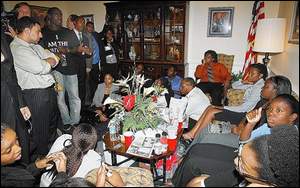
During a regular monthly meeting last night of the Columbia chapter of the National Association for the Advancement of Colored People, residents told a U.S. Department of Justice official such overreaction by some Columbia police officers toward black people is a growing concern and not an isolated problem.

"We are not trying to prevent police from doing what they have to do," said Mary Ratliff, president of the local chapter of the NAACP. "But we’re tired of talking about the problem. We want something done. … When are we going to start fighting for the rights of our people?"

About 25 people attended the meeting with Tom Meade, a member of the Community Relations Service of the justice department, who said he came to listen and gather information.

"We are not a law enforcement agency," Meade said. "We don’t prosecute or find fault."

Ratliff said she invited Meade to the meeting because she has received a growing number of complaints about racial profiling by some Columbia police officers. Among the worst, she said, was the treatment of Scott during the mall incident. "This is unacceptable," Ratliff said.

Smith said his client was shopping at the mall with her children when she heard about a disturbance in the Café Court. Worried about her teenage son and his friend, who were in the area, Scott hurried with her 2- and 8-year-olds to the Café Court to retrieve the boys, Smith said.

When she reached the area, Scott spotted the boys and received permission from a mall security guard to enter and retrieve them, Smith said. But when she started toward the boys, Scott was stopped by a Columbia police officer, who pushed her toward an exit, Smith said.

"He told her she had to leave," he said. "Alva said she had to get her kids. He told her she had to leave, and if she didn’t, she would be arrested for trespassing."

However, Scott’s two younger children were still waiting for her, and she pleaded with the officer to let her get her children, Smith said. That’s when the officer threw her to the floor and handcuffed her, Smith said. The teenage son and his friend also were handcuffed.

Scott was taken to the police department and charged with trespassing, assaulting a police officer and resisting arrest - her first encounter ever with police, Smith said. "If it can happen to her, it can happen to anybody," he said.

To make matters worse, Smith said, his client has been asked by the prosecutor’s office to write a letter of apology to police and has been banned for three years from the mall.

"Her child has had nightmares about this," he said. "She came into my office and broke down and cried. She was hurt, but it’s more than that. It was an assault of her dignity."

Bessie Smith of Columbia, whose son was with Scott’s son that evening, said even though police have told her they dropped charges against her son, she is worried the incident could still show up on his record. "It’s wrong for police officers to make that kind of mistake," Smith said.

Columbia Police Chief Randy Boehm said he was aware of the meeting last night but was not invited to attend. He said his department is conducting a "supervisory review of the officer’s action" in the Scott case.

"As far as an increase in incidents, I have not seen that," Boehm said. "We have not received more complaints about our officers. I think our officers continue to do a very professional job.

"On occasion, do we have an officer who could have handled a situation better? Absolutely, and we try to correct that behavior," he said.

--------------------------------------------------------------------------

NAACP voices concerns on racial profiling

Members of the Columbia chapter of the NAACP met with a representative of the U.S. Department of Justice on Tuesday night in an early effort to take action in response to several complaints regarding police brutality and racial profiling involving the Columbia Police Department. The meeting was called after several black citizens of the community voiced concern over various incidents.

Tom Meade, a member of the Community Relations Service of the Justice Department, came to the meeting to hear the cases and information presented by Mary Ratliff, the president of the Columbia chapter of the National Association for the Advancement of Colored People, and other members of the community. Ratliff said she called the meeting after observing an increased frequency in what she referred to as racial profiling.

Meade said his goal is to examine racial problems and to represent the black community’s concerns by coming up with solutions in accordance with the Police Department. He suggested doing this by creating forums, and examining and possibly improving police diversity training. However, he pointed out that the Community Relations Service does not prosecute or assign fault in legal situations.

Ratliff questioned Columbia Police Chief Randy Boehm’s leadership in the Police Department.

“There have been so many incidents within the past few years that I wonder about his leadership,” she said. “I keep getting the same response that he recognizes that the department has some officers with questionable behavior. But if he knows he has officers like that, why isn’t he getting rid of them? It costs everyone for the mistakes they’re making.”

Ratliff emphasized several individual cases of police brutality and racial profiling involving the Police Department.

Meade will meet with city officials to bring racial issues to light and to take action to examine racial profiling. If these actions don’t help, the next step would be an investigation by the Justice Department. People at the meeting agreed that action to stop police brutality and racial profiling must start immediately.

“The hurt, pain and humiliation of these people trying to do the right thing tears my heart apart,” Ratliff said. “When are we going to come together as a community and fight for the rights of our people? I hope this is the beginning.”

FOR CHILDREN IN THE CONGO, ITS BUSINESS AS USUAL


A just released report declares that the situation for children in the Democratic Republic of the Congo continues to be horrendous. Violations of basic human rights include killing and maiming, rape and other forms of sexual violence, abduction, denial of humanitarian assistance, attacks on schools and recruitment and use of children. In addition, various other violations, such as forced displacement and torture, also continue to be committed against children and their families.

In response to these findings, the Watchlist on Children and Armed Conflict makes urgent recommendations to the governing authorities of DRC, all armed groups operating in DRC, the UN Security Council, the United Nations Organization Mission in the Democratic Republic of the Congo (MONUC), the humanitarian community in DRC, donors and the International Criminal Court. These recommendations urge all parties to take immediate and sustained steps to protect Congolese children and adolescents from further violations and to find remedies for those who have already endured imponderable suffering. First and foremost, Watchlist calls on all armed forces and groups in DRC to immediately halt crimes against children.

The following is a press release from Watchlist on Children and Armed Conflict.

The Watchlist on Children and Armed Conflict strives to end violations against children in armed conflicts and to guarantee their rights. As a global network, the Watchlist builds partnerships among local, national and international non-governmental organizations, enhancing mutual capacities and strengths.


Children Continue to Be Ravaged By Armed Conflict Despite Signs of Progress

Watchlist on Children and Armed Conflict (New York)
PRESS RELEASE
New York/Kinshasa

Children in the Democratic Republic of the Congo (DRC) continue to endure some of the most inhumane treatment found anywhere in the world, despite outward signs of progress, according to a new report by the Watchlist on Children and Armed Conflict.

The report, Struggling to Survive: Children in Armed Conflict in the Democratic Republic of the Congo, documents dozens of continued, pervasive and egregious violations against children by all armed forces and groups operating in DRC and urges that immediate actions be taken to protect Congolese children and to hold the perpetrators of crimes against children accountable.

"Despite the presence of the United Nations' largest peacekeeping operation, the promise of upcoming elections and billions of dollars granted by donors for post-conflict reconstruction in DRC, most Congolese children are not faring any better than they were three years ago – and for some children, health, safety and well-being have drastically deteriorated," said Julia Freedson, Director of Watchlist, a global network of non-governmental organizations based in New York.

Struggling to Survive details heinous violations against children's security and rights in each of the six major categories identified by the United Nations Security Council. These categories include killing and maiming of children, rape and other forms of sexual violence against children, abduction of children, denial of humanitarian assistance for children, attacks on schools and hospitals and recruitment and use of children into armed forces and groups. In addition, the report documents a multitude of other abuses, including forced displacement of children, coercion of children into the illegal exploitation of natural resources and arbitrary detention of children.

Violations against children are committed against a backdrop of outward progress towards reconstruction in DRC, such as the demobilization of thousands of children from armed forces and groups, the significant decrease in the number of displaced people in some areas, serious efforts to confront sexual violence and exploitation and the integration of combatants from armed groups into a unified national army. Another recent positive step taken was the International Criminal Court's arrest of Thomas Lubanga Dyilo of the Union des Patriotes Congolais on charges of enlisting, conscripting and using children in hostilities in DRC.

"Outward signs of progress should not lull the international community into a false sense that children in DRC now live in safety," warned Kathleen Hunt, CARE International's UN Representative and Chairperson of the Watchlist. "To the contrary, stark evidence of the ongoing rape and mutilation of girls, recruitment and use of children by armed groups and other despicable abuses against children continues to be well-documented. In addition, it's widely known that thousands of Congolese children are dying of preventable diseases every day and others are missing out on educational opportunities and other possibilities for advancing their lives."

"The Congolese governing authorities, the UN team and others have yet to implement an effective structure of child protection in DRC. A wide gap remains between commitments to protect children in theory and actual practices on the ground. The widespread trafficking of small arms, difficulties in the disarmament and demobilization process, and the persistence of general insecurity in the eastern DRC will continue to contribute in the weak structure for protection of children for the foreseeable future," said Beck - Bukeni T. Waruzi, Director of Ajedi-Ka /Child Soldiers Project, a local child protection agency operating in eastern DRC.

"Immediate and sustained actions must be taken immediately by the governing authorities of DRC, all armed groups operating in DRC, the UN Security Council, the United Nations Organization Mission in the Democratic Republic of the Congo (MONUC), the humanitarian community in DRC, donors and the International Criminal Court to protect Congolese children from further violations and to find remedies for those who have already endured imponderable suffering," Hunt added.

Watchlist's report is being released today at events in Kinshasa, DRC and at the UN headquarters in New York. A copy of the report is available at www.watchlist.org. Interviews with experts on children in DRC can be arranged.

THE STATE AS SERIAL KILLER


What follows is just an example of a state sponsored serial killer.

The article below comes from Sinn Fein News.


Did Special Branch collude in murders?

A former north Belfast UVF leader was involved in more than a dozen murders while he was an agent for RUC Special Branch. A report due to be completed by Ombudsman Nuala O'Loan is set to expose the role of Special Branch in the murderous activities of one of their agents.

O Loan's probe follows a detailed report "Getting away with murder" by human rights group British Irish Rights Watch. It is believed the Special Branch agent is linked to at least ten murders. Information contained in the BIRW report has been described as "compelling" by those with access to the confidential report.

The serious nature of the evidence BIRW has collated alarmed the human rights groups so much that as well as sending a report to the Ombudsman, the group has also sent copies to the Independent Monitoring Commission, British Secretary of State Peter Hain, US Special Envoy Mitchell Reiss and the US Congress.

Twenty seven-year-old Sharon McKenna a Catholic taxi driver was shot dead by the UVF while visiting a Protestant pensioner in North Belfast in 1993. Two Catholic workmen from County Armagh, Gary Convie and Eamon Fox were shot dead while working on a building site in Tigers Bay in 1994. Other victims were Thomas Sheppard, shot dead in 1996, Rev David Templeton who died following a severe beating in March 1997, Billy Harbinson beaten to death in May 1997, Raymond McCord jnr beaten to death in November 1997, David Greer and Tommy English both shot dead in October 2000.

Ombudsman Nuala O' Loan has been investigating the Special Branch handling of the murder of Raymond McCord for over two years. The inquiry broadened after it emerged that the UVF leader involved in the McCord killing was a Special Branch agent at the time and was also implicated in a series of other murders.

Did Special Branch collude and cover up killings carried out by their agent? This is the question O' Loan is considering in a report due to be published this summer. The inquiry is believed to be the biggest conducted by the Ombudsman.

Former RUC detective Johnston Brown, who ran the UVF agent prior to being ordered to hand him over to Special Branch told the media, "of course there were elements within Special Branch who knew what he was doing but they chose to ignore it."

Tuesday, April 25, 2006

MAOISTS NOT HAPPY


Following the Monday night royal proclamation by Nepals King , thousands of people took to the streets marking the “victory” of people’s rights over “autocracy.” The King reinstated the House of Representatives which was dissolved on 22 May 2002.

Rallies were organised in the capital and elsewhere around the country on Tuesday in support of the restoration of the dissolved House of Representatives through the royal proclamation.

In many areas, the pre-scheduled demonstrations were turned into victory rallies while several other spontaneous rallies were taken out to celebrate the re-establishment of people’s power.

The announcement was hailed by the seven parties.

However, Maoist rebels who have been fighting for years were not impressed with the King's announcement. In a statement signed by Maoist supremo Prachanda and Baburam Bhattarai, the Maoists have blamed the seven parties of committing a ‘historic mistake’ of taking a one-way decision to accept the reinstatement of the house.

The party also urged people to continue peaceful demonstrations to compel political parties to go for the election of the constituent assembly, as it is the only way, they say, out of the present political crisis.

The following is from Kantipur Report.


Maoists demand unconditional constituent assembly elections

KATHMANDU, April 25 - Expressing disagreement over Monday’s Royal Proclamation reinstating the dissolved House of Representatives, the Maoists rebels have “completely dismissed” it and demanded unconditional constituent assembly elections.

The rebels have also announced different protest programmes “until an announcement of unconditional constituent assembly election was made.”

Issuing a statement on Tuesday afternoon, Maoist chairman Prachanda a.k.a. Pushpa Kamal Dahal and No. 2 Maoist leader Dr. Baburam Bhattarai have accused the seven parties of committing a “historic mistake” of welcoming the royal proclamation reinstating the dissolved parliament.

“We want to make it clear that the parties which have welcomed and supported the so-called royal proclamation have broken the 12-point understanding and betrayed the feeling of the Nepali people,” the Maoist statement said.

The Maoists have also announced a protest programme that includes nationwide demonstrations and showdowns, people’s action against those involved in suppression of their programmes, and blockade of the district headquarters and the capital until the announcement of unconditional elections to the constituent assembly.

HAVANA HOSTS THIRD CUBAN OLYMPIAD


The upcoming third Olympiad of Cuban Sports will be a celebration of sports, solidarity and the best of human sentiments.

So far 1,449 athletes from 15 countries have confirmed their participation in the games, and that this figure is likely to increase in the coming days. Several thousand Cuban athletes will aslo participate.

However, the Bushies can't get into the spirit, of course.

In another anti-Cuba action aimed at blocking any possible exchange between the American and Cuban peoples, Washington has denied a US boxing team permission to travel to the island and participate in the island’s Third Olympiad, which kicked off on Monday. A nine-member US boxing team was ready to fly to Cuba to compete in rounds already included on the games’ program; however, US authorities denied the athletes permission to travel

The following comes directly from Granma.


Fidel inaugurates 3rd Cuban Olympiad

PRESIDENT Fidel Castro has opened the 3rd Cuban Sports Olympiad that takes place April 24 to May 6 and, as he put it, will follow the impetus given by the island’s success in the Baseball World Classic.

The leader of the Revolution affirmed that "this modest event" is "taking place after the joy left in the country due to the brilliant performance" of the Cuban team, who won second place in the Classic.

"From today all of you are to be involved in a beautiful fiesta of sports, friendship and solidarity. While violence and unjust wars are expanding, we are here paying tribute to peace, fraternity and the finest values of human beings," Fidel added in an inaugural speech of 20 minutes.

The ceremony in the Havana Sports City Coliseum included a parade by the delegations and a colorful cultural show.

More than 3,000 athletes, of whom 1,400 have arrived from 20 countries, are to compete in 38 disciplines and four exhibitions until May 6, when a giant national simultaneous chess game with 1,000 tables in each of the country’s provinces and the special municipality of the Isle of Youth brings the event to an end.

Fidel assured that the Cuban Olympiad "will combine healthy sports rivalry with scientific, technical and methodological exchanges among the trainers and federations present."

He confirmed that "as a symbol of the noble aspirations of this Olympiad, young students from 40-plus Third World nations being trained in the International Physical Education and Sports School are also to compete."

The Cuban president went on to recall that Cuba recently opened a modern anti-doping lab, which has already done some 8,000 tests and has the backing of the International Olympic Committee. "That is helping us tremendously," he said, "and we are pleased to be able to offer cooperation to sister nations to combat what could be called that other scourge of sports."

He added that a wide-ranging investment program is being developed in the Sports Initiation Schools (EIDE), which will allow for the total reparation of the 15 existing centers – one of them, the José Martí in the capital, has already been restored – and the opening of two new schools, one in Granma and one in Guantánamo, both in eastern Cuba.

"More than 13,000 students in the country’s 169 municipalities will receive the benefits of these works, making it possible to expand from 18 to 29 the sports disciplines to be taught in those schools, the fundamental basis of sports development in our country where, however, sports is developed for everyone, for all young people, for all the population, for all schools and for all cities," Fidel noted.

Osleydis Menéndez, World and Olympic javelin champion, a specialty in which she has the world record, read out the athletes’ oath.

The boxing line-ups in Habana promise to be high quality with representatives from China, Guatemala, Kazakhstan, the Dominican Republic and Venezuela, all interested in measuring up to the island’s World and Olympic champions.

U.S. GOVERNMENT DENIES VISAS TO ITS BOXERS

The U.S. government has refused travel permits to its boxing team, whose members were hoping to compete in the 3rd Cuban Olympiad, according to Sarbelio Fuentes, chief trainer of the island’s national selection.

"We have just received the news that the U.S. selection of nine boxers has not received authorization to compete in our Olympiad," said Fuentes, as AFP reports.

Cuba is to compete with its Olympic and World champions in disciplines such as athletics, diving, judo and wrestling. Baseball is not to have its own tournament because the dates coincide with the final phase of the National Series.

The participating countries are the Bahamas, Brazil, Canada, China, Colombia, the Dominican Republic, Ecuador, El Salvador, Guadalupe, Guatemala, India, the Virgin Islands, Kazakhstan, Mexico, Nicaragua, Russia, Surinam, Trinidad and Tobago, Venezuela and Cuba.

The first edition of the Cuban Olympiad was in December 2002, after the island authorities decided to withdraw athletes from the Central American and Caribbean Games in El Salvador when the government of that country was unable to guarantee the island delegation’s security.

RICE GREETED BY STREET PROTESTS IN GREECE


A visit to Greece by the US Secretary of State has sparked mass protests in the capital. Thousands of people, mostly leftist and anti-war activists, have gathered, demanding that Condoleezza Rice leave the country. Large numbers of police have been deployed around Athens.

The first article below is from Ekathimerini (Greece). The second is from the Athens News Agency.

Rice to visit Athens today amid protests
Security boosted for US diplomat

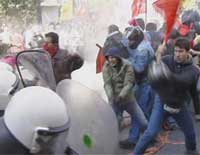
Anti-war protesters and members of left-wing groups yesterday staged protests in central Athens against a visit by US Secretary of State Condoleezza Rice after the Foreign Ministry said she would be arriving this morning, two days earlier than planned.

The ministry announced the change of plan on Sunday — the climax of the Orthodox Easter holiday — without giving an official reason but it is widely regarded as an attempt to limit the size of planned anti-war rallies. The Greek Communist Party (KKE) and members of anti-war groups responded by rescheduling their protest action, beginning with a demonstration outside Parliament yesterday and due to culminate today with two rallies in the city center.

“The minister of war and imperialism is not wanted in this country,” a party statement said.

KKE supporters held a rally outside Parliament yesterday but police stopped protesters from reaching the US Embassy. Some 20 people were detained.

Meanwhile, a group of 30 supporters of the Communist-affiliated union PAME tried to hoist a banner bearing anti-American slogans onto the roof of the Athens Concert Hall, adjacent to the US Embassy, but were stopped by police. Eight protesters restrained a security guard at the venue as the others tried to scale its facade, police said.

Traffic in central Athens will be severely restricted for most of today because of the two demonstrations. Some 5,000 police officers will also be mobilized.

Police will monitor every step of Rice’s agenda and watch potential targets of anti-US ire. A similar demonstration is due to take place in Thessaloniki at 7 p.m.

Meanwhile, Rice is due to have talks with her counterpart, Foreign Minister Dora Bakoyannis, on the situation in Iraq and Iran’s alleged nuclear weapons program as well as Cyprus and Greek-Turkish relations. Rice is also scheduled to meet with Prime Minister Costas Karamanlis before leaving Athens to continue her tour of the region, which includes a trip to Ankara and possibly Nicosia.

Yesterday, opposition politicians’ reaction to Rice’s visit ranged from skepticism to outrage. “It must be clear that the Greek people oppose any prospect of war,” PASOK MP Christos Papoutsis said.

The leader of Synaspismos Left Coalition, Alekos Alavanos, was more outspoken. “A few days after the resurrection, the foreign minister of the USA comes to Athens as a messenger of war,” he said, adding that Rice was “persona non grata” in Greece.
-------------------------------------------------------------------------------------

Protests in Athens, Thessaloniki against Rice visit


Protests against a working visit to Greece by US Secretary of State Condoleezza Rice on Tuesday were held in Athens and the northern Greek city of Thessaloniki by mainly left-wing groups but were prevented from approaching the streets where the US official would pass by a strong police presence.

A protest organised by the Communist Party of Greece (KKE) and the Stop the War organisation began at the University's Proylae on Tuesday morning, while the Greek Social Forum held a separate rally at Klathmonos Square. Two separate marches were also held in Thessaloniki, one organised by KKE and another by the Coalition of the Left, Movements and Ecology party.

The KKE/Stop the War march headed towards Syntagma Square via Panepistimiou Avenue, but were blocked by police at Amerikis Street.

Protestors changed course heading towards Academias Street instead.

A demonstration and march organised by the Greek Social Forum began at Klafthmonos Square in downtown Athens, chanting slogans such as "Hands off Iran" and "Greeks are not eager", expressing their opposition to US foreign policy.

Minor incidents were reported at the Panepistimiou Avenue and Amerikis Street intersection when some protestors tried to break through the police blockade interrupting their march towards Syntagma Square.

Police used tear gas to force protestors to head towards Academias Street.

The Greek Social Forum demonstration, as well as the one organised by the Communist Party of Greece (KKE), ended on Tuesday afternoon.

Two separate protest marches were scheduled to take place in Thessaloniki, one organized by the Communist Party of Greece (KKE) and PAME at Venizelos Square at 7pm on Tuesday evening, while the protest rally organized by the Coalition of the Left, Movements and Ecology (SYN) party, the Greek Social Forum and the ?Alliance - Stop the War? will be held at Kamara, also at 7pm.

The KKE protest march, scheduled to take place after the rally, will end up outside the US Consulate. The organizers of the other protest march have not provided specific information

Monday, April 24, 2006

"WE JUST ASKED FOR RESPECT"


Janitors work under crummy conditions, but they do get paid not much and the do get not much in the way of any benefits. And, apparently, at Florida A&M they get called names, have racial epithets hurled at them and are generally treated like crap. What a deal...

The following article comes to us from the student newspaper at Florida A and M University - The Famuan.


Janitors call treatment unfair and disrespectful
Driadonna Roland

Members of the university custodial staff are upset with university administrators, accusing Physical Plant managers of unprofessional behavior, disrespect, unfair timekeeping practices and neglect in handling their complaints.

Custodial worker Gerald Smith has been at Florida A&M University for more than 25 years. He alleged that in recent years, management has been increasingly rude to employees. Smith said supervisors have called the workers "a bunch of monkeys" and used the "N" word toward them.

"The biggest thing is disrespect. Plant Operations and Maintenance don't treat workers with respect, or even as a human being," said custodial worker Ken Staten.

Staten accuses managers of purposely trying to agitate the janitors. "Management are big liars and they try to sabotage your work," Staten said. "They'll do little things to try to slow your work down. They'll leave excessive trash in areas that I need to come in and clean."

Staten also said that supervisors try to intimidate their employees and that many workers were afraid to come forward.

On April 15, 2005 janitors noticed a sign on a janitorial door that read: "This is not Burger King, you don't get it your way. You take it my way, or you don't get the damn thing."

The following day, Smith wrote a letter to administrators saying situations like the letter created a hostile work environment, but no one responded. Clarence Stallworth, associate vice president of construction and facilities management, spoke of the hierarchy employees must use when filing a complaint.

"In the custodial ranks, you have the supervisor, assistant director and director of plant operations, and he reports to me," Stallworth said.

He said problems are dealt with on an individual basis, but the first step is to make sure there is a valid complaint. Smith said the people in the hierarchy have ignored his letters, slammed doors in his face and hung up on him. In a two-week period, Staten said he received 10 to 12 written reprimands. He rebutted all of them, feeling that management tried to portray him as a troublemaker. Staten became so frustrated that he joined the American Federation of State, County and Municipal Employees. AFSCME is the largest public employee and health care union in the country.

Mary Howard is the vice president and chief steward of the local AFSCME. She said workers file grievances but managers still find ways to "skate around the issues."

Howard advises union members not to speak with managers without a representative present.

"The way things are now, it's your word against theirs, and sometimes management is not always truthful," she said.

Howard said custodial workers are forced to sign blank time sheets. Smith said that workers were threatened with not receiving a check if they did not sign. He said he has not received a copy of his time sheet since 1990.

Smith said he complies with the Personnel Policies and Procedures handbook, but his copy of the handbook was last revised July 1, 1996.

He has not been able to obtain an updated version from the personnel department.

Another major concern janitors have is inaccurate accounts of the time they are allowed to take off. Between 2005 and 2006, Smith was given a reprimand for having 407 hours of "abusive leave."

He contested the charges after finding that holidays and weekends had been included. Management later rescinded the memo on the basis of "inconsistencies."

"If you call in and say you're going to be 10 minutes late for work, they make you use sick leave. I never knew anybody who was only sick for five or 10 minutes, then back well again," Smith said. "Nobody even listens to us. We haven't asked for money; we just asked for respect."

NEW ORLEANS: SO WHAT DID THE ELECTION PROVE


On Saturday, New Orleans held its first election after the Hurricane Katrina disaster. Mayor Ray Nagin and Lieutenant Governor Mitch Landrieu won the two top spots and will face each other in a run-off in May. The race pitted 22 candidates against each other and brought national scrutiny on the shifting racial dynamics of the city. Because many African-Americans still have not been able to return to New Orleans, the city faces the possibility of a white mayor for the first time in almost 30 years.

The following comments on the election in New Orleans comes from Reconstruction Watch.


NOLA Elections: low turnout, more of the same
by CHRIS KROMM
Reconstruction Watch
April 23, 2006

For all the hype surrounding yesterday's "ground-breaking" New Orleans elections for a mayor that will "lead" the city's re-building process (wasn't that supposed to have started months ago?), what the city got yesterday was largely just more of the status quo.

Establishment mayoral candidates Ray Nagin and Mitch Landrieu received over two-thirds of the total vote, easily moving into a run-off between the incumbent mayor, and the son of a former mayor, in May. Their predictable dominance -- and the absence of any true reform or "people's" candidate -- made this an election for different flavors of more of the same, rather than change. (Visit here for the unofficial results.)

Some other quick takes on the April 22 contest:


* The voices of the white backlash, corporate leader Robert Couhig and Peggy Wilson (best known for her comment that New Orleans didn't want "gutter punks, pimps, and welfare queens" back in the city), did miserably yesterday. The only two Republicans in the race received a combined 11% of the vote; Wilson could only muster the support of 772 voters at the polls.

* The media insisted on using the meaninglessly vague word "steady" to describe turnout, which in reality was very low. Out of over 297,000 registered voters in New Orleans before Katrina, only some 108,153 voted overall -- 36% turnout, which is especially horrible for an election with this much importance, and with all the publicity this one garnered. (134,000 voted in the 2002 primaries.)

* The displaced were disenfranchised, as most serious analysts of the elections predicted. No one knows exactly how many registered voters are displaced (some put the figure at around 100,000), but only 20,000 voted through the absurdly difficult absentee ballot process. In other words, up to 80% of the city's evacuees -- many of whom want to come back, but can't due to the city's languishing rebuilding process -- will not be represented.

* Race was a major factor in the vote, although not in the way many think. The two establishment candidates who will go to the run-off are viewed as essentially interchangeable by the electorate: the preliminary results are that Nagin (black) received approximately 10% of the white vote and Landrieu (white) received approximately 30% of the African American vote.

Most election analysis will focus on the surface details, but the real issues -- including the real racial details -- go much deeper: who got to vote vs. who didn't, and the growing divide between the interests of the political and business establishment vs. the hundreds of thousands of New Orleans residents, in and out of the city, struggling to stay afloat.

Chris Kromm is Executive Director of the Institute for Southern Studies and co-editor of Gulf Coast Reconstruction Watch

HAITIAN IMMIGRANTS TAKE TO THE STREETS OF MIAMI


Immigration rules are vastly different depending on what nation you are from. While Cubans are allowed to stay in the country if they make it to U.S. soil, regardless of how they arrived here and their legal status, Haitian refugees are required to show proof of being unjustly jailed even though they often leave their country with only the clothes on their back. And all Haitians, including children, are automatically detained if they are caught without documentation, while most other illegal immigrants are released on bond to family members. Canadians and Europeans, almost universally, can qualify for National Visas or Visa waivers allowing them to work in the United States and come and go as they please. Meanwhile there are caps on annual citizenships granted for immigrants from Mexico and the Philippines and it can take several years for their applications to be seen, let alone approved.

So although being an immigrant from amost anywhere is not easy in this country, Haitian immigrants have for years been the subject of overt discrimination in immigration and asylum matters. Saturday thousands took to the streets of Miami in protest.

The following article is from the Miami Herald.


Thousands march for Haitian rights
Protesters marched through North Miami to protest what they call an unjust policy toward Haitian immigrants.
BY PETER BAILEY
pbailey@MiamiHerald.com

Marching in sync to the sound of beating drums and Haitian folk songs, more than 4,000 protesters filled North Miami's streets Saturday afternoon to denounce U.S. immigration policy toward Haitians.

In the shadow of the federal government's regional immigration offices at 79th Street and Biscayne, the crowd of mostly Haitians flooded the busy boulevard, swaying in political unison to the rhythm of black pride rooted in the world's first black republic -- now broken by poverty.

`NO LONGER INVISIBLE'

Centered at the front lines of their crusade is a long-standing demand: that all Haitians be granted temporary protected status, or TPS, which permits immigrants from a handful of countries in crisis to remain in the United States as lawful residents.

Again and again Saturday, the chant -- ''We Want TPS!'' -- echoed throughout North Miami's streets.

''We're gonna fight to make sure there are no second-class citizens. . . . Haitians will no longer go invisible!'' bellowed Eliseo Medina, executive vice president of the Service Employees International Union, a national organization representing nearly two million workers.

Medina was one of several civic leaders who organized the rally with other groups to protest what they call the unjust policies toward Haitian immigrants that began with the Clinton administration.

''We just want justice for the Haitian people. . . . We've waited for too long,'' local Haitian activist Ronald A. Brisé said.

TPS REQUIREMENTS

Currently, the Department of Homeland Security, which has authority over the TPS program, grants temporary legal status to immigrants from Burundi, El Salvador, Honduras, Liberia, Nicaragua, Somalia and Sudan.

Immigrants from Haiti have never been granted such status under TPS, which Congress first approved in 1990.

TPS is authorized for those immigrants who are forced to flee their home countries because of armed conflict, environmental disaster, or other extraordinary and temporary conditions.

Brisé says Haitians meet every condition. ''Look at Haiti, and ask why we're sent back home,'' he said.

Standing atop a van, Jack Lieberman, of the American Jewish Congress, gave the crowd a more forthright answer: ``It's racism. . . . If they allow the Cubans to stay, why are the Haitians kicked out!''

Cubans are not eligible for TPS. Those Cubans who attempt to enter the United States illegally can receive legal residency if they make it to dry land. If they are stopped at sea, they usually are returned to Cuba.

POWERFUL DRAW

Hundreds of protesters hoisted Haitian flags as they approached 79th Street and Biscayne, and another chant of ''We Want TPS!'' rose from the crowd.

A sense of urgency filled the air, prompting bystanders to follow the procession. One store employee jumped from behind his cash register to join ranks. Among the protesters was Mary Simeon, 42, who knows firsthand of the Haitian struggle for citizenship.

She fled her homeland 11 years ago and now works in a seafood restaurant in Coral Springs. She said Miami will offer a better life for her U.S.-born daughters -- Gina, 7, and Gesula, 5 -- both of whom joined their mother in the march.

''Haiti was hard, but I came here and did well . . . and now I'm a citizen,'' said the elder Simeon. ``I want the same for my people.''

''I'm proud to be Haitian!'' yelled her daughter, Gina.

For countless others, the protest was more personal.

The words ''I need my dad here with me, not back in Haiti,'' was emblazoned across one pink-colored poster raised high above the crowd.

Sunday, April 23, 2006

REPORT FROM BASQUE COUNTRY


The following report is from an associate in Northern Ireland. It highlights the state of human rights in the Basque Country. It also speaks of the harassment of a visiting group who were on a speaking tour of the area. Some of the visitors spoke on parallels between the Basque struggle and that of the Irish.

For Immediate Release: 23/04/2006
Human rights abuses highlighted in Basque Country

Ballymoney Sinn Féin Councillor Daithí McKay has just completed a speaking tour of the Basque Country. The Rasharkin man, who was there representing Ógra Shinn Féin, was to be accompanied by a member of the South African ANC but they were refused access to the region by the Spanish Government. Journalists who were to interview the Sinn Féin man were also subject to harassment from the Spanish authorities. On Friday Cllr McKay gave the opening address - in Basque - at the Basque Topagunea Festival, the first big festival since the ETA Ceasefire and which was attended by over 20,000 people.

Speaking on his return Cllr McKay said:

" The week's events were a very useful insight into the current situation in the Basque region and it is quite clear that Spanish State Torture, which has been highlighted by both the UN and Amnesty International, is still continuing unabated.

“The trip was also a very useful insight into the Basque Youth Movement, which is without doubt, one of the best organised and vibrant youth movements in Europe. The Topagunea Festival, which was held in Etxarri at the weekend, is organised entirely by young people involved in the Basque Youth Movement and is testament to the resilience of young people here who are continually the subject of state harassment and sometimes torture.

“We have been speaking to some young people who have been imprisoned for years without trial, effectively Spanish Internment, and who have also been victim to the Spanish and French Prisoner ‘dispersal’ policy.

“This is when the Governments concerned remove Basque Prisoners from their local areas and place them in prisons as far away from the Basque Country as possible. The result of this is that Prisoners’ relatives have to trek up to and over 1,000km to see their loved ones and this can often involve days on buses at great expense to low-income families. It has also involved in deaths on the roads, one prisoner who we were talking to spoke of how his mother died from sheer exhaustion and obviously stress whilst on the long journey to see her son.”

Cllr McKay also spoke about the Irish Peace Process and drew parallels between both the Basque and Irish conflicts,

"We are keen to see this peace process work and key to this is the lifting of the Spanish ban on Basque political parties, youth groups, trade unions, language groups and newspapers.

"One of the things I highlighted to Basque audiences this week was that a successful peace process relies on positive moves on all sides. In that regard it is clear that the onus is now on the Spanish and French Governments to move this process forward.

"There is also an onus on the International community, and in particular the International media to start covering the human rights abuses that are occurring in this so-called Western democracy, as their efforts to do this have thus far been non-existent."

KANSAS CITY MARCH FOR HEALTHCARE NOW


Kansas City, KS
Saturday April 29
Healthcare Now - Creative Action / March & Rally 11:30 am KU Medical Center half block north of 39th & Rainbow to 47th and Main KCMO Costumes and props will be provided for those who wish to dress as “victims of the broken US healthcare system”


The Healthcare-NOW campaign is supporting a national single-payer healthcare system for all. It would help us get rid of our insurance company problem and our pharmaceutical drug company problem. These are the most important points we want to make.


1. In 73 cities, we are calling our Congressmembers home to hear our Solutions to the healthcare crisis.

2. In a recent poll, 65% of the people in the U.S. said they wanted a government-guaranteed healthcare system.

3. It would cost the nation 30% less money to have a single-payer healthcare system instead of one run by profiteers.

4. We could have a comprehensive health care system that covers everybody for virtually every healthcare need.

5. 50% of the the bankruptcies in the U.S. are caused by health care catastrophes.

6. Most people 70% of those who don't have health care are working -- sometimes two and three jobs.

7. Health care PROFITS are about 30% of our health care expenditures in the country.

8. We support a public-supported, privately- delivered system that provides freedom for doctors and patients.

9. We would cut down on waiting periods for health care and everybody would have more choice of doctors.

10. 95% of us would be paying less for health care than we are now. No co-pays, premiums, deductibles or health care denials.

11. This would cover all doctors, specialists, hospitals, surgeries, mental healthcare, drug treatment, optical and dental care, and long-term care.

Saturday, April 22, 2006

BUSH BUDGET CUTS WILL KILL AMERICAN INDIANS


Urban Indian health clinics are a lifeline for tribal members who live in cities off reservations. The Bush administration has proposed to sever that lifeline.

Bush's proposed budget would eliminate the Urban Indian Health Program, which funds primary, preventive and behavioral health care for the 60% of American Indians and Alaska Natives that reside in urban areas, for savings of $33 million.

The funding provides services to 34 Indian clinics across the country, and if they are closed, many American Indians would have to seek care from reservation clinics which are not exactly down the street.

At the seventh annual Montana-Wyoming Tribal Leaders Council Health Conference in Billings, Mont., Darryl Red Eagle, a council member of the Fort Peck Assiniboine-Sioux Tribes, said reservation health care services are underfunded. He added that dental care is available only on an emergency basis and that patients in need of orthodontic services will not be able to be seen by a doctor until 2017. Anthony Addison, co-chair of the Northern Arapaho Tribe on the Wind River Reservation in Wyoming, said diseases such as cancer, diabetes and cardiovascular problems, as well as illicit drug and alcohol use, are prevalent among American Indians, and he attributed lack of immediate care as part of the problem. "We need to come together in a unified, collaborative effort to do our best to address these issues. Even though money is not allocated at levels we need ... it never has been funded at [the proposed] levels," Addison said.

If those clinics are closed, tribal members likely would have to return to their home reservations to receive health care. But the reservation clinics and hospitals are barely able to provide services for those people eligible for care, let alone an influx of others, Montana and Wyoming tribal leaders said.

Urban Indian health programs report that such a cut would result in bankruptcies, lease defaults, elimination of services to tens of thousands of Indians who may not seek care elsewhere, an increase in the health care disparity for American Indians and Alaska Natives and the near annihilation of a body of medical and cultural knowledge addressing the unique cultural and medical needs of the urban Indian population held almost exclusively by these programs. According to the 2000 Census, nearly 70% of Americans identifying themselves as of American Indian or Alaska Native heritage live in urban areas.

Darryl Red Eagle, a council member of the Fort Peck Assiniboine-Sioux Tribes, said there are already medical “horror stories” because of not enough funding for health care services to his tribe.Dental care is available only on an emergency basis, Red Eagle said, and if someone needs braces the system is backed up until 2017. A tribal elder recently rode to Billings in the back of a pickup to get her medical care, Red Eagle said. A man’s gallstones were not considered a matter of “life and limb,” so he could be referred off-reservation for care until a duct ruptured and he became infected. The man is in Billings recovering but had to have part of his pancreas removed and is on dialysis, Red Eagle said.

Red Eagle held up his left arm and rubbed the elbow where bone chips float, a condition that sometimes hampers use of his arm but that isn’t critical enough to make him eligible for IHS treatment.

“There are solutions, but it takes a community to gather our funding,” Red Eagle said. “There is strength in numbers. We’re bringing all of our resources and numbers together.”

Addison said there is a requirement in treaties between the government and tribes for federal funding to provide health care.

“We need to come together in a unified, collaborative effort to do our best to address these issues,” Addison said. “Even though money is not allocated at levels we need … it never has been funded at those levels.”

Diabetes, heart disease, drug and alcohol abuse and cancer are debilitating young and old alike, Addison said. Those are ailments that don’t stop at reservation boundaries but, in most cases, are more prevalent in Indian Country. Part of the problem, he said, is that too often people have to wait until a condition is advanced before health care is available.

“There are preventative measures that can be done,” Addison said. “But there’s just not enough money to do it.”


The following article is from the Santa Fe New Mexican.

Native American health: Marchers demand Bush restore funds for urban clinics

SALT LAKE CITY — To chanting and the pounding of drums, hundreds of people marched Friday against $33 million in proposed federal cutbacks that could shut down some urban health clinics for American Indians.

“We’re upset that our center is being threatened, and we’re here to send a message that you don’t mess with a federal obligation,” said Dena Ned, executive director of the Indian Walk-In Center in Salt Lake City. “Just because we live off the reservation doesn’t mean we’re not in need of health care.”

About 400 people marched peacefully almost two miles from the clinic to the Wallace F. Bennett Federal Building for a rally, police Sgt. Lamar Ewell said.

President Bush’s 2007 budget proposal says urban Indians could use regular community-health centers. His budget calls for adding more and larger health centers for poor people under a $182 million funding increase. The budget also would increase funding for clinics on Indian reservations by about 4 percent over the 2006 fiscal year, said Scott Milburn, a spokesman for the Office of Management and Budget.

Salt Lake City Mayor Rocky Anderson said those programs would do little to serve American Indians in urban areas, where the clinics double as social-service networks and cultural centers. He said 83 percent of the clients at the city’s walk-in center have no health-insurance coverage. The clinic serves about 4,000 people a year.

Anderson, a Democrat, likened the proposed cut to the government’s “shameful” history of violating tribal treaties. “What is happening now is just part of that pattern of betrayal of Native Americans,” he said.

Sen. Orrin Hatch, R-Utah, said he also opposed the cut. “This health care delivery system has taken decades to create, and if it were to disappear, it would increase the health care disparities and barriers to care for American Indians from that of the general population,” Hatch said in a statement.

Sen. Bob Bennett, R-Utah, a member of the powerful Senate Appropriations Committee, said he would work to restore the funding.

Half the country’s 34 urban Indian clinics might have to close if Bush’s proposal stands, Ned said. The remaining clinics would have to cut services, charge clients or raise money through private donations to stay open, she said.

“If these things are cut off, then we’ll have to go back to the reservation with our tails between our legs,” Eleanor Iron Lightning told the crowd. A member of the Cheyenne River Sioux Tribe from Eagle Butte, S.D., she said she’s used the clinic since she moved to Utah in June 2002.

Community health centers aren’t designed to meet the needs of urban Indians, according to the National Association for Community Centers. The centers are for people without health insurance.

In Utah, Community Health Centers Inc. has a $200,000 contract to provide medical care for the Indian Walk-in Center.

But that’s just a fraction of the clinic’s $1.5 million annual operating budget, Ned said. If the center were to lose its $1.1 million in federal contracts, it would also lose grant funding, effectively cutting about 90 percent of its budget.

The center provides diabetes education, immunizations, substance-abuse treatment, mental-health counseling, holistic care, HIV testing and youth programs. It also operates a food pantry for the United Way that handed out some 5,200 boxes of food to Indians and non-Indians last year.

Nationally, some 60 percent of American Indians and Alaska natives live in urban areas, according to the Census Bureau.

Friday, April 21, 2006

WE SHALL NOT BE MOVED


Keeping you up to date on the Six Nations who aren't going anywhere.

The following is from the Toronto Star. The second is from Indian Country Today.

Native protestors await word on negotiations

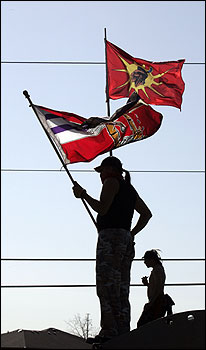
CALEDONIA, Ont. — An uneasy peace settled amid the barricades and bandannas Friday as native protesters occupying a disputed tract of southwestern Ontario land waited to hear whether negotiations to settle the standoff were making any headway.

Chill winds and a steady rain were doing little to weaken the resolve of hundreds of protesters at the half-finished housing development in Caledonia, a community of about 10,000 people a 20-minute drive south of Hamilton.

Some 350 kilometres away, a sympathy protest near Belleville, Ont., halted at least a dozen CN freight trains and disrupted Via Rail's passenger service in one of Canada's busiest travel corridors.

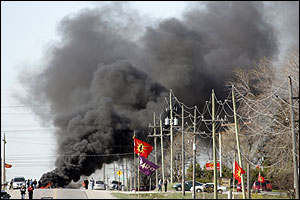
About 50 Mohawks from the Tyendinaga reserve near the town of Maryville, about 200 kilometres east of Toronto, were blocking a CN track to show their support for the Six Nations members in Caledonia.

Acrid black smoke billowed from the scene. A pair of school buses were being used to block a small road leading to the rail tracks. Provincial police officers were watching the protest, but keeping their distance, staying at least 500 metres away.

Members of the Akwesasne reserve near Cornwall, Ont., outside Ottawa staged a small protest near the Canada-U.S. border crossing, holding picket signs and drawing honks of support from passing motorists.

In Caledonia, where huge piles of tires and an abandoned van were set ablaze Thursday as a dramatic show of defiance, smaller fires were burning Friday as protesters wrapped in Six Nations flags huddled in hopes of warmth.

Provincial police were keeping their distance; several cruisers could be seen parked down the road from one of the three barricades preventing access to the makeshift compound as several officers stood in the middle of the road, surveying the scene.

RCMP officers were also lending their support, said Staff Sgt. Paul Marsh. "The RCMP is proving assistance to the OPP in Caledonia, at their request."

The Caledonia standoff erupted Thursday when a police raid aimed at ending a seven-week native occupation resulted in dozens more protesters descending on the scene, pushing police back.

At least 16 people were arrested in the initial raid, but by Friday morning the number of protesters had swelled dramatically, blockading a main highway with burning piles of tires, makeshift barricades and massive piles of gravel.

Sam George, whose brother Dudley was killed by a police sniper during the 1995 clash at Ipperwash Provincial Park, called Friday for calm and urged authorities to treat the dispute in as fair a way as possible.

"Lands now occupied in Caledonia are part of a parcel that were originally promised to the First Nations to be theirs forever," George told a news conference.

"There are probably at least some of the original Six Nations lands that deserve to be returned to them."

Native leaders elsewhere were urging their members to stay away from the scene of the standoff.

"It is clear there are very complex issues involved and the immediate safety of those at the site is of the most urgent concern," Metis Nation of Ontario president Tony Belcourt said in a statement.

Tyendinega Mohawk spokesman Shawn Brant said the Mohawks would remain at the bonfires near Maryville "until proper, dignified and respectful talks" are held to resolve the dispute.

Politicians and aboriginal leaders met all day Friday in an effort to resolve the standoff peacefully, Premier Dalton McGuinty said. No one emerged, however, to report any progress in those talks, which the premier said were attended by the federal and provincial governments as well as police and a mediator.

Several Caledonia schools remained closed Friday as a safety precaution, but school boards in the area said they would reopen on Monday provided tensions at the occupation site don't escalate.
-----------------------------------------------------------------------------

Six Nations Reserve repels Ontario police
© Indian Country Today April 21, 2006. All Rights Reserved
Posted: April 21, 2006
by: Jim Adams / Indian Country Today

OHSWEKEN, Ontario - More than 1,000 residents of Canada's Six Nations Reserve rushed to the site of a standoff between Native protesters and the Ontario Provincial Police during the early hours of April 20 after an armed police raid resulted in 10 arrests and several hospitalizations.

According to one report, two of the hospitalized were non-Native supporters of the protest. About 15 protesters were sleeping at the ''reclamation site'' when a caravan of at least eight police vehicles raided and made arrests.

According to the TV report, police were armed with drawn guns, Taser devices and tear gas, although the weapons were not used.

Protesters at the contested construction site regrouped and pushed police back to the nearby road as the call went out for support from the largely Iroquois community, Amos Key, director of the community radio station CKRZ-FM, said. The Native-run station is broadcasting a live feed from the standoff on its Internet site, www.ckrz.com.

Key said that urgent talks were now under way between the Confederation chiefs and officials of the provincial and federal governments.

Lisa Johnson, of the Bear's Inn in Ohsweken, was following live television coverage of the events all morning and said that residents of the reserve poured into the site as news of the early morning raid spread through the community of 22,000 and by 7:50 a.m. had gathered in sufficient numbers to force the police to leave. As of noon, no police were on the site, although talk spread throughout the community that they were regrouping in riot gear with about 1,000 reinforcements.

The arrests could total up to 15, but protesters who had been arrested were released after being fingerprinted and photographed, although they were warned that they faced jail time if they returned to the site. Several had reportedly rejoined the protesters.

The television coverage resulted by accident. An employee of Hamilton CHTV, noticed the police activity as he drove to work and notified a camera crew, which broadcast from the site all morning. All other reporters were barred from the site by provincial police.

After the OPP withdrew, protesters blocked Highway 6, also known as Plank Road, which runs by the construction site called the Douglas Creek subdivision, and a secondary road. They set a pile of tires on fire and pulled a large dump truck across the road. A large pile of tires and planks were assembled at another crossing, but at last report it had not been set ablaze.

After the roads were blocked, residents continued to reach the site by walking to the surrounding forest.

On the other hand, police closed streets entering the nearby town of Caledonia, although schoolchildren were bused to school early in the morning. Both schools were closed later in the day and parents on the reserve were still uncertain how their children would be returned home.

Haudenosaunee Confederacy chiefs had met all night before the raid. They reportedly told provincial officials that they did not control the protesters, but they were attempting to negotiate on their behalf.

The timing of the raid was still unexplained, but the developers of the subdivision had reportedly threatened to start a civil action against the OPP to pressure it to remove the protesters.

The crisis brought a rare spirit of unity to the reserve, healing a decades-long split between the elected band council and the traditional confederacy chiefs.

The elected council was imposed on the reserve in 1924 by the federal Canadian government to replace the traditional leadership, but the confederacy persisted as an institution often at odds with the elected governments on both sides of the border.

The band council had expressed doubts about the occupation of the Douglas Creek site, which was supported by the confederacy chiefs.

In the aftermath of the raid, however, the council delegated negotiating authority to the chiefs.

The crisis apparently has also hardened the outlook among the traditional chiefs.

According to Key, the chiefs originally instructed the warrior groups in the protest to leave the site if ordered to by the OPP.

Said Key: ''It's escalated and escalated. We're all frustrated. Our goal is to get to the quality of life second to none that Canada espouses to the world, but we are 30 years behind.''

KEEPING IRAN MORAL


I keep forgetting what century I am living in. Out here where I live the state Board of Education next door is mandating schools teach nine weeks of abstinance education and some intelligent design. The state legislature right here is debating whether to essentially declare that Christianity is the state religion. Our President, of course, is in constant communication with God Almighty and declares himself to be the "Decider."

Meanwhile, Iran's police force outlined plans on Tuesday for a renewed crackdown against women who they say show off too much of their bodies in the streets of Tehran (who knew?).

Morteza Talai, Tehran's police chief, told the semi-official Fars agency: "In our campaign, we will confront women showing their bare legs in short pants."

"We are also going to combat women wearing skimpy headscarves, short and form-fitting coats, and the ones walking pets in parks and streets," he said.

I should hope so. Bare legged women with skimpy headscarves walking dogs in the park. Good lord, somebody stop this outrage.

When I was 20 I absolutely would not believe that it would come to this.


The following is from AKI (Italy).

IRAN: MORALISATION CAMPAIGN IN TEHRAN SPARKS FEARS OF CRACKDOWN

Tehran, 21 April (AKI) - A crusade for the moralisation of Iran's society kicked off on Friday in the capital Tehran. Women failing to abide by the regime's definition of good Islamic dress will be fined. Young men with long hair or wearing Western-style T-shirts will also face fines, along with anyone walking around with a dog - an animal considered impure by the Muslim religion. The law approved by the government of Mahmoud Ahmadinejad seeks to defend Islamic values and crack down on Western culture - a move Iranian women interviewed by Adnkronos International (AKI) fear will have a major impact on society.
Some 200 extra police officers - half of them women - are to patrol the streets of Tehran to ensure the new norms are obeyed, said the capital's police chief Morteza Talaii.

From the capital, the Islamisation campaign will be rolled out to other Iranian cities in the coming weeks and many in Tehran fear it will eventually lead to a war against satellite television, private parties and non classical music, be it Iranian or foreign.

"Anyone not wishing to abide by Islamic laws and the government's new measures can start queuing to get a visa and leave the country as soon as possible," suggested Seyyed Mehdi Tabatabaii, a member of parliament with the Abadgaran faction supporting the government.

"We don't intend to use force to impose Islamic rules but expect all citizens to respect our traditions," said Morteza Talaii, Tehran's police chief. There will be no public flogging nor imprisonment for women whose hair might show beneath their headscarves or wearing tight short or tight jackets but there will be very heavy fines.

"The government of Mahmoud Ahmadinejad cannot punish those failing to respect Islamic rules with flaggings or arrests, also because of international pressure over the issue of human rights," said Azadeh Akbari, a young journalist in the capital. "On the other hand, replacing floggings with fines when the middle classes are in dire financial straits is a very efficient deterrent."

Azadeh said that already very early on Friday morning the new police officers were patrolling the streets of Tehran "armed with electric truncheons and hot pepper gas, stopping for the moment only young men with long hair and sparing women, at least for the moment."

"This fight for moralisation starts at the beginning of every summer, though I fear that this time the change will be much more serious and worrying that in the past years," said Somayyeh Nasiriah, a 25-year-old woman working in the film industry. "The campaign announced by the government mainly concerns normal people and not the organised groups of youths openly defying the Islamic Republic," she said. "They don't fear public flogging, let alone fines."

Somayyeh said that for the past few weeks police officers have started stopping cars to question passengers. Young people who are not related get arrested on "illegal relations" charges if caught in a car together.

"Life in Iran is increasingly difficult and these new measures make it unbearable," said Yalda Moayeri, a photographer. "I'm afraid that the cabinet means to make life hard for those failing to adapt to religious impositions," noted Yalda.

"Youths as well as those who are not young anymore don't have the energy anymore to fight such impositions nor to endure the permanent pressure," she said. "We all at risk of falling into a collective depression."

Sociologist Shiva Zarabadi however doesn't think that "the presence of 200 officers in a city of 15 million inhabitants can change things."

"During the campaign leading to his election, the president promised the return of a very religious society to a part of his electorate, while he vowed to others that he would not use repression to impose social and cultural choices," Zarabadi said. "Today, the government is facing the pressure of the religious electorate demanding a moral clean-up of society which doesn't however provide for offenders to be publicly flogged or arrested but to be fined."

"After all, the international situation has changed and the Islamic Republic cannot ignore criticism over its violation of human rights while it is under international scrutiny for its nuclear programme," noted the sociologist.

Nevertheless, Zarabadi is convinced that the government will not succeed in imposing a dress code in a society "where youths who cannot amuse themselves in any way and have few opportunities to socialise let their creativity out with what they wear."

"If they also close this safety valve for young people, they could loose control of the situation," concluded the sociologist.

WHAT A LIFE


I really cannnot imagine what it must be like to live in Iraq today. How does one just go about their daily life. But God bless George Bush the Liberator...

The following is taken from Azzman (Iraq).


More than 19,000 kidnappings in three months – rights groups
By Nidhal al-Mawsawi

More than 15,000 Iraqis were abducted in the first three months of this a year, a statement signed by several Iraqi civil and rights groups said.

The statement said nearly 7,000 families were forced to leave their dwellings and residential quarters as part of the violence linked to sectarian cleansing.

The groups have representatives in each of the countries 18 provinces and the statement described the figures as “conservative.”

“The figures we have arrived at do not represent the real situation. They are less than what actually takes place as our monitors sometimes find it extremely difficult to report due to escalating violence,” the statement said.

It said the fate of all those registered as abducted was not known.

“Among those kidnapped were 2,355 children and 4,959 women,” it said.

The statement said the monitors registered 3,457 “violent acts” across the country in the same period, with 886 of them in Baghdad.

It said the presence of armed militias of various factions were the main reason for the mounting violence.

A VIEW FROM MEXICO


Taking a look at the struggle for immigrant rights from across the border.

This article is from La Jornada (Mexico)


'What We [Mexicans] Can Do to Help the Migrants'

By Gloria Munoz Ramirez
Translated By Carly Gatzert

RECENT protests in defense of the rights of immigrants in the United States are being called historic by virtue of the enormous number of demonstrators. The protests have even been likened to the awakening of the Latino community from within the entrails of a monster, but another analysis identifies this phenomenon as the climax of a decades-long process of organization.

Resistance in the United States has been constant ever since half of our territory was stolen by the U.S. government. However, it wasn't until the second half of the twentieth century that the battle between the Mexican immigrant community and political agenda of the U.S. government began.

Erasmo Cruz, representative of the Xanichetic cooperative (Los Angeles), identifies the 70s as the pivotal moment in which the Mexican community, Chicanos and immigrants, began to gather strength. At this point in time, a political party united by race, that managed to win the mayor's seat in Crystal City, Texas; and there arose the Crusade for Justice, a militant Chicano alliance, led by Reyes Tijerina; the anti-war Movement of 1970s in Los Angeles; Brown Beret Cafes (inspired by the Black Panthers), in addition to high school student protests, and later on, the struggle of Cesar Chavez and the migrant farm workers.

All of these movements received the answer of the United States Government: repression, imprisonment and outright assassination. In the decade of the 80s we witnessed, beyond the growth of immigrant populations, the strengthening of Latino institutions, accompanied by the emergence of a political and financial elite, who reaped the benefits of the resistance of the 1970s.

According to Xanichetic's analysis, it was not until the 90s that symbols of resistance there was a renewed interest on the part of Mexican and Chicano youth in the search for identity. Today, this battle is taking place in the streets. Since March 7, the underdog has crossed the threshold, voicing resistance to the criminalization of the immigrant work force. These are the successors to the protestors of the 70s; young men and women, many of whom are legal U.S. citizens, either first or second generation immigrants.

What can we in Mexico do to show our support? One proposal is to boycott all U.S. businesses. There is talk of a suspension of immigrant labor in the U.S. on International Workers' Day [The Great American Boycott, 2006] as a pressure tactic, to make it widely recognized that Mexican immigrants should have the right to work, an education for their children and medical services.

This is a protest for the right to life and dignity. Whether or not you support this boycott from our side of the border, (in which we will purchase nothing of U.S. origin, nor from any U.S. franchise such as Dunkin Donuts, McDonalds, Burger King, Walmart, Seven-Eleven, etc.), we simply can no longer remain indifferent.

Thursday, April 20, 2006

CANADIAN POLICE ATTACK SIX NATIONS AT DOUGLAS CREEK


++++++++++++++++++++++++++++++++++++++++++++++++++++++++++++++++++++++++++++++++++
BULLETIN, BULLETIN, THIS JUST IN (then go ahead and read the article etc. below for all the information)

Gathering Place First Nations Canadian News Alert
http://gatheringplacefirstnationscanews.ca/


SIX NATIONS PEOPLE STILL UNDER ATTACK

I have just heard from a family member on the scene the stand off has expanded and there are at least 1,000 opp officers on site and they are gearing up to move against the people of Six Nations again...
People are thinking the army will be brought in against them ... The people of Six nations are unarmed

There have been several people beaten by the OPP including two non natives who were standing with the people . they have been taken to hospital.One of the Clam mothers was also beaten by the police.

I am told that the OPP have M-16 to use against the people who are still resisting and there is a large number of people resisting and the numbers keep growing as more and more people arrive to stand with there brother , sisters aunty's and uncles, grandmothers and grandfather.

I repeat the people of Six Nations are UNARMED and have reminded the OPP many times to put there guns down they do not have guns.

Highway six has been blocked off tires have been set on fire in the middle of the road .

Six Nations people are back on the original site at Douglas Creek.

CHCH TV has been covering this off and on . Right now they have broken away .

This could have been handled in a much better way now the OPP have broken the peace no one knows what will happen before this is over.

Prayers are needed as well as phone calls to any and all of the numbers listed below...

The Politicians: Prime Minister of Canada Stephen Harper harper@ parl.gc.ca; Justice Canada webadmin @justice.gc.ca; Indian Affairs InfoPubs @ainc-inac.gc.ca; European Union press.office@consilium.eu.int; Minister Indian Affairs Jim Prentice prentice.j@parl.gc.ca; Ontario Govt. Brendan.Crawley@jus.gov.on.ca; Ontario Premier ; Governor General: Michaelle Jean Fax (613) 998-1664 E-mail: info@gg.ca; Chinese Consulate in Toronto Fax: (416) 324-6468; OPP Brantford 519-756-7050; Hamilton 905-572-2401; Jim Potts OPP liaison 613-795-3907; RCMP London 519-640-7267; Dalton McGuinty, Dalton .McGuinty@premier.gov .on.ca Premier. Legislative Building, Queen's Park, Toronto ON M7A 1A1


Sharon Green
Owner and Editor
Gathering Place First Nations Canadian News
" http://gatheringplacefirstnationscanews.ca/"

+++++++++++++++++++++++++++++++++++++++++++++++++++++++++++++++++++++++++++++++++

A confrontation between indigenous protesters and police escalated this morning hours after Ontario Provincial Police staged a pre-dawn raid at an occupied Caledonia construction site, southwest of Hamilton.

Around 5 a.m., dozens of officers stormed the Douglas Creek Estates to evict native activists who'd occupied the site for almost two months.

However, by 8:30 a.m. an estimated 75 native protesters were back on the site, prompting the OPP to retreat from the area.

Go to http://oreaddaily.blogspot.com/2006/04/six-nations-arent-going-to-back-down.html for background information from an earlier OD article.

The following is from the blog "Sketchy Thoughts."


Ontario Provincial Police Attack Six Nations Reclamation

Early this morning the Ontario Provincial Police attacked the reposession at Douglas Creek, just outside of Caledonia in Ontario. The site had been occupied by members of the Mohawk Nation and their supporters for fifty one days.

Below is a lengthy report by Kahentinetha Horn who was there when the police attacked. One hopes readers will understand if it is at times slightly disjointed – it was clearly written as events unfolded.

What must be put front and center, and repeated, is that the initial police attack was repelled. Nine people were arrested and unknown numbers brutalized, but as of 8:30 am all police had been driven off as hundred of people from Six Nations reservation moved onto the site.

This may be a victory, but the day is still young. People who can are strongly urged to get themselves to the reclamation/occupation site.

If you cannot get there, consider what action you ca take where you are. Pickets, demos, whatever. Or else you can always phone/fax/email the criminals responsible for this:

Stephen Harper, Prime Minister, pm@pm.gc.ca
OPP Brian Haggith 905-772-3322
OPP Indian Advisor Jim Potts 613-795-3907
RCMP London 519-640-7267, 519-756-7050
Brantford-Hamilton 905-572-2401
OPP Caledonia 905-765-2339
C. P. Wright 289-260-9345


Michaelle Jean, Governor General
Phone: (613) 993-8200
Toll Free: 1-800-465-6890
Fax: (613) 998-1664
Email: info@gg.ca

Michael Bryant, Ontario Attorney General
Phone: (416) 326-2220 or (416) 326-2210
Toll Free: 1-800-518-7901
Fax: (416) 326-4007
Email:


What follows is the report by Kahentinetha Horn (please forward far and wide):


ALERT! ALERT! OPP INVADES SIX NATIONS - AIDED BY INDIAN TRAITORS - GO AND WITNESS
Thursday, April 20th 2006

WATCH FOR FURTHER UPDATES


4:20 am the OPP attacked to arrest them. Hauled first 9 off. Some protesters took the Caledonia bridge. Reserve people arrived and repelled the cops. At least 150 heavily armed cops. Vans, trucks, paddy wagons, ambulances (for the cops). They repelled them. The cops came back. They were repelled again. Now at 9:00 am the people have taken the land in question back.

How to get there: From Niagara Falls and Toronto, take Highway 6 straight south from Hamilton to Caledonia.

From buffalo take Highway 3 west to Highway 6 and north on Highway 6 to Caledonia.

From Windsor take Highway 3 East to Highway 6 and go north. These are backways and cops are not likely to be looking at it too much.

8:30 am OPP DISRUPTS PEACE IN QUIET CALEDONIA
The OPP has created an ongoing battle. They sit in their cars, give out false news reports, and wait for reinforcements to come in to squash the Six Nations people but they can't. Everyone is reporting to everyone.

All police have been chased off the perimeter of Douglas Estates for now. Cop were sneaking behind the unfinished houses. One woman went over. A women cop told her she was under arrest. "What do you mean I'm under arrest. You're violating the laws, both ours and international law". Other cops came out and wrestled her down on the ground. She fought all of them. They kneed her to handcuff her. She started booting the cops. Then other Indians arrived on the scene and chased the cops off. As they were leaving they shot her son in back with tasers. The big woman cop was carrying a big gun, something like an Ouzi. "It was a big one". Those cops were fully packed, she said. They failed to arrest her because she resisted. There are 9 arrested. They're supposed to only keep them for 2 hours. 'We haven't seen them back yet". The People are shutting Caledonia down. "We are not armed. We got our land back. Were in! We're at the fire!"

At the 6th Line where the Douglas Estates comes out on the road at the entrance, out to Highway 6 that goes onto the rez. The bypass that goes around Caledonia. At the 6th line overpass, the people there had been blocking that road, they were attacked by the cops, paddy wagons were there. They fought back. It was a brawl. People started coming from the rez and supported them. Immediately there were hydro poles around which they threw on the road and set on fire. They are cutting off Highway 6 the main supply line that goes goes to Nanticoke Hydro Electric plant down on Lake Erie. It is the main transport truck road to Hamilton. This is being blocked.

Some protesters are still holding Caledonia Bridge, the main artery of the city. It's total confusion.

If you have satellite TV, look for Hamilton CH which has a live feed. They have helicopters filming everything.

8:00 am
It is an ongoing situation. 9 people arrested.

There is fighting going on at the No. 6 Line Bridge. It is blocked off. The traditional Longhouse people put a fire there and the OPP pepper sprayed them. But the people started fighting back. The people have moved onto the main bridge in Caledonia. The people moved the police off the land and are going back to the main door and are still there holding on. The cops are still on the road shutting down the bypass. The OPP were chased off by the people and told to get out. OPP got off the land and are in their cars watching and waiting for "orders".

Get the news on the radio stations, newspapers, television.

7:05 am. Two snipers were chased off by the people. They have 50 cops trapped in, who can't get out. A media black out could work against them. More cops are going to come in. Indians don't have weapons but they do have tons of cameras.

In Ipperwash there was a media blackout. The only way the information got out was because some of the people told what they saw. That's why we need people in there. The police showed in that public inquiry there was a deliberate attempt to stop the press from finding out. There were attacks upon people with cameras, those who tried to get the story out. What the police learned is how to do this the right way next time. This is it. They learned all the weaknesses We learned the invaders are psychologically twisted people who pretend to be supporting the law. These are megalomaniacs who think they can say what the law is because they have access to guns. This time they will do it "right". The CTV have made two major movies showing what happens when these twisted personalities are allowed free reign on Indians. We get killed.

There are back room deals in police headquarters to hide the information and protect the police officers that give orders. In the case of Ipperwash, three OPP police officers died suddenly just before they were going to give evidence at the enquiry. What a strange coincidence. It is unfortunate that the poor jerks that are just "following orders" do not realize that they are putting their lives on the line. They are not at risk from Indians, so why all these coincidences?

The Six Nations people have been burning tobacco during this entire occupation for their protection. This is the only weapon that we have. We know the truth is on our side. We are calling upon the natural forces to give us wisdom and guidance through this whole siege. There are repercussions to those involved when you go against people who are innocent and justified in what they are doing. The megalomaniacs who do these kinds of things are only looking out for themselves. They are a danger to all of society. We Indigenous people are within our rights. We want Canada to obey their own laws, and to respect international norms. We want an open and fair hearing. If the colonizers think they own our land, they need to prove it. With this attack they have trashed any pretension to right and decency, democracy and the rule of law. Canada is beginning to slide quickly down the slippery slope of despotism. How can Canada decolonize. The test lies in how they feel toward people who challenge their assumptions. Are they going to use batons, guns and pepper spray? Or are they going to get out their documents and take a serious look at the evidence.

The answer is obvious. Just look at what is happening today. This is a colonial government's hard core. Canada does not believe in reasoned researched and documented solutions. We are seeing how colonial government is going to deal with any kind of questioning of their "might makes right" authority. These are the signs of how a tyrannical government is going to suppress the people from expressing legitimate dissent against a takeover by the powerful elitist interests that are involved. It appears that individual rights are being eliminated systematically all over Turtle Island. This destruction of dissent at Six Nations is done under the cover of media darkness. This is the way it will be done in the future against all people across Turtle Island. This is an experiment in police state tactics against unarmed people who are exercising our rights.

These are the lessons they learned at Gustafsen Lake in 1995 where 77,000 rounds of ammunition were shot at the Indians. In Saskatoon, where Six Indian boys were found frozen to death outside the city put there by police officers. In Winnipeg where J.J. Harper was murdered by the Winnipeg police. At Ipperwash where Dudley George was murdered in cold blood by the OPP. There are over 500 Indigenous women who have "disappeared" and the police have done nothing about it. In the 1960's there was a complaint made in British Columbia because men were looking for Indian children to have sex with them in the streets. The police did nothing about it. Child prostitution is an on-going problem in Vancouver. We don't want the blood lust of Canada's police force to be whetted by spilling the blood of Indians. This vampire regime is moving in on Indians like sharks who smell blood in the water.

6:45 am
Go to Six nations. Take part in the Canadian "democratic" process. Get pepper sprayed. Get beat up. Get arrested. Get killed. No one will know what is going on. Seriously, the media black out is giving the lawless their power. They can do anything they want and who knows where it will stop. Take photos and tell your friends. We don't want another Chile. The state has been involved in murders before like Anna May Aquash. These attackers find a place where they can live out their bizarre fantasies and manias. These people have a twisted view of society and a gun is put in their hands. No psychological testing is done on these guys in police, armies, and bureaucracies. The only test for surviving is a willingness to "follow orders", not the law. These people have no concept of what the law or true democratic rule is.

6:20 AM
Cops all over the place. People are there. More people coming. Pepper sprayed. So far they let everybody go. Some might have been seized. Don't know. Canada using Gestapo tactics instead of making things right. Canada following big brother george bush mentality - invasion, containment, imprisonment and torture of Indigenous people and their families. Next Canada will start hunting down those who continue to protect and try to maintain the sov and jurisdiction of our people. lets not be surprised if Canada puts a deck of 52 for its most wanted Indigenous people and their friends and allies. Free land is our land that is free of Indians.


At 5:55 am this morning, Thursday, April 20th, over 150 heavily armed Ontario Provincial Police with Native mercenaries as body shields, invaded Six Nations land. Some carrying M-16's, in riot gear. 6th line is still open. The Rotinoshon'no are not fighting because they are unarmed. Tear gas has been thrown at them. Some were pepper sprayed. The traitors are the same kind of people who stabbed Crazy Horse, Geronimo, and those who fought for our sovereignty and our lives.

One bridge to the property has been closed.

Witnesses required. This will not be on the national news. Go there and see what is going on. This is a scary precedent. Take pictures. Make reports. Let the world know. report. REPORT. REPORT. Help the people so no one gets hurt. we never wanted violence. Canada has opened to the door to covert state violence on a scale that is unprecedented in Canada. This si the end of any pretense of negotiation with Indigenous people. they're just going to take the land. Canada came in with armaments, guns, paddy wagons (we don’t know what's in there).

Don't let Canada become another Chile. Tell the world. The Rotino'shon:we are on our own land.


MNN Mohawk Nation News
kahentinetha2@yahoo.com

STUDENTS OCCUPYING JEB BUSH'S OFFICE WANT JUSTICE IN THE BOOT CAMP BEATING DEATH OF MARTIN ANDERSON


Aaron Swartz saw it all - live and in person. He saw the "screaming guards. The pressure points. The knee takedowns. The acrid ammonia stick shoved in the face of a rubber-legged 14-year-old named Martin Lee Anderson."

''They killed that boy. They didn't help him. They beat him,'' Aaron, also 14, told The Miami Herald.

Like Martin's family, Aaron thinks there's a coverup. He believes he overheard one guard repeatedly talking of ''revising'' and changing a report or reports, but he doesn't know which ones. He said around 6 p.m. on Jan. 6 a camp counselor told the boys Martin had died of natural causes -- only about two hours after Dr. Charles Siebert finished the autopsy.

Martin Anderson was the fifth kid to die in Florida state custody in the past three years.

The first article below is from the Tallahassee Democrat. The second is from the student newspaper at Florida A and M.


Students stage sit-in at Capitol

Local college students, dissatisfied with Gov. Jeb Bush's response to their demands for justice on behalf of Martin Lee Anderson, spent the night camped outside the governor's office.

"We're staying until we feel the appropriate attention and focus and priority is brought to this issue," said Raymon Alexander, president of the Florida A&M University student body.

The students - from FAMU, Florida State University and Tallahassee Community College - rallied at the Capitol on Wednesday morning and asked for a meeting with the governor. He met with four representatives of the group - including FSU student body President Gabriel Pendas and Alexander - for about 45 minutes Wednesday afternoon.

The students made seven demands: a public apology; a change in venue from Bay County for any trial; release of the second autopsy report; arrest of the guards; a civil suit against the Bay County Sheriff's Office and FDLE; removal of Dr. Charles Siebert as medical examiner in Bay County and removal of the boot-camp nurse.

Alexander described the talk with Bush as political.

"Enough effort has not been committed toward this case," Alexander said.

The students wanted a public discussion with Bush, but the governor declined and would only speak with them privately. Alexander said Bush explained his limitations to them.

"But it's absolutely not good enough," Alexander said. "The governor has used his bully pulpit on many issues. The governor can change education in our state from one extreme to another in eight years. Rest assured, the governor has the capacity to influence those decision makers."

Bush is supposed to meet with Anderson's parents today. However, state Sen. Tony Hill, D-Jacksonville, was adamant that Bush told him he will issue an apology. The governor's spokesman could not confirm the apology, but did confirm a meeting with Anderson's parents today.

A spokesman for the governor said Bush was concerned about the erased e-mails by State Attorney Steve Meadows. Meadows denied trying to hide anything related to Anderson's death.

Anderson, 14, died after an incident at the Bay County boot camp where he was restrained, hit and kneed on Jan. 5. He died Jan. 6 at a hospital in Pensacola. He was sent to the camp for a probation violation.

The incident was caught on the camp's videotape.

As the students settled in on the first floor of the Capitol on Wednesday, about 50 more students gathered in the courtyard in a show of support. Many pressed their faces against the glass to see what was happening inside.

The 35 or so students inside the Capitol dressed in suits and ties, and those outside wore Band-Aids and marched carrying placards and signs stating "Justice for Martin," "Know justice, know peace. No justice, no peace," and "If it had been your child."

Rep. Curtis Richardson, D-Tallahassee, commended the students on the sit-in and for putting pressure on Bush.

Richardson said Bush is being "conspicuously silent on the issue."

Vanessa Baden, a 20-year-old junior at FSU, said Bush did not empathize with the Anderson family.

"That could have been us," Baden said. "I'm holding (Bush) accountable for what we elected him for."

Danyell Shackelford, a 21-year-old sophomore at TCC, shared the same sentiments.

"We are holding Governor Bush accountable for the state-sponsored cover-up," she said.

Capitol police told the group that anyone who left would not be allowed back in. Media who left were not being allowed back in, either.

Only employees and legislators had access after the building was closed at its normal time of 5:30 p.m.

Between a half-dozen and dozen legislators stopped by Wednesday to show their support, bringing chairs for the students and offering to bring in food.

Sen. Frederica Wilson, D-Miami, didn't debate whether the students should continue their protest, but she did say that she was pleased with the governor's actions so far.

"To me the governor has gone over and beyond his duty in this case," she said. She is frustrated by the delay in the second autopsy report and the investigation.


----------------------------------------------------------------------------------

March organized for justice in camp beating

Florida A&M University students, along with students from Florida State University and Tallahassee Community College, will come together Friday to rally for justice for the death of Martin Lee Anderson.

The 14-year-old died Jan. 6 at a Bay County Department of Juvenile Justice boot camp after suffering from repeated blows and kicks from boot camp officers. The entire incident was caught on surveillance cameras located on the outside of the boot camp facility.

The rally will begin at 9 a.m., where students from all of the campuses will meet at the Donald L. Tucker Center will march to the Capitol for the rally.

The protest and rally are expected to last until noon.

Legislators and lawyers from around the state of Florida have come together to raise awareness regarding this issue. The Revs. Jesse Jackson and Al Sharpton and members from Parks & Crump, the law firm representing the family, are among those scheduled to speak at the rally.

Other prominent figures expected to attend include Tionne "T-Boz" Watkins, former TLC member, and Afeni Shakur, mother of slain rapper Tupac Shakur.

The rally was planned by students from all three participating schools.

"(FAMU) has been working hard with Florida State and TCC to

ensure that we have an effective rally," said Philip Agnew, student body vice president. "All of our campus leaders have come together to make this work."

Agnew, along with the other campus leaders, met during the past two weeks to finalize plans for Friday's event. The most important thing Agnew stresses is to show support for the cause. "Many people believe that there is no point of marching,

but they have to remember that marching got us where we are today," he said.

Joshua Moore, 21, a senior biology student from Miami, said, "Society too often focuses on individual events, rather than what the fight is really about." Moore said the issue is more than skin deep. "This is a movement for justice, not about race. We need to let (the government) know that we are not going to stop until justice is served."

Moore is urging people to come out and support the rally in any way possible. "We have tables set up at TCC, FAMU, and FSU about the march on Friday. Just stop by a table and fill out a pledge card. You can help volunteer by donating your time to this magnificent cause; we are accepting monetary donations as well."

Volunteers will be carrying signs and banners, and passing out informational pamphlets to those who attend the rally.

"The key goal is to send a powerful message to the government," Agnew said. "We want to show (the government) that a great majority of students and citizens are opposed to what the government is doing in regards to this situation."

In the past four years, five boys have died because of internal complications after being enrolled in these camps. Three of these young men were black, and two were white. "The government is the perpetrators of this crime. They are the ones that are obstructing justice. We are here to let them know that this will not be tolerated," Agnew said.

Anderson entered the Bay County juvenile boot camp Jan. 5. A couple of hours after his arrival he was sent away in an ambulance. The first autopsy report on Anderson performed by Charles Seibert, a medical examiner, showed that Anderson died of a complication of a sickle cell anemia trait.

A second autopsy revealed there was no way that Anderson could have died from natural causes related to a sickle cell trait.

ensure that we have an effective rally," said Philip Agnew, student body vice president. "All of our campus leaders have come together to make this work."

Agnew, along with the other campus leaders, met during the past two weeks to finalize plans for Friday's event. The most important thing Agnew stressed was support for the cause. "Many people believe that there is no point of marching, but they have to remember that marching got us where we are today," he said.

Joshua Moore, 21, a senior biology student from Miami, said, "Society too often focuses on individual events, rather than what the fight is really about." Moore said the issue is more than skin deep. "We need to let (the government) know that we are not going to stop until justice is served."

Moore is urging people to come out and support the rally in any way possible. "We have tables set up at TCC, FAMU and FSU about the march on Friday. You can help volunteer by donating your time to this magnificent cause; we are accepting monetary donations as well," he said.

Volunteers will be carrying signs and banners, and passing out informational pamphlets to those who attend the rally.

"We want to show (the government) that a great majority of students and citizens are opposed to what the government is doing in regards to this situation," Agnew said.

In the past four years, five boys have died because of internal complications after being enrolled in these camps. "The government is the perpetrators of this crime. They are the ones that are obstructing justice. We are here to let them know that this will not be tolerated," Agnew said.

Anderson entered the Bay County juvenile boot camp Jan. 5. A couple of hours after his arrival he was sent away in an ambulance. The first autopsy report on Anderson performed by Charles Seibert, a medical examiner, showed that Anderson died of a complication of a sickle cell anemia trait.

A second autopsy revealed there was no way that Anderson could have died from natural causes related to a sickle cell trait.