Tuesday, March 28, 2006

SOME VIEWS ON HIP-HOP CULTURE


The following article is from the Contra Costa Times.

Rapper, readers share views on hip-hop culture

Four years ago, Oscar Jackson, aka Paris, the self-proclaimed Black Panther of rap, created Guerrilla Funk Recordings, an independent label for like-minded artists who share his resolve to promote the decades-old black tradition of street-corner rhyming as a positive force for social and political empowerment.

This month, Paris produced an album with political rap pioneers Public Enemy titled "Rebirth of a Nation," complete with lyrical diatribes against war profiteering, the erosion of civil rights and the Bush administration.

Paris' deliberately provocative lyrics often invite controversy and criticism. But this San Ramon husband, father and entrepreneur says he's sounding off in a battle for the soul of black culture, offering a much-needed alternative to major record labels marketing "gangsta" rappers who glorify sex and violence to sell soda and sneakers.

Staff writer Jessica Guynn's Monday A1 profile on Paris, drew strong interest in the Newsroom Roundtable at www.contracostatimes.com. Here are some excerpts from the Q&A session:

ONLINE

For the complete Q&A with Paris, go to the Online Today box at www.contracostatimes.com.

Q: Peace, Bro. Paris. Just saw Rap Dreams last night, movie about Bay Area rappers trying to get up. Everyone's talking about being independent these days, but lots of artists keep thinking all indies are going to be E-40. Wouldn't most upstarts do better to follow your model, or Hieroglyphics model -- lots of work, not a lot of glisten, but a whole lot more payoff?

-- Bruno Z., Oakland

A Peace to you too. There's a glut in the industry right now, and many people are in it for the wrong reasons. If you're into it to get rich, and aren't really focused on the art, then you'll be another casualty as an indie. Too many people now view music as disposable because it is so readily available and can be downloaded for free and file-shared. There is also a common misconception that it is easy to make.

Hip-hop is not the lotto. What you see on shows like MTV's "Cribs" is not the truth either, as most of the material items featured on them don't belong to the artists, but are leased for the show. Everything is smoke and mirrors.

That's why it is necessary, if you are focused and really want to make your mark in music, to know everything there is to know about entertainment contract law, publishing, the retail environment, the inner-workings of distribution arrangements -- everything. Most people treat this as though it's a hobby that they can make a lot of money at. Don't. Treat and respect it as a job and you'll see payoff over the long haul.

Q: I am a woman and I am very concerned about music videos displaying women as objects. You bring many social issues to light. What are your thoughts concerning violence against women in the music industry? Is the music industry concerned at all about this distorted portrayal of women? This touches the same nerve as stereotyping ethnic groups. It is unacceptable.

-- Anonymous, Concord

A Yep, that's a legit concern. The sad part is that there are very few female voices in hip-hop now, and although there isn't much talk of overt violence against women in hip-hop anymore, their objectification can be seen as such. And as far as your point that the issue "touches the same nerve as stereotyping ethnic groups," it IS the stereotyping of ethnic groups, as most rap videos portray women of color as hos and objects.

Men make the decisions, run the labels, decide what imagery gets shown, marketed & promoted to the public, and usually have a target audience of young girls, so it is alarming. Saying that it's on the parents to regulate their kids' input isn't enough either, and that argument is tired. There has to be balance. Of course, I don't want everything to be G-rated, but there has to be choice, and right now there is very little. That's why the Conscious Daughters are featured on Guerrilla Funk, with an album coming out later this summer. There has to be some balance to the pimping of our culture. The Academy Awards celebrated the notion this year that it's "Hard Out Here For a Pimp" but in music it's easy as hell. It's hard out here for a revolutionary.

Q Do you ever get over to the East Coast -- concerts, D.C. marches, just visiting? We'd love to get to see you. Regarding reparations, you're right on when you say so many folks would claim "racism." I find all the time when I speak out about racism, people seem to be on board -- but, bring up white privilege or reparations, most jump off the equality wagon -- and fast!

Do you think that education is the key here? It seems many have very little knowledge about what has gone on in this country since early 1600's, even before (Columbus). Would more education help, or are too many folks just content to remain ignorant about something so important, so emotionally charged, so threatening to their comfort zone? Peace, Paris ...

-- Jeannine M., Richmond, Va.

A Real education is damn near the cure for everything, but you have to realize that we live in a time where people believe what they CHOOSE to believe, even in the face of facts. Bush's success, and the success of the neo-con agenda is a perfect testament to that fact. Anything that threatens the comfort zone of average Americans gets a severe backlash, even if it is true. Our administration is full of killers, we're murdering for profit and expanding U.S. Imperialism, young people are dying, voices of dissent are being silenced, conditions in our communities suck, education is a non-priority, gas (and natural gas) prices are ridiculous and violence and police brutality are still very real issues that need to be addressed. But when we speak out against these conditions we are painted as being unpatriotic. That's what you get when you don't read and get all of your news (and opinions) from Sean Hannity, Rush Limbaugh, Bill O'Reilly, Armstrong Williams, Michael Savage, Ann Coulter, Jesse Lee Peterson and the like. It's sad, really.

Q I am an environmental consultant and we just finished a project in Hunters Point. Everyday around noon, people would come out and a block party would break out. Being a socially aware rap fan, I was listening to the rap they were listening to. Everything was about guns, drugs, and women. But it was not like a kid from the suburbs of Walnut Creek listening to it, it was the people who either live this lifestyle or it is their reality. With this said, do you think that this type of reality based rap hampers or helps in explaining what it can be like living in a lower income area where drugs and guns are an everyday reality?

-- Est., Pleasant Hill

A I've said it many times before ... in our communities, life imitates art. We didn't always have these types of images and messages in our entertainment, and, contrary to what some may believe, there was a time when a sense of community really was FELT in the community, and a lot of it had to do with out entertainment. People respond to the choices presented to them. When our communities have no say in the entertainment choices offered, we get exactly what you're witnessing. If major labels issued a decree tomorrow stating that they would no longer endorse negative material, 99 percent of the artists out there would switch their focus and adapt. It's a cause and effect relationship that directly impacts our lives because of America's obsession with (and emulation of) celebrity.

So we provide a balance. You can dig some of our most recent offerings, with free MP3s, here:

• Public Enemy: www.guerrillafunk.com/publicenemy/rebirthofanation/index.html

• Paris Presents: Hard Truth Soldiers: www.guerrillafunk.com/hardtruthsoldiers/index.html

• T-K.A.S.H.: www.guerrillafunk.com/tkash/turf_war_syndrome/index.html

All are in stores now. Peace, and thanks for writing.

Q: I grew up listening to your music back in 91-92 when I was in high school and fell in love with your production on the beats. My wife who grew up in Oakland and hates rap music for what it glorifies actually took the time to listen to your sonic jihad CD and loved it. She said finally a rapper who is finally talking about something we need to listen too instead of negative stereotypes. However she also mentioned that it's too bad that Paris will never sell millions because of the way the radio shapes the minds of today, where negativity is glorified. So my question, in your opinion, what will it take for artist like Dead Prez, Talib Kweli, yourself, and Public Enemy and my 2nd favorite rapper Kam, to influence the minds of millions and become the in thing to do positive instead of negative.

-- al g, richmond, ca

A Peace Al, and thanks for the support. Guerrilla Funk really is set up to be an alternative to the BS we get from people at companies who market caustic material to us. Guerrilla Funk releases can be found in every major chain, as well as mom and pop stores, with radio and TV advertising on every major network and station. We don't complain about the media, we're becoming it. We don't have to call out the sorry-ass corporate-endorsed material being presented to us by name, we just keep releasing life-affirming material on Guerrilla Funk and let the public decide. There are hella people out there that feel like we do, and each one teaches one. Please spread the word.

FIGHTING ERUPTS AT FUNERAL FOR KURDISH MILITANTS IN TURKEY


Kurds attending the funeral of several members of the PKK killed recently in fighting with Turkish forces battled police in seveal locations yesterday and today.

Clashes between Kurdish supporters of the Kurdistan Workers Party, or PKK, and Turkish security forces caused the death of fourteen Kurds over the weekend, reports the Arabic-language news portal Elaph.

According to Kurdish guerilla reports, the Turkish forces used chemical weapons in the fighting.

Approximately 70 million people live in Turkey; 20 percent of them Kurds.

If you would like to see the PKK platform go to
http://kurds-kurdistan.blogspot.com/2005/12/party-program-of-kurdistan-workers_27.html

The following report is brought to you from Kurdish Media.


Kurdish protesters attack police

Kurdish protesters hurled firebombs at armored police vehicles in southeastern Turkey Tuesday after a funeral for some of the 14 Kurdish guerrillas killed by troops last week.

Police launched tear gas canisters at the crowd of hundreds in return, triggering street clashes which left at least five people injured and several businesses and vehicles damaged in Diyarbakir, the largest city in the Kurdish-dominated southeast, images broadcast by private NTV television showed.

The clashes erupted after protesters chanted pro-Kurdish guerrilla slogans and attacked the police after the funeral of four of the dead guerrillas from the Kurdistan Workers Party, or PKK, which has been fighting for autonomy in southeastern Turkey since 1984.

NTV footage showed at least one armored police vehicle engulfed in flames after being hit by a firebomb in Diyarbakir. The operator of the vehicle immediately turned on the vehicle's pressurized water canon in an attempt to extinguish the fire.

Further west in Adana, some 3,000 Kurdish protesters attending the funeral of another killed guerrilla clashed with police, prompting the police to detain dozens.

Turkish troops had killed 14 Kurdish guerrillas in the province of Mus in a two-day clash that ended on Saturday.

Tensions have been running high in the Kurdish-dominated southeast, where autonomy-seeking Kurdish guerrillas have escalated attacks recently.

The fight for autonomy has claimed the lives of more than 37,000 people. The PKK is considered a terrorist organization by Turkey, the United States and the European Union, reports the AP.

Monday, March 27, 2006

ANOTHER DAY IN LIBERATED IRAQ


I don't usually put out stories about Iraq since they are available from a zillion and one other sources. But today's news from Albawaba just seemed to sum up this insane war, so I am making an exception.

Iraq: Scores die in blasts, US raid and sectarian violence; At least 18 abducted

A suicide bomber hit a joint U.S.-Iraqi military base in northern Iraq on Monday, killing at least 40 people and injuring as many as 30, the Iraqi military said. The attack took place shortly after noon at an Iraqi army recruiting center about 18 miles east of Tal Afar, the AP reported.

The US army said that no Americans had been killed in the explosion.

In Baghdad, a bomb went off in a bus, killing two passengers and wounding at least four others, police Col. Hassan Jaloob said. The bomb had been left in a bag, he said. Elsewhere, a rocket that hit the headquarters of the Shiite Fadhila party in southeast Baghdad killed seven people and injured 13, police Capt. Ali Mahdi said.

Also Monday, gunmen abducted 16 employees of an Iraqi trading company, an Interior Ministry official confirmed. The gunmen arrived at the headquarters of the Saeed import and export company in four cars and drove away with the employees, Lt. Col. Falah al-Mohammadawi said.

In another incident, gunmen kidnapped a university president after storming into his home in Ramadi, 70 miles west of Baghdad, a relative said.

Earlier, 21 tortured and strangled bodies were found on Monday by Iraqi authorities in Baghdad, according to Reuters. The discovery of the corpses was the most recent incident of gruesome violence in Iraq, in what some have already termed a civil war.

Sectarian violence has spiraled to new levels ever since last month's bombing of a Shiite mosque in the town of Sammara by Sunni fighters. Over 80 people have been reported killed over the past 24 hours.

On Sunday, 10 bodies were found by Iraqi authorities in the capital, while an investigation was launched into a report that 30 men had been beheaded near the town of Baquba, reported the New York Times.

Also on Sunday, US troops clashed with Shiite forces in a Baghdad mosque killing some 20 people including an 80-year old imam.

American authorities stated recently that Shiite militias are becoming a growing threat in Iraq, as sectarian tensions rise and mutilated bodies are discovered on an almost daily basis. Aides to the Shiite cleric Muqtada al-Sadr and Iraqi police said the incident took place at a mosque, with police claiming 22 bystanders died and al-Sadr's aides saying 18 innocent men were killed.

The Americans said Iraqi special forces backed by U.S. forces killed 16 "insurgents" in a raid on a community meeting hall after gunmen opened fire on approaching troops.

Shortly after the attack, al-Sadr issued a statement calling for calm. "I call upon all brothers to stay calm and I call upon the Iraqi army to protect the pilgrims as the Nawasib (fighters) are aiming to attack Shiites every day," he said.

Following the raid, Iraqi Prime Minister Ibrahim al-Jaafari, a Shiite, voiced concern and telephoned Iraqi military leaders and U.S. Gen. George Casey to "discuss the situation," said spokesman Abdul Rezzaq Al-Kadhimi.

Iraq's Interior Minister reacted angrily, denouncing the American operation. "Entering the Mustafa Shiite Mosque and killing worshippers was unjustified and a horrible violation from my point of view," Bayan Jabr said on the Al-Arabiya TV news network. "Innocent people inside the mosque offering prayer at sunset were killed."

GEORGE BUSH: PRESIDENT AND PROPHET


I lifted the following little blurb from the Aljazeera website. As the author points out, it turns out George Bush is a prophet. Who would have guessed it?

A reliable prophet of doom
By Joshua Hergesheimer

To some people, George Bush is a visionary, a bold man who will bring democracy to the world’s people, defend America in this new age of insecurity, and hunt down terrorists wherever they may be hiding.

To some, George Bush is an incompetent nutcase, a man who bungled the hunt for Osama bin Laden, got bogged down in Iraq, botched the Katrina relief effort and drove the Iranians to try to develop a nuclear weapon. As George himself famously said: "Our enemies never stop trying to come up with new ways to harm our people, and neither do we."

Visionary, moron, or something in between – everyone has their favourite label. One label that you do not hear very often, however, is prophet.

I believe that George Bush is a prophet. But not just any old prophet. A special kind – one whose actions bring about the very things he claims will happen, albeit without any recognition of his role in causing them to occur. He is, therefore, a self-fulfilling prophet. Let me explain.

In the run-up to the invasion of Iraq, George Bush told the American people that Iraq was somehow connected to global terrorism. He said that under Saddam Hussein’s leadership, Iraq was harbouring terrorists.

At the time, most political analysts and security experts outside of the Pentagon thought he was wrong. If there were any terrorists there, they were sure keeping a low profile. There were no terrorist training camps, nothing to suggest an inflow and outflow of foreign fighters.

In short, there was nothing that would indicate that Iraq was the centre of any terrorist organisation. On the strength of the available evidence, many concluded that he was waging the wrong war.

But just look at Iraq now. Iraq is clearly a centre for terrorism, a global hub for myriad loosely affiliated, interconnected terrorist groups.

I believe that George Bush is a prophet. But not just any old prophet. A special kind – one whose actions bring about the very things he claims will happen, albeit without any recognition of his role in causing them to occur.

Furthermore, not only is there an al-Qaida presence in Iraq, but they have a head office with a high-profile branch leader, Abu Musab al-Zarqawi. There are probably dozens of terrorist training camps, sending jihadi graduates out into short but high-impact careers involving car bombings and suicide attacks on markets, mosques and hospitals.

There are frequent kidnappings and occasional beheadings. Oil supplies are almost continually disrupted, and a large portion of the money originally earmarked for reconstruction is siphoned off paying the exorbitant prices demanded by private security firms. Sectarian violence is raging. It is not yet civil war, but it is getting close. So, three years on, we should admit that, gosh darn it, George was right after all.

For the sceptics out there who remain unconvinced, let me give you another example of George’s prophetic ability.

When Guantanamo Bay first opened, the Bush administration told the rest of the world that it was being used to house people who "hate America and its ideology of freedom". It was a place filled with "al-Qaida sympathisers opposed to our values of justice", people who "would not hesitate to strike against us if given the chance".

Once again, at the time, most military and political strategists outside the defence department thought that George was wrong.

The vast majority of those transferred from Afghanistan had been captured by Afghan security forces who were paid $5,000 for any "terrorists or foreign fighters" they could find.

It was inevitable, therefore, that most of the people had nothing to do with the Taliban or al-Qaida and everything to do with some soldier’s greed. Most detainees were simply in the wrong place at the wrong time. Even the military interrogators and the CIA came to the conclusion there that there was little to be gained from questioning any of them further. Yet the Bush administration refused to release them.

So, is George right? This prophecy is more difficult to verify without first-hand knowledge of the current situation inside Guantanamo. However, I still think it is possible to speculate.

Four years on, after enduring torture, abuse, force-feeding and solitary confinement, it is almost inevitable that many of the detainees will be have developed a dislike for the American doctrine of “freedom”.

After being denied any legal status, after being refused access to lawyers, and with the fear of kangaroo courts that can sentence them to death, it would not be surprising to find that many of the detainees might be suspicious about America’s justice system. That the detainees on hunger strike are not even being allowed to die with dignity, but are being force-fed in the most brutal fashion, would probably cause a few of them to develop, if not a hatred, then at least an intense dislike of what the American people are allowing to be done to them.

And, just as George predicted, those who were released have not hesitated to strike back against America. Several Pakistani men are compiling a legal case and are planning to sue the US government for kidnapping, abuse and illegal detention.

George Bush predicts that his war on terror will be a long war. It may last decades, even generations. It will involve kicking in doors, raiding houses, torturing suspects, bombing villages, invading other countries, deposing other heads of state and setting up puppet governments.

Moazzam Begg, a British citizen and former Guantanamo detainee, has written a book entitled Enemy Combatant: A British Muslim’s Journey to Guantanamo and Back. In it he provides a detailed account of the mistreatment he received. Also, the now-famous Tipton Three are the subject of Micheal Winterbottom’s new movie The Road to Guantanamo. The negative publicity generated by these former inmates will undoubtedly serve to further undermine America’s case for Guantanamo.

And even if what Donald Rumsfeld says is true, that "some of the people we released have later been captured on the battlefield attacking US soldiers", is anyone even slightly surprised? If I were just an ordinary Afghani farmer or teacher, after enduring years of horrific treatment, I would probably be willing to join up and fight the Americans on my release. And there is probably little I could say that would convince my brothers, cousins or sons not to try to avenge my humiliating treatment.

So, if George’s prophecy has not yet fully come true, it soon will. The longer the detainees at Guantanamo are denied justice, the longer they are subjected to torture, abuse or humiliation, the more likely it is that they will develop a hatred of everything for which the US claims to stand. It will not be surprising if some decide to act on their frustrations.

One last point. George Bush predicts that his war on terror will be a long war. It may last decades, even generations. It will involve kicking in doors, raiding houses, torturing suspects, bombing villages, invading other countries, deposing other heads of state and setting up puppet governments. It will involve rooting out and killing terrorists and their sympathisers wherever they may be hiding.

There may be mistakes, of course. There may be unintended casualties, such as Pakistani villages that turn out not to have hosted al-Qaida dinner parties. There may cases of mistaken identity or miscommunication, resulting in innocent people being rendered to countries that use even more horrific methods of torture than the US can dream of employing.

There may even be cases where there turn out not to be stockpiles of weapons of mass destruction in countries where Bush was sure there were. After all, making prophecies is more art than science, and interpreting the meaning of divine revelation takes practice and skill. Sometimes it may not seem right at first, or may contradict the current evidence available.

But given George’s track record on Iraq – which turned out in the end to be a terrorist hotbed – and Guantanamo – where people are now very suspicious of American justice – excuse me if I start to believe him.

George is truly a self-fulfilling prophet. If the US continues its campaign of bombing with impunity, abrogating human rights and threatening to attack anyone, anywhere, any time, then the war on terror will be very long indeed. God help us.

[Joshua Hergesheimer is a Canadian freelance columnist based in the UK. His writing focuses on the implications of political violence in contemporary society.]

SEAL HUNTERS CLASH WITH PROTESTERS


The seal slaughter is underway in Canada and protesters are on the scene.

Below is a statement issued by the Humane Society of the United States. This is followed by an article from CTV.

Statement from Dr. John Grandy on the Ramming of The HSUS's Hunt Observer Boat

The following is a statement from Dr. John Grandy, The Humane Society of the United States' Senior Vice President for Wildlife and Habitat Protection, on the March 26 ramming of a boat carrying HSUS employees and media who were documenting the 2006 Canadian seal hunt.

"Today, a Canadian sealing vessel rammed an inflatable boat carrying employees of The Humane Society of the United States and a member of the media in the Gulf of St. Lawrence. The HSUS team and its boat—present not to disrupt the hunt or obstruct it, but only to document the injuring and killing of seals—was pushed atop an ice floe.

A second sealing boat backed off after seeing our larger boat approaching to assist.

This deliberate attack on our boat was reckless and irresponsible and it posed a tangible threat to the lives of our people and a member of the press. Rebecca Aldworth and other HSUS crew members would only be able to survive for a few minutes if they had been tossed from their boat into the icy waters. As required by law, our boat was staying the required distance from sealers actively engaged in the hunt. Footage from the attack will be turned over to the Royal Canadian Mounted Police, and we expect authorities to prosecute those responsible for this calculated act of violence."

==============================================================================

Activists arrested after first weekend of seal hunt

Tensions between seal hunters and protestors remained high Sunday, as the annual harvest on Canada's East Cost finished its first weekend.

Officials arrested seven people southeast of the Iles de la Madeleine for allegedly violating the conditions of their observer permits, according to the federal Fisheries Department.

Observers must stay more than 10 metres from sealers during the hunt, and officials say the six men and one woman might have broken that condition.

The group was released shortly after their arrest. Officials did not release their names, although only two were Canadian.

In another incident Sunday, a sealing boat reportedly rammed an inflatable Zodiac boat carrying Humane Society of the United States protesters. The collision damaged the Zodiac's propeller.

"We're in Canadian waters and Canadian laws still apply here,'' said Rebecca Aldworth, the society's spokesman.

"The hunters may be frustrated and I know they don't want us documenting their activities, but that doesn't give them the right to risk peoples' lives.''

Many seal hunters are parking their boats and taking a few days off before resuming the harvest.

A spokesman for sealers on the Iles de le Madeleine told The Canadian Press on Sunday that many young harp seals have not yet totally shed their white coats.

Until they do, their pelts have almost no value, said Jean-Claude LaPierre, a longtime sealer.

LaPierre said the harvest was poor and most crews came back with only a few seals.

His boat took just 60 seals -- a relatively low number.

The quota for the hunt in the Gulf of St. Lawrence this year is 91,000 seals.

Fisheries spokesman Marcel Boudreau said about 3,000 seals were taken on Saturday. On a good day, about 5,000 are harvested.

Forty-seven boats were on the water, with most from the Iles de la Madeleine, he said.

As a result, the Gulf hunters are using rifles instead of hakapiks, spiked clubs that are used to crush the young seals' skulls, he said.

With much of the ice in the southern Gulf of St. Lawrence having broken up into small pieces that are drifting out into the Atlantic Ocean, "it will be a very slow hunt this spring," Boudreau said.

Another 234,000 can be taken in the much larger hunt off northern Newfoundland and Labrador beginning next month. About 90 per cent of the seals taken in the Newfoundland hunt are killed with rifles.

Sunday, March 26, 2006

SOMALIA IS NOT A FUN PLACE TO BE


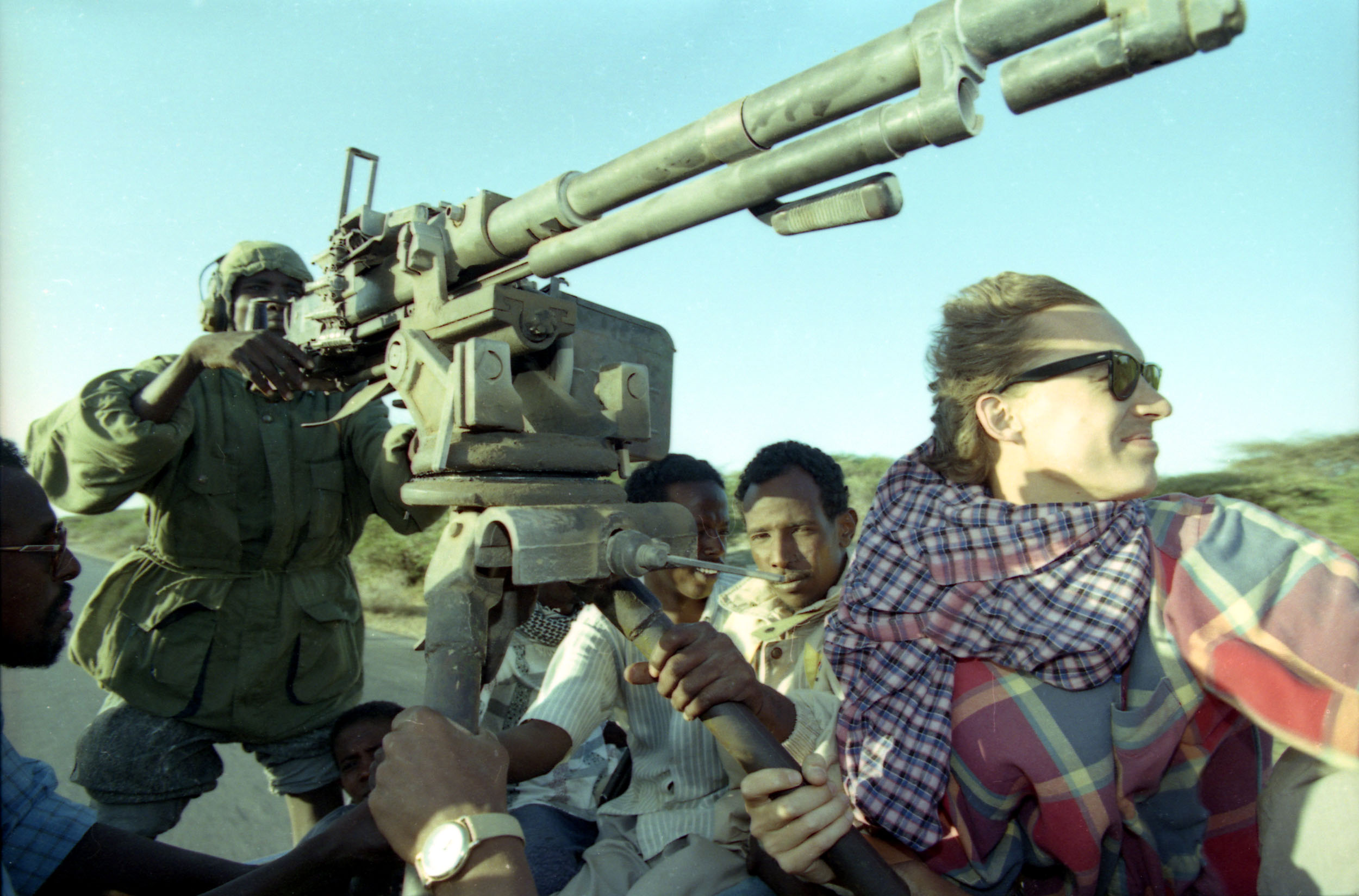
Warring factions have been leaving behind death and destruction in the Somali capital of Mogadishu for several days now (or is it years). This recent violence started Wednesday, pitting fighters who are loyal to Islamic clerics against gunmen allied with local warlords.

According to some Islamic fighters are seeking to boost the power of a group of fundamentalist clerics that has tried recently to assert itself as a new military and political force in the lawless country. Somalia has had no effective government since 1991, when warlords ousted a dictatorship and then turned on each other, carving the nation of 8.2 million people into a patchwork of fiefdoms.

UN sources say the fighting sucked in forces of the Alliance for Peace and the Fight Against International Terrorism, which comprises several Mogadishu-based faction leaders and militiamen loyal to Bashir Raghe. Other members of the alliance include Muhammad Qanyare Afrah, Muse Sudi Yalahow, Omar Finnish and Abdirashid Shire Ilqeyte.

On the other side is Abukar Omar Adan who controls the El-Ma'an beach port - which has served as Mogadishu's port since the closure in 1995 of the city's main port - is reportedly close to the Islamic courts and is receiving support from the Islamic court militia.

According to Aljazeera, the fighting was sparked by a row over land ownership in which one militia leader, Abukar Omar Adan, attempted to grab the piece of land attached to the Aisaley airport north of the capital and that is controlled by rival warlord Bashir Raghe Shirar.

The two men belong to the Warsangale sub-clan of Abgal within the larger Hawiye which is dominant in Mogadishu and its surroundings, but they have different political affiliations.

Adan is allied to the Islamic courts of Mogadishu, which control pockets of the lawless capital, while Shirar is a co-founder of the Alliance for the Restoration of Peace and Counter-Terrorism (ARPCT).

The ARPCT, a coalition of warlords which was formed last month, aims to curb the influence of Islamic extremism in Somalia, while the Islamic militia say they want to maintain law and order.

Seizing control of the disputed piece of land would give Adan strategic means to control the roads leading to the natural port of Elmaan, which became the busiest port after the closure of Mogadishu's main port in 1995 over a revenue dispute among warlords.

Confused?

Can you imagine what it must be like just to be a regular person trying to go about your life?

The following report was taken off the blog Flogging the Simien...whatever. The second article comes from the South Africa Broadcasting Company.

PS - The spelling of people's names differ below, but you'll figure out who is who.


Shaky Ceasefire in Mogadishu
Submitted by soj on March 26, 2006 - 18:01.

The good (but cautious) news out of Somalia is that the fighting has subsided after 4 days of fighting. The militias and their heavy armaments are still in position, so this could be just a temporary lull.

The fighting has occurred in the Galgalato area of northeast Mogadishu in a struggle between two factions over the control of the main functional seaport as well as a small airport. The area had been under the control of Abukar Omar (C)addan, one of the richest mafia members in the city, who is allied with the "Islamic Courts militias".

Another mafia leader, Bashir Rage, allied with the ARPCT (Alliance for the Restoration of Peace and Counter-Terrorism) launched an offensive to seize control. Initially it was (C)addan's militia versus Rage's but soon their various allies joined in, the ARPCT hoping to expand their territory. It looks like the fighting is over partially because the Islamic courts side "won" the battle, although at the cost of 100 civilians dead and at least 200 injured.

Rage denies that he lost, but sounds like sour grapes to me. Of course the ARPCT has said their sole motivation for launching an attack into (C)addan's territory was to "capture foreign terrorists" but that is pure bunk. It was a turf war, pure and simple, although of course saying the word "terrorist" keeps the American financiers of this gang of warlords happy. It looks good in the internal reports going back to Jerry "I saw Satan in photographs of Mogadishu" Boykin or whomever is running this little operation.

There might be some genuine terrorists or card-carrying members of Al-Qaeda operating in the areas under the control of the Islamic Courts militias, but the ARPCT just doesn't have the weaponry or tactics to do anything about it. Meanwhile I'm pleased to see that city elders are working on a negotiated truce. Not only did the fighting displace thousands of civilians, it has also prompted the UN to vacate its offices in Jowhar, some 90km away, where the "national government" is attempting to operate.

Let's hope the dust settles on this one soon and that the ARPCT go back to doing what they do best - extorsion and smuggling khat, drugs, weapons and stolen electronic goods.
==========================================================

Trail of death as fighting subsides in Somalia

March 26, 2006, 15:45

Fighting in Somalia's capital Mogadishu subsided today and residents said militia linked to Islamic courts had taken an upper hand after four days of fierce exchanges of fire that killed at least 70 people. Residents said the group had taken control of the area surrounding the Elmaan port and pushed rival militia loyal to a new "anti-terror" alliance of warlords from the area.

"The warlords have been pushed away from their stronghold, it looks like the Islamists have won the battle," said Ali Abdi, a resident of Mogadishu who managed to visit the battleground on Saturday to collect the body of his relative. But a spokesperson for the newly-formed political group, the Mogadishu Anti-Terrorism Coalition, which comprises many of the city's warlords opposed to the growing influence of the Islamic courts, denied that his group had been defeated.

"Since there was heavy crossfire within the Elmaan port, we decided to halt the fighting in order to open up the port," Hussein Gutale the spokesperson, told Reuters.

Residents flee their homes

The clashes, which began on Wednesday, have killed between 70 and 90 people according to witnesses and hospital sources, most of them militias, but also civilians caught in the battle, including women and children. Dahir Mohamed, the head of the medical department at Madina hospital said the hospital had received 98 people since the fighting started with chest, head and abdomen bullet wounds. Most of the victims were heavily bandaged.

In what Somalis say is the worst fighting in their lawless Horn of Africa country for years, 37 people also died in clashes between the two sides last month. Warlords have dominated the nation of 10 million since the ousting of former dictator Mohamed Siad Barre in 1991.

In the 14th attempt to restore normal government to Somalia, an interim administration set up in Kenya returned last year but has been unable to impose authority. It remains based in Jowhar, outside the capital, because of security fears.

Saturday, March 25, 2006

ACTIVISTS PROTEST ANTI-VIOLENCE MUSIC FEST HELD IN BUILDING OWNED BY SEX TRAFFICER


According to the Coalition Against Trafficking in Women, such trafficking plagues the United States as much as it does underdeveloped nations. Organized prostitution networks have migrated from metropolitan areas to small cities and suburbs. Women trafficked to the United States have been forced to have sex with 400-500 men to pay off $40,000 in debt for their passage.

In 2002, the US Department of State repeated an earlier CIA estimate that each year, about 50,000 women and children are brought against their will to the United States for sexual exploitation.

Traffickers use coercive tactics including deception, fraud, intimidation, isolation, threat and use of physical force, and/or debt bondage to control their victims. Women are typically recruited with promises of good jobs in other countries or provinces, and, lacking better options at home, agree to migrate. Through agents and brokers who arrange the travel and job placements, women are escorted to their destinations and delivered to the employers. Upon reaching their destinations, some women learn that they have been deceived about the nature of the work they will do; most have been lied to about the financial arrangements and conditions of their employment; and all find themselves in coercive and abusive situations from which escape is both difficult and dangerous.

This leads us to a situation in Berkeley where the group Women Against Sexual Slavery called for a boycott of a violence prevention music fest promoted by another women's rights group.

The following article is from Inside Bay Area.


Women's groups clash in Berkeley
By Kristin Bender, STAFF WRITER
Inside Bay Area

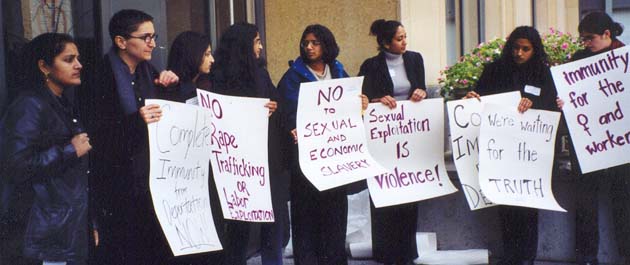
BERKELEY — A women's group against sexual slavery asked people to boycott a violence-prevention music and poetry festival Friday because the building where it was held is owned by a convicted sex-slave trafficker and his family.

A handful of picketers from the group Women Against Sexual Slavery showed up in front of the Shattuck Down Low on Friday night as the GirlFest music, poetry and spoken-word festival got under way.

The building where the anti-violence event was held is owned by members of the Lakireddy family, who several years ago were convicted of bringing girls and women from India to the Bay Area for cheap labor and sexual favors.

Having the festival there, the picketers said, was sending a contradictory message.

"When a group like (GirlFest) goes into a venue that is owned by (those involved with) sex slavery, they really aren't being conscious of the exploitation of women. It seems they could have found another venue," Women Against Sexual Slavery member Marcia Poole said.

Diana Russell, a professor emeritus at Mills College in Oakland and the author of a number of books on sexual violence, asked people headed to GirlFest on Friday to boycott.

"This organization is supposed to be anti-slavery and anti-sex trafficking. It's so contradictory that they would be meeting in this particular location," Russell said.

The three-day festival is being held in Berkeley and San Francisco to highlight the need to end increasing violence against women and girls and to raise money for a nonprofit organization that works to end homophobia, discrimination and sexual violence.

"Our mission is a positive one, and it's really sad that they want to bring this negative vibe when our mission is so much more than that," GirlFest organizer Annie Fukushima said.

The owner of the Shattuck Down Low, 2284 Shattuck Ave., is Daniel Cukierman, 32. He is not connected to the Lakireddy family other than being their tenant. The Lakireddy family owns the Shattuck Avenue building.

Cukierman said he is supporting GirlFest and its message and does not see the point of a boycott.

"Everybody I've talked to are kind of confused by a women's rights group protesting another women's rights group. I think they could work together and do a lot more positive things," he said.

Fukushima, a graduate student at the University of California, Berkeley who has organized a GirlFest in Hawaii, said she did not know the building was owned by the Lakireddy family until three weeks ago.

Fukushima said Poole's group could have done more good by working with GirlFest than against it.

"(Sex trafficking and violence against women) are really structural problems," she said. "Going after this one family is not going to end trafficking in general. If you really want to combat this huge phenomenon you need to look at the structural problems, you need to look at policy. I am really sad at this organization — there is so much more that can be done than just going after an anti-violence group."

Lakireddy Bali Reddy and his son, Vijay Lakireddy, were indicted in 2000, accused of having had an Indian man pose as the father of two sisters to bring them into the country on fraudulent temporary work visas. The older sister died in November 1999 of carbon monoxide poisoning after a heater in her Berkeley apartment malfunctioned.

Prosecutors said these girls and others brought here by similar means were used by Reddy as workers at his and his family's businesses, and for his own sexual gratification. Reddy, now 69, is serving 97 months in federal prison.

Vijay Lakireddy pleaded guilty in 2002 to one count of conspiracy to commit visa fraud and was sentenced to two years in prison, which he has served. Prasad Lakireddy pleaded guilty in 2003 to one count of conspiracy to employ unauthorized aliens and was sentenced to one year of home detention, a $20,000 fine and 300 hours of community service.

Reddy's brother and sister-in-law, Jayaprakash and Annapurna Lakireddy, each pleaded guilty to one count of immigration fraud in 2001. He was sentenced to a year and a day in federal prison and released in June. She served six months of home detention and paid a $2,000 fine.

Venkateswara Vemireddy, who had posed as the victims' father, was given probation and deported to India.

POLICE ABUSE OF LESBIAN, GAY, BISEXUAL AND AND TRANSGENDER PEOPLE DOCUMENTED


A new report by Amnesty International accuses United States law enforcement agencies of widespread homophobia and violence against lesbian, gay, bisexual and transgender people. The report, titled "Stonewalled—Still Demanding Respect," was published on Thursday and is based on interviews conducted between 2003 and 2005.

The following is a press release from Amnesty International.


Police target lesbian, gay, bisexual and transgender people in the USA

“Nothing is more unfair than singling out a group and making them criminal when they are not.”
R. Boevingloh, a 60-year-old gay man, February 2004.

R. Boevingloh was walking in a park in St Louis, Missouri, in June 2001 when he made the mistake of greeting an undercover policeman who walked past him. He was arrested, charged with lewd conduct and placed on two years’ probation. “I did nothing wrong,” he told AI, “I did not ‘cruise’ anyone, did not expose myself, did not hurt anyone and was targeted simply for being a gay male in a city park.”

In a new report AI reveals a range of human rights violations perpetrated by law enforcement officials against LGBT people in the USA. Whilst some of these abuses are so violent that they amount to torture, by far the more pervasive are those abuses committed day in and day out, making life intolerable for many members of the LGBT community.

All too often US law enforcement officials share the prejudices prevalent in society, such as homophobia, racism or sexism. When vague laws give police officers the power to decide what is “offensive”, the enforcement of these laws can become a means of punishing LGBT people for perceived transgression of social norms. LGBT people are frequently targeted for selective enforcement of minor public order or morals offences such as “loitering with intent to solicit”, “public lewdness” or “disorderly conduct”. The California Supreme Court, for instance, noted that the State’s prohibition of “lewd conduct” had been selectively enforced against gay men.

Transgender women are particularly at risk of such prejudicial treatment as many police officers assume that they are sex workers. AI has received numerous reports of transgender women being stopped and questioned by police when going about everyday tasks such as shopping. LGBT rights activists in Chicago told AI that police officers see transgender women as easy targets when they need to meet their allotted arrest quota.

It is hardly surprising that when LGBT people are victims of crime, they often prefer not to report the crime than face a dismissive, hostile or abusive response from the police. AI has found a pattern of police failing to respond appropriately to crimes against LGBT individuals. Police lack of understanding, or in more extreme cases hostility, has resulted in some cases in officers arresting the victims of the crime rather than the perpetrators.

In July 2000 a lesbian in St Paul, Minnesota, reported to a police officer than she had been attacked and abused in a supermarket. The officer refused to take action and even threatened to arrest her and her partner. When she told him that her attacker had called them “dykes”, the police officer replied that if they chose that lifestyle they must “expect some people to have a problem with it”.

Discriminatory policing can affect individuals in virtually every sphere of their daily lives. The effect of police targeting of LGBT people can be profound. Transgender woman Rachel Thompson told AI how a violent attack by a police officer changed her life: “That is when I decided to become an activist – abuse can be very inspiring… I will never forget to fear the police. I will always mistrust the system…”

To view the full report go to http://web.amnesty.org/library/Index/ENGAMR510012006

Friday, March 24, 2006

AIN'T GONNA TAKE IT NO MORE


Thousands of people filled the streets of Milwaukee Thursday for what was billed as “A Day without Latinos” to protest efforts in Congress to target undocumented workers.

The title of the demonstration is borrowed from the 2004 mockumentary “A Day Without a Mexican,” which considers what would happen to California if all Latinos there suddenly disappeared.

The protest concept also borrows from “Day of Absence,” a celebrated 1965 play by the black playwright Douglas Turner Ward, in which all black people mysteriously vanish from a Southern town, leaving work to be done by others.

The article below is from the Milwaukee Journal Sentinel.


Thousands march for immigrants
'A Day Without Latinos' seeks to flex political muscle in divisive debate

By MARK JOHNSON and LINDA SPICE

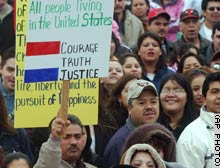
In one of Milwaukee's largest demonstrations in recent years, a mile-long swath of peaceful protesters marched into the city's downtown Thursday chanting, "¡Sí, se puede!" ("Yes, we can!"), carrying Mexican and American flags and signs condemning what they called "anti-immigrant" legislation.

Hundreds of students took the day off school; businesses around southeastern Wisconsin closed; and thousands of workers left their jobs in support of the event billed as "A Day Without Latinos."

Although march organizers put the crowd at 30,000, Milwaukee police estimated that there were between 10,000 and 15,000 marchers, said spokeswoman Anne E. Schwartz. She said there were no arrests.

The march, which culminated in a 90-minute rally in Zeidler Park, followed a similar event two weeks ago in Chicago that drew a crowd of up to 100,000 people.

"This is a historic day," declared Christine Neumann-Ortiz, executive director of Voces de la Frontera, an organization devoted to immigrant and worker rights issues.

"We have people from all walks of life. We have teachers. We have doctors. We have professionals. And, best of all, children. We wanted to recognize the workers who left their jobs today. There has been a strong show of solidarity," she said.

The event underscored both the growing political muscle of Latinos, America's fastest-growing minority, and the divisiveness of immigration issues in the post-9-11era.

One of the targets of Thursday's protest was a sweeping federal bill sponsored by U.S. Rep. Jim Sensenbrenner (R-Wis.) that would keep illegal immigrants in jail until they are processed for deportation, increase penalties for improper entry into the United States, and provide mandatory minimum sentences for illegal immigrants convicted of re-entering the U.S.

Several of the speakers Thursday singled out Sensenbrenner for criticism, including Sheila Cochran of the Milwaukee County Labor Council, who called the bill "wrong-spirited, wrongheaded and just plain wrong."

Xavier Marquez, president of the Racine group Students United for Immigrant Rights, called Sensenbrenner's bill "racist and divisive."

In a statement released later in the day, Sensenbrenner said, "The illegal alien rally held in Milwaukee today was an impressive show of force. But I do not believe that illegal aliens should receive legal government documents such as driver's licenses."

He said many people "have tried to confuse the difference between legal and illegal immigration," and added that putting illegal immigrants on a path toward citizenship "would be a slap in the face to all those who have followed the law and have come to America legally."

As the marchers were gathering, the Milwaukee Common Council voted 11-1 to oppose Sensenbrenner's bill. Instead, they called on Congress to approve an immigration reform bill that would help illegal immigrants attain legal status, expand temporary work visas and tighten border security.

The House passed Sensenbrenner's bill. Both that measure and competing legislation sponsored by U.S. Sens. John McCain (R-Ariz.) and Ted Kennedy (D-Mass.) are awaiting Senate action.

Two Wisconsin measures also drew the ire of speakers at the rally, including a law signed two weeks ago by Gov. Jim Doyle that forces applicants for state driver's licenses to present proof of legal residency. The second measure, if approved and signed by the governor, would deny undocumented immigrants access to school lunches for their children, public medical services and public defenders in court.

A community coalition

The march and rally stitched together a coalition of political leaders, including Mayor Tom Barrett, U.S. Rep. Gwen Moore (D-Wis.) and state Rep. Pedro Colón (D-Milwaukee), as well as labor unions, business groups and religious leaders.

"I am a third-generation Mexican-American. I am not an undocumented immigrant, but I strongly support my undocumented immigrant brothers and sisters in their struggle for justice and their equal rights," said Marquez, the leader of Students United for Immigrant Rights.

"On the Statue of Liberty it says, 'Give me your tired, your hungry, your poor yearning for liberty,' and that's why we're here," said Michael Rosen, president of the local union representing teachers at Milwaukee Area Technical College.

He vowed, "We will not allow George Bush, we will not allow Congressman Sensenbrenner to pit one part of the working class against another part of the working class."

Milwaukee School Board member Jennifer Morales called on all members of the school community "to oppose any law that makes criminals of children." She encouraged school employees to continue to provide services children need, such as food, health care and education.

The march and rally drew many families.

Angel Silva, 13, missed classes at Bruce Guadalupe Middle School to attend the rally with his family, saying, "We're only students. We're not terrorists. We want to get our education and go on to be a good person and live our life well."

His younger brother, Marc Anthony DeLeon, 9, said he opposes the bill "that any immigrant children they can't have lunch at the schools. And we don't think that's right."

The boys' mother, Magdalena DeLeon, 33, of Milwaukee, is a fifth-generation Mexican-American whose family originally immigrated from Jalisco, Mexico. She said she discussed with her children the U.S. Constitution and Declaration of Independence.

"The United States of America was built and established for the freedom of people," she said. "We have to be united as one, liberty and justice for all mankind."

The signs the marchers carried drew heavily on emotion and appealed to values enshrined in the Declaration of Independence and the inscription on the Statue of Liberty.

A large cloth banner said, "Open the doors to citizenship. Immigration is an American experience." A sign showed a photograph of a child wearing a red graduation cap and gown, with the caption, "I'm not a criminal." Another sign said, "You let us fight and die for the country, but we're still not called American."

Several of the speakers were children, including Samantha Pastrana, who led the crowd in the Pledge of Allegiance.

CECILIA FIRE THUNDER, PRESIDENT OF THE OGLALA SIOUX TRIBE, SAYS NO TO SOUTH DAKOTA ABORTION BAN


Cecilia Fire Thunder, the controversial President of the Oglala Sioux Tribe, has thrown a monkey wrench into South Dakota's plan to outlaw all abortions.

The following is taken from Indian Country Today.


South Dakota's abortion ban has sweeping implications
© Indian Country Today March 24, 2006. All Rights Reserved
Posted: March 24, 2006
by: David Melmer / Indian Country Today

PIERRE, S.D. - The South Dakota Legislature created a firestorm when it passed a bill that banned abortion with only one exception: to save the life of the mother. It was signed by Gov. Mike Rounds on March 6.

The bill will become law on July 1 unless either a lawsuit or petitioners get the issue on the November ballot. The law will make it a felony for any doctor to perform an abortion unless the procedure is necessary to save the woman's life. It would make no exception for cases of rape or incest.

Currently only one clinic in the state performs abortions: the Planned Parenthood clinic in Sioux Falls at the extreme eastern part of the state. Doctors from Minnesota come to the clinic, said Kate Looby, director of South Dakota's Planned Parenthood.

Looby told the Legislature that she would consider filing a lawsuit to stop the law from taking effect. She is now working to gather signatures on the petition. Some legislators, while debating the bill, were aware that a lawsuit would be imminent and that it eventually would end up at the U.S. Supreme Court. Some comments from the floor of each house reflected an interest in overturning Roe v. Wade.

A fund has been set up to collect donations to help defray the costs of possible litigation; however, if the petition drive collects enough signatures, litigation will be delayed or not considered.

Both sides of the issue claim they are ready to bring the issue to a vote. Polls indicate the bill will be repealed on a statewide vote because it is too extreme.

Banning abortion is an affront to women and denies them the choice over their bodies that the Creator has given them, said Cecilia Fire Thunder, president of the Oglala Sioux Tribe.

''I have very strong opinions of what happened. These are a bunch of white guys determining what a woman should do with her body,'' Fire Thunder said.

Fire Thunder was a nurse and has worked with women who were traumatized by rape.

''When a woman is raped and becomes pregnant she does not have the choice of aborting. How many men at the state house have ever been raped?'' Fire Thunder asked.

American Indian women will be impacted, if the law takes effect, in greater numbers than any other group. According to national statistics, American Indian women are sexually assaulted at a rate 3.5 times higher than all other racial groups. That means there are seven rapes per 1,000 American Indian women.

''It is very important that we have access to safe, legal pregnancy termination services, whether it is emergency contraceptives right after the assault or an abortion service,'' said Charon Asetoyer, director of the Native American Women's Health Education Resource Center located on the Yankton Sioux Reservation.

She said her organization gets asked weekly by women for referrals. She added that her organization refers the women to Planned Parenthood.

American Indian women who live in the western part of South Dakota must either travel the few hundred miles to Sioux Falls or to Nebraska, which in both cases becomes expensive.

''This will force women out of the state and would cost more money and more time and a lot of women may not realize they have that option. It increases the trauma for those who have been sexually assaulted,'' Asetoyer said.

''It's this big myth that Native American women don't terminate pregnancies; they have always terminated pregnancies, do now and will in the future,'' she said.

She said it is the woman's personal business and that it is not to be scrutinized in the political arena.

Fire Thunder echoed that sentiment and added that adequate funding for sex education, including instructions on how to use contraceptives to prevent unwanted pregnancy, should be a priority.

A bill that was defeated in the current session of the state Legislature would have dictated a method of teaching sex education that was based on abstinence only.

''If they are going to outlaw abortions [they should] put more money into sex education and pregnancy prevention. It's fine to tell people to abstain from sex. Adult people in our country expect young people to abstain when they don't abstain,'' she said.

''It's my personal opinion that it's a woman's choice. She makes the decision and the only person she is going to be accountable to is the Creator and the spirit of that child,'' Fire Thunder said.

Both women said they would support a move to build a Planned Parenthood-type clinic on a reservation where the state would not have jurisdiction. Fire Thunder said Pine Ridge would not be the place.

''I think that somewhere on any reservation in South Dakota, somebody has to step up and make that offer and build such a facility,'' Fire Thunder said, adding that she will not be that person.

The anti-abortion bill has been in the works the past few years during legislative sessions. Rounds vetoed the last bill that came up two years ago on a technicality. He signed the bill this year and the latest poll, taken by a national polling company, found his rating had dropped substantially from a 72 percent favorability rating to 58 percent during the month in which the abortion bill was mostly debated.

Seven other bills that would have restricted women's rights were also defeated this year. An informed consent bill would have required a woman who considered an abortion to undergo a mental screening. Asetoyer said that would open the door to discrimination against women.

Past versions of the abortion bill were supported by out-of-state organizations and many critics claim that is the case this year as well.

''This bill was driven by a small group of right-wing, religious coalition groups. They are trying to do this in several states and they targeted South Dakota primarily because it could be swayed.

Fire Thunder drew a parallel with sovereignty of nations by saying that a woman is a sovereign nation.

''The Creator gave every human being [the right] to make choices for yourself. Another person may not think that is the right choice and a lot of people have made bad choices in their lives, but it's their choice,'' Fire Thunder said.

''We have to honor the gift the Creator gave us; one of the greatest gifts is to choose for ourselves.''

Fire Thunder said she hoped that women who were raped would band together and send a powerful voice across the country.

During many of the hearings on the abortion ban bill, many American Indian women were present as witnesses or observers in hearing rooms.

''It is so inspiring to see this groundswell of Native American women to fight for our rights,'' Asetoyer said.

Thursday, March 23, 2006

WARNING: RIGHT WING NUTS AND SCUMBAGS ON THE LOOSE IN ISRAEL


Baruch Marzel (pictured), the head of the ultra right wing National Jewish Front Party has called on the Israel Defense Forces to assasinate an Israeli peace activist.

Baruch Marzel is an American born right-wing Israeli settler from Hebron. He was a member of Meir Kahane's Kach, which was disqualified by the Israeli Supreme Court from running in the 1988 Israeli elections because its platform was deemed racist, because it advocated the deportation of the Arabs. Following Kahane's assassination in 1990, he moved to lead Kach, one of the splinter groups from the original Kach. In 2003, Marzel joined Herut and became the number two candidate on the party list after Michael Kleiner in the bid to enter the 16th Knesset session. Herut failed to pass the minimum threshold of voters. In 2004 he founded the Jewish National Front Party. Marzel echoed the words of the Right Reverend Pat Robinson following Ariel Sharon's stroke. He stated, "We aren't praying for this evil person. He went against God. He went against the Bible. He betrayed his own country."

On its website the National Jewish Front (Hazit) says, "'HAZIT' declares that Israeli governments over the past 30 years have whetted the appetite of the enemy for Israeli land and their lust for murder. Surrendering parts of the Land of Israel, and the Jewish State's giving up on the accomplishment of its aims, is correctly perceived by the enemy as proof that terror and murder pay off, as Jews run away and close themselves into ghettos, behind concrete walls and separation fences. 'HAZIT' will work in complete opposition to the appeasement and surrender policies of Israeli governments during the last decades. 'HAZIT' will work towards changing basic values, and there will most likely even be a need to reverse them."

Marzel is not the only nut running loose. Michael Kleiner, head of the Herut Party, did manage to get himself and his friends beat up today during a provocation they insighted in the city of Jaffa.

Both articles below are from Ha'aretz.


Marzel urges IDF to assassinate Uri Avnery

By Nadav Shragai

National Jewish Front leader Baruch Marzel, now campaigning for the March 28 Knesset election, said yesterday that the leaders of Kadima are "traitors" and "criminals" and called on the Israel Defense Forces to assassinate the far-left leader of the Gush Shalom movement Uri Avnery.

Speaking yesterday in Jerusalem and Ramle, Marzel said left-wing activists are bringing destruction upon themselves and said they sometimes harm the interests of Israel no less than the country's external enemies.

In response to Avnery's comment that the 2001 assassination of cabinet minister Rehavam Ze'evi was a Palestinian "targeted killing" - a term generally reserved for IDF strikes on militant leaders - Marzel said the IDF needs to target Avnery.

"Traitors sit in Kadima. They betrayed their own principles, Judaism and Zionism," Marzel added.

Peace Now yesterday evening called on Attorney General Menachem Mazuz to examine Marzel's statements on suspicion of incitement.

The far-right extremist also expressed anger at attacks by National Union and the National Religious Party. He said their action increases his chance of not obtaining the minimum number of votes required to enter the Knesset.
==============================================================================

Jaffa residents clash with Herut activists urging their emigration

By Yuval Azoulay, Assaf Carmel and Nadav Shragai, Haaretz Correspondents

Herut party activists and Arab residents of Jaffa clashed on Thursday afternoon after the activists arrived in the city in an attempt to convince its Israeli Arab residents to leave the country.

The activists were headed by party chairman and former MK Michael Kleiner.

Police officers who arrived at the scene dispersed those involved in the brawl.

Convening on Yefet Street, Kleiner began reciting his political doctrine as Herut activists urged Jaffa's Arab residents to emigrate, and offered monetary compensation.

"The land was given to the sons of Israel, and not to the sons of Ishmael. Us. This is our country. Not your country," Kleiner declared. "But we aren't talking about a forced evacuation. We won't force anyone to leave. We're talking about voluntary evacuation, in exchange for fair, or perhaps even higher, monetary compensation. Whoever doesn't want it won't take the money and will stay here, but there are many Arab countries in the region."

Within minutes, dozens of Arab residents crowded around Kleiner and the Herut activists, accusing him of being racist and fomenting strife. The activists said that they were beaten, and that Jaffa residents had thrown eggs and bottles at them.

Jewish residents of Jaffa who were in the area at the time of the incident accused Kleiner of threatening the coexistence between Jews and Arabs in Jaffa.

After a Kleiner supporter took out several bills to prove that he was serious about the intention to compensate Arabs willing to emigrate, one of the Arab residents flung the bills in the air. The money scattered and passers-by collected it for themselves.

After a firecracker was set off, Kleiner and his associates fled to their cars and left the area. No one was hurt.

After the incident, Kleiner said his visit to Jaffa constituted "legitimate activity within the framework of Israeli democracy. We respect them, but they don't respect democracy. This is a business proposal; if they want to, they can take it, if they don't, they won't."

"No one can harm residents of Tel Aviv-Jaffa or the good relations between Jews and Arabs in the city," Tel Aviv-Jaffa Mayor Ron Huldai said in response to the incident.

SEALS THREATENED FROM TWO DIRECTIONS


Hunters and protesters are heading for the Gulf of St Lawrence and the north-east coast of Newfoundland, waiting for the Canadian government to give the go-ahead for the cull. It was expected to start this week.

Ministers have already authorised the slaughter of 325,000 baby harp seals, the second highest number ever. It will be the third successive year in which more than 300,000 of the cubs have been clubbed and shot; by the end of the cull, the death toll since 2004 will top a million.

These seals also face disaster from another direction. Scientists, sat another real danger to the seals comes from climate change. Water temperatures off Newfoundland are 4.5C warmer than this time last year and the ice is already beginning to melt.

Shrinking Arctic ice caps are threatening arctic animals. Polar bears find it harder to find the food as icebergs, their "highways" to a seal food supply, shrink away, or as ice that normally forms fails to appear. The giant white bears need the ice to gain access to ringed and barbed seals which live and play away from land among the ice bergs, yet the ice is breaking up two weeks earlier than normal these days, and polar bears are on average between 176 and 187 pounds lighter. Scientists believe it is because they cannot find food. Every day of ice hunting is critical, as the bears must hunt to build enough fat to last through the forced 5 month fast during winter.

Unseasonable warming can also lead to collapses of the snow caves where female seals bear their young. The young as yet have no blubber and die of exposure when cold conditions return. Scientists suspect that declines in seal populations will occur in this manner, and will ultimately lead to further declines in polar bear populations.

And it isn't just in the arctic.

Retreating ice in the Southern Ocean is making it harder for elephant seal mothers to feed their babies, say Australian researchers.

Environmental scientists Dr Clive McMahon and Harry Burton of the Australian Antarctic Division in Tasmania say a warming climate is changing the ecology of the ocean, where the seals forage.

They say this changing ecology, which has led to a drop in available seal food, is interfering with mothers' ability to feed their young to a healthy weight.

And this has contributed to a dramatic decrease in the seal population over recent decades.

Anyway, back to the "cull". The following article is from Ireland On Line. Below that you will find further information and suggestions for actions on the seal cull.


Canadian embassy picketed by seal cull protesters
23/03/2006 - 13:45:29

Animal right activists today stepped up their campaign for a ban on seal hunting by taking their protest to the Canadian Embassy.

Picketing outside the St Stephen’s Green building, demonstrators urged consumers across Ireland to boycott all Canadian seafood until its annual cull is stopped.

Organiser, Limerick-based activist John Carmody of the Animal Rights Action Network (Aran), pleaded with residents to join their appeal.

“We are asking people in Ireland to contact the Canadian officials and voice their disgust in the violent barbaric slaughtering of seals and boycott Canadian seafood,” he said.

“These seals are hacked, picked to death or clubbed or shot and die very slowly. Some have even been skinned alive or choked on their own blood.

“This is the world’s largest slaughtering of any marine mammals, with thousands of seals already killed this year alone.”

Celebrities all over the world have joined the protest against the killing of 325,000 young seals by registered hunters who claim they decimate cod stocks.

John added: “This seal hunt takes place once the fishing season is over and the fur is sold, mainly in south east Asia.

“We hope this is the last year this takes place, but if the Canadian Government doesn’t stop it we know a worldwide boycott will work.

“We have identified that €126,000 worth of Canadian seafood is sold annually in Ireland.

“There has been a huge boycott in America and we now are stepping up our campaign in the UK and Ireland.”

The seal hunt will begin in the Gulf of St Lawrence this week.

------------------------------------------------------------------------------
Call on Canada's New Prime Minister to End the Seal Slaughter!

With nearly one million seals killed in the past three years alone, Canada’s commercial seal hunt has become the largest, most brutal slaughter of marine mammals on earth.

Each year, Canada allows hundreds of thousands of defenseless baby seals to be cruelly clubbed and shot to death for their fur. The last time this many seals were killed—in the 1950s and 1960s—the harp seal population was reduced by as much as two-thirds.

In 2005, 98.5% of the seals killed were just two months of age or younger. At the time of slaughter, many had not yet eaten their first solid meal or taken their first swim. They literally had no escape from the "hunters."


Last year, The HSUS documented the commercial seal hunt firsthand. What we saw was shocking: conscious baby seals stabbed with boathooks and dragged across the ice, wounded
See The HSUS Animal Channel's slide show on the seal hunt.

seal pups left to choke on their own blood for more than an hour, and conscious seals sliced open and skinned as they struggled. An independent veterinary study conducted in 2001 found much of the same; it concluded that 42% of the seals examined had likely been skinned alive while conscious.

The overwhelming majority of Canadians, Americans, and Europeans oppose the commercial seal hunt, and many of us are willing to use our consumer power to help stop it. To pressure the Canadian government and fishing industry to take action, The HSUS and our ProtectSeals network are asking consumers to boycott Canadian seafood products until the seal hunt has been ended for good.

Sing a petition to the Canadian Prime Minister by clicking http://www.thepetitionsite.com/takeaction/566342047?z00m=76043&z00m=76043#body

Wednesday, March 22, 2006

SAHRAWIS NOT INTERESTED IN KING COMING TO TOWN


King Mohammed VI of Morocco arrived in the Western Sahara on Monday. The unwelcome visit followed the commemoration of the 30th anniversary of the Saharawi Arab Democratic Republic, declared by the Polisario Liberation Front. The King's trip is allegedly aimed at building support for his so-called autonomy plan. During his last visit to the area in 2002, the Moroccan monarch said that his country would "not give up one inch of its Saharan territory, which is inalienable and indivisible".

The Sahara Press Agency reporting on one response says that Saharawi students at the University o Marrakech organised marches on Tuesday evening to denounce the visit of Mohamed VI to the occupied capital of the Saharawi Arab Democratic Republic, El Aaiun, and advocated the exercise by the Saharawi people of their right to self-determination and independence.

During the peaceful marches the Saharawi students raised pictures of the Saharawi human rights activist and political prisoners in addition to placards on which it was written: "We reject the visit of Mohamed VI to El Aaiun and ask for the right of the Saharawi people to exercise their inalienable right to self-determination and independence", the same source indicated.

They also called to the "immediate withdrawal of the Moroccan repressive machine from the occupied territories of the Western Sahara and the unconditional release of all the Saharawi political prisoners", imprisoned in the Moroccan prisons, the same source added.

The Moroccan repressive forces, composed of CMI, police and GUS immediately intervened to disperse the demonstrators an proceeded to the sealing of all the streets leading to the place of the demonstration

SPA also reports that Saharawi students of the secondary school of the occupied city of El Aaiun refused on Tuesday to be forcibly transported in Moroccan military trucks to attend, against their will, to the "royal activities" in the occupied capital of the Saharawi Republic, in a signal of denunciation to the visit of Mohamed VI to the Western Sahara and advocating the right of their people to the self-determination and independence, reported SPS’s correspondent on the ground.

Demonstrators raised the flags of the Saharawi Arab Democratic Republic and chanted in favour of the independence of the Western Sahara, refusing to answer this appeal to attend "these activities."

SPA reports, they also faced the Moroccan settlers stopping them from crossing the Saharawi popular neighbourhood "Giratoria", raising the flags of the Saharawi Arab Democratic Republic and distributing tracts rejecting the visit of the king of Morocco, Mohamed VI, to the Western Sahara.

The Moroccan forces of occupation violently intervened so as to protect and support the settlers, who failed to enter the Giratoria, according to SPA.

Many people, especially youth have been arrested.

Khalil Sidi M'Hamed, Minister of the Occupied Territories and Communities, called Tuesday on the Moroccan and Saharawi civil citizens in he Western Sahara to "dissociate from these reprehensible practices", underlining that the two people, Saharawi an Moroccan, "are victims to the same Moroccan Government".

The Saharawi official also asked the UN to intervene so as to "protect the Saharawi civil citizens, who are victims to these abuses and to grant them the respect of their fundamental freedoms until the decolonisation of their territory".

The first statement below comes from Western Sahara On Line. The second article is some good background on the whole crappy situation regarding the Western Sahara and is from the Norwegian Support Committee for Western Sahara.


Moroccon King Just Not Welcome!!!

Many media and international news agencies as well as reliable reports emanating from the Saharawi occupied territories have recently been reporting that, on the eve of the forthcoming visit to be conducted by the Moroccan King to the occupied Western Sahara, the Moroccan authorities have intensified their military and security presence in the Territory. Thousands of Moroccan soldiers, police forces, gendarmerie and different security corps have been deployed throughout the occupied territories. Barriers and checkpoints have been erected, and security units have been deployed to patrol the key areas. Besides, houses on main streets as well as university campuses were broken in and evacuated. All these measures aim at terrorising and violating the human rights of Saharawi citizens not only in the occupied territories but also in Southern Morocco and in Moroccan universities where Saharawi students study.
----------------------------------------------------------------

How To Be Ignored
Depressing lessons in realpolitik from the Western Sahara.
By Carne Ross

Posted Tuesday, March 21, 2006, at 6:59 AM ET

TINDOUF, Algeria—If any part of you wants to believe that the world is fundamentally just, that wrongs are eventually righted, and that those of us in the West are fair and righteous in the way we treat other countries and cultures, consider the story of the people of Western Sahara. Their history proves that you can have right wholly on your side, international law emphatically in support of your cause, be on the agenda of the U.N. Security Council for decades, and still be ignored.

In 1975, Morocco invaded the former Spanish colony of the Western Sahara. A long and inconclusive guerrilla war followed. The Polisario Front, which represents the people of the Western Sahara known as the Sahrawis, was supported by Algeria. Morocco was supported by France, the United States, and other major powers.

At the cease-fire in 1991, Morocco declared that it would accept a U.N.-supervised referendum on the status of the territory, as an earlier ruling of the International Court of Justice required. At last, the Sahrawis would decide their own future. The United Nations set up a commission to run the referendum. The U.N. Security Council passed scores of resolutions over the years that followed supporting a referendum. But thanks to perpetual obstruction by Morocco, the vote never took place. The United Nations' commission to run the referendum—called MINURSO—still exists, at a cost of nearly $50 million a year. Today, there seems less chance than ever that there will be a vote.

When Morocco first invaded, hundreds of thousands of Sahrawis were driven from the territory. The Polisario Front set up refugee camps in the far southwestern corner of Algeria near the town of Tindouf. Home to some 150,000 refugees, the camps' orderliness and the industry of the inhabitants is striking. The rows of huts and tents are tidy; women and children attend classes. But visitors cannot escape the deep sense of despair and frustration. There are middle-aged people who were born here but have never seen their homeland. Recently the camps, which lie deep in the western reaches of the Sahara desert, were devastated by floods ( see this map). To the rest of the world, out of sight is out of mind.


Geography is one reason the Western Sahara is ignored. The suffering of the Sahrawis lies a long, awkward, and expensive journey away, in a country—Algeria—that most Western countries have long warned against visiting because of its own bloody civil war. Reaching the occupied territory itself is even more difficult, thanks to restrictions placed by the Moroccan authorities, who are no doubt reluctant to publicize the recent wave of Sahrawi demonstrations and consequent arrests (described in a recent Amnesty International report). They have also blocked access to Web sites—such as www.arso.org—that cover events in the territory.

"Where's the story?" editors demand of journalists seeking the expensive plane fare to visit Tindouf. And where indeed is the story, except in the tedious, endless denial of justice to an entire population. With no bombs, only occasional killings (a Sahrawi demonstrator was recently beaten to death by the Moroccan police), and an appalling lack of diplomatic action, the story, though rich in tragedy, lacks the immediate drama required to propel it to the front pages.

The attention we give to blood and destruction also helps keep the story off the news agenda. Since the 1991 cease-fire, the Polisario have forsworn violence as a means to further their cause. The Polisario's leaders know that if they were to resume guerrilla action, the Moroccans would be quick to cry terrorism in order to turn their powerful allies against them. Eager for the simplicity of "us" against the "terrorists," the world's press would almost certainly play along. But the paradox of an ugly world is here very evident: Without bloodshed, no one pays any attention to the Polisario. For all the celebration of the nonviolence of Mandela or Gandhi or King, in the real world pacifism has brought the Polisario virtually nothing.


If you talk to diplomats covering Western Sahara, almost all will admit that right is on the Sahrawis' side. The U.N. special envoy recently told the Security Council that the law clearly favors the Sahrawis. But this means nothing, when, in terms of realpolitik, Morocco has all the countries that matter in its camp. Morocco is a loyal U.S. ally in the war against terrorism (including, allegedly, torturing suspects at Washington's behest). It is equally staunch in fighting illegal immigration into Europe. Morocco is the jumping-off point for many African would-be emigrants, who desperately try to cross the Mediterranean or battle their way into the Spanish enclaves of Ceuta and Melilla. To demonstrate its helpfulness, Morocco has begun to dump the migrants it captures into the minefields beyond the fortified sand barrier known as " the berm" that protects its occupation in the Western Sahara. Some have died.

At the United Nations, there is much hand-wringing about finding a "mutually acceptable" solution to the "dispute," which is, in reality, an occupation. But nothing is done. Morocco has sat tight, watched U.N. envoys come and go, and successfully fooled the world into thinking it a "reforming" Arab government. Meanwhile, it suppresses democracy at home and remains in illegal occupation of someone else's land. It has exploited the mineral wealth of the territory and is now in the process of selling— illegally—rights to fish the Western Sahara's waters to the European Union, which is happy to preach about justice and international law in places where it costs nothing to do so.

This is the ultimate and depressing lesson of the Western Sahara. Whatever anyone tells you about "values" such as democracy or rights being the organizing principles of Western diplomacy, the world is still run according to the dismal calculus of "interests" and realpolitik. Morocco is with us, so the Sahrawis can go to hell. And, frankly, hell is a pretty accurate description of those refugee camps in the Sahara.

Carne Ross is a former British diplomat and director of Independent Diplomat, a nonprofit group that is advising the Sahrawi Arab Democratic Republic, the government-in-exile of the Sahrawi people.

ANNA GINSBERG WINS PILLSBURY BAKE-OFF


Just because I knew you would want to know I print the following from the Austin American Statesman. HOWEVER, PLEASE NOTE I DO NOT IN ANY WAY SHAPE OR FORM CONDONE THE EATING OF CHICKENS...


Austinite wins Pillsbury Bake-Off

Anna Ginsberg won $1 million for chicken and stuffing recipe
By Kitty Crider
AMERICAN-STATESMAN STAFF FOOD EDITOR
Wednesday, March 22, 2006

ORLANDO — Austinite Anna Ginsberg is $1 million richer this morning, as the winner of the 42nd Pillsbury Bake-Off. Her original recipe for Baked Chicken and Spinach Stuffing beat out 98 other finalists from all over the country for the grand prize announced today, which will be awarded as a $50,000 a year annuity for 20 years.

Ginsberg, a stay-at-home mother of a 4-year-old daughter, creatively combined spinach with frozen homestyle waffle sticks, fresh sage and pecans for the stuffing and then used waffle syrup in the peach glaze for the savory chicken dish.

Judge Martha Holmberg, food editor of the Oregonian and former food editor of Fine Cooking magazine, said of the recipe, "It's not a lot of work but feels restauranty in the good sense of the word. The waffle fingers had a nice texture and it was a good way to get spinach and vegetables in there. It's a complete dinner." (Ginsburg's recipe is below.)

Recipes were judged on appearance, appeal, creativity and taste and had to win one of the Bake-Off's six categories before they could compete for the grand prize. Ginsberg's recipe won the Cooking for Two category. Each of the other five category winners earned $10,000 plus GE Profile ovens with Trivection.

All Bake-Off recipes had to include at least two of more than 60 qualifying products from Pillsbury, General Mills, Progresso, Green Giant, Yoplait, Old El Paso and more. Ginsberg used Green Giant frozen spinach and Pillsbury Dunkables waffle sticks.

In addition to the $1 million, Ginsberg, as grand prize winner, will receive $10,000 worth of GE Profile stainless steel kitchen appliances.

Confetti rained down on Ginsberg, à la Vince Young style, as she was announced the grand-prize winner. She grabbed her head with her hands in disbelief. "It's like I haven't woken up yet," she said of the early-morning announcement. She said she made the recipe up for dinner one night, for herself because she likes stuffing. "I thought it was creative and it tastes so good. I ran upstairs and typed it up."

She plans to use the money for her daughter's education and a trip to London. And she has a dream of owning a coffeehouse, with a playscape for kids, where she bakes cookies every day.

Competition cooking is not new to Ginsberg, who began entering recipe contests two years ago and has been a finalist or winner in 15 national ones. Last year her wins included $10,000 in a California raisin contest and $5,000 in Cooking Light. In 2004, she was a Bake-Off finalist and, as such, received a trip to Hollywood, an Advantium oven and a $1,000 supermarket shopping spree. But even though her recipe did not place that year, it whetted her appetite to try again. Rarely entering single recipes in contests, she estimates that she has submitted 300 original creations in two dozen contests in the past couple of years. She was elusive on how many she entered in the Bake-Off but told reporters it was between 1 and 100, hinting the higher end.

While the money is nice, recipe contests are "more of a creative outlet for me," the 35-year-old University of Texas advertising graduate told the American-Statesman last year in a profile for the newspaper after the Cooking Light win.

Ginsberg was not the only Austin resident competing in the Bake-Off. Jennifer Mohn was a finalist in Orlando with a roasted tomato-corn chowder with cilantro pesto. As a finalist, she won an expense-paid trip to the competition at the Gaylord Palms Resort, a $1,700 value.

Judges for the Bake-Off were nine newspaper or magazine food writers (including this writer), dietitians, and cookbook authors, including Angela Shelf Medearis, an Austin radio food show host.


Baked Chicken and Spinach Stuffing
9 Pillsbury® Dunkables® frozen homestyle waffle sticks with 3 syrup cups (from 1 lb 1.3-oz box)
2 tablespoons peach preserves
1/2 teaspoon Worcestershire sauce
2 bone-in skin-on chicken breasts (1 lb)
1/4 teaspoon salt
1/4 teaspoon pepper
1 tablespoon butter or margarine
1/2 cup chopped onion (1 medium)
1/4 cup chicken broth
1/2 teaspoon poultry seasoning
1/2 teaspoon chopped fresh sage
1 1/2 cups Green Giant® frozen cut leaf spinach (from 1-lb bag), thawed, squeezed to drain well
1 tablespoon beaten egg white
1 tablespoon chopped pecans


Heat oven to 350 degrees. Spray 9-inch glass pie plate or 8-inch square pan with cooking spray. In small bowl, mix contents of syrup cups from waffles, the preserves and Worcestershire sauce. Place chicken, skin side up, in pie plate; sprinkle with salt and pepper. Spoon syrup mixture over chicken. Bake uncovered 25 minutes.

Meanwhile, toast waffle sticks as directed on box. Cool slightly, about 2 minutes. Cut waffles into 3/4-inch cubes; set aside. Spray 1-quart casserole with cooking spray (or use 9x5-inch nonstick loaf pan; do not spray). In 10-inch nonstick skillet, melt butter over medium heat. Add onion; cook and stir 2 minutes or until tender. Stir in waffle pieces and broth, breaking up and moistening waffle pieces. Sprinkle with poultry seasoning and sage. Remove from heat; stir in spinach. Cool about 5 minutes. Stir in egg white and pecans.

Spoon stuffing into casserole; place in oven with chicken. Bake uncovered 15 to 25 minutes or until juice of chicken is clear when thickest part is cut to bone (170 degrees) and stuffing is thoroughly heated. Serve chicken with stuffing, spooning remaining sauce in pan over chicken.

STATE OF EMERGENCY DECLARED IN ECUADOR


This follow up on the situation in Ecuador is from the Spanish News Agency EFE.

Protests convulse Ecuador

Quito, Mar 22 (EFE).- Soldiers in armored personnel carriers and on bulldozers deployed in six provinces of central Ecuador on Wednesday to remove barricades blocking highways and enforce a rights-suspending state-of-emergency imposed to quell protests against a free-trade treaty with the United States.

The government decreed the military deployment Tuesday in response to the widespread demonstrations by supporters of the Andean nation's Indian federation, which has denounced and defied the measure, creating a climate of uncertainty over the country's immediate political future.

The outcome of the confrontation between the powerful Confederation of Indigenous Nationalities, or Conaie, which is spearheading the protests, and the weak and unstable administration of President Alfredo Palacio is difficult to predict and its political repercussions uncertain.

In Cotopaxi province, where demonstrators urged on by area mayors had blocked roads to press demands for infrastructure funding, the protests subsided after the government on Tuesday evening delivered some $42 million to local authorities.

On Monday night and early Tuesday, Indians in that region, who have also demanded the termination of the Ecuadorian government's contract with U.S. oil company Occidental Petroleum, citing alleged breach of contract, kept some roads blocked while the army removed barricades in other areas.

Conaie has decided to continue blockading many roads in the Andean highland region, although some of the federation's members told EFE on a road south of Quito that they would avoid clashing with security forces.

Gilberto Talahua, coordinator of the Pachakutik Movement, Conaie's political arm and the Indians' loudest institutional voice, also told EFE that the indigenous protest would continue and be further bolstered with the support of other social sectors that have offered to back their cause.

Talahua referred to Palacio as a "coward" and said that the state-of-emergency decree, which restricts certain constitutional rights including freedom of assembly, shows the government's "inability" to solve problems.

It also shows Palacio's "intolerance of his own people," he said.

"We Indians are not going to back down and alongside us are several other social sectors; our struggle is for the country, not our individual interests," said Talahua, who added that "all cowardly, mendacious and corrupt governments do these kinds of actions, which we don't fear anymore." On Tuesday, Interior Minister Felipe Vega, the fifth to occupy this post in Palacio's 11 months in office, announced the state of emergency in a press conference. The measure left the provinces of Tungurahua, Imbabura, Chimborazo, Cotopaxi, Cañar and part of Pichincha under military control.

According to Vega, who was sworn in Monday after his predecessor resigned last week, the goal of the state of emergency is to "guarantee freedom of transit" within the national territory, as is provided for in the constitution, and put an end to the supply shortages - especially of food and fuel - that have begun to affect central Ecuador.

Vega noted that no arrest warrants have been issued with any Indian leaders, but added that it was necessary to have "a country at peace in order to work" and defended the free-trade negotiations with the United States.

The Indians, for their part, have said they will not halt their protests until the government calls off the talks on a free-trade deal, which they say would be ruinous for the nation's poor people and benefit only the wealthy and powerful, especially the United States. Talks are set to resume Thursday in Washington.

"The pressure Palacio must be receiving (in favor of the free-trade pact) surely is coming from the business leaders, the multinationals, the U.S. embassy," said Talahua, who again denounced the state of emergency and the "attitude of a weak government, which props itself up with these kinds of measures."