Thursday, February 13, 2014

WHAT'S NEW ABOUT THE KOREAN WAR ISN'T

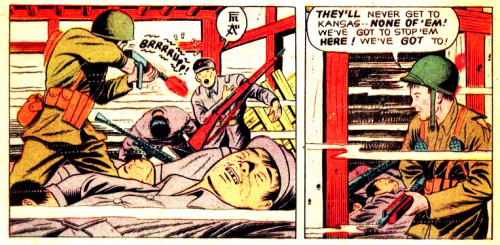
The real meaning of the Korean War. Stopping Communism reaching Kansas.
Growing up in Kansas, I breathed a sigh of relief to have been saved
from the horrors of communism.  

Then those dirty Reds got me anyway!


Why an article that has anything to do with the Korean War now...in 2014?  Maybe it has to do with the messy State known as the Democratic People's Republic of Korea?  Well, a little, but not really so much.  Maybe I just ran into a piece related to it, that I find interesting. Uh, yeah, honestly that's it.  

In Nineteen Eighty-Four, George Orwell wrote: “Who controls the past controls the future: who controls the present controls the past.”  There is some real truth in that, not total mind you, but some.  Still, we control the present and that is a fact.  We just need to continually remind ourselves of that fact.  An honest knowledge of the past doesn't hurt though.  

Meanwhile, back at the ranch.  The Korean War is a war that largely slips through history with little notice.  Considering the huge numbers of people who died and who were injured during that war, that fact seems strange.

As a kid I was pretty much assured by my teachers that the USA was totally in the right in that war and were always the good guys.  The North Koreans and the Chinese were boogeymen, uncivilized barbarians whose main goal seemed to be to torture, abuse, and brainwash everyone and everywhere.

MASH turned the Korean War into Vietnam, and while it was certainly a good TV show and a nice movie, it really told us nothing about the actual War fought on the Korean Peninsula or why it was fought or how it was fought.

My generation was much engulfed in the quagmire of Vietnam for a couple of decades so we, too, mostly forgot about Korea.

Justin Raimondo reminded us in an article last summer:


...whatever the US was fighting for, from 1950, when the war broke out, to 1953, when it ground to a halt, democracy hardly described the American cause.


We were fighting on behalf of Syngman Rhee, the US-educated-and-sponsored dictator of South Korea, whose vibrancy was demonstrated by the large-scale slaughter of his leftist political opponents. For 22 years, Rhee’s word was law, and many thousands of his political opponents were murdered: tens of thousands were jailed or driven into exile. Whatever measure of liberality has reigned on the Korean peninsula was in spite of Washington’s efforts and ongoing military presence. When the country finally rebelled against Rhee, and threw him out in the so-called April Revolution of 1960, he was ferried to safety in a CIA helicopter as crowds converged on the presidential palace.


Raimondo adds some uncomfortable truths here about so-called progressives then,


...the liberals came out in support of the war, with The Nation and The New Republic leading the charge: the antiwar Republicans were "isolationists" and their alliance with "legalists," sniffed TNR, revealed a natural affinity, while progressives were burdened with no such sentimental attachments to the Constitution. The editor of The Nation red-baited Col. Robert McCormick‘s fiercely conservative Chicago Tribune for being on the same side as the American Communist Party. What’s interesting is that the CP’s former fellow-travelers, such as Henry Wallace, Corliss Lamont, and the principals of the Progressive Party – which had run Wallace for President with fulsome Communist support – rallied behind Truman, reveling in the idea of a UN-sponsored war on behalf of "collective security." Obama, it seems, commands a similar ability to inspire the left to throw its vaunted antiwar credentials overboard.

In some ways, Korea was an early version of where we are today.  Empire declaring its right to control everything.  Then it was mostly the US State.  Today it is mostly global capital (with a lot of help from the USA State and its military).  China popping up to replace the Evil Empire (though in a new way) and the US military rushing to encircle it with missiles and bombs and boats and planes.

Maybe, we need to remember where all this led long ago and far away.

Maybe the USA needs to remember the huge role it played in creating the strange state on the northern part of the Korean Peninsula.  Maybe the USA needs to remember that the paranoia of that State and that government, and what even to me seems to be the lunacy of its leaders, didn't just pop up out of nowhere.

Maybe we just need to wonder why that war has remained such a secret for all these years.

Maybe we need to recognize that this "good" war was really just one more "bad" one.

Or maybe we just need to always remember that we what think happened quite likely didn't.

Hmmm...I don't know, but the piece below is from johnpilger.com. 


'Good' and 'bad' war - and the struggle of memory against forgetting

Fifty years ago, E.P. Thompson's 'The Making of the English Working Class' rescued the study of history from the powerful. Kings and queens, landowners, industrialists, politicians and imperialists had owned much of the public memory. In 1980, Howard Zinn's 'A People's History of the United States' also demonstrated that the freedoms and rights we enjoy precariously - free expression, free association, the jury system, the rights of minorities - were the achievements of ordinary people, not the gift of elites.


Historians, like journalists, play their most honourable role when they myth-bust. Eduardo Galeano's 'The Open Veins of Latin America' (1971) achieved this for the people of a continent whose historical memory was colonised and mutated by the dominance of the United States.


The "good" world war of 1939-45 provides a bottomless ethical bath in which the west's "peacetime" conquests are cleansed. De-mystifying historical investigation stands in the way. Richard Overy's '1939: the countdown to war' (2009) is a devastating explanation of why that cataclysm was not inevitable.


We need such smokescreen-clearing now more than ever. The powerful would like us to believe that the likes of Thompson, Zinn and Galeano are no longer necessary: that we live, as Time magazine put it, "in an eternal present", in which reflection is limited to Facebook and historical narrative is the preserve of Hollywood. This is a confidence trick. In 'Nineteen Eighty-Four', George Orwell wrote: "Who controls the past controls the future. Who controls the present controls the past."


The people of Korea understand this well. The slaughter on their peninsula following the second world war is known as the "forgotten war", whose significance for all humanity has long been suppressed in military histories of cold war good versus evil.


I have just read 'The Korean War: A History by Bruce Cumings' (2010), professor of history at the University of Chicago. I first saw Cumings interviewed in Regis Tremblay's extraordinary film, 'The Ghosts of Jeju', which documents the uprising of the people of the southern Korean island of Jeju in 1948 and the campaign of the present-day islanders to stop the building of a base with American missiles aimed provocatively at China.


Like most Koreans, the farmers and fishing families protested the senseless division of their nation between north and south in 1945 - a line drawn along the 38th Parallel by an American official, Dean Rusk, who had "consulted a map around midnight on the day after we obliterated Nagasaki with an atomic bomb," wrote Cumings. The myth of a "good" Korea (the south) and a "bad" Korea (the north) was invented.


In fact, Korea, north and south, has a remarkable people's history of resistance to feudalism and foreign occupation, notably Japan's in the 20th century. When the Americans defeated Japan in 1945, they occupied Korea and often branded those who had resisted the Japanese as "commies". On Jeju island, as many as 60,000 people were massacred by militias supported, directed and, in some cases, commanded by American officers.


This and other unreported atrocities were a "forgotten" prelude to the Korean War (1950-53) in which more people were killed than Japanese died during all of world war two. Cumings' gives an astonishing tally of the degree of destruction of the cities of the north is astonishing: Pyongyang 75 per cent, Sariwon 95 per cent, Sinanju 100 per cent.  Great dams in the north were bombed in order to unleash internal tsunamis. "Anti-personnel" weapons, such as Napalm, were tested on civilians. Cumings' superb investigation helps us understand why today's North Korea seems so strange: an anachronism sustained by an enduring mentality of siege.


"The unhindered machinery of incendiary bombing was visited on the North for three years," he wrote, "yielding a wasteland and a surviving mole people who had learned to love the shelter of caves, mountains, tunnels and redoubts, a subterranean world that became the basis for reconstructing a country and a memento for building a fierce hatred through the ranks of the population. Their truth is not cold, antiquarian, ineffectual knowledge." Cumings quotes Virginia Wolf on how the trauma of this kind of war "confers memory."


The guerrilla leader Kim Il Sung had begun fighting the Japanese militarists in 1932.  Every characteristic attached to the regime he founded - "communist, rogue state, evil enemy" - derives from a ruthless, brutal, heroic resistance: first to Japan, then the United States, which threatened to nuke the rubble its bombers had left. Cumings exposes as propaganda the notion that Kim Il Sung, leader of the "bad" Korea, was a stooge of Moscow. In contrast, the regime that Washington invented in the south, the "good" Korea, was run largely by those who had collaborated with Japan and America.


The Korean War has an unrecognised distinction. It was in the smouldering ruins of the peninsula that the US turned itself into what Cumings calls "an archipelago of empire". When the Soviet Union collapsed in the 1990s, it was as if the whole planet was declared American - or else.


But there is China now. The base currently being built on Cheju island will face the Chinese metropolis of Shanghai, less than 300 miles away, and the industrial heartland of the only country whose economic power is likely to surpass that of the US. "China," says President Obama in a leaked briefing paper, "is our fast emerging strategic threat." By 2020, almost two thirds of all US naval forces in the world will be transferred to the Asia-Pacific region. In an arc extending from Australia to Japan and beyond, China will be ringed by US missiles and nuclear-weapons armed aircraft.  Will this threat to all of us be "forgotten", too? 

____________________________________________________________

Tuesday, February 11, 2014

THE WINTER GAMES ARE VERY PRETTY AND VERY DESTRUCTIVE OF THE EARTH


Ah, the Olympics.  I confess to enjoying the view, but unfortunately the Olympic view is  anything but helpful to the environment. The winter games, especially look beautiful, but think about it for a minute.  What happens when, as in Russia, they decide they just have to build a whole new city landscape to host them.  Try illegal landfills and trashed ecosystems.  Try jail...

Grist writes about the Sochi games:


Not only is this shaping up to be the most expensive Olympics in the history of the games, with $51 billion of new development, it is also arguably one of the most destructive. Five thousand acres of pristine forests have been felled, while wetlands that served as important stopovers for migrating birds have been filled in. Landslides and waste dumping threaten the watershed, which feeds into the Black Sea. Building within national parks in Russia used to be limited, but that regulation was reversed in order to make way for some games facilities, hotels, and roads. Some observers note that the Olympics have provided an opportunity for developers to cash in on what they hope will be a profitable tourist destination in the future.


The construction projects have also left local Sochi-ers in the lurch, facing frequent power shortages, land subsidence, flooding, and widespread pollution. 

Lovely.

The Winter Games have led to wrecked habitat, demolished forests polluted water reservoirs,destroyed wildlife populations and more.   The Mzymta, Sochi's largest river, which flows from a lake in a Caucasus reserve down to the Black Sea, has been profaned.  Even Yahoo Sports noticed:


A road and a railway were built along its undeveloped left bank, connecting Sochi's airport with Olympic skiing venues upstream.


Of the damage done to Sochi's wilderness, "the river is the biggest shame," said Igor Chestin, head of WWF in Russia.


The river is the spawning site of one-fifth of Russia's valuable Black Sea salmon.


"Its value as a fishery has been lost due to the change of the shape of the river, and years of pollution" since Sochi was picked as the 2014 Winter Olympics host in 2007, Chestin said. 

Eccorazzi picks it up:


In a interview with TIME, Suren Gazaryan, a zoologist and member of the environmental campaign group, Environmental Watch of the North Caucasus (EWNC), said that “Sochiorganizers have failed on all their green promises.” Gazaryan explains, that the “construction process for the Games has been hugely damaging for the region. He and the ENWC have documented evidence of illegal waste dumping, construction that has blocked the migration routes of animals such as the brown bear, limited access to drinking water for locals and a generally decreased quality of life for many in the city of Sochi.”


The damage done to the Mzymta, Sochi’s largest river, which flows from a lake in a Caucasus reserve down to the Black Sea is “the biggest shame,” said Igor Chestin, head of the Russian chapter, of the World Wildlife Federation (WWF). The river was the spawning site of many Black Sea salmon, which have now disappeared, or died as a result of water contamination.


“The most dangerous and important part of the damage is the biodiversity lost in the area,” says Gazaryan. “Parts of the national park have been completely destroyed. This area was the most diverse in terms of plant and animal life in Russia.” Official reports by Sochi National Park show that brown bears, and various reptiles, can no longer be found in the area.


In an attempt to try and compensate for the destruction of the land, and the homes of its wildlife, Russia created an Ornithological Park, and planted 1.5 million new trees – three for every one that was cut down in the Sochi National Park, to make way for Olympic sites. Gazaryan says that much of the planting programme had been “pointless.” “The planting could never substitute for the loss of established forest, which is a complex ecosystem,” says Gazaryan. “[T]hese are ecosystems, not a Lego set that you can take apart and then rebuild somewhere else.”


“It’s a profanation,” said Vladimir Zubakin, president of the Russian Bird Union (RBUC), of the human made park. The wetlands were a paradise for up to 65 species of birds, but now the former wetlands lie buried under two metres (6.5 feet) of crushed rock. “They have been lost to the Olympic steamroller,” said Zubakin. “They say it looks pretty now, but birds actually prefer mud.”

I can't go on.

Russia is not interested in hearing about any of this. Well, let's not blame all of Russia, let's blame the Putin government and all of his Big Capital buddies.

The following is from Generation Progress.

SOCHI OLYMPIC GAMES' BIGGEST LOSER-THE ENVIRONMENT


The 2014 Winter Olympic Games began with fanfare and fireworks, but the impacts of two weeks of sports competitions will leave their mark for years to come—and not in an inspiring way.
In the bid for the Olympics, Russia had promised to put on a “zero waste” show and to use the greenest building techniques to date for construction, but these promises have already fallen harder than a ski-jumper missing the landing. Environmentalists, NGO’s, and human rights activists are compiling a picture of the real devastation caused by the Russian Winter Olympics.
First, Sochi is the location of a UNESCO World Heritage site and Sochi National Park, where 8,750 acres of land were cleared to make room for the Games. Olympic contractors promised to plant three trees for every one cut down in the national park, which came out to 1.5 million new trees. But environmentalists point out that planting new trees does not replace the ecosystem value, which contributed to the livelihoods of brown bears, reptiles, and the Black Sea salmon; all species that have suffered population loss or now regionally extinct.
Another ecosystem bulldozed over for Games venues was a sensitive wetlands, the winter home to the vulnerable Dalmatian pelican and other bird species. In its place, the government created the “Ornithological Park,” planted with trees and artificial ponds as a replacement home for the displaced fauna—none of which can be found in the new park.
“The most dangerous and important part of the damage is the biodiversity lost in the area,” zoologist Suren Gazaryan told TIMEMagazine. “Parts of the national park have been completely destroyed. This area was the most diverse in terms of plant and animal life in Russia.”
Gazaryan is a member of the Environmental Watch of the North Caucasus (EWNC), an environmental activist group, who is now living in exile in Estonia to escape criminal charges for his human rights works.
Another EWNC activist, Yevgeny Vitishko, was planning to deliver an environmental impact report of the Winter Games but was jailed after being charged for swearing in public. EWNC members have been been charged and jailed consistently for random criminal charges.
The Sochi Olympics are a demonstration on how environmental and human rights issues easily intersect.
The Humans Rights Watch announced that the Olympic construction has cut off a Russian village from a fresh water source for more than five years, and a new road with no exit or entry ramps has completely cut the village off from public transportation.
“The Russian government is building the most expensive Olympics in history, but many Sochi residents have paid a very high personal price for these games,” Human Rights Watch’s Jane Buchanan said. “The authorities cut Akhshtyr’s villagers off from basic services and have done woefully little to restore them.”
EWNC and other environmental groups have also documented illegal waste dumping and construction blocking animal migration routes, and deforestation has increased the risk of avalanches, mudslides, and landslides on the mountain ridges.
Alexandra Branscombe is a reporter with Generation Progress. Follow her on Twitter @alibranscombe.

Monday, February 10, 2014

THE HUMAN GOAL IS TO ACHIEVE THE MOST FREEDOM POSSIBLE


I believe this belongs at Scission Cultural Monday thingie.  The title, if nothing else contains the word "Dancefloor," so there you go.

I can't come up with an introduction, so I will just use the first couple of paragraphs from the piece I am adding today in its place.  Call me lazy, but I have more fun things to do with my time.


Will true pleasure only exist after the revolution, or will it be indispensable to lead to the revolution?  


Ever since the project of universal emancipation through communist revolution existed there has been a tension between two approaches – a dichotomy of views of people who ostensibly want to reach the same goal. On the one hand we find a view that could be summarized as: Only the revolution will bring about real pleasure and fulfillment, and we have to be ascetic cadres to reach it. The other side seems to declare that: Only by developing pleasures and following our desires will the revolution even become a possibility. If we look back at the two main phases of revolutionary struggles in the last century (ca. 1917-1923 and ca. 1967-77, depending in which country), we can easily see that for many revolutionaries the idea that hedonism and revolution should go together was present and central to the whole project.


Closely related to this is the way the role of work is seen. Marx says in the third volume of Capital: “The empire of freedom begins indeed only there, where work which is defined by misery and external expediency, ceases…” (“Das Reich der Freiheit beginnt in der Tat erst da, wo das Arbeiten, das durch Not und äußere Zweckmässigkeit bestimmt ist, aufhört.”) He leaves no doubt that the empire of freedom is always built on an empire of necessity, but also that it is the human goal to achieve the most freedom possible. And this must include the abolishment of wage labor. 


Far too many communists of various persuasions think it is all about work, the glory of work, the dignity of work, work, work, work.  Not me...and not Marx either.  The idea is to get rid of as much work time as possible so we can become human beings and extend all of our creative powers in a limitless universe. We got to get rid of all that surplus labor, know what I mean?  Actually, the piece I am posting here only has a very little to do with that, I just thought I'd throw it in.

If you read real closely and think real hard you will also see a little bit of the Zapatista ideas floating around in here.  

The article below from Datacide was written in 2011.  Some things have already changed as change just keeps coming faster and faster.  Still the piece makes for an interesting read.


Hedonism and Revolution: The Barricade and the Dancefloor


Will true pleasure only exist after the revolution, or will it be indispensable to lead to the revolution?
1.
Ever since the project of universal emancipation through communist revolution existed there has been a tension between two approaches – a dichotomy of views of people who ostensibly want to reach the same goal. On the one hand we find a view that could be summarized as: Only the revolution will bring about real pleasure and fulfillment, and we have to be ascetic cadres to reach it. The other side seems to declare that: Only by developing pleasures and following our desires will the revolution even become a possibility. If we look back at the two main phases of revolutionary struggles in the last century (ca. 1917-1923 and ca. 1967-77, depending in which country), we can easily see that for many revolutionaries the idea that hedonism and revolution should go together was present and central to the whole project.
Closely related to this is the way the role of work is seen. Marx says in the third volume of Capital: “The empire of freedom begins indeed only there, where work which is defined by misery and external expediency, ceases…” (“Das Reich der Freiheit beginnt in der Tat erst da, wo das Arbeiten, das durch Not und äußere Zweckmässigkeit bestimmt ist, aufhört.”) He leaves no doubt that the empire of freedom is always built on an empire of necessity, but also that it is the human goal to achieve the most freedom possible. And this must include the abolishment of wage labor.
2.
“The revolutionary is a doomed man. He has no personal interests, no business affairs, no emotions, no attachments, no property, and no name. Everything in him is wholly absorbed in the single thought and the single passion for revolution”.
Sergey Nechayev:„Revolutionary Catechism“ (1869)
Sergey Nechayev set the pace for an ascetic image of the revolutionary that would be picked up by the direct heirs of Bakuninism: the Leninists. First of all, the revolutionary is a man. He as such resembles the hero or anti-hero in the western, which is the epitomy of masculinity. He has no desires as a person, and he only has a mission for which the end justifies the means. The “ideal” man has only one passion – the revolution – yet it is he who is supposed to bring about a society of human fulfillment. But this was something that had to go wrong, and the end came in the misery of the Maoist and Trotzkyist milieus.
A close associate of Nechayev, Mikhail Bakunin, had the phantasy that a small number of strategically placed revolutionaries would be able to start the revolution and run it in the form of an invisible dictatorship. This network has some surprisingly basic authoritarian ideas for an anarchist. One can see how it became the leading idea for an avant-garde party as espoused by the Bolsheviks that has led to the dictatorship of a party and not to the dictatorship of the proletariat as supposedly intended. Bakunin would probably try to deny the connection and his adepts would point out that his formulations were directed against the supposedly authoritarian organisation of Marx and his friends, but if we look at the wordings of Nechayev and Bakunin we can sense the specter of Lenin and Mao. According to Lenin’s understanding, the emotionless revolutionary did not have a human mother, but was given birth to by the party. The rigid structure and clandestine operation of this party, to some degree forced upon the Russian Social Democrats by the conditions of their struggle, became the model for the 3rd International and the various Communist Parties founded after the first World War in most countries around the world. As the party became the ruling organisation in Russia, the hierarchies became solidified, a new bureaucratic stratum developed, and finally the party apparatuses became purged of the revolutionaries.
3.
„Revolution is when even one single human is dissatisfied. The state of this dissatisfaction unlocks the arsenal of revolution, the weapons and means for revolution, the source of strength of the motoric antagonism and the collective movement of contradiction, and the aim of revolution: Happiness.“ (“Die Revolution ist, auch wenn nur ein Mensch unzufrieden ist. Der Zustand dieser Unzufriedenheit schliesst das Arsenal der Revolution auf, die Waffen und Revolutionierungsmittel, die Kraftquelle des motorischen Widerspruchs und der gemeinsamen Widerspruchsbewegung, und das Revolutionsziel: das Glück.”)
Franz Jung: “And Again, The Meaning of Revolution”, in “The Technique of Happiness”
After the butchery of the first World War, a situation where capitalism had run its course in a unimaginable blood bath, the way seemed open for world revolution. The victory of the revolution in Russia opened up what seemed like endless possibilities. Despite the harrowing conditions of war communism that followed and the defeat of the revolution in Western Europe by ca. 1923, many attempts were made to extend the political and military victory not just to economics but also to the arts, to sexuality and to communal living.
The revolutionary flood of the first post war years produced many initiatives in the West, combining psychoanalysis with new artistic investigation and revolutionary politics. The surrealists re-discovered the writings of the Marquis de Sade and the utopian socialist Charles Fourier. De Sade of course describes in his writings the unleashing of libertinage in a society of domination. Fourier on the other hand extolls the qualities of free love in large communes he called Phalansteries. But when surrealist leader Andre Breton joined the Communist Party, this was not the revolutionary research the party wanted. They put him in a cell with workers of a gasworks and soon neutralized the input of the surrealists, some of who become ardent Stalinists and went on to write bad poetry in praise of historic materialism. Comparable to this was the tension between the Party officials and people like Wilhelm Reich. The KPD’s book service banned the distribution of Wilhelm Reich’s „The sexual struggle of youth“ (Der sexuelle Kampf der Jugend) in 1932 and expelled him soon after.
The Stalinist counter-revolution which emerged victoriously in the Soviet Union in the late 20’s was not only political, it was also a sexual, moral, literary and artistic counter-revolution. For example, in 1934 a law against homosexuality was re-introduced. The family policies of the Stalinist government became more and more conservative making both divorce and abortion a lot more difficult. The emancipatory project was beaten back.
4.
Crushed by the blows of both fascist and stalinist counter-revolution (which was complete after the Spanish Civil War), the idea of universal emancipation survived in small circles. The combination of political with social, cultural and sexual revolutionary ideas slowly re-emerged after the war in fringe circles of the artistic avant-garde. By the mid-60’s the cold war had been going on for nearly two decades and a long-overdue critique of Bolshevism was coming out of the small left-communist circles and received a wider reception. Simultaneously there was a much wider youth culture developing again from small groups of beatniks or ‚gammler’ who had attempted to drop out in the decade before to the mass phenomenon of the Hippie movement. Take, for example, West Berlin: This city was still an island of the West in the middle of what was then the GDR. Many young West-Germans moved there to dodge the draft, and the university became a hotbed of agitation against the Vietnam war, the Nazi-past of the West German establishment, and the state of emergency laws passed at the time. The leading tendency in the West Berlin SDS saw itself as a self-proclaimed „anti-authoritarian“ tendency. There exists an interesting document authored by 4 of the main proponents of this tendency, called „Gespräch über die Zukunft“ where they phantasize about turning West Berlin into a council republic, and expected the proletariat of the third world to be their allies in the world revolution. These somewhat pompous perspectives in a city with a deeply ingrained anti-communist consensus may seem bizarre now, nevertheless, they had a lot of resonance at the time. Needless to say these authors barely had a class perspective in relation to West Berlin itself.
We witness a brief moment where apparently revolution could just be around the corner, and a cultural rupture seems to going hand in hand with a political rupture. A counter culture is developing with dozens of left wing bars, bookshops, communes. People grow their hair, and start dressing differently. They smoke dope expressing their own opposition to the post-Nazi society, where many old nazis are high up in the justice and political system. The idea of the counter culture as forming a nucleus of a future society in the here and now is manifestly tied to the political groups and struggles. It’s no wonder one of the first armed groups call themselves „Zentralrat der umherschweifenden Haschrebellen“ (“Central council of the nomadic hash rebels”).
Similar things are happening the world over. Maybe it’s a matter of quantity turning into quality, and what could merely be a consumer niche could turn into a counter culture. The author Walter Hollstein writes,”This means that the ‘underground’, if it doesn’t want to corrupt itself, has to manage the step from the subculture to the counter culture. Subculture here solely means the accidental dissensus from dominating culture, which in a temporary way expresses itself limited to its own clothing, fashion, group relations and behavior; counter culture means the manifest alternative in the arsenal of contradictions in this capitalist society.” Hollstein revises his judgement of the Underground from a previous sociological essay to a more positive view here, especially in light of the success of the underground press in the US. Going along with the politisation of the Hippies was the politisation of the underground press in the 60’s that boasted 500 titles and 5 million readers. This went hand in hand with a network of crisis centers, communes, free stores and farm collectives. By 1970 Hollstein sees a situation where the underground is not a phenomenon isolated from the general population anymore. He sees a “restructuring of social space” at work that is coming from “liberated terrains” which are defended against state repression. Nevertheless, Hollstein sees the terrain of social contestation not necessarily as something aiming at an immediate system change. It is about a long term process of social transformation with many possible setbacks.
5.
However, the political scene and the counter culture are developing a problematic relationship. Both the American and the German SDS are spawning a number of purely political parties, or rather nuclei of parties. An analogue development to the German K-Groups happened in the disintegration of the US- SDS into tendencies such as the Progressive Labor Party, mirroring the elitist cadre concepts of the KPD, KPD/ML, the KBW, KABD, the PL/PI and what not. This phenomenon starts showing somewhat bizarre outgrowths. Each of these party-nuclei proclaim to be the true heirs to the historic Communist Party of Germany, based on the early 30’s phase of this party. Their rigorism goes all the way back to the Nechayev way of thinking on the glorification of the selfless party member. While the counter culture sees itself as a first frame of action where spontaneity, autonomy, self organisation and collective activity can be learned, the dogmatic K-groups, as they become to be known, criticize the counter cultural milieus as „subjectivist, individualist, putschist, utopian“. The counter cultural is accused of an aesthetisation of politics, which is a serious charge that directly references how Walter Benjamin characterized fascism.
The author Diethard Krebs counters this with an argument about the game and the ritual. Both are happenings that are repeated following certain rules, but the game can only be played by people who don’t suffer mortal shortages and in societies with an advanced ability to critique themselves. The game depends on freedom from fear. The ritual on the other hand has standardized regimentations and repetitions of orders causing normative behavior. It’s easy to find examples for these kind of forms in the drug culture as the game and the K-groups as strongly ritualized formations.
The fractions drift apart: cadre parties, rural communes, Maoism, and free love, agitating at the factory gate, and taking loads of drugs just go together less and less. At the same time the mainstream of society and culture is imbibing and recuperating more and more elements of the counter culture. Free love gets commodified as pornography, and supposedly subversive rock n’ roll stars are marketed by huge record companies. In the decades since then, tales from the “good old days” of the late 60’s, and ironically even memoirs about their days in the K-groups are part of a veritable industry of historification, at least in Germany.
As the elements of the revolutionary movement drifted apart, they also diminished. By the end of the 70’s the armed struggle had become the trajectory of social war with small minority groups eventually strengthening the state and the consensus of the citizens. On the other hand, sub-cultural strategies helped the rise of postmodernism and the disarming of revolution.
6.
In the 1990’s we at Datacide and others tried to theorize the techno rave scene as a possible proletarian counter culture. For a moment the techno rave had this potential, but not more, and it is now lost. Much more than any „straight“ political direction, we saw in it the possibilities of self-organisation, collectivity and pursuit of pleasure in the counter culture around sound systems, anonymous white label records and illegal parties. This movement was strong enough – at least in the UK – to be directly targeted by laws and by the force of the police. Despite a politisation that did take place especially around the campaigns against the 1994 Criminal Justice Act and the Reclaim the Streets actions, these hopeful developments had run their course by the end of the decade.
In the past decade – despite the worsening crisis of international capitalism – the radical left is in disarray and extremely weak. Worse than that, some of its elements have at points aligned themselves with reactionary and fascist forces under the banner of anti-imperialism. One example amongst many is the British Socialist Workers Party entering an opportunist alliance with the Muslim Brotherhood in the electoral front Respect. Suddenly basic emancipatory aims such as gay rights and women’s rights vanished in an attempt to forge a united front that supported the most reactionary forces such as Hamas or Hezbollah. These groups are financed by the theocracy of Iran where workers and student movements are savagely suppressed and the death penalty is used for "crimes against virtue“.
Conclusion
While we’re at an ebb of the revolutionary movement at the moment, things could look a lot different in 10 years. We don’t know yet how the movement will look, and how its international organisation would constitute itself. But we do know that it will not be an authoritarian cadre party, nor a tiny group hallucinating itself as an invisible dictatorship, nor united fronts with reactionary movements. Until then, a relentless critique has to be applied to everything in existence, as Marx put it, which is an exciting task because as Vaneigem says: "We have a world of pleasures to win and nothing to lose but boredom.“

Christoph Fringeli