Wednesday, February 05, 2014

NORTHERN IRELAND: THE (UNFORTUNATELY) NOT SO STRANGE CASE OF MARTIN COREY


I am wee late with the news, but news like this is actually always timely.

After nearly four years internment, Martin Corey was released from Maghaberry jail, Co Antrim on January 15th, 2014.  Corey was released with a number of conditions, including that he not be allowed to speak to the media.  He is also not allowed to return to his home town.  Other conditions believed to have been imposed on Corey include restrictions on his attendance at certain public and social events.


Corey was hidden from members of the press who had gathered outside the Maghaberry jail, in the six counties in Ireland's north still claimed by Britain, on the night of January 15. The 63-year-old was taken out in a blacked-out prison van directly to a train station, where he was released to his lawyer.


Human Rights in Ireland writes:

... On word that a single camera crew had arrived at Maghaberry to cover the release, Corey was whisked off in a prison van for a secret assignation with his solicitor at nearby Moira railway station. The thwarted BBC news team must have been particularly aggrieved, for these machinations received higher billing on the evening news than almost any other aspect of the four-year saga.


... a general injunction in talking to any media outlet appears plainly disproportionate to any justification for this restriction on his rights. Access to the media by those subject to criminal sanctions, and seeking to expose potential miscarriages of justice, has long been carefully guarded by the UK’s courts.


Martin was interned on secret evidence gathered by secret police and held without a charge or trial since April 2010.  Justice Watch Ireland points out that Corey, a lifelong republican political activist was never charged with any offence and had been denied due process under the law. He had never been given any lawful or legitimate reason for his dentition nor had there ever been any sufficient disclosure documentation made available, despite countless requests by his legal team.
In 1973, at the age of 19 he was sentenced to life in prison for his part in the killing of two Royal Ulster Constabulary (R.U.C.) officers near Lurgan. Mr Corey spent 19 years of his life in prison; he was released in June 1992, six years prior to the signing of the Good Friday Agreement (GFA). Therefore he has served his full sentence and was not released under the provisions of the early release scheme as provided in the GFA.


Without warning on April 16th 2010 he was taken back into custody.  No reason was given to Martin at the time or since.  The British government removed him from his home and his family and never told him why.

The BBC says:
Former Northern Ireland Secretary of State Shaun Woodward had ordered his prison recall on the basis of "closed material" and unspecified allegations of involvement with dissident republicans.

Justice Watch Ireland states:


 Justice Watch Ireland (JWI) welcomes Mr Corey’s eventual release, however, we do so with continuing concern as to the process and manner in which he was detained including that of his release conditions.

The fact that Mr Corey has been incarcerated since April 1, 2010 without trial or charge in Her Majesty’s Prison (HMP) Maghaberry – the fact that he has never been given any lawful or legitimate reason for his dentition nor has there ever been any sufficient disclosure documentation been made available, regardless of the countless requests by his legal team and Human Rights groups, all would infer that he has no case to answer.

JWI call for the immediate removal of all conditions imposed upon the released ‘internee’ Martin Corey and reiterate our position; arraign Martin Corey in an open court and allow due process to take its place; if the authorities are unable or unwilling to do this, let him go unconditionally.

In the absence of afore mentioned process it shall result in making a mockery of the judicial system with evidence dictating that the state has imprisoned 63 year old Mr Corey unlawfully now for almost four years.

If any state can detain an Individual on so called ‘secret evidence’, hold them indefinitely without producing a shred of real evidence, release them years later without the accused ever being able to face their accuser – then have the state judicial apparatus gag them, give no recourse through it’s judiciary system so they may clear their name and be compensated for wrongful detention and abuse, we are facing a future not dissimilar to a Stalinist dictatorship.

The fact that Mr Corey is a political opponent to the current political process would cause one to extrapolate that the entire episode may be of a sinister and politically motivated action.


JWI have great concern as to how this degree of civil rights abuse has been allowed to go unchecked by those statuary bodies deemed to be in place in order to prevent such abuses occurring, particularly when conducted in such an open and notorious way.

All these issues require prompt and full investigation.

Mr Corey has been denied many rights, most importantly this 63 year old man; has been denied and continues to be denied his right to family and personal life as set out in the provisions of Article 8 of the ECHR.

That all said, it should be further noted that a breach of fundamental human rights of one is in fact, a breach of fundamental human rights for all.


Release Martin Corey Campaign spokesperson Cait Trainor said: “It is clear the continued imprisonment of Martin Corey was a political embarrassment to the Northern Ireland Office and he was released in a way that would ensure minimum publicity.
“The British government, secretary of state and all those involved in the internment of Martin Corey showed contempt for human rights and were involved in a despotic policy of ruling by decree.”

The following is from News Junkie Post.  

REPRESSION IN NORTHERN IRELAND: MARTIN COREY'S 
DETENTION WAS ON SECRET EVIDENCE
By Eugene Egan
After almost four years of detention without trial, Irish Republican Martin Corey, 62, was finally released on January 15, 2014. Corey is a member of Republican Sinn Fein, who broke away from Sinn Fein under the leadership of Gerry Adams in 1986. Republic Sinn Fein are linked to the republican dissident group the Continuity Irish Republican Army, who have continued to carry out attacks against British forces based in Northern Ireland.
7226941676_5d13c7d57a_c
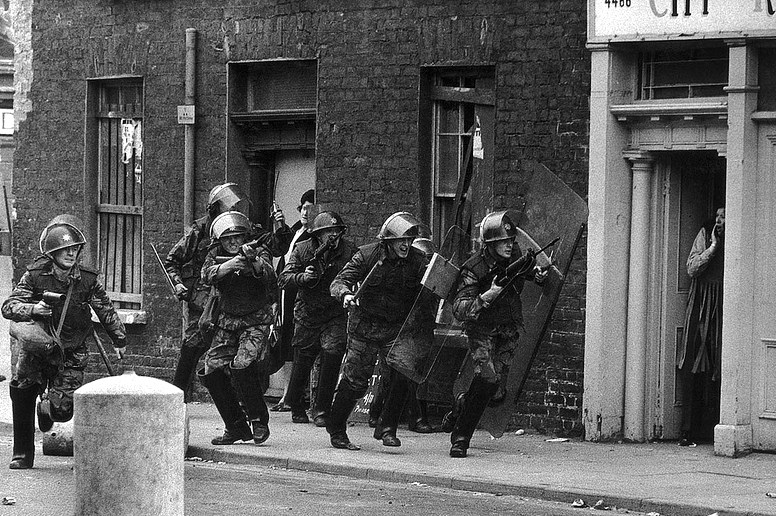
Corey, from Lurgan in County Armagh, was previously jailed for life in 1973 for the killing of two police officers but released in June 1992 after serving 19 years. On April 16, 2010, however, he was arrested, on the orders of Shaun Woodward, the then British Secretary of State for Northern Ireland, and detained in Maghaberry Prison without charge or trial.
4012530560_c232a393f5_z
The Good Friday Agreement
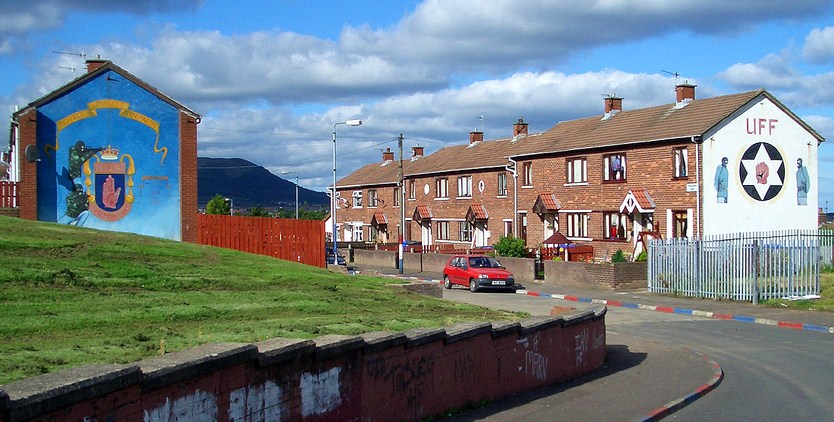
Republican Sinn Fein oppose the Northern Ireland Good Friday Agreement because they see it as a sell-out that copper-fastens British rule in Northern Ireland. This agreement was reached by republican and unionist politicians on Friday April 10, 1998 following peace talks between Irish republicans and the British Government that led to the Provisional Irish Republican Army (Provisional IRA) and loyalist paramilitaries decommissioning their weapons. The agreement allowed for a Power-Sharing Assembly in Stormont, Northern Ireland and “parity of esteem” for Irish nationalists and British unionists. It followed years of a protracted armed campaign by the IRA to force a British withdrawal from Northern Ireland.
3597812610_bdcbb78197_b
Ireland had been under British rule since the 12th century when it was invaded on the orders of the English king Henry 11 in 1169. Over the centuries, there were many uprisings and rebellions against British rule. The British responded with brute force, including a campaign of genocide in the 17th century by Oliver Cromwell’s army which wiped out a third of the Irish population. In addition, the British planted settlers from Scotland and England mostly in the North-East of Ireland: the forerunners of the unionist/loyalist communities in Northern Ireland today. The settlers were Protestants who enjoyed privileges over the native Catholic Irish, which served the interests of Britain’s policy of “divide and rule.”
3996995317_bcb9790304_z
In 1916, an uprising by Irish nationalists in Dublin known as the Easter Rising was defeated. Although it was unsuccessful and their leaders executed, the brutal manner of the executions led to the reawakening of the Irish national consciousness and the formation of the IRA. In the 1918 election, over 73 percent of the Irish people voted for Sinn Fein’s mandate calling for Irish independence, but this was ignored by the British Government. Nevertheless the IRA’s campaign of guerrilla warfare was very effective and led to peace talks between the IRA and the British Government. The talks culminated in the partition of Ireland and the establishment of the Irish Free State, but Northern Ireland would remain under British rule under the Anglo-Irish Treaty of 1921.
3975942517_eaf22bb11a_z
Many Irish republicans were unhappy about this, who insisted on a complete British withdrawal and the establishment of an independent Irish Republic. A civil war ensued between pro-treaty and anti-treaty republicans. The newly-formed Irish government pro-treaty forces were as ruthless, if not more, than the British and were eventually successful in suppressing those republicans who wanted to continue the struggle against partition and for a united Ireland completely free from British rule.
With partition and the suppression of the IRA, Ireland was divided into two reactionary states. The newly-formed state of Northern Ireland was created in such a way as to ensure a Protestant/unionist majority over the Catholic/nationalist community. Laws were introduced that discriminated against Catholics who were denied civil rights and found it hard to get employment and housing.
6254082452_da9d28bf36_b
In 1968, a campaign for civil rights was formed but this was met with baton-charging and other such violence by the protestant-dominated sectarian police force, known as the B-specials, who encouraged loyalist pogroms against the Catholic community. The situation was running out of control with riots and killings and the British army had to be brought in ostensibly to keep the peace, but in reality it was to maintain British rule and prop up the sectarian state. At the same time the Provisional IRA was born to help defend the nationalist community from state violence and force a British withdrawal from Northern Ireland. Water cannons, rubber bullets, curfews and other such like was the order of the day. Internment was introduced in 1971 to deal with the IRA, but this only increased their support and alienated nationalists from the British state.
5546969550_361e1119c1_b
Following almost 30 years of a long protracted military conflict between the Provisional IRA and the British state, a compromise solution was established. This compromise was the Good Friday Agreement. Sinn Fein, the IRA’s political wing, under the leadership of Gerry Adams and Martin McGuinness brokered a peace deal that led to the Provisional IRA decommissioning its weapons in return for power sharing in the Northern Ireland Assembly of Stormont.
3649502635_edfe463a4a_o
The Case of Martin Corey
The British authorities detained Martin Corey for nearly four years on the basis of “closed information”: in other words, “secret evidence.” Neither Corey nor his legal representatives were shown the evidence against him or told why the authorities believed he was a threat.
9734250480_1473e33325_c
In a Judicial Review in July 2012, Corey challenged his detention, leading  Judge Colman Treacy to order his release on bail on the grounds that “closed material” was insufficient evidence to detain him. On the same day, however, the judge’s order was blocked by the Secretary of State, citing grounds of national security, as the evidence against him was secret and could not be disclosed even to the judge.
1396394596_1fca29518c_b
The fact that a man can be taken away from his home and detained on the basis of “secret evidence,” without charge or trial, is a form of selective internment and a blatant disregard for human rights and the due process of law. Supporters of Martin Corey say his detention is part of a vindictive campaign of repression against political activists who speak out against the Good Friday Agreement.
2420828786_47f122f8e5_b
Part of the conditions of his release is that he cannot talk to the media. The Martin Corey Release Campaign welcomed his release but issued a statement saying: “Martin was interned on secret evidence gathered by secret police and held without a charge or trial since April 2010…. The British Government, secretary of state and all those involved in the internment of Martin Corey showed contempt for human rights and were involved in a despotic policy of ruling by decree.”
OLYMPUS DIGITAL CAMERA
The British-controlled state has a long history of using repressive laws and tactics against Irish republicans and nationalists who oppose British rule. Such tactics have included internment, curfews, non-jury courts, paid informers, undercover assassinations, and agent provocateurs. On January 30, 1972, British soldiers shot dead 13 civil-rights marchers in Derry in what became known as Bloody Sunday. In 1978, the European Court of Human Rights found the British government guilty of inhuman and degrading treatment when 14 former internees took legal action after being hooded, beaten, deprived of sleep and food, forced to stand for long periods and subjected to continuous loud noise. More recently, there has been evidence of many British soldiers and policemen colluding with pro-British loyalist death squads.
6119894813_17ece30523_b
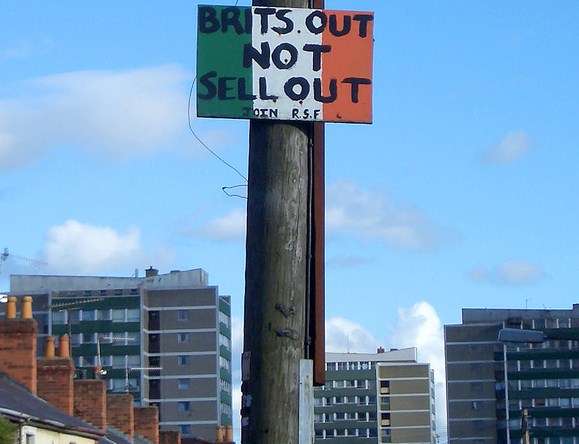
More and more Irish Republicans, socialists and political activists are pointing out that, like the Anglo-Irish Treaty of 1921, the Good Friday Agreement is a ruse by the British Government to maintain British rule in Ireland. They argue that it fails to address the root cause of the conflict: the British presence and the Unionist veto on a united Ireland. Republican Sinn Fein broke away from Sinn Fein over its decision to take seats in the British parliament, arguing that having two separate referendums on a united Ireland (as happened with the agreement’s ratification) was undemocratic, as Northern Ireland is an artificially created state established to ensure a British unionist majority and that the whole of the people, north and south, should be given the right to vote in one all-Ireland referendum. An increase in bombing, shootings and riots in recent years illustrates the growing popular tensions and disillusionment with the peace accord.
1293876106_d09614d492_b
Editor’s notes: Eugene Egan is a political  activist and writer based in the United Kingdom who campaigns on Palestine and Ireland. His work has been published in various British and Irish publications including Palestine News and Ceasefire Magazine. Photographs one, five, six and thirteen by Iker Merodio. Photographs four, nine, eleven, twelve  and  fifteen by PPC Antifa. Photograph ten by The Urban Guerrilla . Photograph three, seven, eight and fourteen  from the Burns Library.
- See more at: http://newsjunkiepost.com/2014/01/17/repression-in-northern-ireland-martin-coreys-detention-was-on-secret-evidence/#sthash.wW2uUgSi.dpuf

Tuesday, February 04, 2014

JEW HATRED IS NOT TO BE TOLERATED ON THE LEFT

THIS IS NOT OKAY


I debated posting the piece below with myself.  I wondered if it came to close to equating anti-zionism with anti-semitism, was it going overboard?  Then, I thought to myself, what the hell am I debating.  Jew hatred is a growing phenomena again pretty much world wide, and I am going to debate doing a piece on it, just because it pertains more to the left then to the right?

Don't get me wrong.  I am not one of those who think the main danger Jews face is from the left.  Look to the Ukraine, look to nazi marches last week in France and Britain, look to the nazis I, and many, many others challenged last fall here in my town. Look at the fundamentalist Christians who support Israel but have no real use for Jews (except to fulfill their weird prophesies).  Look at the reactionary fundamentalist Muslims who target Jews at random. No, the main danger to Jews will always come from the right.  The vast majority of the left will figure it out...

But not always.

For example, virtually any time I post an article about Jew hatred someone, somewhere calls me a zionist.  If I post anything about Israel not being a nazi State, someone will accuse me of being an agent of the Mossad.  No, they don't call me a dirty Jew, but I know where they are coming from.  I obviously make a distinction between anti-zionism and Jew hatred, just as I make a distinction between zionism and Jews.  My history, which I won't repeat here for the hundredth time, my history of action on behalf of the Palestinian People, my history of work with Palestinians (alongside, I might add, sometimes Israeli Jews as well), my history of condemnation of zionism and the State of Israel's racist and oppressive policies, my history of struggle against all forms of racism and white supremacy go back nearly five decades now.  I don't have to prove anything... yet, yet, it seems that I often do.

Why is that?

Why don't people get that using nazi like cartoons of Jews (er zionists) with big noses and evil eyes are not okay?  Why don't they get that using Jewish symbols and equating them with nazi symbols is not okay?  Why don't people get that rich capitalist Jews are rich capitalist who happen to be Jews, just like rich capitalist Methodists are rich capitalist who happen to be Methodists?  Why do so many not get that Netanyahu, Sharon, and all the rest are leaders of a zionist state who are Jews...they are not all Jews and they don't represent the thinking of all Jews (or even all Israelis) anymore than Osama Ben Laden or the Royal family in Saudi Arabia represent all Muslims, etc., etc., etc?  Why do I always have to explain that I, for one, did not come from a wealthy Jewish family, as if because I am a Jew that must not be so?  No one demands that of Episcopalians.

Now, I am not wa waing.  I do not believe Jews, for example, in the USA are an oppressed minority.  Jews in the USA, in my book, have pretty much unfortunately joined the White Republic, just like the Irish, the Italians, and all the rest.  Is there Jew hatred in the USA?  Sure, but it is far from the same thing, not even close, to the white supremacist bull that people of color, especially African Americans face every single day in every single way.  Consequently, while I do spend some time fighting Jew hatred, I spend far, far more time fighting white supremacy.

I also do not feel that being a Jew means you can't be criticized, anymore than being a women, a gay, an African American, a Buddhist, or anything else means you can't be criticized.  However, I also feel you should not ever be criticized simply because you are a Jew or an African American, or any of the others mentioned above.  That seems fairly simple, but for some people it seems impossible.

Anyway, it is a shame I feel compelled to even introduce this piece below from the New Statesman with this sort of introduction, but such is life.  Like I said, I can deal with it.

However, me dealing with it is not the same as a Jew in the Ukraine dealing with it (in fact, I just advised a Jewish friend who is heading to the Ukraine to be careful there, told him the Ukraine has never been a good place for Jews, told him of the rising tide of fascism and nazi like Jew hatred going on right there right now) .  So, yes,  me dealing with it, does not mean that I don't find the rise of Jew hatred, fascism, and nazism just a wee bit scary. Me dealing with it does not mean I am blind to the fact that some of what passes for anti-zionism IS Jew hatred, or that some of the conspiracy crap I wrote about during the Occupy movement was Jew hatred barely disguised, if at all.  Me dealing with it, also, does not mean that I didn't appreciate the reaction of the majority in the Occupy movement who spoke out against such Jew baiting.  Me dealing with it does not mean, I do not recognize that most left anti-zionism is just that - anti-zionism and not Jew hatred.

 Me dealing with it also does not mean that I will spend any less time dealing with the reactionary Jewish nationalism known as Zionism and the ideology and policies and actions of the State it has created...just like a myriad of other Jews, I might add.

Felt compelled again to say that...


The radicalism of fools: the rise of the new anti-Semitism


No self-respecting person on the left should endorse anti-establishment positions that are in reality just cloaked anti-Semitism.


Mixed signals: fans do the quenelle outside a Nantes venue where Dieudonné was due to give a show on 9 January that was banned by the supreme court Arnaud Journois/photoshot.

At the end of December, a couple of days before the five remaining members of the cast of Monty Python’s Flying Circus were reunited on Graham Norton’s BBC sofa, I was reminded of one of the comedy team’s funniest sketches. Entitled “World Forum”, it featured a TV quiz in which various revolutionaries were questioned about important issues – such as who won the FA Cup final in 1949 and which football club was nicknamed the Hammers.
I was reminded of it because I was at the home of the Hammers, Upton Park in east London – reporting on a six-goal thriller between West Ham United and West Brom­wich Albion – when a colleague from another national paper suddenly asked me to define the difference between anti-Semitism and anti-Zionism. Having written a book about Jewish involvement in football, I’m used to inquiries about Tottenham Hotspur’s much-vaunted connections to the community, rabbinical attitudes to playing on the Sabbath and the relatively low number of Jewish players in the professional game. But this was the first time I’d been called on to comment on such a weighty ideological matter. It seemed about as surreal a question as the Python quizmaster’s to one of the icons of the radical left: “Now then, Che, Coventry City last won the FA Cup in what year?”
Then I saw on a TV replay – the match had been broadcast live around the world – the reason for this bizarre inquiry. The French striker Nicolas Anelka had celebrated the first of his two goals for West Brom with his right arm extended towards the ground, palm open, and the other arm bent across his chest, palm touching his right upper arm. It was, apparently, a reverse Nazi salute, invented by the Parisian comic Dieudonné M’bala M’bala. Although missed by most of us journalists at the game, it had been picked up by the cameras and was condemned by shocked tweeters watching it in France. Many of them referred to this “quenelle”, as Dieudonné had named it, as an anti-Semitic gesture; a few preferred the label “anti-Zionist”. Before I could explain the obvious distinction to my colleague, Albion’s caretaker manager, Keith Downing, breezed in to the press room. Besides the obligatory questions about tactics, injuries and controversial refereeing decisions, he was asked about the political significance of Anelka’s salute. “Absolute rubbish,” he snapped. It was an innocuous gesture, “dedicated to a friend [of Anelka’s] who happens to be a comedian”.
When Dieudonné, the friend in question, had initially joked in 2002 about Judaism being “a scam . . . it’s one of the worst, because it’s the first”, he was portrayed as some kind of Pythonesque absurdist. But after it became clear that he meant exactly what he’d said and when, in subsequent one-man shows, he felt compelled to insult the memory of Shoah victims, give a platform to Holocaust deniers and promote all kinds of Jew-hatred, his repulsive brand of humour provoked outrage. Not, it has to be said, universal outrage. On the far right, as would be expected, he was feted as a truth-teller. Less expected, perhaps, has been his growing attraction to the kinds of people who stick, or once stuck, Che posters on their bedroom walls. Despite several convictions for racism – and even though most recently, in a riposte to a critic, he declared: “When I hear Patrick Cohen speak, I think to myself, ‘Gas chambers . . . too bad’” – his attacks on Jewish capitalism and riffs about ripping out Holocaust chapters from history books have been hailed as taboo-breaking by those professing themselves to be radical, anti-establishment leftists.
Which raises a troubling question: is anti-Semitism now the radicalism of fools?
In the late 19th century, the German Marxist August Bebel observed that anti-Jewish prejudice was “the socialism of fools”. From Marx’s plea for the withering away of Jewishness to the popular euphemistic references to “rootless cosmopolitans” in the Stalin era, the left has had, to put it mildly, a problematic relationship with the world’s oldest monotheistic religion. The French left’s relationship has been more difficult than most. During the revolution of 1789, Jews were attacked for clinging selfishly to their religious identity. Even an ardent Dreyfusard such as the socialist leader Jean Jaurès could still insist that “the Jewish race was consumed by a sort of fever for profit”. What is new today is the appeal of this race-hate discourse to a fashionable, anti-globalisation, up-yours, them-and-us (“them” frequently being Jewish financiers and Holocaust memorialisers) coalition of radical Islamists, hip middle-class white Parisians, alienated black youth and Jewish-world-domination conspiracy theorists.
“Look at the composition of Dieudonné’s audiences,” says Philippe Auclair, an author who is the England correspondent of France Football. “There are people from the far right, but also from the far left. People on the margins. There are Green extremists and radical Muslims. To them, the English FA’s action against Anelka [the organisation has finally got round to charging him] is probably proof that American Zionists control the FA. Some of the people tweeting me, for example, have pointed out that the FA’s previous chairman was called Bernstein.”
David Bernstein’s predecessor as chairman at the FA, David Triesman, also happens to be Jewish. “There are some people on the so-called progressive left,” says Triesman, now Labour’s main foreign affairs spokesman in the House of Lords, “who have taken on board anti-Semitic slurs based on the notion of Jewish power and money.”
Triesman and Bernstein, who both pioneered anti-racist initiatives at the FA, pointed out to me that anti-Semitism had virtually disappeared from football stadiums. In fact, last year, despite protracted debate about Tottenham’s use of the term “Yid Army”, the community’s connection to the game became an official cause for celebration. In October, as part of the governing body’s 150th-birthday festivities, the Jewish Museum in London launched its “Four Four Jew” exhibition. The guest speaker was the Arsenal manager, Arsène Wenger, who spoke about the depth and variety of the Anglo-Jewish contribution to soccer. As a fan, reporter and author of a book on the subject, I can confirm that anti-Semitism has almost vanished from the game’s discourse. But can the same be said of left-liberal discourse? Do British radicals, like their counterparts across the Channel, have a Jewish problem?
While acting as an adviser on “Four Four Jew”, Triesman was disturbed to discover that several leading Jewish figures in football had declined to take part. “They didn’t want to be seen in that context because they thought they’d be pilloried, in certain parts of the media, in an anti-Semitic way,” he told me. “They were worried that people would say Jews had too much power in football. Elements of the far left genuinely look at the world and believe a huge amount of power is concentrated into the hands of the Jewish people. It’s not a different view from that taken by the far-right movements of the 1930s.”
It is striking that, weeks after the “reverse Nazi” sign was performed in the East End of London – an area once inhabited by Jewish immigrants fleeing persecution from eastern Europe – the “zero tolerance towards anti-Semitism” line adopted by most football writers has not been replicated by the liberal commentariat. “Perhaps there’s a reluctance because he’s a Muslim,” Auclair says of Anelka’s gesture. “If he had been a white, Anglo-Saxon Protestant there would have been a stink. There would have been outrage by liberals and progressives.”
Unbelievably, some liberals and progressives have defended Anelka. Nabila Ramdani, a French journalist of Algerian descent who writes for the Guardian, sees the Rolls-Royce-driving, hamburger-chain-advertising, multimillionaireenfant terrible as a victim of France’s political class – “because he is the kind of Frenchman many disapprove of – one who is Muslim, black and from a deprived housing estate”. In a column for the National, she wrote: “There is no doubt that Dieudonné has some repulsive views, but until its Premiership debut, the quenelle meant next to nothing at all.” She also noted that “anybody – from schoolchildren to celebrities and politicians – could and did perform [it] during those goofing around moments which are nowadays invariably caught on smartphone cameras”.
She omitted to mention that some of this goofing around took place outside synagogues, Holocaust memorials, Auschwitz and even the Ozar Hatorah Jewish school in Toulouse where Mohamed Merah, a Franco-Algerian gunman, murdered three children and a teacher in 2012.
This worrying phenomenon has not, as yet, entered the British cultural mainstream. True, the humorist David Mitchell, who describes himself as a leftish liberal, offended some Jewish sensibilities in 2009 when he quipped on a radio programme: “There’s actually no truth in the rumour that the last entry in Anne Frank’s diary reads: ‘Today is my birthday, Dad bought me a drum kit.’” But Mitchell, quite reasonably, claimed this was “a joke about people who are hiding, not wanting to make a noise . . . that’s not the same as finding the Holocaust funny”.
In fact, his fellow comedian Russell Brand, our very own idiosyncratic, taboo-breaking anti-hero, last year poked fun at Hugo Boss’s sordid past making uniforms for Nazi Germany – in stark contrast to Dieudonné, who prefers to poke fun at Jews who exaggerate their suffering in the Holocaust. I can remember feeling uncomfortable, as a youngster who played at being a punk, about the prevalence of the swastika in punk fashion, but accepted it to be more the product of a misguided, anarchistic desire to shock than an expression of racism.
Yet it is not so long ago that the Labour MP Tam Dalyell was accusing Tony Blair of being in the pocket of Lord Levy, Peter Mandelson, Jack Straw and a “cabal of Jewish advisers” (Mandelson and Straw have Jewish ancestry but neither is Jewish). In the 2012 London mayoral election, Ken Livingstone suggested that “rich Jews” wouldn’t vote for him. Only last year, the Labour peer Nazir Ahmed claimed his jail sentence for dangerous driving was the result of a Jewish plot and the Liberal Democrat MP David Ward tweeted, “What a shame there isn’t a powerful, well funded Board of Deputies for #Roma” (a reference to the Board of Deputies of British Jews).
“There are left-of-centre people in parlia­ment,” Triesman says, “who are incapable of understanding that you can be in the progressive movement and be Jewish. They can’t accept anything you say on Israel. They think that if you criticise Israel it’s a fiction, that almost anybody who’s Jewish can’t criticise Israel in good faith. Some of the rhetoric around the Israeli boycott movement from the Trotskyite left is anti-Semitic.” Which brings us back to the question asked by my football reporting colleague at Upton Park: what is the difference between anti-Semitism and anti-Zionism?
Criticising Israel, as many Jews do, and Zionism as an ideology, which a much smaller number but still a significant minority of the community does, are perfectly valid positions. Publishing an anti-Zionist cover story featuring a golden Star of David stabbing a pliant Union flag with the headline “A kosher conspiracy?”, as the New Statesman (then under different ownership and editorship) did in 2002, is not. It should not have to be spelled out, though this magazine’s then editor did so in a subsequent apology, that all principled critics of Israeli policies should avoid using anti-Semitic images and narratives. They should not, as the BBC’s Tim Llewellyn once did, accuse American politicians such as Dennis Ross of hiding behind “a lovely Anglo-Saxon name”. (Llewellyn went on to say that Ross is “not just a Jew, he is a Zionist . . . a Zionist propagandist”.) They should have no truck with vile anti-Jewish calumnies, including the blood libel slur, routinely rehearsed in anti-Zionist Arab textbooks.
“The Zionist lobby,” Dieudonné told the Iranian-funded Press TV, “have taken France as hostage and we are in the hands of ignorant people, who know how to structure themselves into a Mafia-like organisation and . . . have now taken over a country.”
As Dave Rich at the Community Security Trust, a charity that monitors anti-Jewish attacks in Britain, explains: “This is not the anti-Zionism of people who think that the Palestinians get a raw deal from Israel: it is the anti-Zionism of the Protocols of the Elders of Zion, of a conspiracy theory that believes the Jews pull all the strings.”
“We need to keep things in perspective,” warns David Feldman, of the Pears Institute for the Study of Anti-Semitism. “We have experienced the worst financial crisis since the 1930s, with Jews prominent in many places [in finance]. Yet in contrast to the situation 80 years ago, few radicals have proposed anti-Semitic explanations.”
As Jonathan Freedland, who writes a weekly column for the Guardian and a monthly commentary for the Jewish Chronicle, points out, so far only “a few marginal political voices” on the British left have flirted with anti-Semitic tropes. However, after a property website owned by a Jewish businessman withdrew its sponsorship of West Brom on 20 January, and then the FA announced it was charging Anelka, the liberal-left commentariat was presented with a perfect opportunity to take a stand against such tropes. Yet more silence. In fact, it was left to the right-wing controversialist Rod Liddle to condemn the striker’s “repulsive” support for his Jew-baiting friend.
“On this issue,” Freedland told me, “all anti-racists of good conscience should have leapt in. Dieudonné is aligned with the far right. He’s had criminal convictions for anti-Semitism. My worry is that, as time passed before the FA’s announcement and the lack of outrage continued, it didn’t send out a strong message about anti-Semitism.
“The quenelle was a previously obscure gesture in this country and now it’s known. So this is the moment to make the point that no self-respecting person on the left should accept a supposedly ‘anti-establishment’ position which in fact says it’s the Jews who are ‘the establishment’.”


Monday, February 03, 2014

BLAH BLAH BLAH AND BLAH


It's cultural Monday,something I am thinking about axing, but still hanging on to for the moment.  I have spent way too long wandering around the web looking for something to put here that might interest someone.   Not sure I ever found that "something."

Then, out of the blue, pops up this essay written by someone who seemed to be running into the same problem as me...there is just too much mumbo jumbo out, too much stuff that seems pretty interesting, that upon second glance just fades off into obscurity.

I think to myself, I kinda like his opening, but then as I go along I start to lose my train of thought.

Voila...sounds like culture to me...sounds like someone talking mumbo jumbo about mumbo jumbo just like some of the stuff I read to me...Lot's of times I just feel like screaming like Whoopi Goldberg in the movie JUMPING JACK FLASH, where she is trying her damnest to decipher the lyrics to Jumping Jack Flash,  " Mick, Mick, Mick! Speak English!"

Good luck.

NOTE TO ME:  Dude, have you seen Theoretical Weekends at Scission...just sayin

The following comes from The Charnel-House.


Far too easily impressed


Image: Pieter Brueghel
“The Flatterers” (1592)

Earlier today, I tried to make my way through this rather long, theory-heavy Facebook thread. It popped up on my feed and some of the first few comments seemed pretty interesting. You know: it concerned concepts and authors like totality, status quo ante, the proletariat, Jameson. Figured I could maybe dig some of the Deleuze and communization stuff, even if I agreed with it less. Then all of a sudden all these theoretical accretions and academic encrustations began to glom onto the original topics under discussion at this crazy, exponential rate — sometimes as backstory or context, but more often as just syncretistic add-ons and meaningless whirligigs, an intellectually promiscuous process of addition, lunatical topsy-turvydom, etc.
Maybe I just didn’t know enough of these theories or theorists, but I don’t think that’s it. Really, I’m not anti-theory at all; I’m good at it. I have a lot more patience for dense theoretical discourse than many people I know. (That much should be obvious to anyone who reads or even glances passingly through this blog). But there’s some massive leveling our generation needs to do. Most of what’s been written recently or being written right now needs to be mercilessly torn down, without remorse or concern about hurt feelings. The elbow-rubbing and chummy collegiality needs to go. We must separate the wheat from the chaff, the Hearts—Stars—Clovers—Blue-Moons from the ordinary cereal. Honestly, we’re far too easily impressed with ourselves and each other. Most of what we produce is total garbage, and we should have no problem owning up to that. No more compliments or gentle “critiques” that just mildly “complicate” or “problematize” whatever bullshit we’re on about lately. Could be way off but who knows.
Anyway, I communicated these sentiments more or less exactly as I just presented them here to the posters in this thread. It was probably ill-advised decision to do so, bound to piss off everyone involved. People tend to get really touchy and insecure whenever their intellectual credentials are challenged. Of course, I wasn’t looking to call anyone out or target anybody in particular, though I could have, but leave things at this fairly generalized level. Still, most in the thread had enough of a sense of humor about themselves to move on quickly and not take it really personally. Except for one person: Louis-Georges Schwartz. He had already complained about the supposed “theater of cruelty” operative in the “spectacle” that is my blog, and took exception to the brief piece I wrote up lampooning the feminist journal LIES. Both because I felt his contributions to the thread were particularly egregious in terms of their jargonistic excess, leaning liberally on Deleuzean mumbo-jumbo and other “continental” gibberish, and because he continued his crybaby routine by blocking me over a Facebook comment, I’m going to repost a couple of Schwartz’s logorrheic gems. As one irreverent left communist remarked upon scrolling through the thread, some of this shit almost reads as deliberate self-parody:
1) Deleuze does not have a “Return to Bergson book” though he did write a 1966 mongraph on the philosopher and uses Bergson’s concepts through out his career. 2) The question of how to articulate the dialectic with duration / a certain deleuzeanism is the secret subject of “The Present Moment” and part of the reason I was ownering about was of articulating the dialectic, deleuzian genetics, and badouvian generation this spring. 3) ‘the collective” (not exactly a TC term doesn’t have to “collective borrow reproductive issues from the culture of private ownership” but it does have to start the future with reproduction as it is or it will be repressing a struggle (because what you are calling “the collective,” Tim, is nothing but a rift, a gendered *ecart.* 4) Any decent person is eschatological. The “Stationary State’ is an eschatology too.
This too, though it abruptly ends with an announcement that he’s blocking me (he cutely even took the trouble to tag me, an uncommon courtesy):
To a certain extent it seems that preserving the systemic dialectic is an alibi ti call for a party or a subject. Articulating the historical and structural dialectics then becomes what we call the task of the party or subject (“clarifying the desires of the working class” / Strategy) and the legislative fantasies of Badiou or Kant’s “duty” can then be produced in all their Oedipal micro-fascism. The above passage is Deleuzean in so far as it takes the Bergsonian notion of duration to be a description of time which takes into account the changes wrote by the passage of time in the syntheses of time themselves. In that model the “subject of history” becomes history itself (just as in Bergson the subject becomes the universe and philosophy converts itself to theology.) Considering the Simon piece is largely about struggle within struggle, the Bergson cite doesn’t seem exactly corrective. The question thisk, I think: is thew temporality described in the citation from Simon above conceptually distinct from the temporality entailed in Autonomia (The time of labor trying exit the plane of capital.) TC needs such a time. The movement image gives the time of the Taylorist “scientific management”/ moment of subsumption and the classical worker’s movements, the time image the time of autonomous labor and relations of refusal. The time of rifts (the post 200 period when the wage demand has lost salience in the capitalist core needs a third time, a time that holds when the social as such has been replaced by economy.) Also, I’m blocking Ross.
There are some writers who can range freely over theorists and philosophers from different epochs and traditions, invoking obscure concepts left and right irrespective of their original context — writers like Adorno, Jameson, or even perhaps Benjamin Noys. Needless to say, as should be obvious from just these passing remarks, Louis-Georges Schwartz is not one of these writers, or even remotely of their caliber. He has none of that casual command of the topic at hand, none of the mastery over the concepts to wield them in a way that isn’t absurd and confounding. Also, and I want to reiterate this, it never ceases to amuse me that people actually block each other over stupid Facebook arguments. Pretty sad.
Furthermore, did what I wrote really come off as that anti-theory to begin with? That really was not my intention. If anything it was meant as a call to arms, to demand more from ourselves and each other, to strive for better and more discerning theoretical argumentation. Maybe I’m a bit off, as I said, and my concerns are misplaced. This could after all just be another empty call for ruthless criticism. I don’t know, though. Marx and Engels were hardly ever impressed by their colleagues or contemporaries. Engels said something to the effect that the only English text from 1820-1845 that deserved to be translated was Thomas Carlyle’s Past and Present. And Marx repeatedly referred to essays Lassalle sent to him, ostensibly supportive of Marx and Engels’ position, as “urine” (I think we can agree he was justified in issuing this judgment).
.
11:08am, 10—30—2013: Terence Blake, an Australian-born philosopher living in France influenced by Paul Feyerabend and Gilles Deleuze, has written up a response to this post in which he reasserts his admiration for a figure like Deleuze while at the same time lamenting the use to which his ideas have since been put. As he puts it, the great French metaphysician inadvertently ended up “diffusing a swarm of ‘words of power’ to be wielded by narcissistic poseurs.” You can read “Where have all the arguments gone?” on his blog.