Monday, August 19, 2013

BUFFY THE VAMPIRE SLAYER AND ME...AND YOU


"Passion. It lies in all of us. Sleeping ... waiting ... and though unwanted, unbidden, it will stir ... open its jaws and howl. It speaks to us ... guides us. Passion rules us all. And we obey. What other choice do we have? Passion is the source of our finest moments. The joy of love ... the clarity of hatred ... the ecstasy of grief. It hurts sometimes more than we can bear. If we could live without passion, maybe we'd know some kind of peace. But we would be hollow. Empty rooms, shuttered and dank. Without passion, we'd be truly dead." - Buffy Summers 


"You know, I always say that a day without an autopsy is like a day without sunshine." -- Buffy Summers


"I think I speak for everyone here when I say, "huh?"  - Buffy Summers


Today's Scission is NOT what one expects to find here at all.  I know some of you will just take one pass and move along, but what can I say.  The truth is the only reason it is here is that I happen to be the oldest big fan of the too long gone TV series,  Buffy the Vampire Slayer.  That's right I loved Buffy and the gang.  I thought, still do, think it was one of the better series ever to appear on regular old TV.  This wasn't some big HBO drama or anything, just a weekly program that dealt with real issues of real importance in the real lives of all of us, but probably even more so of adolescents.  But again, I was already well into my forties when I began a fan and the program said some things to me, too.  Most teenage TV or movies, I can live without.  I do really like Pump Up the Volume.  I also liked the Breakfast Club.  Still they were movies, not just some crappy little TV series.

Buffy was different.  I am not even sure how to describe why.  I guess that is one reason I am running the post below.  The author of the article which appears on the Toast.

There is more to life then politics, economics, war, social justice, racism, and prison.  There is more to life then THE STRUGGLE.  There is the other struggle which is life, your own personal life.  There is love and fear and joy and despair.  Life is full of ups and downs and often lacks any reason or any answers.  Somehow every one of us has to deal with life in our own ways in our own time.  For some of us life is a hell of a lot harder than it is for others.  They say money isn't everything, but you know it can make life a lot more simple and eliminate a lot of hardships.  The rich may piss and moan, but the rich mostly haven't met the poor.  They don't know and they don't care.

The issues of growing up, of trying to figure out who the hell you are, or why the hell you or where the hell you are going (issues which we face ALL of our lives) may seem trite to those of us who call ourselves serious Marxists, communists, activists, etc. etc. etc.  However, most of us know when you are in the middle of these "trite" little times, they sure as hell seem anything but.

Does any of this matter?  Well, yes it does matter.  However, is it worth a spot here, does it make sense for me to be spending time today and offering this up to you?  I don't know really.  You will have to be the judge of that.

And I won't even get into the slayer known as Faith.....

Anyway, like baseball, Scission plays a long season, so every now and then I am entitled to come up with something like this, don't you think?

Anyway, here we go...

BUT BEFORE WE GO TO FAR, I HAVE TO UPDATE WITH ANOTHER PIECE I JUST FOUND AFTER POSTING THIS.  BUFFY AND CAPITALISM NO LESS...NOW IT WILL BE THE SECOND POST BELOW AND IT IS FROM THE GOTHIC IMAGINATION.


A New Version of You


buffyIn 1998, as Joey and Dawson shared their first kiss and Felicity agonized over Ben and Noel, poor Buffy Summers murdered the love of her life. Watching that episode some 15 years later, as a woman well into my 30s, I cried bitter tears. As Buffy made out with her ex-boyfriend, stabbed him in the stomach, and looked on in horror as he got sucked into Hell, it struck me as the most harrowing and realistic breakup in television history, the whole idea that anyone would ever fall for a big lunk like Angel notwithstanding.

The motivation for their split, of course, was to prevent worldwide human annihilation. Those were the stakes of Buffy the Vampire Slayer, which rightfully portrayed the process of growing up as a series of encounters with total fucking apocalypse. Because it perfectly captured the histrionic milieu of high school—and because it was on the WB network—people tend to talk about Buffy as a coming-of-age story. But the show’s real artistic achievement was in its flat rejection of the notion we can ever come to know ourselves, much less someone else.

Unlike most teen dramas, Buffy wasn’t a narrative about finding an identity; it was always about having a lot of them. Okay, sure, Season 1, with its mean girls and first dates and cheerleading tryouts, was a straightforward dramatization of the trials of young adulthood. (No social problem was ever so great that it couldn’t be fixed, however improbably, by killing some vampires.) But as the show progressed, and the Scoobies coped variously with sordid pasts, spells gone wrong, and a horrifying spectrum of abusive boyfriends, its moral universe grew more complex. Identities and alliances shifted and relationships grew ever more muddled as evil—no longer relegated to the Big Bad in the basement—was embodied by familiar faces.

On Felicity, “a new version of you” meant that you got a haircut or switched majors. On Buffy, it usually meant that you were operating under the influence of a malevolent spirit, spell, curse, or hypnotic trance. Frequently, characters were demonically possessed, supernaturally compelled, or otherwise not themselves. Doubles abounded: Angel and his alter ego Angelus, Buffy and her “dark mirror” Faith, Willow and her murderous “kinda gay” doppelgänger, Buffy and the Buffybot, the two Xanders. Life on the Hellmouth required a certain amount of flexibility. You might, for instance, spend 19 years of your life as an only child, only to one day find you have an annoying little sister that monks made out of mystical energy. At any given moment, you might turn into a rat, a demon, a werewolf, or a lesbian. In Sunnydale, no one was ever what they seemed, and by the time you’d figured someone out, they had already turned into someone else.

The problem of identity came to a head in Season 4, when (not for nothing) the Big Bad was an existential Frankenstein figure named Adam. One by one, the central characters went through their own identity crisis. Having been stripped of his station as a Watcher and a librarian, poor Giles played sad guitar at open mic nights. Buffy, in a bid to redefine herself after killing Angel, slept with a womanizer whose bad behavior she couldn’t redress with a sword to the stomach. Oz boffed some werewolf on accident. (Then, whoops! He killed her.) Willow found herself in a delightful, witchy same-sex relationship, Spike started helping the good guys, Xander switched jobs every week, and Anya tried to adjust to life as a human after hundreds of years as a vengeance demon. While remaining a tight-knit group, the Scoobies continually surprised themselves—and each other—with their capacity for change.

As a culture, we place a lot of emphasis on the coming-of-age story, as though it’s something that happens just once, early in life. The series finales of teen dramas tend to perpetuate that myth by suggesting that we emerge into adulthood somewhat inexperienced, but more or less fully formed. How many series end with the female lead finally (“finally”) locking down her soul mate? In 2002-2003, during Buffy’s seventh and final season, both Dawson’s Creek and Felicity fast-forwarded into the future to assure us that Joey ended up with Pacey and Felicity ended up with Ben. Meanwhile, in her finale, Buffy lost not one but two boyfriends and also saved the world, no big. Like most of the show’s episodes, which eschewed cliffhangers or closure in favor of stopping on a quiet, awkward beat, the series ended on a moment of silence as our heroine was asked to contemplate her future. What would Buffy do next? Even she didn’t know.

Over its long (and admittedly uneven) run, the show itself played with the notion of identity. The magic ofBuffy was not just in combining influences as diverse as John Hughes, classic horror, Broadway, and comic books, but also in its ability to dip into straight genre—as in episodes like “Hush” and “Once More, With Feeling”—and still seem utterly like itself. Joss Whedon is known as (among other things) a champion of nerd culture, but his biggest contribution has been in demonstrating that teen drama (one of the most maligned of all genres) was sophisticated and capacious enough to accommodate rigorous emotional honesty, offbeat humor, and instantaneous shifts in tone.

Coming-of-age stories tend to portray young adulthood as a time when we “find ourselves,” whatever that means. But that model ignores the fact that, for better or worse, the very stuff of our selves—our personalities, our preferences, and even our core values—has a remarkable capacity for change. Our task is to make sure that some semblance of self stays intact as we age. It’s hard because we tend to renounce our Past Selves (those haircuts!), and we have a hard time envisioning our Future Selves at all. In real life, this proliferation of selves can cause continuity problems. (Certainly I don’t recognize the Me who once owned a pink pleather skirt.) On Buffy, despite the limitations of its 45-minute format, the characters juggled multiple versions of themselves all the time, constantly grappling with the contradictions, anxiety, and consequences surrounding who they had been, who they were, and who they would become in a surprisingly cogent way.

After floundering for a time, most of Buffy’s contemporaries (Felicity, Rory from Gilmore Girls) found themselves by the time they graduated college. However much I loved those shows, their journeys did not speak to me. The life of a vampire slayer—gritty and exhausting, with bouts of immaturity, ill-advised romantic entanglements, and the occasional need to kill an evil bug—is the one that I actually recognize, the one that maps onto some semblance of life. It’s a model that makes just as much sense when you’re 15 as when you’re 35, because who ever actually figures it out, really?

The thing is, Buffy was never about a girl coming of age. In her universe, as in ours, no one ever finds herself, at least not for long. With its relentless parade of Big Bads, demonic possessions, and fug leather pants, Buffy shows us how to face life’s central challenge: accepting the monsters we have all had to be, and those we have yet to become.

---------------------------


Gothic capitalism: Marx, monsters and Buffy

 by Lena Wånggren 


These days, I often feel as if we live in some kind of dystopian fantasy: the divide between poor and rich increases every day because of deliberate government policy, with half a million people in Britain today being forced to use food banks, and racists organising demonstrations in our streets while neoliberal politicians employ the same xenophobic discourse. The economic and social structures in which we live are frightening – indeed gothic. This blog post, the final of my three ones, will explore the economic system in which we live through the metaphor of the monster, examining such economic monsters both in Marx and in a more recent popular text: Buffy the Vampire Slayer (1997-2003).

'Buffy the Anarcho-Syndicalist: Capitalism Bites'

As Franco Moretti claims, ‘monsters are metaphors’ (105); their bodies standing in for the fears of a certain time and place. Jessie Givner in fact argues that it is the monster’s ability to be seen as a metaphor that makes the creature particularly monstrous (274). Likewise, Judith Halberstam argues that excessive interpretability is the hallmark of monstrosity; monsters are ‘meaning machines’ that can represent gender, race, nationality, class, and sexuality in one body: ‘The monster functions as monster, when it is able to condense as many fear-producing traits as possible into one body’ (21-22). Its ability to be seen as a metaphor can be seen as a part of what makes it monstrous.

Capitalism, with its seemingly magical market movements, lends itself well to metaphorical description. Karl Marx famously describes the gothic character of capitalism, in various of his works, through monstrous metaphors: werewolves and other creatures abound. He specifically and repeatedly uses the metaphor of the vampire to describe the capitalist, and the functions of capitalism. There are also numerous other descriptions in his works with imagery deriving from the vampire metaphor, such as mentions of blood and blood-sucking (Neocleous 669). In the Grundrisse (1857) Marx explains: ‘Capital posits the permanence of value (to a certain degree) by incarnating itself in fleeting commodities and taking on their form, but at the same time changing them just as constantly; alternates between its eternal form in money and its passing form in commodities; … But capital obtains this ability only by constantly sucking in living labour as its soul, vampire-like’ (646). As Halberstam notes, Marx here describes the economic system in which we live, capitalism, as gothic in itself; it is gothic ‘in its ability to transfer matter into commodity, commodity into value and value into capitalism’ (103).

As David McNally notes in Monsters of the Market: Zombies, Vampires and Global Capitalism (2010), ‘the idea that something monstrous is at work in the operations of global capitalism is never far from the surface today’ (9), in politics, journalism and popular culture. One specific text making full use of the metaphoricity of the monster is the 1997-2003 tv series Buffy the Vampire Slayer. With its abundance of monsters – ranging from vampires, werevolves and various other kinds of demons, to human-made creatures – the series presents many opportunities for analysing the social and political significance of the monster, and for examining what McNally calls the ‘monstrous forms of every-day life in a capitalist world system’ (2).

The series’s creator Joss Whedon is outspoken about his political values – we saw them recently in his satirical zombie-themed anti-Romney (Zomney) video before the last US election. Romney, Whedon tells us, will bring the country quickly towards a zombie apocalypse: ‘Romney is ready to make the deep rollbacks in health care, education, social services, reproductive rights that will guarantee poverty, unemployment, overpopulation, disease, rioting: all crucial elements in creating a nightmare zombie wasteland. But it’s his commitment to ungoverned corporate privilege that will nosedive this economy into true insolvency and chaos, the kind of chaos you can’t buy back. Money is only so much paper to the undead.’ Whedon’s description of capitalism as a kind of zombie economics is not new; it is made explicit in John Quiggin’s recent Zombie Economics: How Dead Ideas Still Walk among Us (2010), in which he examines the persistence of market-based ideas among politicians and economists, despite the failure of market liberalism. Even after the financial crisis, the dead ideas behind market-based ideology still stalk the land, walking among us – and must, Quiggin argues, be killed off once and for all.


Coming back to Whedon, and Buffy, and the gothic capitalism described in the series. We find one of the most explicit thematisations of monstrous capitalism in Buffy in the first episode of the third season, entitled ‘Anne’. Having killed her vampire boyfriend Angel in the previous season, Buffy in this episode is hiding in an unknown city, posing as an anonymous ‘Anne’ and working in a dingy diner.


Already at the beginning of the episode we see the focus on the social faults in the current economic system, when Buffy on the way home from work walks past several destitute and homeless people in the streets, people with no social safety net, several of them begging, many of them telling Buffy: ‘I am noone’. Only one person in this city seems to care about these impoverished people: a director of a local centre, the ‘Family Home’, which welcomes everyone, offering food and support.


However, the director, calling himself Ken, is not the person he claims to be. When Buffy is contacted by an old acquaintance, Lily, whose boyfriend has gone missing, she discovers a whole machinery of exploitation beneath the city. Buffy finds the missing boyfriend among a group of people sleeping rough – but the boyfriend is dead, and seems to have aged about 60-70 years, ‘like something drained the life out of him’. Not drained by a vampire – that could not have accelerated the ageing process – but by something different.

As it turns out, the seemingly altruistic Ken is in fact a demon, not a benefactor. (So much for ‘caring capitalism’!) Buffy rips off his human mask, which reveals underneath it the face of a demon.


The local centre turns out to be an underground workplace, where people are being used as slave labour, forced to work in order to survive. Ken – now in his demon shape – tells Buffy: ‘Welcome to my world’. In this slavery den, the unwanted, the casualised, the precariat, exist. Here time moves more quickly, and everyone ages faster – which explains the death of Lily’s prematurely aged boyfriend.

In a passage from the chapter on the working day, Marx in Capital (vol.1) (1876) explains the vampiric nature of capitalism:

‘Capital is dead labour which, vampire-like, lives only by sucking living labour, and lives the more, the more labour it sucks. The time during which the worker works is the time during which the capitalist consumes the labour-power he has bought from him. If the worker consumes his disposable time for himself, he robs the capitalist.’ (342)

Here, the capitalist demon sucks the life out of the workers, consuming their labour-power so as to make as much profit as possible. But still, this system ‘only slightly quenches the vampire thirst for the living blood of labour’ (Capital 367). While the worker might think that they dispose of themselves freely, Marx writes, once they have sold their labour-power to the capitalist, ‘it was discovered that he was no “free agent”, that the period of time for which he is free to sell his labour-power is the period of time for which he is forced to sell it, that in fact the vampire will not let go “while there remains a single muscle, sinew or drop of blood to be exploited”‘ (415-416). As Buffy understands: ‘You just work us ’til we’re too old and then spit us back out?’
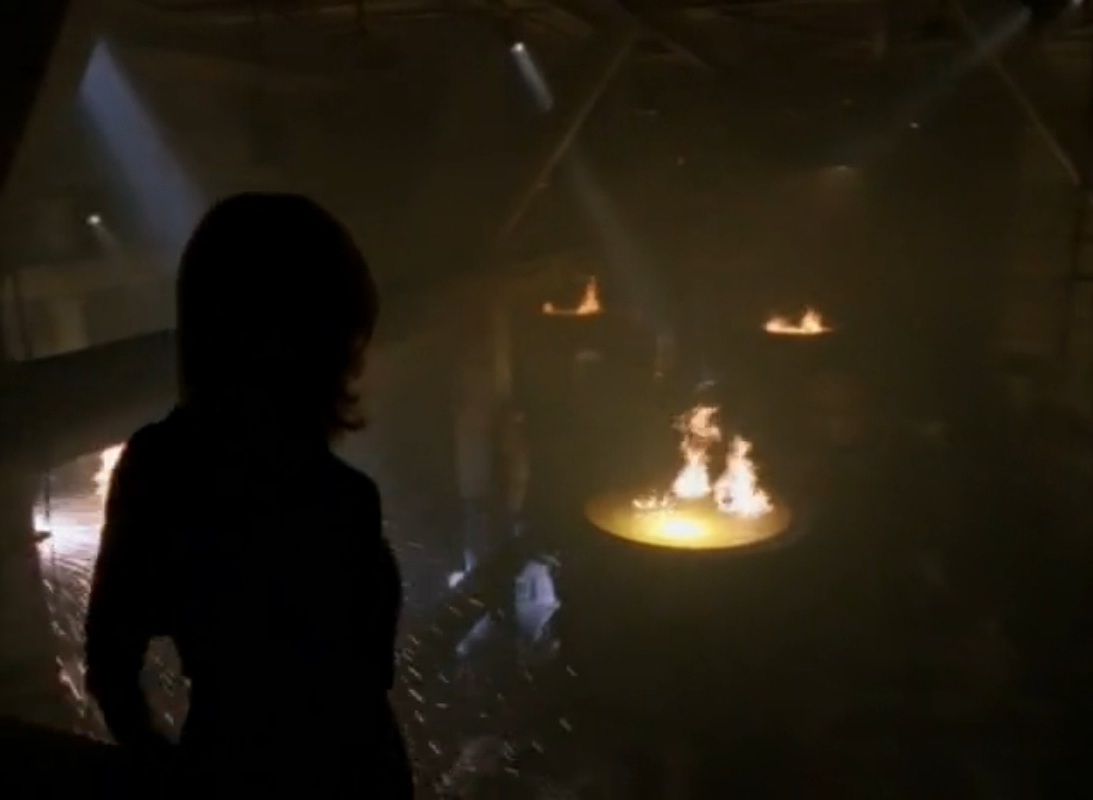
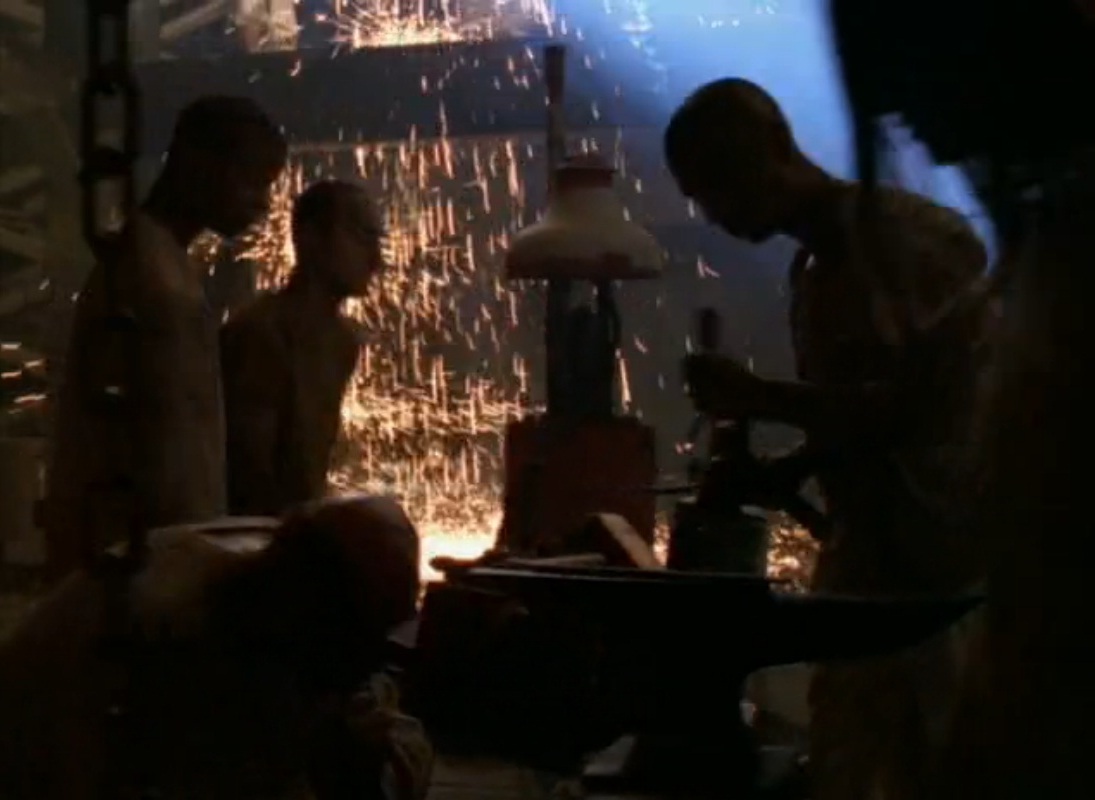
The people taken here by the ‘caring capitalist’ demon Ken are chosen precisely because of their precarious situation; they have no one who cares about them in the other world, so will not be missed. In this gothic capitalist world, the workers have no identity – their sole purpose is to work. As one of the guards tells the labourers: ‘You work, and you live – that is all. You do not complain, or laugh, or do anything besides work. Whatever you thought, whatever you were, does not matter. You are no one now.’ The slave-labourers are forced to repeat this, in order to avoid getting beaten. This mantra, ‘I am noone’, is what we earlier heard the impoverished people say to Buffy when above ground – one of them, we find out, having been Lily’s boyfriend. The labourers are worthless commodities in this system.

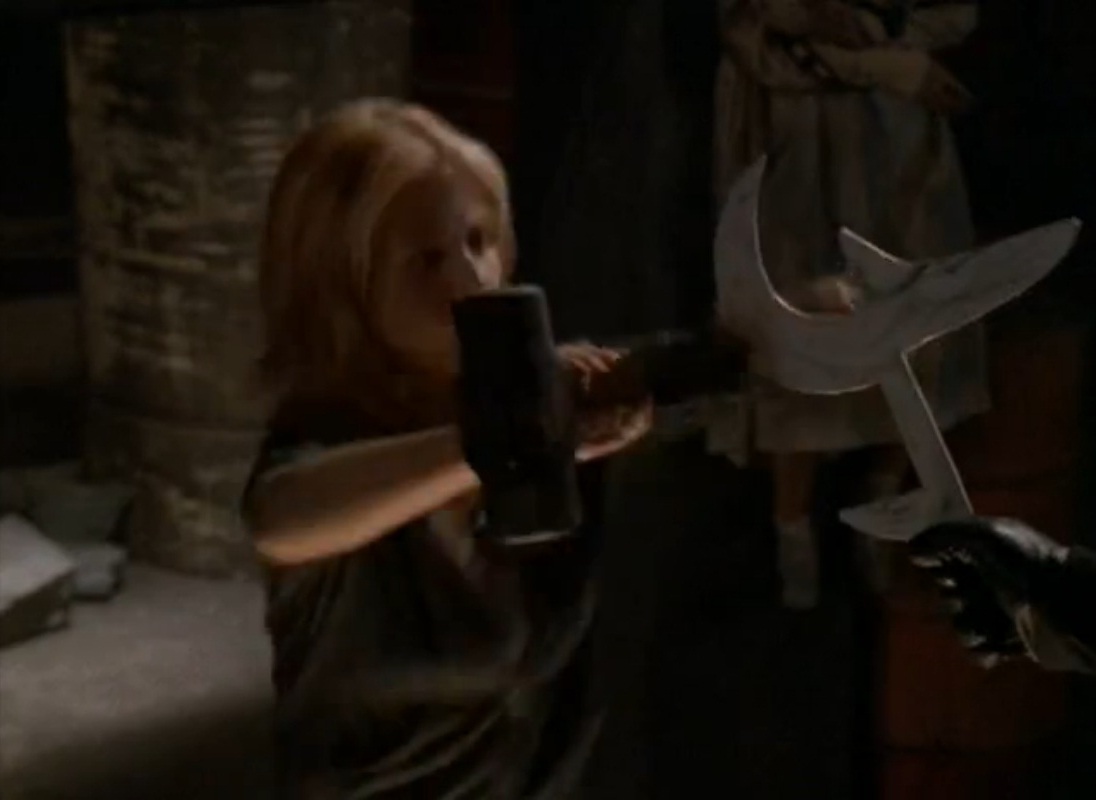
Buffy of course does not respond well to the guard’s bullying: she strikes the guard, takes her group of fellow prisoners and prepares to flee their enslavement. Having sent off some of the workers to the surface, Buffy kills off guard after guard, while demon capitalist Ken watches his system of exploitation collapse: ‘Humans don’t fight back… Humans don’t fight back! That’s how this works!’ That might be true; as McNally states, perhaps the most monstrous aspect of gothic capitalism is the way in which this exploitative system becomes ‘normalised and naturalised via its colonisation of the essential fabric of every-day life’ (2). There is some beautifully over-the-top imagery here, as Buffy takes the weapons of the guards she defeats: from one of the first guards, she takes a hammer; from another one, she takes a sickle-like knife. With the traditional hammer and sickle – the classic symbols of communism, representing the unity between industrial and agricultural workers – she fights off the last demons of capitalism before bringing the freed workers to the surface of the city.

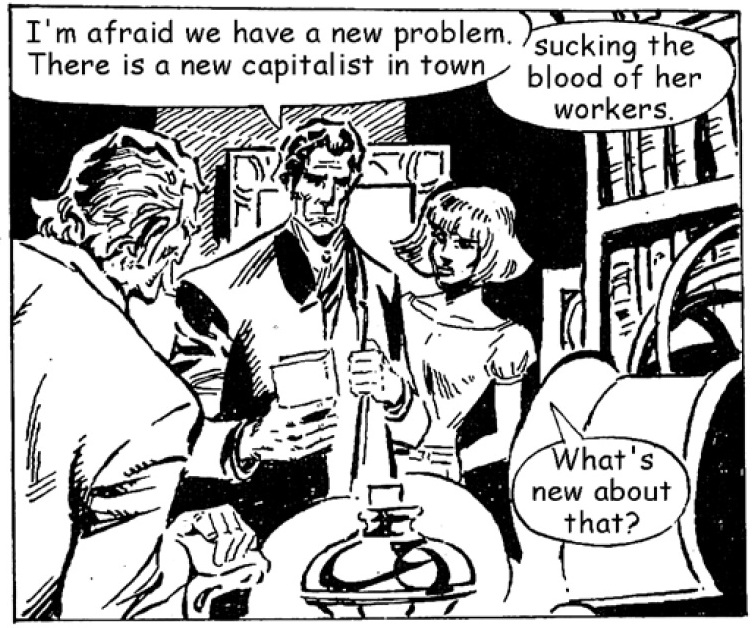
The anticapitalist imagery from the ‘Anne’ episode in Buffy the Vampire Slayer is taken a step further in the detourned comic Buffy the Anarcho-Syndicalist: Capitalism Bites. Featuring Buffy as anarcho-syndicalist hero, and her Watcher Giles as a hardened revolutionary, together with other comrades from outside of the usual Buffy characters, the story presents the slayer fighting the evil vampire capitalist CEO of Blood Red Enterprises.
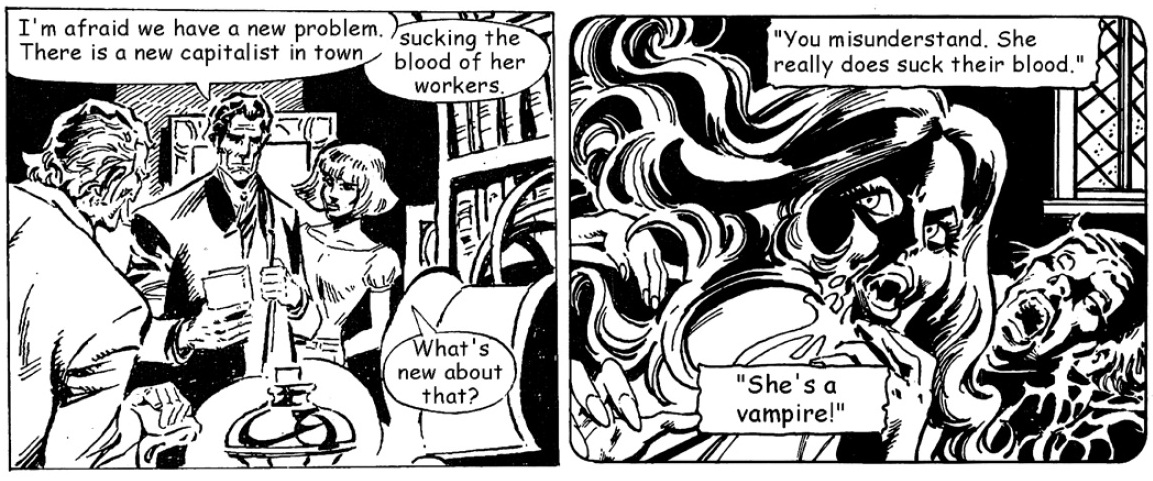

Of course, since Buffy is an anticapitalist vampire slayer, she defeats the gothic capitalists in Sunnydale. But there are many more metaphorical and and some very real monsters out there. So join a trade union (Boris Karloff style! [1]), fight some neoliberal vampires, organise against zombie economics.


- See more at: http://www.gothic.stir.ac.uk/uncategorized/gothic-capitalism-marx-monsters-and-buffy/#sthash.LqDAgbEx.dpuf

Saturday, August 17, 2013

STATE OR REVOLUTION


It is theoretical weekends here at Scission and today we take a look at the State, at the Bolsheviks, at Lenin, at Marx, at whatever happened to simply SMASHING THE STATE.  Right off the bat, I will tell you there are some things in the post below which I disagree with.  For example, I think Marx is let off the hook to easily.  Marx's views of the state were confused, contradictory and often just a plain mess.  However, thought there are many things I consider incorrect in the post, there are some things that I like, and anyway, as you all know this space, this theoretical weekends space isn't reserved only for things with which I agree, but is reserved for things with which I find interesting and useful and worthwhile.

I would suggest, if you really want to dig into the whole question of Marx, Engels, Lenin, and all the rest of those folks, and  how they viewed the State in more  depth that you return to a work by an old comrade of mine, Tom Clark,  since passed, (and with whom I eventually split with for a number of reason), and a work of his which was first published here entitled State and Counter Revolution.  The easiest way to view it is by going to   http://www.marxists.org/history/erol/ncm-1a/tom-clark/index.htm

The post below is from The Commune.


The State or Revolution


5082013The State and Revolution, (Lenin’s pamphlet – a polemic against Kautsky, Plekhanov and the Anarchists) was an apt title in the light of his view of the relationship between a revolution and the nature of a post-capitalist society. He and the Bolsheviks undoubtedly believed in Revolution, at least up to the overthrow of the Duma, the rejection of Constituent Assembly idea and achieving ‘all power to the soviets’. However, they also firmly believed in the need for a strong State.  Roy Ratcliffe puts his view on the state or Revolution.

858674_4456673250368_1151187276_o
The workers, soldiers and peasants, from 1905 to 1917, progressively initiated uprisings and revolutionary episodes and then, riding an exceptionally high wave of activity and protest in October 1917, the Bolsheviks convinced workers, soldiers and peasants that for their own good, it was necessary to create a strong state apparatus. They created a state institution which they protected and strengthened by employing special bodies of (predominantly) armed men. As the effective head of that state, Lenin in 1919 declared the following;
“This new state organisation is being born in travail …” (Lenin. Complete Works. Volume 29. page 375.)
Later he added;
“The dictatorship of the proletariat does not fear any resort to compulsion and to the most severe, decisive and ruthless forms of coercion by the state.” (Lenin. Complete Works. Volume 31. page 497.)
Later still:
“We took over the old machinery of the state, and that was our misfortune. Very often this machinery operates against us…here at the top, where we exercise political power, the machine functions somehow…Down below, however, there are hundreds of thousands of old officials whom we got from the Tsar and from bourgeois society, and who partly deliberately and partly unwittingly, work against us.” (Lenin. Complete Works. Volume 33 page 428/429.)
This institution of ‘ruthless coercion’ (Lenin’s own words) was progressively directed against workers and peasants and anyone else who disagreed with the Bolsheviks sectarian project. However, well before the workers, peasants and soldiers could be convinced of the need for such a separate institution over and above them, the ranks of the Bolsheviks had first to be convinced – for it was by no means the opinion of all anti-capitalists at the time.
As the dominant political figure within the Bolshevik faction of the Russian Social Democratic Party, it was down to Lenin to provide sufficient evidence for his belief in the necessity of a strong post-capitalist state. This task was crucially important in order to persuade the party and its supporters that those who opposed a post-capitalist state were entirely wrong. The evidence was carefully gathered, collated and then later presented to the party members in the above-noted pamphlet ‘State and Revolution’. Lenin, in writing this document, selected and assembled a comprehensive series of extracts from Marx and Engels, to support and back up his firm belief in the ‘instrumentality’ of a state after a workers’ revolution.
Lenin was able to interpret and mediate the thoughts and writings of these two revolutionary-humanists in order to confirm conclusions he already held. It is my contention that these were conclusions that – had they been alive – both Marx and Engels, would have disassociated themselves from. I have also no doubt they would have also been vigorously scathing about the reality of the post-capitalist social and economic forms promoted and defended by all Bolsheviks, and subsequent communists. For Marx it was; ‘State or Revolution; whilst for Lenin it really was ‘State and Revolution’ The material the latter used and how he used it in that pamphlet to justify his position continues below.
The material Lenin used.
In his polemic on the state against the Anarchists and others Lenin, correctly claims that Marx’s position on the state had been ‘distorted’. Indeed it has! And not just by Anarchists and opportunists – but also by his so-called followers.. Nor is it always done deliberately. Marx has often been simply misunderstood or insufficiently studied – even by those calling themselves ‘Marxists’. Despite this observation of distortion, Lenin uses Engels, more than Marx and indeed it is with Engels that he starts this pamphlet. Engels in the work Lenin first chose, observed that in the development of human societies from their earliest forms several distinguishing features emerge. One in particular is the establishment of a separate public power and relates to the question of a state;
“The second distinguishing feature is the establishment of a public power, which no longer directly coincides with the population organising itself as an armed force.” (Engels. ‘Origin of the Family, Private Property and the State’ 1891)
Using this particular work by Engels Lenin correctly sketched out the emergence of a ‘public power’ (a state) as an organ of class oppression finally perfected under the capitalist mode of production. Engels, in line with Marx, argued that in a classless post-capitalist form of production, the state will be put into a ‘museum of antiquities’. But Lenin suggested something different. He proposed that the state will “turn the means of production into state property”.
This indeed, was an earlier position of Marx but that was before the Paris Commune. Later, in a preface to the ‘Communist Manifesto’ Marx of course famously declared his earlier view of the state needed substantial modification after studying the events of 1871. It needed abolishing! Lenin does in fact mention this! However, in the next offering, using Anti-Duhring – a later work by Engels – there is a clear suggestion by Lenin of an institution called the state which workers will use before it eventually withers away. Lenin goes on to add;
“..Engels speaks here of the proletarian revolution ‘abolishing’ the bourgeois state, while the words about the state withering away refer to the remnants of the proletarian state after the socialist revolution.” (Lenin. State and Revolution’ Chapter 1. part 4.)
Here we witness Lenin building upon an outdated formulation by Engels and introducing into the revolutionary process a two-stage and a two state progression. 1. Abolish the bourgeois state and 2. create a proletarian state. Lenin in Chapter 2, then turns to Marx and quotes from ‘The Poverty of Philosophy’ where Marx argues that in the post-capital ‘associations’ of workers there will be no more ‘political power groups’. In this view the overthrow of the bourgeoisie will lay the foundation for the sway of the working classes which Marx at that moment in time (1847- 48 ) termed the ‘dictatorship of the proletariat’. Lenin uses this early formulation by Marx to conclude that Marx proposed the existence of a state which was; ..”so constituted that it begins to wither away immediately”. Lenin in what amounts to sophistry then added;
“The proletariat needs state power, a centralised organisation of force, an organisation of violence, both to crush the resistance of the exploiters and to lead the enormous mass of the population – the peasants, the petty-bourgeoisie and semi-proletarians – in the work of organising a socialist economy. By educating the workers party, Marxism educates the vanguard of the proletariat, capable of assuming power and leading the whole people to socialism, of directing and organising the new system.” (Lenin. State and Revolution Chapter 2, section 1.)
This is the classic Leninist and Bolshevik position on the state. It is a view in which a state controlled by a ‘vanguard’ carries through the post-capitalist revolutionary measures, pushing or dragging everyone else along with it. The wage-workers remain wage workers, while the state re-forges society. This extract also includes the perceived leading role of the ‘party’ in any post-capitalist reconstruction. Later Lenin recognises that Marx, in 1852, had not specifically raised the question of what was to take the place of the destroyed bourgeois state machine.
He then noted that Marx and Engels concluded that their earlier formulations had become outdated and workers could no longer use the bourgeois state for their own purposes but need to ‘smash it’. So far so good. The bourgeois state is to be destroyed, (that is the political aspect of the revolution) but the crucial question remains. What is to be put in its place to fully carry out the economic and social revolution in the mode of production? Another form of state power?
To be or not to be! (that was the question.)
This issue has long disturbed and divided many anti-capitalists. The later Engels along with Lenin, Trotsky and the majority of Bolsheviks proposed a strong state which would – for an undetermined period of time – seize control of the major economic assets, guide the economy and lead or coerce the population into the correct paths as they saw them. Eventually this state, they suggested, would wither away. Those who opposed such a position (anarchists, Marx and other anti-capitalists) argued that taking over or setting up another state – no matter what its stated intentions – would have a momentum of its own becoming a separate force standing above society. This debate, often heated, obviously predates Lenin and the Bolsheviks and was seriously taken up by Marx, who called for the state’s abolition.
Yet Lenin – after the October revolution – only considered it a misfortune that; “We took over the old machinery of the state….”. In other words according to Lenin, under the Bolsheviks, the state with its bourgeois and aristocratic elements, had not even been smashed! Indeed, it had been taken over, along with many of the existing officials and bureaucrats – ”who work against us”. In other words, part 1 of Lenin’s two-state theoretical solution had not even been implemented! As we shall see, this reveals a serious discrepancy between Lenin and Marx. In section 2 of this sustained polemic, Lenin reproduces a few extracts from Marx’s ‘The Civil War in France’ and concludes from them that;
“The Commune therefore, appears to have replaced and smashed the state only by fuller democracy: abolition of the standing army; all officials to be elected and subject to recall. But as a matter of fact this ‘only’ signifies a gigantic replacement of certain institutions by other institutions of a fundamentally different type. (Lenin. ibid.)
The verbal hinge ‘but’ in this further sentence is an interesting sophist-style insertion by Lenin of Engels’ and his own position. It adds to the first sentence the need for a special post-capitalist ‘institution’ and confirms his earlier (asserted) two-stage process. After the dismantling of the bourgeois state, the creation of another organ of coercion and suppression. A state which as Lenin later stated would not fear to enact “ruthless forms of coercion”.
It would be an institution that would become an employer of workers and would have the power to reduce “the remuneration of all servants of the state to the level of workman’s wages”. Clearly, remuneration, as with other important economic and social issues, would not be decided by the workers, but by the state officials. Here we have a the unequivocal proposal for a replacement ‘state’ institution which enacts ‘measures’, employs workers at average wages and has officials who are supposed to be subject to recall. Lenin continues;
These measures concern the reorganisation of the state, the purely political reorganisation of society.” (Lenin. State and Revolution. Chapter Section 2.)
So again according to Lenin, the state is to be reorganised not smashed and involve the ‘whole population without exception’ in discharging its functions. Supervising these functions will be wage-working officials on average wages. This is an extremely confused and confusing proposal and is undoubtedly idealistic if not oxymoronic. A state, by definition is a separate public power from that of the armed people. Also it is not what transpired at any stage in the Soviet Union under the Bolsheviks. Lenin at that point in State and Revolution (ie the call for ‘the purely political reorganisation of society.’) was also ignoring Marx on the limitations of politics and the need to cast off politics in all its forms. Marx for example notes that;
“Where political parties exist, each party sees the root of every evil in the fact that instead of itself an opposing party stands at the helm of the state. Even radical and revolutionary politicians seek the root of evil , not in the essential nature of the state, but in a definite state form, which they wish to replace by a different state form……The political mind is a political mind precisely because it thinks within the framework of politics. The keener and more lively it is, the more incapable it is of understanding social ills. (Marx in Marx/Engels. Collected Works. Volume 3. Page 197/199. Emphasis added RR)
This and other cogent observations of politics by Marx are well worth considering for those who think that politics are ‘the’ solution to the problems facing the working and oppressed classes. There can be no doubt that Lenin had a keen and lively political mind. He certainly demonstrates its use in this polemic with those who disagreed with him on this and other issues. Using selected excerpts from Marx and mainly from Engels, Lenin, in State and Revolution, presents an apparently convincing theoretical argument for what was to transpire in the Soviet Union, after the October Revolution. Convincing, only if one fails to understand Marx’s general revolutionary-humanist position on the self-activity of the working class. Before considering Marx further a few additional extracts from Lenin are worth noting to indicate his consistency on this question.
“It follows that under communism there remains for a time, not only bourgeois law, but even the bourgeois state, without the bourgeoisie.” (Lenin. S & R. Chapter 5.)
And:
“The point is whether the old state machine (bound by thousands of threads to the bourgeois and permeated through and through with routine and inertia) shall remain, or be destroyed and replaced by a new one. Revolution consists not in the new class commanding, governing with the aid of the old state machine, but in this class smashing this machine and commanding, governing with the aid of a new machine.” (Lenin. S & R. Chapter 6.)
It is clear from these somewhat self-contradicting extracts, that Lenin adopted as a firm principle the creation of a post-capitalist machine, institution or state which would be the engine driving the revolution forward. At this stage in his pamphlet he also argued that this state would be administered by everyone and that the whole working people would be armed. Yet it is well documented that what transpired in reality was a ‘special’ state and a corresponding bureaucracy along with a special armed force (the Red Army) and a secret police (the Cheka) along with numerous planning and implementing Orgburea’s. We also know the whole project went disastrously wrong from very early on, despite or perhaps because of (among other things) the states “most severe, decisive and ruthless forms of coercion“ against reluctant workers and peasants. So much coercion in fact that the Soviet Union has long ceased to be an example that working people would seriously want to follow.
Sophistry – the use of plausible but unsound arguments.
Lenin and the Bolsheviks got it so wrong for so long because Lenin became a ‘revered’ ‘leader’ and the ‘State and Revolution’ became something of a sacred gospel that few bothered or dared to criticise – a gospel to be learned, not questioned. This was a reverence and deference which lasted well into the 20th century. The theoretical and practical mistake made by Lenin and his supporters was also compounded and gained inertia because the distinction between the formulation ’dictatorship of the proletariat’ made by Marx at one point and the ‘content’ of what he personally understood this to represent did not receive sufficient consideration.
The same problem exists between distinguishing the form and content of words such as ‘association’ and self-governance also used by Marx. Without further definition, ‘Governance’ can be separated from self – and it was under Bolshevism! The ‘soviets’ were indeed at first a form of workers and soldiers ‘association‘, but were then transformed into an organs of the state. The term ‘dictatorship’ by the whole proletariat can and was disconnected from the proletariat and became a dictatorship over the proletariat. These facts illustrate that the ‘content’ of terms is far more important than the particular descriptive labels used. For example, consider the following content of Marx‘s position on the term ‘emancipation of the working class‘.
“The emancipation of the working classes must be achieved by the working classes themselves. We cannot therefore co-operate with people who openly state the that the workers are too uneducated to emancipate themselves and must be freed from above by philanthropic persons from the upper and lower middle classes.” (Marx/Engels Selected Correspondence. Progress. Page 307
Yet it is clear from reading Lenin’s output, that as a middle-class trained lawyer, he did not think working people in general could be trusted with their own emancipation. See for example Lenin Complete Works, Volume 26 page 414 for a vivid example; (other examples to follow.) And one final extract from Lenin’s ‘State and Revolution:
“We are not utopians, we do not “dream” of dispensing at once with all administration, with all subordination…..No, we want the socialist revolution with people as they are now, with people who cannot dispense with subordination, control, and foremen and accountants. The subordination, however, must be to the armed vanguard of all the exploited and working, people ie to the proletariat.” (Lenin. S & R. Chapter 3, section 3.)
This polemical assertion by Lenin amounts to a typical sectarian type mocking of an alternative position. It is a type of fictional distortion of a potential opponents character – this time as ‘utopians’ and ‘dreamers’ – which is meant to undermine – in ‘loyal’ followers – an alternative theoretical and practical position. On top of that, Lenin also denigrates workers and peasants as ‘needing’ subordination and control. Marx considered workers and peasants even in the 19th century as capable of self-activity and self-organisation, whilst Lenin in the 20th thought they were not and should slavishly expect and accept subordination, coercion and control.
So in publishing ‘State and Revolution’, Lenin had set up his less critical followers to accept a stereotyped inadequacy of the working class and a stereotyped utopianism of opponents of a state. He then lulled them further into compliance with his view by adding that subordination should be to another abstract formulation – the proletariat. However, we know that by the dictatorship of the proletariat, Lenin meant the armed Communist Party State and its most loyal supporters. We know this because he unmistakably stated it when openly accused of operating a one party dictatorship.
“Yes it is a dictatorship of one party! This is what we stand for and we will not shift form that position.” (Lenin. Collected Works Volume 29 page 535)
And he just as plainly stated the reasons;
“…the dictatorship of the proletariat cannot be exercised through an organisation embracing the whole of that class……it can only be exercised by a vanguard that has absorbed the revolutionary energy of the class. The whole is like an arrangement of cogwheels.” (Lenin. Collected Works. Volume 32, page 21.)
Vanguards and cogwheels – driving the revolution forward – or even backward as it turned out! That just about sums up Leninism and Bolshevism. By selecting certain statements and interpreting any literary ambiguity in Marx and mainly Engels in a particular way – in other words by sophistry – he was able in ‘State and Revolution’ to lay the ground for what he and his supporters were able to put into practice once they had assumed positions of power. Yet if we go back over the thoughts of Marx on this question it is possible to arrive at a different interpretation both of the dictatorship of the proletariat and of the question of a special elite institution of coercion after the bourgeois state and its power has been physically closed down.
The differences between Marx and Lenin.
Marx was not a politician. Lenin was. Marx was scathing of all politics. Lenin lived for politics. That is one difference. However, this was not necessarily the deciding factor between them on this question. In ‘State and Revolution’ Lenin claimed that like him, Marx was a centralist – but he was definitely not. To correct this ‘centrist’ distortion a special footnote was made to the ‘Address of the Central Committee to the Communist League’ explaining that a reference to centralism was a mistake owing to ‘liberal falsifiers of history’. In fact in re-examining the organisational question both Marx and Engels considered ‘provisional and local self-government’ had become ‘the most powerful lever of the revolution.“ Lenin fails to recognise or even mention this in State and Revolution. Yet this theoretical and practical difference over ‘politics’ and ‘centralism’ is not the only one relevant to this crucial issue. The discrepancy on the question of the state goes much deeper.
Marx made his own direct study of actual working people in numerous revolutionary and non-revolutionary situations to arrive at his own independent conclusions on their ability, the nature of the commune and the dangers of substituting a state for the newly acquired collective power. Lenin on the other hand studied Marx and Engels to settle the question of the state. For this reason, Lenin’s conclusions on the state in ‘State and Revolution’ were dependent upon a particular reading of Marx and Engels – not on any directly observed reality. This ‘reading’ being perhaps also influenced by his desire to polemicize against Kautsky and the anarchists. In contrast, Marx, after extensive involvement alongside workers in the 1st International and elsewhere, made the following comment on the Paris Commune;
“From the very outset the Commune was compelled to recognise that the working class, once come to power, could not go on managing with the old state machine; that in order not to lose again its only just conquered supremacy, this working class must, on the one hand, do away with all the old repressive machinery used against itself, and on the other safeguard itself against its own deputies and officials, by declaring them all, without exception, subject to recall at any moment.” (Marx. Class Struggles in France. Peking edition. Page 15. Emphasis added. RR.)
With regard to the first point we have already seen earlier that Lenin admitted that not all the previous repressive machinery was done away with. “We took over the old machinery of the state…” With regard to the second, safeguarding themselves against its own deputies and officials was something actually denied to the workers and peasants of the Soviet Union. Eg. “Yes it is a dictatorship of one party!”
Furthermore, safeguarding themselves against their elected and unelected party officials was also something denied to the rank and file Bolsheviks, let alone the ordinary workers and peasants. (On this question see Lenin. Complete Works. Volume 32 page 50). Party ‘appointments’ were the preferred method of choice under the leadership of Lenin, Trotsky and Stalin (See Lenin’s ‘Better fewer but Better‘).
Yet such safeguarding against elected delegates is the most fundamental content of any descriptive term given to the post-capitalist structures which emerge after an anti-capitalist revolution. Marx on the post-capitalist reconstruction of society;
“Does this mean that after the fall of the old society there will be a new class domination culminating in a new political power? No. The condition for the emancipation of the working class is the abolition of all classes…The working class in the course of its development, will substitute for the old civil society an association which will exclude classes and their antagonism, and there will be no more political power properly so-called, since political power is precisely the official expression of antagonism in civil society.” (Marx ’The Poverty of Philosophy’ Collected Works Vol. 6 page 211-212.)
It is clear that the Bolshevik position, justified by Lenin in State and Revolution and implemented in the Soviet Union with the approval of the Bolshevik Central Committee members, was substantially different than that proposed by Marx or the form chosen by the workers and others in the Paris Commune. For Lenin it was to be the case that after the fall of the old society there would remain a political power in charge – the ‘vanguard’ – the Bolsheviks! Yet the Bolsheviks were a group – self-claiming – to be the vanguard of the working class and entitled to exercise a state ‘dictatorship‘ against the workers! For Marx it was the workers commune which would be the institutional and organisational form for continuing the revolution and all which was to follow. For example in debate with the Anarchist Bukharin Marx stated;
“..as soon as the functions have ceased to be political ones, there exists 1) no governmental function, 2) the distribution of the general functions has become a business matter, that gives no one domination, 3) election has nothing of its present political character.” (Marx. Conspectus of Bukharin’s Statism and Anarchy‘.)
So no governmental function, no domination, no politics in elections. Marx further argued that the ‘greatest measure of the commune was its own existence’. He noted that the solution was simple – as all great things. It provided ‘the rational medium’, ‘the political form of social emancipation’, it allowed the return of the powers usurped by the state to the ‘living forces’ of the ‘popular masses’. That was the content of Marx’s term ‘governmental machinery’!
Not actually a machine, of course – that was just a figure of speech – but a non-elitist, low cost living organism capable of collective action, reflection, self-criticism, correction and economic development – a commune! Indeed, continuing the argument with the anarchists and replying to their accusation directed against Marx and others of wishing to implement a form of government over the workers, he replied among other similar points , ‘Non, mon cher‘ ;
“..the whole thing begins with the self-government of the commune….”.(Marx. Conspectus of Bukharin’s Statism and Anarchy‘.)
Permanent Revolution.
So the concept of a post-capitalist ‘state-institution’ doing things for (and against workers) is missing in Marx – who knew very well the problems connected with the separation of such public-power. For Marx the ‘dictatorship of the proletariat’ was to be exercised by the proletariat organised in its self-governing local communities in which all citizens capable of bearing arms would do so. These local self-governing communities would be federated in the manner they saw fit in order to co-ordinate economic, social and defensive activities. They would only ‘dictate’ to those defeated pro-capitalist forces which wished to become parasitic on the new form or disrupt the peaceful progress (an ongoing revolutionary economic transformation) to an alternative post-capitalist mode of production. Certainly not dictate to and coerce their own class or other oppressed classes.
Also missing in Marx is the concept of a special, self-appointed ‘vanguard’ needed to lead the working and oppressed classes to their emancipation – to free them from above – and also tell them what to think! Their own self-critical experience in a revolutionary transformation of the mode of production was to be a class-wide experience not that of a ‘party vanguard’. A further important content of the term ‘self-activity’ of ‘working people’ used by Marx lies in the following; “..the alteration of men on a mass scale is necessary, an alteration which can only take place in a practical movement, a revolution: the revolution is necessary, therefore, not only because the ruling class cannot be overthrown in any other way, but also because the class overthrowing it can only in a revolution succeed in ridding itself of all the muck of ages and become fitted to found society anew.” (Marx. German Ideology. Coll. Wks Vol. 5 page 53.)
Lenin and the Bolsheviks differed from Marx on the form and content of the post-capitalist structures created by the working and oppressed classes during uprisings and revolutions. Instead of revolutionary self-activity of the masses, they created a powerful state, with loyal bodies of armed men, which produced top-down plans and coerced workers, soldiers and peasants into fulfilling them. Even internal critics of this ruling party were bullied and coerced well before Stalin, a favoured colleague of Lenin’s for much of Lenin’s life, took it to its logical conclusion and escalated a red terror calling it socialism. In contrast – before finally discarding the by then soiled term ‘socialism’ Marx commented on the purpose and function of a post-capitalist mode of production;
This socialism is the declaration of the permanence of the revolution, the class dictatorship of the proletariat as the necessary transit point to the abolition of class distinctions generally, to the abolition of all the relations of production on which they rest, to the abolition of all the social relations that correspond to these relations of production, to the revolutionising of all the ideas that result from these social relations. (Marx. Class Struggles in France. Foreign Languages edition. page 198.)
We can see, if we are not blinded by ‘faith‘ or stubbornness, that not only was Lenin’s ‘State and Revolution’ profoundly wrong in theory, its applied conclusions proved tragically destructive in practice. Leninism and Bolshevism has thus become a theoretical and practical model to strenuously avoid in pursuit of a working class post-capitalist mode of production. The Soviet State and its senior architects, Lenin, Trotsky, Stalin etc., represent a serious historical and intellectual barrier to the post-capitalist project. It is a barrier which urgently needs to be overcome. One last point from Marx on the nature of the working class revolution as it relates to the idea and practice of any state.
“It was a revolution against the ‘State’ itself, of this supernaturalist abortion of society, a resumption by the people for the people of its own social life.” (Marx. ’The Civil War in France‘. Peking edition. page 172.)
And as Marx also noted, states by direct taxation, become the first and steadily increasing charge on the producers labour. For Marx, a workers and citizens associative self-government, based upon the example of Commune, was the ultimate form of defensive and operational association, and in its continuance, the beginning of the revolutionary post-capitalist transformation. Local and region self-government was to be the foundation of all which was to follow. It was to be the immediate lever of change not a future result – granted to them by a self-selected so-called worker-friendly but coercive government ruled by a party-political elite – after an indeterminate period of time.
The crucial practical contribution by the Communards of Paris and written up by Marx in his various drafts (later interpreted by Engels), was something that Lenin de-constructed and skilfully reconstructed in the ‘State and Revolution’ to suit his own political preferences. This detailed polemic and his forceful character allowed him to influence a political elite (the Bolsheviks) and together they created a power structure (the Soviet State) over the working and oppressed classes. It was a state that stifled and distorted the revolution and strangled the self-activity of the masses – as any ‘state’ must. From the standpoint of workers and the oppressed the choice is clear: during a revolutionary upsurge its either a State or Revolution; one or the other; for the two are incompatible.
[ See also ‘Marxists versus Marx’. and ‘The Party: Help or Hindrance.‘ both athttp://www.critical-mass.net