Tuesday, July 30, 2013

THOSE WORKING THE LAND AREN'T WORRIED ABOUT HOW YOU DEFINE THEM


The peasantry has always been a perplexing "class" for Marxists.  Let's face it, most of us have always considered them somewhat reactionary, hardworking, but most assuredly not part of the working class.  There are many reasons for this, none of which I am going to bother getting into now.  I will just say that   Marx considered the peasantry to be disorganized, dispersed, and incapable of carrying out change. Marx also expected that this class would tend to disappear, with most becoming displaced from the land and joining the proletariat. The more successful might become landowners or capitalist farmers.  It has not exactly yet turned out that way, though the peasantry has certainly diminished in size, just take a gander at China.  It is also that when Marx wrote of the peasantry he saw them as a feudal remnant that stood in the way of the progressive development of capitalism.

Later communists such as Lenin and Mao took different and often contradictory positions on the role of the peasantry...mostly to suit the needs of how they viewed the revolutionary situation within their respective countries.


The question now is for some is with Empire, with global capital, with social production, where is the peasantry in relations to the working class, and, perhaps, more importantly, in relation to the multitude.

Antonio Negri writes:

I think that after ’68 and with the beginning of the neo-liberal counterrevolution the structure of organising labour and in consequence the organization, the making of class composition has changed profoundly.

The factory stays no longer in the centre of value production. The value is created by putting to work the whole of society. We call multitude all the workers who are put to work inside society to create profit. We consider all the workers in the whole of society to be exploited, men, women, people who work in services, people who work in nursing, people who work in linguistic relations, people who work in the cultural field, in all of the social relations, and in so far as they are exploited we consider them part of the multitude, inasmuch as they are singularities. We see the multitude as a multiplicity of exploited singularities. The singularities are singularities of labour; anyone is working in different ways, and the singularity is the singularity of exploited labour....

When we take for example the peasantry. Peasants have always been considered to be outside the working class, to be something that should become working class. This always has been complete rubbish because the peasants always worked, worked hard, worked on things, worked as singularities. Nowadays we find ourselves facing a peasant class in the countries that are becoming increasingly irrelevant for capitalist development, and inside this peasant class we find on one side to a great extend the organisation of industrial labour, on the other side we find the specificity of peasant labour, which is singular, which means a specific contact with nature, the making of good cheese, of good vine. It means finding this unique quality of labour, finding inside the diversity, inside the difference the common elements, that are, of course, joint elements of exploitation, but on the other side the specificity of the peasant’s capacity to relate oneself to the earth and to transform it, transform it into good cheese and good vine. Only in this way we can think of relations with the industrial working class, and not with workers’ aristocracy, that wouldn’t be mechanical.

In a review of the book Empire by Negri and Hardt, Eric Mason writes:


One problem caused by giving immaterial labor a central role in the project of the multitude is the question of the participation of those who labor on the land and do not trade primarily in immaterial labor-namely, peasants. Hardt and Negri admit as much when they state that the “figure of the peasant may pose the greatest challenge for the project of the multitude.” The disappearance of the peasant from struggles over democracy (like the disappearance of the “figure of the industrial worker, the service industry worker, and all other separate categories”) is welcomed by Hardt and Negri, who see this as part of the “more general trend of the socialization of all figures of labor.” In other words, the multitude depends on the becoming common of multiplicity, while each form of labor is assumed to be able to retain its singularity.

Of course, there are "multitudes" who disagree totally with Negri and Hardt and others who make a mountain out of the multitudes.  They say they are totally muddling class and class struggle...and worse.

The truth is I am not getting into that debate here, today.  

The post below is simply an example of the fact that not everyone is all that concerned with how anyone defines class or the peasantry.  They just are...

The following is from Red Pepper.


Twenty years of peasant organising

Adam Payne of the newly-formed Landworkers’ Alliance in the UK reports from La Via 

Campesina's global conference

La Via Campesina's 6th conference

Between the 5 and 14 of June, La Via Campesina, the global peasants union, held its 6th international conference in Jakarta, Indonesia. Alongside 500 delegates from member organisations around the world, two representatives from the recently affiliated ‘Landworkers’ Alliance’ in the UK joined the gathering.

La Via Campesina (literally ‘the peasants’ way’) is an international union of peasants and small farmers representing 188 member organisations in 88 counties. The total membership is in excess of 200 million and growing constantly as new organisations join. The international conferences are held every four years and are the highest forum for decision making within the organisation. This conference also marked the 20th birthday of the movement and was a place for the membership to celebrate as well as strategise.

The past 20 years have seen La Via Campesina grow to become the largest and most internationally respected farmers organisation in the world. Not only is it seen as the representative voice of peasant farmers in civil society and inter-governmental forums; it is also considered by many as offering the most legitimate critique of neoliberalism and the most convincing vision of alternatives. Its power in international forums is derived from its strict ‘producers only’ membership policy, and its democratic functioning which give it a grassroots and representative voice.

La Via Campesina was established in 1993 to unite the opposition of peasants movements to the World Trade Organisation’s agreement on agriculture, a free market trade agreement that has had disastrous implications for the livelihoods of small-scale producers. Since then they have been extremely successful in giving international visibility to the peasant movement. As Julia, a farmer from Germany said: ‘we have the dexterity of an organisation combined with the courage of a social movement’. They take every opportunity to remind the world that 75 per cent of our food is produced by peasants, but that rural areas are often the most deprived and exploited. La Via Campesina argues that peasants and peasant-led solutions must be seen and heard as protagonists in food and agricultural policy.

A primary aim of the conference was to build consensus in the organisation about the focus for the coming four years. Unlike the last conference, which focused on improving internal functioning, in Jakarta a lot of space was given to formulating strategy. A number of topics emerged and were passionately articulated but there was a remarkable consensus on the main challenges that peasants farmers face worldwide and the most effective ways to challenge these forces of oppression. 


Land grabbing and agrarian reform emerged as a significant issue at the conference. It is clear that in the five years since the 2008 food crisis the enclosure and privatisation of land and common resources has increased significantly worldwide. Both state led and private sector land acquisitions are leading to higher and higher concentrations of ownership, taking previously common resources away from peasants and driving up the cost of land. The issue of land grabbing is set firmly in a wider critique of the corporate ‘green’ economy and the commodification of nature. 


In response to the increase in land grabbing, La Via Campesina has amplified its discourse on agrarian reform. Redistribution of productive land to producers and public legislation to prevent land grabs are high on it’s agenda. This is happening at national levels through lobbying and direct actions and internationally through the UN’s Comittee on Food Security (CFS) where ‘voluntary guidelines for the responsible tenure of farms, fisheries and forests’ have recently been agreed, and ‘guidelines for responsible agricultural investment’ are being discussed. As always, these international forums have yielded vague results, with no binding mechanisms for implementation, but represent important steps in the slow path to public policy on tenure, land grabs and investment. 


Closely linked to the opposition to land grabbing are increasing campaigns against public-private partnerships that use development rhetoric to open markets and create space for international investment in agriculture. The G8’s new alliance on food security and nutrition is one such example of a ‘development programme’ that seeks to facilitate access to land and markets for agribusiness at the expense of peasant livelihoods and traditions.

GM and the commodification of seed remained high on the agenda with a recent proposal from the European commission on the regulation of plant health and marketing taking up a lot of energy in the European regional meetings. The proposal seeks to streamline the European seed industry, creating better incentives for companies to invest in seeds. However the proposal would place fees and registration requirements on small scale seed breeders and growers that would threaten livelihoods and the development of peasant seeds. Internationally the anti GMO campaign has been growing in strength with large scale direct actions against GM in Spain, France, Mexico, India and Haiti. La Via Campesina’s position on GM is that it is an unnecessary technology that damages peasant livelihoods and food security by concentrating power in the food chain in the hands of a few companies and commodified crops. They argue that to end hunger we need to address the situations of those who already produce food, and those who want to. Seeking to build a diverse and resilient local food system rather than the export-focused business-led model that GM is designed for.

La Via Campesina’s struggle against agribusiness spreads far beyond the issue of GM. The conference saw the adoption of a global ‘campaign against agrotoxics’ (genres of chemical known in the UK as pesticides which includes herbicides, fungicides and insecticides) that was initiated by Latin American organisations in 2011. The campaign highlights that monopolies in the agrochemical market (just 6 control 67.9% of the market) force farmers into debt and dependence, but also that agrotoxics are dangerous to people and ecology and are responsible for a lot of death and disease among agricultural workers.

Repression of social movements was also high on the agenda and space was made in the conference to honour the hundreds of peasants who have been threatened, persecuted, imprisoned and murdered in their struggles. In a number of the regions where members are active state and paramilitary violence against peasant movements is extreme. A member of the delegation from Honduras described how many of his colleagues had been killed for speaking and organising to defend the rights of agricultural workers. The issue is linked closely to the campaign against violence against women which seeks to build the strength and solidarity in the movement by challenging prejudices. In recognition of the intense repression faced by many members, La Via Campesina works hard to build inclusion and solidarity within the movement. As practical steps towards this they set quotas on the participation of men, women and youth, ensuring equal space for different voices.

Food sovereignty and agroecology 


To develop their proposals for an alternative agricultural policy framework, La Via Campesina came up with the concept of food sovereignty in 1996. Set upon the recognition that food and agriculture are a key element of struggles for social justice in both rural and urban areas, food sovereignty is the fundamental right for all peoples, nations and states to control food and agricultural systems and policies, ensuring everyone has adequate, affordable, nutritious and culturally appropriate food. This requires the right to define and control methods of production, transformation, and distribution at local, national and international levels. Most significantly it encompasses as socio-economic and political transformation. Food sovereignty was a huge part of the discourse at the conference and is used by all kinds of organisations to describe the alternatives that the La Via Campesina offers. While it sounds complicated when dressed in the language of policy, the fundamentals of food sovereignty are the basic demands of farmers around the world: fair prices for food and agricultural products, prioritisation to local and sustainable production and support for new entrants to agriculture alongside a curbing of the power of transnational corporations. 


As the failures of the import dependant food security model become clearer, food sovereignty is getting a broader recognition in public policy. Some counties, including Ecuador, Bolivia, Venezuela, Senegal, Mali and Nepal have written food sovereignty into their policy frameworks, and it is gaining recognition in the UN’s Food and Agriculture Organisation (FAO) and Committee on Food Security (CFS). The sharing of victories and strategies for taking food sovereignty to public policy was a big component of the conference and something that will be happening more in the coming years. 


In the institutions 


The work of La Via Campesina was described to me by an Italian farmer as 1 per cent institutional, 99 per cent mobilisation and mutual aid. At the institutional level, La Via Campesina have been working to create and hold a space for social movements in the UN’s intergovernmental forums for agricultural policy. They are actively lobbying in the FAO, the CFS and the European Union. The main focus here at the moment is twofold, first, following a successful attack on the World Bank’s attempts to write an ‘initiative on responsible investment’, La Via Campesina has been active in taking the issue to the more democratic forum of the CFS where it is working to build the ‘guidelines on responsible agricultural investment’ into an instrument that can be used to defend communities against land grabbing.

In addition La Via Campesina have drafted a bill for the rights of peasants that has been accepted by the UN human rights commission and is now being pushed for ratification by the general assembly. 


In the institutions, La Via Campesina’s main aim is often just to give visibility to peasant issues and hold a channel open for farmers voices. As a farmer from Canada said at the conference, ‘often a victory in the institutions is just preventing a bad thing from happening’. Nevertheless, both the bill on the rights of peasants, and the guidelines for responsible agricultural investments hold huge potential for supporting la via campesinas work on the ground with internationally recognised frameworks. 


Don’t forget you are a farmer 


In the achievements of the organisation it is easy to forget that really this is a farmers movement, focussed on supporting the livelihoods of peasants around the world. It is in this realm that the movement is having its biggest impacts and it came through clearly in the feeling at the conference. The last 20 years have seen a huge quantity of visits and exchanges with innumerable ideas translated between producers in different contexts. The cumulative effect of all this is to build confidence and capacity among farmers organisations to take active and political roles in directing their futures. 


In a time when protest seems to come and go it is inspiring to see an organisation build to this size without compromising its vision, its voice or its demographics. It is amazing that the organisation remains such a united, democratic and honest representation of the issues producers face.


Monday, July 29, 2013

WE WILL NEVER KNOW ED SNOWDEN


Believe it or not, I actually have a friend who once worked for the NSA in a very similar position to that of Ed Snowden.  I was talking to him about Snowden's politics and what I had found.  He comments that there is no way we will ever really know who Snowden is or why he did what he did.  I asked my friend how I knew he is who I think he is.  His reply, with a wry smile, was, "No one knows who I am."

Don't even ask how I am acquainted with this guy.

Anyway, my conclusion is that he is right.  Snowden could be anyone, anything.  Maybe he is a right wing libertarian, maybe he is a closet leftie, maybe he is really just an NSA guy or a geek, maybe he is none of the above.  Who knows.  Who knows why he leaked what he did and who knows if what he leaked is real or leaked for some reason other than we can guess.  Who knows what the government knows.  Who freakin knows?

In any event, one thing I still hold to at this time is that he does not belong in some pantheon of left or progressive heroes.  

I'll let it go at that and return to regular programing right here tomorrow.

SCISSION BACK TOMORROW??

My new modem has arrived.  My computer should be back on line.   With luck SCISSION will be back to normal and really back tomorrow...god willing and the creeks don't rise...

Sunday, July 28, 2013

ELABORATION ON ED SNOWDEN IS RON PAUL

Because my post on Ed Snowden raised such a howl in certain quarters, I am going to copy a few of my responses to those attacks on me in Facebook.  They often will refer to specific comments, but you will get the drift and I hope this further defines my position and why I posted what I'd did.

FROM FACEBOOK

FROM ME:  The linked articles are for information purposes,only.  As I,have said I don't buy all the opinions expressed in them, just the facts in them...most importantly Snowden's own words.  That is why I linked them.  I encourage anyone to do the research themselves.  One last comment for the hundredth times.  I support completely the deed, I do not support completely Snowden himself.  Finally, I am not out to get Snowden obviously.  The fact that he is a small time right wing libertarian doesnt really matter much to me as far as him personally.  What I am trying to point out is that the left has no reason to canonize him personally (because they have not made the effort to bother with an understanding of his politics).  By doing so in an uncritical way, the left fails to distinguishing between what is progressive and what is reactionary.  This in turn only helps to further the cause of those like Ron Paul, and worse, who may be anti state, or may oppose this or that war, or may support the legalization of marijuana but who also just happen be right wing.  This sows confusion within our ranks and amongst those we are trying to reach.  It is as simple as that.  This is not really about Snowden, it is about "us."  It is the same situation as those who were themselves progressive in the Occupy movement while embracing Paul and his ilk ( who just so happen to be a pack of right wing racist, Jew hating, capitalists, conspiracy theorists and more).  This is the same as those who mistakenly allowed the anti globalization movement to be infiltrated by the likes of Pat Buchananites, and worse because these reactionaries and racists happened, for their own reasons, to oppose globalization.  We do not ally with reactionaries, white supremacists, nazis or even right wing libertarians.  Again, the issue is not Snowden personally, it is the political orientation he represents.  Should he change, hey, more power to him.  It is not difficult to support the deed without supporting his politics. I do not support the government persecution of Snowden.  I obviously believe the violations of civil liberties by not merely Obama ( as  Snowden and some here would have you believe), but by the State...this did not just start.  it has been going on for long, long time.  I, in no way defend Obama or the State.  To imply such is a lie and a red herring.  I oppose Empire and global capital, white supremacy, white skin privilige, patriarchy in all it's manifestation, and have been actively doing so for nearly five decades now. My blog Scission is very clear.  i am an autonomous Marxist and a communist with a little c.  i am anti vanguard party and support the self organization and self emancipation of the working class and the multitudes.  i am a consistent opponent of white skin privilige which I view as a crucial prop holdong up capitalism and the US state.  I have served prison time for my political beliefs and deeds (if you want to know more about my beliefs feel free to bother with my Facebook info).  I hope this clears things up, Ellen.  I suppose I was not clear enough to begin with.  Maybe because I have been making the case for decades now that it important for "us" to understand these things, to distinguish between friends and foes, between progressives and reactionaries, between left wing revolutionaries and right wing revolutionaries, and to weed all the reactionaries like the Paulists, the anarcho-capitalists, white nationalists etc, who can sound like they are one of us on some issue, but certainly are not, and who attract vulnerable good folks with some part of their message.  Okay, is that clear.


FROM ME:  My belief is that there are two reasons which are really one as to why he released the documents.  He is a libertarian, be it a right wing one, and libertarians are opposed to government imtrusion into our lives...and do support some civil liberties ( of courser, amongst the civil liberties they support is the "liberty" to be, for example, a racist). Also, I think that it was only when Snowden realized even people like him, a nice priviliges white man and reactionary libertarian were amongst those being snooped on, he became outraged. Notice his comments that he would have shot previous leakers in the balls...notice that although the State has been spying on leftists, Black liberation supporters, civil rights leaders, Muslims, etc for a long time, and that the Patriot act was passed more than a decade ago, he has never said a word before and gone quietly about his work...doing just that apparently. However, as they say "when the State came for him", so to speak, he gets some backbone and does his deed. I am glad he did, but I am not fooled as to why he did. Whew,,,I can blather on...sorry...

Saturday, July 27, 2013

ED SNOWDEN IS RON PAUL

I am so tired of the left propping up Ed Snowden as one of OUR heroes. Has he not said or done anything that is not out of the Ron Paul right wing libertarian play book?  Has he been involved in any truly leftist struggles...against white supremacy, racism, global capital, patriarchy, etc. etc. has he spoken out on the US history of genocide of American Indians? Has he had anything to say about George  Zimmerman, about stand your ground, about mass incarceration? Get over this absurd love affair with a man who didn't tell us anything we didn't already know.


I needed to say this, so I am using my ipad to say it, since my computer is down.

Below are some links, I would suggest you who believe in Ed Snowden as a hero should glance at.

NOTE: I am posting these links not because I endorse the comments or view expressed in them, but merely because they each contain either the direct words of Ed Snowden or display an action of his.

http://arstechnica.com/tech-policy/2013/06/exclusive-in-2009-ed-snowden-said-leakers-should-be-shot-then-he-became-one/3/


http://www.addictinginfo.org/2013/07/06/have-we-all-been-fooled-by-edward-snowden/

http://littlegreenfootballs.com/article/42287_Crazed_Libertarian_Militia_Loves_Edward_Snowden

http://www.buzzfeed.com/hunterschwarz/edward-snowden-donated-to-raul-paul-in-2012

Monday, July 22, 2013

STRANGE DAZE

Apparently getting my teeth pulled wrecked my modem.  So until that is fixed SCISSION will be silent.  It is just too much trouble to do on my ipad.  I should be back in service one week from today.

BYE BYE

Thursday, July 18, 2013

SEE YOU MONDAY...OR SO THEY SAY


Starting some nine month long,  just no fun dental stuff...something strange about paying for pain.

 God willing and the creeks don't rise, I'll be here on Monday...

Wednesday, July 17, 2013

"...MAKE OUR ENEMIES FEAR THE CONSEQUENCES OF THEIR ACTIONS"


This wasn't what I planned to post today, but I read it and thought it is what I should post today.  I agree with most of this  analysis. (
I don't agree, for one example, with letting racism and white supremacy off as a mental illness and thus with the title chosen for this piece.   I believe rather that white Americans are "blinded and bound"  by their white skin privilege.  However, that is me, and that is minor, and I do get the idea, and it does SEEM like madness).  I do most assuredly agree with the advice to African Americans which is the conclusion in the piece by the executive editor of Black Agenda Report posted here,

"We must organize for self-defense, in every meaning of the term, and create a Black political dynamic – a Movement – that will make our enemies fear the consequences of their actions."

For white American my advice is to look to the life of John Brown and figure it out. 


Trayvon and White Madness


by BAR executive editor Glen Ford

“George Zimmerman is no more provably racist in a U.S. court than most white Americans” – which is why a Justice Department action will get nowhere. Whites consider it “reasonable” to believe in the inherent dangerousness of Black males. “’Not guilty’ is reasonable, when everyone that counts shares the same assumptions as the perpetrator.”

The government would have to prove that Zimmerman was motivated by racial animus.”

When Trayvon Martin was murdered by a “creepy cracker” in February, 2012, an outraged Black America mobilized to force the State of Florida to put the perpetrator on trial. Seventeen months later, in the words of President Obama, “a jury has spoken,” affirming Florida’s original contention that Trayvon’s death was not a criminal act.

The White House also wanted Trayvon to be forgotten. Three weeks after the shooting, speaking through his press secretary, the president declared, “obviously we're not going to wade into a local law-enforcement matter." A few days later, Obama sought to placate Black public opinion with a statement of physical fact: “If I had a son, he’d look like Trayvon.”

In the wake of the acquittal, Obama’s press people have announced he’ll stay out of the case while Attorney General Eric Holder pretends to explore the possibility of pursuing civil rights charges against George Zimmerman. Holder told the sorority sisters of Delta Sigma Theta that Martin’s death was “tragic” and “unnecessary,” but a federal prosecution of Zimmerman is highly unlikely. The government would have to prove that Zimmerman was motivated by racial animus – a fact that is as obvious to Black America as a mob lynching at high noon at Times Square. However, except for the fact that he murdered a teenager, George Zimmerman is no more provably racist in a U.S. court than most white Americans – which is why the Florida cops and prosecutors initially refused to arrest him, why the jury acquitted him, and why the bulk of the corporate media empathized with the defense.

Zimmerman was acting on the same racist assumption that motivates police across the country.”

The white public at-large shares with Zimmerman the belief – a received wisdom, embedded in their worldview – that young Black males are inherently dangerous. From this “fact” flows a reflex of behaviors that, to most whites, are simply commonsensical. If young Black males are inherently dangerous, they must be watched, relentlessly. Black hyper-surveillance is the great intake mechanism for mass Black Incarceration. Zimmerman, the self-appointed neighborhood watchman, was acting on the same racist assumption that motivates police across the country, which is why the cops in Zimmerman’s trial were more valuable to the defense than to the prosecution. The same goes for the prosecutors and judge, much of whose daily lives are organized around the inherent dangerousness of young Black men.

Naturally, the cops testified that they saw no racial animus in Zimmerman’s actions – just as they would deny that their own hyper-surveillance of Black communities is motivated by animus. The jury, like the vast majority of white Americans, approves of the Black surveillance regime, and of those civilians that also keep an eye out for “crime” – which is synonymous with “Black males.” As juror B37 put it, Zimmerman’s “heart was in the right place” – meaning, she saw Zimmerman’s profiling and pursuit of Trayvon as well-intentioned and civic-minded; clearly, not malicious. Something “just went terribly wrong" – an unfortunate turn of events, but not a crime. The unanimous verdict shows the other jurors also perceived no malice – no racial motivation – by Zimmerman.

In fact, white folks in general do not think it is racist or evidence of malice to believe that Black males are a prima facie threat; it’s just a fact. Therefore, it is “reasonable” that civilians, as well as cops, be prepared to use deadly force in confrontations with Black males.

The white public at-large shares with Zimmerman the belief that young Black males are inherently dangerous.”

The answer to the question: What would a reasonable person do? is essential to American law. Police, prosecutors, judges and jurors base their decisions on their own subjective perception of the state of mind of people who harm or kill, and the reasonableness of their actions. To most white people, it is reasonable to reflexively suspect young Black males of having criminal intent, and reasonable to fear for one’s life in a confrontation with such a person. “Not guilty” is reasonable, when everyone that counts shares the same assumptions as the perpetrator.

Black people cannot fix that. We cannot change white people’s warped perceptions of the world, although, Lord knows, we’ve tried. It has been 45 years since passage of the last major civil rights bill, the Fair Housing Act, yet housing segregation remains general, overwhelmingly due to white people’s decisions in the housing market, based on their racial assumptions. So powerful is the general white racist belief in Black criminality and inferiority, the mere presence of African Americans on or near property devalues the land. This is racism with the practical force of economic law. The same “law” has locked Black unemployment at roughly twice that of whites for more than two generations – an outcome so consistent over time it must be a product of the political culture (racism) rather than the vicissitudes of the marketplace.

The Brown Supreme Court decision is nearly 60 years old, yet school segregation is, in some ways, more entrenched than ever – again, because of white peoples decisions. Not only is school segregation on the rise, but charterization is creating an alternative public-financed system designed primarily for Black and brown kids. In many cities, whites can only be retained in the public schools by offering them the best facilities and programs. School desegregation has largely been abandoned as a lost cause, because of the whites’ “intransigence” – a euphemism for enduring racism: a refusal to share space with Black people.

But, the criminal justice system is white supremacy’s playground, where racial hatreds, fears and suspicions are given free rein. One out of eight prison inmates on the planet are African American, proof of the general white urge to purge Blacks from the national landscape. Trayvon Martin fell victim to the extrajudicial component of the Black-erasure machine.

Racism is a form of mental illness, in which the afflicted perceive things that are not there, and are blind to that which is right in front of their eyes.”

White people don’t think they are malicious and racist; rather, they are simply defending themselves (quite reasonably, they believe) from Black evildoing. That whites perceive themselves as under collective attack is evident in the results of a Harvard and Tufts University study, which shows majorities of whites are convinced they are the primary victims of racial discrimination in America. Such mass madness is incomprehensible to sane people, but racism is a form of mental illness, in which the afflicted perceive things that are not there, and are blind to that which is right in front of their eyes.

To live under the sway of such people is a nightmare. Most of African American history has been a struggle to mollify or tame the racist beast, to find a way to coexist with white insanity, possibly to cure it, or to make ourselves powerful and independent enough that the madness cannot harm us too badly. George Zimmerman’s acquittal is so painful to Black America because it signals that our ancient enemy – white supremacy – is alive and raging, virtually impervious to any legal levers we can pull. The feeling of impotence is heightened by the growing realization that the Black president – a man who, in his noxious “Philadelphia” speech, denied that racism had ever been endemic to America – cannot and will not make anyone atone for Trayvon.

We have been in this spot before – or, rather, we have always been in this spot, but have for the last 40 years been urged to imagine that something fundamental had changed among white Americans. Trayvon smacks us awake.

We must organize for self-defense, in every meaning of the term, and create a Black political dynamic – a Movement – that will make our enemies fear the consequences of their actions.

BAR executive editor Glen Ford can be contacted at Glen.Ford@BlackAgendaReport.com.

Tuesday, July 16, 2013

DEATH AND RESISTANCE IN HONDURAS / INDIGENOUS VERSUS THE EMPIRE


Tomas Garcia, a leader of the indigenous Lenca community in Honduras has been murdered.  Garcia died from a bullet fired by a member of the Honduran armed forces.  His son Allan was severly wounded.  Radio Resistencia reports:


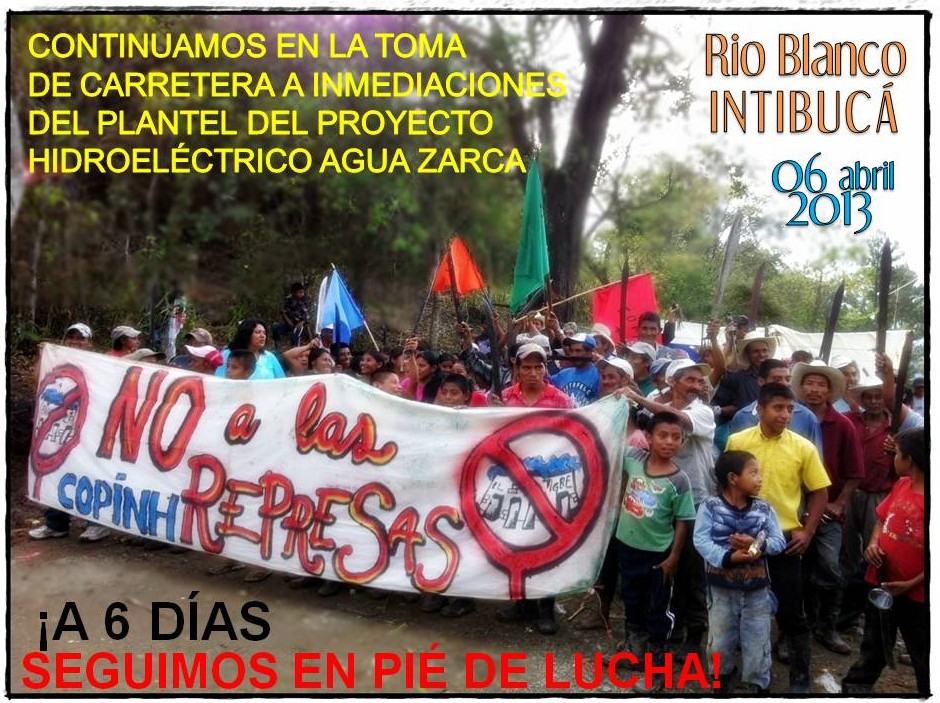
Allan García, 17 year-old Lenca boy, was checked in to the Santa Barbara hospital this Monday at 1:00pm, injured by the Honduran military in the community of Río Blanco, Intibucá. The medical diagnosis is that a high-caliber bullet went through his thorax and that he requires urgent medical intervention. He was sent via emergency transfer this afternoon to Hospital Mario Rivas in San Pedro Sula. In the same attack, his father —Tomás García Domínguez, Lenca community organizer—was murdered around noon, also by the army which is guarding the DESA Company of the Chinese state firm SYNOHIDRO, which plans to build a dam on the Gualcarque River against the will of the indigenous community.


The dam being built by the Chinese firm is widely opposed by the indigenous people in the area.  Honduran Culture and Politics tells us: 


That company, SYNOHIDRO, is well known as the contractor for controversial dams proposed on the Patuca River in Olancho, in eastern Honduras, expected to cause major environmental damage in the Rio Platano Biosphere, and protested by indigenous people in eastern Honduras as prejudicial to their livelihoods.


This company, representing global capital in this situation,  has paid little regard to the desires of the people of the region.  As SOA Watch has stated:


In clear violation of ILO Convention 169 on the rights of Indigenous Peoples, the Lenca community of Rio Blanco was not consulted on whether they wanted this project or not. And when the Municipal Mayor finally did hold a town hall meeting about the project, he got up and left the meeting when the community voted against the project, refusing to sign the acta in an attempt to invalidate the meeting.


Well, sometimes the multitude decides consulted or not they have something to say.  The indigenous people of Honduras have been battling the Empire over this dam ever since the idea came along. 

The fight of the Lenca people is part of a much larger struggle against the seizure of indigenous lands by international capital and its state representatives that started over 500 years ago, and continues to this day.  
Berta Caceres, Director of the Council of Indigenous and Popular Organizations of Honduras (COPINH), who was himself arrested protesting the site in May says on Indian Country Today:

There is a displacement of the population that has traditionally lived on those lands, practically an eviction...DESA [of Honduras] and SINOHYDRO (a transnational Chinese hydroelectric project builder) have exerted brutal pressure against the communities, with maneuvers such as co-opting leaders and the offering of bribes, and on the other hand repression, systematic harassment, and the occupation of the territory by the army, the police and security guards and gang members.

The Rio Blanco case is very important and emblematic  because it is a struggle against a very strong transnational power such as SINOHYDRO and it represents the opening of the doors to big capital for the creation of mega projects through the Law of Special Regimes or better known as the Law of Model Cities that gave a chance to not only this transnational, but to large investments in the north.

Because of these facts, it's important to fight against the Agua Zarca project which is the beginning of the plunder and eviction through the Model City projects which is a laboratory for what is being executed in Honduras, within what is perversely known as the Transpacific Treaty.


The Company and the State blame the indigenous for the death.  El Heraldo writes:


Their story goes that "owing to the violent intervention of the demonstrators of COPINH Tomás García died, and Allan García Domínguez also was injured", leaving a bizarre impression that it was the protesters, not the military, who resorted to firing on the crowd.


How many times have we heard such nosnsense, whereby those killed by the Empire are at fault for being killed by the Empire.  The Empire, of course, is never responsible and the multitudes are just resisting whatever, I guess, becasue they have nothing better to do.

The following is from Intercontinental Cry.


Honduran Army Kills Indigenous Leader of COPINH Who Resisted Dam in Rio Blanco

BY  • JUL 16, 2013

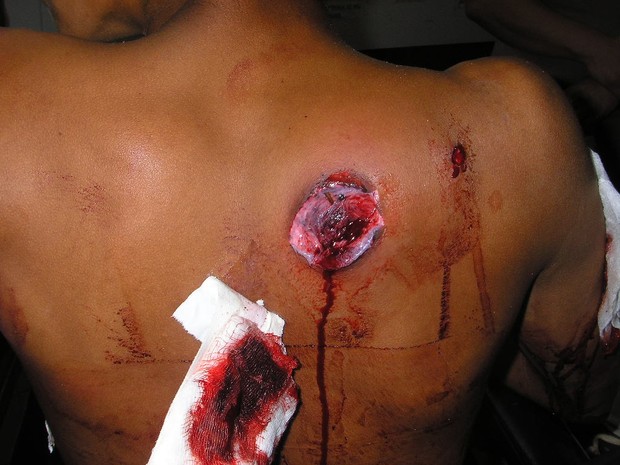
Photo: Alan García, Tomas’s son, shows the injuries inflicted by the Army (COPINH)
On Monday July 15th, while the Lenca community of Rio Blanco, in Honduras, marked 106 days of resistance to the building of Agua Zarca hydroelectric dam, the Army indiscriminately shot at the demonstrators killing one of the leaders of the resistance, Tomas Garcia, and seriously injuring his son (photo).

Tomas was a Lenca indigenous leader who was part of his community’s Indigenous and Auxiliary Council and of the National Council of the Civic Council of Popular and Indigenous Organizations of Honduras (COPINH).

The Honduran activist was shot dead while he was walking with other community members to the project’s facilities owned by Desa and Sinohydro companies, while his son, who was seriously injured by a high-calibre bullet, is in hospital and his life is in danger, Berta Caceres, leader of COPINH, told Real World Radio.

Berta described the act as “a desperate and criminal reaction” by the companies that want to build a dam on River Gualcaeque, seriously affecting the communities living there. The Honduran army supports the companies, said Berta, and they even pay for the transportation and maintenance of troops deployed by the Honduran government in Tegucigalpa in Rio Blanco.

On Monday night, COPINH reported of more military troops being deployed in Zacapa, Santa Barbara, and there were fears of new shootings against civilians during the wake of the murdered indigenous leader.

“The community is outraged. We are in great sorrow, also because we believe we have to continue our struggle”, said Berta during a phone interview. “As the elections approach (in November) they want to teach COPINH a lesson”, she explained and said the community decided to continue occupying the access to the dam.

A few hours after the incidents, COPINH had reported that since Friday 12, top executives of the company Desarrollo Energético Sociedad Anónima (DESA)- which is in charge of the project together with the original group Sinohydro – travelled to meet with local hitmen, who are responsible for direct threats against several members of the indigenous council, including Tomas Garcia.

Before they started shooting at civilians, the military made no attempt to talk with the activists, said Berta.

The leader of COPINH was illegally arrested in May and submitted to a trial for purportedly having an illegal weapon, something that the court could not prove and the case was finally dismissed.

The leader highlighted that in the new cases of repression against residents of the community of Rio Blanco, we urgently need international solidarity to report the civic and military authorities and both companies for murder.

“We are aware that we are confronted with an impunity strategy in a context that seems to be worsening”, said Berta. She said the communities’ determination to defend their territory is strengthened in these situations of state and private violence.

In fact, river Gualcarque is considered an essential part of the Lenca spirituality and the communities are confronting the business projects as a tribute to their culture’s symbolic figure: Lempira.

“We continue fighting, we are not afraid, we will not be prey to fear and we will continue this peaceful but strong battle for life”, she concluded.


Monday, July 15, 2013

TRAYVON MARTIN, MARISSA ALEXANDER: THE SYSTEM WORKED JUST AS DESIGNED


It's Monday and I can't quite let it go yet, won't ever really let it go.  I am compelled to once again return to the inglorious injustice done this weekend by what the defense and the prosecution in the Trayvon Martin case call the best legal system in the world.  Such arrogance.  How often does someone describe something, anything about the USA the best in the world.  Ask them why they think that and they will stutter and say it just is.  The USA is the best at everything and that's the way it goes.

Such crap.

What is important to keep in mind is that the US judicial system WORKED exactly as it is designed to work in the case of Trayvon Martin.  It WORKED again exactly as it is designed to work in the case of Marissa Alexander.  Many see a contradiction.  There is none.  

One can't possibly take an honest read of US history, of the founding papers, of the founding fathers, of a few centuries of Supreme Court decisions, at a history of slavery, Jim Crow, and mass incarceration...at a foundation of white supremacy, of murders of civil rights activists and those struggling for liberation of the African American People, of the every day bits of racism that blacks in America face always...and on and on and reach any conclusion other than the system worked just fine in both cases.

The system needs to go.

It ain't broken.  It was never otherwise.  All the white liberal media pundits, all the good white  liberal folks who honestly are outraged by the verdict in one or both of these cases miss the point entirely.  You want to be outraged, be outraged at America, be outraged at the pillars upon which this "greatest country" in the world is built.  

And don't just be "outraged" and then head home to your own gated communities, to your own private schools, to your own pieces of heaven and go back to sleep.  GET IT! DO SOMETHING!

It is time for white working people to GET IT, too.  Get that you are the recipient of all sorts of privileges just because you are a member of the white club.  Get that those who do exploit and steal from you, who keep you down are sitting at the top of a white power structure laughing at you, but happy to have you aboard.  GROW UP and smell the roses already.  Sometimes I grow weary of making excuses for you and talking about how white supremacy is all mystified and hidden behind a mountain of material advantages.  You aren't blind and you aren't idiots.  Quit pretending you don't see what is going on.  Figure it out already.  This white skin privilege thing has been going on for a long time now.  It is hard to miss.

Yes, I should come down harder on the out and out racists, white supremacist scum, profiling murders, and the like, but that is too easy.  It is too easy to blame a few white sheets for all the dirty laundry that makes up this brave and free and land of ours.

Am I pissed.  Yes, I am pissed.  Walking around pissed all the time is not the way I want to live, but boy is it hard not to do just that.  Of course, like everyone else I find many moments of joy and good feelings, even sometimes of hope.

This is not one of those moments.

The following is from The Frenzy.


Trayvon Martin, Marissa Alexander, and 

the founding of the US

The murder of Trayvon Martin and jailing of Marissa Alexander aren’t just about racism —they’re about slavery.

Many groups of people face racist violence and discrimination in the US, but what African Americans, or any other people deemed to be “Black” face runs even deeper. This whole damn country was founded on these principles: Black people are the property of white people, and Black people count only as 3/5 of a human.

And these rules aren’t just legacy, but are still our lived realities, every day. White people get away with murdering Black people, every day, every day, every day. And Black and Brown men, imprisoned in large numbers in rural parts of many states (and hey, I’m talking up North here —stop blaming this on “the South”!) count as “population” to determine local congressional seats in the counties where they are imprisoned, not in their homes, yet aren’t allowed to vote for those seats. I think that’s pretty damn close to counting as only 3/5 of a human, don’t you?

Some days I think that if there weren’t for-profit prisons and strong prison guard unions the State wouldn’t even pretend to care about Black-on-Black crime; they don’t actually care about those killed. They only care about two motives: making profit, and maintaining white supremacy. Imprisoning people for Black-on-Black violence serves both of these, the latter by the myriad ways having been imprisoned destroys lives by making employment impossible, breaking up families, destroying education, denying the right vote and on and ugly ugly on.

Imprisoning white people for killing Black people might serve the profit motive, but maintaining white supremacy trumps profit, every time. To have found Zimmerman guilty of murder would be to say that Trayvon Martin was fully, legally, human, and that’s not how this country was set up.

Imprisoning Marissa Alexander definitely serves both profit and supremacy. What in the world would the US do if Black folks thought they had the right to take up arms to defend themselves? And this question goes to the heart of how the US was established to protect a slave-holding social system, for the deepest fear of that system was that the enslaved, who outnumbered the owners so greatly, would rise up.

I’ve already seen many many comments about how “The system is broken” or how this was a “travesty against justice.” But THIS IS HOW THE SYSTEM WAS SET UP TO WORK. And while the acquittal is a travesty against the abstract concept of Justice, it is exactly what the US justice system was set up to do —maintain the vision of the founding fathers. Who held generations captive in violently enforced slavery, raped women held in slavery, and sold their own children from these rapes as slaves.

Where, in those founding principles, does anyone possibly think Trayvon Martin’s murder would matter?

And, finally, because I found this on Facebook this morning and it so brilliantly sums up the situation, a quotation from Frederick Douglass’ My Bondage and My Freedom:

The slaveholders, with a craftiness peculiar to themselves, by encouraging the enmity of the poor laboring white man against the blacks, succeeded in making the said white man almost as much a slave as the black slave himself. The difference between the white slave and the black slave was this: the latter belonged to one slaveholder, while the former belonged to the slaveholders collectively. The white slave had taken from him by indirection what the black slave had taken from him directly and without ceremony. Both were plundered, and by the same plunderers. The slave was robbed by his master of all his earnings, above what was required for his bare physical necessities, and the white laboring man was robbed by the slave system of the just results of his labor, because he was flung into competition with a class of laborers who worked without wages. The slaveholders blinded them to this competition by keeping alive their prejudice against the slaves as men, not against them as slaves. They appealed to their pride, often denouncing emancipation as tending to place the white working man on an equality with negroes, and by this means they succeeded in drawing off the minds of the poor whites from the real fact, that by the rich slave master they were already regarded as but a single remove from equality with the slave. The impression was cunningly made that slavery was the only power that could prevent the laboring white man from falling to the level of the slave’s poverty and degradation. To make this enmity deep and broad between the slave and the poor white man, the latter was allowed to abuse and whip the former without hindrance.

Sunday, July 14, 2013

DOES GEORGE ZIMMERMAN HAVE A LINE HE WOULDN'T CROSS? / A POEM BY BILL BERKOWITZ


It is supposed to be theoretical weekends at Scission.  Unfortunately there is nothing theoretical about yesterday's ending to the George Zimmerman trial which completed the "legal" lynching of Trayvon Martin.  I have not felt such a visceral  sense of sadness, anger, and outrage in a long, long time as when I heard the verdict of "not guilty."  Was I shocked that such a thing could transpire in this country?  Not really, but still I listened with a sense of disbelief which grew as I watched the smiling reaction of the "special prosecutor," as I heard her colleagues on the prosecution team thank the jury and actually comment that their prayers had been answered.  I had to turn off the television.  When I turned it back on, I found myself watching the loathsome defense team gloating and actually commenting that it had taken too long for justice to be found for George Zimmerman.  They and Zimmerman's brother added that if Zimmerman had been black there never would have been a trial.  I felt like I was living in some alternate universe.  

I lay awake last night knowing that I had to say something here, but the words to use failed me.  How could I express anything near what I was feeling?  I awoke this morning to an email from my old friend Bill Berkowitz and to a poem which he had written which took care of that for me.  I will share that with you now.


Does George Zimmerman Have a Line He Wouldn't Cross?


Does George Zimmerman have a line he wouldn't cross?
If he does, would it be a 15 year-old black boy
or girl?
Would it be a child of 13, 11, 9, 7, or 3?
Would the black child have to be taller than five feet ten inches?
What if that child was five feet eight inches or five feet three inches or barely five feet?
Would he still have attacked if it was a five feet two inch six year-old girl
carrying a soda and a bag of skittles?
Would his defense attorney still be so smug and disrespectful?
What if our five feet two inch girl walking home carrying a soda and a bag of skittles 
wore a hoodless sweatshirt?
Would Zimmerman have accosted her?
Would he have shot her dead?
Is another self-declared neighborhood-watch armed-vigilante
setting his sights on another black child?  


Bill Berkowitz, July 14, 2013