Thursday, February 21, 2013

THE MOST DANGEROUS JOB IN THE EMPIRE AWARD GOES TO: SHIPBREAKING


Ship Breaking?  What is that?  It is the most dangerous job in the world according to many.  In Bangladesh it is big time big business.  Big Business which pays its workers as little as 47 cents per day to break up huge, rusting ships and tankers for up to twelve hours per day, seven days per week.  Ship Breaking in Bangladesh is second only in size to Pakistan.  Ship breaking  as Australia's Sunday Night describes it:


It’s one of the most jaw-dropping sights of the modern world. For as far as the eye can see, along a stretch of coastline in Bangladesh, hundreds of mammoth supertankers lie beached on the sand.

This is the place where the world’s ships come to die. The country’s lax labor laws and poor environmental standards mean the Bangladeshi coast is the final dumping ground for these lumbering giants.

A 2010 investigative report from the Institute for Global Labour and Human Rights found that amongst the thirty thousand workers involved in this most perilous and grueling work are children.  The report found that on the average one worker is injured each day and one dies every three weeks.


Workers are exposed to numerous toxins without any protection. Each ship contains an average of 15,000 pounds of asbestos and 10 to 100 tons of lead paint. Workers also come in contact with mercury, arsenic, dioxins, PCBs and carcinogenic fumes. Helpers, often children who go barefoot or wear flip-flops, use hammers to break apart the asbestos inside the ships, which they carry out and dump on the sand.

The ship-breaking workers lack even the most rudimentary protective gear. Cutters, who use blowtorches to sever ship hulls, wear sunglasses rather than protective goggles. They wrap dirty bandanas around their noses and mouths since they are not given respiratory masks. And they wear two sets of shirts for lack of welding vests and hope that the sparks will not burn through to their skin. Still, it happens every day.

The workers live in misery, with six sharing a small room, often sleeping directly on the dirty concrete floor. No one has a mattress.

“The workers are very clear on two points,” Kernaghan said, “that they will die early, and that there have been no improvements whatsoever over the last 30 years with respect to worker rights or health and safety. It does not have to be this way! Every child worker could be sent to school for $750 a year—including a living stipend to replace their wages. For less than $350 a year, every worker could be provided safety gear—which would save lives. The G-20 nations, which dominate world shipping, must guarantee respect for the legal rights of workers and must remove all toxic materials from their ships before they are sent to Bangladesh for scrapping.”

16-year-old Khorshed Alam was one of those lucky workers.  He  was crushed to death on July 17 when a metal plate fell on him. The boy had left school to start working in the yards and support his family. He worked a 12-hour night shift at the SRS shipbreaking yard in Chittagong for 25 USD cents an hour, or just under 3 USD per day.  He is dead.

Again, this is big business.   Of the approximate 45,000 ocean-going ships in the world about 700 are taken out of service every year. At the end of their sailing life, ships are sold so that the valuable steel – about 95% of a ships mass can be reused.  Research Initiative for Social Equity writes:


Ship breaking on the beach, which already at that time was prohibited in most countries, could be done in Bangladesh without any concern. Poverty and millions of people without education were looking for livelihood opportunities. They provided cheap and exploitable human man power needed for the ship breaking industry. No major investments were required for engaging in ship breaking. The present type of ship breaking in Bangladesh just require a large winch, some blowtorches and maybe a bulldozer. Rest of the operation is just raw human man power. Labour is extremely cheap, environmental and labour standards are loosely applied and no pre-cleaning of the ships are required for entering the ship breaking beach in Chittagong.

Ship breaking is therefore a lucrative business with few risks for the yard owners, investors and money lenders. The ship breaking industry in Bangladesh is estimated worth an annual turn over of around 1.5 billion dollars. Globally some 700 ocean-going vessels are scrapped each year, and more than 100 of them are scrapped in Bangladesh. Some of the ships are 350 meter long with a weight up to 10-15.000 tons. It is estimated that app. 30 percent of the world’s Light Displacement Tonnes (LDT) were scrapped in Bangladesh during the period 2000-2010.

It was found that majority of the labour (40.75%) are between the ages of 18-22 years old. Only 1.13% of labour is between 46-60 years old. One of the most disturbing findings was that child labour (under the age of 18) made up 10.94% of the workforce. 46.42% of yard workers are illiterate while 43.02% attained primary school education. There are no arrangements for pure drinking water, healthy food, hygienic toilets and living conditions for the workers. It was observed that 86.44% of the labour force stated that they received no medical facilities from the ship yard owners, 5.93% said they received medical facilities, 4.15% said they got medical facilities but in a nominal way or by way of first aid treatment and 1.69% stated sometimes they got medical facilities and sometimes not. As the government has not recognised it as an industry, the industry based labour laws (for example the Factory Act 1965) do not apply. Though the workers have been working in the scrap yards for years they are not allowed to form or join a trade union to bargain and enforce their rights. The workers are deprived of proper compensation due to the lack of a valid contract. In order to maximize profits little is done to minimalize the risk of accidents (Source: YPSA’s baseline survey).

Working in the ship breaking yards is a very dangerous job, which involves many human health risks. Sometimes gases explode killing workers. It also happens that workers are crushed by tumbling or falling steel parts. Sometimes workers fall from the high sides of ships on which they are working without safety harnesses. Many of the oxyacetylene cutters work without goggles. Few wear shoes, let alone protective clothing. Local organisations in Bangladesh estimate that some 1000-2000 workers have died in the last 30 years, and many more have suffered serious injuries. General health statistics show that the percentage of people with disabilities in the Chittagong area is above average for the country as a whole, because many workers have lost limbs or got other disabilities from working in the ship breaking yards.

The labourers lack basic equipment. When a new ship arrives, there are containers, chambers and tanks, which contain oil, petroleum and poisonous gases. One method used for checking the level of danger in these parts of the ship is to lower down chickens in a string to check whether there are dangerous gases. If the chickens survive, the first workers will enter to clean for oil, petroleum and other flammable substances. The flammable substances are often burned off before the cutters enter to rip the ship apart. Gas explosions is a common phenomenon.

It is estimated that half of the workers are under 22 years and nearly half of them are illiterate. Some believe that up to around 20 percent of the total work force consist of children. The workers are poor and they have no other alternatives for supporting themselves and their families than to work in the ship breaking yards. There are often no other job alternatives for them. The workers do not know much about rules and regulations on basic occupational health standards and safety. The labourers or their families are poorly compensated when injured or killed.

Are you getting the picture.  

This is not a job you want.  This is a job you have no choice but to take.  This is a job of the Empire.

This ships that are being broken up by poor workers in South Asia, of course, come from other, more developed parts of the Empire...places like Europe.  The technology and the like obviously exist in Europe for Europe to take care of its own shit, but it is much more profitable to drop them off on the beaches of places like Bangladesh...so that is where they go.  

The government of Bangladesh does next to nothing to protect these workers.  The governments of Europe turn their eyes in the other direction and act as if they have no responsibility.  The masters of global capital could care less.  The safety, the lives of workers is not their concern.

It's a global world we live in.

The following if from NGO Shipbreaking Platform.


Press release – European Shipowners dumped 365 Toxic Ships on South Asian Beaches Last Year


European Shipowners dumped 365 Toxic Ships on South Asian Beaches Last Year

Need for financial mechanism to hold shipowners accountable and prevent reflagging is urgent

Brussels, 5 February 2013 – A record-breaking number of 365 toxics-laden ships were sent for breaking by European shipowners to the beaches of South Asia in 2012, according to a list released today by the NGO Shipbreaking Platform, a global coalition of environmental, human rights and labour rights organisations working for safe and sustainable ship recycling. This number represents a 75% increase from 2011, when 210 EU-owned ships were sent for breaking in India, Bangladesh and Pakistan[1].

Despite the possibility of proper disposal in Europe or other developed countries, the vast majority of European shipping companies continue to profit by having their ships broken cheaply and dangerously on the beaches of South Asia. The EU must adopt mechanisms that will prevent European shipowners from exporting toxic ships for breaking in developing countries and instead recycle them according to the health, safety and environmental laws and standards of their own countries,” says Patrizia Heidegger, Executive Director of the NGO Shipbreaking Platform.

Of the top 10 European “global dumpers” in 2012, Greek shipowners were number one, dumping 167 ships on South Asian beaches, or nearly half of all ships sent by European shipowners in 2012. German shipowners represented the second largest group of toxic ship dumpers (48 ships) followed by shipowners from the UK (30 ships), Norway (23 ships), Cyprus (13 ships), Bulgaria (8 ships), Denmark (6 ships) and the Netherlands (5 ships). Shipowners from all countries, except the Netherlands and Norway[2], increased the number of end-of-life ships exported to Asia, with Italian shipowners sending three times as many ships in 2012 compared to the year before and MSC, the main Swiss containership and cruise ships company[2], beaching 23 ships in 2012, compared to only 5 in 2011. The rest was sent by shipowners based in Estonia (3 ships), Sweden (3 ships), Lithuania (2 ships), Belgium (2 ships), Romania (2 ships), Latvia (1 ship) and Poland (1 ship).

The Platform’s 2012 list shows that most of the end-of-life ships sent by European shipowners did not fly an EU flag[3]. In fact, 240 of them used what is commonly referred to as the “flags of convenience” phenomenon, using flags such as Panama, Liberia, the Bahamas or St Kitts-and-Nevis, which makes it more difficult for the EU to prevent their dismantling in substandard facilities. The NGO Shipbreaking Platform is currently working with the European Parliament to introduce a financial mechanism that would help shipowners internalize the costs of proper disposal of the hazardous materials found in end-of-life vessels. The Platform wants the mechanism to apply to all ships calling at European ports, instead of only addressing EU-flagged vessels. The financial mechanism could be a fund financed by fees paid by shipowners; an insurance; or a savings account guaranteeing that funds are put aside for safe and environmentally sound ship recycling. The EU Commission failed to introduce such a financial mechanism in its proposal for a European Regulation on ship recycling published in March 2012. Under the Cypriot Presidency, which ended in December, the EU Council failed to strengthen the Commission proposal. Coincidentally, in 2012, Cypriot shipowners sent 13 ships to the South Asian beaches. Also Greece and Germany, the two biggest European ships dumpers, do not show the political will to stop the export of end-of-life vessels.

China is another major destination of concern for end-of-life ships sold by EU-based shipowners. Both China and the EU have ratified the Basel Ban Amendment that prohibits any transboundary movement of hazardous waste exported from OECD to non-OECD countries. While today’s list focuses on end-of-life ships sent to beaches in South Asia, and even though the Shipbreaking Platform welcomes the fact that China has outlawed beaching and uses a higher level of mechanization, it notes with continued concern, the absence of independent trade unions in China, the lack of proper downstream management of toxic residues such as PCBs as well as the fact that such exports are likely to violate the Basel Ban Amendment.


CONTACT:
Patrizia Heidegger
Executive Director
NGO Shipbreaking Platform
Rue de la Linière 11
1060 Brussels
patrizia@shipbreakingplatform.org
+32 2 6094 419

NOTES:

The 2012 list can be downloaded in PDF or Excel format

[1] The 2011 list is available here: http://bit.ly/A89gAS

[2] Although Norway and Switzerland are not amongst the 27 Member States of the European Union, both are part of EFTA (the European Free-Trade Association) and shipping companies based in these countries need to abide by certain EU laws, including the Waste Shipment Regulation.

[3] In 2012, out of the 365 EU-owned ships sent for breaking to South Asia, only 83 flew European flags. 90 ships used the flag of Panama; 60 used Liberia; 30 used Saint Kitts-and-Nevis; 23 used the Marshall Islands; 15 used Comoros; 12 used Saint Vincent-and-Grenadines; and 10 used the Bahamas. Some shipping companies based outside of the European Union also used a European flag for their end-of-life ship, amongst whom: Japan (1 Dutch flag), Ukraine (1 Slovakian flag), the United Arab Emirates (1 Maltese flag), Croatia (1 Maltese flag), the USA (1 Greek flag), Singapore (1 Norwegian flag and 1 Cypriot flag), China (2 Cypriot flags), Monaco (2 British flags) and Russia (3 Cypriot flags).

ABOUT THE LIST

The European origin of the ships is determined either by their use of a European/EFTA flag (Iceland, Norway, Switzerland, and Liechtenstein) and/or because the last owner of the ship before the shipbreakers bought it was European-based. We have chosen to use the last beneficial owner of the ship as a reference in all previous reports. As defined by maritime database Lloyd’s List, the beneficial owner “may be the vessel’s management company or the trading name of a group, both of which are generally perceived to represent the ultimate owners of the vessel”. Therefore when looking at the report both these factors need to be taken into account when considering the data. The only destinations for end-of-life ships taken into account in this report, as for the Platform’s previous reports, are Gadani in Pakistan; Alang, Sachana, and Mumbai in India; and Chittagong in Bangladesh. Some ships may be missing from this list, which does not pretend to be exhaustive. Some data are provided by the industry on a voluntary basis. The list was compiled using Lloyd’s List, Intermodal, Robin des Bois reports, Equasis, and 

Wednesday, February 20, 2013

LIFE GRAB IN ETHIOPIA


There may be centers in the Empire, but there is no CENTER.  The Empire is not Washington despite so many who desire it to be so.  The Empire is more than the USA.

The Empire and Capital are everywhere.  There is no outside, only inside these days.  That is what globalization really means.  Capital really is global and nation states really become weaker every day.  They are still here, mind you, but have less control over Capital every single day.

Our goal should not be to return to the "good old days."  Our goal should be to create an alter "Empire" of the Multitudes.  This would be a world without Capital, without capitalist accumulation, and exploitation.  This can only be accomplished by the multitudes.  No one else can do it -  no Party, no union, no NGO, no nation state,  just the working people of the world.

This brings us to what is happening in Ethiopia.  The land and resources which are being stolen from the people who live on them.  Who is doing what to whom.

In this instance we are talking about land being stolen by companies from India.  The article below at one point seems to imply that the Indian government is responsible for all this,  but does anyone really believe India, the nation, is ultimately behind all this?  I think that is a too simple an explanation.  Does anyone believe that New Delhi is the capital of the Empire and the bureaucrats who call themselves the government are in charge?   No one denies that those bureaucrats do not act on behalf of national and international Capital, and no one finds those bureaucrats  blameless, but...it goes beyond that.

In the article is also the suggestion that the Ethiopian government must reform itself and act on behalf of its people.  Of course, this is also not the solution.  The solution does not lie with the government at all.  Only the multitude, the working people, farmers, peasants of Ethiopia, of India, of the world are the solution.

This is the very sort of thinking which lends to a reactionary strategy of "we need to get back to the good old days of a strongly regulating nation state," but we KNOW there were no good old days of capitalism.  Just as Marx recognized that early capitalism was actually an advance over feudalism (despite all its horror), so must we come to grips that globalization is an advance over what came before.  We do not embrace it, of course, we work to push beyond to a new world entirely, but one last time, we don't do that by going backwards.

Just saying....

The following is from Food Crisis and the Global Land Grab.


How Ethiopians are being pushed off their land
The Hindu | 19 February 2013

by ASHISH KOTHARI


“It is not a land-grab, it is a life-grab. It is daylight robbery. But if we protest, if we speak the truth, we could end up in jail or worse.” Obang Metho was referring to the leasing of land to foreign companies in Ethiopia, spreading over nearly four million hectares. Nyikaw Ochalla joined in: “This is happening in the lands I grew up in, and it is my relatives and childhood friends who are being jailed, beaten up, and driven out; my childhood memories are being violated.”


Metho of the Solidarity Movement for a New Ethiopia, and Ochalla of the Anuak Survival Organisation were speaking at the “Indian-Ethiopian Seminar on Land Investments” organised on February 5-6, 2013 in New Delhi. The seminar was put together by Indian civil society groups Indian Social Action Forum (Insaf), Popular Education and Action Centre (Peace), and Kalpavriksh, the research institution Council for Social Development, and the U.S.-based research group Oakland Institute.


Indian stakes


The stories narrated by Obang and Ochalla were harrowing. The lands being leased by the Ethiopian government to companies from India, China, Malaysia, and other countries, were claimed by it to be “empty.” In actual fact these are areas occupied or used by pastoral and small farming communities, as also grasslands and forests with significant wildlife. Decisions are being taken in the country’s capital to give up these lands ostensibly to help the country produce food and generate revenues; the underlying message is that either there is no one there to do the job, or that local communities are simply not up to the mark.


Indian companies are among the biggest players in the land deals, with investments of over $5 billion, and leases over 6,00,000 hectares. Karuturi Global, a Bangalore-based agroproduce company has alone received 3,00,000 hectares. Claims by these companies and by the Ethiopian government that the deals are legal and entail no human rights violations, have been shown as false in a series of on-ground investigations. The Oakland Institute has meticulously documented the nexus of corporations, politicians, investors, and officials that has made the land-grab possible. It notes that there is no public consultation with local communities (much less their consent), many of whom find out that their pastures or fields have been sold off only when bulldozers arrive. Any form of resistance or even questioning is met with imprisonment, beating up, and even killing. Both private security companies and the Ethiopian government’s own forces are used to protect the investors. And there is a total lack of environmental and social impact assessments in these deals.


It is also stated sometimes that what Indian companies are doing abroad, is not the responsibility of the government. But this ignores the various ways in which the Indian government facilitates and supports such deals, not only through diplomatic channels but also financially (even if indirectly). For instance the Indian Export-Import Bank has pledged $640 million of credit over five years for Ethiopia’s sugar industry, and the fact that Indian companies are getting the biggest deals for sugarcane plantations cannot be unconnected.


Mass displacement


Obang and Ochalla were careful to clarify that they were not against India’s people, who they realised could not be supporting such land-grab; however, for the affected communities, “it is Indians who are doing this to us.” It is therefore important for groups here to question the intentions and actions of Indian companies and the Indian government agencies supporting them. Does their behaviour in Ethiopia meet the laws or guidelines under which Indian companies act within their own country? Does it meet international standards of human rights and environmental sustainability that India is a signatory to?


Over the next couple of years, the Ethiopian government plans to forcibly move 1.5 million people off their homelands and concentrate them into a few settlements in a process called “villagisation.” It claims that this will enable it to provide efficient and good quality services like drinking water, sanitation, schools, and clinics, which is not possible in the case of today’s scattered, small settlements. But Obang and Ochalla point out that all the relocation is taking place from lands targeted by investor companies, and that even where communities are saying they would much rather stay where they are with whatever amenities they have, they are being forcibly moved out.


The claim that such investments are a “win-win” deal for the Ethiopian people and Indian companies is also questionable. Much of the production (sugarcane, cotton, jatropha, etc) is meant for export, and local foodgrains which are the staple diet are not being grown. Very little local employment is created; there is no requirement by the Ethiopian government that companies have to hire locally. Nor is there any contractual clause by which the money generated is to remain within the Ethiopian economy. A handful of businessmen and politicians are the prime beneficiaries.


Obang and Ochalla were at pains to state that part of the blame for this sell-out is located within the country’s own history, in which sometimes adverse relations between different tribes have become entrenched in the political system. The country’s ruling elite are from a tiny minority belonging to one ethnic group, who can ignore the sufferings of other groups affected by land-grab. In this sense, it is the Ethiopian people themselves who have to resolve the problem. But there is also an important role for India’s people, especially in highlighting the role of their own companies and government, and facilitating greater awareness of what is taking place in the name of Ethiopia’s development.


Odisha parallel


What is happening in Ethiopia (and other African countries) is an outcome of India’s own aggressive push towards globalised economic growth. The growth fetish has led to situations of both internal and external colonisation, in which farms, waterbodies, forests, grasslands and other natural resources are all up for grabs.


It was an ironical coincidence that on the very days the consultations on Indian land-grab in Ethiopia were taking place in New Delhi, police action was under way to forcibly evict villagers in Odisha to make way for the Korean multinational Posco. Representatives of movements from Jharkhand, Karnataka and elsewhere told Obang and Ochalla that they were facing similar repression while resisting forcible takeover by the government or by corporations. The currently dominant model of “development” is pushing such violence across the globe, wherever dominant nation-states and giant corporations are eyeing land and resources.


In such a situation, people in India who care for human rights, ecological sustainability, and basic justice, have to raise fundamental critiques of “development” and centralised governance, and work towards radical alternatives that secure the rights of all people to food, water, shelter, energy, learning, health and livelihoods. Such alternatives are already demonstrated to be feasible at thousands of sites across the world, but it requires a mindset change for both the Ethiopian and Indian governments to facilitate the empowerment of local communities to adopt them, rather than paving the way for corporate takeover. Neither the founders of India nor of Ethiopia would have dreamt of a future in which development takes place at gunpoint.


(Ashish Kothari is with Kalpavriksh, Pune.)


Tuesday, February 19, 2013

WHY SOME KIDS NEXT DOOR ROBBED A GREEK BANK


I'm not sure what it is I want you to do with this.  I just thought getting into the minds of these Greek anarchist bank "robbers" would be interesting.  No one on the US left much wants to ever even talk about things like this, some because  they don't want to feel the pious wrath of fundamentalist pacifists, some because they think the police will show up at their door.  I don't care about the first, but would prefer the police stay away from my door.

Let's be clear, I am NOT ADVOCATING anyone go out and rob a bank.  However, some people do believe there are plenty of justification for such things and I think people need to understand their motivation, their aims, and their reasoning.

Another reason I do this is because I know what it is like to be charged with a violent political crime and watch many people suddenly move ever so slightly further away from you.

I also, fortunately, know what it feels like to have still others, some total strangers, some old friends, some family be there for you.

And with that personal note I present to you from Occupied London/From the Greek Streets...

PS: This post comes with its own background.

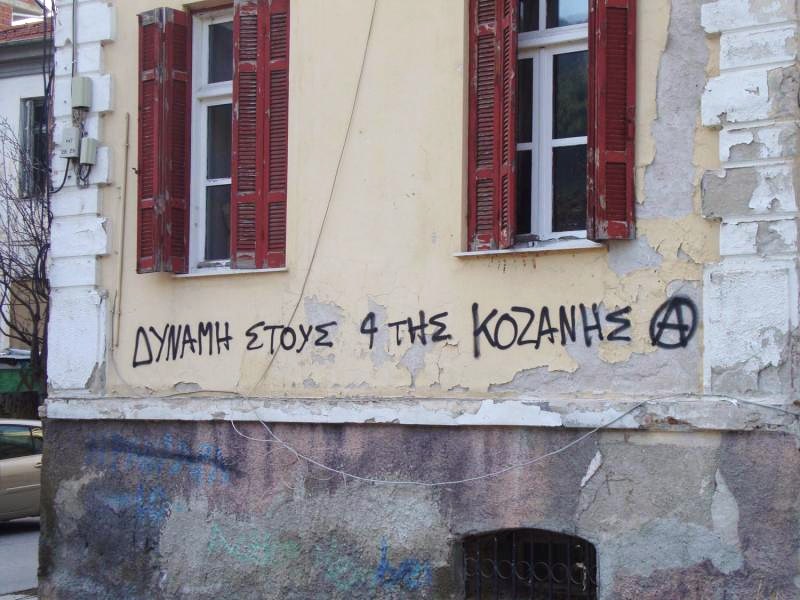
Text by the 4 arrested anarchists concerning the double robbery in Velvento, Kozani


For background to the case see: police’s Special Anti-terrorist Unit enter hospital’s Emergency Department while tortured anarchist is treated by doctorsGreek police publish images of arrested and tortured anarchists that are altered in photoshopRegarding Andreas-Dimitris Bourzoukos, one of the four arrested and tortured anarchists in Kozani and statement by three of the anarchists arrested for the bank robbery in Kozani.

Our days pass, our nights don’t
We run toward our escape, whilst around us a full-out manhunt is playing out. Behind us lies a life that is predetermined, carved from the hands of the sovereign, with the aim for us to internalise submission as an objective condition, to morally legitimise systems of law and rules, to equalise the individual with a statistical logic of numbers. Ahead of us, the world of our “utopian” fantasies that is conquered with violence alone. One life, one chance and determined choices.
Gaze at the gap in-between the clouds and jump, because the fall was never a more certain choice.
On Friday, 01.02, along with a group of comrades, we conducted a double robbery, of the Agricultural Bank and the Post Office in Velvento, Kozani. In our opinion it is of some importance to analyse, to an extent, the operational part of the robbery. This, primarily in order to highlight all the elements of the case, the choices that we made, the mistakes we conducted and the reasons that lead us to these:
And so, on that Friday morning, we attacked the two targets split in two teams. Our aim from the upstart was to take the money from both safes, as it did indeed happen. During our escape, a series of unfortunate events and mistaken handling of these lead to the exposure both of our vehicle as well as our direction to the police.
Due to the police grip that was automatically formed, the comrade driving the van that was externally transformed to look like an ambulance, sought exit routes for the team conducting the robberies. In this attempt of his, he made the mistake of driving three times in front of a vehicle of the cops, which resulted in him being considered suspect. A chase followed and then, due to non-familiarity with the area that he ended up in, he reached four dead ends in the mud-roads of the pits, which resulted in him being surrounded in the last one – and having no other actual space to escape. And so, once he set the van alight, he was arrested. Following these developments and while our comrade with the escape vehicle was already in the hands of the cops, our available options were significantly narrowed down.
We therefore decided to stop the first passing vehicle, since this would guarantee a more safe escape for us and our comrades. The main issue in this condition was for the cops not to learn about the new escape vehicle of our comrades – and so we decided to keep its driver in the van with us, until we would find a way for us to escape too. This is approximately when we crossed paths with a police car, which gradually turned into an intense chase until the city of Veroia, with most of the police forces available in the area, behind us. We obviously did not for a moment consider using the hostage in person as a human shield (we would not have a problem, for example, should we have had the manager of a bank) – after all, the police did not know of his existence. In the end, he acted as a human shield for the cops, without their knowledge – since he comprised the reason for which we did not use our weapons in order to escape. Because our consciousness and our moral code do not allow us to risk the life of a random person who found themselves with us against their will.
At this point we would like to make clear that we did not have the weapons just for the purpose of scaring off, but as a weapon in the off-chance of a clash between us and the cops. Therefore, the reason why we did not act in the corresponding way, in order to escape, was a condition in which we found ourselves due to a mistaken handling.
The only option for an escape by this point was speed – and our attempt to gain ground with our vehicle from the cops who were chasing us. Of course, the city of Veroia does not offer itself for something like this, and so we were soon trapped in a narrow street, resulting in our arrest. During our arrest, the only thing that we stated was that the person that we had with us had nothing to do neither with the robbery, nor with us. Despite this, the cops continued beating him too, at least for as long as we had eye-contact with him.
The above narration is not conducted as part of some boosting or self-promotion, but in order to invert the legacy of the arrests without a fight that the conditions lead us to.
* * * * *
The narration ends at the police headquarters in Veroia, where an hours-long torturing of three of us by the pigs of the police took place. The tactics are well-known and expected: hood, tying with handcuffs behind our backs and beatings.
We consider a given that there is a clear separating line behind us and the system, which marks the war between two worlds. The world of sovereignty, repression and submission and the world of freedom, which we create and keep alive through the restless struggle against authority.
In this war, the pigs of the police comprise a permanent target of the anarchist guerrillas  as a front-line and repressive branch of the mechanisms of sovereignty. For this reason, we considered the stance of the cops against us a given. If the state did not fight us, then we would have a good reason to be worried. Torturing, as a method, were, are and will be a weapon in the arsenal of any given authority. Us, of course, as anarchists, refuse to use methods of torturing against our enemies and promote the dignified practice of political “executions”, since we do not want to reproduce the rottenness of their world, but to eliminate it.
The opinion that sees people in struggle are pray in the hands of mechanisms of repression internalises the idea of defeat amidst subversive circles. It is the acceptance of a conceptualisation of curtailing the war against the enemies of freedom, as part of the acceptance of the bourgeois social morality and legality. And in order for us to be clear, the cue above concerns statements of the like of those by ANTARSYA or by A.K. [Anti-authoritarian Movement]. Which contribute more to reformism than to radicalisation. It is unnecessary for us to refer to journalists, SYRIZA and other parts of the system which address us with “friendly” statements in order to attempt to re-approach those consciousnesses that begin to divert from the norm, serving, in this way, the stabilisation of the regime.
Now, concerning facing the practices of torture, our own response lies in polymorphic action. The highlighting of particular events through actions of counter-information such as communiques, posters, gatherings, demonstrations etc. is definitely necessary, in order for an ever-increasing number of people to reach a conclusion. A conclusion that leaves no space for “isolated incidents” or “revanchist behaviours” but leads to the understanding that physical violence was always a means of repression and control by society. It comprises part of the war between sovereignty and revolt.
Of course, this message must spread equally with a message of terror for those natural torturers, the cops. In order for cops not to beat up, the intra-systemic denunciations and legal procedures have no meaning – while they also imply concessions and an informal acceptance of the juridical or journalistic authority. It takes resistance – and resistance must have violent form, too. Because an attack against the cops –– not only those of Veroia – either with stones, either with molotovs, ether with guns, leads them undoubtedly to a reassessment of their choices, counting their wounds before they lay hand again. Because as it has been very correctly been pointed out, the enemies have names and addresses.
* * * * *
We shall not refer in detail to the role of banks – in any case, at the time that we live in this is well-known to everybody. They existence is a continued robbery. For us, as anarchists, they comprise a target for attacks of all kinds: arsonist, bombing, robbing. Of course, there was much of a discussion about our case and there is undoubtedly a need for us to inverse these impressions. To strike against the continuous attempt of designification of our choice, and to highlight the rottenness of the sociological approach and the pseudo-humanitarian background, which they wanted to assign to us, due to [our] age.
“Next door kids and they attack a bank. Why?”
Because robbery is a consciously political act. It does not comprise the next level of a restless adolescent period, aspirations for personal wealth, nor of course is it a result of our supposed laziness. Yet it includes the desire not to bind our lives to the brutal exploitation of waged labour. Our refusal to become gears for financial interests. Our resistance against the charging ahead of mental and value bankruptcy of their world.
It is clear for us that we do not negate creativity within our communities. After all, putting together a robbery requires mental and physical labour. Yet we refuse to enslave our creativity to the world of production and reproduction of labour. Of course, for us the negation of waged slavery would hold little meaning if we did not at the same time act toward its destruction. We are remorseless anarchists and we do not seek sympathy, compassion or understanding because we acted “wrong” in a “wrong” world. We seek the spread of our values and practices and we will fight for this until our last word, until our last bullet.
* * * * *
Each aggressive act of ours is also a moment of the total revolutionary war playing out at all levels. The money from this robbery was not destined for the artificial consumer paradise. It is simply the tool in order to move all forms of struggle. From the printing of communiques to the purchase of weapons and explosives, for the funding of illegal structures of defense and attack. From the rental of our illegal houses to the supply of explosives in order to blow up their social peace.
Our aim is the spread of direct action against the generalised condition of slavery that we experience. Whether in a guerrilla formation, or openly, face-to-face, with any way each of us appreciates to be more fertile and effective, in any way fancied by each individual and group that contribute to the struggle. Always, the aim of each move of ours, of every guerrilla attack, is the spread of revolutionary consciousness. In order to stand consciously against the world of universal enslavement, against an ever-transforming enemy that sweeps everything in their path. Against this condition, the struggle for freedom and the attempt to assign combative elements to every aspect of anarchist struggle is fertile and necessary.
Because anarchy can never become a pleasant idea amidst the world of universal submission; rather, it finds itself in a never-ending clash with it. It cannot limit itself neither to harmless and democratically acceptable expressions, nor to fetishisms of the mediums –– but it comprises, rather, an undivided totality of all forms of struggle. Each individual or group, according with the desires, the intentions and their reasoning, contributes by any means possible, to the continuation of the struggle. Anarchy is our way to organise, to live and to struggle. It is the organisation without any restrictions, it is the incessant struggle. It is the extreme camaraderie that we experience in the revolted communities, against the rotten social fabric.
In closing, we would like to greet all the comrades who acted. Pasting posters, shouting slogans, organising gatherings, issuing solidarity statements (from inside and outside prison).To those who, at this moment, prepare their attacks.
PS. 1. We also want to send our solidarity to the hunger striker Spyros Dravilas, who gives a painful and tough struggle for a breath of freedom. Much strength.
PS. 2. A short while ago, comrade Ryo from Indonesia was killed in a random fray. Ryo was anarchist who promoted international solidarity through his action. Now, even when he is absent from the hostilities that we cause against the existent, we are convinced that we always look toward the same star, the star of continuous anarchist revolt. Honour to comrade RYO.
The anarchists:
Nikos Romanos
Dimitris Politis
Andreas-Dimitris Mpourzoukos
Giannis Michailidis

Monday, February 18, 2013

GREYHOUNDS: RACED TO DEATH ALL OVER THE DAMN WORLD


Since my best friend Hawk is a "retired" racing greyhound, I have vowed to use my site on a regular basis to do what I can to bring to an end the killing, abuse, and torture of these lovely animals.  

I am aware that, in general, I am more radical then your average run of the mill greyhound racing opponent (I am talking about my politics in general, not my concern for greyhounds).  I bet what I am about to tell you many on our side would publicly condemn (but, by god, in their hearts I bet you they cheer on the direct action taken at one track on the other side of the Atlantic).  We have been talking for years, rescuing for years, and seeing dogs tortured and killed for years.  Over in England someone got tired of just talking about it.

It seems that someone(s) busted their way into the Coventry Greyhound racing track site last month.  They sprayed graffiti all over including at the main entrance.  They glued the padlock and cut wires around the stadium. They cut electric wires on the trap and the manual cables, too. No big deal really, but I'm sure these people were just frustrated and wanted to do something.

The track at Coventry has been the site of years of protests.

One of the reasons for this sort of thing is highlighted at Action for Greyhounds.


R.I.P. DEAR BOY LOCAL DEE JAY 25.05.2008 to 15.05.2012

 Tuesday May 15th 2012 a young black male greyhound’s life was tragicly cut short in a trial at Coventry greyhound stadium, before the track officially reopened on Sunday May 20th.

LOCAL DEE JAY (also known as LOCAL FLAWLESS) was born in Ireland on May 25th 2008 along with 3 black sisters (Danesrath Mel, Local Kuro and Local Gaffer). His first race in Ireland was on September 3rd 2009 at Kilkenny greyhound track.

Throughout his brief racing ‘career’ he was dragged from here to Clonmel and Shelbourne Park, then in the U.K from Sittingbounre, Wimbledon, Romford, Brough Park, Belle Vue, Hove & Brighton, Yarmouth, Monmore and Hall Green.

His last race on a licensed track was at Hall Green on 18th April 2012 but he was raced to death at Coventry Stadium in a trial on Tuesday 15th May before the track officially opened on Sunday May 20th. Trained by the daughter of Coventry greyhound track proprietor Harry Fenton.

Coventry Stadium has been named the ‘stadium of Death’ by local greyhound protection group C.A.G.E. (Coventry Against Greyhound Exploitation) who vow to carry out peaceful protests outside the track until it is forced to close  (see article on their first demo).

Raced to death!

Remember racing is not like a choice made by these creatures.  They love to run, no doubt about it.  They love to run with each other, no doubt about it.  They don't, however, CHOOSE to be mistreated, live in unsanitary boxes,  fed poor quality food, receive inadequate veterinary care, be constantly and chronically injured, and executed when they aren't "good" enough, or too old, or too ornery. 

Meanwhile, on the other side of the world in Macau sits the track called the Canidrome.  As per normal greyhunds are mistreated and die for the pleasure of owners, breeders, gamblers...MONEY.

As reported by Greyhounds Rescue Holland:


Built in 1931, the Canidrome is a worn out facility that does not provide even the most basic welfare standards for dogs.  When not racing they are confined for long periods of time in tiny cages stacked two high, when they do race many sustain serious injuries and those who finish outside the top three in five races in a row, are simply destroyed.  According to officials, around 400 dogs are killed by lethal injection each year and every greyhound arriving at the track is dead within three years.

Many countries, including Australia, allow dogs to be exported to Macau knowing full well what their fate will be.   There is no adoption program allowed here.  None, zero, zip. An investigation by Australia's Sunday Morning Post and a greyhound rescue/protection group last year found that 383 greyhounds imported from Australia were killed at the Canidrome that year alone.  The investigation also found that nearly every single one of those dogs were perfectly healthy.  It seems that if a dog fails to finish in the top three for five consecutive races, they are killed.

It is so bad that even some of the owners are complaining.  They say their requests to have their dogs adopted.  rather then destrouyed have been refused by the owners of Canidrome.  Some owners are refusing to allow their dogs to be killed and are, at least, paying for room and board at the track (which is no great place to live, but I suppose is better then being butchered) even though they are no longer racing.  

Anima chairman Albano Martins says talks with the track are going nowhere.  

"Those people at the Canidrome are just joking with the Macau government. We have four or five adopters ready to take the dogs but nothing is happening."

The first article below is from the Guardian.  The second is from Care2.


Macau's Canidrome greyhound track is targeted by animal rights groups

Activists are concerned that dogs at the Chinese enclave's track are killed once their racing days are over
The Canidrome stadium in Macau
The Canidrome stadium in Macau, where an animal protection group says 302 greyhounds were injured in a 10-week period, with a sixth likely to have been killed. Photograph: Neil Setchfield / Alamy/Alamy

The howling of the dogs can be heard behind the high concrete walls topped with barbed wire that circle the Canidrome in Macau. This run-down track near the former Portuguese colony's border withChina is the only greyhound track in Asia, and is targeted by animal activists, who accuse its owners of brutality and of killing dogs after their racing days end.

Some greyhound tracks run active rehoming programmes, but discussions about one at the Canidrome have broken down because of a lack of trust, according to the Macau animal rights group, Anima.

The Canidrome, built in 1930, is in the north of Macau, the gambling hub of China. On race night, men wearing livery to match that of the six dogs march out under the floodlights in a near-empty stadium as the dogs strain at their leashes and defecate on the track before being shoved into the starting gate.

A whirring sound grows louder as the locked-in dogs whimper. Then the mechanised lure flashes by and the dogs are released, gulping up the track with amazing speed. All too soon, that mad dash is over and the dogs are taken away – perhaps to their death.

"There are reports from animal welfare groups that many of the owners think of the dogs just as an investment, so that when the dog is injured they don't want to pay for the maintenance," said one handler who, forbidden by his bosses to talk, refused to give his name. "So the dogs are just killed."

No one else at the Canidrome would talk, neither staff nor management.

This handler, a veteran staff member, believes the dogs he looks after are "happy". But he won't say more, fearing for his job.

A study by the animal protection group Grey2K – which runs greyhound rescue projects in the US – estimated that 383 dogs were put down in Macau in 2010. The Macau press has reported Choi U Fai, head of Macau's municipal and civic affairs animal control division, as saying 30 dogs were killed each month.

Grey2K said that its analysis of records held by Canidrome showed that 302 greyhounds were injured in a 10-week period, many suffering multiple injuries, including broken limbs. A sixth of those hurt were "recommended retired", which Grey2K interprets as meaning they were killed.

"It's a one-way death sentence," said Charmaine Settle of Grey2K after a visit to Canidrome last November. A dog needed only to come unplaced in three races before being put on death row, a charge the Canidrome has denied.

Albano Martins, of Anima, was hoping he could start finding homes for greyhounds released from racing. But even if owners can be persuaded to rehome instead of kill their dogs, his problems are just starting.

Macau is an overcrowded, over-developed enclave dedicated to huge gambling complexes. It has a shifting population of mainland Chinese tourists and high-rollers and migrant workers from south-east Asia – leaving little time or space for the niceties of pet ownership.

"Macau and Anima cannot absorb such a huge amount of animals. And Macau is a such a tiny place, with no laws at all protecting animals – we are afraid to have them here," said Martins.

He has been pressing the government of Macau for dog safeguards since 2003.

Embarrassed by the attention it has received in lurid local exposés, the Canidrome management is also facing pressure from Australia, the main source of the 360 dogs it imports each year.

The Australia chapter of the Animals Asia group is pressing Canberra to ban the export of the greyhounds. Many argue the only solution is to end the racing. "Everybody in Macau is embarrassed," said Martins, who wants to meet owners in the enclave, though not at the track. He said he finds it hard to go there and hear the dogs howling.

++++++++++++++++++++++++++++++++++++++++++++++++++++++++++++++++++++


Racing Greyhounds in Asia Denied Adoption, Killed Instead


Greyhound racing is an unsavory business. From poor living conditions to illegal drugs, racing dogs lead unenviable lives.

On top of that, they tend to be short lives. Racers live for only a few years: they “are usually put down if they fail to finish in the top three for five consecutive races,” reports the South China Morning Post.

A few owners who race their dogs are compassionate enough to want the animals adopted rather than killed. But a greyhound boarding facility in Macau is refusing owners’ requests to adopt retired dogs out and insisting on killing them instead, according to the advocacy group Anima.

Even if the Macau Canidrome agreed to adoptions, it might not be easy to find homes for the greyhounds. “Macau is an overcrowded, over-developed enclave dedicated to huge gambling complexes,” The Guardian reports. “It has a shifting population of mainland Chinese tourists and high-rollers and migrant workers from south-east Asia – leaving little time or space for the niceties of pet ownership.”

Most of the dogs at the Canidrome are imported from Australia, which is facing pressure to ban the export of greyhounds to Macau. “Many argue the only solution is to end the racing,” The Guardian notes.

The Macau Canidrome, the only greyhound racing track in Asia, euthanizes more than 30 dogs a month.  It also sees a startling number of injuries: “Grey2K said that its analysis of records held by Canidrome showed that 302 greyhounds were injured in a 10-week period, many suffering multiple injuries, including broken limbs,” according to The Guardian. A list of the injuries is available from GREY2K USA.

Greyhounds in the U.S. also suffer frequent injuries, including “broken legs, paralysis, head trauma, and death from cardiac arrest.”

They also suffer more intentional abuse. They “are confined in small cages barely large enough for them to stand up or turn around for” 20 or more hours each day, according to advocacy group GREY2K USA. In the United States “dogs are fed the cheapest meat available,” meaning the flesh from “dying, diseased, disabled and dead livestock” that is deemed unfit for human consumption.

Some racing dogs are also fed illegal drugs, like cocaine. One trainer found guilty of doping his dog was fined a mere $50.

Mother dogs and their puppies are kept in warehouse-type cages, stacked one atop the other, at American facilities.

The fates of greyhounds bred for racing are not surprising. Any time humans use animals for their own purposes the animals get the short end of the stick: this is the case for factory farming, vivisection and animals in circuses. Matters deteriorate when corporations like the Macau Canidrome enter the picture. As profits become more important the animals’ welfare matters even less than it did before.

The Macau Canidrome has so far refused to develop or participate in an adoption program. It is time to shut it down and end greyhound racing in Asia.