Wednesday, January 16, 2013

HAITI: WHERE THE DREAM REFUSES TO DIE


The people of Haiti have been screwed over so often by so many - colonialism, imperialism, Empire, not to mention a few local dictators thrown in for good measure.  Yet, they never give up, not ever.  They have risen up so often and so ferociously for their freedom to create a history of their own as to be a heroic example for all of us from which to learn.  The struggle is never ending, no matter how dark, no matter how many set backs, just no matter, the multitude will arise and the parasites will someday be cast into the fire of revolution.

The continuing story of what has happened since the great hurricane of three years hence continues that saga.  Amazingly some of the same enemies who have plagued this island for centuries are there to play a more modern, yet just as dastardly role.  

Well, one day, yet again, this people whose glorious revolution so long ago stands as a bright fire in the night will again strike a match and burn away those who steal from them, who oppress them, who exploit them...and amazingly even blame them.


The article below is from Pambazuka News.


The debt owed to Haiti

Nia Imara


Why, after three years, is there so little evidence of reconstruction? Hundreds of thousands of homes and more than one thousand schools were destroyed on January 12, 2010; given that the world pledged nearly $10 billion in aid, why has there been hardly any construction of permanent housing or new schools? Three years later, why do more than 350,000 Haitians remain homeless, living in tent camps, while foreign companies are opening new, multimillion-dollar, luxury hotels?


The simple answer to these questions is twofold. Amongst those with the power and resources to effect change in Haiti, there is not the will to rebuild the country in a genuinely democratic and inclusive fashion. Second, efforts to bring about an authentic reconstruction will be stunted, as long as Haiti — ruled by a government not chosen by the people — continues to be under military occupation.


A recent report in the New York Times gives an account of the money contributed by the world to assist the earthquake victims and to help rebuild Haiti and, in doing so, provides a rather mild criticism of the work of nongovernmental organizations (NGOs) there. [1] As estimated by the Times, of $7.5 billion in aid that has thus far been disbursed, half has gone to temporary relief aid, including temporary shelters (that is, tents), clinics, schools, and emergency food relief. Of the remaining half, a small fraction has been allotted to actual reconstruction.


Most earthquake survivors, however, have yet to benefit from this aid in any meaningful or lasting way. Most of the money has gone to foreign NGOs and private contractors, for whom the earthquake has proved to be tremendously profitable. When these groups spend their collected money, a significant percentage is invariably sucked into administrative costs before it ever reaches the Haitians for whom it was ostensibly intended. Oxfam, for instance, has spent more than one third of its $96 million budget (over a two-year period) on management costs. Additionally, many Haitians have expressed outrage at how such NGOs and private contractors have driven up the cost of living since the earthquake: while their employees rent expensive apartments, drive around in brand new cars, and shop at grocery stores that most Haitians cannot afford, a Haitian family in Port-Au-Prince is considered lucky if it can have at least one meal a day.


A report by the Center for Global Development corroborates the assessment of the New York Times that the reconstruction of Haiti’s infrastructure has been lethargic, largely because the recipients of aid money have, more often than not, been non-Haitian groups that have not prioritized actual reconstruction. [2] The Center for Global Development report, less conservative than the Times estimate, discloses that $9.04 billion in aid has been disbursed since 2010, and that most of it has gone back to the donors, foreign NGOs, private contractors, and the United Nations.


THE LACK OF WILL


For all the data provided in the New York Times and the Center for Global Development reports, they ultimately miss the fundamental reasons for why so little has improved in Haiti since the quake. In her Times article, Deborah Sontag attributes the virtual lack of reconstruction to the immensity of the undertaking; to the over-ambitiousness of donors and aid organizations; to the “weakness and volatility” of the Haitian government. She reports on how millions of dollars have been siphoned by planning meetings that never produce tangible results, and how the handful of projects that were finally initiated — such as the American-subsidized construction of 750 houses in Caracol — were abandoned even before half-complete. 


But to describe the reconstruction efforts of foreign organizations and the Haitian government as ambitious and “idealistic” must seem absurd to the homeless of Port-Au-Prince who have watched luxury hotels sprout up on the hills of Petionville. This past December, after major setbacks three years ago, the Royal Oasis Hotel opened its doors onto 128 rooms that cost more per night than most Haitians make in a year. The Clinton Bush Haiti Fund invested $2 million in the hotel, which — though its construction began before the 2010 earthquake — reveals how expeditiously progress and profits can be attained in Haiti, if only there is the will. Best Western Premier is also scheduled to open a new hotel in Petionville, and the International Red Cross is said to be considering the building of a hotel on $10.5 million worth of land it purchased with donations raised for quake recovery. Meanwhile, according to the New York Times article, the same Red Cross is sitting on more than $500 million in donations.

What Sontag refers to as the “weakness and volatility” of the Haitian government, a great many Haitians see as outright deceit and illegitimacy. In September, October, and November 2012, Haitians throughout the country staged demonstrations to protest the repressive, corrupt administration of President Michel Martelly, who ascended to power a year after the quake in spite of fraudulent elections. Dominican journalist Nuria Piera exposed Martelly for accepting $2.6 million in bribes since the first round of presidential elections in 2010. And Haitian Senator Moise Jean-Charles recently reproached him for getting a $20,000 per diem — paid by the Haitian government — on his frequent trips abroad.

As a solution to the reconstruction stalemate, the Center for Global Development report recommends that donors be more supportive of the needs and priorities of the Haitian government. But similar to the foreign donors and organizations that have attempted to reconstruct Haiti without seeking much input from Haitians themselves, these recommendations fail to see that the priorities of Martelly and his supporters have never been those of the majority of the Haitian people. 


FOX GUARDING THE HENHOUSE


On each anniversary of the 2010 earthquake, the U.S. media have remarked on the slow progress of reconstruction. They have generally attributed America’s and the world’s failure to live up to their promises to two interrelated causes: the dysfunction of the Haitian government and the obstacles met when trying to work with Haitian leadership. But this perspective misleadingly presumes that the government, under Michel Martelly, has legitimacy. This point of view ignores the fact that the current government was not democratically elected, since the most popular political party, Lavalas, was banned from participating in the last several elections. More fundamentally, it ignores the reality that Haiti is under a destructive, military occupation that is maintained by some of the same parties who claim to want to rebuild Haiti.

It seems absurd that those responsible for undermining Haiti’s democracy and supporting repressive regimes — the Duvaliers, Martelly — should later rally to Haiti’s cause. It is common knowledge in Haiti that the United States, France, and Canada backed the February 2004 coup d’état in which then President Jean-Bertrand Aristide was forced into exile; without these nations’ financial and military support, the kidnapping/coup and subsequent occupation would not have been possible.


Michel Martelly’s priorities are wholly opposed to those of most Haitians. Since his inauguration in March 2011, the public has consistently called for his resignation. In giving its support to Martelly, it would appear that the Obama administration has implicitly thrown its weight behind his repressive policies — in the form of arbitrary arrests and political persecution; his paramilitary activities, his laundering of national resources; his designs to change Haiti’s constitution; and the forced evictions he authorized after the earthquake.


WHO OWES WHOM?


In February 2010, finance ministers from the G7 nations met and agreed to cancel Haiti’s bilateral debt. The exact amount that was forgiven was not reported, but at the time Haiti’s debt was estimated at $1.9 billion, $1.2 billion of which was supposedly canceled by the G7 the previous June. 


Given that the earthquake damage was estimated at nearly $8 billion — which surpassed Haiti’s gross domestic product — the debt cancellation was praised by some who noted the obvious: the Haitian people could now free up more of their limited resources for rebuilding. But if one understands the history of Haiti’s exploitation by some of these very same G7 nations — namely, France, the US, and Canada — one will see that their “forgiveness” was too little, too late. For this sort of forgiveness seems rather like a thief throwing a few coins to the victim he already robbed.


Twenty-one years after the Haitian Revolutionary War ended, France demanded that its former colony pay 150 million gold francs as compensation for its losses, which included human “property.” In order to make the payment — valued at $21.7 in 2002 — Haiti had to take out a number of loans from French and American banks, and her economy, infrastructure, and educational system suffered.


Why didn’t the G7 nations take this debt into consideration at their February 2010 meeting? The only alternatives are to condone or condemn France’s crime against Haiti.

Why didn’t the G7 nations consider that most of Haiti’s recent “debt” was incurred prior to the first democratic elections in 1990? Loans that Haiti received during this period fed and fattened the repressive Duvalier dictatorship, including the death squads that murdered tens of thousands of people.

Today, then, the question ought not be how much debt the world superpowers condescend to forgive Haiti, nor even how many millions they promise for earthquake relief. Genuine rebuilding must take as its premise that the Haitian people are due a justice at least 200-years-old. Their claims for justice are both legally and morally sound and have been ignored for far too long.


* Nia Imara is a member of Haiti Action Committee

Tuesday, January 15, 2013

THE STRUGGLE FOR GREYHOUNDS AND THE VIDEO THE BREEDERS DON'T WANT YOU TO SEE


I hope you don't mind but I have decided to utilize my blog  to fight the continued abuse of racing greyhounds by a racing industry run by nothing but a group of greedy capitalists.  Since I have been living with greyhound friends now for about fifteen years and have come to know this increbibly gentle and loving breed of dogs, I have also grown more and more aware of the torturous lives they face before the lucky ones find a forever home.  Below, you will find two articles.  The first is from Grey2KUSA and includes some video which, well, you can imagine.  The video's release was actually delayed by the tactics of the Greyhound Racing Industry which does all in its power to prevent the truth of their horrible treatment these graceful dogs from being exposed.  The second is from Greyhound Safe and provides some information from around the world concerning a summing up of the  the campaign to save greyhounds from abuse and death in 2012...and more.


VICTORY FOR THE DOGS: WATCH THE VIDEO GREYHOUND BREEDERS DON'T WANT YOU TO SEE


A greyhound lives outside at an Oklahoma breeding facility
On Christmas morning, greyhound advocates won a major victory when the Secret Life of Greyhound Puppies was restored by YouTube. This video documents the greyhound breeding industry as never before, and includes photographs that were taken by local officials, greyhound breeders, and owners, at facilities in Oklahoma, Kansas, Texas and West Virginia.  This video is the first real glimpse into the secretive greyhound breeding industry, and shows puppies being tattooed at a few months of age, puppies kept outside with just small buildings for shelter, and breeding dogs enduring lives of confinement.


The video was temporarily removed from YouTube earlier this month after a greyhound breeder filed a false copyright claim. We immediately responded to this claim, and asserted our fair use and free speech rights. Yesterday, our response was accepted and the video was fully restored.


It shouldn't surprise anyone that greyhound breeders would go to extreme lengths to prevent the public from seeing how greyhounds live. However, GREY2K USA will not be deterred by these cynical tactics. I predicted that we would win this challenge when it was filed, and noted that we have won every such challenge we have faced.


Please watch The Secret Life of Greyhound Puppies today, then forward it to everyone you know. Let's send dog race promoters a message that they cannot silence us, and we will continue to be a strong voice for the greyhounds.


WATCH VIDEO

Monday, January 14, 2013

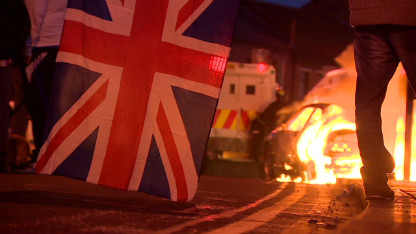
WHAT IN THE HELL IS GOING ON IN NORTHERN IRELAND NOW


Okay, I have been watching for weeks this "flag" controversy in Northern Ireland.  I've watched loyalist violence, police violence, attacks on Republican neighborhoods, road blocks and all the rest.  What the hell is going on?  I wish I was capable of giving a truly informed response, but I admit that I am not.  That is both because I don't know enough and because there are lots of answers and too much history.

There are those who see it as just one more replay of the the Republican-loyalist war, or even a struggle between unionists and nationalists and the failure of leadership in the unionist parties.   There are those who want to blame it on the Protestant refusal to accept Catholics of Northern Ireland as even belonging in the six counties.  There are those who see class struggle and capitalist obfuscation. All sides also blame the police, the PSNI.  I would guess they all have some hold on the truth which lies spread across that whole spectrum.

Workers's Liberty, which represent a Marxist, libertarian, working class brand of socialism  believes the protests and riots, "reveal an undercurrent of rudderless desperation amongst Ulster loyalists."  They write:


...for all this, the protests, numbering just a few thousand, have involved relatively few people. They are a far cry from past instances of loyalist discontent in the 1970s and 1980s, which saw rallies rallies of hundreds of thousands protest the prorogation of the Stormont parliament and the Anglo-Irish Agreement.


....
Despite the superfluity of potential leaders, the protests lack any strategic leadership. In the past, larger upsurges of loyalist anger usually served to advance one or other fraction of the Unionist establishment, such as former Unionist minister William Craig's Vanguard movement against direct rule, or Ian Paisley's doomed campaign against the Good Friday Agreement which nevertheless allowed the DUP to eventually supplant its Ulster Unionist rivals.


True to their ideological orientation, Worker's LIberty presents the following analysis:
Meanwhile, a recent report has highlighted levels of enduring poverty, unemployment and social exclusion in Northern Ireland. There is no 'mechanical' connection between immiseration and the recent unrest and the primary trigger remains a political one. Yet, continuing high levels of unemployment and poverty have seen sections of the population alienated from the political system, and undoubtedly sharpen loyalists' self-perception as 'losers' in the 'peace process'.

Some of this is warranted; some is not. It is true that Northern Ireland as a whole has had consistently higher levels of people not in paid work than the rest of the United Kingdom. Moreover, as of January 2012, 5.4% of the working-age population in NI was claiming Job Seekers' Allowance (JSA), compared with 4% on average. This is a long-lasting trend: in 1996 the level was 8.4% as compared to 6.2%, and in 2000 the figures were 4.2% and 3.3% respectively.


Northern Ireland also has a high level of households without work (21%), households with only one adult working (31%) and a growth of part-time work as a proportion of the total number of jobs. This is one of the factors behind high levels of in-work poverty and child poverty.

Nevertheless, it remains the case that Catholics are more likely to be in poverty than Protestants. The poverty rate for Protestants is 19%, compared to 26% for Catholics. In the three years up to 2000, 28% of working-age Protestants were not in paid work compared to 35%.

'Objectively', the perception held by loyalists of Protestants being left behind by Catholics is wrong. Yet this is beside the point. Absolute levels of poverty and unemployment in Northern Ireland are high amongst both communities. In Belfast, where much of the unrest has taken place, the employment gap between Catholics and Protestants is only 3% (37% to 34%); the salient fact here is not the slightly lower levels for Protestants but that over a third of the Belfast working-age population, regardless of religious identity, is not in paid work.

To explain the protests, one must understand that working-class Protestants are clinging to the one thing that, in their minds, does separate them from their fellow Catholics workers: that is, the vestigial privilege of their Protestant British national identity. And as James Connolly wrote, when the 'working class is obsessed with visions of glory, patriotism, war, loyalty or political or religious bigotry, it can find no room in its mind for considerations of its own interests as a class.'

The idea of uniformly impoverished Catholic community, too, must be jettisoned. The overall differentiation within the Catholic community is wider than that between the communities. Part of the lower average work rates for Catholics is down to the geographical discrepancy between the west and east of Northern Ireland. Some of this can be explained by sectarianism, such as the historic concentration of civil service employment in Greater Belfast by the old Stormont regime, with only limited attempts at de-centralisation thereafter. Other factors, such as distance to major ports and other transport hubs cannot.

What is clear, however, is that, when geography, age, disability and other factors are taken into considerations, the remaining gap in work rates between Catholics and Protestants which cannot be explained – that down to religion itself – is falling.

Some of this is reflected in changing attitudes. Turnout in the 2011 Northern Ireland Assembly election was 54.5% - down 15 points since the first Assembly election in Northern Ireland – suggesting disenchantment with the main parties and a diminishing desire to vote in order to keep out the 'other side.' When given a poll in 2008 which included 3 graduated degrees of identification with the Irish and British national identities (as well as both exclusive answers), 58% of respondents replied that they were some mixture of both, while 45% of respondents answered 'neither' when asked whether they were unionist or nationalist.


 Former Northern Ireland Secretary Peter Hain is even making a link between the troubles and Northern Ireland’s unemployment rate of 7.8%, but with a twist,

Youth unemployment is horrific in Northern Ireland and particularly loyalist youngsters feel that they don’t have a future. They think that republicans are getting everything.
You’ve got youngsters without training, without jobs, on both sides of the divide actually feeling that this is ‘not their scene’ any more.
Because they can’t get jobs, they don’t have a stake so they’re causing trouble, and there’s also, I think, an identity issue there as well.

Gerry Adams, of Sinn Fein writes at his own blog, that the sectarianism of the past "still haunts the north."  He adds:

For unionism the northern state was their state. It didn't matter that some unionists also lived in appalling housing or worked in terrible conditions. The northern state – the Orange state – belonged to them. It gave them a sense of belonging, of cohesion and superiority.

The Peace Process and the Good Friday Agreement have changed all of that....
The underlying ethos of the Good Friday Agreement is parity of esteem, mutual respect and equality.It is also about change. Any process of change present big challenges. There are those who fear change.They see equality for all citizens as a threat.

It is clear that there are some among unionism who want to turn the clock back. Who believe that mutual respect means nationalists accepting that the unionist ethos must dominate.

That’s not mutual respect or equality. Nor does it reflect the political and demographic realities of today. 90 years ago the northern state was carved out of the rest of the island on the basis that it provided unionists with what was then believed to be a permanent in-built two thirds majority...

In the most recent census figures published just before Christmas less than half of the population designated themselves as being British. 40% said they had a British only identity. 

A quarter of citizens stated that they had an Irish only identity while 21% said they had a northern Irish only identity. That’s 46% of the population rejecting a British identity and seeing themselves as Irish.

So, the north is not as British as Finchley – as Margaret Thatcher once claimed – and unionists have to accept that almost half of citizens in the north have a different identity.

Could this gradual change in demographics and in peoples’ opinions be part of the motivation of those who seek to stoke the sectarian fires? 

Could the decline in the unionist vote be part of the rational for the response of some unionists to the changes that are taking place?

Playing the orange card – fuelling sectarian divisions - is an old unionist and British tactic used to mobilise unionist opinion and put nationalists in their place.

It is a dangerous tactic which in the past brought pogroms and partition and decades of violence.

The vast majority of the protests taking place around the flag issue are illegal. Most are being organised by BNP, UVF and criminal elements, some of whom are well known drug pushers. They are seeking to exploit this situation for their own ends.


Following the attacks this weekend on the Short Strand neighborhood by reactionaries and unionists, Eirgi added the following....


 Short Strand – history repeating itself
14/01/13
Short Strand / An Trá GhearrAs so often has been the case in the past, when unionism in the Six Counties finds itself facing any form of internal turmoil, it inevitably strikes out at what can be perceived, in unionist eyes at least, as a common enemy.

Those unfortunate enough to be on the receiving end of such reactionary violence are, more often than not, nationalists living in isolated and vulnerable communities.

Saturday (January 12) was the latest manifestation of this unpalatable reality when up to 1,000 unionists, allegedly engaged in a ‘peaceful’ protest connected with the ongoing controversy over the flying of the British flag, launched yet another orchestrated physical assault against residents and homes in the Short Strand area of Belfast.

Those who live in more sophisticated societies will not readily appreciate the fear and the terror which these organized sectarian forays engender in such a vulnerable, minority community.

The Short Strand is a small working class, nationalist/republican enclave. Situated on the east bank of the River Lagan, this small area, consisting of around 900 homes and a population of less than 3,000 men, women and young people, is completely dwarfed by its unionist neighbours in East Belfast, with a population of 60,000, which surround it on the other three sides. Despite this very obvious imbalance, unionist politicians have repeatedly attempted to falsely portray the minority community as the aggressors.

In 1970, violent large-scale unionist attacks on the Short Strand led to one of the first major gun battles in modern times between republicans and the forces both of unionism and the Six-County state as republican volunteers were left with no alternative but to use arms in defence of the families living within the streets of this little community. Led by Billy McKee, a small group of very lightly armed republicans repelled wave after wave of unionist assaults on the area.

That iconic armed defence of the Short Strand was to propel the Provisionals, who had separated from the Official IRA several months earlier in December ’69, onto the world stage and kick-started what would become a prolonged and intense armed revolt that lasted for over a quarter of a century.

During that conflict, almost fifty residents of the Short Strand met with violent deaths, many of them at the hands of British controlled unionist death squads.
On Saturday, Short Strand residents and their homes were again attacked by crowds of hostile unionists. It was but the latest in a whole series of assaults on that community in recent weeks.

In scenes reminiscent of 1970, the Six County police force permitted unionist mobs to march along the Albertbridge Road, literally within just a few feet of nationalist homes.

Long before those mobs had crossed over the Albert Bridge (adjacent to the main Belfast Central railway station) on their way towards the Short Strand on Saturday afternoon, it was apparent to many news reporters and observers that the unionist crowd was intent on causing mayhem.

But, just like the RUC in 1970, today’s modernised and ‘reformed’ police force, the PSNI, effectively channelled the unionist mob directly towards, rather than away from, the Short Strand.

Attack on Short StrandAt approximately 2.30pm, a crowd of around 1,000 militant unionists were escorted by the PSNI from the city centre and down the Albertbridge Road, which is 100% nationalist. The unionist mob then proceeded to launch sustained attacks on residents and their homes. At the same time, the PSNI pushed back and attacked other Short Strand residents who had rushed to aid their neighbours in defending their families and homes.

Well-known unionist paramilitary figures, often euphemistically described by the two main unionist parties, the news media and the PSNI as ‘loyalist community workers’, were openly seen to proactively encourage the attacks on nationalist people and homes.

Saturday’s attack on the Short Strand raises many questions – questions which will be uncomfortable for members and supporters of constitutional nationalist parties who support and endorse policing in the Six Counties.

Constitutional nationalist parties need to come clean and either admit or refute the PSNI’s public position that, during the days leading up to Saturday, elected and un-elected representatives from those parties had been involved with the PSNI in a“significant engagement with representatives from all communities, in anticipation of a movement of protestors into and out of the city centre from east Belfast”.

Any nationalist representative who may have been involved in such engagement with the PSNI would certainly appear to have failed to embody or characterize the very real fears, concerns and apprehensions existing within the Short Strand community about the potential for violence towards members of that same community.

It is, of course, possible that the PSNI simply refused to accept that such fears and concerns were real.

Equally, it is also possible that any such nationalist representatives engaging with the PSNI just felt, for no reason other than their own political credibility and publicity purposes, that they just had to be seen to be at least giving the appearance of doing something while, at the same time, those representatives already knew that absolutely no recognition would be given to any views they expressed.

For over six weeks in various parts of the Six Counties, unionists have now been able to blockade town centres, main routes and thoroughfares with often little or no intervention by the PSNI.

In scenes reminiscent of the blockades mounted by unionists and ignored by the RUC in relation to the Garvaghy Road during the latter half of the 1990s, today just a handful of unionist protestors can halt traffic and disrupt life while members of the PSNI, like their RUC predecessors, stand idly by.

Indeed, in quite a number of areas in recent weeks, there is a growing perception that it is members of the PSNI, rather than unionist protestors, that are responsible for the blockades that are affecting traffic, business and normal life.

That growing perception alone poses a major question for the political credibility of constitutional nationalism.

What is particularly striking is the inescapable fact that concerns being raised about the Six County police force’s inability and unwillingness to deal with unionist aggression today are strikingly similar to those same concerns which were expressed in previous decades.