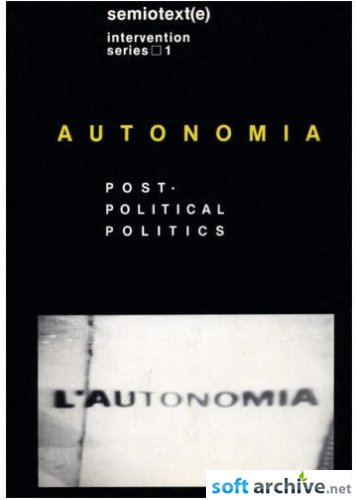
The original “movement of movements,” Autonomia grew out of the Italian student and worker mobilizations of 1968. It included migrant workers, feminists, and the unemployed. In 1977, it exploded into open revolt in the industrialized north of Italy. It made important links between theory and action and marked a major transition away from party structures towards mass anti-authoritarianism.
Somewhere between an anthology and a cloud of news clippings, Semiotexte’s Autonomia: Post-Political Politics is an attempt to conceptualize Autonomia as an event. A reprint of a 1980 edition of the Semiotexte journal, Autonomia comprises three main parts, Italian (post)-Marxist Autonomist theory, the arrest of its theorists, and their critiques of the Leninist urban guerilla Red Brigades with whom the prosecution conflated them. These are bookended by introductions by Lotringer and Marazzi and a short comic from the Autonomist journal Metropoli.
While the assemblage might have functioned to bring together the event of Autonomia in 1980, today it’s painfully obscure even to those who are familiar with the movements, theorists, and course of events it sets out to explore. Even when there are indications of endnotes to explain the legions of minor officials and demonstrations that get mentioned, they are often missing. Other articles are cut to the point of nonsense. Oresto Scalzone’s “From Guaranteeism to Armed Politics” contains the section concerned with guaranteeism but armed struggle is nowhere to be found. Although it’s not the only one, the contribution by American pacifist Judith Malina is simply a terrible piece of writing. While I understand the desire to publish a facsimile, it’s painful to see that Semiotexte couldn’t be bothered to correct the typos and fill in the blanks for readers to make the edition worthwhile.1
If you try to read it cover-to-cover, Autonomia: Post-Political Politics is a terrible book and a painful experience. However, if you’re choosy, the collection can offer an interesting glimpse into the history of engaged theory. What’s more, Autonomia’s failures call into question our own anti-authoritarian practices. The trick is to avoid the articles that read like a cross between aged Reuters copy and wiretap transcripts, which are largely those dealing with the April 7th arrests of Autonomist theorists.
The reasons the movement was called “Autonomia” becomes clear in the course of the theoretical articles. The name denotes a state of affairs where something gives itself its own law or standard. In the first instance, it refers to those sections of the movement that were literally trying to build autonomous spaces outside of capitalism. In the second instance, it refers to the autonomy of workers from the “official worker’s movement,” the Italian Communist Party, and the parliamentary system. In the third instance, it refers to the autonomous productivity of the working class, which challenges capitalism to adapt to it. This point is significant, since it contradicts the Marxist orthodoxy that finds the working class beholden to the whims of capital. According to Autonomist theorist Mario Tronti, “the problem is already the other way around, and has been right from the start” (31).
While Marxism is the touchstone of Autonomist thought, Autonomia transformed several key concepts and, in the process, significantly altered class analysis and its relation to class struggle. Tronti’s article “The Strategy of Refusal” addresses these transformations by considering the relationship between the class, its organization, and the revolution. According to Tronti, “when the class constitutes itself as a party, it is revolution in action” and that “the relationship Class-Party-Revolution is far tighter… than it is currently being presented, even by Marxists” (33-34). If we take this “tight” relationship to its logical conclusion, we can see that there is no interval between party, class, and revolution. For Tronti, the self-articulation of the working class as such is a revolutionary political achievement since it implies its breaking with its exploitative articulation by capital. Since the collapse of the temporal interval means that there can be no “planning for the revolution,” Autonomia focuses on the self-valorization of the class through the organization of workers’ refusal to submit to the logic of capital.
Each time the class articulates itself, capital must disrupt this composition with its own articulation or lose its dominance and die. According to Tronti, “increasing organization of exploitation, its continual reorganization at the very highest levels of industry and society are … responses by capital to workers’ refusal to submit” (31). The autonomous process of working class self-organization interacts with the process of capital but does not depend on it. For Tronti, working class power is “non-institutionalised political power” (32). Following this “tight” model to its conclusion, it becomes clear that class composition as a process is itself the field of political struggle.
Widening the political field in this way means that the entire social process – both inside and outside the factory – can be analysed in terms of its implications for class composition. In “The Tribe of Moles,” Sergio Bologna describes how “the concepts of capital and class composition are far better suited to define the dynamic of class relations today as relations of power” (36). For Autonomia, not only is revolution a present-tense phenomenon, it is also a process that takes place in homes, schools, the media, and in the factory. These multiple fields of engagement mean that there are also multiple openings for revolutionary politics. These are the entry holes of the eponymous “Tribe of Moles” that digs away wherever capital articulates people into processes of exploitation.
Given the reoccupation of the large factories by the political system, Bologna proposes that it is the small factory that provides “the best terrain” for the mole to “dig once again” (50-51, 54). Since struggles are related to one another in the first instance only through their conflict with capital’s productive articulation, Bologna argues that political potential rests in “a set of recompositional mechanisms that start, precisely, from a base of dishomogeneity” (51). Campaigns like wages for housework and the 150 hours paid study leave for factory workers made links across these varied fields, putting the factory, the university and the home in close contact, and so recombining them into a movement without homogenizing those based in each sector. At its best, the concept of class composition allows Autonomia to remain within the anti-capitalist tradition while diversifying its mode of struggle. It avoids falling into the ad hoc “common front” logic of a majority of political minorities because the struggle for class composition gives it unity.
Yet, maintaining class struggle at the centre of autonomist thought requires the sacrifice of an easily identifiable and homogenous protagonist. The dissolution of the hegemonic category “worker” marks a transition from socialist humanism to communist post-humanism. Although Negri’s concept of “proletarian self-valorisation” entails a humanist project insofar as it considers direct valorization without passage through the commodity cycle, it ends by overturning the basis for humanist universality. This is because production itself fractures beyond recognition without the commodity form to constrain it. Autonomous social workers produce and realize their desires directly. They overflow the subjective limits of the “mass” worker and spill over into a schizo cluster of subjectivities as conceptualized by Deleuze and Guattari. Since socialist humanism is anchored by the universality of the social worker, the productive differentiation of social workers disrupts humanism.
Paolo Virno’s “Dreamers of a Successful Life” provides an interesting account of Autonomia’s movement toward the anti-humanist economy of desire envisioned by Deleuze and Guattari. He is critical of those who heap praise on the “new desires” for leisure, drugs, creative outlets, self-improvement, wellness and more, on the grounds that these desires are mistakenly imagined as outside of the productive cycle of capitalism itself. For Virno, “social needs no longer represent either the point of departure or the point of arrival for the process of production.” Instead, “they constitute a ‘middle term’ in the route traveled [sic] by ‘money as capital’” (115). Rather than denoting the “existential radicalness” of my own being, needs express the historical form of labour and are part of “that ‘expanded reproduction’ of the prevailing social relationships” (115). These diversifying needs are invested by capitalist articulation of the working class. However, Virno pushes it one step further. He writes:
either needs are ordered by money and abstract labor, or they are filtered and arranged in a hierarchy in accordance with all the ramifications of the social aspect of the labor process, which is no longer measurable in terms of the law of value… from the reality of a broadened concept of labor stems a hierarchy of needs oriented toward emancipation, a hierarchy which is antithetical to the one mandated by the general equivalent (116).
For Virno, not only is desire itself not above suspicion, it must also be reworked as part of the revolutionary project. This requires that desire itself become an object of work and that it be subjected to hierarchical ordering on the basis of its use value for the project of self-valorization. This is in close proximity to the ethics of reconfigured desire in Deleuze and Guattari’s work and the erotic ethics of techniques of the self in late Foucault, even while Virno maintains an explicitly revolutionary program.
Part of Virno’s argument is that the revolutionary reorganization of needs requires a break with abstract labour and the general equivalent. It necessarily implies a break with capitalist economics, since money is the general equivalent and wage labour is human productive activity converted into its abstract monetary equivalent. In this way, Virno’s analysis of desire leads him to reject economics and labour as contrary to revolutionary self-valorization. This is the point that Tronti arrives at through his macroanalysis of class struggle (where labour is the imposition of capital upon workers). It’s not simply that capitalists wish to maximize their profit; labour is the condition for the existence of capitalists in the first place. Economics and labour are tools that rationalize and maintain capital’s dependence on, and dominance over, the working class despite capital’s ultimate subordination to workers (31). Consequently, for Negri, “proletarian self-valorisation is the power to withdraw from exchange value and the ability to reappropriate the world of use values” (66). At its simplest, Negri is referring to the worker’s ability to take the afternoon off and enjoy the sunshine, a use value that can’t be circulated to enrich capital. Pushed further, his thesis encompasses the refusal to allow potentially convertible use-values to be converted into exchange values, as when workers steal products rather than allowing them to be sold. At its logical conclusion, Autonomia implies a turn toward the direct appropriation of use-values.
The practical implications of this point are significant. The turn toward use-value demands a break with the social-democratic logic of collective bargaining, which poses demands in the language of exchange-value (pay for holidays, raises, insurance, etc.). In contrast, the emphasis on use-value allows for demands to be made that accord with subjects other than homo oeconomicus (including, at its threshold, group subjects of collective enjoyment). In this way, Autonomia’s orientation to use-value ties together diverse forms of engagement including absenteeism, the autoreduction movement,2 squats, the occupation of public space, and pirate radio. Each of these forms of engagement is objectively anti-capitalist because it breaks the relationship between money and use value that allows labour to be imposed on workers. They also work to integrate “non-workers” into the struggle, thus drawing the tribe of moles together to form a pack. As social workers, they recompose the new working class. As marginal phenomena, these forms of engagement are easily recovered by power structures. However, when they are linked together, they advance the process of self-valorization by joining people together in struggle while (at the same time) aiding an exodus from the labour relation.
Autonomia’s analysis of exchange value and their emphasis on use value suggests a left criticism of socialism. Following from direct struggles over class-composition and opposition to the state as the means by which the working class becomes articulated exploited labour, Autonomia stands in opposition to socialism. From the point of view of left movements in North America, this might seem divisive and unreasonable. However, given the historical failure of socialism in the East and West, this line of reasoning deserves further consideration. Autonomia was a movement for communism; it implemented communism as its means of struggle. In contrast, socialism is a system concerned with the distribution of exchange value. It depends on the generalization of labour and state regulated class articulation to stabilize itself. This is antithetical to self-valorization, class composition, and post-economic cooperation. Socialized capital is still capital and behaves as such. While Marx suggested that socialism was an intermediate step from capitalism towards communism, Autonomia considered socialism an exploitative development of capitalism, contrary to communism, and considering the advanced stage of today’s capitalism, argued for the viability of creating communism directly, here and now. Strategically, this means that we should not throw our energy behind centre-left strategies concerned with reforms. Instead, we need to work to make openings for the moles to begin digging once again.
Despite these important theoretical developments, Autonomia failed to achieve its goal. Exploitation was not replaced with self-organized communism, but rather was intensified. The Italian state made strategic use of the Red Brigades terrorist attacks in order to imprison tens of thousands of activists. But while the state’s actions seriously impacted the movement, they cannot be viewed as the cause of Autonomia’s failure. As an anti-authoritarian movement, Autonomia’s vulnerability to this attack is a practical failure to disrupt the state. Given that state repression is now more effective than ever, the question with which we must concern ourselves is how Autonomia found itself in a position to be repressed at all.
Paradoxically, it appears that Autonomia’s failure arose precisely because it was so massive and vibrant. The movement’s theorists attempted to find a unified language of universal expression so that the movement could bring together disparate social sectors in order to compose a new political subject. In the process, they became recognizable to the state as humanist subjects capable of expressing themselves. This represents a step backwards from class composition as social workers, a step back into the capitalist articulation of and domination over the working class. In so doing, they made themselves targets for arrest and imprisonment. Autonomia was still too intelligible, too universal, too much of a movement, and still too representational, mirroring the communications logic of the mass media. By launching so many books, magazines, newspapers, and radio stations, they allowed new noises to overtake new values.
This sombre note can be detected in Félix Guattari and Eric Alliez’s contributions “The Proliferation of Margins” and “Hegel and the Wobblies.” Although militants with Autonomia seem to have understood the pressing need to break with universality, it was never thoroughly put into practice. Similarly, Collective A / Traverso argue that Autonomia’s failure arose from the fact that it obsessed over truth, opposing the obvious to the secret rather than seeking to become an imperceptible current or contagion. This is not a dry historical point since the contemporary theory of “Multitude” is a reworking of class composition and still works in much the same way. So too do many recent projects of the global extra-parliamentary left – from Gaza support to open borders activism to the renewal of labour organising. For the stunning successes and terrible failures of Autonomia, and our own organising, Autonomia: Post-Political Politics (or at least a portion of it) deserves careful consideration by contemporary anti-capitalists.
Notes
1 Of course, an electronic facsimile of the original journal is available on-line at generation-online.org and text files of articles are available there and through marxists.org
2 “Autoreduction” is the term given to the process by which consumers set the price of commodities according to what they deem to be reasonable.