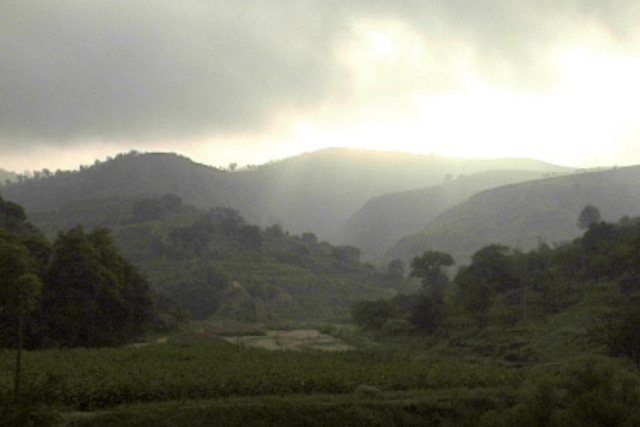
 |
| THE LOESS PLATEAU THE CRADLE OF CHINESE CIVILIZATION |
I was thinking last night I ought to do something once in a while that isn't an awful story...for all or our's sanity.
I came up with this. Here is something that does show that once in a while anyway, someone, even a State, for some reason, does actually take on a project that benefits the ecology. It shows that some things are at least possible. Though I don't totally understand what the author means when he talks about making the basis of money a functional ecosystem instead of being derived from production and consumption, I do understand when he mentions "valuing ecological function above production." It is when he combines the two concepts that I again become somewhat mixed up. When he writes in conclusion that, "By valuing ecosystem function above production and consumption and making this the basis of the global monetary system it becomes possible to restore all degraded land anywhere on the planet," I again grow confused. It does seem to me to maybe be a "nice" way of saying, at a minimum, we can't continue on with capitalism. I certainly agree with that.
Read the long story below. It is interesting, remarkable, different, and I think is well worth thinking about.
After all, someone has to do something.
The following is from The Permaculture Research Instittue of Australia.
Finding Sustainability in Ecosystem Restoration
Biodiversity, Community Projects, Conservation, Consumerism, Deforestation, Food Shortages,Global Warming/Climate Change, Plant Systems, Population, Regional Water Cycle,Rehabilitation, Soil Conservation, Soil Erosion & Contamination, Trees, Water Contaminaton & Loss, Water Harvesting — by John D. Liu November 17, 2012

Before (below) and after (above), Loess Plateau Watershed Rehabiliation Project

A Breakthough of Worldwide Importance
In 1995, as the Chinese government and people were beginning an ambitious effort to restore the cradle of Chinese civilization, I was asked by the World Bank to document the “Loess Plateau Watershed Rehabilitation Project”. Originally the Loess Plateau had been fully vegetated with massive forests and grasslands. Resources extracted from the giant forests, rushing rivers, and abundance of the earth in this place blossomed into the magnificence of the Han, the Qin and the Tang dynasties. The accomplishments of the early Chinese dynasties, based in this area, rank among the greatest human scientific and artistic achievements of any age. The Loess Plateau gave birth to the Han race, the largest ethnic group on the planet, and the plateau is generally considered by historians and geographers to be the second place on Earth where human beings began to use settled agriculture.
As bright as the beginning was, the area over time suffered and eventually was almost completely denuded of vegetation. By 1000 years ago the Loess Plateau had been abandoned by the wealthy and powerful and by the mid-1990s was famous mainly for a continuous cycle of flooding, drought and famine known as “China’s Sorrow”. Over the years since beginning this inquiry in 1995 I have witnessed an extraordinary transformation on the Loess Plateau. The changes have been brought about by differentiating and designating ecological and economic land, infiltrating rainfall, terracing, and consciously increasing biomass and organic material through massive planting of trees in the ecological land and using better agriculture methods in the economic lands.
A measure of ecological function has been returned to the region and the general direction of development is now positive and accumulative with the functionality continuing to improve. The changes on the Loess Plateau have been transformational and are contributing to a growing movement to restore all degraded land on the Earth. As my understanding has grown I have presented the Loess Plateau restoration efforts and results of the restoration worldwide through public speaking and in several films including: “The Lessons of the Loess Plateau”, “Hope in a Changing Climate” and “Green Gold”.
I have been on a very long journey of inquiry since beginning to study China’s Loess Plateau. This article contains much of the journey, the wonder and beauty I have seen along the way and the conclusions that I have come to. My experiences have made me realize that while we live in interesting times, we are not helpless in the face of the many challenges we are grappling with. Biodiversity loss, human induced climate changes, increasing incidence of extreme weather, pollution, food insecurity, desertification, human population growth, financial crisis, racism, war, violence, and migration, are just some of the concerns that we have. What exactly is happening? Why do we seem to be on a downward spiral, leading seemingly toward an eventual catastrophic collapse? Are all these negative outcomes inevitable? Is it “God’s Wrath” directed at us because we have sinned and because of this we have been cast out from paradise? Should we take that literally or could this be a poetic metaphor intended to lead us to understanding? The inquiry that began with a short assignment to document a project in China has led me to every continent on Earth and to cast my thoughts across historical, evolutionary and geologic time. My focus in the beginning was to gain a better understanding of the biophysical aspects of Earth Systems but has more recently turned to how this is related to human activity, work and the economy. Surprising implications are emerging. What was at first distant from current events is now suggesting a new development paradigm that could address the most serious problems we face with profound implications for the present and the future.
Studying the Loess Plateau has proven to be broadly analogous to studying other cradles of civilization on the planet. By reducing biodiversity, biomass and accumulated organic matter the people of the Loess Plateau destroyed the ability to infiltrate and retain rainfall in biomass and organic soils, causing an area the size of France to dry out. Without the constant nutrient recycling from decaying organic matter, the soil and its fertility was eroded away by wind and water and the place was left barren and subject to intense flooding, drought and famine. There is evidence throughout the world of this phenomenon. This outcome is similar in Mesopotamia, the Mediterranean, Central Asia, the Sahel region of North Africa and elsewhere. What is different about the Loess Plateau is that there was a conscious decision to try to reverse the degradation at scale and restore ecological function to a vast area. The work on the Loess Plateau is helping prove that it is possible to rehabilitate large-scale damaged ecosystems and that this is the best way we have to mitigate and adapt to human induced climate changes as well as address numerous other problems.
Background: Natural Systems Global Research
The historical degradation and the contemporary restoration of China’s Loess Plateau is a complex story but it can be analyzed and understood. To really understand this some background information is necessary. For me this has meant traveling to degraded lands all over the world but also to the remaining pristine ecosystems in Africa, Asia, and the Americas to see what systems that have not been altered by human beings are like and what has been lost when we have changed the systems. My journey has taken me to over 80 countries around the world to look at the differences and similarities between the vegetative, hydrological and ecological functioning in various continents and ecosystems.
This has made me rather philosophical. With a good imagination it is possible to think back to a time before human beings had massively altered natural systems on the Earth. When we leave the environment that we humans have constructed even now we find great forests rich with oxygen, moisture, the scent of orchids and other flowers. These great remnants of the Earth’s natural systems can be found on all continents. In these great primary forests epiphytes cling to every surface, making it seem that the trees have beards hanging from their limbs and fur on their bark. Even the rocks are covered in moss or mottled with lichens. The forest floor is covered with decaying organic matter, the remains of former generations of plants, from which spring giant ferns and colorful fungi. Animal droppings on the pathways, paw-prints, birdsong and animal cries, provide evidence that the forest is not just for plants.
Within these forests are ancient trees that live for thousands of years. Giant trees anchoring vast diverse ecosystems, coexisting with their descendents and symbiotically with myriad forms of life. When it rains the raindrops hit the towering ancient canopy and then drizzle down, nurturing each level of the multi-story environment. Water drops bead on the tips of the leaves, slowly forming, and when fat and heavy they drop to the next lower level, the process beginning again. The air is dense with humidity that bathes everything in the forest. Water springs spontaneously from rock formations and flows joyously in clear streams growing stronger and stronger until eventually forming great rivers.
The rivers flowing from the highland forests inundate the wetlands in the lower lands below on their paths to the sea. During the rainy seasons these wetland systems absorb huge amounts of water and during the dry seasons they slowly release it so that the land is never dry. At various times in the year the sky is darkened by enormous migratory flocks of birds. Various species compete in seeking nesting grounds in a riot of birdsong and the beating of wings. In the coastal zones where the land and the sea meet are vast mangrove forests, the interface between the land and the sea and the breeding grounds for much of the sea’s life. Where there is little rainfall one finds seemingly endless grasslands interspersed with trees and plants specially adapted to the exact rainfall patterns of each specific ecological habitat. In the grasslands and savannah regions vast herds of migratory animals abound.
Evolutionary Trends: Through Decay to Fertility
In visiting these places and studying how they function I found that three evolutionary trends have been continuously at work. The first trend is toward total colonization of the Earth by biological life. The second trend is toward the constant accumulation of organic material as each generation of life gives up its body in death. The third trend is toward continuous differentiation through speciation leading to the potential of infinite variety in genetics or biodiversity. These trends over evolutionary time transformed a lifeless rock surrounded by poisonous gases into a wonderful garden. The basic engine for this change is photosynthesis, which takes sunlight, water and geologic minerals and converts them to living biomass. The photosynthesizing biomass has through gas exchange over prodigious time created and maintained the oxygenated atmosphere that we now breathe. The enormous quantities of biomass and accumulated organic material also infiltrate and retain rainfall releasing the moisture in respiration, creating, constantly filtering and continuously renewing the hydrological cycle that provides the water we drink and use in so many ways. The decay of organic matter over evolutionary time has built and renewed the fertility of the soil from which our food emerges. Even the fossil energy that we are so blithely using is derived from ancient photosynthesis and organic matter that decayed under specific pressurized conditions. These processes and functions of nature are the physical basis of life.
The Ecological Collapse of Civilizations
Into this natural world our human ancestors were born and as many great cultural cosmologies state we emerged in paradise. Through ingenuity and courage, we humans have become the latest dominant animal species. Our elevation to this lofty position has taken place in the relatively short time since the last ice age receded approximately 10,000 years ago. Yet we do not exist separately from other parts of the living earth, we are part of this system. As human power has grown we have cut down vast forests, converted natural systems to agriculture, relentlessly grazed our livestock, built great cities and industrial zones. Throughout the last 10,000 years various civilizations have risen but they have also fallen. Human history shows numerous examples of civilizations that failed to conserve and protect the natural diversity of life, the fertility of the soil and the hydrological cycle, and collapsed. Currently, as we experience biodiversity loss, extreme weather events, desertification, food insecurity, human induced climate changes, financial crisis, poverty, disparity, war and all our other problems we are facing the same fate as those civilizations that went before us. But our dilemma is somewhat more dangerous because while in the past the centers of power and affluence just shifted we are now altering planetary ecosystems. We urgently need to understand what is happening and what to do to ensure that history does not repeat itself.
| "Witnessing the incredible potential of restoration has helped me to understand that degradation is not inevitable and that there is a path forward for humanity that leads to a sustainable future." |
Our ancestors took great pride in their accomplishment as magnificent structures and complex institutions grew in the same way that we are now sure that our accomplishments are significant and enduring. But this can also be seen as hubris that focuses our attention on the transient and blinds us to the enduring and profound. Seeing how the early Chinese had destroyed the very systems needed for life has helped me to understand the process of ecological degradation and the relationship between human activity and degradation. Witnessing the incredible potential of restoration has helped me to understand that degradation is not inevitable and that there is a path forward for humanity that leads to a sustainable future.
What we know about the ancient civilizations of our human ancestors we glean from the ruins we unearth of once magnificent palaces and temples. The broken statues that stare at us across time suggest how seriously each generation takes their own existence. But finally the people who built these palaces die and if we don’t keep pulling the weeds up by the roots, biological life will swallow the infrastructure whole and it is again up to generations far in the future to “discover” the ruins and try to make sense of it all. But while the exploits and lives of our ancestors may be vague we do receive a record of what their lives did to the natural systems. We are left with the consequences of their understanding and decisions concerning the infiltration, retention and regulation of water, the respect or lack of respect for biodiversity and their understanding of fertility in the soils. The geographical records documenting this are quite clear. Virtually every past civilization degraded their ecosystem and many were driven to collapse when the system could no longer support them with food or water. That so many different civilizations in different parts of the world all suffered the same fate makes me consider humanity as a species and not a collection of different races. We may have cultural differences but our similarities are too great to ignore, not to mention the genetic evidence that we are all related.

In Rwanda, where relatively recent ecological degradation from over-farming in
the designated protected highland watersheds saw the near failure of the country’s
hydro-electricity supply, the government has undertaken a similar rehabilitation
project to China’s and experienced almost immediate improvements. Free ranging
goats are, however, still a problem. Gishwati Forest, Rwanda.
All the great civilizations include a great respect for the wisdom and contribution of those who have lived and died in the many generations that have gone before. Within the rise and fall of the great ancient civilizations on earth are profound lessons that our ancestors are sharing with us. The lessons of the Loess Plateau show that soil is not simply a medium for our agricultural crops to stand in and that fertility is not simply nitrogen, phosphorous and potassium to stimulate growth. Organic matter is required to recycle nutrients from one generation of life to the next and microbiologic communities that live in organic soils are required not only to assist in recycling but also to release nutrients from geologic materials and to infiltrate and retain moisture. Understanding that these same organic soils are the second largest carbon sink on Earth after the oceans is to recognize their role in mitigating and adapting to human induced climate changes and how they are of vital importance for our survival and sustainability.
The people of the Loess Plateau had interrupted the three great evolutionary trends that created the living system and that regulate the ecological functions on the plateau. The long destructive patterns of behavior on the plateau had left a nearly completely dysfunctional system. The cycle of poverty, ecological destruction was manifest in the cycle of flooding, drought and famine. Erosion of the loose sedimentary soils meant that huge sediment loads were deposited into the Yellow River increasing the risk that the river would flood it banks. Without vegetation cover or soil moisture the natural evaporation rates and temperatures were artificially elevated causing the plateau to be hotter and drier than necessary.
All this can be briefly stated as a reduction of biodiversity, leading to a reduction of biomass, that necessarily causes a reduction in the accumulation of organic matter, all of which causes reduction in gas exchange through reduced photosynthesis, a massive reduction in nutrient cycling through the loss of decaying organic material and a reduction in infiltration and retention of rainfall leading to the loss of natural regulation of the hydrological cycle, the weather and the climate. This is a very concise description of the developmental trajectory that has lead to the ecological collapse and the failure of numerous human civilizations.
The Causes of Degradation
In the Loess Plateau a multiyear study was implemented in the early 1990s in order to determine what was causing the consistent degradation. The negative factors that caused the vegetation to be lost were identified as tree cutting, farming on steep slopes and free ranging of goats and sheep. All of these negative behaviors were eventually banned. While understanding how ecosystems become dysfunctional is extremely important and somewhat satisfying, in order to get a different outcome on the Loess Plateau it was necessary to have a complete change in people’s behavior. Although many people assume, that in China, governed by the Chinese Communist Party, that the government could just order the people to give up their traditional behaviors, this was not the case. A massive public education campaign using the well-tested Participatory Rural Assessment (PRA) was employed to engage the population into the inquiry. This meant that the people could understand not only what the government was asking them to do but why. Geographical Information Systems (GIS) was also employed providing satellite images to map every watershed on the plateau. In this way a unique address could be assigned to even the smallest watercourse. Enterprise software that reflected every investment and every intervention was also used to track changes throughout the management chain.

Above: Former intact rainforest, recently highly impacted by mountain top and
slope farming, Gishwati Forest, Rwanda. Below: The White Nile and Congo River
watershed, functioning highland water tower system, Nyungwe Rainforest
Kamiranzovu, Isumo Waterfall, Rwanda.
slope farming, Gishwati Forest, Rwanda. Below: The White Nile and Congo River
watershed, functioning highland water tower system, Nyungwe Rainforest
Kamiranzovu, Isumo Waterfall, Rwanda.

The Problem: Productivity Valued over Ecosystem Function
Once the basic historical mistakes that needed to be addressed were identified a plan was developed and several physical interventions were envisioned. This began by making an econometric evaluation of profound importance. The Chinese recognized that the ecologic function that was being lost was vastly more valuable than the productivity that was being extracted from the plateau. This allowed them to make a huge breakthrough that is leading to several non-linear and somewhat counter-intuitive outcomes. Because they determined that the ecosystem value was higher than the productive value it made sense to designate much of the land as ecological land rather than economic land. This measure alone is a giant step forward in ensuring that biodiversity will survive into future generations. This step also concentrated the agricultural development in smaller areas where there could be focused investment and improvement. Although using Geographical Information Systems was basically a mapping exercise, it provided a strong tool to show everyone what was being contemplated and what was at stake. Since the project area was 35,000 sq kilometers the work reached a scale that went far beyond individual or even community production and income and reached landscape or ecological scales.
The Dynamics of Rainfall
One of the most fascinating things that I have learned on this journey is about the dynamics of rainfall and the role of the canopy, undergrowth and organic matter in regulating the natural water cycle. For the restoration of the Loess Plateau the next step was an engineering feat. Due to the massive impact that centuries and millennia of poor agricultural practices had it was necessary to first ensure that all the rain was infiltrated and retained where it fell. The plateau like many other parts of the world receives water at specific times of the year. These rainy seasons in this part of the world are monsoonal and depend on rainfall coming out of the Himalayan Mountains. These rain patterns have been relatively consistent and should have given a clue to ancient peoples what was happening to them. But because of the slow pace of change that might have been happening over generations they failed to see that although the rainfall was not changing that much, the infiltration, retention and evaporation was changing at a far greater pace. The answer was a series of engineering works such as, sediment traps, check dams, meanders and terraces, all designed to slow the runoff, to infiltrate and to hold the water within the system. In the very beginning this was a physical intervention but it quickly became a biophysical intervention as permanent vegetation grew up in both the ecological and the economic lands.
Differentiation Between Ecological and Economic Land
The Chinese determined that although the value of the ecological function was higher than the value of the production the people still needed to eat, to feed their livestock and to make some money by selling things on the local, regional and global economy. Having already banned slope farming they were limited in how much land could be used for agriculture. In order to maximize the area available for farming they decided to terrace the hillsides. If they could make the fields flat then they would be useful for farming without the enormous erosion caused by the slope farming. If they could not be terraced then the land would by necessity fall into the ecological land category and the people would not be allowed to farm it. This was a second massive engineering task and it was achieved by hiring the people to engage in the activity. This meant that the people gained in three ways. They were earning money, they were learning new sustainable agricultural methods and they would eventually own the outputs that came from the fields.
Worldwide Recognition of Land Rehabilitation
| “By bringing scientists, technicians and managers into the local communities the Chinese essentially helped transition poor, often illiterate subsistence agriculturalists to a new paradigm within one generation.” |
Over the years of following the rehabilitation of the Loess Plateau I have witnessed the land change from a fundamentally degraded system into a system that is stimulating the growth of vast amounts of biomass, accumulating organic matter in the soil, protecting and creating new habitat for biodiversity and naturally infiltrating and retaining rainfall. The results have exceeded even the designer’s expectations and have shown that it is possible to rehabilitate large-scale damaged ecosystems. By bringing scientists, technicians and managers into the local communities the Chinese essentially helped transition poor, often illiterate subsistence agriculturalists to a new paradigm within one generation.

Above: Displaced and growing populations pushing into once undisturbed highland
forests, Gishwati Forest, Rwanda. Below: Njungwe Forest, monitoring wild
chimpanzees, Rwanda.
forests, Gishwati Forest, Rwanda. Below: Njungwe Forest, monitoring wild
chimpanzees, Rwanda.

Seeing and documenting the restoration of the Loess Plateau has been a source of inspiration and purpose but also a huge responsibility. When I began to realize how important the developments I was witnessing were, I began to speak publically about it. This has led to hundreds of opportunities to speak to various audiences of all sorts from the British Royal Society, to elementary school children, to many universities and to the presidents of several countries. As well the films are helping inform many about the potential of restoration. Gradually, a shift in perception is emerging all over the world, the principles outlined in this essay are being taken up by various institutions, organizations and individuals. The United Nations Framework Convention on Climate Change (UNFCCC) has begun to see the importance of restoration, as had the United Nations Convention on Biological Diversity (UNCBD) and the United Nations Convention on Combating Desertification (UNCCD). The United Nations Forum on Forests (UNFF) has adopted the idea of restoration as has the Global Partnership on Forest and Landscape Restoration.
In the beginning of February 2011 at the United Nations General Assembly in New York the Rwanda Forest Landscape Restoration Initiative was formally launched. In August 2011 the Society for Ecological Restoration held its global meeting in Merida, Yucatan in Mexico where nearly one thousand scholars and restoration engineers convened to discuss the potential worldwide. In the beginning of September 2011 the Bonn Initiative led by the German Government set a target of restoring 150 million hectares or about 7 % of the estimated 2 billion hectares of degraded lands around the world. As I have been studying, documenting and communicating about the potential of restoration it has gone from being virtually ignored to being considered by many as the most viable option humanity has to combat human induced climate changes, biodiversity loss, desertification and more.
Human Economics and the Earth’s Ecology
Gradually as I have become aware of the enormous implications of what I have been studying I began to consider why do civilizations separated by large distances and in various times all end up destroying their ecosystems? My conclusions from observing natural systems in every continent suggest that it is not at all inevitable that ecosystems must degrade. They are degraded because human beings don’t understand or value their function. These thoughts have led me to examine human economics in relationship to the earth’s ecology and what I have found is perhaps of equal importance to the biophysical understandings, and the potential of restoration that has been detailed in this essay.
| “As long as our global economy continues to value production and consumption higher than the functioning ecosystem the results will remain the same and the outcome for humanity and the planet is bleak.” |
What the Chinese found on the Loess Plateau that allowed them to take the crucial step toward restoration was the theoretical understanding that “Ecosystem Function is vastly more valuable than the production and consumption of goods and services”. This statement changes everything. Over historical time human beings have valued the production and consumption of products and services higher than they have valued ecosystem function. Actually the situation is even worse because ecosystem function was not valued at all but was considered as a free good. This is just simply wrong and has created a perverse incentive to degrade the ecosystem. As long as our global economy continues to value production and consumption higher than the functioning ecosystem the results will remain the same and the outcome for humanity and the planet is bleak. It seems that humanity has made a gigantic error through our ignorance and has compounded this error over historical time. Some clichés such as “money is the root of all evil” perhaps should not be dismissed without consideration.
Money is now derived from the production and consumption of goods and services. This is the Gross Domestic Product or GDP. This thinking says that the total of the economy is what we produce and consume. But there is the rub. All the products and services we produce and consume come from functional ecosystems. If the ecosystems collapse then we actually have no productivity. This suggests the same finding that the Chinese had, that “Ecosystem Function is vastly more valuable than the production and consumption of goods and services". Recently there have been many attempts to envision “Green Economics” but the problem with many of these efforts is that they leave the fundamentals the same. They continue to assume that the basis of money is production and consumption.
This line of thinking made me ask: “What would happen if money were not derived from production and consumption, but the basis of money was functional ecosystems”? The answer seems to be that everything would change. Society would be completely transformed by this understanding, instead of working to produce and consume more and more, humanity would work to ensure that ecosystems functioned well. If ecosystem function was the basis of money the development trajectory would be accumulative and ecosystem function would be protected and improved. This replaces scarcity with abundance. This shows where and how the economy can grow larger than it is now but it doesn’t require endless and mindless growth of production and consumption in order to have wealth.

Pen fed sheep are a firm and increasingly observed rule now for all of China
When we study the consequences of human impact on biodiversity, desertification and climate changes, we realize that we are facing enormous problems and that the solutions must be equal to the size and difficulty of the problems. Redefining the basis of money and wealth certainly fits these criteria. Many of the problems we are facing were created long ago and have been institutionalized and legalized over generations. This makes it difficult to act because we must return and address fundamental mistakes of past. These mistakes are not our fault and we tend to simply accept them because they were envisioned and created long before we came onto the scene. Yet in order for us to ensure a sustainable future we must address these legacy issues.

Above: Mongolia — high impact from herding too many animals.
Below: Mongolia — vast dry steppe landscape

Poverty: Valuing Production over Ecosystems
Studying and documenting in over 80 countries around the world has allowed me to see many large degraded areas and one common denominator seems to be poverty. Large numbers of poor people are degrading their ecosystems in order to survive. Yet when one looks deeply into the situation one finds that the poverty has been imposed on the region because the people have been told that the natural ecosystem is worthless and only the products extracted and sold to the global production and consumption economy are of value. If ecosystem function were in fact valued the people often would not be poor at all. It is not simply ironic but terribly cruel that the developed world is providing “development assistance” to many countries and actually telling them that they must restore their ecosystems when simultaneously the values that the developed world have imposed on these societies are causing of the degradation.
Mali is a very good example of this. 14 million people live in lands measuring over 1 million square kilometers. This is like the population of Los Angeles living in an area almost twice the size of France. In Mali each year the inner Niger Delta floods to over 6 meters. This immense amount of water over evolutionary time was absorbed into giant trees and the specialized grasses. 85% of the vegetation is water and holding this much water in place helps to regulate the water cycle, the weather and the climate. But historically and now the vegetative cover has been consistently decreased. Simultaneously we are worried about biodiversity loss, desertification, the risk of extreme weather events such as flooding and drought, and the potential that human activity is causing massive climate changes including temperature increases. I have not found any biophysical reasons why the vegetation in Mali must be decreased. There doesn’t seem to be anything stopping the vegetation from returning except that we don’t value it and force the local people to cut it in order to get some money to participate in the global economy. Valuing production higher than ecosystem function in Mali forces virtually the entire population into poverty and destroys the very regulatory functions the world needs to reduce the threats of desertification, biodiversity loss, extreme weather events and climate change. Just think what would happen in Mali if ecosystem function were valued higher than production and consumption. Vegetation would again cover the land because it would be recognized as the basis of wealth.
The example of Mali is only one of numerous countries where the potential for rehabilitation is huge. However, in order to restore these systems the reasons that they were degraded in the first place must be addressed. And it is not simply in developing countries that valuing ecological function above production would have an impact. In the developed world millions of people are striving to produce and consume as much as they can because they are rewarded to do so. We are told that we must grow the economy and in order to do that we must produce more. The problem is that there are limits to growth. We cannot endlessly produce and consume more and more without catastrophic outcomes. For those with jobs it means working more hours and working harder. For those without jobs it means slipping further away from acceptability, the respect of others and sometimes even losing self-respect. This is the system, the daily grind, the rat race and it is just assumed to be necessary to serve this model. But it is illogical, immoral and impossible to sustain it. It is illogical because all the products and services we produce and consume can be shown to come from functional ecosystems, which we have valued at zero and this creates a perverse incentive to degrade the ecosystem. It is immoral because this system has been imposed on billions of people without their understanding or agreement and many of these have been impoverished by the experience. It is impossible because we cannot infinitely extract finite resources to grow the economy. It is like trying to fill a bottomless pit. If we stay the course we are finished. This is why Sir Nicolas Stern said that the “Business as usual scenario is no longer possible.” So for those trapped in this world of over production and over consumption, what would turn this juggernaut toward a more sustainable path?
The Path to a Sustainable Future and Climate Stability
For both the poor of the world living in large degraded ecosystems, and the so-called wealthy in the developed world, transformational change now seems to be required. Humanity cannot survive without functional ecosystems and the actions of all people are needed to act together as a species on a planetary scale to ensure that vital Earth systems are restored. From what I have seen the determining factors for survival and sustainability on the Earth are biodiversity, biomass and accumulation of organic matter, the more the better. The lessons of the Loess Plateau show that it is possible to restore large scale damaged ecosystems and that this mitigates and helps us adapt to climate impacts, makes the land more resilient and increases productivity. The Loess Plateau also shows that valuing ecosystem function higher than production and consumption allows one to make the choices necessary to make long-term investments and see the results of trans-generational thinking.
It can be daunting to consider the problems we currently face. There is much to distract us from pursuing what we imagine must be a dreadful pursuit. But the decisions we make are going to determine what the future will be for those who come after us.
Over the years I have been studying and documenting functional and dysfunctional ecosystems I have come to a number of realizations. One is that there are rarely biophysical reasons that ecosystems become dysfunctional. Ecosystems are mainly disrupted when human beings don’t value the function but instead value the products and services that are extracted from functional ecosystems.
By valuing ecosystem function above production and consumption and making this the basis of the global monetary system it becomes possible to restore all degraded land anywhere on the planet. We already have the knowledge necessary to do this and we certainly have the need for us to do this given the enormous threat of climate change. This seems to be the way to change the paradigm from producing and consuming for the wealthy and to end the grinding poverty that has been imposed on billions in the developing world. This is also the way to ensure that the great forests, wetlands, grasslands all return to the earth in their splendor and function for future generations to benefit from, admire and cherish. This is the development trajectory that leads to a sustainable future.
~~~~~
 John Dennis Liu
Senior Research Fellow, IUCN
Director, Environmental Education Media Project (EEMP)
+86-13911-565016
Currently though crowd sourcing and partnerships we have “Hope in a Changing Climate” in English, Chinese, French, German, Spanish, Russian, Vietnamese, and Arabic is currently in production (although may be affected by unrest in the Middle East). These films are only a small part of the Environmental Education materials created and distributed by the Environmental Education Media Project (EEMP). We are seeking volunteers and partnerships to collaborate to ensure people all over the world can benefit what we have learned and produced.
High Resolution Copies of the Films for Broadcasting are available. If you would like to broadcast or to translate these films into other languages please contact the Environmental Education Media Project and we will help you.
Check out: www.whatifwechange.org


