Tuesday, February 14, 2012

THIRTY TWO IRISH WORKERS ARE OCCUPYING THEIR WORKPLACE AND WINNING THE HEARTS OF THE IRISH PEOPLE


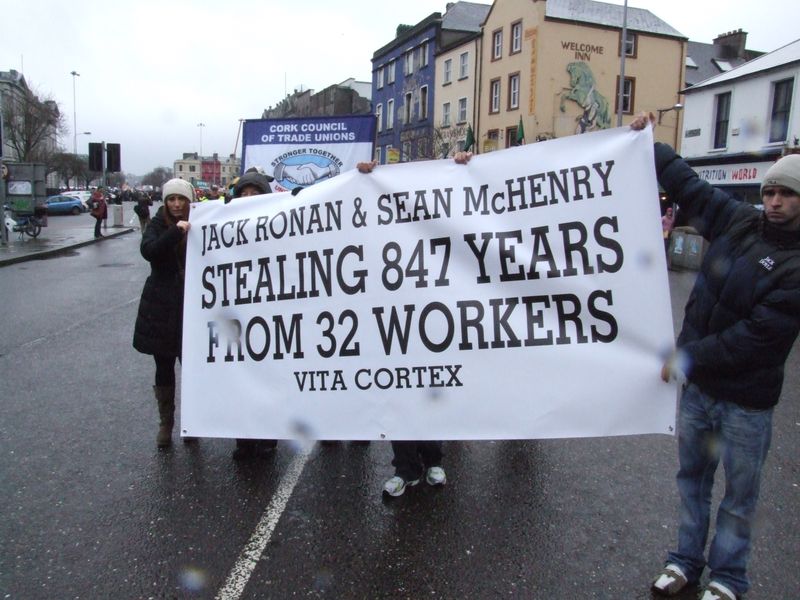
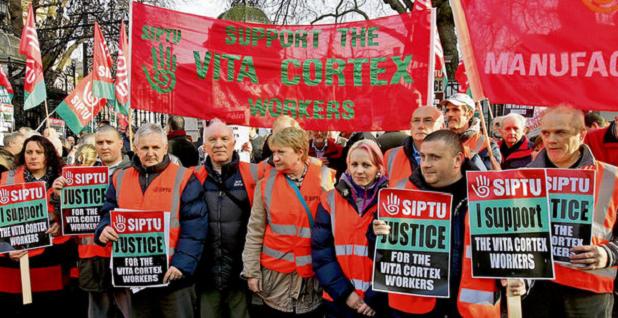
Last weekend more than five thousand people marched in Cork, Ireland in support of workers who have been occupying the Vita Cortex plant for three months.  Amongst the marchers were local La Senza workers who are engaged in a similar struggle.


Thirty-two former workers were not paid redundancy when the foam manufacturing plant in Ballyphehane closed in mid-December and have been staging a sit-in protest at the facility ever since.

Service Industrial and Technical Union (SIPTU) spokesperson Anne Egar said the workers' campaign has captured the sympathy of the nation.

She told the Irish Examiner, "I think that their dignity has been an example to everyone around the country," she said.

"Their story has certainly resonated with people."


While the support of the SIPTU is appreciated it is to be said that it is blunted by the Union"s association with the governing Irish Labour Party and the class collaborationish history of Irish trade unions in general.  As Ceasefire Magazine writes:


"...thus there have been no calls for the government to put pressure on Vita Five Five to fulfill its legal obligation to file its accountsm, nor any demands for the government to save the workers’ jobs through nationalization or proposals for solidarity actions by workers in Vita Cortex’s other factories in Belfast and Althlone."
Late in January, the workers issues an open letter which reads:


"Today marks the 42nd day of our sit-in. When we began this protest we really didn’t believe that we would still be here in late January. We honestly believed that Jack Ronan would see the light and pay us a just redundancy given the 847 years of service that we have given to Vita Cortex. Sadly, following the collapse of LRC talks on Friday, it is clear that he remains determined to cling to an intransigent position.
"Some of the moves made on his part, over the course of the negotiations, have left us feeling disgusted. The situation is disappointing and we look forward to the day when Mr Ronan realises the gravity of the injustice that he is perpetuating against us. We hope that he will find the decency to turn away from his current path. It is time for him to meet his responsibilities not only a businessman but also as a human being.
"The Irish public have been amazing in their support of our struggle. However, we are aware that life moves on. But life cannot move on for us until we secure an equitable resolution. We never asked to be seen as heroes or role models but we are grateful to those who have described us in such glowing terms. We also realised, sometime ago, that this is not just about us. It is fight that must be won in order to ensure that this cannot and does not happen to anybody ever again.
"The media have rallied to our cause and this is something that should be recognised. But we call on all media outlets not to forget us in absence of talks or negotiations. The struggle is here on the factory floor. The media has done a great job in bringing our story to you all and we hope that they will continue to do so.
"We also ask everybody to get behind us online through Facebook and Twitter. The online campaign has done wonders in terms of internationalising our situation. It continues to gain momentum by the minute.
We call on all politicians to intensify their representations on our behalf. We particularly call on government ministers to take action and use their influence to ensure that we end up with a fair deal.
"We also ask all the employers of Ireland to treat their workers with respect and dignity during these difficult times. There a great many honest and hardworking business owners in Ireland. Many of you are our friends. Indeed, many of you have supported our fight for a fair settlement. Unfortunately, in times of economic hardship communications can become strained and conflict can arise. However, nobody should have to go through what we are going through.
"One way of working towards economic recovery would be the development of a real and genuine departure from old thinking and tired ideas. The emergence of a values-based relationship between employers and workers can become a reality but only if the will exists to work towards it. However, such a departure cannot carry with it, the weight of injustices such as the one being carried-out against us over the last six weeks.
So here we remain folks: sitting-in for justice, asking for support.
Sincerely,
The Workers of Vita Cortex
January 26, 2012"


The following article is from Libcom.org

Vita Cortex ‘sit in’ reaches 60 days

Vita Cortex ‘sit in’ reaches 60 days
Vita Cortex announced it was closing its Cork plant in September 2011. When the workers finally got issued their notice in December they discovered that the bosses had screwed them out of their redundancy payments. The workers occupied the factory, and have remained there since. Their occupation has now reached 60 days. They are refusing to leave until the bosses cough up what they owe.
Since December last year, thirty two workers have occupied a foam packing factory in Cork, Ireland. They are demanding redundancy payments that they were promised.
Workers at the plant were promised 1.2 million Euro’s in September when it was announced the plant would be closing, and production transferred elsewhere.
Staff were given their redundancy notices on December 16th (merry Christmas) yet there was no sign of the money they were owed.
In response, the workers occupied the factory and have remained there ever since. They have since rejected a derisory offer from the bosses of 1,500 Euro’s each to leave.
For many of the workers Vita Cortex is all they have known. The 32 occupiers have worked for the company for a combined total of 847 years. They now face little chance of finding alternative work as there are over 25,000 unemployed people currently living in and around Cork.
In a typical bosses trick, Vita Cortex has shifted money here, there, and everywhere, passing assets between companies making it difficult for anyone to get at it.
In a show of solidarity, the local fire brigade has been delivering food to the occupiers, and a taxi firm has been offering their services free of charge.
Yesterday, over 5,000 people marched through Cork in support of the occupation. It was the biggest demonstration that Cork has seen in years.

Monday, February 13, 2012

PORTUGAL IS GREECE YESTERDAY AND GREECE IS PORTUGAL TOMORROW


WHO IS THAT GUY ON THE FLAG?


You have heard by now all about this last weekend in Greece where the lid is coming off.  I had intended to do an article on this right here, right now.  However, I figured lets just look around a minute.

Portugal is what I found

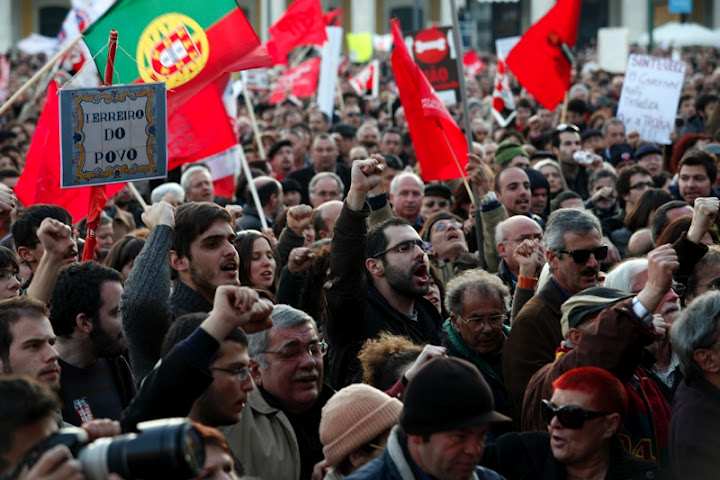
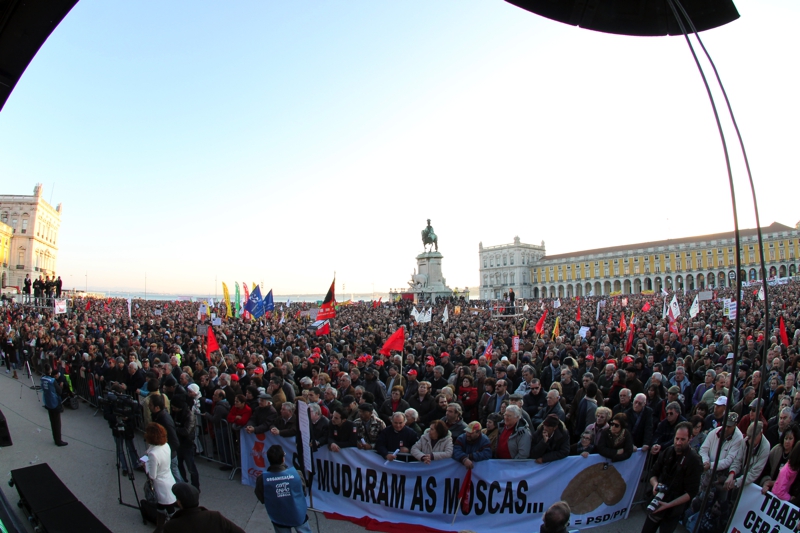
As the Empire's money men from the IMF head into that country to view what they have accomplished with their "austerity" (are you tired of that word yet) plan, the largest protests in three decades erupted to meet them.  Hundreds of thousands of people representing the Portuguese section of the world wide multitude packed Lisbon's Palace Square to protest.

They protest with good cause.  since the IMF's plan was instituted the unemployment, the official unemplpyment rate has jumped to record levels and pushed Portugal into it's worst recession in nearly forty yearts.  The IMF plan includes cuts of 13 to 14 percent to civil servants wages and pensions.  

Good job, Money Men.

Armenio Carlos, the leader of the Confederation fo Portuguese Workers, said: 
“We are here to protest against exploitation, inequality and poverty... 
The bailout is good for the creditors, who get billions in interest and commissions, good for the banks...but the measures are really bad for the workers, youth, pensioners, for 2.7 million Portuguese on the verge of poverty and those already below the poverty line." 
According to Xinhua, one protestor, Sandra Raimundo, said,  "I am not willing to pay for the debt that the government made. I have been unemployed for three months at this moment, and I have to take care of my son."

EU financial leaders had been thinking things were swell in Portugal and there would be no repeat of Greece.  Seems maybe they are wrong.


The following is from In Defense of Marxism.


PORTUGAL: MASSIVE DEMONSTRATION AGAINST CUTS AND AUSTERITY


February 11 saw 300,000 people march in the Portuguese capital Lisbon against the reform of the labour law and the austerity measures proposed by the government as part of the bailout agreed with the troika. The CGTP trade union, which organised the demonstration under the slogan of “no to exploitation, inequality and impoverishment”, described it as the largest in 30 years.


 Mass demonstration against austerity - Photo: CGTP INTERSINDICALMass demonstration against austerity - Photo: CGTP INTERSINDICALThe demonstration had four rallying points and converged in the huge Palace Square, which was renamed the “People’s Square”. (See Pictures here and at the end of this article)
Since it was elected in June, the right-wing coalition government of Passos Coelho has faithfully implemented the demands of the troika as part of the bailout of the Portuguese economy. Coelho has even boasted that in cutting the deficit and addressing the economy’s “structural problems” he is going further  than what is actually being demanded in the terms of the Memorandum of Understanding.
These are massive attacks on the living standards of the Portuguese workers and people, through increased taxes, cuts in wages and pensions, privatisation of public companies, payment for healthcare, increased fares in public transport, higher tuition fees, increased hours of work, attacks on collective bargaining rights, etc.
As was to be expected, these measures have contributed to worsening the economic crisis. Portugal’s GDP contracted by 1.6% in 2011, and is expected by the Bank of Portugal  to suffer an “unprecedented economic contraction” of 3.1% in 2012 and a further 0.3% fall in 2013. These sacrifices which are demanded of the Portuguese people are not even achieving their stated aim of reducing public debt which is forecast to grow to 116% of GDP in 2012 (from 107% in 2011). To this you have to add 94% household debt and 130% corporate debt, both figures unchanged since 2009.
No-one really believes that Portugal will be able to return to the markets for further funding in 2013 as was the initial aim of the bailout. Portuguese bonds were trading in the secondary market at an interest rate of 17% after Standard and Poor’s downgraded them to junk bond status in January.
These economic figures are what dominated the mood at the trade union demonstration on Saturday. The experience of Greece is very much in the minds of millions of Portuguese today: the Greek workers and people have been forced to take massive cuts in living standards and still nothing has been resolved. Why should the Portuguese go through the same experience?
portugalfeb11Photo: CGTP INTERSINDICALLike in Greece, to the futility of it all you have to add the realisation that the country is no longer ruled by its elected representatives, but by unelected faceless forces in Brussels, Frankfurt and Washington. The troika representatives regularly visit Portugal to oversee progress in the implementation of the measures, like colonial governors in the past. European bureaucrats whisper in the ears of Portuguese ministers: “you are being good, bleeding your country dry, unlike the naughty Greeks, and as a reward you might get some relief in the terms of the bail out”.
Not only this, but the institutions of the troika (IMF, ECB, EU) will also be paid 30 billion euro in interest and commissions on top of the 78 billion euro bailout (of which 12 billion are going directly to bail out private banks).
The Portuguese government is also being praised by the troika for its speed in delivering the programme of privatisation of state-owned companies, having sold off the electricity grid and power generating companies to Chinese state investors.
The latest package of measures, related above all to the reform of the labour law, which is going to be presented to parliament in the next few days, has been agreed with the bosses’ organisations but also with the leaders of the UGT trade union, which have thus broken the unity of action with the CGTP. The so-called “Social Partnership Agreement” includes the following measures:
•Reduction of holiday entitlement from 25 to 22 days a year.
•Reduction in the number of public holidays from 13 to 9 (significantly Independence day and Republic day are axed!).
•Reduction in lay off compensation from 30 days per year worked to 20 days.
•Flexibilisation of working hours – 150 hours a year will be decided by the employer, lengthening the working day in busy periods, shortening it in others.
•Unemployed workers who accept work that pays less than their unemployment benefit are to keep 50 per cent of that benefit (thus saving the employer a lot of money).
•50% reduction in overtime payment and in the payment of the 2 annual bonus payments.
•Increasing the cases in which workers can be sacked legally.
•Reduction in unemployment benefit, both in relation to the amount of money received and the length of time for which it will be received.
•Weakening of national collective bargaining in favour of company agreements (where workers are in a weaker position).
The UGT leaders justified their signing up to these measures with the “lesser evil” argument, saying that the conditions demanded by the troika in the Memorandum were even worse and that through negotiations they had managed to somehow soften the blow. This argument, similar to the one used by the leaders of UGT and CCOO trade unions in Spain to sign a wage restraint agreement which also weakens national collective bargaining, does not have any merit to it. Once you agree to the principle that workers must accept attacks in their rights and conditions (and these are serious attacks), then, inevitably the capitalists will demand more and more attacks, while the union organisations will have been discredited in front of their own members and will be in a much worse position to organise any resistance.
The truth is that, looking at the hard economic facts, the troika will demand even harsher cuts from the Portuguese government in order to comply with the deficit reduction targets in the face of deeper economic recession. The agreement that the UGT leaders have signed will not mean the end but the beginning of sustained attacks on workers’ rights and conditions which are “necessary” from the point of view of “restoring Portugal’s competitivity.”
A skilful non-sectarian policy on the part of the leadership and the activists of the CGTP would now put the leaders of the UGT under a lot of pressure. It is vital to build on the unity of action achieved in the last two general strikes (the most recent one in November 2011 http://www.marxist.com/powerful-november-general-strike-portugal.htm) at factory and workplace level. The aim should be to put the UGT leaders under enormous pressure from below so that they break the agreement they have signed and return to the path of mobilization or else, that workplace, regional and industry-wide structures and rank and file activists of the union disown the policies of their own leaders and join the CGTP in protest actions.

A genuine socialist alternative required

More than 6 months after the election of the right-wing government, opinion polls only register a very slight shift to the left. The two coalition partners, PSD and CDS/PP, have lost about 3% (from 50.3% to 46.7%), while the former ruling social-democratic PS has increased from 28 to 30%, having mildly criticized some of the measures, which at the end of the day are fundamentally the same ones contained in  the Memorandum they signed while in office. To the left of the Socialist Party, the Communist Party increases from 7.9% to 8.5% and the Bloco de Esquerda from 5.1% to 6.5%.
These two parties present a comprehensive criticism of the measures proposed and have now started to adopt a language which includes more references to capitalism and with socialism as the alternative. However, the leaders of these two formations are not offering a serious alternative to the consequences of the crisis of capitalism in Portugal.
Instead of saying clearly that the debt should be repudiated, both the PCP and the BE talk of “renegotiating the debt,” while the BE leaders insist on an audit of the debt with the aim of determining which parts of it are “illegitimate” and which should therefore be repudiated. This is a false argument. If you accept the debt has to be renegotiated, you are saying that it should be paid, but perhaps not all of it, not so fast, etc. For the investors to accept such a deal, you will have to show that you are serious about lowering the deficit and the debt… by making massive cuts! This is exactly what is already happening in Greece. The latest austerity package which the Greek people are resisting in the streets is the result of the renegotiation of the debt with the private investors!
The main difference between the BE and the PCP seems to be that while the leaders of the former have the illusion that Europe should be saved and given a “social” character (http://www.esquerda.net/sites/default/files/resolmesa4fev2012.pdf), the Communist Party leaders erect themselves as the defenders of “national production” and “the struggle against imports” (http://pcp.pt/contra_exploracao_aumento_horario/lutar-por-um-portugal-com-futuro).
This is a false choice. There is no such thing as a “social Europe”. The European Union under capitalism means permanent austerity policies and the rule of capitalists and bankers, dominated by those of the countries with a stronger capitalist class.
On the other hand, the idea of defending national production through protectionist barriers means pitching Portuguese workers against the workers of other countries while leaving the profits of the capitalists untouched. Hardly a Communist policy! A “sovereign” capitalist Portugal implementing protectionist policies is also a reactionary utopia. It is precisely the weakness of Portuguese capitalism that has made the economic crisis worse. How could Portuguese products compete in a world market riddled with protectionist counter-measures from its trading partners? Only by attacking workers rights and conditions.
The real alternative is to first of all recognize that these measures are the direct consequence of the crisis of capitalism and the attempt of the ruling class to solve it by making workers pay. Therefore, the only realistic solution is a decisive break with the capitalist system, through the collective ownership and democratic planning of the economy in the interests of the majority of the population. The alternative is socialism. Such an alternative cannot be conceived within the limits of one nation state and even less within the borders of an economically weak country like Portugal. It needs to be linked to the struggle for the Socialist United States of Europe.
On the other hand, neither the trade union leaders nor the leaders of these two parties offer a clear plan of struggle to defeat these austerity measures. The BE correctly talks of a sustained plan of mobilization and the need for the widest possible unity of action against these measures, but then makes no concrete proposals other than some “days of action” in late April. The CGTP statement adopted at the demonstration, again, correctly talks of the need for unity in action and to enlarge the mobilization, but gives no concrete lead, other than calling on all to participate in yet another demonstration on February 29th coinciding with the day of action called by the European TUC.
The mass demonstration on February 11 was a very positive step, but it also came after the November 24 general strike which in itself did not force the government to retreat. In Greece there have been now over 17 separate 24 and 48 hour general strikes and the ruling class still continues to impose austerity packages.
Conclusions need to be drawn from this. What is required is, on the industrial plane, a plan of increasing and sustained action to defeat these measures. That should start with a 24-hour general strike, and then needs to be escalated towards a 48h, a 72h and then an indefinite general strike if necessary. These strikes should be built through democratic strike committees at all levels (company, local, regional and national), so that the workers themselves are fully involved in deciding the plan of action and organizing the movement.
On the political front, the PCP and the BE should offer a united front on the basis of a clear socialist programme, including the repudiation of the debt and the nationalization of the banks and main companies under democratic workers' control. This should be combined with an internationalist approach of linking the struggle of the Portuguese workers with that of the workers in the rest of Europe and the world.
In our opinion, there is no other “realistic” solution to the problems facing the Portuguese workers and youth. In the course of the bitter struggles and experiences of the next few months and years, wider layers of the workers' movement will draw the conclusion that it is the capitalism system that is the problem. What is required is the building of a Marxist revolutionary tendency with roots in the working class organizations able to offer a clear and general alternative that connects with this instinctive conclusions of the masses and gives these a concrete expression.

THE NOT SO MYSTERIOUS DISEASE OF CAPITALISM IS KILLING THE WORKING PEOPLE OF CENTRAL AMERICA


The story is that a "mystery" disease is killing thousands in Central America.  Health officials throw their hands up in alarm and confusion as to why the incidence of chronic kidney disease is so much higher than anywhere else in the world.  It's the second biggest cause of death among men in El Salvador, and in Nicaragua it's a bigger killer of men than HIV and diabetes combined.


El Salvador's health minister recently called on the international community for help. She said the epidemic is "wasting away our populations". 


Dr. Richard Johnson, a kidney specialist at Colorado University who has studied the illness told news sources.


"There are other ways to damage the kidney. Heavy metals, chemicals, toxins have all been considered, but to date there have been no leading candidates to explain what's going on in Nicaragua … As these possibilities get exhausted, recurrent dehydration is moving up on the list."


What could it be?


Turns out is is the Empire, it is global capital, it is CAPITALISM.

The following is from the San Francisco Chronicle.


Mystery disease kills thousands in Central America


IMAGES
In this Friday, Jan. 20, 2012 photo, two men work in the fields of the San Antonio sugar mill in Chichigalpa, Nicaragua. A mysterious epidemic is devastating the Pacific coast of Central America, killing more than 24,000 people in El Salvador and Nicaragua since 2000 and striking thousands of others with chronic kidney disease at rates unseen virtually anywhere else. Many of the victims were manual laborers or worked in the sugarcane fields that cover much of the coastal lowlands.
(02-11) 21:00 PST CHICHIGALPA, Nicaragua (AP) --


Jesus Ignacio Flores started working when he was 16, laboring long hours on construction sites and in the fields of his country's biggest sugar plantation.
Three years ago his kidneys started to fail and flooded his body with toxins. He became too weak to work, wracked by cramps, headaches and vomiting.


On Jan. 19 he died on the porch of his house. He was 51. His withered body was dressed by his weeping wife, embraced a final time, then carried in the bed of a pickup truck to a grave on the edge of Chichigalpa, a town in Nicaragua's sugar-growing heartland, where studies have found more than one in four men showing symptoms of chronic kidney disease.


A mysterious epidemic is devastating the Pacific coast of Central America, killing more than 24,000 people in El Salvador and Nicaragua since 2000 and striking thousands of others with chronic kidney disease at rates unseen virtually anywhere else. Scientists say they have received reports of the phenomenon as far north as southern Mexico and as far south as Panama.


Last year it reached the point where El Salvador's health minister, Dr. Maria Isabel Rodriguez, appealed for international help, saying the epidemic was undermining health systems.


Wilfredo Ordonez, who has harvested corn, sesame and rice for more than 30 years in the Bajo Lempa region of El Salvador, was hit by the chronic disease when he was 38. Ten years later, he depends on dialysis treatments he administers to himself four times a day.


"This is a disease that comes with no warning, and when they find it, it's too late," Ordonez said as he lay on a hammock on his porch.


Many of the victims were manual laborers or worked in sugar cane fields that cover much of the coastal lowlands. Patients, local doctors and activists say they believe the culprit lurks among the agricultural chemicals workers have used for years with virtually none of the protections required in more developed countries. But a growing body of evidence supports a more complicated and counterintuitive hypothesis.


The roots of the epidemic, scientists say, appear to lie in the grueling nature of the work performed by its victims, including construction workers, miners and others who labor hour after hour without enough water in blazing temperatures, pushing their bodies through repeated bouts of extreme dehydration and heat stress for years on end. Many start as young as 10. The punishing routine appears to be a key part of some previously unknown trigger of chronic kidney disease, which is normally caused by diabetes and high-blood pressure, maladies absent in most of the patients in Central America.


"The thing that evidence most strongly points to is this idea of manual labor and not enough hydration," said Daniel Brooks, a professor of epidemiology at Boston University's School of Public Health, who has worked on a series of studies of the kidney disease epidemic.


Because hard work and intense heat alone are hardly a phenomenon unique to Central America, some researchers will not rule out manmade factors. But no strong evidence has turned up.


"I think that everything points away from pesticides," said Dr. Catharina Wesseling, an occupational and environmental epidemiologist who also is regional director of the Program on Work, Health and Environment in Central America. "It is too multinational; it is too spread out.


"I would place my bet on repeated dehydration, acute attacks everyday. That is my bet, my guess, but nothing is proved."


Dr. Richard J. Johnson, a kidney specialist at the University of Colorado, Denver, is working with other researchers investigating the cause of the disease. They too suspect chronic dehydration.


"This is a new concept, but there's some evidence supporting it," Johnson said. "There are other ways to damage the kidney. Heavy metals, chemicals, toxins have all been considered, but to date there have been no leading candidates to explain what's going on in Nicaragua ...


"As these possibilities get exhausted, recurrent dehydration is moving up on the list."


In Nicaragua, the number of annual deaths from chronic kidney disease more than doubled in a decade, from 466 in 2000 to 1,047 in 2010, according to the Pan American Health Organization, a regional arm of the World Health Organization. In El Salvador, the agency reported a similar jump, from 1,282 in 2000 to 2,181 in 2010.


Farther down the coast, in the cane-growing lowlands of northern Costa Rica, there also have been sharp increases in kidney disease, Wesseling said, and the Pan American body's statistics show deaths are on the rise in Panama, although at less dramatic rates.


While some of the rising numbers may be due to better record-keeping, scientists have no doubt they are facing something deadly and previously unknown to medicine.


In nations with more developed health systems, the disease that impairs the kidney's ability to cleanse the blood is diagnosed relatively early and treated with dialysis in medical clinics. In Central America, many of the victims treat themselves at home with a cheaper but less efficient form of dialysis, or go without any dialysis at all.


At a hospital in the Nicaraguan town of Chinandega, Segundo Zapata Palacios sat motionless in his room, bent over with his head on the bed.


"He no longer wants to talk," said his wife, Enma Vanegas.


His levels of creatinine, a chemical marker of kidney failure, were 25 times the normal amount.


His family told him he was being hospitalized to receive dialysis. In reality, the hope was to ease his pain before his inevitable death, said Carmen Rios, a leader of Nicaragua's Association of Chronic Kidney Disease Patients, a support and advocacy group.


"There's already nothing to do," she said. "He was hospitalized on Jan. 23 just waiting to die."
Zapata Palacios passed away on Jan. 26. He was 49.


Working with scientists from Costa Rica, El Salvador and Nicaragua, Wesseling tested groups on the coast and compared them with groups who had similar work habits and exposure to pesticide but lived and worked more than 500 meters (1,500 feet) above sea level.


Some 30 percent of coastal dwellers had elevated levels of creatinine, strongly suggesting environment rather than agrochemicals was to blame, Brooks, the epidemiologist, said. The study is expected to be published in a peer-reviewed journal in coming weeks.


Brooks and Johnson, the kidney specialist, said they have seen echoes of the Central American phenomenon in reports from hot farming areas in Sri Lanka, Egypt and the Indian east coast.


"We don't really know how widespread this is," Brooks said. "This may be an under-recognized epidemic."


Jason Glaser, co-founder of a group working to help victims of the epidemic in Nicaragua, said he and colleagues also have begun receiving reports of mysterious kidney disease among sugar cane workers in Australia.


Despite the growing consensus among international experts, Elsy Brizuela, a doctor who works with an El Salvadoran project to treat workers and research the epidemic, discounts the dehydration theory and insists "the common factor is exposure to herbicides and poisons."


Nicaragua's highest rates of chronic kidney disease show up around the Ingenio San Antonio, a plant owned by the Pellas Group conglomerate, whose sugar mill processes nearly half the nation's sugar. Flores and Zapata Palacios both worked at the plantation.


According to one of Brooks' studies, about eight years ago the factory started providing electrolyte solution and protein cookies to workers who previously brought their own water to work. But the study also found that some workers were cutting sugar cane for as long as 9 1/2 hours a day with virtually no break and little shade in average temperatures of 30 C (87 F).


In 2006, the plantation, owned by one of the country's richest families, received $36.5 million in loans from the International Finance Corp., the private-sector arm of the World Bank Group, to buy more land, expand its processing plant and produce more sugar for consumers and ethanol production.


In a statement, the IFC said it had examined the social and environmental impacts of its loans as part of a due diligence process and did not identify kidney disease as something related to the sugar plantation's operations.


Nonetheless, the statement said, "we are concerned about this disease that affects not only Nicaragua but other countries in the region, and will follow closely any new findings."


Ariel Granera, a spokesman for the Pellas' business conglomerate, said that starting as early as 1993 the company had begun taking a wide variety of precautions to avoid heat stress in its workers, from starting their shifts very early in the morning to providing them with many gallons of drinking water per day.


Associated Press reporters saw workers bringing water bottles from their homes, which they refilled during the day from large cylinders of water in the buses that bring them to the fields.


Glaser, the co-founder of the activist group in Nicaragua, La Isla Foundation, said that nonetheless many worker protections in the region are badly enforced by the companies and government regulators, particularly measures to stop workers with failing kidneys from working in the cane fields owned by the Pellas Group and other companies.


Many workers disqualified by tests showing high levels of creatinine go back to work in the fields for subcontractors with less stringent standards, he said. Some use false IDs, or give their IDs to their healthy sons, who then pass the tests and go work in the cane fields, damaging their kidneys.


"This is the only job in town," Glaser said. "It's all they're trained to do. It's all they know."


The Ingenio San Antonio mill processes cane from more than 24,000 hectares (60,000 acres) of fields, about half directly owned by the mill and most of the rest by independent farmers.


The trade group for Nicaragua's sugar companies said the Boston University study had confirmed that "the agricultural sugar industry in Nicaragua has no responsibility whatsoever for chronic renal insufficiency in Nicaragua" because the research found that "in the current body of scientific knowledge there is no way to establish a direct link between sugar cane cultivation and renal insufficiency."


Brooks, the epidemiologist at Boston University, told the AP that the study simply said there was no definitive scientific proof of the cause, but that all possible connections remained open to future research.


In comparison with Nicaragua, where thousands of kidney disease sufferers work for large sugar estates, in El Salvador many of them are independent small farmers. They blame agricultural chemicals and few appear to have significantly changed their work habits in response to the latest research, which has not received significant publicity in El Salvador.


In Nicaragua, the dangers are better known, but still, workers need jobs. Zapata Palacios left eight children. Three of them work in the cane fields.


Two already show signs of disease.


___
Associated Press writer Filadelfo Aleman reported this story in Chichigalpa, Nicaragua, and Michael Weissenstein reported from Mexico City. AP writers Marcos Aleman in Bajo Lempa, El Salvador, and Romina Ruiz-Goiriena in Guatemala City contributed to this report.


Read more: http://www.sfgate.com/cgi-bin/article.cgi?f=/n/a/2012/02/11/international/i210034S79.DTL&ao=all#ixzz1mIpLWEHz


Sunday, February 12, 2012

FRANTZ FANON AND THE "LUMPENPROLETARIAT"


Theoretical weekends sort of continues with this...


FRANTZ FANON AND THE "LUMPENPROLETARIAT"


Fanon's ideas are not the product of armchair reflection, then. Nor were they entirely original. No man's are. But the synthesis was very much his, and his views on violence and on the revolutionary potential of the lumpenproletariat, which I discuss below, reopened issues which had not received much attention since the era of Bakunin. He acquired most of his intellectual stock of ideas, however, from two well-developed traditions with which, as a French colonial subject, he inevitably came into contact: the tradition of Black protest in the form of nLgritude, and the existentialist and Marxist traditions.

It is not merely to understand the genesis of his thought that we need to locate him in these traditions, however. Fanon would have been the first to insist that the validity of his theories could never be established simply by cognitive tests, by the yardstick of their internal consistency or logical rigour. He would have argued that not even the extent to which they constituted adequate analyses or explanations of the condition of life in the Third World, as purely intellectual exercises, would have constituted an adequate test, either. For he was not just trying to understand the Third World, he was trying to change it. He would have asked that his theories be evalu- ated in the light of revolutionary practice.

The successive formative components in his thinking were, firstly, his discovery of Black consciousness; secondly, his revolt against racist colonialism embodied in his theory of violence; thirdly, the incorporation of existentialist and Marxist influences; and, finally, his ideas on the transformation of society via revolution in the Third World. But it is his ideas on the agencies and sources of this trans- formation- the revolutionary party, the peasantry and the so-called lumpenproletariat- that we wish to pay special attention to. Because this last is the most underemphasized element in his thinking, and because it is his most original notion, it will receive most attention here, but we should remember that party and peasantry are the other two key elements.

There are 32 more pages to go...if interested click 
                                   HERE