Monday, January 04, 2010

BUILDING A MASS MOVEMENT: SAVE THE PLANET, FIGHT RACISM


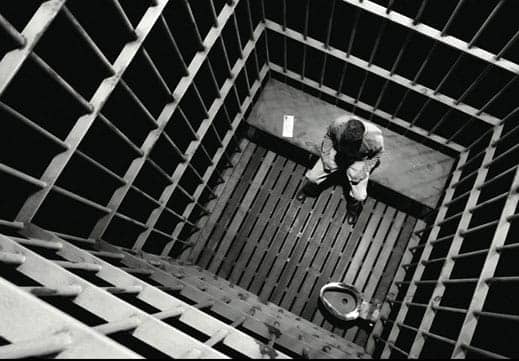
This "Call" is actually from me.

The accompanying image was taken from the article, "It's Time to Build a Mass Movement" by Bruce Dixon which appeared in the Black Commentator. I would recommend reading it as well.

BUILDING A MASS MOVEMENT: SAVE THE PLANET, FIGHT RACISM

I've spent forty years of my life as a serious activist. I've been to prison as a result and I've also had fun. I've been involved in one way or another in about every "issue" to come down the left wing pike during that time. I've seen some changes. I haven't seen nearly enough. I'm tied of hearing about past movements. Though I was there, I'm tired of hearing about the 60s. The suggestions I'm about to make are aimed at folks one hell of a lot younger than me. Young activists have the energy, the spirit, the strength to make things happen. Young activists have not become cynical like so many of my compatriots.

I should note that I come from a framework which I would describe as anti-racist, anti-imperialist, and Marxist. For me, what we used to call the primary contradictions are race and class. It is through that prism that I view the world.

TOO MUCH THIS AND THAT
Today we have people working on a multitude of different issues. Most of them are perfectly worthwhile, need to be dealt with and all that. However, when we focus all of our energy on our own particular cause we are spread too thin. We accomplish too little. We need to create a mass movement. We need a couple of major causes upon which to concentrate. This doesn't mean you, your friends, or your organizations cannot continue to work on and organize around your own issue whatever it may be. Not only can you, but you must. Again, there is much to be done. However, to build a real mass movement that results in sustained change we need to line up on a few core issues. I'm suggesting two major causes that all of us can organize around.

WHAT THAT SOMETHING IS NOT
It is not the anti-war movement. Why? Unlike the anti-war movement during the Vietnam era, today there is no good guy. Back then, we could all rally around the struggle of the Vietnamese people for national liberation. Well, hopefully we are not about to rally around the Taliban or Al-Quieda. Not too many people are going to sign up for that assignment, including me. This, of course, does not mean we should stop calling for US troops out of Afghanistan, but it does mean we aren't out chanting "Tal, Tal, Taliban is gonna win." If anything, we should be supporting some sort of true liberation movement in Afghanistan, a progressive one. If it isn't there, it isn't there. The people of Afghanistan, of course, deserve OUR support. Unfortunately, at the moment, they don't have anyone substantial in the fight, so to speak. It is going to be impossible to build a huge anti-war movement when neither side of the warring parties offer anything progressive. We can't create a progressive struggle for liberation in Afghanistan, but we can encourage one and that is what we should be doing while trying to get foreign troops the hell out.

It could have been anti-globalization. I think it almost was. The evil of globalization was something to build a militant international movement upon. The only problem was that it was pretty complex for a whole lot of people to understand – most especially Americans who like things very simple. Still those organizing around the issue did a hell of a job and were making tremendous headway creating a truly international movement. Then, however, just as that movement was gaining real strength along came the invasion of Iraq and the anti-war movement which ended up sucking the life out of the anti-globalization movement. Had the anti-war movement latched onto and become a part of the anti-globalization movement something very interesting might have resulted.

This isn't to say there should not be an anti-war campaign. Of course there should. This isn't to say there should not be an anti-globalization campaign. Of course there should.

However, in my humble opinion, it is going to be impossible to build THE MOVEMENT upon these smaller movements.

SO
As I said, I am going to present you with two major causes with which to rally around. These causes are distinct, yet must be linked.

Fighting racism is a cause we must all embrace. Until we confront all forms of racism, until whites confront their white skin privilege, nothing we do is ever going to be truly revolutionary or even progressive. Until our movement confronts racism and white supremacy there will never be real change. Racism is engrained in our psyche, in the fabric of our being. In the U.S. at this time in history we must continue to and increase the struggle against racism. This is simply our duty. Without confronting racism and white supremacy any mass movement we create will degenerate and become reactionary.

In America, it is racism directed at African Americans that has been most primary. We cannot forget this. We cannot pretend it is no longer true. We are not living in some post racial America.

At the same time as their population increases in the U.S. we are and will continue to see increasing racism directed at Hispanics. The anti-immigration forces are merely the beginning of what is no doubt to come.

Whites must act under the leadership of people of color in this aspect of the struggle. African Americans don't need whites to organize them, neither do Hispanics, or American Indians or any other people of color. White people must strive to become "race traitors." White people must strive to learn from the likes of John Brown. Whites must organize other whites. White people must be on the front lines fighting white supremacy, everyday, everywhere.

So what is this other big issue you ask me? I am talking about global warming and the environmental destruction of our planet. It will eventually devastate us all, whites, Blacks, Hispanics, Asians, Indians, all of us. Men and women, gays and straights all of us. And not just us. All the free wild animals of the planet are being destroyed right alongside us. It is the creatures of the planet, the fish of the sea, the birds in the air, the great cats, the wolves, the bears that are the ones dying off right now. Not tomorrow, right now. They are being poisoned today. Their habitats are drying up, melting, dying even as I write this.

This is an issue tinged with all the others as well. Who is and will suffer first and the most amongst us – people of color, the indigenous, people in the developing countries, working people, the poor. Who will suffer last amongst us? You guessed it – white folks, the wealthy, the United States, Western Europe. Who causes most of the suffering – the rich, the powerful, the huge corporations, mostly white, mostly men, mostly the big developed countries. What has to go to save the planet? Capitalism has to go, traditional states have to go, racism has to go, the way we organize our societies has to go, our current way of thinking itself has to go. We have got to understand that ultimately we, and the animals, the plants, and water and the air – we are all connected, all essentially one. We all live or we all die.

I am not for going quietly into the night. The movement we build must be one that convinces more and more people to look beyond tomorrow morning and beyond the end of their nose. That is particularly difficult here in America. But we, you and I, must know time is simply running out. We either get this done in the next few years or we might as well throw in the towel. It is possible we are already too late. I'm 60 years old. I'll probably live a relatively normal life span (which doesn't mean I don't care about what happens, which doesn't mean I don't want the Earth to live on after me). I'll tell you what, if you're twenty, if your two, if your one of the famous unborn, well, you ought to be mad as hell at the rest of us. And you sure as hell will be one day. Only it may be when it is hot and dry, when there isn't much to eat or drink. It may be while wars and civil wars rage across the planet as nations and regions run out of water, or food, or land, or power. When it gets like that people will fight back and with each other. However, it'll be for nothing then.

And by the way, the future is now. People are starving now. Islands are sinking now. Coastlines are going away now. Deserts are expanding now. Rainforests are disappearing now. The ice caps are melting now. Greenland is becoming green now. We can no longer look at record floods in the north of England and say, "well you can't blame any one incident on global warming." The "one incidents" are adding up too quickly. We can't just shrug off the fact that every fish in the damn world is carrying carcinogens in their systems right now. We can't shrug off the fact that mother's milk is turning to poison right now. We can't pretend that the great aquifers under the Great Plains States are drying up now. Tomorrow is today.

We must act now.

WHO SHOULD BE ON BOARD

All progressive forces should be on board – whether you call yourself a revolutionary, a communist, an anarchist, a socialist, a liberal, a pacifist (or not) – this movement needs you. There is no room in such an undertaking for anti-communism and there is no need that everyone subscribes to the exact same "line." The truth is that debate within the movement is a good thing, not a bad one. The truth is that a little ideological struggle is not something to fear. The truth also is that all of us have to be willing to understand who are our friends, who are on the same side as us. We have to realize that in a mass movement no one grouping can hold sway over everyone else. That just won't work.

Further, no one has to stop doing what they are doing now. No one has to stop being an animal rights activist, no one has to stop fighting for gender equality or gay rights, no one has to give up the class struggle or the women's movement, no one has to stop fighting police brutality, no one has to stop trying to abolish the prison industrial system, no one has to stop organizing workers, and no one has to stop trying to free political prisoners. All of that needs to be done. I believe that a mass movement will actually benefit every one of these battles and more. If we can build one large mass movement based upon the issues I am putting forward, each of us will also be aided in our own individual work. I've seen it happen. It has happened. It always happens.

However, I'm not talking about the smallest common denominator politics here. I'm not for rallying everyone around the lowest level that we can find. One of the problems encountered by the anti-globalization movement was the troubling reality that there were those on the right, even racists, who latched on for their own reasons and with their own agendas. We do not want those people with us. Just because someone says they are against global warming does not make them our friend. Just because someone is against globalization, does not make them our friend. We must be watchful and we must make constantly clear that we are about justice, freedom, equality. We must be clear that we are against racism, nationalism,sexism, religious bigotry, exploitation, big power hegemony and what I would call imperialism (but you may call something else). We are against needless wars.

SOMETHING IS MISSING
Some of you have probably noticed that I have not discussed tactics. That is intentional. There are a number of reasons why I have made that choice. They include:
• The internet is no place for such a discussion.
• In earlier drafts I did in fact include a section on tactics. What resulted was the centering of the discussion on tactics at the expense of everything else. That was my fault, but it was not something I wanted to happen.
• In all honesty, I am not that comfortable with my ability to develop a rational position on tactics. I believe that future conversation with many more people involved will be necessary to even begin that discussion.
• We do not need to decide tactics right now.

When the discussion of tactics does happen what we need is to find ways to effectively organize and educate ourselves and others in a manner which can most effectively at this time move forward the agenda of fighting racism and saving the earth.

FINALLY
What I have presented here I present with all humility. I could be way off base. I recognize that. What I most want to do is get the discussion to move forward on how to build a true mass movement so that we can begin creating it. I do not believe that discussion can last forever. I believe that time is crucial.

If you have other ideas, and I'm sure you do, you should put them forward.

REG
December 1, 2009

Sunday, January 03, 2010

From the Worker-Communist Party of Iran


I'm just re-printing a couple of items from the Worker-Communist Party of Iran about the current uprising.

Class character of the current revolution
This resolution was adopted at the 7th congress of Worker-communist Party of Iran earlier in December 2009

1- The movement that began June 2009 in Iran, and goes on strongly as ever, is a revolution aimed at bringing down the Islamic Republic to reach freedom, equality and welfare for all. As far as its genuine content and the objective circumstances that have given rise to it are concerned, the present revolution has its origin in the class opposition between the bourgeoisie and the working class, and can be victorious only by ending the former's political and economic domination.

2- The formation of the current revolution per se is indicative of the working-class horizon, or alternative, enjoying the upper hand over right-wing scenarios such as "reconstruction", "gradual transformation", "regime change", and other nationalist-ethnic-religious alternatives. The formation of the revolution confirms and firmly establishes the working-class perspective with respect to the most fundamental transformation of the status quo. It also bears out the fact that revolution is the most desirable as well as viable way to destroy the regime of Islamic Republic and liberate the whole society from political and economic domination of the bourgeoisie. The formulation and publicization of the said perspective as well as ceaseless practice for its realization by the workers' class-political representative, i.e., Worker-communist Party of Iran, has itself been instrumental in the formation of the current revolution.

3- The formation of revolution in Iran opens an active and effective front for beating back such reactionary movements as political Islam, the militarism of the Western's bourgeoisie, and the corresponding socio-political theories like cultural relativism, multi-culturalism, and so on. The Iranian revolution turns the human being and the universal humanist values into the focal point of the class struggle between the world proletariat and the world bourgeoisie, and thus presents the honorable, civilized people of the world with a bright, promising perspective. The current revolution enjoys therefore a high capacity for enlisting the support of the world working class as well as the public opinion of the freedom-loving people across the globe.

4- The working class is the only class that is both willing and able to bring the present revolution to victory. For, on the one hand, the emancipation of the working class from exploitation and the domination of the bourgeoisie is objectively, actually, pending the emancipation of the whole society from the prevailing poverty, suppression, discrimination, oppression, and repression. On the other hand, the people's demands, their ideals, namely women's liberation, emancipation from the clutches of religion, cultural emancipation, modernity, unconditional political and social freedoms, eradication of poverty and securing welfare for all are represented only by the working-class perspective, [reflected in] the working class [party-political] program. The demands and ideals of the citizens at large are, for all practical intents and purposes, achievable only through the realization of the socialist objectives, the socialist program, of the working class. In the process of the present revolution the working class can, and should, rally onder its standard the great majority of the citizens, overthrow Islamic Republic, and realize [the slogan] "freedom, equality, welfare".

5- The working class can position itself at the head of the current revolution only through its political party. Advancement, deepening, radicalization and the eventual victory of the revolution is pending the people embracing the party of the working class as the representative of the masses' critique, their dissatisfaction with, and their objections to, the status quo, as well as accepting it as the leader of the mass struggle for the overthrow of Islamic Republic. Such a party should, firstly, represent the political and social objectives of the revolution, and make its presence felt in the field of the fight over the political power, and, secondly, be accepted as the leader by the society. Under the political circumstances in Iran, Worker-communist Party of Iran enjoys the said characteristics, and possesses the necessary capabilities to obtain the position of the leader of the revolution.

6- Worker-communist Party of Iran fights with all its might to advance, strengthen, organize, lead and bring to victory the present revolution. The Party calls on all activists in the workers' movement and all revolutionaries in the student and women's liberation movements, as well as in all other protest movements of other sections of the society to get actively involved on the basis of the Party's policies, and to join its ranks.

-----------------------------------

Manifesto of the Iranian Revolution

The revolution that has started since June 2009 is the outburst of the repressed anger of the people against the criminal Islamic regime of Iran. This is a revolution for liberation from a corrupt system, for smashing a machine of murder, plunder, ignorance and lies which has been wrecking the lives of the people for thirty years. This revolution will not stop until it has crushed the entire inhuman system in power.

But this revolution is not just about the liberation of the people of Iran from the Islamic nightmare. It is not even just a source of hope and inspiration for the people in Islam-stricken regions. This revolution speaks from the heart of the people of the world. Fundamentally, it is a revolution against a dark period identified by the offensive of the New Right and the New World Order; September 11 and the rise of political Islam; and the War on Terror and conflagration of the world in the war of terrorists. A period which by the metamorphosis of the human being through religion, ethnicity and nationality, by defining the relations amongst members of humankind as the Clash of Civilisations, and by denying the universal rights of the human being by the notion of Cultural Relativism has in fact imposed a Postmodern Middle Ages on humanity. The Iranian revolution is in fact the voice of the Third Camp against this regression of the bourgeoisie of our age. It is a voice that shouts “Freedom, Equality, Human Identity”. It is for this reason that songs have been written for this revolution from around the world, and Neda has become a hero of the people of the world.

The Iranian revolution is, first and foremost, against religious and Islamic rule. It is deeply secular and opposed to the rule of ignorance, superstition and the clergy. In this respect it is pursuing, in a radical way, the unfinished, or forgotten, tasks of the French Revolution. With the victory of this revolution, not only will religion become completely separate from the state and the educational system, but any privilege, law and tradition giving the religious apparatus the right to interfere in social life will also be abolished. Religion will be pushed to the sphere of voluntary choice and private beliefs of adults. Official religion will be abolished, and the hold of religion on society and social affairs will be ended. Thus, for the first time, genuine freedom to have or not to have a religion will be established. The Iranian revolution has already, in a practical way, delivered its severe censure on the appeasement of political Islam by European and Western governments and the shameless reversal on secularism. The anti-religious revolution in Iran is the beginning of a new Renaissance in human history.

The present revolution in Iran is a “women’s revolution”, not only because it is immediately against sexual apartheid and a misogynist government, and not only because women and girls are at its forefront in fervent demonstrations and street battles, but also because the maxim “women’s freedom is a measure of society’s freedom” is increasingly etched in the consciousness of the masses of the people. The unconditional equality of women is the inviolable decree of the present revolution. This revolution is another step forward in the efforts of modern humanity for liberation from vile gender slavery. From the October 1917 Russian revolution to the women’s liberation movement in the West; from the women’s demonstrations in Iran against the veil in March 1979 to thirty years of women’s resistance and protest against Islamic veil, discrimination and humiliation – these make up the backbone and inspiration of the present revolution in Iran. The victory of the present revolution will not only have a phenomenal impact on the status and struggle of women in Islam-stricken countries, but will also advance the women’s liberation movement in the world as a whole.

The revolution in Iran is about freedom. The realisation of the most radical and human definition of individual, civil, cultural and political freedom is the immediate task of the ‘Twitter’ and ‘Facebook’ generation which has risen up in revolt. It does not accept any restriction on freedom of expression, assembly, strike and organisation or other political freedoms. It does not recognise any boundaries for the freedom to criticise “sanctities”. It does not accept any censorship on culture, art, literature and human creative activity. It is against any interference of the state or any official authority in the private lives - including in the sexual relations and preferences - of members of society. Not only should political prisoners be freed, but the very notion of political prisoner should be abolished. This is a revolution against the death penalty and all brutal or Islamic punishments. It is not only against Kahrizak, but also against Guantanamo and its corresponding political culture - from shock therapy to rape and torture, which have been elevated to official tools of the state. This is a revolution not only for cultural liberation from Islam, dictatorship and any backwardness and recourse to “one’s own culture”, but stands for a global, human and modern culture. In this sense, the nearest counterpart of the Iranian revolution are the 1960s’ and 70s’ civil rights movements in the USA and Western Europe, with the difference that this revolution along with Marx goes further than “civil society”, and aims for a “human society” or “social humanity”.

This revolution is the powerful response of a poverty-stricken society to the ruling parasites. It is a revolution for abolishing poverty, unemployment and the appalling gulf between the life of a billionaire minority and that of the great mass of deprived people living under the poverty line. This is a revolution not only against non-payment of wages of millions of workers, but in essence against the very sale and purchase of human creative power and the rule of blind and brutal market laws on people’s lives. This is a revolution for putting an end to drug addiction, prostitution, the plight of working street children, homelessness, depression, suicide and all that is the result of the poverty running amok in Iranian society. This is a revolution for “livelihood and dignity”, for “bread and roses too”.

Thus the present revolution in Iran is about the liberation of the human being in all political, social, intellectual, cultural and economic dimensions. This is a revolution against all false identities for the human being, be it religious, ethnic or national, and ultimately for putting an end to the division of people into classes. This is a revolution for human dignity, for happiness, freedom, welfare and equality for all in the enjoyment of the material and intellectual riches of social life. It is indeed a revolution for reclaiming the will of the human being, in both individual and social capacities. In one word, as we said from day one, this is “a human revolution for a human rule”. Thus the revolution in Iran links up with great efforts in history – from Spartacus to the Jacobins of the French Revolution, from the Paris Communards to workers of Petrograd, from the councils of the 1979 revolution in Iran to the anti-capitalist movement at the start of the third millennium, stretching from Seattle to Rome. The Iranian revolution is fundamentally against modern wage slavery, whose time has long been up, and which for its survival has needed to resort to religion, superstition, torture, prison, terror, and the nuclear bomb. This slogan of Tehran’s students expresses the foundations of the Iranian revolution: Socialism or barbarism!

The triumph of the revolution of the people of Iran over the Islamic Republic will open up a new chapter in the world and will be a new stepping stone for putting an end to class history and for the start of genuine human history. The Seventh Congress of the Worker-communist Party of Iran calls on the people of the world for a more enthusiastic and resolute support of the Iranian revolution and people. The Congress sends its greetings to women, youth and workers in Iran and calls on them to join the ranks of the Party for the victory of this revolution and realisation of this Manifesto.

Adopted unanimously by the Seventh Congress of the Worker-communist Party of Iran, 5-6 December 2009.

Gaza Women Do Not Need Islamic Law Imposed on Them


Don't go there! Don't implement Islamic law in the Gaza! Although Hamas says they are doing no such things, there is increasing evidence to the contrary. "There is an Islamist movement in power here, and it seeks to reflect that on our political and social systems," women's right activist Zainab Al-Ghonaimi said recently. Jeez, that's all the women of Gaza need next.

The following is from Xinhua.

Hamas encourages Gaza women to follow Islamic code


GAZA, Jan. 3 (Xinhua) -- Aya Rachi, a 11-year-old girl from Gaza, did not pay much attention to the female preacher's speech. Wearing a worn-out sweater, she seems to be only interested in receiving robes and headscarf for free.

"I want to receive a veil just like all the other girls, and I will wear a Hijab (headscarf) with it," said Rachi, one of the girls and women who get veils and robes for free under the Hamas Islamic veil project.

"I came because I can't afford new garments," she said.

Rachi's case is very common in the Hamas-ruled Gaza Strip. Having been under a tight Israeli blockade for more than three years, people living there are suffering from poverty.

Hamas movement has recently initiated a project in cooperation with the Association of Young Muslim Women, to give away free robes to girls in secondary schools according to their residence areas.

Since the Islamic Hamas movement has seized control of the Gaza Strip in June 2007, and routed secular President Mahmoud Abbas security forces, Hamas has been trying to implement the Islamic law in the Gaza Strip, mainly at schools, institutions and courts by imposing the Islamic dress or Hijab on women.

The first two neighborhoods that Hamas began with, were al-Tuffah and Sheja'eya in eastern Gaza City, where girls gathered and were taught about the necessity of wearing the Hijab to conceal their bodies.

Within brief moments, al-Tuffah sports hall was packed. Middle aged women came with their young daughters to receive long robes and dresses promised by Hamas.

Safaa Shallah, a board member of the Young Muslim Association affiliated with Hamas, said that "the goal of this project is to disseminate the Islamic dress code and effectively eliminate the wanton behavior."

She said that the project will be implemented at two stages, the first stage which started this week, would include the distribution of 600 Islamic uniforms in the two neighborhoods, adding that next week another 600 uniforms will be distributed forfree at al-Daraj neighborhood in central Gaza city.

Huda N'eim, a Hamas activist told Xinhua that "wearing the Hijab will be the first step towards implementing the Islamic law," adding that "the Western communities disapprove women who wear the Hijab in a bid to prevent women from wearing it in their own countries."

However, the deposed government of Hamas movement has officially denied that it is trying to implement the Islamic law in the Gaza Strip. But the campaign of Islamic virtue carried out and supported by officials in Hamas government had drawn concerns over the Islamization of Gaza.

Asmaa al-Ghoul, an activist in women's rights in Gaza, said that "human beings have the freedom to express their opinions and beliefs."

Al-Ghoul, who had faced troubles with Hamas security officers last summer when she walked on Gaza beach without covering her head with a scarf, went on saying that "if religion is used to exploit one's mind and impose certain policies on individuals, then it is unacceptable."

Nour el-Masri, who also lives in Gaza city and wears a veil, said governments and institutions should not impose certain values on people.

"If the government or any benevolent society wants to help the people, they should do it without expecting political returns," said el-Masri.

Gaza: More of the Same the Old Same Old


A year after the invasion, after numerous international promises, many solidarity marches, intermittent fighting, visits by diplomats, public outcry, various ceasefires, the misery continues in Gaza.

The following is from Relief Web.

A new year for Gaza? Waiting for a miracle
Source: Oxfam
Date: 01 Jan 2010


This entry was posted by Karl Schembri on January 1st, 2010 at 8:00 am and is filed under General, Humanitarian, News Blog.

One year since Israel's 22-day assault on Gaza, the coastal strip is still struggling to survive under a crippling blockade. Karl Schembri writes about the hardships the 1.5 million people of Gaza are still being forced to endure in this cruel and protracted man-made crisis.

A stone's throw away from the Israeli border in Shajaiya, a group of young men are rummaging among the steel and concrete that remains of the Sarayo Biscuits Factory.

Hasan Ahmed Al Awadi, who worked here as a watchman, now sits looking at the rubble. He is using part of the former offices to raise some poultry.

"I can't give you biscuits but I have some chickens," he tells me smiling.

A year ago, Israeli tanks and fighter planes reduced the factory to rubble, leaving 50 workers jobless and Hasan's colleague dead.

Further down the road, Al Wafa Hospital has just managed to get a consignment of cement and glass smuggled from the tunnels to be able to repair the extensive damage to the new state of the art four-storey building for physical rehabilitation and the elderly.

"We had a totally new building that was meant to be inaugurated in January 2009," says the head of rehabilitation, Dr Kamees Al Issi. "The Israelis 'inaugurated' it for us. Not one window pane was left intact."

Facing the hospital is the Gaza juice factory. The cold store was totally burnt down and most of the equipment destroyed. The factory now employs half of the 100 workers it had before the war, and they are manually capping and labelling bottles through new equipment they managed to get through the clandestine tunnels under the border with Egypt.

In Zeitoun, Sameh Sawafiri had a poultry farm of 30,000 chickens providing most of Gaza's supply of eggs. Israeli soldiers flattened them all in their cages with their tanks. Now he has managed to reopen with one-third of the chickens had a year ago and a lot of debts.

The owners of El Bader Flour Mill in Beit Lahiya were not so lucky. Israeli planes targeted the central nerve of the mill, leaving it totally out of action.

"Since the war we had to stop completely," says Hamdan Hamada who still pays 25 of the 85 workers in the hope they will be able to resume work soon. "We need iron, cement and equipment, but Israel is not allowing us to get anything. We are waiting for a political decision from Israel to get the material to reconstruct our flourmill. So far we only got promises."

A year since the war on Gaza, most of the coastal strip is still at a standstill, waiting for a political decision from Israel, and for pressure from the rest of the world, for the blockade to be lifted. Billions of dollars pledged for reconstruction remain out of reach, making significant reconstruction and recovery impossible.

Driving through the streets of Gaza, the rubble is still everywhere, with many of the bombed buildings still standing like skeletons, memorials to destruction. In some parts, the rubble has started being cleared in the last few weeks, but Israel's and Egypt's ban on construction material makes it impossible to rebuild the 3,535 homes that were totally destroyed last January.

Mohammed Zaid Hader's family from Izbet Abed Rabbo is one of around 1,000 still living in tents. It is their second winter facing the cold and the rain. Left totally impoverished since his four-storey house was destroyed, he has become one of the 80% of Gazans dependent on humanitarian aid.

Nawer Thabet from Juhor Ad Dik lost her mother and only sister when their house was shelled. One year on, she is still in trauma, recounting, in tears, how she is unable to go back to the house where her mother always welcomed her. (Read Nawer's blog)

"I remember this tragedy everyday, I can't get it out of my mind. I still can't go back to our house in Johr Al Deek, I can't face it," she says.

Everyone says they were used to attacks from the Israeli army, but this was something else altogether. The attacks were coming from everywhere, leaving nowhere to escape as people were forbidden to leave the Gaza Strip to seek refuge far from the conflict zone.

Children are perhaps paying the highest price. The war taught them that not even their homes were safe, and not even their parents could protect them. Ahmed Hdeir, father of six from Beit Lahiya, told his children the war was just a computer game.

"But when they hit our house I couldn't keep up that story," he says.

They still suffer from nightmares and he takes them to psychologists for counselling every week. During the Eid festival in late November, thousands of children were playing in the streets with toy guns. Gazan psychiatrists are concerned about both the widespread trauma and the potential radicalisation of those that may now choose the path of the martyr when everything is lost.

A whole generation of children has never been out of Gaza. Unlike their parents, most of whom used to work in Israel and have Jewish friends, the only Israelis they have seen were armed soldiers keen on destroying their houses and killing their relatives.

Now, the Egyptian government is reportedly erecting yet another wall in Rafah - an iron barrier meant to stop tunnel smuggling. Tunnels are the only lifeline left for Gazans, and in their resourcefulness they might also find a way around this latest obstacle.

Gazans are known for their resilience and creative ways of getting by against all odds, but they are paying a very high price. Even before the war, the blockade was collectively punishing an entire population, leaving scars that will take decades to heal. But the healing cannot begin until Gazans are given that chance, until the blockade comes to an end.


Saturday, January 02, 2010

Nazis Planned to Help Fund Terrorist Attacks with Sale of Auschwitz Sign

It now appears that the theft of the ignominious sign from the front gate of Auschwitz
is linked to a plot by neo-nazi terrorists bent on carrying out a string of attacks in Sweden. The money used from the expected sale of the sign was to help fund the planned carnage. Amongst sites targeted by the nazis were the Riksdagen, the parliament building in Stockholm, as well as the foreign ministry and the home of the prime minister.

The following is from the Guardian.

Neo-Nazi Bomb Plot Linked to Auschwitz Sign Theft

Thieves contracted by a neo-Nazi group that planned to sell sign to fund attacks in Sweden, newspaper claims


Arbeit Macht Frei sign at Auschwitz

The Auschwitz sign before it was stolen Photograph: Irek Dorozanski/Reuters

It sounds like the plot of a Steig Larsson thriller: a band of eastern European criminals is contracted to steal an iconic piece of Nazi memorabilia, which is then sold to a mysterious collector to finance a neofascist bomb attack on the Swedish parliament.

But today it emerged that Swedish investigators are helping Polish detectives investigate the theft of the sign from Auschwitz, amid reports that the robbery was linked to a rightwing terror plot.

The wrought iron plaque reading Arbeit Macht Frei (work sets you free) which spanned the entrance at the former Nazi death camp was wrenched from the gate on 18 December, and recovered three days later, cut into three pieces, in a forest in northern Poland.

The robbery prompted Poland to declare a state of emergency, and provoked impassioned calls for the sign's return from concentration camp survivors and the Israeli prime minister, Binyamin Netanyahu.

The five men being held in police custody in Krakow in connection with the theft have been described by Polish prosecutors as common criminals who had apparently acted for financial gain.

But according to the Swedish daily Aftonbladet, the men were contracted by a neo-Nazi group which planned to sell it on to a third party, a foreign rightwing extremist or collector of Nazi memorabilia, with the aim of using the funds to finance a string of attacks in Stockholm.

Boguslawa Marcinkowska, the spokeswoman for the public prosecutor's office in krakow, said: "The evidence that we have so far points to there being links with Sweden". Polish state television TVP1 quoted official sources saying that Swedish neo-Nazis were behind the theft.

Poland's justice minister, Krzysztof Kwiatkowski, said: "The investigations have taken on a much broader dimension than we had initially thought".

The Swedish justice ministry has confirmed that it is helping the Polish police with investigations after the state prosecutor's office in Krakow lodged an official application asking for its help.

Separately, the Swedish security service Säpo, confirmed that it was investigating an alleged neo-Nazi plot to blow up the Riksdagen, the parliament building in Stockholm, as well as the foreign ministry and the home of the prime minister, Fredrik Reinfeldt. The aim of the plot, according to Säpo, was to create as much disruption as possible ahead of the 2010 parliamentary elections. It would not confirm or deny reports of a possible connection between the plot and the Auschwitz sign theft.

Polish investigators, who said from the start of the inquiry that they suspected the mastermind of the robbery operated outside Poland, would only say today that he or she "came from a European country".

The five suspected robbers, aged between 25 and 39, all have criminal records but none is suspected of having a neo-Nazi background. They were reportedly set to receive a total of 20,000 zlotys (£4,320) to share between them for the theft. The police told the Polish press agency PAP that they believe a foreign national, possibly the person who ordered the theft, visited the former death camp prior to the robbery in order to be able to plan it in detail.

The theft was carried out without attracting the attention of nightwatchmen or being caught on CCTV cameras. But in their haste to make off with the sign, the thieves dropped the letter i from the word Frei. It was found in the snow nearby.

The wider plot has the whiff of a thriller by the late Swedish writer Larsson, not least because he was an expert on right-wing extremism, a subject which he wove into many of his books.

Larsson sought to expose neo-Nazi activity in Sweden, forming in 1995 the group Expo-foundation, following eight murders for which neo-Nazis were held responsible. For several years the scene was considered small but particularly brutal.

There are plans next month to celebrate the 65th anniversary of the liberation of the Auschwitz death camp in which around 1.1 million people, most of them Jews, died. Blacksmiths are meanwhile working on repairing the sign, which stands as a cynical commentary on the Holocaust, in time for the event.

Concern about the safety of the Auschwitz site, which is now a memorial and museum, has prompted local authorities to promise to install more close circuit television cameras and to review its security procedures.

Publicity surrounding the robbery has attracted financial donations from around the world.

• This article was amended on 31 December 2009. The original described Aftonbladet as a Danish newspaper, and Fredrik Reinfeldt as Sweden's president. This has been corrected.


Canada: It's Time to Pay the Piper

Canada, oh, Canada, you've got some explaining to do. When it comes to extracting mineral resources there is no country like Canada. Did I mention what happens in the process of that extraction? The land is destroyed. People's lives are destroyed. Did I mention we're not just talking about in Canada? Oh, that would be bad enough, but we're talking about people and lands all across the globe - from Panama to the Philippines from Tanzania to Guatemala. Indigenous people are the primary victims of Canada's rush for riches. Canada, oh Canada, who the hell do you think you are - the United States...

The following is from Intercontinental Cry.


Briefing on the Human Rights and Environmental Abuses of Canadian Corporations

With more than a thousand mining and exploration companies operating around the world, Canada is by far the most productive country when it comes to mineral extraction.

It is a source of great pride in some circles. However, as this briefing demonstrates, it is also a source of great fear and revulsion for tens of thousands of people around the world: the attendant victims of Canada’s mining industry.

In many cases, these victims, often residing on communally-held lands, are evicted from their homes and displaced without any form of compensation. Sometimes they are held back at gun point while their villages and property is destroyed; not to mention their graveyards, sacred sites, farmlands and other areas key to their culture and physical survival.

Local environments are also frequently contaminated with mercury, cyanide, uranium, arsenic and a host of other hazardous chemicals which families often end up consuming without knowledge, but with obvious consequences.

Further, when communities try to address these issues, either through direct confrontation and protest, by going to court, or by begging to be consulted before their lands and livelihoods are taken from them, they are frequently turned into criminals and treated as less-than-human beings: They are kidnapped, tied up, tortured, raped, shot, stabbed, burned, suffocated, executed. Others are arbitrarily detained by company security forces or arrested by state police, often because of false charges laid against them.

There are also cases where companies have used bribery, coercion and extortion to gain concessions which are inhabited and actively used by Indigenous People. And others where a company asserts it has consulted the local population and gained their “unanimous support” even though they have not.

This briefing is intended to provide an introduction to some of these aforementioned cases of abuse. It is by no means a complete accounting. However, time permitting, it will be extended upon request.

It is also intended to provide further evidence toward the need for legislation in Canada.

As you may know, Bill C-300, an Act respecting Corporate Accountability for the Activities of Mining, Oil and Gas Corporations in Developing Countries, is currently being discussed in the House of commons.

Bill C-300 represents the best available chance to ensure Canadian corporations comply with the basic form of law, and especially human rights standards and environmental regulations, as MiningWatch Canada has previously noted.

If Legislated, the Bill would:

  • Put in place human rights, labour, and environmental standards that Canadian extractive companies receiving government support must live up to when they operate in developing countries;
  • Create a complaints mechanism that will allow members of affected communities abroad, or Canadians, to file complaints against companies that are not living up to those standards;
  • Create a possible sanction for companies that are found to be out of compliance with the standards, in the form of loss of government financial and political support.

The importance of such regulations, while making some Canadians squirm in their chairs, cannot be understated. Nor can they be buried by desperate-sounding claims that Bill C-300 would bring “Congolese style politics — with its constant threat of harassment and shake-down — to Canada”, that it “amounts to a limit on Canadian sovereignty,” and that it just isn’t necessary because companies “are already accountable… with respect to responsible behavior.” And anyways it doesn’t matter, because they’re not doing anything wrong.

Reality speaks for itself, regardless of what we want, what we prefer, or what we’d rather not think about so we can sleep care free at night. Tens of thousands of people around the world have no such luxury. Instead, they are forced to bare an irreconcilable cultural, physical, religious, social, economic, cultural and environmental burden while benefiting the least, if at all, from the Canadian company’s activities.

Guatemala

HudBay Minerals – In September 2009, two Maya Qeqchi were killed and more than a dozen injured in two separate attacks connected to HudBay Minerals’ nickel mine in El Estor, Guatemala. In the first attack, HudBay’s private security forces opened fire on the Mayas while attempting to remove them from their land. One person was killed and at least eight others were injured by bullets. The second attack involved a group of men armed with machine guns opening fire on a mini-bus. Again, one person was killed, and nine others wounded. This is but the latest in a long line of attacks and human rights violations against Indigenous Peoples in El Estor Guamatela who’ve only just ever wanted to live their own lives and meet their own needs, without being poisoned, molested and sacrificed.
(1) http://solidaridadconguatemala.blogspot.com/2009/09/comunicado-de-prensa-comunidades-de-el.html
(2) http://www.dominionpaper.ca/weblogs/dawn/2947

GoldCorp – In February, 2009, a research team from the Pastoral Commission for Peace and Ecology (COPAE) confirmed that Goldcorp’s Marlin mine in the municipality of San Miguel Ixtahuacan, Guatemala, is poisoning local water supplies. Ever since the Marlin mine opened in 2004, the people of San Jose Ixcaniche have suffered from an array of serious health problems, including skin rashes, hair loss and unexplained “open wounds”. At least two infants from the community have died from unknown causes, since 2007. Despite the study, Goldcorp insists that there is no chemicals in the water, and that the health problems are the result of “bad hygiene”, a lack of water and “fleas”.

Goldcorp is also blamed for illegally purchasing local lands, depleting local water, negatively impacting crops and cattle, and damaging more than 100 homes as a result of digging and blasting at the mine. Some mine opponents have been “disappeared” and brutally murdered, while others have been arbitrarily arrested.
(1) http://www.rightsaction.org/articles/San_Miguel_022009.htm
(2) http://resistance-mining.org/english/?q=node/99
(3) http://www.catapa.be/en/news/500
(4) http://www.dominionpaper.ca/articles/2744
(5) http://intercontinentalcry.org/mining-re-sisters-from-guatemala/

Skye Resource – In early 2007, hundreds of police and soldiers forcibly evicted the inhabitants of communities living on their ancestral land, which the Guatemalan military government gave to the Canadian mining company INCO in 1965. Skye Resources now claims the land. In January, 2007, with the army and police at their side, company workers took chainsaws and torches to people’s homes, while women and children stood by. Skye Resources claims that they maintained “a peaceful atmosphere during this action.” In any event, the fact remains: it’s Mayan land.
(1) http://www.youtube.com/watch?v=0K1XzNPTcMA
(2) http://www.dominionpaper.ca/articles/899

Mexico

Continuum – According to local community leaders, 13 freshwater springs have
completely disappeared as a result of Continuum’s reactivation of the historic “Natividad” gold mine in Oaxaca. Local water sources have also been contaminated by the mine, effecting food security, and gravely impacting the health of the local indigenous population.
(1) http://www.dominionpaper.ca/articles/1632

Fortuna – On May 6, 2009, a mass of federal and state police troopers brought a violent end to a community blockade near Fortuna’s Trinidad Silver Mine in the municipality of San Jose Progreso, Oaxaca, Mexico. The blockade was set up as a last resort, to resist any further contamination of their water supplies.
(1) http://www.dominionpaper.ca/articles/2644
(2) http://intercontinentalcry.org/violent-eviction-of-community-blockade-near-trinidad-mine/

New Gold – Situated near the Mexican village of Cerro de San Pedro, New Gold Inc.’s Cerro de San Pedro Mine was formally shut down in November 2009, after the Mexican Supreme Court canceled its environmental permit. The mine threatened to contaminate a region occupied by more than 1.3 million people. Incidentally, a similar ruling was issued by the same court in 2005, however, the company (along with the federal Ministry of the Environment and Natural Resources, or SEMARNAT) ignored it.

Since the mine was shut down, several Community members and activists have received death threats from mine supporters, and government officials attempting to visit the community have been “stoned in their vehicles by mine employees.”
(1) http://www.dominionpaper.ca/articles/2036
(2) http://intercontinentalcry.org/mexican-high-court-rules-canadian-gold-mine-illegal/
(3) http://faomontreal.wordpress.com/2009/12/14/members-of-the-fao-attacked-in-cerro-de-san-pedro/

Blackfire Exploration – Also in November 2009, Mariano Abarca Roblero, “a passionate critic of Blackfire”, was murdered in front of his home in Chicomuselo, Chiapas, Mexico. Mr. Abarca was a respected member of the community, who endured threats, prison and violence due to opposition the Calgary-based company’s mining project. Three individuals have been arrested in connection to the shooting of Mr. Abarca: one current Blackfire employee and two former employees.

Coincidentally, on December 8, 2009, the company’s gold mine was shut down by Mexican authorities. According to the Chiapas Secretary for the Environment, the company has wrongfully polluted the environment with toxins, and diverted streams and built roads without any authorization.
(1) http://www.youtube.com/watch?v=6UUvYfZPKxQ
(2) http://intercontinentalcry.org/blackfire-mine-shut-down-over-environmental-concerns/
(3) http://www.miningwatch.ca/en/documents-show-corruption-and-intimidation-canadian-mining-firm-blackfire-its-mexican-operations-ott

Peru

Dorato Resources Inc. – In August 2009, Awajún and Wampis indigenous people in the Cordillera del Cóndor region of Peru, near the Ecuadoran border, issued a statement giving Dorato Resources Inc. 15 days to voluntarily leave their territory. According to the Awajún and Wampis, Dorato was granted their mining concession in contravention of Rule 71 of Peru’s Constitution, which prohibits foreign companies to operate a mine near a border. Further, Dorato’s mine is located in the ancestral territory of the Awajún and Wampis. But even so, they have not been consulted by the government or the company. This is a violation of ILO Convention 169, the adherence to which is considered mandatory.
(1) http://www.ww4report.com/node/7729
(2) http://amazonasindigena.blogspot.com/2009/12/provocacion-indigenas-awajun-y-wampis.html

IAMGOLD (IAG) – The Awajun and Wampis also find themselves dealing with IAG, taking much the same approach as with Dorato. However, there is one major difference here: IAG’s operation is completely illegal, at least, according to the Ministry of Energy and Mines in Peru. Felipe Ramirez, a Director for the ministry’s Environmental Affairs office, stated in lat November, 2009, that the company hasn’t even so much as asked the govenrment for a permit to mine or explore on the Awajún and Wampis territory. “What they are doing is illegal,” the official states. IAG, on the other hand, denies any kind of wrongdoing on their part.
(1) http://intercontinentalcry.org/awajun-and-wampis-detain-gold-mine-employees/
(2) http://www.laht.com/article.asp?ArticleId=347770&CategoryId=14095

El Salvador

Pacific Rim – A wave of Violence, kidnappings and death threats have been tearing through the northern state of Cabañas–where the Pacific Rim Mining Corporation has lost millions of dollars in its effort to exploit the region’s gold deposits. At least three prominent community leaders have been killed since the company’s El Dorado mine had its environmental license revoked in July 2008. Most recently, Dora “Alicia” Sorto Rodriguez was killed on December 26, 2009. “Alicia,” as she was known to friends, was eight months pregnant and carried her 3-year-old son in her arms as she was shot dead. The child was shot in the foot and is receiving medical care.

Amidst all of this, Pacific Rim is suing the government of El Salvador for refusing to let them go ahead with their mine, despite the overbearing environmental disaster that would ensue.
(1) http://therealnews.com/t/index.php?option=com_content&task=view&id=31&Itemid=74&jumival=4118&updaterx=2009-08-13+02:14:31
(2) http://upsidedownworld.org/main/content/view/2279/74/
(3) http://www.cispes.org/index.php?option=com_content&task=view&id=648&Itemid=1

Panama

Petaquilla Minerals, Inmet Mining – As a many as 24 local communities are opposed to the Petaquilla Gold mine project—which is owned by the Panama company Minera Petaquilla, and developed by the Vancouver-based junior company, Petaquilla Minerals and the Toronto-based company, Inmet Mining. The reason for the opposition, quite simply, is the “aberrant predation and destruction of the Mesoamerican Biological Corridor, where hundreds of hectares of virgin jungle and forest have been cut down, and where the mountain passes and rivers that made the area one of the most important in the world due to its rich biodiversity have been destroyed and polluted.” The communities say “they have never been consulted, but rather deceived, and their lands have been taken from them unfairly in many ways, including the destruction and burning of ranches of indigenous peoples, without even indemnifying the local residents.”
(1) http://ciampanama.org/es/noticias.php?idNoticia=380

United States

Barrick Gold – In early December, the federal Ninth Circuit Court of Appeals blocked construction on Barrick Gold’s Cortez Hills gold mine because of the “irreparable environmental harm threatened by this massive project,” situated on the flank of Mount Tenabo, a site of great cultural and historical importance to the Shoshone People. However, just one day after the court issued its ruling, Barrick Gold announced that it did not recognize the ruling, and will not cease construction of the mine.
(1) http://www.dominionpaper.ca/articles/2218
(2) http://intercontinentalcry.org/western-shoshone-prevail-at-ninth-circuit-court-on-mining-sacred-land/

Philippines

Central Gold Asia – Central Gold Asia, at the beginning of its activity, painted a rosy picture—complete with promises of employment and social development—before the eight local communities who would be impacted by their mine. After years of operation, however, the reality proved to be something else entirely. Farmers have been displaced with meager monetary compensation and relocated to lands which they cannot use for farming. Rivers have been closed off; while others have polluted, effecting rice fields and fish ponds and the waters sources of nearby communities. Worst of all, the port of Barrera, a long time source of livelihood for everyone living along the coastlines, is now a pit of toxic mine waste, which could easily overflow at any minute.
(1) http://intercontinentalcry.org/philippines-thousands-protesting-open-pit-gold-mine/

TVI Pacific – In Zamboanga del Norte, the indigenous Subanon are struggling to hold on to their culture and traditions. Based in Toronto, TVI Pacific, has made “a dumpsite” of Mount Canatuan, which the Subanon hold sacred, violated their customary law, and displaced them from their lands without compensation. Further, the companies security forces have threatened and physically assaulted the Subanon on numerous occasions.
(1) http://intercontinentalcry.org/canadas-tvi-pacific-faces-tribal-justice/
(2) http://pcij.org/i-report/2008/canadian-quandary.html
(3) http://www.miningwatch.ca/en/tvi-pacific-again-implicated-forced-evictions-its-canatuan-project-philippines

Placer Dome (Barrick Gold)
In 1993, the small island of Marinduque became the site of the worst industrial disaster in Philippines history. One of Placer Dome’s tailings dams unexpectedly burst, sending millions of tons of toxic waste down the Mogpog river. The resulting flash flood swept away everything in its path: homes, livestock, people. Three years later, a second tailings dam burst, sending even more waste down the Boac river in the opposite direction. Both rivers were biologically devastated. And the company refused to clean up them up, despite an order from the government of Marinduque. Instead, Placer Dome abandoned their mine project and snook out of the country. Today, both rivers remain biologically dead.

Almost ten years later, in 2005, the government of Marinduque filed a lawsuit against the company in a Nevada state court over both disasters, and or allegedly dumping waste in various freshwater areas. One year later, Barrick Gold bought a controlling share of the company. The case was thrown out in 2007, but it has since been reinstated.
(1) http://allan.lissner.net/mining-and-water-marinduque/
(2) http://pcij.org/stories/canadian-transnational-dumps-waste-responsibility-in-marinduque/
(3) http://protestbarrick.net/article.php?id=521

India

Aluminium Company of Canada (ALCAN), UAIL – For more than 16 years, local Indigenous communities in Kasipur have struggled to protect their lands and scared sites from UAIL’s presence in the Baphlimali hills of Orissa, India. Three villages were displaced by the company, while others—promised housing, schools and jobs by the government—continue to wait with empty hands. Several community members have also been thrown in jail under false charges of murder and theft. Others have been murdered. And the company has created massive rifts in communities by bribing individuals to keep them informed about local campaigns.
(1) http://www.montrealmirror.com/ARCHIVES/2003/112003/news2.html

Tibet

Continental Minerals, Silvercorp Metals, Eldorado Gold, Silk Road Resources, Maxy Gold Corp, Inter-Citic Minerals, Sterling Group Ventures Inc. – In 1999, the Chinese government launched the “Western Development Strategy”—a politically motivated plan to further consolidate control over Tibet through economic rather than military means. The strategy opened the floodgates to the destruction of Tibetan culture, identity, and their agriculture-based economies.

Tibetans want development in their territory and they want to end decades of poverty imposed by the Chinese government. However, at present they are denied the right to benefit and, since 1959, determine the use of their natural resources.
(1) http://stopminingtibet.com/

Papua New Guinea

Nautilus – Indigenous people from the Bismark Sea region of Papua New Guinea are deeply concerned about Nautilus’ experimental deep sea mining process off the East New Britain Coast. While the project has yet to move forward, the local population has never been consulted or informed about the real and potential effects of the mine. At a three-day conference in July 2008, indigenous representatives stated their emphatic opposition to the mine, stating their need and their right to maintain their health, livelihoods and resources.
(1) http://www.mediaglobal.org/article/2009-02-05/analysis-digging-in-neptunes-kingdom-the-first-deep-sea-mining-project

South Africa

Uranium One – The Toronto-based mining company, Uranium One—who’s “operations have been made possible with backing from the Canadian Embassy and CIDA (Canadian International Development Agency) in South Africa”—has been accused of human rights abuses and the systemic violation of workers rights at their Dominion Reefs Uranium mine in South Africa. The Canadian Pension Plan Investment Board also has millions of dollars invested in the company.

For instance, in October 2008, workers alleged that they were denied access to protective gear while working in the uranium mine. The workers explained that they had nothing more than overalls. And now they suffer from a wide range of health problems, including cancer, asthma, and tuberculosis. In addition, four women have miscarried, and at least 12 workers have died since the mine opened in 2004.
(1) http://intercontinentalcry.org/uranium-company-accused-of-killing-communites-in-south-africa/

Tanzania

Barrick Gold – Tanzania’s Bulyanhulu and North Mara gold mines are monuments to everything wrong with the global mining industry. From day one, both projects have brought more harm than good to local communities. Several villages have been displaced, there have been murders and human rights abuses, the environment has been repeatedly contaminated, and workers have been frequently exploited.

Most recently, in July 2009, the Tanzanian govenrment banned the use of water from the Tigithe River near the North Mara mine to investigate allegations that the mine’s tailings dam was leaking. As many as 20 local villagers and more than 250 heads of cattle died in the weeks leading up to the move. A recent study found extremely high concentrations of arsenic and other chemicals near the mine.
(1) http://www.africafiles.org/article.asp?ID=22228
(2) http://allan.lissner.net/category/someone-elses-treasure-tanzania/
(3) http://intercontinentalcry.org/tanzania-government-bans-water-use-near-barrick-gold-mine/

Revolution in Iran


In Iran, the road leads to revolution...

The following was a message to members of the facebook group
URGENT: Solidarity with uprising in Iran by A.G.

People of Iran have moved beyond the pro- system opposition

The 27 December 2009 protest in Iran was a powerful blow to the totality of the Islamic regime. This was a blow not only to Khamanie's faction and his cronies, but also a blow to Mosavi's faction in opposition; it was a powerful response to the faction that advocates protecting of the system from opposition.

They – the pro-system oppositions.*- have tried to project the movement of the people of Iran as a movement for reform within the framework of the Islamic system. Of course people have time and again shown that they do not want to go back to the Khomanie's era. This was clear for everyone to see earlier in October and November protests, however the 27th was a landmark in this regard which openly and clearly showed that the people in Iran do not believe in any of the factions of the Islamic regime.

This was clear by choice of methods and forms of struggle and slogans that aimed at both factions and whole lot of the Islamic regime.

Khamanie's faction in power had been preparing the military forces and bajisi groups for months and had rounded up thousands of people before last Sunday. The Mosavie faction in opposition before the 27th had tried to confine the protest within the framework of the religious ceremonies, tried their luck, once more, to limit the people's protest to defending of the Islam, Khomeini's era and advocated peaceful protest, religious slogan etc; One other event that was used was death of Montazerie seven days earlier. The Mosavi Faction – the pro-system opposition– had called Montazeri, "the father of human rights in Iran" and were to use 27th as day of commemorating Montazeri.

What actually happened was to upset of these strategy. Men and Women, side by side, took to the streets with a clear political agenda of anti-government slogans and with confronting the military forces such as Pasdaran and Basiji's and on many occasions arrested these thugs and burnt their vehicles. The protesters also attacked the government thugs who were organised in religious groups for the ceremonies. There were no evidence that people were using the religious ceremonies and religious pretext to say what they wanted. They talked in their own clear language of anti-Khamanie, against the dictatorship and against they totality of the system of Velayat faghih.

This was a revolt with a clear political slogan without any reliance on the slogans and methods of "the pro-system opposition."

This was a defeat for the Mosavie as they had always advocated peaceful protests; people not only responded to the oppressive forces of the regime by chasing them and made them on occasions to give up and run away; the people also in reality faced off "the pro-system opposition" faction.

When we examine the last Sunday's events, we see a classic urban revolt against a dictatorship. The video clips of the day show how every street have been barricaded as in classic street battle formation with a more confident masses confronting the oppressive forces.

This situation forced the figure heads of "the pro-system opposition" both n Iran and abroad on many occasions to condemn violence and asked people to keep the protests peaceful. They actually coached their policy in stating that the government forces attacked the dignity of the religious ceremonies of the people by their violence. The same is of course is said by the other faction in power that it was the people who undermined the dignity of Ashura ceremonies.

As far as the people were concerned the question was not about upholding the dignity of religious ceremonies. The issue for people was to confront a brutal Islamic dictatorship and bring it down with all of its military and religious machinery. The Islamic government in Iran realises this; of course the faction in power wants to save the system by naked suppression and brute force, and the other faction wants to lead the movement in the dark alleys of working within the framework of the Islamic system.

The 27th December replied to both of these policies. People know what they want; they know their enemy well and are determined to overthrow this regime completely. This movement can only end with the victory of the people's revolution against Islamic republic and that day is now not too far away.

----------------------

This is a translation by Fariborz Pooya of the transcript of daily "10 minutes with Hamid Taghvaie" which is a TV program broadcast daily on New Channel satellite TV to Iran and Europe. This episode was broadcast on 30 December 2009.

*Mosavie and Kahroubi and their supporters call themselves protectors of the ststem of the Islamic regime and advocate return to the time of ayatollah Khomeini and early days of the Islamic government – when Mosavi himself was in power.

**Montazeri was one of the main architects of the Islamic system of Velayat fagheh which was the foundation for the government established by Ayatollah Khomeini in 1979 which was the basis of the relationship between Islam and the state as codified in his work Velayat-e Faqih of the government of the Islamic Jurists,"

Friday, January 01, 2010

Something is Rotten and it Ain't Just in Denmark

http://www.indybay.org/uploads/2009/07/24/mcjlogobig.pdf_600_.jpgThere are still folks who were swept up by cops in Copenhagen while protesting the climate summit controlled by Big Capital locked up in Denmark today. They've got something to say.

The following is from Mobilization for Climate Justice.

Statement from those still imprisoned in Denmark

January 1st, 2010


Something is rotten (but not just) in Denmark. As a matter of fact,
thousands of people have been considered, without any evidence, a
threat to the society. Hundreds have been arrested and some are
still under detention, waiting for judgement or under investigation.
Among them, us, the undersigned.
We want to tell the story from the peculiar viewpoint of those that
still see the sky from behind the bars.


>A UN meeting of crucial importance has failed because of several
>contradictions and tensions that have shown up during the COP15. The
>primary concern of the powerfuls was the governance of the energy
>supply for neverending growth. This was the case whether they were
>from the overdeveloped world, like the EU countries or the US, or
>from the so-called developing countries, like China or Brazil.
>
>At odds, hundreds of delegates and thousands of people in the
>streets have raised the issue that the rationale of life must be
>(and actually is) opposed to that of profit. we have strongly
>affirmed our will to stop anthropic pressure on the biosphere.
>
>A crisis of the energy paradigm is coming soon. The mechanism of the
>global governance have proven to be overhelmingly precarious. The
>powerfuls failed not only in reaching an agreement on their internal
>equilibrivre but also in keeping the formal control of the
>discussion.
>
>Climate change is an extreme and ultimate expression of the violence
>of the capitalistic growth paradigm. People globally are
>increasingly showing the willingness of taking the power to rebel
>against that violence. we have seen that in Copenhagen, as well as
>we have seen that same violence. Hundreds of people have been
>arrested without any reason or clear evidence, or for participating
>in peacefull and legitimate demonstrations. Even mild examples of
>civil disobedience have been considered as a serious threath to the
>social order.
>
>In response we ask - What order do we threaten and who ordered it?
>Is it that order in which we do not anymore own our bodies? The
>order well beyond the terms of any reasonable "social contract" that
>we would ever sign, where our bodies can be taken, managed,
>constrained and imprisoned without any serious evidence of crime. Is
>it that order in which the decision are more and more shielded from
>any social conflicts? Where the governance less and less belongs to
>people, not even through the parliament? As a matter of fact,
>non-democratic organisms like the WTO, the NB, the G-whatever rule
>beyond any control.
>
>We are forced to notice that the theater of democracy is a brokenone
>as soon as, one approaches the core of the power. That is why we
>reclaim the power to the people. We reclaim the power over our own
>lives. Above all, we reclaim the power to counterpose the rationale
>of life and of the commons to the rationale of profit. It may have
>been declared illegal, but still we consider it fully legitimate.
>
>Since no real space is left in the broken theater, we reclaimed our
>collective power - Actually we expected it - to speak about the
>climate and energy issues. Issues that, for us, involve critical
>nodes of global justice, survival of man and energy independence. We
>did marching with our bodies.
>
>We prefer to enter the space where the power is locked dancing and
>singing. We would have liked to do this at the Bella center, to
>disrupt the session in accord with hundreds of delegates. But we
>were, as always, violently hampered by the police. They arrested our
>boddies in an attempt to arrest our ideas. we risked our bodies,
>trying to protect them just by staing close to each other. We value
>our bodies: We need them to make love, to stay together and to enjoy
>lif. They hold our brains, with beautifull bright ideas and views.
>They hold our hearts filled with passion and joy. Nevertheless, we
>risked them. we risked our bodies getting locked in prisons.
>In fact, what would be the worth of thinking and feeling if the
>bodies did not move? Doing nothing, letting-it-happen, would be the
>worst form of complicity with the business that wanted to hack the
>UN meeting. At the COP15 we moved, and we will keep moving.
>
>Exactly like love, civil dosibedience can not just be told. We must
>make it, with our bodies. Otherwise, we would not really think about
>what we love, and we would not really love what we think about. It's
>as simple as that. It's a matter of love, justice and dignity.
>
>How the COP15 has ended proves that we were right. Many of us are
>paying what is mandatory for an obsessive, pervasive and total
>repression: To find a guilty at the cost of inventing it (along with
>the crime perhaps).
>
>We are detained with evidently absurd accusations about either
>violences that actually did not take place or conspiracies and
>organizing of law-breaking actions.
>
>We do not feel guilty for having shown, together with thousands, the
>reclamation of the independence of our lives from profit's rule. If
>the laws oppose this, it was legitimate to peacefully - but still
>conflictually - break them.
>
>We are just temporarily docked, ready to sail again with a wind
>stronger than ever. It's a matter of love, justice and dignity.
>
>Luca Tornatore - from the Italien social centres network "see you in
>Copenhagen".
>Natasha Verco - Climate Justice Action
>Stine Gry Jonassen - Climate Justice Action
>Tannie Nyboe - Climate Justice Action
>Johannes Paul Schul Meyer
>Arvip Peschel
>Christian Becker
>Kharlanchuck Dzmitry
>Cristoph Lang
>Anthony Arrabal

Fight Racism and White Supremacy: 2010 and Beyond

The struggle against racism and white supremacy is far, far from over. Whoever happens to be in the White House means very little to "young people in the hood." Ikemba S. Mutulu, a man well known within the Nevada prison system as a beloved teacher, as a man who knows of what he speaks, as a person one can turn to in times of troubles, as an organizer who is resolute in the fight for justice even behind bars, says, "There are no magic bullets or symbolisms that can kill the stink of racism in America." All of us who are refuse to accept the twin scourge of racism and white supremacy must redouble our work to eliminate them. 2010 is just another year.

The following is from the San Francisco Bay View.

The struggle ain’t over

by Ikemba S. Mutulu


Every day I see it, from the block to the college campus, on the idiot box (TV) and in the music. “My president is Black, my Lambo is blue, and I’ll be god damned if my rims ain’t too.” OK and I’m diggin’ this renewed sense of community as well, brought on by a Black man in the White House – especially one of Mr. Obama’s background, which is a step forward for all Americans to take pride in.

But the struggle ain’t over. Those who’ve given in to the euphoria of the moment need only speak with young people in the hood. Try telling them how far we’ve come from the lynchings, trained attack dogs, our leaders murdered and shut up in these pens on trumped up charges. Those youngsters will tell you that’s the same shit they see every day.

One Time just smoked a brotha at a liquor store last week. And their mothers and fathers are in the pen right now for some shit they didn’t do. Check what’s happening in the prisons throughout the country. The criminalization of religions identified primarily with people of color, and all of our true teachers and s/heroes from the slave rebellions on up to the civil rights era – we get slammed in the hole just for speaking their names.


Here at Ely State Max in Nevada, they’ve removed all Islamic literature from the library. But you can read up on witches and warlocks all day. No shit! And here it is I’ve never been part of a gang, but I am labelled a gang leader for teaching these young brothers about the history of struggle and rebellion against oppression among our people in America who our true teachers and leaders were: men and women like Marcus, Malcolm, Assata, Huey and George.

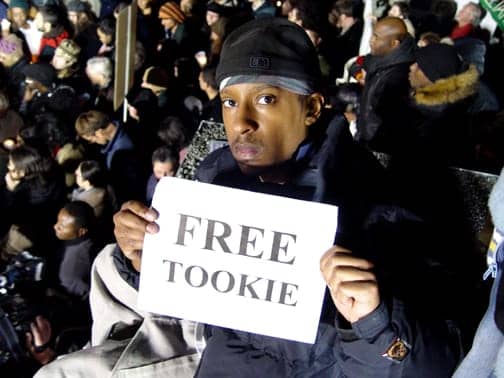
Back in California, the Terminator said it all when he gave the OK to murder Bro. Tookie, condemning him for acknowledging his teachers who helped to redeem him as a man, transforming himself from a destructive force in the community to a positive force for peace and unity. The fact Mr. Obama felt he had to bite his tongue and apologize for being critical of the Cambridge police who unlawfully arrested his friend, Professor Gates.

It’s all testimony to the fact: The struggle ain’t over. We must understand the momentum of this feel-good moment will not carry us – just as MLK needed Malcolm X for people to know what the alternatives would be if people of color in this country were not given their civil rights.

The thousands – largely young and Black – who demanded Tookie’s freedom outside San Quentin’s gate the night of Dec. 13, 2005, and agonized through his half hour long, torturous execution vowed that the struggle ain’t over. – Photo: Minister of Information JR


We need that same warrior spirit now – which is why even though I retired my G-hand long ago to push for peaceful means of change and working together, I refuse to repress or hide my anger at the brutality and barbarism I see every day, a lot of it taking place in our name. And I will not condemn the young Gs out there who carry that spirit of rebellion, or who maybe feel the way Bro. Lovelle did when he held court in the street. These are not monsters; these are young men who have been failed and betrayed by a corrupt system that doesn’t work.

It troubles me so many people actually believe somehow racism died upon the election of a Black president. But these courts are still falsely convicting and excessively sentencing Blacks and Browns by the thousands, the prisons are still implementing these archaic policies to strip us of our strength and humanity, the police are still murdering us like wild animals in the streets.

And the government’s foreign policies dealing with nations of color are still as racist as ever. They ignore the plight of our friends and neighbors, Haiti and South America, living in extreme poverty, while pursuing the mythical terrorists in Iraq and Afghanistan – sending these unmanned drones to drop 200-pound bombs on the heads of innocent women and children, that are ironically navigated from a joystick right here in Nevada.

Shit, we still got judges in this country who refuse to marry interracial couples. And it is troubling still to hear some Whites speak as if Blacks and Browns owe them something for electing a Black president and allowing us to put a Latina on the Supreme Court. As if these things were given to us as a gift from the goodness of their hearts, rather than won from the blood and sacrifice of our own.

Ikemba, aka Marritte Funches, is legendary in Nevada prisons as a beloved teacher and has long been a friend and supporter of the Bay View.


That’s how you know the struggle ain’t over. Nothing in the history of America has ever been given to people of color. And, truth be told, the future of this country depends on us – on our efforts to bring America from under the shadows of its past.

But we as a country must shake off the fog and understand there are no magic bullets or symbolisms that can kill the stink of racism in America. We must continue to be conscious and work together to remove the flaws in our system that foster the divides of race, class, gender etc. We must clean up the courts, reform the prisons and bring personal accountability to the police departments, so that if a cop kills an innocent civilian, uses excessive force or lies to falsely incarcerate someone or cover up a mistake, they’ll be prosecuted just like anyone else.

Maybe when we do this, and we as a country have learned to reconcile our past, not only in our minds and monuments, but in our schools and textbooks, when politicians are no longer allowed to be bribed or bought off, when health care and higher education are respected as rights rather than privileges for rich people, then real progress can be claimed. But for now, the struggle ain’t over.

Send this brave and brilliant soldier in the struggle some love and light: Ikemba S. Mutulu, s/n Marritte Funches, #37050, P.O. Box 1989, Ely, NV 89301, and check out his work on the August Initiative at Augustinitiative.org.