Thursday, May 11, 2006

GULAG AMERICA


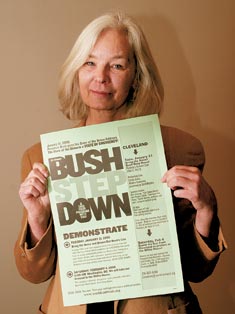
In Cleveland Heights, Ohio, Carol Fisher has been charged with a major felony for putting posters on public lamp-posts. Fisher was hanging "World Can't Wait, Bush Step Down" posters on Lee Road telephone poles January 28 when some cops pointed out to her that the city has a law against that. They asked for an ID. She didn't have one with her. Fisher turned and walked toward the poster, in compliance with the officer’s warning. But instead of allowing her to take it down or just issuing a citation, the cops attacked and according to testimony one was “grinding his
knee into [Fisher’s] back and [her] face into the sidewalk.”

The following is from The World Can’t Wait.


Judge Orders World Can't Wait Activist to Jail Psych Unit

Judge Timothy McGinty forcibly incarcerated Carol Fisher in the psych unit of the Cuyahoga County Jail in downtown Cleveland, where she now sits for an indefinite period of time.

In a hastily called hearing yesterday, Judge McGinty made a highly unusual and outrageous decision to force Carol to undergo a state psychological exam as part of her pre-sentencing investigation. From the very start of Carol's case, the judge has openly said that she must have mental problems for resisting an unlawful and brutal encounter with Cleveland Heights police. He went even further in yesterday's hearing, saying that her opposition to the Bush regime makes her "delusional."

The small courtroom on the 21st floor of the Justice Center was ringed with 5 armed court bailiffs. McGinty started off the hearing by making Carol stand up and had one of her attorneys read her t-shirt, which said:

"Wanted for Illegally Crossing Borders: The Bush Regime
"If you are going to insist that crossing borders illegally is a crime which cannot be tolerated, how about George Bush, Dick Cheney, Donald Rumsfeld, Condoleezza Rice (and yes, Colin Powell) and the rest of that gang, with their highly illegal, and violent, 'crossing of the border'-into Iraq, among other places?!"

McGinty then said this was proof of her delusion! He also kept saying Carol "wants" to go to jail, and that she has a "martyr complex." When Carol tried to explain why she wouldn't take this test, the judge's only response was, "I do not negotiate with felons."

Does Carol really want to go to jail? No! But she is not willing to comply with a vindictive court ordered test to "prove" her sanity. And more than that, she is taking a stand for everyone who is angry and fearful of a government that, under the rubric of "national security and the war on terror," willfully and unapologetically tramples on the most basic rights of privacy. Think about this in light of the NSA spying scandal, and now Bush wants to install the head of the notorious NSA to be CIA chief! As Carol said before she went to jail, "I'd be crazy to go along with this shit! That which you will not resist and mobilize to stop, you will learn--or be forced--to accept."

Just look at this whole case: a woman posts a "Bush Step Down" poster on a telephone pole, being brutalized by the police in the process, and now not only faces 3 years in prison but also a mandatory psych exam. As Terry Gilbert, one of Carol's attorneys said, "This is Gulag stuff--saying that people who are dissidents are crazy." He further added that in his 33 years of practicing law, he has never seen anything like this.

Is this the kind of country you want to live in?

On the phone this morning, Carol Fisher stated that, in addition to sending her to the psych unit, McGinty has also put her on "suicide watch"! They have taken away her eyeglasses. And if she refuses the psych exam, she will be forcibly sent to North Coast Mental Institute for a 20 day evaluation.

Legal challenges are continuing, including seeking a writ of habeas corpus.

When the transcripts are available to the public, they will show how outrageous this hearing was.

*Donate to Carol's legal defense. It costs a lot of money to get transcripts, file appeals, etc. Make checks payable to “Carol Fisher Defense Fund” and mail to “NION/WCW PO Box 609034 Cleveland, OH 44109.

Wednesday, May 10, 2006

FAITH HEALER STAY HOME OR GOT SNAKES WILL TRAVEL


Trinidad's largest Hindu organization wanted the prime minister to bar American televangelist Benny Hinn from visiting the country.

When that didn't happen they called on the cops to arrest the dude.

Hinn plans to visit the diverse Caribbean nation from May 19th through the 21st. The Sanatan Dharma Maha Saba says Hinn will threaten the country's religious harmony.

The organization has taken out newspaper ads claiming Hinn's revivals are illegal because he makes money by faith healing. Faith healing is against the law in Trinidad.

Meanwhile, the wife of the man who died soon after he was said to have been healed by Hinn seven years ago had this bit of advice for sick people who plan to attend Hinn's crusade this month: Visit a doctor instead.

Chance's ailing husband, Marcano Siewkumar, went to Hinn's crusade at the Queen's Park Savannah, Port of Spain in 1999. Struggling to walk, he was chosen as one of the people to be healed that night, and was lifted onto the stage

Siewkumar, who suffered with heart disease, kidney failure and hypertension, was told he was healed.

The Siewkumar miracle as it was called was broadcast on a Christian television cable channel by Hinn who said he had cast out more demons in Trinidad than anywhere else he had preached.

Chance said her husband was bitter until his death, which came 33 days after the healing.

Benny Hinn Ministries is based in the suburbs of Dallas. It's estimated to raise more than 100 (m) million dollars a year.

The following rather strange article is from Caribbean Net News.


Hindus want American televangelist arrested on arrival in Trinidad
Wednesday, May 10, 2006

PORT OF SPAIN, Trinidad: A major Hindu organisation in Trinidad, the Sanatan Dharma Maha Sabha, wants the Commissioner of Police to arrest American televangelist Benny Hinn, under the Summary Offences Act, as soon as he arrives in Trinidad for a second visit, the Inter Religious Organisation was told on Monday.

Devant Maharaj, who represented the Hindu religion in place of Maha Sabha general secretary Sat Maharaj, said he made the call when he was asked to elaborate on the Maha Sabha's position on Hinn's three-day crusade scheduled to start in Port of Spain on May 19.

The meeting was held at Archbishop House, Port of Spain, and among those present were IRO chairman Cyril Paul and Roman Catholic Archbishop Edward Gilbert.

Devant Maharaj said much of the discussions at the three-hour long meeting centred on Hinn's visit.

He said he told the meeting that the Maha Sabha was of the opinion that the police had been quick to arrest stage artistes under similar circumstances.

Maharaj was referring to Hinn's first visit in 1999 during which the Maha Sabha felt that Hinn had attacked the national community by casting aspersions on Trinidad and Tobago as a land of voodoo and had painted it negatively with a primitive brush.

Sat Maharaj said the Maha Sabha had set aside a budget of $100,000 to counter Hinn's visit. "We are not leaving his attack on Trinidad and Tobago alone," Maharaj said.

STILL HOMELESS IN IRAQ


Three years of instability and war have created a massive number of homeless in Iraq. The main reason for terrible living conditions for thousands of Iraqis is that many houses have been destroyed over years of conflict in the country. The country's housing problem dates back to previous conflicts, but has been exacerbated by the current war, insurgency and instability in the recent past. The numbers of homes destroyed goes up daily and very little is investested in housing.

The report below is from IRIN.


Displaced in 2003, still homeless

BAGHDAD - Local aid agencies warn that families displaced immediately following the US-led invasion of Iraq in 2003 still remain homeless.

"We urge international aid agencies to help us support the displaced, especially in terms of food and shelter," said Waleed Rashdi, a spokesman for the Aid Agencies Association in Iraq. "Because all the aid is now being sent to the recently-displaced, while other groups are suffering seriously."

Dina Abou Samra, a Middle East analyst at the Geneva-based Internal Displacement Monitoring Centre at the Norwegian Refugee Council (NRC) agreed with this assessment. "The media has focused much attention on those displaced within the last weeks [victims of sectarian violence]," she said. "But it's urgent that the needs of many other groups of displaced people are also addressed." She went on to say that such people - many of whom have remained homeless for almost three years - be provided with shelter, food and access to clean water and health services.

According to experts, the reasons for the large-scale displacements are myriad. "Displacement has been caused by spontaneous returns [of large ethnic populations to certain areas], general insecurity and sectarian violence," said Abou Samra. "Also, many refugees returning to Iraq are becoming internally displaced, due to reasons like insecurity and the lack of housing and basic services."

Meanwhile, displacement experts say that ongoing sectarian violence has contributed to the increase in the number of displaced families.

The recently-displaced people are primarily located in the provinces of Baghdad, Anbar, Diyala, Najaf and Karbala. According to reports the split between displaced Sunni Arabs and Shi'a Arabs is about 50:50 but they are moving in different directions with the vast majority of Shi'a heading south and Sunnis tending to move to the west and north.

"It's estimated that there are more than one million internally displaced people in Iraq today," said NRC's Dina Abou Samra. "This is in addition to the estimated 100,000 people newly displaced last month."

"To this number we must also add all the people trying to flee to neighbouring countries, for whom there are no official statistics," said NCCI spokesman Cedric Turlan. "There are hundreds of thousands of Iraqis in Jordan and Syria, and it seems that Egypt has also begun taking in large numbers."

This item comes to you via IRIN, a UN humanitarian news and information service, but may not necessarily reflect the views of the United Nations or its agencies. All IRIN material may be reposted or reprinted free-of-charge; refer to the copyright page for conditions of use. IRIN is a project of the UN Office for the Coordination of Humanitarian Affairs.

PEOPLE OF ECUADOR WANT THEIR SHARE OF OIL REVENUES


In Ecuador yesterday police on motorcycles, with dogs and using tear gas bombs attacked 150 people violently at Plaza de la Independencia. The marchers were there to voice thier opposition to the government´s intention to parley a new contract with US Oxy Oil Corporation.

The small country on the western coast of South America is the eighth-largest supplier of oil to the U.S. As in other nations awash in oil money, the sight of so much wealth flowing to foreign corporations has exacerbated the frustrations of many Ecuadoreans, who confront widespread poverty.

Oxy, which has been operating in eastern Ecuador for 20 years, extracts nearly 100,000 crude oil barrels a day and gives 12 percent to the State. The company generated 7% of its worldwide production from its Ecuador fields last year and is the country's top private producer.

The Los Angeles company earned $5.2 billion last year on revenues of $15.2 billion. In the past three years its shares have tripled in value

The first article below is from Prensa Latina. The second article is from MISNA.


Oxy Unraveling Ecuador Govt

The Ecuadorian administration´s longing to renegotiate with US Oxy Oil Corp, despite rejection by the population, is inflaming the national political scene, where deputies are already calling to bring President Alfredo Palacio to trial.

Tuesday, the government had to deal with a first warning, when thousands of people from the Amazon descended on the capital, Quito, to demand that the contract with Oxy, polluter and violator of 30 national regulations, be allowed to expire.

Amazonian leaders, joined by indigenous and political movements, gave the government a 15-day deadline to cancel the contract or they would restart protests.

Meanwhile, various deputies are collecting signatures to begin political trials against Palacio, Energy Minister Ivan Rodriguez, and Attorney General Jose Maria Borja.

------------------------------------------------------------------------------
INDIGENOUS PROTESTS RESUME FOR NATIONALISATION OF HYDROCARBONS

After a few weeks of ‘truce’ thousands of indigenous of the Amazon regions returned on the streets of Quito, demanding the nationalisation of hydrocarbons and the expulsion from the nation of the US Oxy oil company, accused of violating its contract with the government: “We are here to consign to the authorities a manifesto approved by all the communities of Pastaza, Morona Santiago, Sucumbíos, Napo, Zamora and Chinchipe, in which we call on the government to rescind the accord with Oxy and to not sign the Free Trade Accord with the United States”, stated Guadalupe Llori, prefect of the Orellana province. “We will not tolerate another farce in detriment to the Ecuadorians. Oxy has to go because it blatantly violated the laws in force”, added Gilberto Talahua, co-ordinator of the ‘Movimiento Pachakitik’, political wing of the Confederation of Indigenous Nations (CONAIE). The Attorney General’s office charges the American company with selling, without consulting the Ecuadorian State, 40% of its oil extraction rights in an Amazonian well to the Canadian ‘Encana’: after insisting on the annulment of the contract, in the past days it however suggested new negotiations to consent the company to continue operating in Ecuadorian territory. In return, Oxy offered $20million in damages to Quito and 50% of the surplus proceeds from the hike in oil prices on the world market. A proposal judged “petty” even by the State ‘Petroecuador’ oil company.

Tuesday, May 09, 2006

SHOREWOOD HIGH IN THE NEWS


Something is up at Shorewood Hight School in Shorline, Washington.

The following report is from KOMO in Seattle, Washington.


Shoreline Students Walk Out In Protest

SHORELINE - Students in Shoreline walked out Tuesday morning, protesting budget cuts that could mean layoffs for teachers and staff.

About 300 students from Shorewood High School wrote letters telling the school board and administrators what they want and hand delivered them to them.

The Shoreline School District is $5 million over budget after hired consultants found the district estimated they had 3,500 vocational students, but turns out they only had 700.

More students meant more money, so the district thought it had millions more than it actually did.

Some 45 teaching jobs, nurses, security, and the students' beloved activity coordinator Larry Stewart's job are on the line to make up for that mistake, and students don't think they should pay.

"We want to make sure that the board knows that the things that are important to us are being heard," said student Chase Parker.

"Teachers shouldn't be cut," added student Sabrina Boyle. "And administrators need to see that three superintendents is absurd. $160,000 a year could pay for two teaching jobs, not just one superintendent job."

Police made sure that students were safe during that about three-mile round trip walk. And when they returned to school, some teachers clapped. They said had they didn't help organize but they agree with the students' stand.

The district controller and the director of budget and accounting resigned after those mistakes, and the superintendent is on paid administrative leave but some administrators say he should go too.

"I am scared of the jobs of my instructional assistants that I need to make a good program," said Shorewood High School teacher Veronica Cook. "I'm also scared for the other teachers in this building that are going to have classes close to 40.

"Well, we still are keeping a superintendent, associate superintendent, and assistant superintendent positions. I'm sorry, we have a superintendent that makes a whole lot of money. no matter what happens, he was responsible."

The district says right now they are looking into all options of what to do to try and save money for next year, including charging to play sports. But as it stands right now, they're going to hold more school board meetings to figure out how to handle the mess.

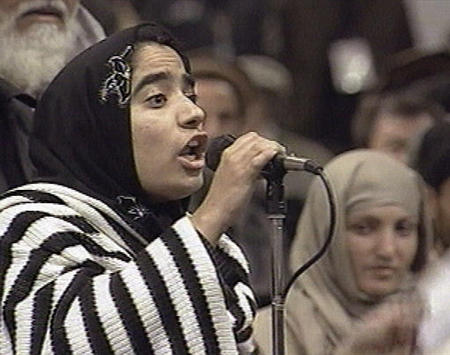
MALALAI JOYA: "THEY CAN KILL ME BUT THEY CANNOT KILL MY VOICE."


Malalai Joya , 27, a member of Afghanistan's parliament and a former refugee turned activist, is determined to tell it like it is, regardless of the risks and fear.

Joya was physically and verbally assaulted during a parliament session yesterday when she denounced certain warlord members of that body. It wasn't the first time.

Malalai Joya was elected to the 249-seat National Assembly, or Wolesi Jirga in September 2005, as a representative of Farah Province. Malalai won the second highest number of votes in the province.

Malalai Joya rose to fame in December 2003 when, as an elected delegate to the Constitutional Loya Jirga, she spoke out publicly against the domination of warlords. Since then she has survived four assassination attempts, and travels in Afghanistan under a burqa and with armed guards.

She is the daughter of a former medical student who was wounded while fighting against the Soviet occupation of Afghanistan. Malalai was 4 years old when her family fled Afghanistan in 1982 to the refugee camps of Iran and then Pakistan. She finished her education in Pakistan and began teaching literacy courses to other women at age 19. After the Soviets left, Malalai Joya returned to Afghanistan in 1998 during the Taliban's reign. During that time she established an orphanage and health clinic, and was soon a vocal opponent of the Taliban.

In her speech yesterday she declared that there were “two types of Mujahidin — one who were really Mujahidin, the second who killed tens of thousands of innocent people and who are criminals”.

That was too much apparently for the guys.

After the attack she told the Times of London, “I have lots of threats. I have had people call me to threaten me, and in Kabul have to stay in a different house every night. I don’t feel safe. I’m never scared because I tell the truth and I believe in the truth and in democracy. They can kill me but they cannot kill my voice.”

The following is from AFP via Afghan News Network.


Scuffle in Afghan parliament after woman MP criticises warlords

Former warlords in Afghanistan's parliament hurled water bottles and rushed at a woman MP after she accused them of being involved in the deaths of thousands of people.

Malalai Joya said bearded and turbaned MPs who were once warlords in the country's decades of conflict had to be restrained from physically attacking her after a heated session of the four-month-old parliament.

The uproar, in which several MPs rose from their chairs shouting, was shown on television. A cameraman from a private television station said one of the MPs had slapped him across the face while he was filming the scuffle.

Joya, who has had death threats against her after a similar outburst during a meeting to draw up a post-Taliban constitution in 2003, alleged that she had heard a prominent former warlord telling his men "to stab me with a knife".

"Several of them threw water bottles at me and many others rushed towards me to beat me up," she said in an interview with AFP afterwards.

Joya, in her late 20s, said the MPs had reacted angrily to her statement that some of the men who led the resistance to the 10-year Soviet occupation were responsible for the deaths of thousands of civilians in a civil war that erupted after the Soviet withdrawal in 1989.

Her comments were made in a debate about the anniversary last month of the defeat of communism in Afghanistan in 1993 when the government that replaced the Soviet administration was toppled.

"I told them that we have two types of mujahedin -- one who were really mujahed (holy warriors) the second, those who killed tens of thousands of innocent people and who are criminals. My words sparked their anger," she said.

The civil war ended with the 1996 takeover of the extremist Taliban regime that was ousted in late 2001 by a US-led coalition.

Joya caused a similar outburst at a 2003 constitutional Loya Jirga, or traditional gathering, when she said the once-powerful warlords involved in atrocities in the war deserved punishment.

Delegates rushed at her, yelling "Allahu akbar" (God is the greatest) and demanding her expulsion, and had to be kept back by soldiers.

The incident catapulted Joya into the international spotlight that was on the country as it emerged from the oppression of the Taliban, which kept women behind doors and barred them from political and economic activities.

The parliament, inaugurated in December after the first general parliamentary election in around 30 years, is dominated by former mujahedin but includes MPs eager to push the country along the road to democracy.

NORTHERN IRELAND: "THIS IS THE RESULT"


A Catholic schoolboy attacked by a unionist mob in the County Antrim town of Ballymena has died of his injuries (see yesterday's OD for further information). The victim, who was on a life-support machine last night succumbed to his injuries and died in hospital as his family maintained a bedside vigil.

Sinn Fein MLA Philip McGuigan expressed his sympathy to the family and commented, "This murder was unjustifiable and was motivated entirely by sectarian hatred and bigotry.

"I was in Ballymena last night and there remains much anger at the events of the weekend and indeed at the years of discrimination and inequality which led directly to the circumstances which gave rise to this horrific crime.

"The catholic community in Ballymena have as much right as anyone else to live, worship and conduct business in that town as any other group. Unfortunately there are those within unionism in the town who have for decades sought to demonise and discriminate against nationalists and republicans in Ballymena.

Sinn Fein's Gerry Adams added, "I want to express my condolences and sympathies to the family of Michael McIlveen. He is the latest victim of sectarian hatred. Sectarianism is rampant in our society. It has to be tackled.
"The key to ending sectarianism is in the hands of political and civic leaders. Political leaders need to work together to challenge those who prefer the old ways. Achieving this means not just ending sectarianism on our streets but also adopting the implementation of policies which can eradicate deep rooted sectarianism and discrimination wherever it exists."

The first article below is from the Irish News. The second is from the Belfast Telegraph. The third is a statement from the 32 County Sovereignty Movement


Don’t Let This Happen Again Plead Murdered Boy’s Family

THE heartbroken family of murdered Catholic Michael McIlveen (15) wanted this picture (see accompanying picture), taken minutes after he died, published as a stark message of what sectarianism can do.

Michael lost his fight for life last night after being
savagely att-acked in Ballymena, Co Antrim, early on
Sunday.

Last night his life-support mach-ine was switched off.

His distraught family – mother Gina, his younger brother,
and two sisters – were at his bedside, inconsolable.

Michael’s uncle gently kissed his forehead – his nephew’s
bed in the intensive care unit of Antrim Area Hospital
surrounded by those who loved him.

It was screened off but such was the outpouring of grief
that other patients in the small ward were only too aware
that a mother had been robbed of a son on the cusp on
adulthood.

The teenager, who only last week proudly stood as godfather
to his sister’s new baby, was singled out for no other
reason than being a Catholic.

Desperate that no-one else suffers, his family last night
pleaded for an end to sectarianism.

Another uncle explained why the family wanted Michael’s
picture published.

“We just want to show people out there what happens when
gangs on both sides roam about – this is the result,” he
said.

“We want politicians, especially in Ballymena, to get their
fingers out and get something done be-fore somebody else is
murdered.

“He was just 15, just 15. He was a quiet wee teenager. His
mother is devastated.

“He stood for his sister's baby last week. Now he is dead.
It is such a waste.”

Michael was battered by a gang – at least one brandishing a
baseball bat – just minutes after buying a takeaway pizza.

He was set upon outside a house in Granville Drive at
around 12.30am.

Despite being repeatedly beat-en, Michael managed to
struggle home, where the full extent of his injuries was
realised and he was rushed to hospital.

Last night four men and a juvenile were being quizzed by
police.

One of the suspects is reported to have been a Catholic.
============================================================================

Streets of fear

'It was only a matter of time before something like this happened and I just pray there won't be any more bloodshed'

By Debra Douglas
09 May 2006

In recent years, the bustling town of Ballymena has been plagued with sectarian attacks including a spate of petrol and paint bombings last summer.

But last weekend, simmering tensions reached boiling point, and a Catholic teenager was seriously injured in a brutal attack. Last night Michael McIlveen died of his injuries.

According to Delia Close, an Independent member of Ballymena's District Policing Partnership, the police had warned about clashes between groups of young people last year.

Senior officers warned that if the community did not address the issue, someone would lose their life. Now they are dealing with the murder they feared would happen.

It seemed it was only a matter of time before an attack ended with a tragic fatality.

Only a few weeks ago, a man sustained a punctured lung after being stabbed during a serious sectarian incident involving about 20 youths in a shopping centre in the town.

A 17-year-old was charged with disorderly behaviour and assaulting the 16-year-old brother of the stabbing victim.

The court heard that during the week before the attack, gangs of youths from both sections of the community "had been roaming around".

A police officer told the court that on the Friday night before the stabbing, a number of nationalists were arrested after a loyalist was headbutted at Cameron's car park and that loyalist youths "were out looking for retaliation" the next night.

Several weeks later, and only yards away from where the loyalist was headbutted, Michael McIlveen was set upon by a gang following an altercation at a nearby cinema, and after days hooked up to a life-support machine, he tragically died.

Hours after Michael was attacked, a 45-year-old man suffered head wounds after being attacked in the Dunclug area of Ballymena in what police believe was a linked incident.

Locals passing the scene of the violent attack said they weren't surprised by what happened.

Speaking to the Belfast Telegraph as a police helicopter hovered above, one resident, who asked not to be named, said: "It was only a matter of time before something like this happened and I just pray there won't be any more bloodshed on our streets. The police need to get to the bottom of this and sort it out.

"Ballymena has got a reputation as a trouble spot now and is it any wonder with things like this going on."

But the town's DUP Mayor, Tommy Nicholl, said efforts had been made to try and prevent the simmering tensions reaching the boiling point they now appear to be at.

"We have been concerned about the situation for some time but, sadly, it has come to the point now where a teenager has been killed," he said.

"Last summer, we had petrol bomb attacks on schools, churches and other places and I decided through the Mayor's initiative to look at some way of improving the situation.

"I have taken a number of steps, including bringing the clergy together to see if they can exercise influence over the local community along with the PSNI.

"I felt we were moving in the right direction. We're getting the red, white and blue paint removed from the kerbs in Harryville and the mural depicting paramilitary groups has been removed as part of a good relations strategy.

"We are doing everything we can to deal with the issue of sectarianism and try and eradicate it, but there is more to be done.

"I want to bring the people of Ballymena together and have a society where everybody respects one another's point of view."

Factions urged to 'draw back from the brink'

A Co Antrim community was last night urged to "draw back from the brink" following the killing of a 15-year-old schoolboy in a brutal sectarian attack.

As family and friends last night mourned the death of Michael McIlveen, politicians on both sides of the political divide in Ballymena called for calm.

The town's DUP Mayor, Tommy Nicholl, said it was vital those with influence within the community did everything in their power to resolve the current situation.

"I would say to anyone with influence over those people concerned to get them to draw back from the brink, sit down and consider what it is they are doing," he told the Belfast Telegraph.

North Antrim MP Ian Paisley labelled the attack on MIchael as "horrific" and said "that those who have been responsible for this must have the full rigour of the law applied to them".

Ulster Unionist councillor James Currie called for a zero- tolerance approach to all sectarian attacks.

"I offer my deepest sympathies to the family of this young teenager," he said.

"I am confident that those responsible for this attack will be brought to justice by the police. The police have been active in their approach to halt such incidents and they are doing a very good job in maintaining this to a minimum.

"There is no place for this type of behaviour within our society and I hope that the police employ a zero-tolerance approach to show others that these crimes will not be tolerated."

Sinn Fein Assembly member Philip McGuigan said: "My thoughts are with the family at this time.

"Tensions have been high in the town and have now escalated to the point where a young man has been killed.

"Everyone has a part to play in ensuring these sort of attacks are brought to an end for the good of all the community."

SDLP assembly member Declan O'Loan also said tensions had been high recently.

"There's no point shirking the unpleasant fact that this murder was a sectarian act of the most horrendous nature," he added.

Earlier yesterday, Secretary of State Peter Hain issued a stern pledge to catch those responsible for the attack on Michael.

"This is an awful sectarianism which harks back to Northern Ireland's dark and brutal past. We are going to work to hunt down those responsible and make sure this kind of thing does not happen again," he said.

=============================================================================

Press Release: 32 County Sovereignty Movement
8/05/2006
Contact: Andy Martin Director of Publicity
Phone 07742439449 or e-mail sovereign_nation@hotmail.com

Nationalist concerns grow as murder highlights police inaction in Ballymena.

The 32 County Sovereignty Movement extend our deepest sympathies to the family of Michael McIlveen following his Murder at the hands of Loyalists in Ballymena. Michael was attacked by a Loyalist gang wielding baseball bats and severely beaten in Garfield place and tragically died on Monday evening as a result of this sectarian attack.

Three witness who gave statements to the police on Monday were visited within a matter of hours by the RUC/PSNI whoinformed them that their lives were under threat from Loyalists and then asked them did they want to retract their statements. The 32 County Sovereignty Movement view the behaviour of the police with alarm given the timescale between the statements being given and the death threats received. How did these Loyalists know statements had been taken and the identities of those who had made the statements? This follows equally worrying behaviour on Sunday evening following the attack when local republicans were in the area trying to calm tensions. A group of Loyalists armed with Stanley knives and claw hammers entered a street where the republicans were visiting relatives of Michael McIlveen. Local residents took a number of hurling sticks from some children who were playing in the street presumably to defend thmselves at which point the RUC/PSNI arrived in the street and surrounded the nationalists. When nationalist residents protested and pointed out that there were armed Loyalists still in the street the police told them that they would deal with that after they had dealt with them, when it was pointed out that the nationalist residents had done nothing a further five landrovers of police in riot gear entered the street and stood outside the house, again ignoring the loyalists who calmly made their way out of the area unhindered.

Recently a man who was stabbed by a gang of up to thirty Loyalists who rampaged through a shopping centre in Ballymena was charged with assault and affray, presumably for trying to defend himself while those who attacked him got away scott free.

The murder of Michael McIlveen is the latest in a litany of attacks by Loyalists in Ballymena and the lack of action by the police illustrates perfectly that despite cosmetic changes they are still a sectarian police force. Ballymena town centre is still a no go area for nationalists who live in constant fear of attack both in the town and within nationalist areas. The police appear unwilling or unable to protect nationalists and recent events have confirmed that the RUC/PSNI are, at the very least, turning a blind eye to Loyalist aggression in Ballymena. The 32 County Sovereignty Movement call on nationalists to remain vigilant and to unite to defend themselves from attacks by pro British death squads both in and out of uniform.

Monday, May 08, 2006

WINNIPEG: ANOTHER INDIAN DEAD


"The colonial world is a world cut in two. The dividing line, the frontiers are shown by barracks and police stations. In the colonies it is the policeman and the soldier who are the official, instituted go-betweens, the spokesmen of the settler and his rule of oppression." - Frantz Fanon, The Wretched of the Earth

On January 31, 2005, Matthew Dumas, an 18-year-old Anishnabe, was pepper-sprayed, shot twice and killed by a Winnipeg Police officer supposedly looking for a robbery suspect. The cops say that Dumas was a suspect in a robbery and was holding a screwdriver.

The thing is there is nothing unusual about the police shooting of Dumas. Nothing at all.

The following comes from The Drum (Canada).


Students to probe abuse by cops
by Lyndenn Behm

Their name, AID Winnipeg, couldn't have been more blunt in summing up the group's concerns. AID stands for Another Indian Dead.

This summer Aboriginal self-government students from the University of Winnipeg will be assessing the extent of police brutality with the goal of getting rid of the current Law Enforcement Review Agency (LERA). They say the current process is virtually useless and should be replaced with something that would make police more easily held to account for acts of brutality.

More than 2,000 cases of improper police conduct have been brought to LERA since it was formed in the mid 1980s, but not a single one has resulted in punitive measures being taken against police, AID organizer Ryan Bruyere told a demonstration outside the Manitoba Legislature in March.

That rally, held on the International Day Against Police Brutality, marked the beginning of AID's campaign, which then went into recess until after spring exams. About six dozen people listened as AID organizers read off a list of people who had been killed through situations involving police.

"The reason we are here today is to make sure no more (victims) are on the list," Bruyere said.

Bruyere and other students at the Aboriginal self-governance program at the University of Winnipeg organized the demonstration and handed out pamphlets regarding the AID Winnipeg campaign.

The objectives of AID include:

A petition and letter-writing campaign directed at Manitoba justice Minister Gord McIntosh;
Community consultations with concerned groups;
Finding legal professional to assist with research and advocating;
Researching incidents and telling the stories of victims of police misconduct over the last 35 years in Winnipeg;
The establishment of a non-profit fund to provide monetary support for victims of police violence;
Pressing the police for transparency.
When addressing the crowd Bruyere repeated a statement from AID's pamphlet that police are a reflection of the community they serve, and the people AID represents are seen as part of the community. "I sense that we are not afraid of the police, but rather of the community."


Another representative of AID Winnipeg, Jake Wark, said the hundreds of complaints registered with LERA represent only a portion of the actual brutality, because many victims are "too bruised and too broken" to file a complaint.

Cyril Shorting, also with the U of W program, said the LERA process is imbalanced because the police are well funded while the victims are often poor. The process is long, stressful and hard on victims.

Dave Brophy, a non-Aboriginal person, spoke of how the small rally in support of the victims of police brutality was poorly attended compared to that last year for an upper middle-class teenager who was killed in weapons crossfire while walking on a sidewalk downtown.

One time more than 550 people including prominent politicians turned out and this lead to Operation Clean Sweep and the hiring of an additional 40 police officers, he said.

"I don't want to belittle anyone's suffering but it is unfortunate that (some) people came to the vigil with a heavy-handed message," he said, adding that the solution doesn't rest in hiring more police officers.

The AID representatives said innovative solutions, not more policing, are needed.

MIXED BAG OF NEWS ON LABOR ACTIVISTS IN IRAN


Several workers who have been held in jail since a demonstration in Saqez, Iran on May Day of 2004 are being released.

In Saqez this year, the security forces attempted to shut down the independent May Day event in the city, but the large number of participants deterred them from doing so. However, the police blockaded the area to prevent further participation of people in the event.

A May Day rally in Teheran, organized by the Syndicate of Workers of the Tehran and Suburbs Bus Company, was attacked by hundreds of police. Numerous union members and students from various universities in Tehran were arrested during the police assault. As of May 6, 2006 all of the detainees have been released although some with restrictive bail conditions. Many still will have to appear in court to face possible charges. Many members of the board of directors of the syndicate, including some of those arrested on May first, have already been charged with serious allegations including “propaganda against the regime” and “practices against the national security” and will have to face trial in the near future.

Mansour Osanloo, the President of the Syndicate of Workers of the Tehran and Suburbs Bus Company, has been in prison since December 22nd, 2005.

The following is a Report by International Alliance in Support of Workers in Iran.


Iran: Repeal of Prison Sentences Against the Saqez Labour Activists!

Congratulations to All Our Fellow Workers around the World on the Repeal of Prison Sentences Against the Saqez Labour Activists!

On Saturday, May 1st, 2004, hundreds of workers and their families in the City of Saqez, Kurdistan province, staged a rally and march to commemorate the International Workers’ Day. The event was organized by “the First of May Council”, which was a committee consists of the city’s labour activists that acted independently from the government-sponsored Workers’ House. At about 5:00 p. m., the Islamic Republic’s intelligence and security forces as well as the “plain clothes” units attacked marchers, as the result of which about 50 participants were arrested and taken into custody. They were accused of participating in a May Day celebration. The same evening all those arrested were released with the exception of 7 people: Hadi Tanoumand, Esmail Khodkam, Borhan Divargar, Jalal Hosseini, Mohamad AbdiPour, Mohsen Hakimi and Mahmoud Salehi. The seven remaining activists started a hunger strike from the moment they were held in protest against their unlawful detentions and the violent methods used to detain them. The 7 detainees were held without charge for 12 days in Sannadaj and Saqez, while they were still on hunger strike and their health had deteriorated. They were released on May 12th, 2004 on heavy bail conditions.

These seven labour leaders were prosecuted, during a process that took over 18 months, mostly behind closed doors, for “organizing an illegal gathering” as well as other charges including “conspiring to commit criminal acts against national security” and sympathizing with Komala, which is a well-known banned socialist organization in Iran’s Kurdistan. Although all charges pertaining to association with the Komala were withdrawn, Mahmoud Salehi, the former President of the Bakery Workers’ Association of the city of Saqez and the current spokesperson for the Coordinating Committee to Form Worker’s Organisation, was sentenced to 5 years imprisonment and 3 years in exile in the city of Ghorveh. Jalal Hosseini, a member of the Bakery Workers’ Association of the city of Saqez, was sentenced to 3 years imprisonment, whereas Hadi Tanomand and Esmail Khodkam were acquitted. A couple days later, the Saqez Revolutionary Court sentenced Mohsen Hakimi, Borhan Divargar and Mohammad Abdipour to two years imprisonment. Hence five out of the seven initially charged had been sentenced.

There have been massive campaigns, organized both in Iran and abroad, against the arrests and subsequent charges against the Saqez Seven. Iranian labour, social and political activists and the international labour movements, including the ICFTU, Global Unions federations and national labour organizations all over the world, have been pressuring the Iranian government to drop the charges made against the “Saqez Seven” and to respect the right to organize, assembly and association for workers in Iran.

As a result of such a strong campaign both in the country and internationally as well as the resolve of the Saqez Seven and their families all the sentences against Mahmoud Salehi, Jalal Hosseini, Mohsen Hakimi, Borhan Divargar and Mohammad Abdipour were finally overturned this week by the Kurdistan Province Court of Appeal, Division 7.

It is absolutely imperative to emphasize that regardless of any possible attempts by the Iranian government and the judiciary system to get back to these fellow workers or other labour activists in the future, and despite the fact that Mansour Osanlou, the president of the Syndicate of Tehran transport workers, has been in custody for more than 4 months without any trials, the repeal of the sentences against the Saqez labour activists is considered a great victory for the Iranian working class and the labour movements in Iran. It also proves that true international labour solidarity efforts can and will make a huge difference in our struggles for workers’ rights and freedoms.

International Alliance in Support of Workers in Iran

CATHOLIC TEEN VICIOUSLY BEATEN IN NORTHERN IRELAND


Four men have been arrested for questioning following a serious assault of a teenager in County Antrim, Northern Ireland at the weekend.

The 15-year-old boy was walking home with friends after a night out, when they were confronted by a gang of men between midnight and 1am on Sunday. The victim's friends managed to escape, however when the teenager became separated from his friends, he was attacked and beaten, possibly with baseball bats. He managed to make his way back home, before being taken to Antrim Area hospital, where he remains in a critical condition on a life support machine.


The following is from Sinn Fein News.

Unionists attack leaves 15-year-old Catholic boy critically injured

A 15-year-old Catholic boy was critically injured in a sectarian attack in County Antrim on Saturday. The boy and a friend were brutally attacked by a unionist mob some of whom were armed with weapon who attacked him with a baseball bat and then jumped on his head. His friend escaped.

Saturday nights attack is the latest in a long line of attacks on Catholics, their homes churches and schools in the wider Ballymena area.

The DUP fail to engage in any power sharing on the Council. The local MP Ian Paisley went AWOL last summer at the height of the last anti-Catholic campaign which saw an attempt to ethnically cleanse a neighbouring village.

Sinn Féin Assembly member for North Antrim Philip McGuigan has said that unionist politicians in Ballymena and the areas MP Ian Paisley cannot ignore their responsibility for creating the conditions which gave rise to the sectarian attack on a young Catholic man in the town over the weekend. Mr McGuigan said that he would be contacting the Irish government to insist that they began to take some action to guarantee Irish citizens safety in the town.

Mr McGuigan said:

"Unionist politicians and in particular the DUP who control the local council cannot ignore their responsibility for creating the conditions which have given rise to violent attacks upon Catholics in this area by unionist gangs.

„The DUP failure to create conditions in Ballymena where the small Catholic community can live and work in peace does raise serious questions about the ability of the DUP to share power at any level with the representatives of the nationalist and republican community. Time and again when they get the opportunity to do so they fail to step up to the mark instead preferring to play to the lowest common denominator within their community."

Sunday, May 07, 2006

NEW PERSPECTIVE ON THE IMMIGRATION DEBATE, BLACKS AND BROWNS


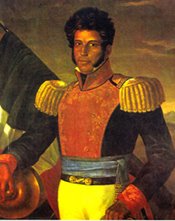
In 1829, AfroMexican President Vicente Guerrero (see accompanying picture) signed a decree banning slavery in the Mexican Republic.

The following comes from the San Francisco Bay View.


Mexico welcomed fugitive slaves and African American job-seekers
New perspectives on the immigration debate

By Ron Wilkins

There are, of course, many angles from which to view the escalating immigration debate. Mexican immigrants, who constitute the largest share of the undocumented, have a unique history with the African population inside the United States. As the Black community weighs in on this very contentious issue, it becomes necessary for us - both black and brown - to review the history that we share.

However, before reviewing our history together, I need to say unequivocally that the U.S. seizure of more than half of Mexico's territory in 1848 netted Washington more than 80 percent of Mexico's fertile land and was a criminal act. And that if Mexico today still included California and Texas, she would possess more oil than Saudi Arabia and have sufficient economic infrastructure to employ all of her people.

When Mexican people say that "the border crossed us, we did not cross the border," they speak the truth, and more Black people - most of whom are not strangers to oppression, exploitation, domination and exclusion - need to appreciate that.

It has been said that for most of the 19th century, Mexican immigrants were more highly regarded by African Americans than any other immigrant group. What may account for this, at least in part, is the enormous if not pivotal role undertaken by Black fighters in the war to secure Mexican independence from Spain and abolish slavery. Unfortunately, many of us repeat the falsehoods of our adversaries and have forgotten our special relationship with Mexican and Indigenous peoples.

It is time that our memories be restored and that the nay Sayers and nativist Negroes among us either put up or shut up. What follows is the little known history of Mexico serving as a refuge for fugitive slaves and a provider of job opportunities for Blacks emigrating from the U.S. to Mexico.

From the very beginning of his Texas colonization scheme, a determined and deceitful Stephen Austin sought to have Mexican officials acquiesce to the settlement of slave-owning whites into the territory. It was generally acknowledged that the people and government of Mexico abhorred slavery and were determined to prohibit its practice within the Mexican republic.

Beginning in 1822, at least 20,000 Anglos, many with their slave property, settled into Texas. Jared Groce, one of the first of Stephen Austin's Texas settlers that year, arrived with 90 enslaved Africans.

The Mexican Federal Law of July 13, 1824, clearly favored and promoted the emancipation of slaves. Mexico had even stipulated that it was prepared to compensate North American owners of fugitive slaves. Determined instead to have things their way, Anglos began to press for an extradition treaty which would require Mexico to return fugitive slaves.

From 1825 until the end of the Civil War in 1865, Mexican authorities continuously thwarted attempts by slave-holding Texas settlers to conclude fugitive slave extradition treaties between the two parties. During this period of extremely tense relations between the two governments, Mexico consistently repudiated and forbade the institution of slavery in its territory, while U.S. officials and Texas slave-owners continuously sought ways to circumvent Mexican law. The Mexican authorities thwarted repeated attempts by slave-holding Texas settlers to conclude fugitive slave extradition treaties between the two parties.

In 1826 the Committee of Foreign Relations of the Mexican Chamber of Deputies refused to compromise on the issue of fugitive slaves and defended the right of enslaved Africans to liberate themselves. Mexican government officials cited "the inalienable right which the Author of nature has conceded to him (meaning enslaved persons)." Congress member Erasmo Seguin from Texas commented that the Congress was "resolved to decree the perpetual extinction in the Republic of commerce and traffic in slaves and that their introduction into our territory should not be permitted under any pretext".

Again in October 1828, the Mexican Senate rejected 14 articles of a newly-proposed treaty and harshly criticized Article 33, stating "it would be most extraordinary that in a treaty between two free republics slavery should be encouraged by obliging ours to deliver up fugitive slaves to their merciless and barbarous masters of North America".

Reporting on the growing number of Anglo settlers in Texas, Mexican Gen. Teran reported, "Most of them have slaves, and these slaves are beginning to learn the favorable intent of Mexican law to their unfortunate condition and are becoming restless under their yokes …" Gen. Teran went on to describe the cruelty meted out by masters to restless slaves: "They extract their teeth, set on the dogs to tear them in pieces, the most lenient being he who but flogs his slaves until they are flayed."

On Sept. 15, 1829, AfroMexican President Vicente Guerrero signed a decree banning slavery in the Mexican Republic. Yielding to appeals from panicked settlers and Mexican collaborators who saw Mexico benefiting economically from the Anglo presence, Guerrero exempted Texas from the prohibition on the introduction of slaves into the republic, on Dec. 2. Several months later, the Mexican government severely restricted Anglo immigration and banned the introduction of slaves into the republic.

Undeterred, the Anglos succeeded in negotiating a new treaty with Mexico in 1831, which included Article 34, which called for pursuit and reclamation of fugitive slaves. After considerable wrangling between the Mexican Chamber of Deputies and Senate, Article 34 was removed from the treaty. Also, by 1831 it became apparent through debate within the Mexican Senate that the government's welcoming of fugitive slaves was not completely altruistic.

Some Mexican officials, fearful of U.S. military intervention, had begun to see it as wise to encourage the development of runaway slave colonies along the Northern border as a way to lessen the threat posed by the U.S. As historian Rosalie Schwartz put it, many Mexican officials "reasoned these fugitives, choosing between liberty under the Mexican government and bondage in the United States, would fight to protect their Mexican freedom more vigorously than any mercenaries." As the interests of Mexican officials and U.S. abolitionists coincided during the early 1830s, a modest number of former slaves established themselves in Texas and fared well during the period.

In 1836, after the fall of the Alamo and its slave-owning or pro-slavery leaders, such as William Travis, Jim Bowie and Davy Crockett, Mexican forces were defeated and an independent Texas was eventually annexed by the United States. However, before the expulsion of Mexican forces from Texas, Brig. Gen. Jose Urrea evicted scores of illegally-settled plantation owners, liberated slaves and, in many instances, granted them on-the-spot titles to the land they had worked.

Oddly enough, many Black people call for "40 acres and a mule" - a reference to Union Gen. Sherman's Special Field Order 15 and Gen. Howard's Circular 13, which made some land available to former slaves. But what one never hears are references to Mexican Gen. Jose Urrea and the land titles that he and his men granted to former Texas slaves following the defeat of the Alamo, a generation before the Civil War.

Even after the loss of Texas, Mexican officials refused to formally acknowledge Texas independence on the grounds that it "would be equivalent to the sanction and recognition of slavery." After Texas independence, the slave population mushroomed, and the number of runaways across the South Texas-North Mexico border increased. In 1842, Mexico's Constitutional Congress reasserted the nation's commitment to fugitive slaves. In 1847, 38,753 slaves and 102,961 whites were listed in the first official Texas census. In 1850, in a new treaty accord with the United States, Mexico again refused to provide for the return of fugitive slaves

The slave institution in Texas was continuously undermined by defiant Tejanos (Mexicans in Texas), who took great risks and invested enormous resources toward facilitating the escape of enslaved Africans. The Texas to Mexico routes to freedom constituted major unacknowledged extensions of the "Underground Railroad." Tejanos were variously accused of "tampering with slave property," "consorting with Blacks" and stirring up among the slave population "a spirit of insubordination."

Plantation owners in Central Texas adopted various resolutions aimed at preventing Mexicans from aiding the slave population. Whites in Guadalupe County prohibited Mexican "peons" from entering the county and anyone from conducting business or interacting with enslaved persons without authorization from the owners.

Bexar County whites suggested that "Mexican strangers entering from San Antonio register at the mayor's office and give an account of themselves and their business." Delegates to a convention in Gonzales resolved that "counties should organize vigilance committees to prosecute persons tampering with slaves" and that all citizens and slaveholders were to endeavor to prevent Mexicans from communicating with Blacks.

Whites in Austin decreed that "all transient Mexicans should be warned to leave within 10 days, that all remaining should be forcibly expelled unless their good character and good behavior were substantiated by responsible American citizens" and that "Mexicans should no longer be employed and their presence in the area should be discouraged." In Matagorda County, all Mexicans were driven out under the bogus claim that they were wandering, indigent sub-humans who "have no fixed domicile but hang around the plantations, taking the likeliest negro girls for wives … they often steal horses, and these girls too, and endeavor to run them to Mexico".

By the year 1855, the estimates were that as many as 4,000 to 5,000 formerly enslaved Africans had escaped to Mexico. Slaveholders became so alarmed at this trend that they requested and received approximately one fifth of the standing U.S. Army which was deployed along the Texas-Mexico border in a vain effort to stem the flow of runaways.

Defiant Mexicans stood their ground, refused to return runaways, and continued supporting slave uprisings and providing assistance to escaping slaves. In the words of Felix Haywood, a Texas slave, whose experience is recalled in "The Slave Narratives of Texas, "Sometimes someone would come along and try to get us to run up north and be free. We used to laugh at that. There was no reason to run up north. All we had to do was walk, but walk south, and we'd be free as soon as we crossed the Rio Grande".

What a difference a border made

1857 was a year whose profound irony made it one of the most interesting. 1857 was the year that the U.S. Supreme Court ruled against Dred Scott, an enslaved African who had sued for his freedom, on the grounds that his owner had forfeited any claim to him after taking him into a free state. Ironically, 1857 was the same year that the Mexican Congress adopted Article 13, declaring that an enslaved person was free the moment he set foot on Mexican soil.

Mexico as a provider of job opportunities for African Americans

During the 1890s, hundreds of Black migrants fed up with slave-like conditions and segregation, left Alabama for Mexico and established 10 large colonies. Shortly thereafter, during the period of the Mexican Revolution, large numbers of Black people migrated from New Orleans to Tampico, Mexico, as the oil industry prospered.

These Africans in Mexico established branches of Marcus Garvey's Universal Negro Improvement Association. One of the Black oil workers who came to Tampico stated, "There is no race prejudice; everyone is treated according to his abilities." During the same period, Black heavyweight champion Jack Johnson asserted that Mexico was "willing not only to give us the privileges of Mexican citizenship, but was also willing to champion our cause."

Juan Uribe, a major Mexican official, visiting Los Angeles in 1919, was quoted as saying, "My only regret is that it is not physically possible to immediately transport several million African Americans to my beloved Mexico, where the north yields her riches as nowhere else and where people are not disturbed by artificial standards of race or color."

Similarly, African American immigrant Theodore Troy said, "I am going to a land where freedom and opportunity beckon me as well as every other man, woman and child of dark skin. In this land, there are no Jim Crow laws to fetter me; I am not denied opportunity because of the color of my skin, and wonderful undeveloped resources of a country smiled upon by God beckon my genius on to their development."

A Black colony which included 50 families developed fruit orchards and engaged in cattle raising. It established itself in Baja, California, in the Santa Clara and Vallecitos Valleys situated between Ensenada and Tecate, approximately 30 miles south of San Diego and lasted into the 1960s.

Not to be overlooked is the enormous success of the Negro Baseball Leagues in Mexico during the 1930s and 1940s. Black ball players together with 400-500 family members seeking relief from racism in the U.S. and segregated institutions were hosted in Mexico by generally respectful competitors and admiring fans. One competitor in particular, Ray Dandridge, played for 18 years in Mexico before Jackie Robinson gained admission into U.S. major league baseball.

Also, from the 1930s to the 1960s, major Mexican muralists, such as Diego Rivera, David Siqueiros and Jose Clemente Orozco invited prominent African American artists such as Hale Woodruff, John Biggers, Elizabeth Catlett and Charles White to the Mexican Art School, where they developed an art style which helped them to connect images more effectively to ethnic and class struggle.

Of course there are many more historical intersections where Mexican and African people cooperated with each other. A few examples were the solidarity between the Student Nonviolent Coordinating Committee (SNCC)/ Black Panther Party and Brown Berets, SNCC and the Alianza Federal de Pueblos Libres and El Movimiento Estudiantil Chicano de Atzlan (MEChA) and the Black Student Union (BSU).

Mack Lyons, a Black member of the United Farmworkers Union's National Executive, negotiated its contract with Coca Cola, which owns Minutemaid and sizeable Florida orange groves. In Los Angeles during the '90s, Black and Brown students recognizing common history and mutual interests formed the African and Latino Youth Summit (ALYS).

Admittedly, Vicente Fox is no Vicente Guerrero. The Mexico of today is profoundly different from the refuge that once welcomed fugitive slaves or land of opportunity that embraced African American job-seekers; yet its beautiful history of support for African Americans in need of allies cannot be erased.

It might prove useful to see the relationship between Black and Brown people as similar to the bond between a man and woman. It is beautiful most of the time, but there are moments when it is tested and may become strained. When this happens, one or both must give more and work to increase or renew trust.

Pass this material on to others. The Black or Brown reader of this piece should now know that the best of our history together as Black and Brown people speaks to the necessity of collaborating during the worst of times. A wise people are a grateful people and never content themselves with recalling and celebrating their legendary alliance with an important neighbor. Instead, they press forward, fully aware that mutually supportive relationships are still possible and necessary.

Ron Wilkins is a former member of the Student Nonviolent Coordinating Committee (SNCC) and is presently a professor in the Department of Africana Studies at California State University, Dominguez Hills. Special acknowledgement is extended to historians Rosalie Schwartz, Gerald Horne, Rodolfo Acuna and Omar Farouk, whose earlier investigative efforts in the field of African-Mexican collaboration contributed to making this work possible.
Saturday, May 06, 2006

NAUSEATING NEW LAW AIMED AT NIGERIA'S GAYS AND LESBIANS


With the blessing of the Nigerian Anglican Church and its leader, Archbishop Peter Akinola, the government of Nigeria has tabled in parliament one of the world's most comprehensive and “oppressive piece of anti-gay legislation.”

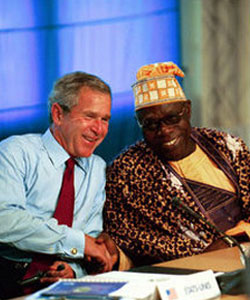
The President of Nigeria, Olusegun Obasanjo (pictured with his special friend), has declared that homosexual practice "is clearly unBiblical, unnatural and definitely unAfrican."

Canada's Anglican bishops have unanimously endorsed a strong resolution expressing "grave concern" about proposed legislation in Nigeria that "would prohibit or severely restrict the freedom of speech, association, expression and assembly of gay and lesbian persons."

Their motion also criticized the (Anglican) Church of Nigeria for its support of the legislation, reports the magazine Anglican World and ACNS.

George Broadhead, secretary of Nigeria's Gay and Lesbian Humanist Association, said: "This is probably the most oppressive piece of anti-gay legislation to have been introduced in modern times. We fear for the safety of all gay people in Nigeria, because when this law is implemented it will unleash a deep-rooted and murderous religious-based homophobia. There will be witch
hunts and persecution on a wide scale.

What is this law all about. Read below for the awful details.

The following is from WHRnet (Women's Human Rights Net)


Criminalizing Homosexuality the Nigerian Way
Source: Uhuru-Wazobia

Nigeria is about to set itself apart, yet again, in one of the most sweeping anti-gay laws in the world. While the pending civil law proposes a lighter sentence than the criminal law, its legal reach is breathtaking. Interestingly, homosexuality is already criminalized in Nigeria. Depending on whether the accused is Christian or Muslim, the penalty is either 14 years imprisonment or death by stoning. So, with such legal deterrents already in place, what is the purpose of the new Same-Sex Bill? Have the numbers of gays and lesbians seeking to marry or procure civil unions in Nigeria become so significant as to warrant a specific prohibition? In fact, the bill is about much more than protecting the sanctity of marriage.

The full title of the pending law is A BILL FOR AN ACT TO MAKE PROVISIONS FOR THE PROHIBITION OF SEXUAL RELATIONSHIP BETWEEN PERSONS OF THE SAME SEX, CELEBRATION OF MARRIAGE BY THEM AND FOR OTHER MATTERS CONNECTED THEREWITH. As such, its primary purpose is to prohibit same-sex marriages, whether civil or religious. It extends the criminal ambit to include all persons who aid, assist, preside over, witness or even cater such an occasion. Marriages made and recognized by other countries will become null and void in Nigeria. The law also forbids gay people from forming associations, whether to publicize or defend their lives.

Furthermore, the Nigerian government proposes to criminalize any organization that works on gay and lesbian issues, even if it doesn't do so overtly. Any public display, including a march for gender equality or the rights of the disabled or a group of youth rallying for their favorite sports team, if there is a "gay" person present, will be a criminal act. Any literature on gay and lesbian issues published by the media, even electronically, will be a criminal act. Any one who exercises his/her right to associate and work collectively with people, to write and express ideas, to witness for and advocate on behalf of others, whether those others are actually gay, will have committed a crime. And finally, whether Nigerian citizens do these things in public or in private, they will be legally liable for them.

Effectively, the new law will isolate gays and lesbians from community and from legal recourse. Under the guise of preventing gay marriage it will, in one fell swoop, create a new category of person in Nigeria. This new person need not be identified but may merely be suspected. He or she will have little individual right to protection from injustice because his/her very right to exist will be in legal limbo. He or she may not join others to protect themselves nor seek public or private support and protection because basic rights of association will not exist for them. Such a person, cut off from legal moorings in the polity becomes an outsider and an easy scapegoat in distressing times.

So we ask ourselves, this bill is such a surprise at this moment in Nigerian political life, what else is going on? We know who it hurts but whom does it benefit? At its worst, it stands to unleash hysteria against citizens of Nigeria. At its very least, it is a diversion from something else. By playing on presumed national homophobia, it seeks to divert domestic attention away from other matters. From the looks of the political landscape, it isn't hard to imagine why Nigerians might need some distracting.

President Obasanjo, is trying to force an illegal third term and has polarized the country, raising political tensions to a fever pitch. His challenger is a Muslim whose supporters have made possible and backed the last 30 years of military rule. They now insist that the President will not have a third term. Overall, Muslim and Christian tension is at an all-time high and has lately broken out into deadly violence. Refugee organizations estimate that up to 5 million people have been displaced by communal violence in Nigeria in the last five years.

While disagreeing on many issues, Muslim and Christian leaders in Nigeria seem to agree on the nefariousness of homosexuality. So a political strategy that involves disenfranchising gays seems a reasonable approach to accord between them. Such astute guidance comes currently from the person of the Archbishop of Nigeria, Dr Peter Akinola. (The Archbishop is actively seeking to split the Anglican Church and to move its center to the southern hemisphere, ostensibly to Nigeria.) In order to galvanize support for his more imperial objective, he has demonized gays and uses an anti-gay pulpit to advance his agenda. President Obasanjo publicly supports the Archbishop saying, that homosexuality is "un-Biblical, unnatural and definitely un-African" and that it is "a perversion of the divine order, and sin."

In the meantime, rebellion is in the air in the economic heart of the country. The beleaguered peoples of the Niger Delta have finally taken matters into their own hands with an insurrection that has cut oil exports by over 25%. If eastern parts of the Delta join in, exports could drop to 50%. Between the fears of civil conflict throughout Nigeria and an open armed hostility in oil country, the world's eighth largest exporter, finds itself at another pivotal moment in its history. Its response is to incite furor against an already marginalized group of people who pose no threat either to the government or to the society.

Fomenting anti-gay sentiment is a simple, cost-effective means to animate and coalesce a splintered and critical electorate. This bill is an Abujan horse, a cover that mollifies enough people while sneaking insidious forces into their midst. It is a pre-emptive law that trades on public, national homophobia to pass sweeping controls on the rights of association, conscience, expression and assembly. It will open the way for increased violence against gay and lesbian citizens, violence that is already occurring with impunity and, often, at the hands of public servants.

Next week, the Nigerian parliament is expected to pass this bill into law.

In solidarity with gay and lesbian citizens of Nigeria, human rights organizations, and concerned Christian and Muslim people around the world, we urge the government of Nigeria to:

Withdraw the bill

Guarantee safety and protection for all persons irrespective of their sex, gender, sexual orientation, gender identity and expression, or religion;

Respect its international human rights obligations under the International Covenant on Civil and Political Rights, the African Charter on Human and Peoples' Rights, and the Convention on the Elimination of All Forms of Discrimination Against Women.

We urge lesbian, gay, bisexual, transgender people and allies around the world to add their voices against this bill, to support our friends in Nigeria, and to demonstrate to governments of the world that our lives will not be easily used for their political purposes.


Uhuru-Wazobia
uhuruwazobia@gmail.com


Uhuru-Wazobia is an educational, advocacy and social membership organization for gays, lesbians, bisexuals and transgendered people from Continental Africa. The organization was formed by Africans to respond to our specific needs as members of the larger gay and lesbian community.

Our primary goal is to provide support, contact and growth opportunities for our members who are dealing with the many complexities of being gay, African and living outside of their countries of origin. Uhuru-Wazobia will also serve as an information center for and about African gays and lesbians, a voice for our community in its relationship with government, the media and other relevant organizations.

Uhuru-Wazobia is a democratic, egalitarian, participating organization that aims to be a supportive, safe and empowering space for its members. Uhuru-Wazobia aims to enshrine the best traditions of African community and family, while allowing us to define our own sexual and cultural identities, independent of both western imposed constructs and the imposed constructs of African "heterosexism."

NO ONE LIKES BUSH EXCEPT ONE GUY


President Bush will give the commencement address at Oklahoma State University today. But even in the late, great state of Oklahoma protesters are ready and waiting.

The following is from KTEN in Stillwater.


Protesters wait to greet president in Stillwater

STILLWATER, Okla. A protest of President Bush's appearance is being held about a block from Boone Pickens Stadium in Stillwater.

About 250 demonstrators held signs as a band played anti-Bush songs. One protester held a sign that read -- quote -- "Worst President Ever."

Protester Laurie Keeley of Tulsa says she had to take advantage of the fact that Bush came to Oklahoma.

Stillwater police and Oklahoma Highway Patrol troopers were on hand, but the protest was peaceful.

But some O-S-U grads thought the protest was inappropriate. Biological Sciences major Vincent Miller of Toronto, Canada, says the day should be about the graduates and that Bush was honoring them with his presence.

Friday, May 05, 2006

SIX NATIONS UPDATE - HELP STILL NEEDED


NOTE: Although some media are reporting as if the siege is over simply because the Ontario and federal governments have committed to negotiations, this is not the case. Troops have not been withdrawn, and Six Nations people and supporters are still fearful of another invasion. It is also not certain that the Ontario and federal governments will engage in meaningful discussion of the key land issues. Sustained pressure is needed. Please continue to encourage people to take action.

Key current concerns:

OPP, RCMP, and any other police or military forces that have been brought to the area must immediately be withdrawn. Their presence is not protective, but rather encourages escalation.

Six Nations people reclaiming their lands are not criminals. Charges must be dropped against the people arrested on April 20.

Camp communications must not be interfered with. People in the camp must be free to contact media, loved ones, solidarity organizations, etc.

The federal and Ontario governments must move from their past positions and approach the talks with the Haudenoniso (Council of Chiefs) in an honourable and meaningful way.


Search the Oread Daily Archives for numerous previous articles on this subject.

The following comes from First Perspective.


Six Nations short on supplies at Caledonia

People camping out at the Six Nations reclamation site say they need medical supplies, personal hygiene products, food and a variety of other products.

"Sometimes there are 50 people there, sometimes there is a few hundred," Hazel Hill, who is with the group, said Thursday (May 4).

The group, which began its non-violent demostration more than two months ago, has sent an e-mail, which is circulating through its network of supporters, identifying products that are needed. Money can also be donated instead of products, Hill said.

Many of the products that are needed are low-value items, which means shipping costs would be significant in relation to the value of the products. Kitchen/food needs include such things as cookies, meat, drink crystals, cheese, ice, milk, cheese and sugar as well as dish soap, large Styrofoam cups, and plastic cutlery. Medical needs include a spinal board, a stethoscope, blankets and bandages. In all about six dozen items are listed.

Hill and another supporter at the blockade, Janie Jamieson, say they have been receiving tremendous moral support from across Canada and around the world.

"I am just totally amazed with the e-mails, " Hill said. "In the four directions around the world we are getting support"

People wanting to make donations can call 519-445-0719.

The situation near the southern Ontario town of Calcedonia has also ben marred by ugliness, with reports of pamphlet of the Ku Klux Klan being ciruculated at demonstrations by non-Aboriginal people upset by the blockade set up by Six Nations Mohawks. A public demonstration last week also included signs such as "Where is John Wayne when you need him?" Some of the people with the blockade have speculated that some people are trying to provoke confrontation so that Ontario calls in the military to take down the blockade.

SOUTH KOREAN FARMERS UPSET OVER PLANNED U.S. BASE


Several thousand South Korean riot police using blasts of water and the sheer weight of their numbers stormed a school compound near Camp Humphreys on Thursday and ousted protesters who’d been barricaded there for months.

Villagers and farmers don't feel like being evicted to make way for the camp's expansion.

The camp is to be tripled in size by 2008 to accommodate both the command headquarters in Yongsan, Seoul and infantry units stationed north of Seoul.

A consultation carried out before the eviction did not result in the farmers' concerns being taken into account, and appeared to be mainly for show, according to those protesting the eviction. Protesters have complained that the Ministry of National Defence, which initiated the request for an eviction order, acted unilaterally in deciding on an eviction deadline and was not prepared to listen to the needs of the residents.

In December 2004 the Korean government planned to give an extra 2,851 acres to the US Army base Camp Humphreys in Kyonggi province. In December 2005 the government's Land Expropriation Committee approved the 'imminent domain' seizure of the village of Daechuri, a move which made the farmers' existence on their land illegal.

After the "consultation" led by the Ministry of National Defence, the residents of Daechuri were offered a lump sum in compensation, determined on a low estimation of the value of their land. The area is reclaimed from tidal flats, meaning the land price was already low compared to other farming areas. It would be almost impossible to buy equivalent areas of land for subsistence farming with the lump sum offered.

The following, interestingly enough, comes from Military.com.


South Koreans Protest Planned U.S. Base

Pyongtaek South Korea -- Anti-US activists and villagers scuffled with police for a second day on Friday, May 5 at a site designated for expanded US military facilities south of Seoul. Several people were injured, according to police.

On Thursday, police armed with batons and shields evicted the remaining occupants and activists from an elementary school, a makeshift headquarters for the protesters. More than 500 were arrested, and some 210 police and protesters were injured.

"We will never fail to cultivate paddies. No farming means death for us," said a resident at Daechuri, who refuses to leave the village despite a government offer of monetary compensation.

To halt farming and ensure eviction, military engineer troops erected a 29-kilometre-long wire fence near Camp Humphreys in Pyongtaek, 70 kilometres south of Seoul, with the help of 15 UH-60 transport helicopters.

The Pyongtaek City government also designated 2.85m pyong (one pyong equals 3.3 square meters) as a restricted area for military facility protection at the request of the Defence Ministry.

"We will take steps to counter the government action, such as how to circumvent checkpoints surrounding the villages," said a civic activist from an ad hoc committee opposing plans to expand Camp Humphreys.

The land has been earmarked to enable Camp Humphreys to triple in size by 2008 and become the US military's chief installation in South Korea.

The US military plans to relocate its Yongsan Garrison in downtown Seoul and the 2nd Infantry Division near the border with North Korea to Pyongtaek.

But some farmers and organized protesters have defied government orders to leave the site and vowed to plant a new spring rice crop in spite of government efforts to evict them.

The Humphreys expansion is part of the US global troop realignment plan to transform its fixed military bases into more mobile, streamlined forces.

About 30,000 US troops are stationed in South Korea, a legacy of the 1950-53 Korean War. The two Koreas are still technically in a state of war since the Korean War ended with an armistice, not a peace treaty.

HARM REDUCTIONISTS MEET IN VANCOUVER


The obvious failure and lunacy of the War on Drugs by now should be apparent to everyone. It is not, of course.

I began advocating for "Harm Reduction" way back when while working at a Free Clinic and watching helplessly as this nation's drug policy became a lethal one in the face of HIV.

As my worklife became more and more involved with what the medicos referred to as IVDUs or Intravenious Drug Users it became increasingly apparent and so obvious that Harm Reduction is the most practical, realistic approach to drug problems (both that of society and that of the individual). So obvious in fact that I sometimes fail to understand why anyone of sound mind can't see it.

Of course, then I remember where I'm living and when I'm living.

I suppose a rational drug policy can be viewed as comprising four elements: drug treatment, criminal justice, drug use prevention and harm reduction. In Vancouver, this is known as the Four Pillars Drug Strategy.

The Four Pillars Drug Strategy is the City of Vancouver's policy and plan for reducing drug-related harm in Vancouver. The "four pillars" of the city's drug policy are:

Harm reduction - reducing the spread of deadly communicable diseases, preventing drug overdose deaths, increasing substance users' contact with health care services and drug treatment programs, and reducing consumption of drugs in the street;

Prevention - using a variety of strategies to help people understand substance misuse, the negative health impacts and legal risks associated with substance use and abuse, encouraging people to make healthy choices, and providing opportunities to help reduce the likelihood of substance abuse, including affordable housing, employment training and jobs, recreation and long-term economic development;

Treatment - offering individuals access to services that help people come to terms with substance misuse and lead healthier lives, including outpatient and peer-based counseling, methadone programs, daytime and residential treatment, housing support, and ongoing medical care; and,

Enforcement - recognizing the need for peace and quiet, public order and safety in the Downtown Eastside and other Vancouver neighbourhoods by targeting organized crime, drug dealing, drug houses, problem businesses involved in the drug trade, and improving coordination with health services and other agencies that link drug users to withdrawal management (detox), treatment, counseling and prevention services.


The Harm Reduction Coalition, a national organization in the United States, defines harm reduction as a set of practical strategies that reduce the negative consequences of drug use, incorporating a spectrum of techniques that range from safer use to managed use to abstinence. Harm reduction strategies meet drug users where they're at, addressing conditions of use along with the use itself. Because harm reduction demands that interventions and policies designed to serve drug users reflect specific individual and community needs, there is no universal definition of, or formula for, implementing harm reduction.

The following is from Drug War Chronicle.


Harm Reductionists Gather in Vancouver 5/5/06

More than a thousand activists, front-line workers, researchers, and civil and political officials from 93 countries gathered in Vancouver this week for the 17th Annual International Harm Reduction Conference sponsored by the International Harm Reduction Association. While famed for its stunning physical setting and Pacific Rim cosmopolitanism, it is the city's well-deserved reputation for cutting-edge drug law reform and harm reduction projects that makes it a natural for the IHRA.

While the conference supported the city's vanguard efforts, the city also supported the conference. "I see addiction as a disability," said Sam Sullivan, Vancouver's wheel-chair-bound mayor, who just two weeks ago stirred up a firestorm by suggesting the city should provide heroin and cocaine to its addict population. "I am committed to changing the appalling way we deal with our drug-disabled people," he said to loud applause at the opening session of the gathering. "This is an issue I am committed to die on."

Sullivan was followed by IHRA executive director Gerry Stimson, who congratulated the crowd on its size and vowed to make the conference more user friendly. "It's great to see how large this meeting is," Stimson said. "We've always put a great emphasis on user involvement. This is IHRA's conference, but it is also your conference," he said.

Indeed, the five-day conference was replete with sessions devoted to, led by, or including activist drug users, including a session on "Advancing Harm Reduction Through Human Rights." In that session, Dirk Schaeffer of the German user group JES explained how the "network of junkies, users, and methadone people" developed over the past 15 years to become a formidable presence in German drug policy. The group now operates 10 workshops a year organized by drug users for people in rural areas and advocates for the involvement of drug users in setting policy, as well as the standard harm reduction measures.

"Drug users cannot be ignored in Germany anymore," said Schaeffer. "Like all men and women, drug users have human dignity, and they don't need to obtain it by abstaining from drug use." While drug users can be seen as a threat to the social order, Schaeffer said, user groups and other harm reduction workers should work together. "All of us want to stop the criminalization of drug users and secure these people's human rights," he said.

But the drug users' organizations still feel to some degree like black sheep at a conference dominated by salaried workers with official positions. One of the many satellite activities at the conference was drug user groups' efforts to form an international network, a task on which members worked throughout the week before issuing a joint declaration.

Mayor Sullivan was only the first of a cavalcade of Canadians who addressed the conference on a dizzying variety of topics, sharing with the rest of the world the knowledge they had developed in years of ground-breaking work in the Great White North. In a Tuesday session on regulating drugs, Vancouver Coastal Health Addiction Services clinical supervisor Mark Haden laid out a painstaking grid of issues surrounded the regulated distribution of drugs: Should there be restrictions on sales locations or sales hours or packaging or advertising? Should buyers be licensed or required to pass a pre-test or unrestricted? Should sales be done by private enterprise or by government?

Haden, a public health specialist, did not explicitly recommend any one set of restrictions, but instead noted that these mind-numbing issues are the ones that will have to be dealt with if an end to drug prohibition is to be seriously considered.

Haden was followed by Vancouver drug policy coordinator Donald Macpherson, who explained the tensions among the different parts of the city's Four Pillars -- prevention, treatment, harm reduction, and law enforcement -- drug strategy. "The city has been very strong on promoting dialog on these complex, thorny issues," he said. "There is a tension here in Vancouver between the police and the other pillars, but we need law enforcement to come to the table."

But for Macpherson, it's ultimately about getting the police out of the picture. "We need new laws and regulations for psychoactive substances," he said. "Our current laws create harm; prohibition does not stop sales and use. Instead, we need to incorporate public health principles."

Macpherson also seconded Mayor Sullivan's call for free heroin for addicts, adding that drug maintenance should not be limited to heroin. While noting that Sullivan had asked him to pull together research to support expanding the city's NAOMI heroin maintenance pilot program, Macpherson said there was already sufficient scientific support for such programs from other countries. The program could include treating crack users with amphetamines, he added.

Former Colombian Attorney General Gustavo de Greiff, now titular head of the Latin American anti-prohibitionist organization REFORMA, was characteristically forthright in his discussion of legalization and harm reduction on the same panel -- in fact he did not even speak the words "harm reduction" during his presentation. "Drug prohibition is a failure, not because I say so, but according to their own reports. What we need is legalization, which is regulation of the production, trade, and consumption of drugs," he said.

The usefulness -- and the limitations -- of the North American Opioid Maintenance Initiative (NAOMI) were made clear in a moving address by Diane Tobin, head of the Vancouver Area Network of Drug Users (VANDU). "I'm a 30-year heroin addict," she said. "I knew when I was 17 I needed heroin to get through the day. Recently enrolled in the NAOMI program, Tobin said it has helped stabilize her life. "I don't have to go out scoring to get drugs illegally," she said. But while life is better now, Tobin and the dozens of other NAOMI participants face the prospect of being gradually cut off when their one-year experiment ends.

It's not only access to drugs, but being able to use them safely, said Luiz Paulo Guanabara of the Brazilian drug policy, harm reduction, and virtual users' group, Psicotropicus. "Cocaine is deeply rooted in peoples' imaginary. We have to accept this fact," he said as he discussed a Psicotropicus program that distributed hepatitis prevention kits (a plastic straw and a condom enclosed in a package with health warnings) to cocaine users. In a study of the prevention kit program, Guanabara reported, he found that 88% of cocaine snorters shared straws and 50% snorted until their noses bled, while only 36% always used a condom.

Still, said Guanabara, users like and make use of the kits. Such efforts can increase the safety of cocaine users, he said. "It is a heresy to say you can take cocaine safely, but most users are unharmed," he said. "Yes, safe cocaine exists."

With its 112-page program appearing as big as a medium-sized book and hundreds of sessions, satellite sessions, and related events, it is impossible to do justice to the Vancouver harm reduction conference in one article. Suffice it to say that the array of topics covered ranged across the spectrum from the mechanics of dealing one-on-one with drug users to the big picture view of global drug and harm reduction policy.

As part of the big picture, the misguided efforts of the United States in the global sphere received repeated and critical attention. "US foreign policy on HIV is a hybrid religious-moral/scientific approach," complained Jonathan Cohen of Human Rights Watch's HIV/AIDS Project. "They prefer funding faith-based organizations, while they ban money for needle exchange programs, and they apply the misleading idea that abstinence is 100% effective." Still, said Cohen, the administration is uncomfortable appearing to stray too far from science, and there is room for harm reductionists to maneuver. "Demand guidance from them," he said. "Ask them just what their rules mean and how they apply. Make them justify them."

The US government also drew critical attention from Pedro Chequer, former director of Brazil's National AIDS Program, who accused the US of "subverting" the war against AIDS. "Religious proselytizing in the US fight against AIDS is back," Chequer complained, noting that Brazil had been forced to reject a $39 million USAID grant because it would require Brazilian groups to abide by "religiously-based policies crafted by pseudo-moralist politicians."

The conference officially ended Thursday afternoon, but related events continue through the weekend. The Vancouver-based Keeping the Door Open, a harm reduction and social justice organization, continued holding events past the official closing. Today, Canadian drug user groups will meet in an effort to form a national front. And tomorrow, Vancouver's cannabis nation will take to the streets as part of the Million Marijuana March, whose theme this year is "Free Marc Emery," the downtown Vancouver seed seller and marijuana activist now threatened with extradition to the US.