Friday, April 28, 2006

MAY DAY AND IMMIGRATION RIGHTS


The Great American Boycott 2006, A Day Without An Immigrant” calls for a nationwide general immigration strike on May 1 to protest the current anti-immigration bill.

While there are debates about the exact nature of how the actions on May 1 should go, there is little doubt something is blowing in the wind.

This ought to be a May Day unlike any seen for a long time in the USA.


The following article comes from the New Standard.

Support Builds for Immigration Protests, Boycott
As May 1 action looms, undocumented workers discuss their power, solidarity
by Kari Lydersen

Chicago; Apr. 28 – In the 2004 independent film A Day Without a Mexican, Californians woke up and all the Mexicans had disappeared. Lawns went untended, hotel rooms sat uncleaned, and countless other jobs performed by low-paid immigrants were left undone.

Immigrant-rights groups have frequently mentioned this film and the larger concept behind it during the past six weeks of massive pro-immigrant marches. In Chicago, where the first of the large demonstrations took place, a central theme has been waking the American public up to the economic importance of immigrants. Organizers say they want to show how much immigrants, including close to 12 million undocumented ones, contribute with their labor and with their buying power.

At the March 10 Chicago demonstration, during which more than 100,000 immigrants and their supporters hit the streets, a group handed out flyers for a hastily organized boycott of Miller beer. Demonstrators targeted Miller Brewing Co. because the company's PAC had donated $2,000 to Wisconsin Republican Congressman F. James Sensenbrenner Jr., sponsor of the harshly anti-immigrant bill that passed the House of Representatives last year.

Merchants on 26th Street, Chicago's main Mexican commercial drag in the Little Village neighborhood, said that by evening customers were refusing to buy Miller. The message reached beer distributors quickly, and by the following week officials from the company's Milwaukee headquarters had met with coalition organizers and put out a statement opposing the House's legislation.

"A lot of immigrants are not eligible to vote, but we have the purchasing power," said Salvador Cervantes, a member of the Chicago organizing coalition.

The idea amplified on April 10, when immigrant marchers in scores of cities and towns across the country pledged to refrain from shopping, working or going to school, wearing white T-shirts to symbolize their unity in creating a "day without immigrants."

A boycott on May Day has likewise been called in many cities across the country as part of pro-immigrant demonstrations. Called a paro in Spanish, the term is generally understood to mean both refusing to buy and refusing to work or go to school.

But the plan for a paro is not universally endorsed by all immigrant-rights groups. In Chicago, the organizing coalition known as the Movimiento 10 de Marzo, or the March 10 Movement, decided not to call for a boycott or general strike in the city, largely because of the involvement of labor unions that said they could not legally endorse such an action because their contracts prohibit them.

The question of whether to participate in nationwide calls for a May 1 boycott was hashed out at a contentious April 22 meeting, where the local coalition decided to support calls for boycotts in other cities, but refrain from a boycott in Chicago.

"We consider it a matter of wording," said Jorge Mujica, Illinois secretary general for the Democratic Revolution Party (PRD), a Mexican political party and one of the central coalition organizers. "If people are marching all day, they're not working, buying things or going to school. But since we have the unions, we can't call a boycott or a strike. We'd rather have labor on our side than call for a boycott. As for the national and international boycott, we think it's beautiful."

But some organizers described this as caving in to unions and politicians that were pushing for a more moderate stance.

"I wish the unions had stayed out of it and let people celebrate May Day the way they wanted," said Rafael Cervantes, an activist from Monterrey, Mexico who has lived in Chicago for decades. "The boycott was a symbol for people, an icon, a way to say we matter, we are an important cog in this machine, we produce and we consume. It's ironic that the unions are saying they could not support it because it would be illegal, but the whole reason we're marching is that people are here 'illegally.'"

Tom Hansen, founder and director of the Mexico Solidarity Network, a grassroots organization working for social change on both sides of the US-Mexico border, said the boycott is only one example of the larger ideological battle that is going on in the immigrant-rights movement. "The reformists want to 'manage' the movement with a lot of US flags and a discourse about family values, et cetera," Hansen told The NewStandard. "The more progressive elements want to move the discussion to one about exploitation, labor rights and the meaning of citizenship."

On April 24 union leaders held a press conference supporting the march and framing it as not only about immigration but about rights for all workers. They said a boycott was beside the point for the labor issues they wanted to highlight.

"We're not even putting it into the equation," said Moises Zavala, a Chicago organizer for the United Food and Commercial Workers (UFCW). "This is the day to recognize our labor history and bring it full circle. In Chicago we're not endorsing a boycott; we're out to march to show our numbers and recognize the importance of May Day."

Teamsters organizers said that rather than discussing a strike or boycott, they were trying to get employers on workers' side; helping employees petition their employers for time off or paid holidays to attend the demonstrations.

In Los Angeles, where other mass protests are planned, some groups will be carrying out work stoppages and boycotts and attending a daytime downtown march. Others who plan to go to work and school will attend a separate demonstration in the late afternoon.

Thousands of truck drivers working out of the Port of Los Angeles and cab drivers who serve Los Angeles International Airport are expected to strike for the day or possibly the week.

"If truckers aren't trucking, the port isn't working," said Los Angeles attorney and organizer Jim DeMaegt. "If cab drivers don't drive, LAX will be shut down. Nobody knows precisely what will happen, but there is a lot of support."

DeMaegt thinks a massive strike would force policy change faster than some other types of actions. "We say a day without shopping is good; going to speeches, going marches is good," he told TNS. "But stopping work – a day without workers will close the country. A day without goods going in and out of the ports and airports of the US, and we'll have a policy change within a week."

The truckers and cab drivers are organized but are not members of official labor unions, giving them the freedom to strike without worrying about legal issues binding unions.

The truckers and cab drivers are protesting against rising fuel prices and low pay, along with calling for immigration reform.

DeMaegt said local Teamsters officials are not supporting a work stoppage but support the overall mobilization.

Aquilina Soriano-Versoza, executive director of the Pilipino Workers' Center, noted that many of their members are home-healthcare workers, so they don't want to endanger their clients by skipping work; but they will support the mobilization nonetheless.

"They can't leave their patients, but they're in solidarity," Soriano-Versoza said. "There are a whole range of ways people can participate."

She noted that many employers, particularly in the Koreatown garment industry, have given their workers the day off thanks to organizing by community groups and employees.

Alexis Lanza, an activist with the Chicago group La Voz de los de Abajo (The Voice of Those Below) and an immigrant from Honduras, said he supported the call for a one-day boycott. "I think it would have been good if the US united on that," he said. "But there are lots of interests, unions and different groups, and it's not easy to balance those things."

Lanza would prefer long-term boycotts of products from companies that donate to anti-immigrant politicians or promote policies that hurt Latin Americans through international trade or employment policies. The Chicago committee discussed proposals for a long-term boycott of Coca-Cola, with its notorious human-rights record, and a local Mexican cheese company that buys from Rep. Sensenbrenner's state, Wisconsin. But those proposals were not adopted.

"Calling a boycott for just one day strategically doesn't have that big an impact; it's symbolic," said Lanza. "The next day you'll be buying the same products again."

Lanza thinks even without an official boycott, the demonstrations will make immigrants' economic power clear. "If you're calling on people to close their businesses during the march, that's like a boycott, except you're not calling it that," Lanza said.

Some groups in other cities have not endorsed the boycott out of fear there will be a backlash against immigrants or that workers will lose their jobs for skipping work. But in Chicago, where many workers fired for participating in the March 10 demonstrations were reinstated after immigrant organizers threatened to protest workplaces, advocates say they are not that worried.

"I really feel this time around nobody is going to get fired," said Mujica. "We have prepared this so well with the letters for employees to give to their employers." He noted the group is distributing letters in several languages for workers to download and use to explain their cause while formally requesting time off.

In Arizona, the coalition that organized a 100,000-strong protest on April 10 in Phoenix waffled about supporting a boycott. Last week, the Somos America (We are America) coalition announced it was supporting demonstrations and other forms of protest, but not endorsing the boycott due to fear of a backlash and concern for immigrants' job security.

But, according to the group's chairman, Roberto Reveles, who spoke to the Arizona Republic, the recent arrests of 1,187 undocumented immigrants in federal raids on pallet maker IFCO Systems locations in 26 states including Arizona, spurred the group to change its mind.

Reveles told the Republic that his group wanted "to make a statement against the latest raids," which came "at a time when they should be working toward immigration reform rather than instilling additional fear in the lives of undocumented workers and their families."

The success of the boycott, according to Hansen of the Mexico Solidarity Network, will depend "on how many people participate, what the impacts are and, most importantly, the kind of political consciousness that accompanies the tactic."

"The idea is to change hearts and minds," he said, "and to give immigrants a sense of their power. This is particularly important for a group that has been repressed and exploited for so long, on both sides of the border. A change in the collective appreciation of what is possible is the real goal of the boycott."


© 2006 The NewStandard. All rights reserved. The NewStandard is a non-profit publisher that encourages noncommercial reproduction of its content. Reprints must prominently attribute the author and The NewStandard, hyperlink to http://newstandardnews.net (online) or display newstandardnews.net (print), and carry this notice. For more information or commercial reprint rights, please see the TNS reprint policy.

TRANSPLANT TOURISM


Wealthy Westerners who don't want to wait for an organ donor are travelling to poorer countries to find the organ they need.

Every day, 17 Americans die of organ failure. In Canada, a patient can wait seven years for an organ transplant. In Israel, the average wait for a kidney transplant is four years.

As a result, many are travelling to countries like the Philippines where they can buy a kidney and have the transplant done in a modern hospital. These people are called "transplant tourists".

The illegal trade in organs is growing.

For some time the practice of luring poor people with money to sell their organs, especially kidneys, has been associated with India along with other Asian countries and Brazil.

But no more.

Egypt is a regional hub for the human organs trade. Wonder why? There are no official statistics, but this is a country where social inequality is high and a quarter of the population is believed to live under the poverty line.

The "liberation" of Iraq has opened a new market. With unemployment in Iraq at about 60 per cent, the chance to earn money by touting body parts is a more calculated risk than, say, becoming a $150-a-month rookie policeman at the mercy of suicide attackers.

While most donors who sell their organs are poor and hoping (against hope) for a better life, authorities think that not all are volunteers but are merely victims of an elaborate extortion rings that capture and forcefully remove organs which they sell to wealthy buyers.

And even considering the sacrifice, most of those who willingly sell their organs get paid peanuts while the doctors and brokers get the lion share.

Bill Berkowitz takes a look at what is the hell is going on.

The following piece appeared originally at Inter Press Service.


"Transplant Tourism" Flourishes in Developing World
Bill Berkowitz, Inter Press Service

OAKLAND, California, Apr 27 (IPS) - While stories about the illegal trade in body parts -- often obtained by traffickers for measly sums paid to the donor or for nothing at all -- may seem better suited for the big screen, episodic television or science fiction novels, they are occurring in the real world with disturbing frequency.

Nancy Scheper-Hughes, a professor of medical anthropology at the University of California, Berkeley, knows this all too well. She is the co-founder and director of Organs Watch, a project that originated in widespread rumours of body snatching and organ theft in the urban shantytowns of Brazil in the mid-1980s.

In a new essay published in the March/April 2006 edition of the Nacla Report on the Americas, titled "Biopiracy and the Global Quest for Human Organs", Scheper-Hughes says that, "U.S. or Japanese medical agents working for large hospitals abroad... abducted bodies", harvested the parts they wanted, especially eyes, kidneys, hearts, and livers, and then unceremoniously dumped the remains "on the sides of country roads or in hospital dumpsters".

Although medical professionals denied this was happening, in 1997 Scheper-Hughes began following the trail of rumours about the grim trade. Over the years, she has traveled to 12 countries and visited more than 50 scenes of illicit organs and tissues procurement.

Legislation has been passed in several countries to crack down on the trade in body parts, but Scheper-Hughes told IPS that "things are still quite unstable".

"China is preparing a new law making transplant tourism illegal. There will be no payment for organs and no foreign transplant patients," she said.

"It's too early to say whether it will stick or give rise to a shadow transplant economy. A new law was passed in Israel, making it illegal for Israeli transplant patients to be reimbursed by their national health insurance carriers for illegal transplants."

"Despite all this legislative activity, transplant tourism grows stealthily on the margins, as patients are 'voting with their legs' to solve their problems. Eventually, I see paid kidney donors becoming routine and eventually legal so that the trade will occur nationally rather than transnationally. That would be a sad outcome, but perhaps it is inevitable now that the cat is out of the bag," she concluded.

One of her more shocking realisations was that the underground body parts industry had gone from being something that "evoked shock and revulsion bordering on nausea" to becoming a "fait accompli -- an accepted medical fact defended on pragmatic grounds".

As a member of the panel on Ethics, Access and Safety in Tissue and Organ Transplant at a 2003 World Heath Organisation meeting, Scheper-Hughes witnessed an official from a private eye bank "defend the 'necessary' commercialisation of tissue banks in the developing world".

Without government support for "subsidised tissue banking", the argument went, poor countries had to resort to international trading/selling of body parts that were not being used locally and that could be transported through informal agreements to the developed world, where they are in great demand for orthopedic and other high-tech surgeries.

And, in what on the face of it appears to be a win-win situation, "In exchange, the poor donor-institutions could receive a steady supply of scarce corneas."

Organs Watch discovered a "large, unregulated, multi-million-dollar business in human tissues, taken without consent or procured from the naïve family members of brain-dead donors who believe their 'gifts' would be used altruistically to save lives and reduce human suffering".

Instead, these "gifts" were turned into commodities that were bought and sold, processed and transported, picking up additional value as they moved toward the market. Organs Watch found that bone and skin grafts were sold and processed by private biotech firms in the U.S. and turned into expensive commercial products for dentists, orthopedics and plastic surgery.

In South Africa, official documentation revealed that "human heart valves [had been] taken without consent from the bodies of poor blacks in the local police mortuary and shipped for 'handling costs' to medical centres in Germany and Austria", the group says.

In 2002, Scheper-Hughes apprised the South African Ministry of Health of a scheme originating at a national tissue bank that involved "the transfer of hundreds of Achilles tendons that were removed without consent from the bodies of the victims of township violence and shipped by the director of the tissues bank to a corrupt U.S. businessman who paid 200 dollars for each tendon".

Shipped to the U.S. via South Korea, they were ultimately repackaged and sold locally and abroad to private medical and biotech firms for 1,200 dollars each.

As is most often the case, everyone, except the poor people from whom these tendons came, benefited handsomely from the deal.

The rise in "illegal transplant tourism" -- a term coined by Scheper-Hughes -- was "developed to meet an insatiable demand for organ transplants that rises exponentially against a flat supply of organs donated through traditional and regulated means," she writes in the essay.

While donations have remained flat -- increasing only 33 percent over the past decade or so -- the number of patients on national waiting lists has increased by 236 percent.

With the increased need, poor people are recruited or entrapped into donating their body parts to satisfy the demand from rich patients who can afford to travel abroad and, Scheper-Hughes says, to break national laws and international medical regulations to get the organs and medical procedures they need.

Scheper-Hughes told IPS that she continues to be very active with Organs Watch, and is currently working with the World Health Organisation on several "black spots" in illegal transplant tourism -- China, Pakistan -- as well as with the ministry of health and the federal police in South Africa and Brazil with respect to arrests and trials of "transplant surgeon outlaws".

Thursday, April 27, 2006

NOT BUSINESS AS USUAL IN SEATTLE TODAY


Protesters have stopped traffic in Seattle demanding that more African-American workers be hired for a major light rail project in the city.

Millions and millions of dollars are being put into projects all over the city of Seattle, but a small amount — something like one percent — has gone to to disadvantaged businesses. And black workers are not being hired. The Sound Transit Project is a major example of the problem.

The story below is from the Seattle Times.


Protesters stop traffic, demand more black workers on Sound Transit light-rail project

Demonstrators entered a Sound Transit job site and briefly blocked traffic on Rainier Avenue South in Seattle late this morning to protest what they called a lack of African-American workers on a light-rail project that runs through their community.

There were a few confrontations when irritated motorists tried to inch through groups of protesters, but there was no violence. About 70 people held hands in a circle at Rainier and Martin Luther King Jr. Way South and concluded the protest about noon. They planned to gather again when the politicians on Sound Transit's governing board held their regular meeting today.

The dispute has been simmering for three years, as black ministers and activists have urged the agency not to forget small, black-owned businesses when it awarded nine-figure contracts in 2003-04.

"Sound Transit presented us with a cutting-edge contract that promised to incorporate African Americans into the work force," said James Kelly, the director of the Urban League of Metropolitan Seattle. "Well, the results are in, and of the 91,000 labor hours recorded in the last four months, only 1,900 hours were accumulated by African Americans."

Sound Transit's light-rail director, Ahmad Fazel, said the agency is barred by federal regulations from targeting contracts based on race. Sound Transit does set and meet goals for broader participation by minority, female and disabled business owners.

"I hope that you know Sound Transit is serious about this issue and will continue to work with you," Fazel told Charles Rolland, one of the demonstrators.

Rolland cautioned him, "Contents under pressure -- if you don't relieve it, it's going to escalate."

The transit agency says that based on data it collects from major contractors, 11 percent of work hours have been performed by African Americans since 2004, but protest leaders are skeptical of the numbers. The Community Coalition for Contracts and Jobs, leading the protests, said that fewer than 2 percent of contracts go to African-American businesses.

The regional transit agency is building a $2.7 billion, 16-mile line from Westlake Center in downtown Seattle to Seattle-Tacoma International Airport.

Earlier today, the demonstrators chanted, "No black contracts, no black jobs, no light rail!" outside the gate of another job site, along Airport Way South, where a tunnel through Beacon Hill is being drilled.

THE SITUATION IN THE SOLOMON ISLANDS


Tensions in the Solomon Islands have eased, a day after its embattled prime minister resigned. A dusk to dawn curfew was lifted in the capital of Honiara, more than a week after Snyder Rini's election as prime minister sparked two days of burning and looting amid allegations of official corruption.

The first item below is from NZTV (New Zealand).The second article below which is an analysis of the whole situation comes from the blog site Reading the Maps.


Honiara calm after curfew lifted
There have been no reports of trouble in the Solomon Islands' capital Honiara overnight, following the lifting of an eight-day curfew imposed last week.

The scene on the streets last night was markedly different, with police roadblocks and military patrols making way for locals to go about their lives.

A 6pm - 6am curfew was imposed on April 19 after riots and looting which destroyed most of Chinatown in the capital.

The riots began after the secret election of a new prime minister who finally resigned on Wednesday.

Radio New Zealand's reporter in Honiara says there is no doubt the curfew took a toll, with businesses losing earnings and many people left frustrated.

New Zealand Defence Minister, Phil Goff, who is in Honiara, will this morning meet local MPs before returning to New Zealand.

Australia's Justice Minister Chris Ellison will visit Honiara today.

He will meet MPs from all parties to discuss recent developments and the way forward for the Regional Assistance Mission in the Solomon Islands (RAMSI).

=================================================================================

The Solomons: it's about imperialism

Most of the media coverage of recent events in the Solomon Islands has focused on the sensational details of riot and disorder: burning buildings, beaten-up cops, and looted shops have all been paraded across our screens. Explanations of the reasons for the riots in Honiara have been hard to find. Some commentators like Russell Brown have resorted to racist stereotypes of an uncontrollable 'communalist' people; others like the Herald's Audrey Young have ventured the slightly more sophisticated opinion that the riots were caused by resentment of Chinese and Taiwanese interference in Solomons politics.

Missing from the mainstream media has been any sort of account of the role that the United States, Britain and their South Pacific deputy sheriffs Australia and New Zealand have played in creating and maintaining the manifold troubles of Solomon Islands society. The Regional Assistance Mission to the Solomon Islands (RAMSI) has faced various criticisms of its handling of the riots, but no one has suggested that the Mission and the regional powers that back it are part of the Solomons' problems, not their solution.

When mainly Australian and New Zealand troops occupied the Solomons under the banner of RAMSI in 2003 the country was in the grip of a crisis that had been manufactured in the offices of the International Monetary Fund. Under pressure from the Australian and New Zealand governments, the Solomons had implemented IMF 'reforms' that devastated its economy and profoundly destabilised its society. RAMSI's occupation has only exacerbated the crisis.

After gaining independence from Britain in 1977, the Solomons found itself with a primitive infrastructure and an economy fashioned by the selfishness of a colonialism that prefered plunder to sustainable economic development. Always heavily dependent on the prices it could get for exports of its raw materials, in particular timber and gold, the Solomons economy took a big hit when the 'Asian flu' of 1997 led to a drop in demand in its key export markets. In 1998 alone, the GDP of the country declined by 10%.

Pressured by Britain, Australia, and the US, the government of Bartholomew Ulufa'alu responded by implementing a programme of drastic economic 'reforms' drawn up by the International Monetary Fund. The country's currency was devalued by 20%, and hundreds of public employees were sacked. Conflict between the country's different ethnic groups followed, and at the beginning of 2000 a coup put Ulufa'alu into 'protective custody'. Continuing violence left the country's economy in ruins.

Instead of admitting the role that IMF policies had played in the collapse of the Solomons, the Howard government in Canberra used the chaos in its neighbour to demand even more brutal 'reforms' as the price of humanitarian aid. In November 2002 the government of Sir Allan Kemakeza began a new programme of spending and job cuts, sacking a third of public sector employees. Even worse, Kemakeza was forced to cede control of his government's Finance Ministry to Lloyd Powell, the Australian head of a New Zealand-based multinational company called Solomon Leonard. At a conference held in Honiara in June 2002, the IMF had demanded Powell's appointment as Permanent Secretary of Finance as the price of any new financial aid to the Solomons.

The second round of IMF reforms had predictable consequences. Even rudimentary health and education services collapsed in the slums of Honiara and in the provinces; power blackouts became frequent even in the capital; law and order broke down as police and judges went unpaid; and competition for scarce government funds renewed conflict between ethnic groups.

By the middle of 2003 it was clear that the reform of the Solomons economy by imperialism could only take place at gunpoint. The Howard government had become the US's most loyal ally in the Asia-Pacific region, having just participated in the invasion of Iraq. Proclaiming the Solomons a 'failed state' that like Iraq could become a base for terrorists and the cause of regional instability, Australia organised a force of 2,500 troops to occupy the country.

The real reason for the invasion was two-fold. In the first place, Australia and New Zealand feared that the chaos in the Solomons could damage their own economies, by ruining the many Australasian companies that do business in the islands. In the second place, the Howard government's masters in Washington had become alarmed by the prospect of the Solomons turning either to China or to France for aid money and help in restoring law and order. With colonies in New Caledonia and French Polynesia, France still maintains a strong presence in the Pacific, and early in 2003 it had offered military aid to the Solomons government. Neither the US nor Australia wanted to see an expansion of French influence in an region they considered their own backyard. After the formation of RAMSI was announced in July 2003 the French offered troops for the force, but were brusquely turned down by Australian Foreign Minister Alexander Downer.

With its economy booming, China is seeking energetically to expand its influence in the Pacific. The country's drive to build trade and diplomatic ties has become particularly urgent since the government of Taiwan began using 'chequebook diplomacy' to bribe small countries with votes in the UN and similar international bodies to recognise the government in Taipei rather than its rival in Beijing. With its view of China as an emerging rival superpower and potential medium-term military foe, the Bush government was concerned by the possibility of increased Chinese involvement in the Solomons.

The government of New Zealand had extra reasons of its own for involving itself in the occupation of the Solomons. After tacking away from Australia and the US by siding with France and China over the invasion of Iraq, the Clark government was desperate to assuage anger in Canberra and Washington by proving that it could still 'play ball' in the Pacific. In addition to making up with its old allies, the Labour government believed that it could moderate the unilateralist tendencies of Australia and the US. Clark and her Foreign Minister Phil Goff trumpeted the multinational make-up of RAMSI and the consent of the Kemakeza and Solomons parliament government to RAMSI's intervention as triumphs of multinationalism over the 'Iraq approach'. In reality, the RAMSI force was dominated by Australia, and the Kemakeza government had already been stripped of most of its ability to make independent decisions. The Australian government treated the vote of the Solomons' parliament as a fait accompli: it had dispatched some 2,000 troops to Honiara before the vote had even been taken.

In the two and three quarter years it has occupied the Solomons, the RAMSI force has made it abundantly clear that it acts on behalf of the Pacific's big states and international capital, not on behalf of the people of the Solomons. Like the army occupying Iraq, RAMSI's soldiers are exempted from prosecution or even investigation under Solomons law. They have authority over the Solomons' own police force. Soon after landing in the Solomons RAMSI had begun making sweeping arrests - by the anniversary of the occupation it had detained 700 people, most of whom had not faced any sort of trial. In August 2004 eighty of these detainees staged a rebellion at Rove Prison in Honiara. After breaking out of their cells and overpowering guards, the prisoners shouted slogans condemning their 'inhuman treatment'. Most had been held in solitary confinement for a year. Despite the protest, hundreds of people are still detained without trial in the Solomons.

RAMSI has also felt free to intimidate the population of the Solomons and over-rule the country's government whenever it has felt the interests of international capital have been threatened. In March 2004, for instance, the Solomons' remaining public sector workers voted to stage a national strike to demand a pay rise. In an effort to avert a strike, the Solomons government announced a meagre increase of 2.5%. RAMSI's response was swift: the head of the Solomon Islands Public Employees Union was summouned by RAMSI staff to the Australian embassy, where he was warned that he was 'destabilising' the country. Shortly afterwards a RAMSI representative handed the same union leader a written warning that if he did not revoke the pay claim Australian aid to the Solomons would be suspended. Eventually the union capitulated.

The riots that have destroyed large parts of Honiara in the past week can only be understood against the backdrop of the history of imperialism's exploitation of the Solomons. The underdevelopment left by British colonialism has been exacerbated by brutal IMF policies which Australia and New Zealand have shown themselves prepared to implement at the point of a gun.

The rioters have accused Taiwanese and Chinese businessmen and diplomats of interfering with the electoral process by bribing key politicians, and condemned the new Prime Minister Snyder Rini as corrupt. But it is imperialism and RAMSI's occupation of the Solomons which has created the environment for such corruption. The arbitrary, arrogant, and self-interested behaviour of RAMSI has created an atmosphere in which graft can flourish. IMF policies and RAMSI occupation have greatly weakened the institutions of the Solomons state and cowed the trade unions, which might have acted as watchdogs against corruption. The Chinese and Taiwanese dealmakers and chequebook diplomats have stepped into the economic vacuum created by the failure of IMF policies and Australasian businesses to deliver prosperity.

The Australian and New Zealand governments have responded to the riots in Honiara by sending more troops to prop up RAMSI. The left and labour movement should respond by demanding the withdrawal of all occupying troops from the country.

ANNOUNCEMENT: INTERNATIONAL DAY OF ACTION TO STOP "DIVINE STRAKE"


The following announcement is from the Western Shoshone Defense Project.

* International Indian Treaty Council * Western Shoshone Defense Project * Indigenous Environmental Network * Shundahai Network * Nevada Desert Experience * Citizen Alert * Western Shoshone National Council

The “Stop Divine Strake Coalition” Calls for an International Day of Action


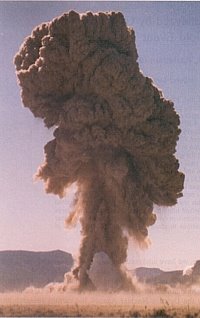
The U.S. Defense Threat Reduction Agency (DTRA) plans to detonate a 700-ton ammonium nitrate and fuel oil explosive on June 2, 2006 at the Nevada Test Site (NTS), a federal facility 65 miles north of Las Vegas. They are calling this test “Divine Strake.”

While this test is not nuclear in composition, its purpose, according to DTRA documents, is to “simulate a low-yield nuclear weapon.” Given that previous nuclear tests have occurred only a few miles away from where Divine Strake will occur, this test raises the specter of kicking up previous radioactive contamination and sending it downwind. We have been told too many half-truths and outright lies to believe in the “safety” of this test. Furthermore, no full environmental impact statement has been done to verify that there is no radioactive contamination at the particular site.

It must be stressed that the presence of the United States military on Western Shoshone land is uninvited. In fact, the Western Shoshone have been fighting for sovereignty over their ancestral and treaty-recognized lands, and to shut down the NTS for years. Most recently, their efforts brought them to the United Nations Committee on the Elimination of Racial Discrimination (CERD) which found the United States in violation of recognized fundamental human rights standards and international law, and ordered the United States to “freeze”, “desist” and “stop” their activities on Western Shoshone land. All this while the DTRA was preparing for the “Divine Strake” test

As tensions increase with Iran, speculation has increased in the media and elsewhere that this test, in conjunction with other military projects, is building up to an imminent attack on the peoples of Iran, possibly in the form of nuclear bombardment. This test is seemingly a “war game” to initiate a U.S. led invasion of Iran. Many media articles about Divine Strake and its possible role in the escalation of tension with Iran may be found on www.shundahai.org/divine_strake.htm and www.disarmamentactivist.org

Because our goal is to stop the test, and to not expose anyone to undue health risks from the actual blast, our focus will be an International Day of Action on Sunday May 28, 2006 (Memorial Day Weekend) at the Nevada Test Site Peace Camp, located across Highway 95 from the Test Site. We are looking for allied organizations to join our coalition, and either join us at the Nevada Test Site on the 28th, or stage actions in their own communities throughout the following week.

Some of our anticipated activities will be:
¨ Delivering eviction/deportation notices to the U.S. Department of Defense and Department of Energy as illegal, non-respecting immigrants to indigenous lands.
¨ A rally with speakers from indigenous, immigrant, nuclear abolition, and peace and justice communities.
¨ Non-violent direct action training
¨ Peacekeeper training
¨ Workshops on the history of the test site and radiation compensation, indigenous sovereignty, and the escalation with Iran.
¨ Spiritual ceremonies to remember those who have suffered or died as a result of war and nuclear weapons testing.
¨ Brainstorming workshops on what common actions folks can do later in the week in their respective cities
¨ Vigil activities at U.S. Federal Buildings and Bechtel Corporation offices on June 1 and June 2, if the test has not been canceled.


Some of our anticipated needs are:

¨ Getting the word out to sympathetic communities
¨ Development of fliers and other outreach materials
¨ Optimizing media participation both before, during and after the event
¨ Providing shelter, food and water to participants
¨ Organizing workshops
¨ Providing “peacekeepers” to keep the event on message and free of violence.


Ongoing activities – Please keep the phone calls, letters coming!
The test detonation can be cancelled. We call for the United States Government to do so immediately. Concerned citizens can call or write to express their opinions to their Congressional Representatives and:

President George W. Bush comments@whitehouse.gov 202-456-1111
The White House
1600 Pennsylvania Avenue NW
Washington, DC 20500

Secretary of Defense Donald Rumsfeld http://www.dod.gov/faq/comment.html
Secretary Donald H. Rumsfeld
Secretary of Defense
1000 Defense Pentagon
Washington, DC 20301-1000

James Tegnelia dtra.publicaffairs@dtra.mil (800) 701-5096
Defense Threat Reduction Aagency
Attn: James Tegnelia
8725 John J Kingman RD Stop 6201
Fort Belvoir, VA 22060-6201


Please contact us if you would like to join our coalition. We will then proceed with detailed plans based on the coalition’s collective abilities.
www.treatycouncil.org jimbosimmons@treatycouncil.org andrea@treatycouncil.org
www.wsdp.org wsdp@igc.org
www.ienearth.org rshimek@ienearth.org ien@igc.org
www.shundahai.org eileen_mccabe_olsen@yahoo.com pete@shundahai.org
www.nevadadesertexperience.org amy@nevadadesertexperience.org
www.citizenalert.org pmj1@citizenalert.org, tonyg@citizenalert.org

Wednesday, April 26, 2006

WORKERS COMMUNIST PARTY OF IRAN: THE 'NUCLEAR CRISIS" OF THE ISLAMIC REPUBLIC AND THE WESTERN POWERS


Although the following resolution from the Workers Communist Party of Iran was adopted in February, I have never seen it published anywhere (which doesn't mean it wasn't, just means I didn't see it). Anyway, I am publishing it in full.


The “Nuclear Crisis” of the Islamic Republic and the Western Powers

1- With Iran on the verge of being referred to the UN Security Council, the nuclear crisis of the Islamic Republic of Iran (IR) and the Western powers, has taken a dangerous turn that can sink the Middle East and the world into another horrendous war with catastrophic consequences. This new development calls the working class and people of Iran, as well as people of the region and the world, to follow this crisis with open eyes and keep abreast of the events and by closing their ranks take a clear stance.

2- The escalation of this crisis is the result of the perseverance of both sides of this crisis over their wider reactionary aims. In the wider context, the nuclear crisis is the manifestation of the confrontation between the two poles of world terrorism; the terrorism of the US and its allies and the Islamic terrorism over the redrawing the political and ideological map of the region, helped by the resurgence of the Political Islam and Islamic terrorism in Iraq in the aftermath of the US invasion of Iraq. Under such circumstances, this nuclear crisis has become the battle ground to establish who has the political and ideological upper hand in the region and elsewhere.

3- The US descend into the quagmire created by the invasion of Iraq; the emergence of the political Islam in Iraq and the victory of Hamas in Palestine have enticed the IR to attempt to put up a more strategic challenge against the US and Israel. After two decades of efforts to establish a closer relation with the West, the IR now seeks its survival through confrontation. For the IR return to the Islamic fascism against the West and Israel and its insistence on heightening the nuclear crisis serve as a means for bargaining for a better share for the Political Islam in the region and also a means to expand and intensify the suppression of the escalating workers’ movement and disenchanted masses of people. The IR will not hesitate, to commit any crimes against humanity, in pursuit of extending the influence of the political Islam in the region and the consolidation of its power. This is the reason why this nuclear crisis is so critical. The IR armed with atomic bombs present a real danger for the people of Iran, the region and the world.

4- For the US and its allies, the escalation of the nuclear crisis provides an opportunity to justify their military bullying under the pretext of safeguarding the world against the threat of the IR armed with atomic bombs and also offers a way out of the quagmire that they are in. In these desperate times the camp of the US and its allies and in particular Israel will not refrain from resorting to the use of force and atomic bombs. The logic of the US and its allies, just as in the case of the war against Iraq, is based on a preference for military action rather than attempts to find a political solution, bearing in mind that the condition for confrontation with Iran has, since the invasion of Iraq, worsened for the US.

5- The IR is rigorously pursing acquisition of nuclear weapons. In the face of this reality the US and the West are unable to intervene. Legally, the West can not prevent the IR from acquiring the atomic bomb and lacks practical means to stop them. They can not force the IR to retreat and the IR is unwilling to voluntarily abandon its nuclear programme. In the final analysis the military options will prevail. But the Iraqi experience has shown that the US warmongering will lead to the deterioration of the situation for the people of the region and the world. The IR and the West can not put an end to this impasse.

6- The real solution lies with the people of Iran. Only through the revolutionary overthrow of the IR can the world get rid of the IR armed with atomic bombs. People of Iran do not want the IR to acquire atomic bombs. People of Iran are keen to get rid of the IR. The world, the civilised humanity and the peace loving and progressive people of the world can and should, by putting up a clear and resolute opposition to the warmongering and the dangerous atomic confrontation and by supporting the movement of the Iranian people to overthrow the IR, secure a resolution to this crisis.

7- The framework of a clear and radical policy to end the stand off between the IR and the West is as follows:

a- People of Iran, at the forefront of the people of the region with the support of the progressive people around the world, can and should offer their own independent solution and the final say against both sides of this confrontation.

b- Neutralising the threat of the IR armed with atomic bombs, and putting an end to its misadventures can only come about through its overthrow at the hands of the people of Iran. People of Iran by raising the demand for freedom and equality based on the “Charter for the Overthrow of the IR” must mobilise their forces in places of work, districts and universities and by joining the “Freedom Guards” must take their affairs into their own hands.

c- People of Iran and the world must resolutely oppose the imposition of economic sanction. Sanction will primarily hurt the people of Iran rather than the Islamic regime. The economic sanction will leave damaging consequences on the livelihood of people and will intensify the police and military grip over people’s lives.

d- People of Iran must oppose any threat of military action, albeit localised, against Iran. Military action against Iran will not remove the threat of IR or lead to its overthrow but will rather prolong its life and will lead to the militarization of the society; constricting political environment for the workers and people to carry out their struggle against the IR; Iraqization of Iran and the destruction of the fabrics of the society.

e- With the escalation of the current crisis and on the verge of a military conflict, gangs of the ethnic and federalist groups, political and armed gangsters, fanatic Arian patriots and various Hezbollah thugs will emerge and by inciting reactionary intimidation and creating division amongst people will push the entire society towards a catastrophe and will cause the disintegration of the civil life. Such a scenario must be opposed by a united and consorted effort.

f- It is clear that legally every country should be able to benefit from nuclear energy technology. The interest of the working class and people, in general, rests with the universal nuclear weapons disarmament and the destruction of all weapons of mass destruction. Till such a time there can not be any monopoly over nuclear weapons for certain countries and it is not acceptable that a number of countries have access to nuclear weapons and the rest be deprived. But the current nuclear confrontation is not a legal conflict and should not be viewed as such. This is part and parcel of a wider confrontation between two poles of terrorism. The interest of the people of Iran and the world demands that IR should not acquire nuclear weapons. This can only be achieved through overthrowing the IR.

People!

The danger is very real! We must consciously, openly and actively enter this arena and mobilise our forces against both sides of this dangerous conflict. The resolution of this conflict is in our hands. The solution is the revolutionary overthrow of the IR through our insurrection and uprising. Let us turn our opposition against this nuclear crisis into a decisive struggle to overthrow the IR through our united action.

Worker-communist Party of Iran - Hekmatist

Political Bureau

February 9, 2006

SHAKING IN THEIR BOOTS


It will come as no surprise to anyone that arrests were made at the West Point Military Academy when Equality Riders showed up to talk with cadets about the army's "don't ask, don't tell policy" and other related issues. Such open discussion is not allwed even though U.S. Military Academy is also an institution of higher learning.

The Equality riders say, "At military and religious colleges around the nation bans on LGBT enrollment force students into closets of fear and self-hate. These bans devalue the life of LGBT people and slam the door on academic freedom."

Apparently the United States Army is afraid of allowing its cadets to be exposed to such wildly radical ideas.

Last October despite warnings to the contrary a similar group from SoulForce was allowed on the grounds of the US Naval Academy where they conversed with cadets over pizza at a dining hall and between classes in the yard.

The Navy survived the visit.

We get the following up to date news from SOULFORCE.


Twenty-one arrested at West Point Equality Ride action

(Highland Falls, NY) - Military police arrested fifteen Equality Riders and 6 community members as they attempted to step onto the United States Military Academy at West Point to speak as citizens and taxpayers opposed to the military's 'Don't Ask Don't Tell' policy. The policy prevents openly lesbian, gay, bisexual and transgender (LGBT) people from serving in the military or attending West Point.

"We are here as LGBT people to pose one important question to the future military leaders that attend West Point," said Haven Herrin, Equality Ride co-director. "The question is, 'Would you serve with me?' If the answer is 'yes,' then we need to tell Congress that military members are open to LGBT people serving with them. If the answer is 'no,' then we need to sit down and have a conversation with cadets that is 13 years overdue."

As they have at military campuses around the country, Equality Riders wore t-shirts with the question, "Would you serve with me?" printed on them. At the front gate of the Academy, Riders and community members stepped up to a line of Military Police who informed them that if they trespassed onto campus, they would be charged with a federal offense. The Riders and community members stepped past the MP's one-by-one and were escorted back to the front of the gate. Undeterred, they returned and stepped past the MP's again and were arrested and escorted onto the campus for processing. All those arrested were given a summons and immediately released.

Equality Rider Monica Carmean spoke as one of the organizers the West Point visit. "I am here as a straight ally because so often policies like 'Don't Ask Don't Tell' are put in place in the name of heterosexual people," Carmean said. "This policy reflects not just individual prejudice, but government-sanctioned discrimination."

Around 10,000 service members have been discharged under the 'Don't Ask Don't Tell' policy at a cost of 364 million dollars to the U.S. government. Several of those discharged have been trained in crucial skills such as Arabic language.

Prior to the stop at West Point, Equality Riders were contacted by closeted cadets at the school. Although the cadets were unable to make an appearance at the action for fear of being expelled, one informed Riders that several cadets had pooled a donation and contributed to the Equality Ride.

A West Point professor, Richard Schoonhoven, watched the events unfold from the front gate. "I think it's a shame that the Academy isn't willing to enter into a constructive dialogue with Soulforce on this issue," Schoonhoven said. "'Don't Ask Don't Tell' is a problematic policy that needs to be addressed."

The Equality Ride has been hosted during its stay in New York City by Soulforce New York City. On Tuesday night, Soulforce NYC hosted a reception and fundraiser for the Equality Ride at the Hasted-Hunt Gallery in Manhattan. More than 150 people attended the event, including Soulforce founder Mel White, Neil Giuliano, executive director of the Gay and Lesbian Alliance Against Defamation (GLAAD) and Ted Allen of Queer Eye for the Straight Guy. The morning of the action at West Point, Soulforce NYC hosted a breakfast for the Riders at Judson Memorial Church in Manhattan.

The West Point visit is the final stop on the Equality Ride. Riders will have a chance to enjoy New York City on Thursday and then will return to Washington for a weekend of discussion and planning for the future.

For more information on the Equality Ride stop at West Point, see: www.equalityride.com/westpoint

BEING BLACK IN COLUMBIA, MISSOURI


Columbia, Missouri is the home of the University of Missouri.

Columbia, Missouri has a long and tarnished history of racism.

Columbia, Missouri's African American residents, many of them from the city’s First Ward, have long expressed dissatisfaction with a city they characterize as divided, unjust and unresponsive to their needs. The list of complaints include double-digit unemployment, high arrest rates for black juveniles, lack of spending on recreation and social development in the First Ward and high dropout rates.

Many say they have been victims of police profiling and the unnecessary use of force during vehicle stops or searches.

In fact, Columbia police made 13,569 traffic stops in 2005. Of the drivers, 74 percent were white, and 21 percent were black. Of the white drivers stopped, 8 percent were subjected to searches. Nineteen percent of the black drivers were subjected to searches.

Columbia’s population is about 82 percent white and 9 percent black.

And guess what, studies have found the percentage of total searches in which contraband was found was slightly higher among whites.

The first article below comes from the Columbia Tribune. The following article comes from the Missourian.


Local blacks allege police discriminate

Columbia attorney David Tyson Smith said police overreacted earlier this year when they wrestled his client to the floor and handcuffed her while trying to contain a disturbance at Columbia Mall.

Alva Scott was doing what any mother would do when faced with a threatening situation, Smith said. She was trying to protect her children.

During a regular monthly meeting last night of the Columbia chapter of the National Association for the Advancement of Colored People, residents told a U.S. Department of Justice official such overreaction by some Columbia police officers toward black people is a growing concern and not an isolated problem.

"We are not trying to prevent police from doing what they have to do," said Mary Ratliff, president of the local chapter of the NAACP. "But we’re tired of talking about the problem. We want something done. … When are we going to start fighting for the rights of our people?"

About 25 people attended the meeting with Tom Meade, a member of the Community Relations Service of the justice department, who said he came to listen and gather information.

"We are not a law enforcement agency," Meade said. "We don’t prosecute or find fault."

Ratliff said she invited Meade to the meeting because she has received a growing number of complaints about racial profiling by some Columbia police officers. Among the worst, she said, was the treatment of Scott during the mall incident. "This is unacceptable," Ratliff said.

Smith said his client was shopping at the mall with her children when she heard about a disturbance in the Café Court. Worried about her teenage son and his friend, who were in the area, Scott hurried with her 2- and 8-year-olds to the Café Court to retrieve the boys, Smith said.

When she reached the area, Scott spotted the boys and received permission from a mall security guard to enter and retrieve them, Smith said. But when she started toward the boys, Scott was stopped by a Columbia police officer, who pushed her toward an exit, Smith said.

"He told her she had to leave," he said. "Alva said she had to get her kids. He told her she had to leave, and if she didn’t, she would be arrested for trespassing."

However, Scott’s two younger children were still waiting for her, and she pleaded with the officer to let her get her children, Smith said. That’s when the officer threw her to the floor and handcuffed her, Smith said. The teenage son and his friend also were handcuffed.

Scott was taken to the police department and charged with trespassing, assaulting a police officer and resisting arrest - her first encounter ever with police, Smith said. "If it can happen to her, it can happen to anybody," he said.

To make matters worse, Smith said, his client has been asked by the prosecutor’s office to write a letter of apology to police and has been banned for three years from the mall.

"Her child has had nightmares about this," he said. "She came into my office and broke down and cried. She was hurt, but it’s more than that. It was an assault of her dignity."

Bessie Smith of Columbia, whose son was with Scott’s son that evening, said even though police have told her they dropped charges against her son, she is worried the incident could still show up on his record. "It’s wrong for police officers to make that kind of mistake," Smith said.

Columbia Police Chief Randy Boehm said he was aware of the meeting last night but was not invited to attend. He said his department is conducting a "supervisory review of the officer’s action" in the Scott case.

"As far as an increase in incidents, I have not seen that," Boehm said. "We have not received more complaints about our officers. I think our officers continue to do a very professional job.

"On occasion, do we have an officer who could have handled a situation better? Absolutely, and we try to correct that behavior," he said.

--------------------------------------------------------------------------

NAACP voices concerns on racial profiling

Members of the Columbia chapter of the NAACP met with a representative of the U.S. Department of Justice on Tuesday night in an early effort to take action in response to several complaints regarding police brutality and racial profiling involving the Columbia Police Department. The meeting was called after several black citizens of the community voiced concern over various incidents.

Tom Meade, a member of the Community Relations Service of the Justice Department, came to the meeting to hear the cases and information presented by Mary Ratliff, the president of the Columbia chapter of the National Association for the Advancement of Colored People, and other members of the community. Ratliff said she called the meeting after observing an increased frequency in what she referred to as racial profiling.

Meade said his goal is to examine racial problems and to represent the black community’s concerns by coming up with solutions in accordance with the Police Department. He suggested doing this by creating forums, and examining and possibly improving police diversity training. However, he pointed out that the Community Relations Service does not prosecute or assign fault in legal situations.

Ratliff questioned Columbia Police Chief Randy Boehm’s leadership in the Police Department.

“There have been so many incidents within the past few years that I wonder about his leadership,” she said. “I keep getting the same response that he recognizes that the department has some officers with questionable behavior. But if he knows he has officers like that, why isn’t he getting rid of them? It costs everyone for the mistakes they’re making.”

Ratliff emphasized several individual cases of police brutality and racial profiling involving the Police Department.

Meade will meet with city officials to bring racial issues to light and to take action to examine racial profiling. If these actions don’t help, the next step would be an investigation by the Justice Department. People at the meeting agreed that action to stop police brutality and racial profiling must start immediately.

“The hurt, pain and humiliation of these people trying to do the right thing tears my heart apart,” Ratliff said. “When are we going to come together as a community and fight for the rights of our people? I hope this is the beginning.”

FOR CHILDREN IN THE CONGO, ITS BUSINESS AS USUAL


A just released report declares that the situation for children in the Democratic Republic of the Congo continues to be horrendous. Violations of basic human rights include killing and maiming, rape and other forms of sexual violence, abduction, denial of humanitarian assistance, attacks on schools and recruitment and use of children. In addition, various other violations, such as forced displacement and torture, also continue to be committed against children and their families.

In response to these findings, the Watchlist on Children and Armed Conflict makes urgent recommendations to the governing authorities of DRC, all armed groups operating in DRC, the UN Security Council, the United Nations Organization Mission in the Democratic Republic of the Congo (MONUC), the humanitarian community in DRC, donors and the International Criminal Court. These recommendations urge all parties to take immediate and sustained steps to protect Congolese children and adolescents from further violations and to find remedies for those who have already endured imponderable suffering. First and foremost, Watchlist calls on all armed forces and groups in DRC to immediately halt crimes against children.

The following is a press release from Watchlist on Children and Armed Conflict.

The Watchlist on Children and Armed Conflict strives to end violations against children in armed conflicts and to guarantee their rights. As a global network, the Watchlist builds partnerships among local, national and international non-governmental organizations, enhancing mutual capacities and strengths.


Children Continue to Be Ravaged By Armed Conflict Despite Signs of Progress

Watchlist on Children and Armed Conflict (New York)
PRESS RELEASE
New York/Kinshasa

Children in the Democratic Republic of the Congo (DRC) continue to endure some of the most inhumane treatment found anywhere in the world, despite outward signs of progress, according to a new report by the Watchlist on Children and Armed Conflict.

The report, Struggling to Survive: Children in Armed Conflict in the Democratic Republic of the Congo, documents dozens of continued, pervasive and egregious violations against children by all armed forces and groups operating in DRC and urges that immediate actions be taken to protect Congolese children and to hold the perpetrators of crimes against children accountable.

"Despite the presence of the United Nations' largest peacekeeping operation, the promise of upcoming elections and billions of dollars granted by donors for post-conflict reconstruction in DRC, most Congolese children are not faring any better than they were three years ago – and for some children, health, safety and well-being have drastically deteriorated," said Julia Freedson, Director of Watchlist, a global network of non-governmental organizations based in New York.

Struggling to Survive details heinous violations against children's security and rights in each of the six major categories identified by the United Nations Security Council. These categories include killing and maiming of children, rape and other forms of sexual violence against children, abduction of children, denial of humanitarian assistance for children, attacks on schools and hospitals and recruitment and use of children into armed forces and groups. In addition, the report documents a multitude of other abuses, including forced displacement of children, coercion of children into the illegal exploitation of natural resources and arbitrary detention of children.

Violations against children are committed against a backdrop of outward progress towards reconstruction in DRC, such as the demobilization of thousands of children from armed forces and groups, the significant decrease in the number of displaced people in some areas, serious efforts to confront sexual violence and exploitation and the integration of combatants from armed groups into a unified national army. Another recent positive step taken was the International Criminal Court's arrest of Thomas Lubanga Dyilo of the Union des Patriotes Congolais on charges of enlisting, conscripting and using children in hostilities in DRC.

"Outward signs of progress should not lull the international community into a false sense that children in DRC now live in safety," warned Kathleen Hunt, CARE International's UN Representative and Chairperson of the Watchlist. "To the contrary, stark evidence of the ongoing rape and mutilation of girls, recruitment and use of children by armed groups and other despicable abuses against children continues to be well-documented. In addition, it's widely known that thousands of Congolese children are dying of preventable diseases every day and others are missing out on educational opportunities and other possibilities for advancing their lives."

"The Congolese governing authorities, the UN team and others have yet to implement an effective structure of child protection in DRC. A wide gap remains between commitments to protect children in theory and actual practices on the ground. The widespread trafficking of small arms, difficulties in the disarmament and demobilization process, and the persistence of general insecurity in the eastern DRC will continue to contribute in the weak structure for protection of children for the foreseeable future," said Beck - Bukeni T. Waruzi, Director of Ajedi-Ka /Child Soldiers Project, a local child protection agency operating in eastern DRC.

"Immediate and sustained actions must be taken immediately by the governing authorities of DRC, all armed groups operating in DRC, the UN Security Council, the United Nations Organization Mission in the Democratic Republic of the Congo (MONUC), the humanitarian community in DRC, donors and the International Criminal Court to protect Congolese children from further violations and to find remedies for those who have already endured imponderable suffering," Hunt added.

Watchlist's report is being released today at events in Kinshasa, DRC and at the UN headquarters in New York. A copy of the report is available at www.watchlist.org. Interviews with experts on children in DRC can be arranged.

THE STATE AS SERIAL KILLER


What follows is just an example of a state sponsored serial killer.

The article below comes from Sinn Fein News.


Did Special Branch collude in murders?

A former north Belfast UVF leader was involved in more than a dozen murders while he was an agent for RUC Special Branch. A report due to be completed by Ombudsman Nuala O'Loan is set to expose the role of Special Branch in the murderous activities of one of their agents.

O Loan's probe follows a detailed report "Getting away with murder" by human rights group British Irish Rights Watch. It is believed the Special Branch agent is linked to at least ten murders. Information contained in the BIRW report has been described as "compelling" by those with access to the confidential report.

The serious nature of the evidence BIRW has collated alarmed the human rights groups so much that as well as sending a report to the Ombudsman, the group has also sent copies to the Independent Monitoring Commission, British Secretary of State Peter Hain, US Special Envoy Mitchell Reiss and the US Congress.

Twenty seven-year-old Sharon McKenna a Catholic taxi driver was shot dead by the UVF while visiting a Protestant pensioner in North Belfast in 1993. Two Catholic workmen from County Armagh, Gary Convie and Eamon Fox were shot dead while working on a building site in Tigers Bay in 1994. Other victims were Thomas Sheppard, shot dead in 1996, Rev David Templeton who died following a severe beating in March 1997, Billy Harbinson beaten to death in May 1997, Raymond McCord jnr beaten to death in November 1997, David Greer and Tommy English both shot dead in October 2000.

Ombudsman Nuala O' Loan has been investigating the Special Branch handling of the murder of Raymond McCord for over two years. The inquiry broadened after it emerged that the UVF leader involved in the McCord killing was a Special Branch agent at the time and was also implicated in a series of other murders.

Did Special Branch collude and cover up killings carried out by their agent? This is the question O' Loan is considering in a report due to be published this summer. The inquiry is believed to be the biggest conducted by the Ombudsman.

Former RUC detective Johnston Brown, who ran the UVF agent prior to being ordered to hand him over to Special Branch told the media, "of course there were elements within Special Branch who knew what he was doing but they chose to ignore it."

Tuesday, April 25, 2006

MAOISTS NOT HAPPY


Following the Monday night royal proclamation by Nepals King , thousands of people took to the streets marking the “victory” of people’s rights over “autocracy.” The King reinstated the House of Representatives which was dissolved on 22 May 2002.

Rallies were organised in the capital and elsewhere around the country on Tuesday in support of the restoration of the dissolved House of Representatives through the royal proclamation.

In many areas, the pre-scheduled demonstrations were turned into victory rallies while several other spontaneous rallies were taken out to celebrate the re-establishment of people’s power.

The announcement was hailed by the seven parties.

However, Maoist rebels who have been fighting for years were not impressed with the King's announcement. In a statement signed by Maoist supremo Prachanda and Baburam Bhattarai, the Maoists have blamed the seven parties of committing a ‘historic mistake’ of taking a one-way decision to accept the reinstatement of the house.

The party also urged people to continue peaceful demonstrations to compel political parties to go for the election of the constituent assembly, as it is the only way, they say, out of the present political crisis.

The following is from Kantipur Report.


Maoists demand unconditional constituent assembly elections

KATHMANDU, April 25 - Expressing disagreement over Monday’s Royal Proclamation reinstating the dissolved House of Representatives, the Maoists rebels have “completely dismissed” it and demanded unconditional constituent assembly elections.

The rebels have also announced different protest programmes “until an announcement of unconditional constituent assembly election was made.”

Issuing a statement on Tuesday afternoon, Maoist chairman Prachanda a.k.a. Pushpa Kamal Dahal and No. 2 Maoist leader Dr. Baburam Bhattarai have accused the seven parties of committing a “historic mistake” of welcoming the royal proclamation reinstating the dissolved parliament.

“We want to make it clear that the parties which have welcomed and supported the so-called royal proclamation have broken the 12-point understanding and betrayed the feeling of the Nepali people,” the Maoist statement said.

The Maoists have also announced a protest programme that includes nationwide demonstrations and showdowns, people’s action against those involved in suppression of their programmes, and blockade of the district headquarters and the capital until the announcement of unconditional elections to the constituent assembly.

HAVANA HOSTS THIRD CUBAN OLYMPIAD


The upcoming third Olympiad of Cuban Sports will be a celebration of sports, solidarity and the best of human sentiments.

So far 1,449 athletes from 15 countries have confirmed their participation in the games, and that this figure is likely to increase in the coming days. Several thousand Cuban athletes will aslo participate.

However, the Bushies can't get into the spirit, of course.

In another anti-Cuba action aimed at blocking any possible exchange between the American and Cuban peoples, Washington has denied a US boxing team permission to travel to the island and participate in the island’s Third Olympiad, which kicked off on Monday. A nine-member US boxing team was ready to fly to Cuba to compete in rounds already included on the games’ program; however, US authorities denied the athletes permission to travel

The following comes directly from Granma.


Fidel inaugurates 3rd Cuban Olympiad

PRESIDENT Fidel Castro has opened the 3rd Cuban Sports Olympiad that takes place April 24 to May 6 and, as he put it, will follow the impetus given by the island’s success in the Baseball World Classic.

The leader of the Revolution affirmed that "this modest event" is "taking place after the joy left in the country due to the brilliant performance" of the Cuban team, who won second place in the Classic.

"From today all of you are to be involved in a beautiful fiesta of sports, friendship and solidarity. While violence and unjust wars are expanding, we are here paying tribute to peace, fraternity and the finest values of human beings," Fidel added in an inaugural speech of 20 minutes.

The ceremony in the Havana Sports City Coliseum included a parade by the delegations and a colorful cultural show.

More than 3,000 athletes, of whom 1,400 have arrived from 20 countries, are to compete in 38 disciplines and four exhibitions until May 6, when a giant national simultaneous chess game with 1,000 tables in each of the country’s provinces and the special municipality of the Isle of Youth brings the event to an end.

Fidel assured that the Cuban Olympiad "will combine healthy sports rivalry with scientific, technical and methodological exchanges among the trainers and federations present."

He confirmed that "as a symbol of the noble aspirations of this Olympiad, young students from 40-plus Third World nations being trained in the International Physical Education and Sports School are also to compete."

The Cuban president went on to recall that Cuba recently opened a modern anti-doping lab, which has already done some 8,000 tests and has the backing of the International Olympic Committee. "That is helping us tremendously," he said, "and we are pleased to be able to offer cooperation to sister nations to combat what could be called that other scourge of sports."

He added that a wide-ranging investment program is being developed in the Sports Initiation Schools (EIDE), which will allow for the total reparation of the 15 existing centers – one of them, the José Martí in the capital, has already been restored – and the opening of two new schools, one in Granma and one in Guantánamo, both in eastern Cuba.

"More than 13,000 students in the country’s 169 municipalities will receive the benefits of these works, making it possible to expand from 18 to 29 the sports disciplines to be taught in those schools, the fundamental basis of sports development in our country where, however, sports is developed for everyone, for all young people, for all the population, for all schools and for all cities," Fidel noted.

Osleydis Menéndez, World and Olympic javelin champion, a specialty in which she has the world record, read out the athletes’ oath.

The boxing line-ups in Habana promise to be high quality with representatives from China, Guatemala, Kazakhstan, the Dominican Republic and Venezuela, all interested in measuring up to the island’s World and Olympic champions.

U.S. GOVERNMENT DENIES VISAS TO ITS BOXERS

The U.S. government has refused travel permits to its boxing team, whose members were hoping to compete in the 3rd Cuban Olympiad, according to Sarbelio Fuentes, chief trainer of the island’s national selection.

"We have just received the news that the U.S. selection of nine boxers has not received authorization to compete in our Olympiad," said Fuentes, as AFP reports.

Cuba is to compete with its Olympic and World champions in disciplines such as athletics, diving, judo and wrestling. Baseball is not to have its own tournament because the dates coincide with the final phase of the National Series.

The participating countries are the Bahamas, Brazil, Canada, China, Colombia, the Dominican Republic, Ecuador, El Salvador, Guadalupe, Guatemala, India, the Virgin Islands, Kazakhstan, Mexico, Nicaragua, Russia, Surinam, Trinidad and Tobago, Venezuela and Cuba.

The first edition of the Cuban Olympiad was in December 2002, after the island authorities decided to withdraw athletes from the Central American and Caribbean Games in El Salvador when the government of that country was unable to guarantee the island delegation’s security.

RICE GREETED BY STREET PROTESTS IN GREECE


A visit to Greece by the US Secretary of State has sparked mass protests in the capital. Thousands of people, mostly leftist and anti-war activists, have gathered, demanding that Condoleezza Rice leave the country. Large numbers of police have been deployed around Athens.

The first article below is from Ekathimerini (Greece). The second is from the Athens News Agency.

Rice to visit Athens today amid protests
Security boosted for US diplomat

Anti-war protesters and members of left-wing groups yesterday staged protests in central Athens against a visit by US Secretary of State Condoleezza Rice after the Foreign Ministry said she would be arriving this morning, two days earlier than planned.

The ministry announced the change of plan on Sunday — the climax of the Orthodox Easter holiday — without giving an official reason but it is widely regarded as an attempt to limit the size of planned anti-war rallies. The Greek Communist Party (KKE) and members of anti-war groups responded by rescheduling their protest action, beginning with a demonstration outside Parliament yesterday and due to culminate today with two rallies in the city center.

“The minister of war and imperialism is not wanted in this country,” a party statement said.

KKE supporters held a rally outside Parliament yesterday but police stopped protesters from reaching the US Embassy. Some 20 people were detained.

Meanwhile, a group of 30 supporters of the Communist-affiliated union PAME tried to hoist a banner bearing anti-American slogans onto the roof of the Athens Concert Hall, adjacent to the US Embassy, but were stopped by police. Eight protesters restrained a security guard at the venue as the others tried to scale its facade, police said.

Traffic in central Athens will be severely restricted for most of today because of the two demonstrations. Some 5,000 police officers will also be mobilized.

Police will monitor every step of Rice’s agenda and watch potential targets of anti-US ire. A similar demonstration is due to take place in Thessaloniki at 7 p.m.

Meanwhile, Rice is due to have talks with her counterpart, Foreign Minister Dora Bakoyannis, on the situation in Iraq and Iran’s alleged nuclear weapons program as well as Cyprus and Greek-Turkish relations. Rice is also scheduled to meet with Prime Minister Costas Karamanlis before leaving Athens to continue her tour of the region, which includes a trip to Ankara and possibly Nicosia.

Yesterday, opposition politicians’ reaction to Rice’s visit ranged from skepticism to outrage. “It must be clear that the Greek people oppose any prospect of war,” PASOK MP Christos Papoutsis said.

The leader of Synaspismos Left Coalition, Alekos Alavanos, was more outspoken. “A few days after the resurrection, the foreign minister of the USA comes to Athens as a messenger of war,” he said, adding that Rice was “persona non grata” in Greece.
-------------------------------------------------------------------------------------

Protests in Athens, Thessaloniki against Rice visit


Protests against a working visit to Greece by US Secretary of State Condoleezza Rice on Tuesday were held in Athens and the northern Greek city of Thessaloniki by mainly left-wing groups but were prevented from approaching the streets where the US official would pass by a strong police presence.

A protest organised by the Communist Party of Greece (KKE) and the Stop the War organisation began at the University's Proylae on Tuesday morning, while the Greek Social Forum held a separate rally at Klathmonos Square. Two separate marches were also held in Thessaloniki, one organised by KKE and another by the Coalition of the Left, Movements and Ecology party.

The KKE/Stop the War march headed towards Syntagma Square via Panepistimiou Avenue, but were blocked by police at Amerikis Street.

Protestors changed course heading towards Academias Street instead.

A demonstration and march organised by the Greek Social Forum began at Klafthmonos Square in downtown Athens, chanting slogans such as "Hands off Iran" and "Greeks are not eager", expressing their opposition to US foreign policy.

Minor incidents were reported at the Panepistimiou Avenue and Amerikis Street intersection when some protestors tried to break through the police blockade interrupting their march towards Syntagma Square.

Police used tear gas to force protestors to head towards Academias Street.

The Greek Social Forum demonstration, as well as the one organised by the Communist Party of Greece (KKE), ended on Tuesday afternoon.

Two separate protest marches were scheduled to take place in Thessaloniki, one organized by the Communist Party of Greece (KKE) and PAME at Venizelos Square at 7pm on Tuesday evening, while the protest rally organized by the Coalition of the Left, Movements and Ecology (SYN) party, the Greek Social Forum and the ?Alliance - Stop the War? will be held at Kamara, also at 7pm.

The KKE protest march, scheduled to take place after the rally, will end up outside the US Consulate. The organizers of the other protest march have not provided specific information

Monday, April 24, 2006

"WE JUST ASKED FOR RESPECT"


Janitors work under crummy conditions, but they do get paid not much and the do get not much in the way of any benefits. And, apparently, at Florida A&M they get called names, have racial epithets hurled at them and are generally treated like crap. What a deal...

The following article comes to us from the student newspaper at Florida A and M University - The Famuan.


Janitors call treatment unfair and disrespectful
Driadonna Roland

Members of the university custodial staff are upset with university administrators, accusing Physical Plant managers of unprofessional behavior, disrespect, unfair timekeeping practices and neglect in handling their complaints.

Custodial worker Gerald Smith has been at Florida A&M University for more than 25 years. He alleged that in recent years, management has been increasingly rude to employees. Smith said supervisors have called the workers "a bunch of monkeys" and used the "N" word toward them.

"The biggest thing is disrespect. Plant Operations and Maintenance don't treat workers with respect, or even as a human being," said custodial worker Ken Staten.

Staten accuses managers of purposely trying to agitate the janitors. "Management are big liars and they try to sabotage your work," Staten said. "They'll do little things to try to slow your work down. They'll leave excessive trash in areas that I need to come in and clean."

Staten also said that supervisors try to intimidate their employees and that many workers were afraid to come forward.

On April 15, 2005 janitors noticed a sign on a janitorial door that read: "This is not Burger King, you don't get it your way. You take it my way, or you don't get the damn thing."

The following day, Smith wrote a letter to administrators saying situations like the letter created a hostile work environment, but no one responded. Clarence Stallworth, associate vice president of construction and facilities management, spoke of the hierarchy employees must use when filing a complaint.

"In the custodial ranks, you have the supervisor, assistant director and director of plant operations, and he reports to me," Stallworth said.

He said problems are dealt with on an individual basis, but the first step is to make sure there is a valid complaint. Smith said the people in the hierarchy have ignored his letters, slammed doors in his face and hung up on him. In a two-week period, Staten said he received 10 to 12 written reprimands. He rebutted all of them, feeling that management tried to portray him as a troublemaker. Staten became so frustrated that he joined the American Federation of State, County and Municipal Employees. AFSCME is the largest public employee and health care union in the country.

Mary Howard is the vice president and chief steward of the local AFSCME. She said workers file grievances but managers still find ways to "skate around the issues."

Howard advises union members not to speak with managers without a representative present.

"The way things are now, it's your word against theirs, and sometimes management is not always truthful," she said.

Howard said custodial workers are forced to sign blank time sheets. Smith said that workers were threatened with not receiving a check if they did not sign. He said he has not received a copy of his time sheet since 1990.

Smith said he complies with the Personnel Policies and Procedures handbook, but his copy of the handbook was last revised July 1, 1996.

He has not been able to obtain an updated version from the personnel department.

Another major concern janitors have is inaccurate accounts of the time they are allowed to take off. Between 2005 and 2006, Smith was given a reprimand for having 407 hours of "abusive leave."

He contested the charges after finding that holidays and weekends had been included. Management later rescinded the memo on the basis of "inconsistencies."

"If you call in and say you're going to be 10 minutes late for work, they make you use sick leave. I never knew anybody who was only sick for five or 10 minutes, then back well again," Smith said. "Nobody even listens to us. We haven't asked for money; we just asked for respect."

NEW ORLEANS: SO WHAT DID THE ELECTION PROVE


On Saturday, New Orleans held its first election after the Hurricane Katrina disaster. Mayor Ray Nagin and Lieutenant Governor Mitch Landrieu won the two top spots and will face each other in a run-off in May. The race pitted 22 candidates against each other and brought national scrutiny on the shifting racial dynamics of the city. Because many African-Americans still have not been able to return to New Orleans, the city faces the possibility of a white mayor for the first time in almost 30 years.

The following comments on the election in New Orleans comes from Reconstruction Watch.


NOLA Elections: low turnout, more of the same
by CHRIS KROMM
Reconstruction Watch
April 23, 2006

For all the hype surrounding yesterday's "ground-breaking" New Orleans elections for a mayor that will "lead" the city's re-building process (wasn't that supposed to have started months ago?), what the city got yesterday was largely just more of the status quo.

Establishment mayoral candidates Ray Nagin and Mitch Landrieu received over two-thirds of the total vote, easily moving into a run-off between the incumbent mayor, and the son of a former mayor, in May. Their predictable dominance -- and the absence of any true reform or "people's" candidate -- made this an election for different flavors of more of the same, rather than change. (Visit here for the unofficial results.)

Some other quick takes on the April 22 contest:


* The voices of the white backlash, corporate leader Robert Couhig and Peggy Wilson (best known for her comment that New Orleans didn't want "gutter punks, pimps, and welfare queens" back in the city), did miserably yesterday. The only two Republicans in the race received a combined 11% of the vote; Wilson could only muster the support of 772 voters at the polls.

* The media insisted on using the meaninglessly vague word "steady" to describe turnout, which in reality was very low. Out of over 297,000 registered voters in New Orleans before Katrina, only some 108,153 voted overall -- 36% turnout, which is especially horrible for an election with this much importance, and with all the publicity this one garnered. (134,000 voted in the 2002 primaries.)

* The displaced were disenfranchised, as most serious analysts of the elections predicted. No one knows exactly how many registered voters are displaced (some put the figure at around 100,000), but only 20,000 voted through the absurdly difficult absentee ballot process. In other words, up to 80% of the city's evacuees -- many of whom want to come back, but can't due to the city's languishing rebuilding process -- will not be represented.

* Race was a major factor in the vote, although not in the way many think. The two establishment candidates who will go to the run-off are viewed as essentially interchangeable by the electorate: the preliminary results are that Nagin (black) received approximately 10% of the white vote and Landrieu (white) received approximately 30% of the African American vote.

Most election analysis will focus on the surface details, but the real issues -- including the real racial details -- go much deeper: who got to vote vs. who didn't, and the growing divide between the interests of the political and business establishment vs. the hundreds of thousands of New Orleans residents, in and out of the city, struggling to stay afloat.

Chris Kromm is Executive Director of the Institute for Southern Studies and co-editor of Gulf Coast Reconstruction Watch

HAITIAN IMMIGRANTS TAKE TO THE STREETS OF MIAMI


Immigration rules are vastly different depending on what nation you are from. While Cubans are allowed to stay in the country if they make it to U.S. soil, regardless of how they arrived here and their legal status, Haitian refugees are required to show proof of being unjustly jailed even though they often leave their country with only the clothes on their back. And all Haitians, including children, are automatically detained if they are caught without documentation, while most other illegal immigrants are released on bond to family members. Canadians and Europeans, almost universally, can qualify for National Visas or Visa waivers allowing them to work in the United States and come and go as they please. Meanwhile there are caps on annual citizenships granted for immigrants from Mexico and the Philippines and it can take several years for their applications to be seen, let alone approved.

So although being an immigrant from amost anywhere is not easy in this country, Haitian immigrants have for years been the subject of overt discrimination in immigration and asylum matters. Saturday thousands took to the streets of Miami in protest.

The following article is from the Miami Herald.


Thousands march for Haitian rights
Protesters marched through North Miami to protest what they call an unjust policy toward Haitian immigrants.
BY PETER BAILEY
pbailey@MiamiHerald.com

Marching in sync to the sound of beating drums and Haitian folk songs, more than 4,000 protesters filled North Miami's streets Saturday afternoon to denounce U.S. immigration policy toward Haitians.

In the shadow of the federal government's regional immigration offices at 79th Street and Biscayne, the crowd of mostly Haitians flooded the busy boulevard, swaying in political unison to the rhythm of black pride rooted in the world's first black republic -- now broken by poverty.

`NO LONGER INVISIBLE'

Centered at the front lines of their crusade is a long-standing demand: that all Haitians be granted temporary protected status, or TPS, which permits immigrants from a handful of countries in crisis to remain in the United States as lawful residents.

Again and again Saturday, the chant -- ''We Want TPS!'' -- echoed throughout North Miami's streets.

''We're gonna fight to make sure there are no second-class citizens. . . . Haitians will no longer go invisible!'' bellowed Eliseo Medina, executive vice president of the Service Employees International Union, a national organization representing nearly two million workers.

Medina was one of several civic leaders who organized the rally with other groups to protest what they call the unjust policies toward Haitian immigrants that began with the Clinton administration.

''We just want justice for the Haitian people. . . . We've waited for too long,'' local Haitian activist Ronald A. Brisé said.

TPS REQUIREMENTS

Currently, the Department of Homeland Security, which has authority over the TPS program, grants temporary legal status to immigrants from Burundi, El Salvador, Honduras, Liberia, Nicaragua, Somalia and Sudan.

Immigrants from Haiti have never been granted such status under TPS, which Congress first approved in 1990.

TPS is authorized for those immigrants who are forced to flee their home countries because of armed conflict, environmental disaster, or other extraordinary and temporary conditions.

Brisé says Haitians meet every condition. ''Look at Haiti, and ask why we're sent back home,'' he said.

Standing atop a van, Jack Lieberman, of the American Jewish Congress, gave the crowd a more forthright answer: ``It's racism. . . . If they allow the Cubans to stay, why are the Haitians kicked out!''

Cubans are not eligible for TPS. Those Cubans who attempt to enter the United States illegally can receive legal residency if they make it to dry land. If they are stopped at sea, they usually are returned to Cuba.

POWERFUL DRAW

Hundreds of protesters hoisted Haitian flags as they approached 79th Street and Biscayne, and another chant of ''We Want TPS!'' rose from the crowd.

A sense of urgency filled the air, prompting bystanders to follow the procession. One store employee jumped from behind his cash register to join ranks. Among the protesters was Mary Simeon, 42, who knows firsthand of the Haitian struggle for citizenship.

She fled her homeland 11 years ago and now works in a seafood restaurant in Coral Springs. She said Miami will offer a better life for her U.S.-born daughters -- Gina, 7, and Gesula, 5 -- both of whom joined their mother in the march.

''Haiti was hard, but I came here and did well . . . and now I'm a citizen,'' said the elder Simeon. ``I want the same for my people.''

''I'm proud to be Haitian!'' yelled her daughter, Gina.

For countless others, the protest was more personal.

The words ''I need my dad here with me, not back in Haiti,'' was emblazoned across one pink-colored poster raised high above the crowd.

Sunday, April 23, 2006

REPORT FROM BASQUE COUNTRY


The following report is from an associate in Northern Ireland. It highlights the state of human rights in the Basque Country. It also speaks of the harassment of a visiting group who were on a speaking tour of the area. Some of the visitors spoke on parallels between the Basque struggle and that of the Irish.

For Immediate Release: 23/04/2006
Human rights abuses highlighted in Basque Country

Ballymoney Sinn Féin Councillor Daithí McKay has just completed a speaking tour of the Basque Country. The Rasharkin man, who was there representing Ógra Shinn Féin, was to be accompanied by a member of the South African ANC but they were refused access to the region by the Spanish Government. Journalists who were to interview the Sinn Féin man were also subject to harassment from the Spanish authorities. On Friday Cllr McKay gave the opening address - in Basque - at the Basque Topagunea Festival, the first big festival since the ETA Ceasefire and which was attended by over 20,000 people.

Speaking on his return Cllr McKay said:

" The week's events were a very useful insight into the current situation in the Basque region and it is quite clear that Spanish State Torture, which has been highlighted by both the UN and Amnesty International, is still continuing unabated.

“The trip was also a very useful insight into the Basque Youth Movement, which is without doubt, one of the best organised and vibrant youth movements in Europe. The Topagunea Festival, which was held in Etxarri at the weekend, is organised entirely by young people involved in the Basque Youth Movement and is testament to the resilience of young people here who are continually the subject of state harassment and sometimes torture.

“We have been speaking to some young people who have been imprisoned for years without trial, effectively Spanish Internment, and who have also been victim to the Spanish and French Prisoner ‘dispersal’ policy.

“This is when the Governments concerned remove Basque Prisoners from their local areas and place them in prisons as far away from the Basque Country as possible. The result of this is that Prisoners’ relatives have to trek up to and over 1,000km to see their loved ones and this can often involve days on buses at great expense to low-income families. It has also involved in deaths on the roads, one prisoner who we were talking to spoke of how his mother died from sheer exhaustion and obviously stress whilst on the long journey to see her son.”

Cllr McKay also spoke about the Irish Peace Process and drew parallels between both the Basque and Irish conflicts,

"We are keen to see this peace process work and key to this is the lifting of the Spanish ban on Basque political parties, youth groups, trade unions, language groups and newspapers.

"One of the things I highlighted to Basque audiences this week was that a successful peace process relies on positive moves on all sides. In that regard it is clear that the onus is now on the Spanish and French Governments to move this process forward.

"There is also an onus on the International community, and in particular the International media to start covering the human rights abuses that are occurring in this so-called Western democracy, as their efforts to do this have thus far been non-existent."

KANSAS CITY MARCH FOR HEALTHCARE NOW


Kansas City, KS
Saturday April 29
Healthcare Now - Creative Action / March & Rally 11:30 am KU Medical Center half block north of 39th & Rainbow to 47th and Main KCMO Costumes and props will be provided for those who wish to dress as “victims of the broken US healthcare system”


The Healthcare-NOW campaign is supporting a national single-payer healthcare system for all. It would help us get rid of our insurance company problem and our pharmaceutical drug company problem. These are the most important points we want to make.


1. In 73 cities, we are calling our Congressmembers home to hear our Solutions to the healthcare crisis.

2. In a recent poll, 65% of the people in the U.S. said they wanted a government-guaranteed healthcare system.

3. It would cost the nation 30% less money to have a single-payer healthcare system instead of one run by profiteers.

4. We could have a comprehensive health care system that covers everybody for virtually every healthcare need.

5. 50% of the the bankruptcies in the U.S. are caused by health care catastrophes.

6. Most people 70% of those who don't have health care are working -- sometimes two and three jobs.

7. Health care PROFITS are about 30% of our health care expenditures in the country.

8. We support a public-supported, privately- delivered system that provides freedom for doctors and patients.

9. We would cut down on waiting periods for health care and everybody would have more choice of doctors.

10. 95% of us would be paying less for health care than we are now. No co-pays, premiums, deductibles or health care denials.

11. This would cover all doctors, specialists, hospitals, surgeries, mental healthcare, drug treatment, optical and dental care, and long-term care.